

Decommissioning telecom equipment rarely fails because a company can't find a recycler. It fails because the wrong partner shows up for the wrong kind of project. A vendor that handles office cleanouts well may struggle with serialized carrier gear, audited chain of custody, or coordinated pickups across multiple sites. A large national provider may be excellent for complex rollouts but slow for a fast-moving branch shutdown.
That's why choosing the best telecom equipment recycling company isn't really about picking the biggest name. It's about matching the provider to your risk profile, asset mix, reporting needs, and recovery goals. Security matters first. If retired switches, routers, firewalls, servers, and carrier hardware leave your control without documented handling, you've created an avoidable compliance problem. After that, I look at logistics discipline, downstream processing transparency, and whether the vendor can recover value before defaulting to scrap.
This guide is written for IT managers, infrastructure teams, operations leaders, and finance stakeholders who need a practical short list. I'm focusing on companies that are relevant for commercial telecom and network equipment disposition, not household drop-off programs. Some are better for nationwide enterprise work. Some are stronger on telecom-specific decommissioning. Some fit best when you need audited destruction and straightforward execution without a long procurement cycle.
If you're also reviewing the systems that track retired assets before disposition, this separate guide to compare 2026 asset management tools is worth keeping open in another tab.
1. Beyond Surplus

A branch shutdown is scheduled for Friday. By Monday, the racks need to be cleared, drives accounted for, and finance needs a record of what still had resale value. In that kind of project, Beyond Surplus makes sense for teams that need secure pickup, documented disposition, and practical field support from the same vendor.
For telecom equipment recycling, that combination matters because the job rarely stops at hauling equipment away. The provider needs to remove hardware cleanly, maintain chain of custody, support data destruction, and issue documentation that holds up during an audit. Beyond Surplus is built around that operating model.
The company supports business pickups across the U.S., coordinates de-installation work, and offers certified data wiping plus on-site and off-site hard drive shredding with certificates of destruction and recycling. For IT managers in healthcare, finance, education, government, or enterprise environments, that service scope is more useful than a recycler that only closes the loop with a weight ticket.
Where Beyond Surplus fits best
Beyond Surplus fits best when the project includes more than one moving part. Good examples include office network refreshes, data center de-installs, warehouse telecom clear-outs, and mixed loads that combine switches, routers, servers, phones, storage, and accessories. That mixed-asset capability matters because many telecom retirements are really broader ITAD events with a telecom component, not isolated recycling jobs.
It also works well for lean internal teams. Pickup scheduling, palletization support, and removal logistics reduce the amount of hands-on coordination your staff has to absorb.
Practical rule: If the project includes sensitive data, multiple asset classes, or audit exposure, choose the vendor with the cleanest documentation and custody process.
Pricing is quote-based rather than published as a flat schedule. That can slow down buyers who want instant numbers, but it is usually the right approach for telecom gear because asset condition, resale potential, site access, labor needs, and freight all affect the economics. In practice, that trade-off often produces a more accurate scope and fewer surprises after pickup.
What works well and what to watch
The strongest point here is balance. Beyond Surplus can handle regulated and enterprise environments without making smaller commercial projects feel overengineered. Some equipment may qualify for no-charge recycling, while certain service conditions, lower-value loads, or labor-heavy pickups can add cost. The company also indicates that priority pickup generally starts around one pallet, which is a useful screening point during vendor selection.
That threshold highlights an issue buyers should evaluate early. Small telecom cleanouts are often inefficient to move on their own, especially if resale value is limited. In those cases, the decision becomes operational. Hold assets until you can consolidate the load, or remove them immediately because the compliance and storage risk is higher than the pickup cost.
For practical planning, Beyond Surplus is a strong fit for branch closures, MDF and IDF refreshes, post-migration network teardowns, and multi-asset decommissions where security records matter as much as recycling itself.
If you also want a broader consumer-oriented reference point on end-of-life device handling, this mobile phone recycling guide is useful background. For this list, Beyond Surplus stands out on the business side, especially where pickup execution and audit-ready reporting carry equal weight.
Best for
- Audited business pickups: Good fit for organizations that need certificates of destruction and recycling.
- Mixed telecom and IT loads: Useful when network gear moves with servers, endpoints, storage, or accessories.
- Compliance-focused programs: Strong option for healthcare, finance, education, government, and enterprise teams.
Trade-offs
- Residential work is not the focus: This is geared toward business and institutional pickups.
- Pricing requires scope review: You need a project discussion rather than a cart checkout.
- Volume still matters: Very small one-off jobs may be better bundled before pickup.
2. HOBI International, Inc.

HOBI International, Inc. is a strong option when your telecom recycling project sits inside a broader mobile, endpoint, and infrastructure recovery program. HOBI has long-standing ITAD depth, and that matters if your retired network gear is only one part of a larger disposition stream.
The company is especially relevant for enterprises and carriers that want formal compliance processes, documented data destruction, and centralized program governance across multiple sites. In those environments, the biggest operational problem usually isn't recycling. It's consistency.
Why enterprise teams shortlist HOBI
HOBI's appeal is its process maturity. The company is known for handling decommissioning, resale, certified recycling, and documentation in one program. That can simplify internal coordination between IT, procurement, legal, sustainability, and finance.
Its ESG reporting and carbon or impact calculators also make HOBI easier to justify when sustainability reporting is part of the project brief. Not every ITAD buyer cares about that. Public companies and larger private firms usually do.
The best telecom equipment recycling company for a carrier isn't always the best one for a regional business. HOBI leans enterprise, and that's both its strength and its constraint.
Real trade-offs
If you need white-glove structure, HOBI makes sense. If you need a truck next week for an urgent, uncomplicated site pull, the onboarding may feel heavier than a more regionally focused provider. That doesn't make it worse. It just means the operating model is built for repeatable programs rather than casual pickups.
Pricing is quote-based, which is normal in this category. I'd also expect a more formal planning cycle for multi-facility decommissions, especially if serialized reporting and downstream recovery planning are required.
Best for
- Multi-site enterprise programs: Centralized governance and repeatable workflows.
- Telecom plus mobility streams: Useful when phones, tablets, and network gear move together.
- Sustainability reporting needs: Better fit when ESG documentation matters internally.
Watch for
- Formal onboarding: Strong for large programs, slower for simple one-offs.
- Quote-driven scope: You'll need asset detail up front.
- Enterprise bias: Small jobs may not get the same operational advantage.
3. Teltech Group

Teltech Group is one of the more telecom-native names on this list. If you're managing carrier infrastructure, network sunsets, transport changes, or broad technology overlays, Teltech's specialization is the reason to look closely.
Some recyclers are primarily ITAD firms that also accept telecom gear. Teltech starts from the telecom side. That's a meaningful difference when the work includes RAN, microwave, core, and fiber environments where removal sequencing, field coordination, redeployment, and residual asset value all matter.
Where Teltech is strongest
Teltech is a solid fit for operators that want recover-first thinking. The company emphasizes reverse logistics, asset recovery, redeployment, and resale before certified recycling. For telecom projects, that's the right order of operations. Too many programs destroy residual value because they treat every retired unit as scrap on day one.
Carrier and operator environments also benefit from documented chain of custody and telecom-specific program management. Site access, field handoff, inventory control, and staged recovery workflows can derail projects if the recycler doesn't understand network operations.
Field note: For a carrier sunset, the recycler should understand the difference between “equipment removed” and “program closed.” Closure requires inventory reconciliation, final reporting, and downstream disposition proof.
Limits to keep in mind
The trade-off is accessibility. Teltech's public materials lean more toward strategic telecom content than simple buyer-facing pricing or package detail. That's common with specialized firms serving large accounts. It also means smaller organizations may need to work harder during the qualification phase to confirm fit.
If you're a regional enterprise with a few closets full of switches and edge gear, Teltech may be more specialized than you need. If you're coordinating a broad sunset or overlay with multiple field sites, that specialization becomes a major advantage.
Best for
- Carrier network sunsets: Strong fit for telecom-heavy decommissioning.
- Recover-first programs: Better when reuse and resale are priorities before scrap.
- Complex reverse logistics: Useful for staged, multi-site infrastructure projects.
Less ideal for
- Small one-site jobs: The model appears better suited to larger telecom programs.
- Buyers who want instant pricing: Public pricing detail is limited.
- General office cleanouts: A broader ITAD firm may be simpler.
4. PICS Telecom

PICS Telecom makes the most sense when the project is driven by telecom lifecycle change, not by general IT cleanup. Think sunset programs, vendor transitions, large infrastructure retirements, and multi-region recovery efforts where redeployment and resale sit ahead of recycling.
That vendor-agnostic posture is useful. In real telecom environments, retired assets rarely come from one OEM. You may be dealing with mixed generations of equipment across different manufacturers, storage states, and geographic regions. A recycler that's comfortable across that mix is easier to operationalize.
Why operators use firms like PICS
PICS approaches end-of-life telecom as a lifecycle management problem. That usually means audit, reporting, reverse logistics, warehousing, redeployment, and then recycling for anything that has no remaining use path. For operators under pressure to shut down old infrastructure while still extracting value, that sequence is practical.
It's also a good fit if your internal team wants one partner coordinating more than just the final handoff. Once gear is spread across warehouses, field sites, and staging locations, the project becomes a logistics issue as much as a recycling issue.
What to verify before award
PICS looks strongest for larger telecom-specific engagements. The caution is that buyers should verify certifications and security controls directly during the RFP process rather than assuming every telecom specialist has the same ITAD-grade compliance stack as a general enterprise recycler.
That isn't a knock on PICS. It's standard buying discipline. If your project includes any storage, subscriber data risk, network configuration data, or regulated records exposure, document your sanitization and chain-of-custody requirements explicitly before pickup.
Best for
- Telecom lifecycle transitions: Strong on sunset and decommission planning.
- Multi-region projects: Helpful when warehousing and redeployment are involved.
- Mixed OEM environments: Vendor-agnostic handling can simplify operations.
Potential drawbacks
- May be oversized for smaller jobs: Large-project DNA can be a mismatch for light volumes.
- Verification needed: Ask for current certification and reporting documentation during procurement.
- Telecom-first orientation: Less ideal if your project is really a general IT cleanout.
5. Sims Lifecycle Services

A common telecom disposition problem looks like this: equipment is coming out of several sites at once, finance wants recovery reporting, security wants serialized tracking, and the project crosses more than one country. That is the kind of assignment where Sims Lifecycle Services belongs on the shortlist.
Scale is the main reason. The company operates in more than 20 countries and, according to the company profile summarized in this industry roundup of top e-waste recycling companies, processed nearly 10 million tonnes of end-of-life electronics, metals, and IT assets in 2017 and generated USD 6.64 billion in FY18 revenue. For telecom operators, colocation providers, and large enterprises, that footprint reduces the need to stitch together regional vendors.
Sims fits buyers who need control as much as disposition. The same source points to data center de-racking services and serialized tracking for telecom hardware. That matters on larger network retirements where the project team has to prove what was removed, where it moved, and how each asset was handled.
The recovery model also deserves attention. Resale usually gets the most attention in an RFP, but telecom projects always produce a residual stream that has little or no secondary market value. The same source cites advanced smelting capabilities and high material recovery performance, which is relevant if you are measuring environmental outcomes alongside financial return.
In practice, Sims is strongest when the recycler has to function like a program manager, not just a downstream outlet.
Where Sims fits best
Sims makes the most sense for projects with formal governance requirements. Multi-country rollouts, carrier network sunsets, data center exits, and regulated environments all benefit from a provider built for documentation, process control, and large-volume logistics.
There is a trade-off. Large providers tend to run structured onboarding, defined scopes, and procurement-heavy workflows. That is often the right model for a national decommission. It can feel slow or expensive if you only need to clear a modest amount of telecom gear from one site.
Best for
- National and global telecom programs: Good fit when assets, stakeholders, and compliance requirements span regions.
- Large data center and network decommissions: Useful where serialized tracking and formal reporting are part of sign-off.
- Organizations with strict governance: Stronger fit for enterprises that need documented process control from pickup through final disposition.
Trade-offs
- Longer procurement cycles: Better suited to planned projects than urgent cleanouts.
- Less attractive for small lots: Per-unit economics can be harder to justify on low-volume jobs.
- More formal operating model: Expect defined process steps, documentation requirements, and account setup before execution.
6. Dynamic Lifecycle Innovations
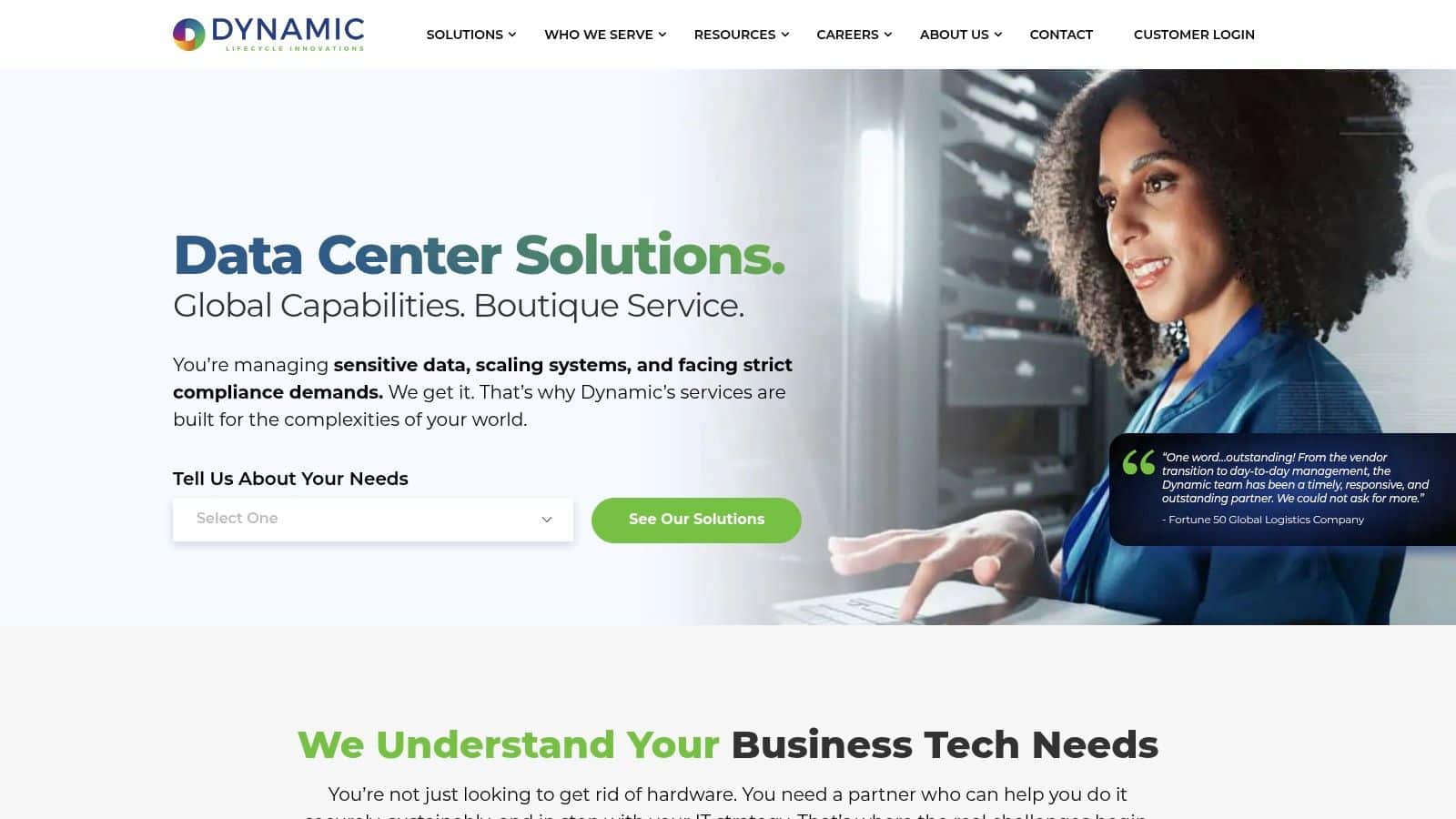
Dynamic Lifecycle Innovations is a good choice for companies that want operational maturity and sustainability visibility in the same program. It's not as telecom-branded as some specialists on this list, but it does offer the ingredients many enterprise IT and infrastructure teams care about: decommissioning support, logistics coordination, certified data destruction, and environmental reporting.
That makes Dynamic especially relevant for organizations where telecom assets are part of a wider IT refresh. If network hardware is leaving alongside user devices, servers, storage, and OEM-return streams, a process-oriented ITAD partner can be easier to manage than a narrowly telecom-focused vendor.
Why Dynamic earns a spot
Dynamic's value is in systematized operations. OEM program management, multi-site logistics, and ESG-oriented reporting help when the project has stakeholders beyond infrastructure. Sustainability teams, procurement leaders, and finance often want more than a pickup confirmation. They want a clean record of what moved, what was destroyed, what was remarketed, and what environmental outcomes can be reported internally.
For teams trying to standardize disposition policies across regions or business units, that can be more important than telecom specialization alone.
The practical caution
The website doesn't foreground telecom-specific case detail the way telecom-native firms do, so buyers should validate facility capabilities, certifications, and any special handling requirements during the RFP process. That's especially true if your retired assets include carrier gear, specialized radios, or project conditions that require field-intensive removal workflows.
Still, for many enterprise buyers, the broader process maturity is the point. The best telecom equipment recycling company isn't always the narrowest specialist. Sometimes it's the provider that can integrate telecom with the rest of your asset disposition program cleanly.
Best for
- Enterprise IT refreshes with telecom included: Strong cross-asset fit.
- Organizations with ESG reporting needs: Useful sustainability metrics.
- OEM and programmatic work: Good for standardized, repeatable processes.
Keep in mind
- Less telecom-specific positioning: Ask direct questions about network gear workflows.
- RFP validation matters: Confirm certifications and service scope.
- May not replace a carrier specialist: Best for mixed enterprise environments.
7. Iron Mountain Asset Lifecycle Management
Iron Mountain Asset Lifecycle Management is the governance-heavy option. If the deciding factor is trust, documentation, and national enterprise execution, it belongs on the shortlist. Large organizations already using Iron Mountain in other records, information, or secure handling contexts may find the transition into asset lifecycle services operationally convenient.
For telecom and network equipment, the brand advantage is straightforward. Stakeholders tend to understand the value of documented custody, formal processes, certificates, and scalable logistics. That reduces friction during internal approval.
Where Iron Mountain is strongest
Iron Mountain ALM is a fit for complex decommissioning where auditability matters as much as equipment removal. Data center and network asset disposition, secure transport, sanitization, shredding, and remarketing all map well to enterprise environments with strict procurement and compliance controls.
This is particularly useful when several internal groups need reassurance from the same program. Security wants sanitization proof. Legal wants documented handling. Finance wants value recovery. Operations wants a vendor that can execute in multiple locations.
For highly regulated organizations, the paperwork is part of the service. If the provider can't produce clean documentation, the project isn't finished.
What buyers should expect
Iron Mountain tends to be optimized for enterprise volumes and structured programs. That means smaller projects may cost more than with a lighter-weight regional provider, and urgent one-off removals can feel process-heavy.
That said, the formality is often the reason buyers choose it. When the internal standard is “show me the chain of custody,” a provider built around governance usually wins.
Best for
- Regulated sectors: Strong fit for finance, healthcare, and government-style controls.
- National enterprise programs: Broad coverage and scalable processes.
- Audit-ready reporting: Good when documentation quality is essential.
Possible downsides
- Less nimble for small jobs: Formality can slow simple requests.
- Enterprise-oriented pricing: Smaller volumes may not pencil out as well.
- Not the leanest option: Best when governance outweighs speed.
Top 7 Telecom Equipment Recycling Companies Comparison
| Provider | Implementation Complexity 🔄 | Resource Requirements ⚡ | Expected Outcomes 📊⭐ | Ideal Use Cases 💡 | Key Advantages ⭐ |
|---|---|---|---|---|---|
| Beyond Surplus | Moderate, coordinated logistics & on/off‑site services 🔄 | Low–Medium, uses own fleet; pallet threshold for priority pickups ⚡ | Certified data destruction, audit-ready reports, some value recovery; reliable turnaround ⭐⭐⭐⭐ | IT directors, data centers, regulated orgs needing certified disposal 💡 | Certified wiping/shredding, chain‑of‑custody, nationwide logistics |
| HOBI International, Inc. | Moderate–High, formal enterprise onboarding and compliance 🔄 | Medium–High, multi‑site logistics and program management ⚡ | Strong compliance posture, detailed documentation, telecom disposition expertise ⭐⭐⭐⭐ | Carrier programs, Fortune‑level enterprises, multi‑site projects 💡 | 30+ years, multi‑site U.S. presence, robust certifications |
| Teltech Group | High, end‑to‑end reverse logistics for complex network projects 🔄 | High, large carrier sunsets and multi‑site coordination ⚡ | Maximized asset recovery/resale and documented chain‑of‑custody ⭐⭐⭐⭐ | Carriers/operators executing RAN/core/multi‑site decommissions 💡 | Deep telecom domain expertise; reuse‑first approach |
| PICS Telecom | High, turnkey, multi‑region decommission workflows 🔄 | High, global operations, warehousing and redeployment ⚡ | Recover‑first outcomes (redeploy/resale) with compliant recycling where needed ⭐⭐⭐ | Multi‑region operators and major network sunsetting projects 💡 | Vendor‑agnostic processing; global footprint for large rollouts |
| Sims Lifecycle Services (SLS) | High, enterprise program governance and portals 🔄 | High, global scale, Circular Centers and program overhead ⚡ | Large‑scale reuse and material recovery, strong reporting and certifications ⭐⭐⭐⭐ | Nationwide/global refreshes, regulated industries, large data centers 💡 | Broad certification stack, reuse centers, mature reporting tools |
| Dynamic Lifecycle Innovations | Moderate, established operations with customization 🔄 | Medium, OEM program support and nationwide logistics ⚡ | Certified destruction, ESG metrics and avoided emissions reporting ⭐⭐⭐ | Organizations seeking OEM take‑back integration and ESG transparency 💡 | Transparent sustainability reporting and flexible program customization |
| Iron Mountain ALM | High, formal playbooks and rigorous governance 🔄 | High, enterprise‑grade field services and secure transport ⚡ | Audit‑ready programs, secure chain‑of‑custody and global remarketing ⭐⭐⭐⭐ | Large telecom operators and highly regulated enterprises requiring high trust 💡 | Strong brand trust, scalable coverage, detailed documentation |
Final Verdict Matching a Recycler to Your Requirements
A telecom retirement project can fail in a few predictable places. Assets leave the site without a clean serial record. Data-bearing gear gets mixed into a general scrap load. The pickup goes fine, but reporting arrives late or lacks the detail internal audit expects. In larger carrier work, the bigger risk is coordination. Field removal, staging, reconciliation, resale triage, and final disposition have to stay aligned from day one.
That is why vendor selection should start with the job you need done. A single-site cleanout, a regional switch refresh, and a nationwide carrier sunset do not require the same operating model. The right choice depends on what your team cannot afford to get wrong. For some IT managers, that is chain of custody. For others, it is maximizing value recovery without slowing down the project closeout.
Beyond Surplus fits well where the requirement is practical execution across pickup, de-installation support, certified data destruction, and audit-ready documentation. HOBI and Sims make more sense when program structure, broader scale, and formal governance matter more than speed on a smaller job. Teltech Group and PICS Telecom stand out when the project is telecom-heavy and the provider needs to understand network overlays, sunsets, and redeployment channels. Iron Mountain ALM is a strong fit for organizations that put trust, controls, and documentation at the top of the scorecard. Dynamic Lifecycle Innovations works well for teams that want secure disposition tied to sustainability reporting and a broader ITAD program.
The better buying question is not whether a company recycles telecom equipment. Ask how it handles serialized intake, exception processing, storage, packaging assumptions, data-bearing devices, resale decisions, and downstream accountability. Those details usually determine whether the project closes cleanly or turns into weeks of avoidable follow-up.
Before awarding the work, request:
- Current certifications: Match them to your internal policy, customer requirements, and any regulated data obligations.
- Sample reporting: Review actual destruction certificates, recycling certificates, settlement reports, and asset-level inventory outputs.
- Chain-of-custody detail: Confirm who touches the equipment at pickup, transport, processing, and final disposition.
- Value recovery methodology: Ask how the vendor sorts redeployable, remarketable, and scrap-only assets.
- Logistics scope: Clarify who provides labor, pallets, gaylords, packing materials, loading support, and site signage if needed.
Pricing also needs a disciplined review. Telecom recycling quotes often look similar at first glance, especially for mid-volume projects. The spread usually shows up later in labor assumptions, freight, de-installation scope, certificate quality, or how exceptions are billed. I have seen low bids lose their appeal once secondary pickups, manual inventory reconciliation, or missing documentation had to be fixed after the fact.
A strong recycler helps your team finish the project with fewer loose ends. That means secure handling, clean records, defensible compliance, and value recovery where the equipment still has a market. Use that framework to match the provider to the project, instead of defaulting to the biggest name or the cheapest quote.
If you need a partner that combines secure data destruction, nationwide business pickup, telecom and IT asset recovery, and audit-ready documentation, Beyond Surplus is one option to evaluate as you scope the work and compare bids.


