

For IT managers and business owners in Atlanta, Georgia, understanding universal waste is key to streamlined, compliant operations. Think of it as an EPA-created "fast pass" for handling common hazardous items like batteries and fluorescent bulbs. This special category simplifies recycling by cutting through the complex regulations that typically apply to hazardous materials, making it easier for Atlanta businesses to manage waste responsibly.
Understanding Universal Waste in Your Atlanta Business
The term "universal waste" might sound complex, but its purpose is to make it easier and more cost-effective for commercial enterprises like yours to responsibly recycle specific types of widespread hazardous waste. This is not a license to discard these items in a standard dumpster. Instead, it offers a streamlined compliance path designed to encourage proper disposal and prevent harmful substances from entering landfills.
For IT and facilities managers in Atlanta, mastering this concept is the first step toward mitigating risk, reducing costs, and enhancing your company’s environmental credentials. It allows your business to bypass the costly and time-consuming processes of full-scale hazardous waste management.
The Universal Waste Rule provides several practical advantages for businesses:
- Longer On-Site Storage: Your business can accumulate universal waste at its facility for up to one year, enabling fewer, more efficient pickups from your recycling partner.
- Simple Labeling: The labeling requirements are straightforward. A container simply needs to be clearly marked with designations like "Universal Waste—Batteries" or "Universal Waste—Lamps."
- No Manifests Needed: Your business is not required to complete formal hazardous waste manifests for shipping, which significantly reduces administrative burdens.
- Less Intensive Training: The training required for your employees is much simpler compared to the stringent requirements for handling fully regulated hazardous waste.
By correctly identifying and managing these materials, your Atlanta business can avoid substantial regulatory fines and build a stronger reputation for corporate responsibility. This is especially critical during large-scale projects like office cleanouts or data center decommissioning, where large volumes of these items can be generated. You can explore the consequences of improper disposal by reading about the environmental impact of electronic waste in our guide.
To equip your team to identify these items, it is essential to understand the main categories and their appearance in a typical office or data center setting.
Common Universal Waste Categories and Business Examples
This table outlines the main federal categories and provides concrete examples likely to be found in your commercial facility.
| Universal Waste Category | Common Business and IT Examples |
|---|---|
| Batteries | Uninterruptible Power Supply (UPS) batteries from data centers, lithium-ion batteries from laptops and mobile devices, alkaline batteries from keyboards and mice, and small batteries from server motherboards. |
| Pesticides | Primarily relevant for landscaping and facility grounds maintenance, including recalled or unused pesticides. |
| Mercury-Containing Equipment | Older thermostats, pressure gauges, industrial switches, and various types of metering devices found in legacy facility or laboratory equipment. |
| Lamps | Fluorescent tubes from office overhead lighting, compact fluorescent lamps (CFLs), high-intensity discharge (HID) lamps from warehouses, and mercury vapor lamps. |
Knowing what qualifies as universal waste helps your team segregate these materials correctly from the outset. This simple sorting practice is a cornerstone of any efficient and compliant IT asset and facility management program, ensuring hazardous components are handled safely.
Identifying Universal Waste in Your IT and Facility Operations
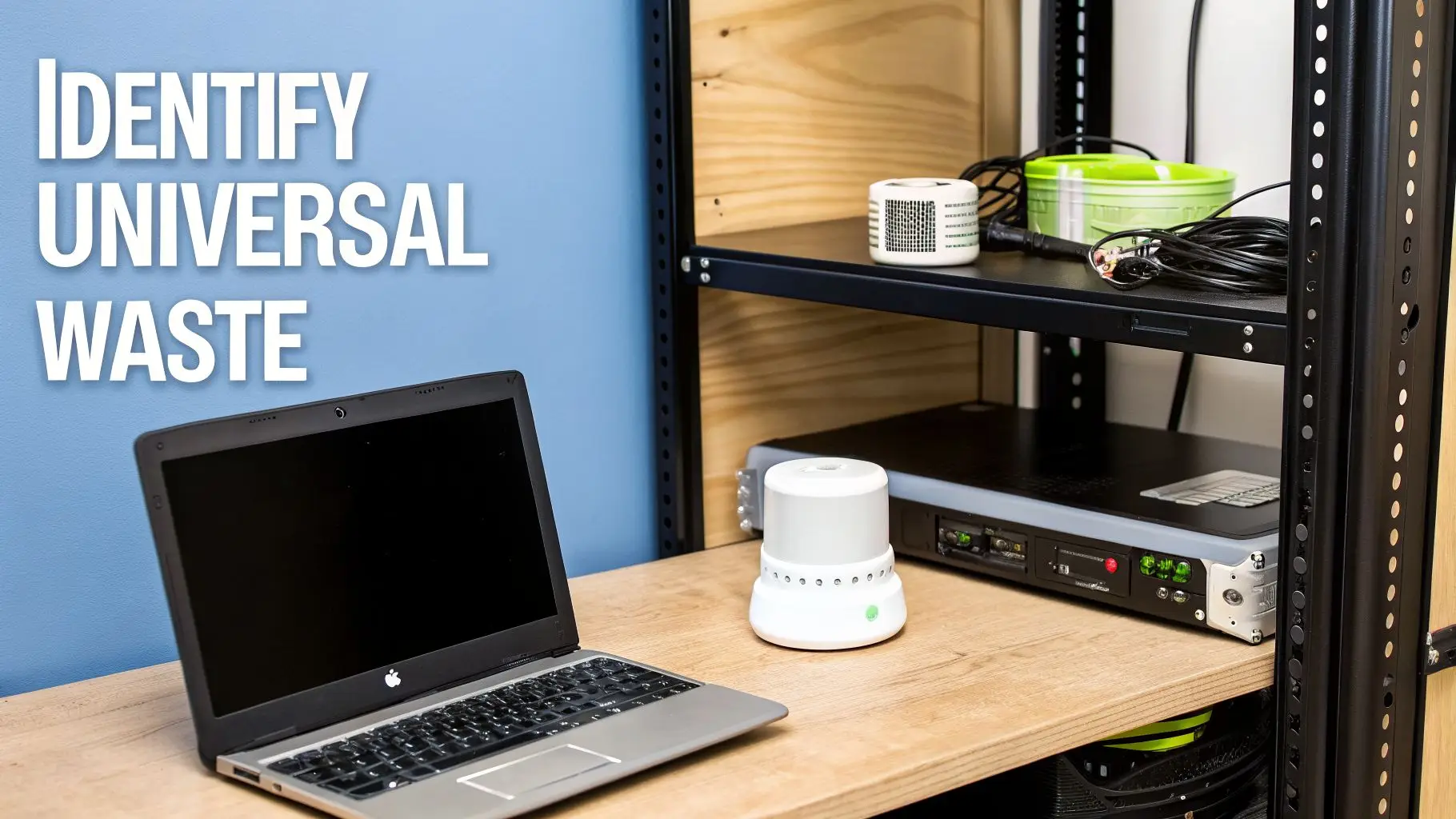
Now that the basics of universal waste are covered, let's discuss where you will find it in your commercial operations. For IT and facility managers in Atlanta, these materials are ubiquitous, often hiding in plain sight during routine maintenance, office relocations, and major IT infrastructure upgrades.
Proficiency in identifying these items is the crucial first step toward safe handling and maintaining compliance. The objective is to train your team to see beyond old equipment and recognize the potential hazards within, which is why these items are regulated.
Batteries Common in Business Environments
Batteries are likely the most common type of universal waste your business generates. They power everything from large-scale backup systems in your data center to wireless peripherals at a workstation. Because they contain heavy metals like lead, cadmium, and lithium, they cannot be disposed of in the trash.
Here are the typical types your team will encounter:
- Uninterruptible Power Supply (UPS) Batteries: These are the large, heavy lead-acid batteries that keep servers and network equipment operational during a power outage.
- Lithium-Ion Batteries: Found in nearly all modern enterprise technology, including corporate laptops, smartphones, and tablets.
- Alkaline Batteries: Standard AA, AAA, C, D, and 9-volt batteries that power keyboards, mice, and other office devices.
- CMOS Batteries: Small, coin-shaped batteries on motherboards in servers, desktops, and laptops that retain system settings.
It is vital to segregate these from your regular e-waste stream for proper handling. Beyond Surplus provides comprehensive recycling for entire IT assets, ensuring all components, including batteries, are managed correctly.
Lamps and Lighting Fixtures
Lighting fixtures in commercial buildings are another major source of universal waste. Many bulbs contain mercury, a potent neurotoxin that can cause significant environmental damage if a bulb breaks.
The EPA estimates that recycling just one fluorescent bulb prevents 0.35 mg of mercury from polluting the environment. This impact accumulates rapidly across thousands of fixtures in a commercial property.
Be vigilant for these types of universal waste lamps during facility maintenance or upgrades:
- Linear Fluorescent Tubes: The long T5, T8, and T12 bulbs found in most office ceiling lights.
- Compact Fluorescent Lamps (CFLs): The spiral-shaped, energy-efficient bulbs often used in smaller fixtures.
- High-Intensity Discharge (HID) Lamps: Powerful lights used for warehouses, parking lots, and factory floors, including metal halide, high-pressure sodium, and mercury vapor lamps.
Mercury-Containing Equipment
Besides lamps, mercury was once a common component in various switches and gauges. While not prevalent in new IT hardware, these items frequently appear when decommissioning older facilities, laboratories, or industrial control systems.
These devices typically contain a small glass tube of liquid mercury that completes an electrical circuit. Look for:
- Legacy thermostats and temperature gauges.
- Industrial pressure or flow switches.
- Vintage electrical relays and contactors.
While identifying these items, consider other regulated materials in your facility. For example, while not universal waste, evolving regulations for refrigerant changes in HVAC systems also demand special end-of-life management. A broad awareness helps ensure full compliance.
Navigating Federal and Georgia-Specific Waste Regulations
To ensure your Atlanta business operates without compliance issues, a firm understanding of both federal rules and Georgia’s specific approach to universal waste is necessary. The federal Universal Waste Rule, codified in 40 CFR part 273, serves as the national baseline. It offers a simpler, more flexible method for managing common hazardous items compared to stricter hazardous waste regulations.
This federal rule was designed to ease the burden on businesses like yours. It allows for longer on-site storage times and simplifies procedures for handling, labeling, and transport. This streamlined approach encourages recycling and proper disposal by reducing administrative overhead and costs.
The Federal Foundation for Universal Waste
The federal Universal Waste Rule establishes a special category for these items, providing significant advantages over managing more heavily regulated hazardous waste. For managers overseeing IT assets and facilities, understanding these benefits is crucial for a manageable compliance program.
Key benefits under the federal rule include:
- One-Year Accumulation Time: You can store universal waste at your facility for up to 365 days, providing flexibility to schedule fewer, more cost-effective pickups.
- Simplified Labeling: Your containers must be clearly marked (e.g., "Universal Waste—Lamps" or "Used Batteries"), a far simpler requirement than the complex labeling for other hazardous waste.
- No Manifest Required: Unlike shipments of other hazardous materials, you do not need a formal EPA hazardous waste manifest for transport, eliminating significant paperwork.
- Basic Employee Training: Your team needs to understand proper handling and emergency procedures, but the training is much less intensive than that required for full hazardous waste handlers.
These federal standards provide a predictable and manageable foundation for companies nationwide. However, states can implement their own stricter regulations.
Georgia-Specific Regulations and EPD Oversight
While Georgia largely adheres to the federal Universal Waste Rule, the Georgia Environmental Protection Division (EPD) has its own enforcement standards that Atlanta businesses must follow. The good news is that Georgia has not added extra items to the universal waste list, simplifying compliance for multi-state corporations.
However, Georgia’s EPD is rigorous in enforcing existing rules. They expect every business handling universal waste—from small enterprises to large corporations—to meticulously follow the federal guidelines for storage, labeling, and time limits. This alignment means your primary focus should be on perfectly executing the core requirements of 40 CFR part 273. For a deeper analysis of the state’s requirements, refer to our guide on compliant electronics recycling in Georgia.
Working with a knowledgeable partner like Beyond Surplus ensures your universal waste program not only meets the federal baseline but also satisfies the Georgia EPD’s strict enforcement standards, protecting your business from penalties.
Your Actionable Compliance Checklist for Universal Waste
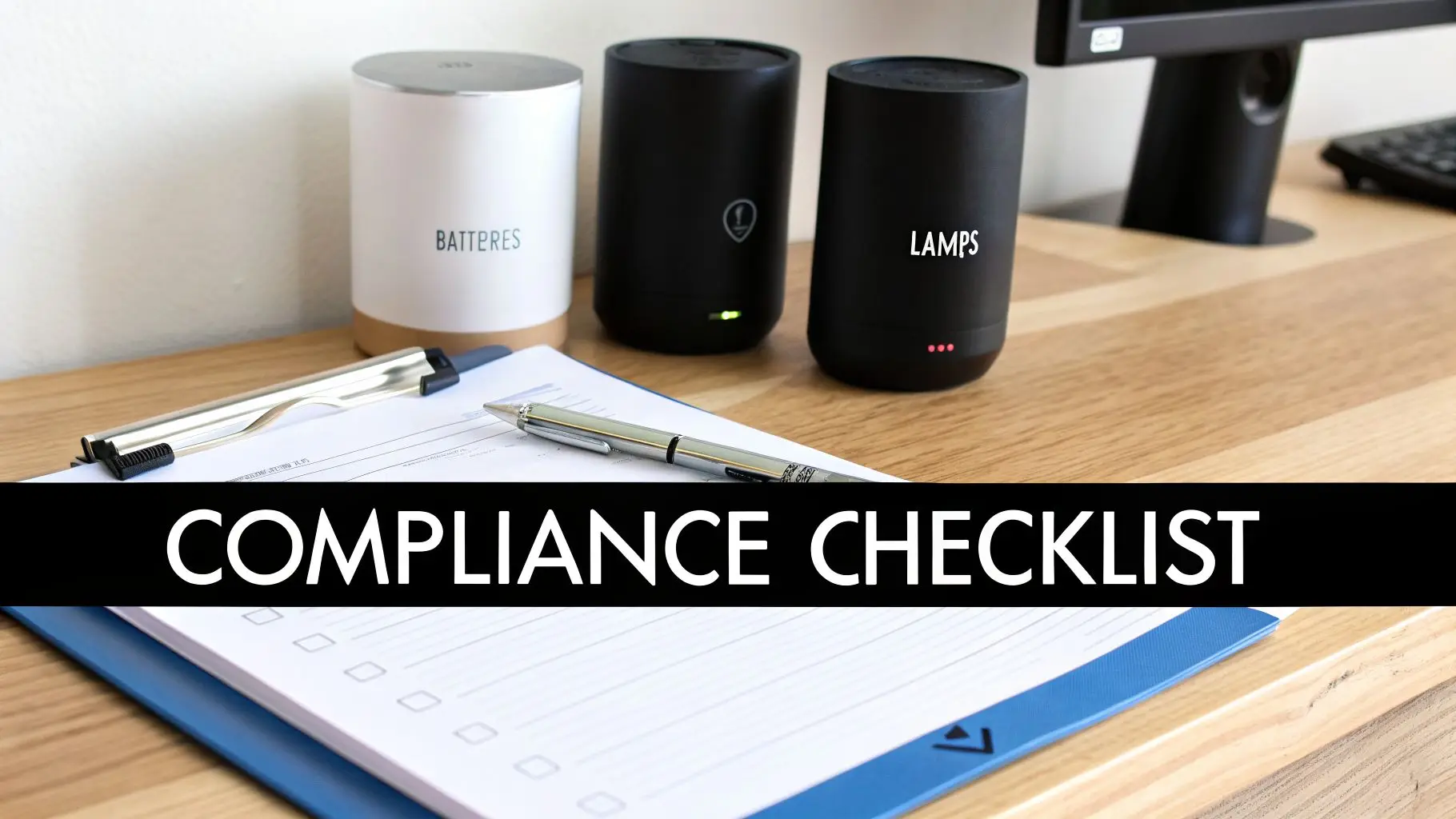
Regulations can be complex. The key is to transform legal text into a straightforward action plan. This checklist is your practical guide to establishing a compliant universal waste system in your Atlanta facility.
View these steps as a smart risk management strategy. Adherence protects your business from significant fines and demonstrates a commitment to environmental responsibility. With clear instructions, compliance becomes a routine part of your operations.
Step 1: Containerization and Segregation
Proper storage is your first line of defense. It prevents spills, breakage, and cross-contamination. You must keep each category of universal waste separate in containers that are sturdy, sealed, and made of a material that will not react with the contents.
- For Lamps: The original cardboard boxes are ideal. Dedicated fiber drums also work well. The primary goal is to prevent bulb breakage and mercury vapor release.
- For Batteries: Store them in a non-conductive container, such as a plastic drum or pail. It is crucial to prevent terminals from touching to avoid shorts and fires. Taping the ends of lithium-ion batteries is a common best practice.
- For Mercury-Containing Equipment: Place these devices inside a secure, closed container to ensure the small glass ampules holding the mercury are not crushed.
Additionally, containers must remain closed unless waste is being added or removed. This simple rule is a key focus for inspectors.
Step 2: Labeling and Date Tracking
Clear communication is non-negotiable under the Universal Waste Rule. Every container must be clearly marked to identify its contents, and you must track its accumulation time.
Proper labeling is one of the easiest ways to avoid a compliance violation. An inspector should be able to immediately identify a container's contents and its collection start date.
Your labels require two key pieces of information:
- The waste type: Use clear, simple wording like "Universal Waste—Lamps," "Used Batteries," or "Universal Waste—Mercury-Containing Equipment."
- The accumulation start date: This is the date the first piece of waste was placed in the container. This date starts the 365-day clock for transporting the waste to a recycling facility.
Tracking these dates is essential for proving compliance with the one-year accumulation limit. A simple logbook or spreadsheet is effective. For more tips on managing asset timelines, our year-end IT equipment disposal checklist offers helpful insights.
Step 3: Employee Training and Emergency Response
Your employees handle these materials daily, making their training critical. While less intensive than for full hazardous waste, your team still needs to be prepared.
Training should cover the basics:
- How to correctly identify and handle each type of universal waste.
- Your procedures for proper labeling and container storage.
- What to do in case of an accident, such as a broken fluorescent bulb or a leaking battery.
It is a best practice to document this training. A simple sign-in sheet from a safety meeting is often sufficient to demonstrate due diligence to an inspector. Finally, ensure spill kits are readily available, especially in areas where lamps are handled.
How Partnering with an ITAD Provider Streamlines Disposal
Managing universal waste in-house can divert your team from core business functions. Partnering with a certified IT Asset Disposition (ITAD) provider like Beyond Surplus transforms this compliance burden into a simple, automated process. It is the difference between coordinating multiple vendors and making a single call for a complete solution.
The true value lies in an integrated approach. A skilled ITAD partner manages not only your retired servers and laptops but also the associated universal waste—such as UPS batteries or office lamps. This consolidation saves significant time and administrative effort.
The Integrated ITAD Workflow
Working with a professional ITAD firm provides a structured, documented process that guarantees compliance from the moment assets leave your premises. Instead of your team managing accumulation dates and labeling, you transfer the entire responsibility to specialists, which also formally transfers liability away from your company.
The typical workflow includes:
- Scheduled Pickup: We arrange a single pickup to collect all retired assets, including IT equipment and any associated universal waste.
- Secure Transport: All materials are transported under a secure chain of custody from your Atlanta facility to a certified processing plant.
- Sorting and Processing: At the facility, trained technicians segregate universal waste from other electronics for specialized, compliant handling and recycling.
- Documentation: You receive a Certificate of Recycling, which serves as official proof of proper disposal and completes the transfer of liability.
This end-to-end management offers complete peace of mind. Learn more about how our Atlanta ITAD services are designed to support your business.
Beyond Compliance to Value Recovery
A strategic ITAD partnership is about more than waste disposal; it helps you recover hidden value and supports a circular economy. This is increasingly important as global circularity has declined and recycled materials account for only a small fraction of material consumption.
By working with ITAD experts, companies can keep valuable materials out of landfills, receive funds through asset buyback programs, and ensure all data is securely destroyed. This turns a compliance task into an opportunity for smarter, more sustainable operations.
By partnering with a certified ITAD provider, your business transforms a potential liability into a strategic advantage. You ensure compliance, protect your brand, and contribute to a more sustainable circular economy, all while focusing on your core operations.
Ultimately, outsourcing your universal waste management to an ITAD expert is a strategic business decision. It simplifies complex logistics, reduces risk, and helps your company achieve its environmental, social, and governance (ESG) goals. Instead of your facility managers becoming waste experts, they can rely on a partner whose entire business is built on safe, secure, and compliant disposal.
Common Questions About Universal Waste Management
Even with a solid plan, questions arise when managing universal waste. We have compiled common inquiries from Atlanta businesses to provide quick, practical answers for navigating real-world compliance scenarios.
Can I Throw Universal Waste Like Batteries in My Regular Business Trash?
Absolutely not. Disposing of universal waste in regular solid waste trash is illegal in Atlanta and nationwide. These items, from batteries to fluorescent lamps, contain hazardous materials like lead, mercury, and cadmium that can contaminate soil and groundwater in a standard landfill. The Universal Waste Rule provides a manageable system for recycling these items but strictly prohibits mixing them with everyday commercial trash. Non-compliance can lead to significant fines and environmental liability for your business.
What Is the Difference Between Universal Waste and Hazardous Waste?
It is useful to view universal waste as a special subcategory of hazardous waste. The EPA created a simplified, more flexible set of rules for these common items to encourage proper recycling among businesses.
You can think of universal waste regulations as an "express lane" for compliance. They remove the most difficult parts of traditional hazardous waste management—like formal manifests and intensive training—for things like batteries and lamps.
This distinction significantly impacts your daily operations. For universal waste, your business benefits from:
- Longer on-site accumulation times (up to one year).
- No requirement for a formal hazardous waste manifest for transport.
- Less demanding employee training requirements.
These streamlined rules make it much easier for businesses to correctly manage these common waste streams compared to other, more tightly regulated hazardous materials.
Does My Business Need a Permit to Generate Universal Waste?
No, your business does not need a special permit just for generating universal waste. Instead, regulations classify your business based on the quantity of universal waste you have on-site at any given time.
If you accumulate less than 5,000 kg (approximately 11,000 lbs), your business is considered a Small Quantity Handler of Universal Waste (SQHUW). Accumulating more than that makes you a Large Quantity Handler (LQHUW), which involves additional responsibilities like notifying the EPA and maintaining more detailed records. In either case, a "generation permit" is not required. The key is to follow the correct handling, labeling, and time-limit rules for your status.
What Documentation Do I Need When I Recycle My Universal Waste?
While a formal hazardous waste manifest is not required for transport, you must be able to prove you handled the waste responsibly. This documentation is your primary defense in an audit.
Best practice is to maintain clear records, such as a bill of lading, an invoice from your recycler, or an internal log showing:
- The type and amount of waste shipped.
- The date it was sent off-site.
- The name and address of the certified facility that received it.
Partnering with a certified ITAD provider is the most effective way to manage this documentation. This infographic illustrates the partnership process.
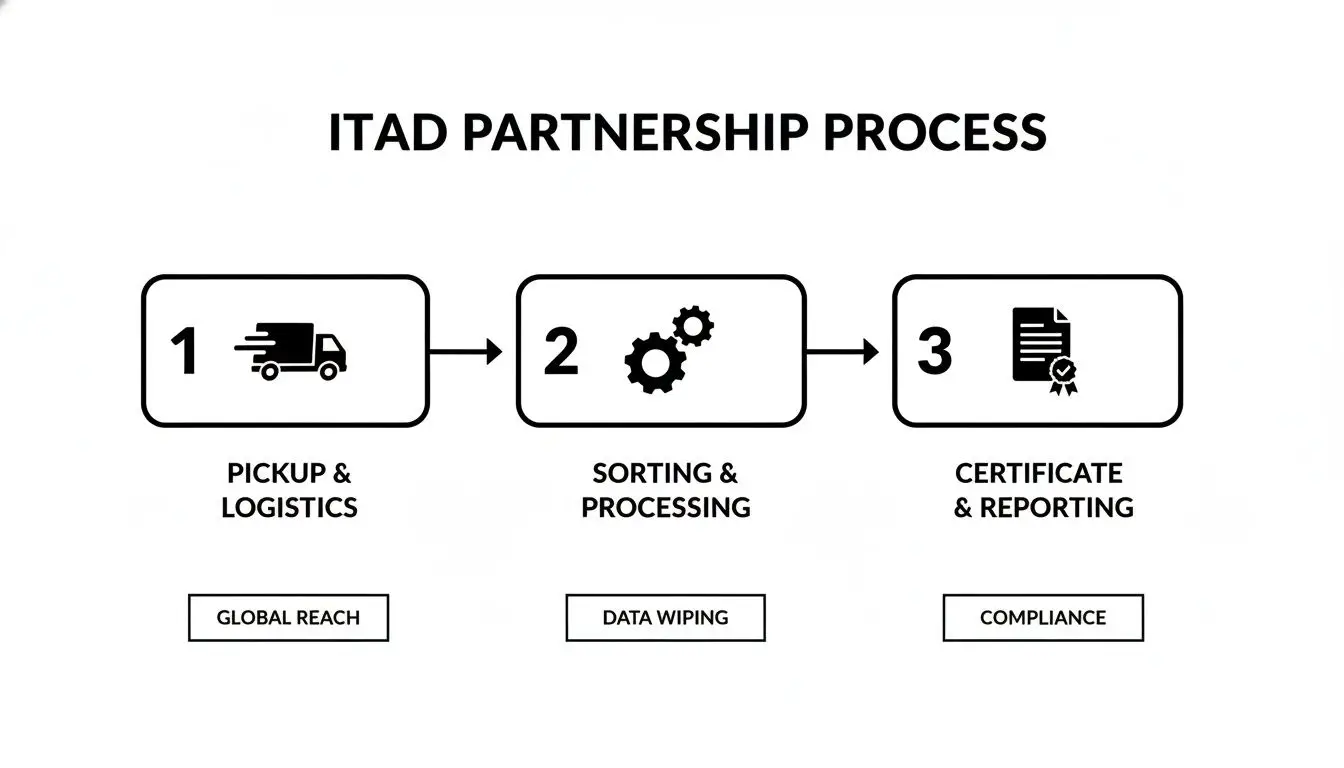
A professional partner simplifies compliance into a few straightforward steps, culminating in official reporting. When you work with a provider like Beyond Surplus, you receive a Certificate of Recycling. This document provides an official, auditable record proving proper disposal and legally transfers liability away from your business, serving as the gold standard for demonstrating due diligence.
Can States Add Their Own Items to the Universal Waste List?
Yes, states have the authority to add other types of waste to their universal waste programs. While Georgia currently adheres to the federal list, other states have expanded their definitions. For instance, some states have added paint and paint-related waste to their universal waste rules. This highlights the importance for multi-location businesses to be aware of state-specific regulations. The core federal categories remain consistent, but vigilance for state-level additions is necessary.
Contact Beyond Surplus for certified electronics recycling and secure IT asset disposal that includes compliant universal waste management. Let our experts handle the complexities of e-waste so you can focus on your business. Learn more about our services and schedule a pickup at https://www.beyondsurplus.com.


