

Old routers in a telecom closet rarely look urgent. They sit on shelves beside retired switches, VoIP phones, firewall appliances, access points, and coils of disconnected cabling. But once gear leaves production, it doesn’t leave risk behind. In most organizations, telecom equipment disposal is where data security, environmental compliance, logistics, and asset recovery all collide.
That’s why a disposal project shouldn’t be treated like bulk junk removal. A strong process starts before pickup and ends only when you have auditable proof of sanitization, final disposition, and liability transfer. If you manage infrastructure for a corporate office, hospital, warehouse network, campus, call center, or distributed branch environment, the right decision at each step depends on your security profile, budget, and the residual value sitting in the equipment.
The Hidden Risks in Your Decommissioned Telecom Gear
An old switch may still hold configuration files. A voice gateway may retain call routing data. A firewall or edge appliance may contain credentials, logs, VPN settings, and network maps. The mistake many teams make is assuming that if a device is powered down, it’s harmless.
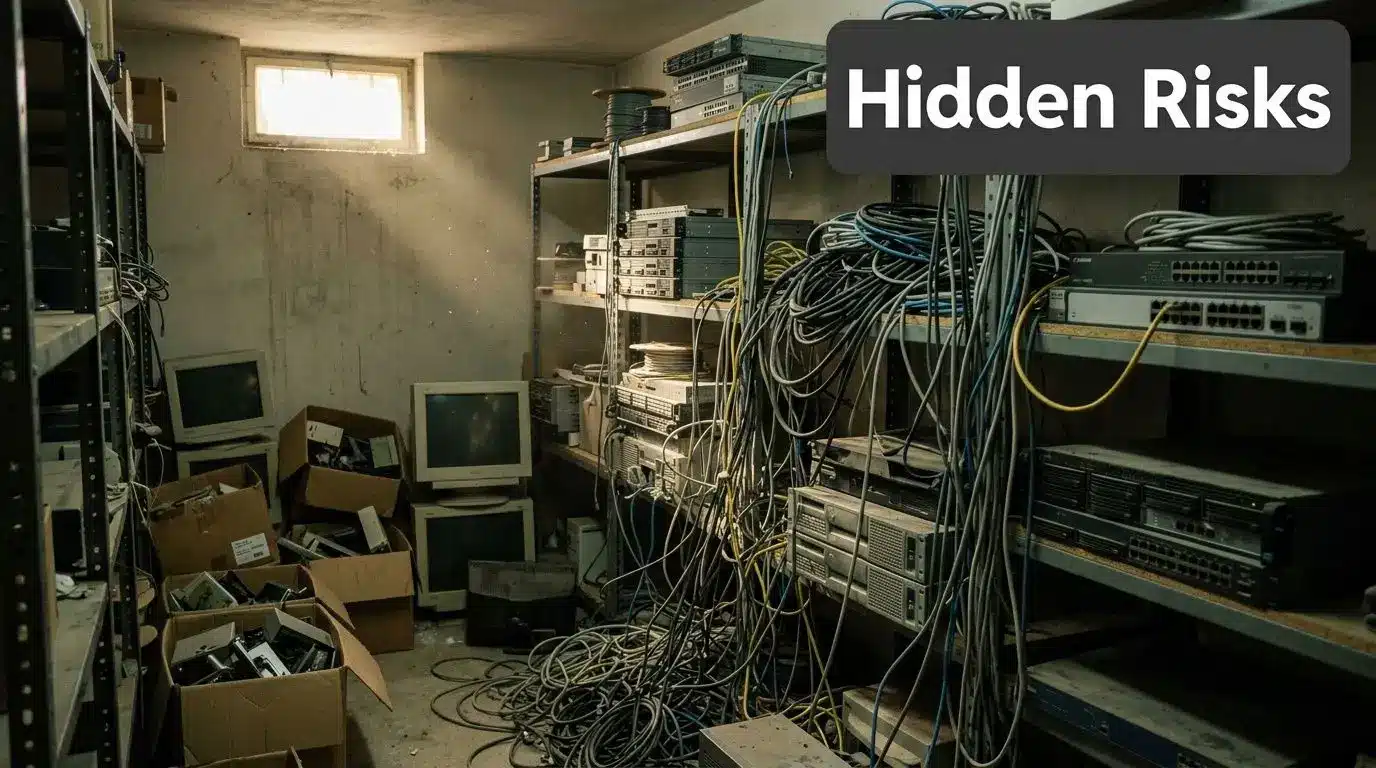
Why storage is not a neutral choice
A locked closet feels safer than disposal. In practice, it often creates a blind spot. Gear gets moved, labels fall off, staff changes, and no one can say with confidence what data remains on which asset or whether anything has gone missing.
That exposure is bigger than one office. Global e-waste generation reached 62 million tonnes in 2022, with small IT and telecommunication equipment contributing 5 million tonnes. Only 22.3% was formally collected and recycled, resulting in US$62 billion in lost recoverable resources according to global e-waste statistics. That should change how corporate teams think about a stack of decommissioned telecom hardware. It’s not just clutter. It’s security risk, compliance risk, and unrealized value.
The three risks that matter most
- Data exposure: Network devices often store more than people expect, including admin credentials, IP schemes, logs, and user associations.
- Compliance failure: If your process can’t prove secure handling and final disposition, legal and audit problems follow.
- Asset loss: Resalable devices, reusable parts, and recoverable commodities lose value when they sit too long or get handled as scrap.
Practical rule: If you can’t produce a serial-based record of where a telecom asset is, what data process it went through, and what happened to it at the end, you don’t have control of disposal.
For many IT managers, the wake-up call comes after reading about data breaches caused by improper equipment disposal. Telecom assets deserve the same governance you apply to servers and laptops. Sometimes more, because network gear is easy to overlook and often rich in sensitive configuration data.
Building Your Disposal Strategy with an Asset Inventory
The first useful disposal decision isn’t wipe, shred, or recycle. It’s inventory. If you skip this step, every later decision gets weaker because you’re guessing about value, risk, transport needs, and processing method.
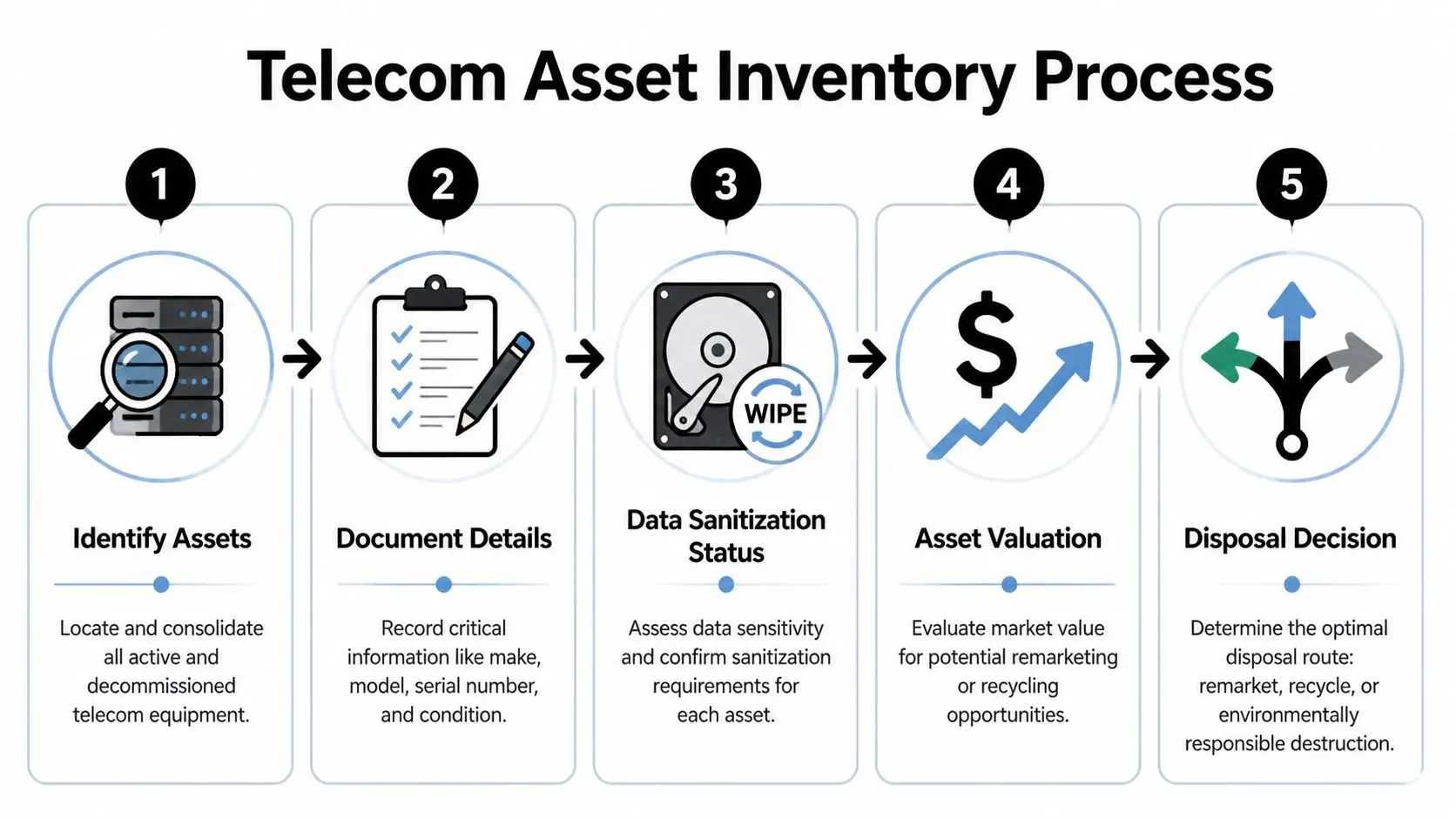
What a useful inventory actually captures
A disposal inventory isn’t a rough item count. It’s a decision document. At minimum, capture:
- Asset identity: make, model, serial number, asset tag, and device type
- Location: closet, rack, branch office, MDF, IDF, storage room, or warehouse
- Condition: working, repairable, incomplete, damaged, or scrap
- Data sensitivity: likely configuration storage, embedded media, removable storage, or no data concern
- Disposition path: reuse, resale, parts harvest, recycle, or destroy
Many teams build this in Excel. Others export from CMDB, ERP, or endpoint platforms and then validate onsite. For larger environments, barcode or RFID tracking sharply improves handoff accuracy. When inventory is done well, the project stops being “a pile of old telecom stuff” and becomes a controlled stream of assets with distinct outcomes.
Sort by outcome, not by product family
A common mistake is organizing everything into categories like phones, switches, routers, and cables, then stopping there. That’s good for visibility, but it doesn’t guide disposal. Sort by likely outcome instead.
Remarketable assets
Enterprise switches, newer routers, rack accessories, optics, and selected voice hardware may still carry resale value if they’re complete and clean.Components for harvest
Power supplies, line cards, transceivers, memory, rails, and faceplates can matter when the full unit doesn’t.Recycling-grade material
Damaged boards, mixed metals, obsolete cabling, and broken peripherals belong in downstream recycling, not storage.
The inventory should tell you what deserves protection, what deserves testing, and what deserves fast removal.
For organizations formalizing this process, REDCHIP's IT asset management solutions offer a useful example of how asset records, lifecycle tracking, and governance can support end-of-life decisions before disposal ever starts.
Questions that improve the inventory
Use the first pass to answer practical questions, not theoretical ones:
- Does this device contain internal storage or retained configuration data?
- Is it complete enough to remarket, or already destined for material recovery?
- Will removing it require de-installation labor, cable tracing, or rack work?
- Is there enough volume at this site to palletize, or will this move as boxed serialized equipment?
Those answers shape budget, pickup method, sanitization approach, and recovery expectations. Good telecom equipment disposal starts with knowing exactly what you have, and what each item is worth protecting.
Choosing Your Data Destruction Method
This is the point where many projects go right or wrong. A retired telecom asset may still hold credentials, call records, provisioning data, subscriber details, WLAN settings, or internal topology information. If you choose the wrong sanitization method, you either create unnecessary risk or destroy hardware that still had recoverable value.
Start with the decision logic
Don’t begin by asking which destruction method is strongest. Ask which one fits the asset.
If the device has resale value and your compliance posture allows it, software-based sanitization is usually the first option. If the media is magnetic and you need irreversible destruction, degaussing becomes relevant. If the device is highly sensitive, damaged, non-functional, or subject to strict destruction requirements, shredding is the cleanest answer.
Data sanitization for ITAD projects should adhere to NIST 800-88 standards, which can achieve 99.9% data recovery impossibility. For high-security telecom gear, physical destruction via shredding to a particle size of less than 2mm is the gold standard, as outlined in this review of electronics disposal efficiency and data sanitization.
Data sanitization method comparison
| Method | Security Level | Asset Reusability | Best For | Compliance Fit |
|---|---|---|---|---|
| Software wiping | High when NIST-aligned and verified | Preserved | Functional devices with resale or redeployment potential | Strong when you need documented sanitization and value recovery |
| Degaussing | High for magnetic media | Lost after treatment | Magnetic drives where reuse is not required | Useful when policy requires media neutralization before downstream handling |
| Physical shredding | Highest for irreversible destruction | None | High-security telecom gear, failed media, damaged devices, sensitive environments | Best fit where destruction must be final and auditable |
What works and what doesn’t
Software wiping works when the media is accessible, the device is functional enough to process, and you want to preserve value. Tools such as DBAN, Blancco, ATA Secure Erase workflows, and verification reporting are useful in structured ITAD projects. What doesn’t work is assuming a factory reset equals sanitization. On telecom gear, it often doesn’t.
Degaussing works for magnetic media. It’s not a universal answer, and it doesn’t make sense for every telecom asset. Teams sometimes overapply it because it sounds secure. The trade-off is simple. Once media is degaussed, remarketing value tied to that storage component is gone.
Physical shredding works when policy, contract requirements, or risk tolerance leave no room for doubt. For some healthcare, finance, defense-adjacent, and government environments, that’s the right call. It is also the right answer when chain-of-custody gaps or damaged media make verification unreliable.
If the question in a risk review is “Can we prove the data was destroyed?”, shredding gives the clearest answer.
Onsite versus offsite destruction
This is usually a governance choice, not just a budget choice.
Choose onsite when the assets are highly sensitive, your auditors want direct observation, or your leadership won’t allow media to leave intact. Onsite service gives immediate control, but it can slow the project and reduce options for resale if you destroy entire devices rather than sanitize media selectively.
Choose offsite when the provider can maintain serialized custody, secure transport, controlled intake, and documented processing. Offsite workflows are often more efficient for mixed telecom loads because they allow testing, triage, and differentiated outcomes.
Some organizations also use a hybrid model. High-risk devices get destroyed onsite. Lower-risk equipment moves offsite for sanitization, testing, and value recovery. That often balances security and financial return better than applying one method to everything.
If you’re weighing whether magnetic media destruction belongs in your program, this overview of what a degausser is helps frame where it fits and where it doesn’t. And if your internal stakeholders need a broader business case for stricter handling, this discussion of data privacy for Houston businesses is a useful reminder that disposal decisions affect trust, not just compliance paperwork.
Unlocking Hidden Value in Retired Telecom Assets
Many organizations budget telecom equipment disposal as a pure expense. That’s often the wrong model. Some retired assets belong in certified recycling, but others still have resale potential, parts value, or commodity recovery worth planning around.
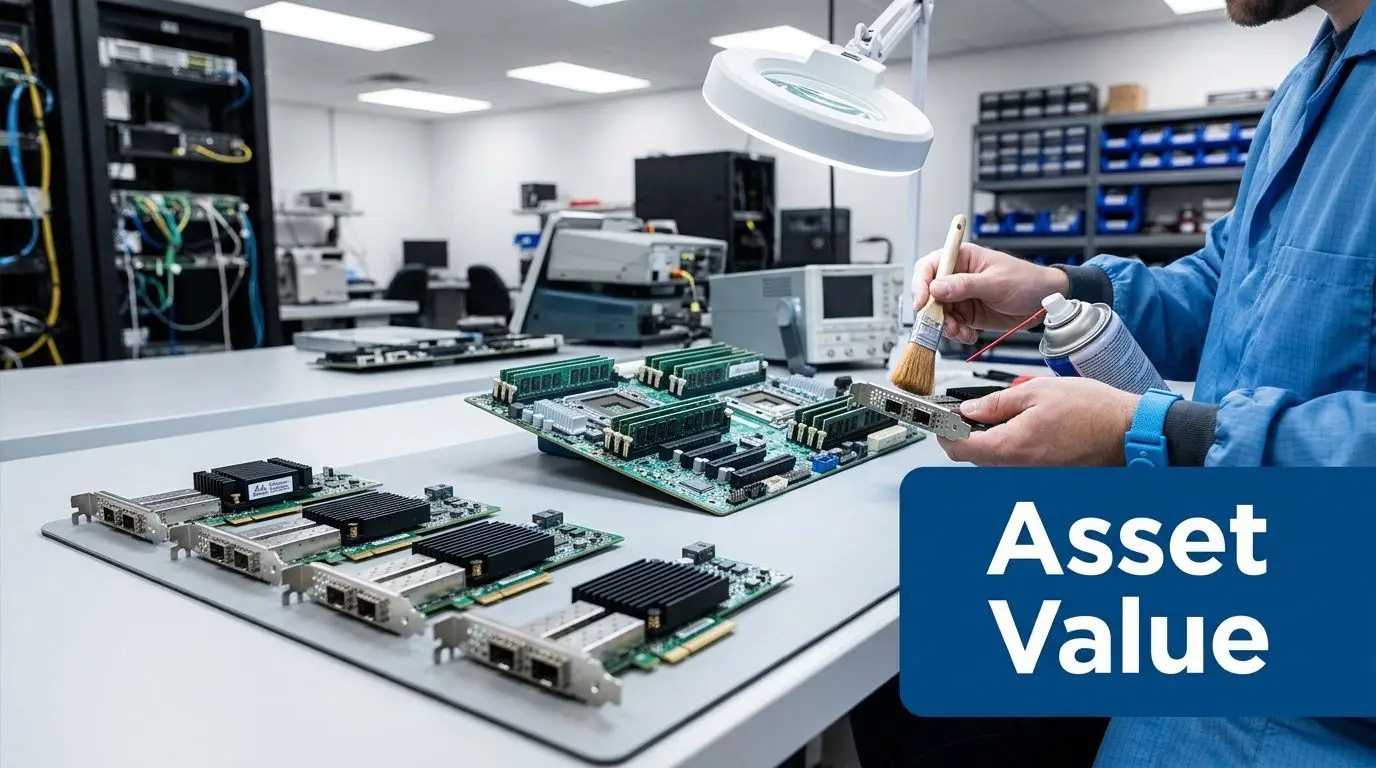
Where value usually hides
The obvious candidates are enterprise switches, routers, optics, and related rack hardware that still have market demand. The less obvious category is infrastructure removed during upgrades. Fiber migrations, office consolidations, and data center de-installs often generate a large amount of cabling and ancillary equipment that finance teams underestimate.
During fiber optic migrations, companies like AT&T have recycled over 14,000 tons of copper wiring in just a few years. With copper prices on the rise, investment recovery from retired cabling and components represents a significant, often overlooked, ROI opportunity in telecom disposal projects, based on reporting about telecom companies turning copper into cash.
What improves recovery
- Clean segregation: Keep resale candidates separate from scrap-grade material.
- Complete assemblies: Power supplies, faceplates, rails, antennas, and transceivers matter.
- Early triage: Don’t wait until movers or electricians have mixed valuable gear with low-grade debris.
- Selective destruction: Destroy the media or sensitive component, not the entire chassis, when policy allows.
A practical ITAD engagement often produces more value from disciplined sorting than from aggressive price negotiation. The gain comes from preserving options. Once a loaded pallet of telecom hardware is treated as anonymous scrap, the higher-value path usually disappears.
A disposal project creates the most recovery when IT, facilities, and procurement agree on disposition rules before de-installation starts.
Lifecycle thinking helps here. Even consumer-side repair culture offers a relevant lesson. The DIY iPhone maintenance guide shows how cleaning, refurbishment, and parts preservation can extend usable life. In enterprise telecom, the same principle applies at a different scale. Condition affects resale, and rough handling destroys margin.
For teams evaluating remarketing options in the Southeast, IT equipment resale in Georgia illustrates how structured buyback and resale channels can fit alongside secure disposition. Beyond Surplus also offers IT buyback and logistics coordination as part of broader ITAD workflows for organizations that want one vendor managing pickup, sanitization, and recovery reporting.
Executing Secure Logistics and Chain of Custody
A disposal strategy fails in transit if no one can prove what left your facility, who handled it, and where it went next. Logistics is where otherwise solid plans break down. Assets get commingled. Pallets lose labels. Pickup teams arrive without the right packing plan. Then the audit trail starts to wobble.
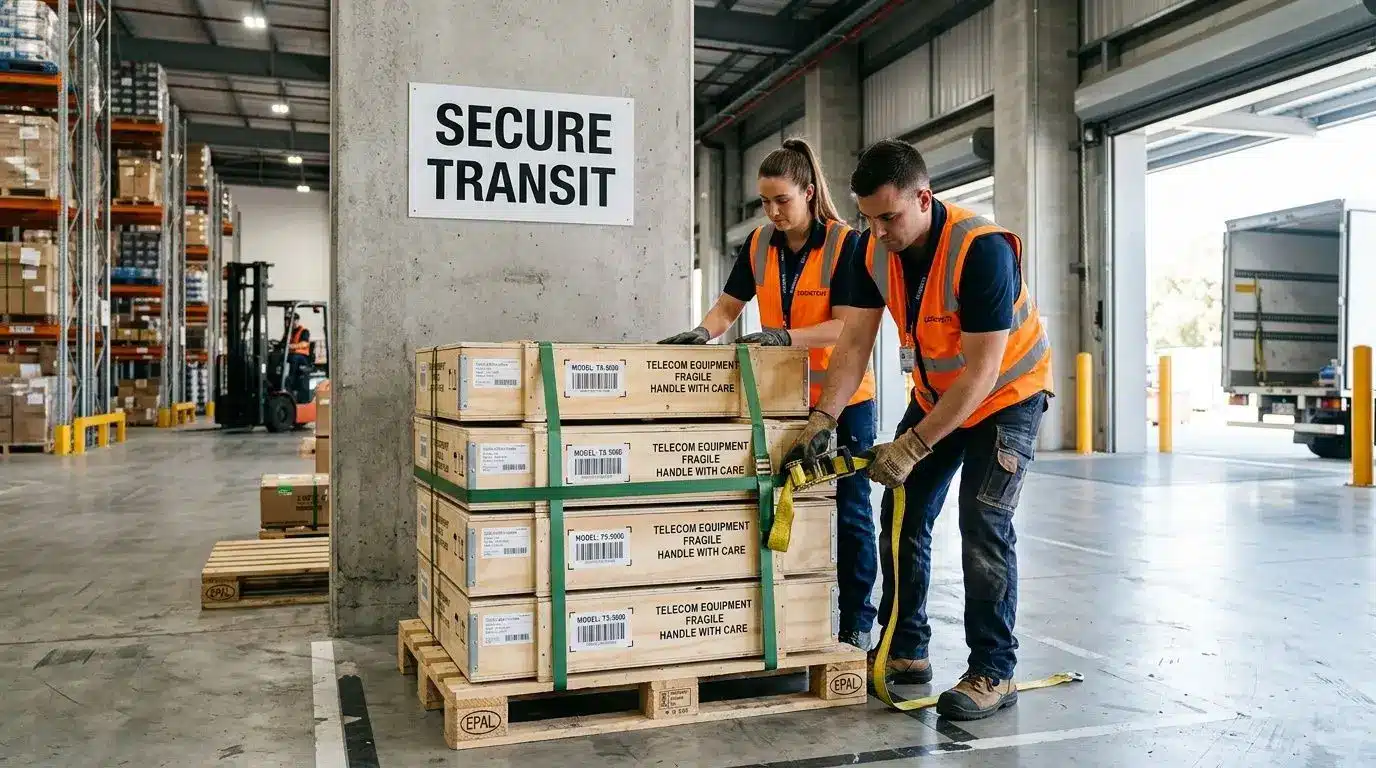
What secure pickup should look like
Before pickup day, validate the inventory against the physical assets. Remove loose accessories from random boxes and reconnect them to the correct units where possible. Separate gear that requires special handling, such as battery-backed devices, damaged units, or equipment awaiting onsite destruction.
Then prepare the load for movement:
- Box small serialized items when individual tracking matters more than speed.
- Palletize stable rack gear with clear labels by site, room, or project batch.
- Document exceptions such as missing drives, broken chassis, or partial assemblies.
- Control access so retired telecom assets aren’t left in open loading areas.
Chain of custody is the control point
A real chain of custody is an unbroken record from handoff to final disposition. That means pickup documentation, serialized intake, transport visibility, receiving confirmation, processing records, and final certificates. If any stage depends on verbal confirmation or an informal spreadsheet, the process is weaker than it looks.
For larger removals, especially in colocation, campus, and enterprise network environments, the logistics piece often overlaps with data center decommissioning services. That matters because telecom disposal isn’t always just a pickup. It can involve de-racking, cable removal, staging, and move management under site access controls.
The best disposal documentation answers four questions fast: what was collected, when custody changed, what process was applied, and how each asset was finally dispositioned.
When vendors can’t explain their custody flow in plain language, that’s a warning sign. Good logistics should reduce uncertainty, not create more of it.
Meeting Environmental and Regulatory Obligations
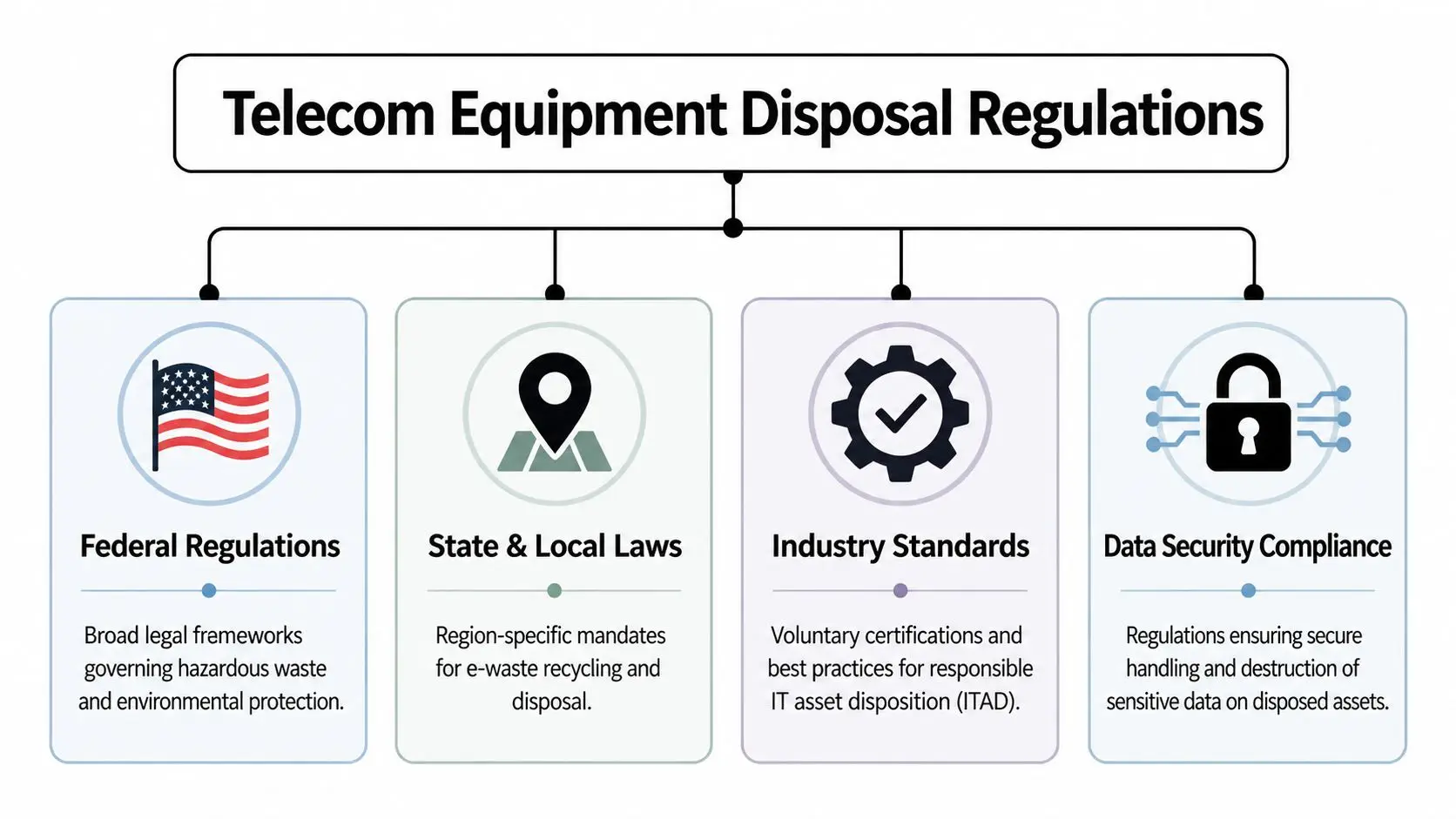
Compliance gets treated as paperwork too often. It’s really about process design. If your telecom equipment disposal workflow doesn’t align with environmental rules and data handling obligations, the certificate at the end won’t save it.
What the regulatory landscape means in practice
For business users, the important point isn’t memorizing every rule. It’s understanding what your disposal partner must be able to prove.
The FTC Disposal Rule matters because organizations handling sensitive consumer information need reasonable measures to protect against unauthorized access during disposal. If telecom devices may contain stored customer or employee data, that requirement becomes relevant fast.
HIPAA raises the stakes for healthcare entities and business associates. If a network appliance, voice system, or related hardware might contain protected health information or support systems tied to it, disposal has to fit your security rule obligations and documentation standards.
State electronics recycling laws add another layer. They vary, but the operational implication is straightforward. You need a downstream process that handles hazardous components correctly and keeps prohibited material out of landfill channels.
Why certification matters
Environmentally sound recycling, following standards like R2/RIOS, aims for over 90% diversion from landfill. Certified processes can recover 98% of ferrous and non-ferrous metals and ensure hazardous components are handled safely, which stands in sharp contrast to global recycling performance described in Eurostat waste statistics for electrical and electronic equipment.
That matters because certifications signal operational discipline. They don’t replace your own due diligence, but they do show that the recycler or ITAD provider is working within recognized controls for environmental management, downstream accountability, and process documentation.
The documents you should expect
Ask for documents that map to the actual work performed, not generic summary letters.
- Certificate of data destruction: confirms sanitization or destruction method for covered assets or media
- Certificate of recycling: confirms material entered compliant recycling streams
- Serialized asset report: ties individual assets to final outcomes where required
- Chain-of-custody records: show handoff, transport, receipt, and processing continuity
If a vendor offers certificates but can’t show how they connect to serialized equipment and actual process records, the paperwork has limited value.
For regulated organizations, legal defensibility comes from the full record set. You want evidence that the devices were controlled, sanitized appropriately, and sent through environmentally sound downstream channels. The certificate is the final page, not the whole story.
Your Vendor Vetting Checklist and Final Steps
Choosing a telecom equipment disposal vendor is less about promises and more about operational clarity. The right partner should be able to walk through the project from inventory to final certificate without hand-waving.
Questions worth asking before you schedule pickup
- What certifications and controls do you maintain? Ask how they apply to both recycling and data-bearing assets.
- How do you track serialized telecom equipment from pickup through final disposition? Listen for specifics, not marketing language.
- Which sanitization methods do you support? The answer should include when wiping, degaussing, or shredding is appropriate.
- How do you handle value recovery? You want transparency on testing, grading, resale eligibility, and commodity segregation.
- What documents will I receive at project close? Require sample reporting before the work begins.
Final operational checks
Confirm site access requirements, loading constraints, de-installation scope, and whether batteries, cabling, and non-rack peripherals are included. If you’re operating across multiple offices, define whether the vendor can normalize inventory and reporting across all locations.
For internal review, this vendor due diligence checklist is a useful starting point for procurement, IT, compliance, and facilities teams evaluating an ITAD provider together.
The best outcome is simple. Your organization exits the project with less risk, clear documentation, and a rational split between destruction, recycling, and recovery.
Frequently Asked Questions on Telecom Disposal
What’s the difference between an ITAD provider and a general e-waste recycler
A general recycler may be able to collect mixed electronics and process commodity material responsibly. An ITAD provider is usually the better fit when telecom assets need serialized tracking, verified data sanitization, asset value recovery, and formal chain-of-custody reporting. For corporate network gear, that distinction matters.
Can telecom equipment be donated instead of recycled
Sometimes, yes. But only after strict data sanitization and practical screening for usefulness. Repurposing telecom gear for nonprofits can help address the digital divide, and with 31% of Americans hoarding unused electronics, donation offers a socially responsible alternative that can reduce production emissions by 80-90% versus manufacturing new devices, according to this analysis of recycling electronic tech and donation pathways.
That said, not every retired switch, router, or phone is a good donation candidate. The equipment has to be safe, functional enough to justify refurbishment, and relevant to the recipient’s environment. Donation isn’t a shortcut around sanitization or logistics.
How long does a typical telecom equipment disposal project take
It depends on inventory quality, the number of sites, access restrictions, and whether de-installation is part of the job. A clean, well-labeled batch moves much faster than a room full of mixed hardware with no records. The biggest delays usually come from unclear asset ownership, poor staging, and late decisions about data destruction.
Should we destroy everything to be safe
Usually not. Total destruction can solve one problem while creating two others. You may destroy reusable assets that could have been sanitized and remarketed, and you may increase project cost without improving the outcome materially. The better approach is to classify assets by risk and choose the destruction method that matches that class.
If you’re planning a telecom refresh, office consolidation, network decommission, or data center shutdown, Beyond Surplus can help you structure the project around secure data handling, documented chain of custody, certified recycling, and practical asset recovery. Contact the team to discuss pickup, de-installation support, and compliant telecom equipment disposal for your organization.


