Your team just finished a device refresh. The old laptops are stacked in a conference room. A few servers are waiting in a cage. Someone suggests finding an “ewaste store” and dropping everything off this week.
That sounds efficient. It usually isn’t.
For a business, end-of-life IT handling isn’t a cleanup task. It’s a security decision, a compliance decision, and often a financial decision. The wrong outlet can leave you with no proof of destruction, no audit trail, and no clear transfer of liability.
The Growing Challenge of Business E-Waste Disposal
An ewaste store looks like an easy answer when equipment starts piling up after a refresh, relocation, merger, or data center project. But the volume of discarded electronics is no longer a small operational nuisance. It’s a global business problem.
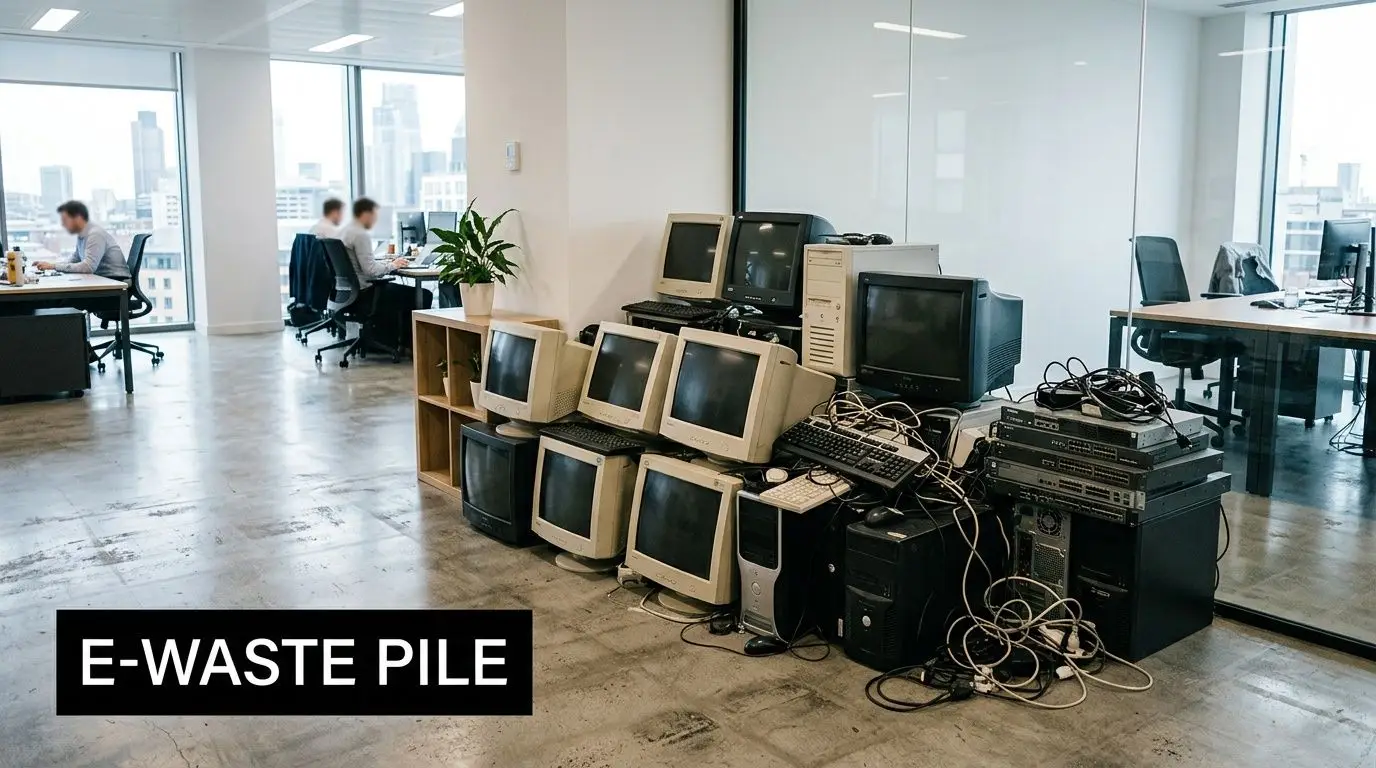
In 2022, the world generated a record 62 million tonnes of electronic waste, equal to 7.8 kg per person globally, an 82% increase from 2010. That volume would fill about 1.55 million 40-tonne trucks, enough to circle the equator bumper-to-bumper, according to the Global E-waste Monitor figures summarized here.
Why businesses get this wrong
Most companies treat retired hardware as surplus property. That’s the first mistake.
Retired devices still contain data, regulated components, and residual value. A desktop with a dead deployment lifecycle may still carry customer records. A network appliance may still hold credentials. A pallet of mixed gear may still include reusable assets that shouldn’t be shredded blindly.
Practical rule: If the asset ever touched company data, the disposal process belongs in your risk program, not your janitorial workflow.
A basic drop-off model rarely matches business needs such as:
- Documented pickup controls that show who touched each asset
- Serialized reporting for laptops, drives, servers, and networking gear
- Verified downstream handling for regulated or hazardous material streams
- Recovery planning for equipment that still has remarketing value
What smart teams do instead
They define disposal before the refresh starts.
That means building a disposition path for every asset class. Reuse. resale. redeployment. destruction. recycling. Businesses that need a starting point can review commercial e-waste services and compare them against their own security and compliance obligations.
If you’re evaluating an ewaste store for business equipment, ask one direct question first. Can this provider prove what happened to every asset after it left your building? If the answer is vague, keep looking.
What Exactly Is an E-Waste Store
An ewaste store is usually a collection point. It may be a retail-style location, a recycling drop-off site, or a small operator that accepts electronics for basic handling.
That model has a purpose. It’s built for convenience. It’s not built for enterprise control.
The simplest definition
Think of an ewaste store as a front-end intake point. You bring devices in. The operator accepts them. Materials are sorted, consolidated, and moved into recycling channels.
For straightforward public drop-off, that can work. For business IT assets, that definition should raise concerns.
A better analogy is this. An ewaste store is to IT asset disposition what a neighborhood mailbox is to a full logistics network. Both move items from point A to point B. Only one is designed for tracking, exception handling, documentation, and accountability at scale.
What an ewaste store usually focuses on
Most ewaste stores emphasize convenience first. Business users need more than convenience.
Typical characteristics include:
- Drop-off centric workflow with limited operational customization
- General intake procedures rather than asset-by-asset business inventory controls
- Recycling-first orientation instead of full lifecycle decision-making
- Light reporting compared with enterprise disposition records
If you want a baseline for what commercial electronics processing should look like, review how dedicated e-waste recycling services are structured for organizations rather than casual drop-offs.
A collection point answers, “Can you take this?”
A business-grade partner answers, “What happens to each item, who documents it, and how do you prove it?”
That distinction matters because companies don’t need a place that merely accepts devices. They need a partner that can control outcomes.
E-Waste Store vs Full-Service ITAD Provider
The market itself is moving toward specialization. The global e-waste management market is projected to grow from 58.36 million tons in 2026 to 74.25 million tons by 2034, reflecting a more professionalized industry where businesses seek partners that manage compliance and risk, not just collection, as noted by Fortune Business Insights.
That shift makes sense. Business disposal has outgrown the drop-off mentality.
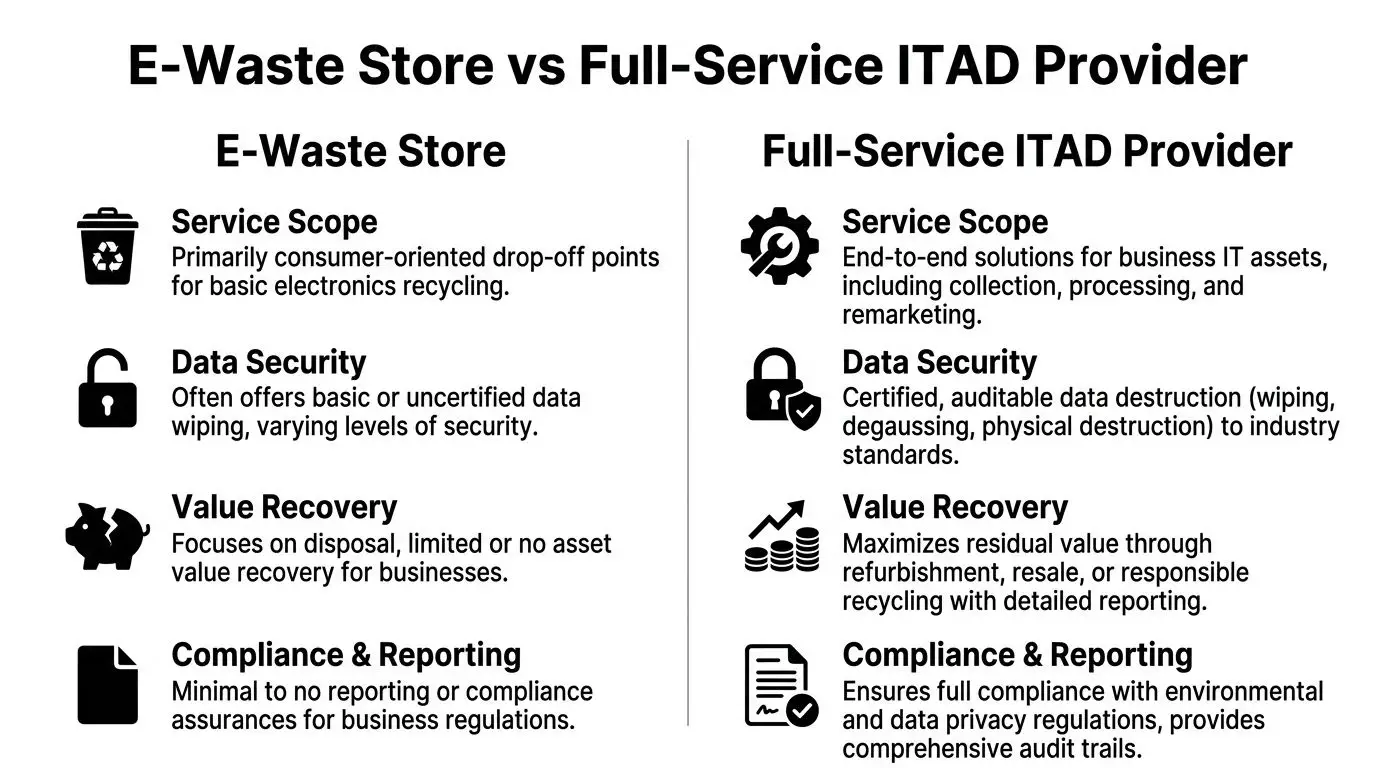
Service Comparison: E-Waste Store vs. ITAD Provider
| Feature | Typical E-Waste Store | Professional ITAD Provider (e.g., Beyond Surplus) |
|---|---|---|
| Service scope | Basic intake and recycling | End-to-end asset disposition, logistics, reporting, and value recovery |
| Data handling | May offer vague wiping claims | Defined destruction methods with audit documentation |
| Chain of custody | Often limited | Controlled transfer from pickup through final disposition |
| Compliance support | Minimal business-specific guidance | Built around regulated business requirements |
| Asset tracking | Batch-oriented or informal | Serialized inventories and disposition records |
| Value recovery | Usually secondary or absent | Refurbishment, resale, and recovery planning when appropriate |
| Project scale | Best for simple drop-offs | Designed for offices, multi-site programs, and data centers |
Where the key distinction appears
A local ewaste store solves a transportation problem. A full-service ITAD provider solves a governance problem.
That difference shows up fast when you need any of the following:
- Multi-site coordination for branch offices
- Device-level reporting for procurement and audit teams
- Separation of reuse from destruction so value isn’t lost
- Formal documentation for legal, privacy, and environmental review
If you’re comparing business disposal options, start with this question: is the provider built around convenience or accountability?
A useful reference point is this explanation of IT asset disposition. It frames the work correctly. ITAD isn’t just recycling. It’s the controlled retirement of business technology.
Why Data Security Transcends Simple Recycling
The biggest mistake companies make is using the word “recycling” as if it automatically includes “data destruction.” It doesn’t.
A device can be recycled physically while its data was never properly sanitized. That’s the liability gap.
According to this analysis of barriers to e-waste recycling, a primary barrier is fear of data breaches, and up to 85% of e-waste in the US is unaccounted for, partly because of privacy concerns. That same source makes the key point businesses ignore. Without certified data destruction and chain-of-custody documentation, users of a basic ewaste store have no way to verify that sensitive information was eliminated.
What “secure” should mean
For business assets, secure disposal should include a defined sanitization method, documented handling, and a final record that proves completion.
That can involve data wiping, physical shredding, or other destruction controls based on device type and risk profile. If your team is also planning migrations before retirement, these secure data transfer methods are a useful operational reference because they reinforce the same principle: data handling must be intentional, documented, and controlled.
What to demand from any provider
Don’t accept “we wipe drives” as a sufficient answer.
Ask for:
- Method clarity so you know whether the provider wipes, shreds, or applies another process
- Chain-of-custody proof from pickup through processing
- Certificates of destruction tied to your job or asset record
- Process alignment with recognized standards such as NIST 800-88
If a recycler can’t explain exactly how it handles hard drives, SSDs, and mobile devices, it isn’t a serious business option.
For teams evaluating vendors, this is the essential benchmark for secure destruction of hard drives. Security isn’t a side service. It’s the core requirement.
Meeting Compliance and Ensuring Chain of Custody
Liability doesn’t end when the truck leaves your dock. It ends when you can prove proper disposition.
That’s why chain of custody matters. Not as industry jargon, but as evidence.
What compliant handling looks like
Under New York State facility requirements, compliant e-waste operations must use fully enclosed buildings and maintain a detailed tracking system for the date, weight, type, and origin of materials, as outlined by the New York State Department of Environmental Protection. That standard of care separates professional ITAD operations from informal collection points.
For a business customer, the lesson is simple. Proper handling requires documented controls at every stage:
- Pickup documentation that identifies what was removed
- Secure storage conditions before processing
- Material tracking records that preserve asset history
- Final disposition reporting that closes the loop
Why regulators care
The FTC Disposal Rule is one example of why “we dropped it off” isn’t a defense. Healthcare organizations also have to think about HIPAA. Financial firms have their own privacy and records obligations. Manufacturers and government contractors often face contractual handling requirements on top of statutory ones.
If you need a plain-English refresher on the broader legal concept, this overview of regulatory compliance is a useful grounding point.
The document that matters most after pickup is the one you can hand to counsel, audit, or procurement and say, “This is the complete record.”
An ewaste store may be able to accept your gear. That doesn’t mean it can support your audit trail. Businesses should insist on chain-of-custody records that are specific enough to survive internal review, customer scrutiny, and regulator questions.
Scalable ITAD Services for Your Organization
A serious ITAD program has to work for more than one office and more than one asset type. It must handle user devices, server infrastructure, storage, networking gear, lab equipment, and project-based retirements without creating a new risk every time.
That’s where scale matters.
Leading processors operate facilities capable of shredding up to one billion pounds of electronics annually using football-field-length systems, and that industrial capacity includes NIST 800-88 compliant data destruction, according to ERI’s electronics recycling overview. That’s a different universe from a local ewaste store.
What scalable service includes
For organizations, scale isn’t just volume. It’s process consistency across different scenarios.
A capable ITAD partner should support:
- Office refreshes with coordinated pickups, packing guidance, and inventory capture
- Data center decommissioning where racks, drives, and infrastructure need controlled removal
- Product destruction for recalled, obsolete, or proprietary equipment
- IT asset recovery when selected devices can be refurbished or resold instead of scrapped
Why this changes the business case
A local ewaste store treats all inbound material as a disposal event. A full ITAD program treats it as a decision tree.
Some assets should be destroyed immediately. Others should be wiped and redeployed. Others may return value through resale channels. That’s how mature organizations reduce risk without wasting recoverable equipment.
Operator advice: Don’t choose your end-of-life vendor by proximity. Choose by whether it can handle your hardest project, not your easiest one.
If a provider can’t support a staged refresh, a multi-site pickup, or a decommissioning event, it isn’t scalable enough for business use.
Partner with Beyond Surplus for Secure and Compliant ITAD
An ewaste store can be fine for simple collection. It is not the right answer for most business technology retirement projects.
Companies need documented data destruction, auditable chain of custody, compliance-ready reporting, and a process that separates remarketing from destruction. That’s what protects the business. That’s what stands up in audit. That’s what keeps old equipment from becoming a new liability.
If your organization is evaluating disposal options in Georgia or planning a broader commercial program, review these ITAD services in Georgia and use them as the benchmark. The standard should be clear. Secure pickup. controlled handling. verified destruction. transparent reporting.
Anything less is just a drop-off.
Contact Beyond Surplus for certified electronics recycling, secure data destruction, and compliant IT asset disposal built for business, not basic drop-off.