A retired laptop in a storage room can carry the same legal and operational risk as a live production endpoint. That's why secure data destruction trends in Atlanta have shifted from basic disposal to documented risk control.
The financial backdrop is hard to ignore. IBM's 2025 breach figures put the global average breach cost at $4.44 million and the U.S. average at $10.22 million, with an average lifecycle of 241 days from identification to containment, according to StationX's summary of IBM breach data. For an Atlanta IT director, that changes the conversation. Old servers, failed SSDs, backup media, and employee laptops aren't scrap first. They're liability first.
Most organizations already know they need to “dispose of devices securely.” The problem is choosing the right method, preserving asset value where possible, and building records that can survive an audit. That's where most programs still break down.
The High Stakes of Data Disposition in Atlanta
Atlanta businesses in healthcare, finance, logistics, legal services, and technology all face the same end-of-life problem. Devices age out faster than governance processes do. Equipment gets stacked in closets, held for a future refresh cycle, or moved between offices with weak tracking.
That's where risk accumulates.
A decommissioned server still holds credentials, archived files, customer records, or internal documentation unless someone has verified sanitization. A cracked laptop with a dead screen may still contain readable data. An unlabeled box of mixed media creates a chain-of-custody blind spot before the truck even arrives.
Why disposal now sits inside risk management
Secure disposal used to be treated like facilities work. In practice, it belongs with IT, security, compliance, procurement, and finance. The decision affects:
- Breach exposure: Retired assets can still expose regulated or confidential data.
- Audit readiness: Regulators and auditors want proof, not assumptions.
- Asset recovery: Functional devices may still have resale or redeployment value.
- Operational cleanup: Storage rooms full of retired equipment create control failures.
Practical rule: If a device ever stored business data, treat its disposition as a governed event, not a recycling task.
In Atlanta, that matters even more because many organizations operate in sectors where records retention, privacy obligations, and internal controls are closely examined. The better programs don't just destroy data. They define who approved the disposition, what method was used, and what evidence was retained.
Market Forces Driving Data Destruction Demand
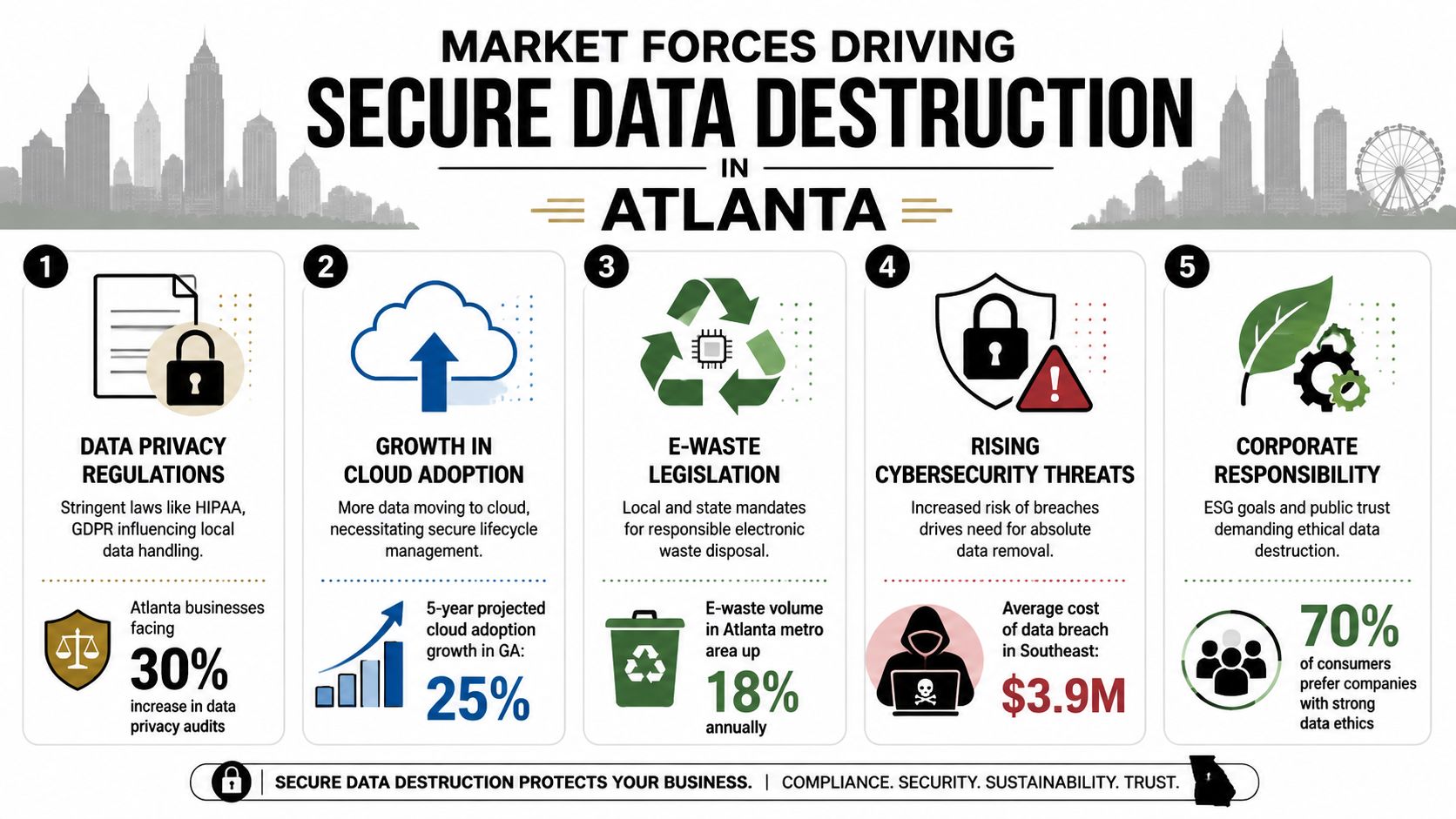
The secure data destruction market isn't a side niche anymore. It's expanding because companies are connecting end-of-life asset handling to cyber risk, compliance, and ITAD value recovery.
According to Research and Markets coverage of the secure data destruction market, the market was valued at USD 4.1 billion in 2026 and is projected to reach USD 5.91 billion by 2030 at a 9.6% CAGR. The broader data destruction service market is projected to grow from USD 2.5 billion in 2024 to USD 7.8 billion by 2033 at about 12% CAGR.
What's driving the increase
The first driver is simple. Companies hold more data across more endpoints than they used to. That includes laptops, virtualized server hosts, removable media, network appliances, and backup assets that often sit outside the spotlight.
The second driver is governance. Legal, privacy, and internal audit teams now expect disposal records to be specific enough to defend. “Disposed of old computers” isn't a control.
Why Atlanta is a practical fit for these services
Atlanta organizations often manage distributed offices, regional warehouses, clinics, financial branches, and hybrid work fleets. That creates a steady stream of retired devices moving through refresh cycles, closures, relocations, and mergers.
Three market realities stand out:
- Value recovery matters: If a working laptop can be wiped and reused, shredding it may destroy recoverable value.
- Mixed media is normal: Programs have to address SSDs, tapes, flash media, and specialty devices, not just hard drives.
- Documentation has become part of the service: Certificates, serial tracking, and method reporting now influence vendor selection.
The maturing market tells you something important. Buyers no longer want disposal alone. They want a defensible process.
That's the core of secure data destruction trends in Atlanta. The demand is growing because organizations need a process that reduces risk without wasting reusable hardware.
Navigating Atlanta's Compliance and Regulatory Landscape
Compliance doesn't tell you which vendor to hire. It does tell you what failure looks like. If your organization handles patient records, consumer financial information, personnel files, or other sensitive data, disposal has to be controlled and provable.

What regulated organizations need to prove
Healthcare teams usually focus on whether protected data remained on the device. Finance teams often focus on consumer information and disposal controls. Legal and HR teams worry about records that may still live on old endpoints, shared drives, or removable media.
The practical standard is higher than deletion. Simple file deletion doesn't create reliable proof, and it doesn't reflect a controlled sanitization process.
A compliant process usually requires:
- Asset identification: Know exactly what media is leaving your environment.
- Method selection: Match the sanitization or destruction method to the media condition and data sensitivity.
- Custody control: Document transfer from your team to the disposal provider.
- Final evidence: Keep records that show what happened to each asset.
Where local teams often get it wrong
Many Atlanta businesses have policies for procurement and deployment, but weak rules for retirement. That's where auditors find gaps. Devices may be approved for disposal before anyone classifies the data, checks whether they're reusable, or records serial numbers.
A stronger approach is to build disposal into your compliance workflow the same way you treat onboarding and patching. Teams reviewing local obligations can start with this Atlanta e-waste laws and business compliance guide, then map those obligations to internal pickup, approval, and evidence procedures.
If your destruction record can't show which specific assets were processed and how, it won't help much when someone asks harder questions later.
Choosing Your Method Wiping vs Physical Destruction
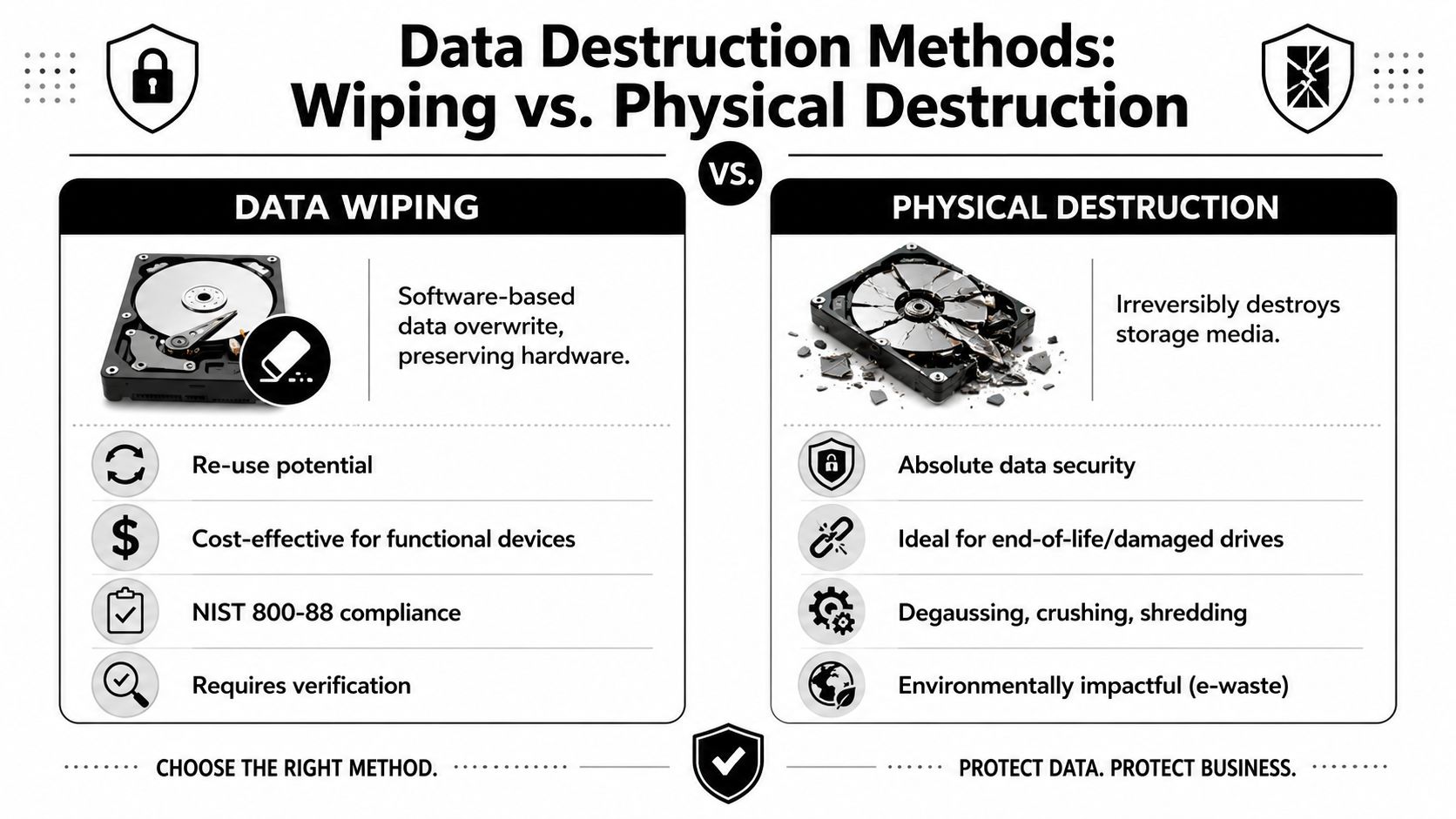
Atlanta companies make choices that can save money or create avoidable waste. Too many programs default to shredding every drive because it feels safer. Sometimes that's correct. Sometimes it destroys working assets that could have been sanitized, redeployed, or sold.
Guidance specific to this decision says that certified wiping is appropriate for functional laptops, servers, and desktops and can meet common governance and privacy standards, while physical shredding is best for damaged, end-of-life, or ultra-sensitive media, as outlined in Atlanta Computer Recycling's discussion of Atlanta data destruction.
Beyond Surplus also describes a practical three-tier framework for secure destruction: Clear, Purge, and Destroy, with reusable assets typically routed to wiping or cryptographic erasure and end-of-life media routed to physical destruction, as outlined on Beyond Surplus secure data destruction.
Use a method-by-risk decision model
The right question isn't “Which method is safest?” The right question is “Which method is appropriate for this asset, this data class, and this intended outcome?”
| Device condition | Data sensitivity | Likely method | Business effect |
|---|---|---|---|
| Functional and reusable | Standard business data | Certified wiping | Preserves reuse or resale potential |
| Functional but highly sensitive | High sensitivity | Purge-level sanitization or destruction | Higher assurance, possible loss of value |
| Damaged or unreadable | Any sensitivity | Physical destruction | Eliminates recovery risk |
| End-of-life media | High sensitivity or unknown | Physical destruction | Best fit when no reuse value remains |
When wiping makes sense
Choose certified wiping when the asset still works and your team wants value recovery or internal redeployment. This usually fits refresh projects involving business laptops, desktops, and servers with no physical media failure.
Wiping works best when you can verify the process and tie the report back to the device record. If your vendor can't prove the wipe result at the asset level, the method may be technically sound but operationally weak.
A practical starting point for internal teams is this hard drive wipe guide for computer disposal planning.
When physical destruction is the better call
Choose shredding, crushing, pulverizing, or other destructive methods when the media is damaged, failed, or no longer worth recovering. It's also the cleaner option when your policy requires destruction for ultra-sensitive data or when uncertainty about the media condition makes sanitization verification unreliable.
Wiping protects value. Destruction protects certainty. Good programs know when each one matters more.
What doesn't work is applying one method to every device. That creates either unnecessary waste or unnecessary risk.
Audit-Proofing Your Chain of Custody Documentation
A generic certificate might satisfy an internal checklist. It won't satisfy a serious audit question. The documentation trend in Atlanta is moving toward device-level traceability, and that's the right direction.
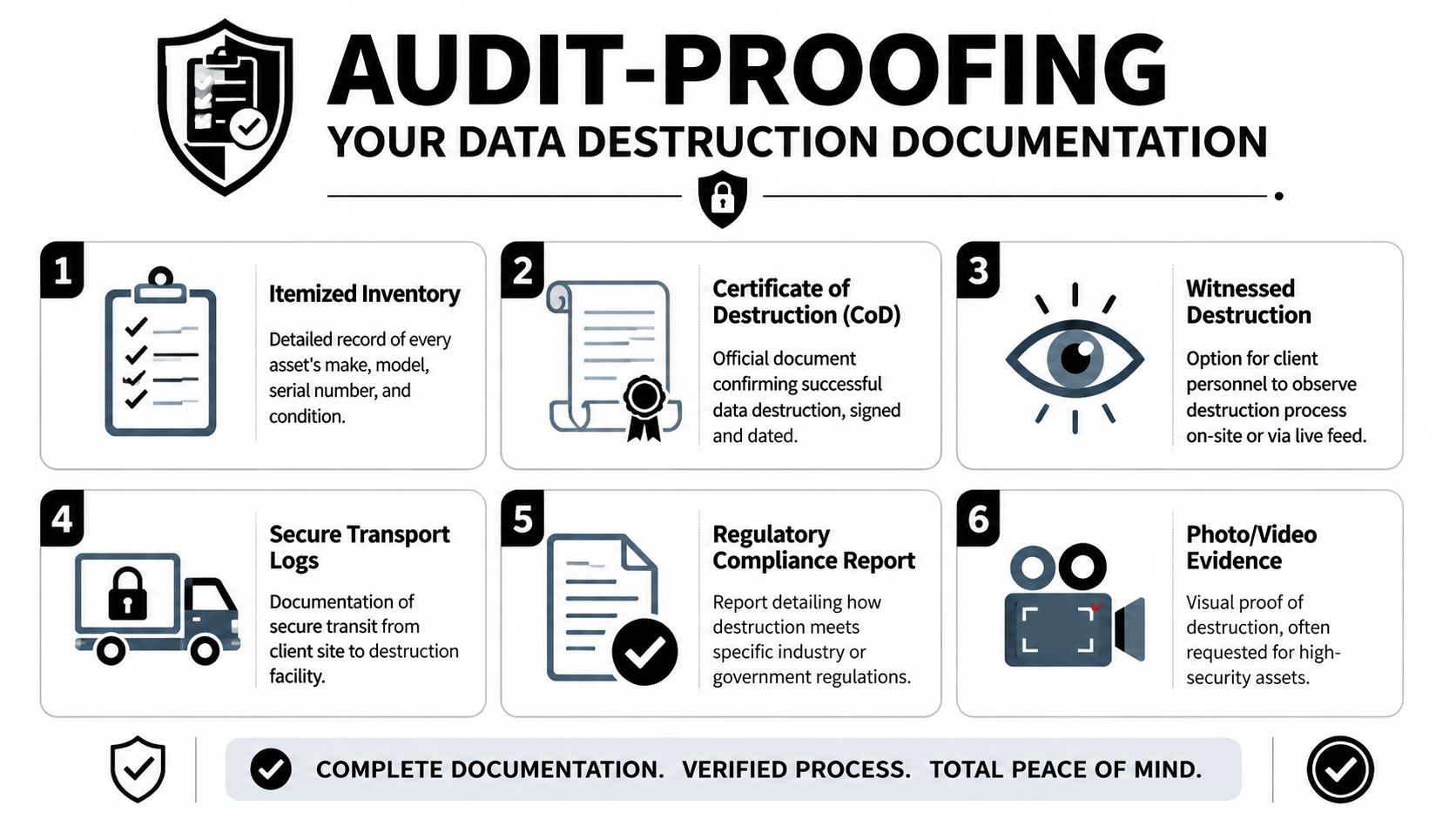
Organizations should record serial numbers, user assignment, data classification, and the exact sanitization or destruction method before pickup. A description like “one pallet of computers” is not audit-ready, and documentation should cover media such as flash drives, SD cards, and backup tapes, according to ReWorx guidance on IT risk management trends for Atlanta businesses.
What an audit-ready record should include
If you're reviewing a vendor packet, look past the certificate title and check the fields. Strong records usually include:
- Device identity: Manufacturer, model, asset tag, and serial number.
- Ownership context: Department, site, or assigned user if your policy tracks it.
- Media detail: Whether the device contained HDDs, SSDs, flash media, tapes, or other storage.
- Disposition method: The exact wipe, purge, or destruction method used.
- Custody milestones: Pickup date, transfer points, processing date, and final disposition date.
What weak documentation looks like
Weak records are vague. They summarize volume but not items. They confirm that “materials were destroyed” but not what those materials were. They often miss mixed media entirely.
That creates problems in three common scenarios:
- An internal audit asks for proof on one executive laptop.
- Legal asks whether backup tapes from a closed office were included.
- Security investigates whether a specific failed SSD was destroyed or only collected.
If the answer lives inside a pallet count, your process isn't defensible.
For teams building a stronger record set, this certificate of destruction template resource is a useful benchmark for the level of detail a vendor should be able to support.
Your certificate should read like an inventory event with a security outcome, not like a hauling receipt.
Sustainability and E-Waste in Corporate ITAD
Security and sustainability aren't competing goals. In a well-run ITAD program, they support each other.
If a device is functional and can be sanitized correctly, wiping can extend its life through resale, redeployment, donation, or parts harvesting. That reduces unnecessary destruction and supports circular use of business equipment. If the media is damaged or the device is at end of life, physical destruction may still be the right call. The sustainability question then shifts to downstream recycling and material handling.
Where companies create avoidable waste
The biggest sustainability mistake isn't shredding when destruction is required. It's shredding by default when a usable asset could have been securely wiped and returned to service. That decision cuts off both financial recovery and reuse potential.
A stronger policy separates assets into two lanes:
- Reuse lane: Functional devices with verified sanitization potential
- Destruction lane: Failed, obsolete, or high-sensitivity media with no practical recovery path
What responsible ITAD looks like in practice
Corporate sustainability teams usually care less about slogans and more about process discipline. They want to know that reusable equipment was evaluated before destruction and that non-reusable material went into a legitimate recycling stream.
That's where disposal policy and ESG reporting start to overlap. This Georgia sustainable IT disposal and ESG ITAD overview is a useful way to frame those conversations internally.
A secure program shouldn't force you to choose between compliance and environmental responsibility. The better approach is simple. Reuse what can be safely sanitized. Destroy what can't. Document both.
Selecting Your Secure Data Destruction Partner in Atlanta
The wrong vendor usually looks fine in the sales process. The gaps show up later in missing records, unclear custody logs, weak media handling, or one-size-fits-all destruction recommendations.
A better vendor review starts with operational questions, not marketing claims.
What to ask before you sign
Use this checklist when comparing providers:
- Can they support both wiping and destruction? If they only sell one method, expect biased recommendations.
- Do they track assets at the device level? You want serial-based reporting, not bulk summaries.
- Can they handle mixed media? Ask specifically about SSDs, flash media, tapes, and nontraditional data-bearing items.
- How do they document custody? Pickup logs, intake scans, and final method records should connect cleanly.
- Do they align with your ITAD goals? Some projects focus on risk elimination. Others need value recovery too.
Match the vendor to your real environment
A hospital, law firm, manufacturer, and colocation operator won't have the same disposal profile. Your vendor should ask about data class, media condition, site count, logistics, and reuse intent before recommending a workflow.
It also helps to separate device data destruction from public-facing data removal. If your security team is also reviewing personal or brand exposure online, this guide to online data erasure covers a different but related problem.
For a procurement-side checklist, this step-by-step guide to choosing an ITAD vendor in Georgia is a practical starting point.
The right partner for secure data destruction trends in Atlanta is the one that can defend method selection, preserve value when appropriate, and produce records that hold up under pressure.
If your organization needs a clearer process for certified wiping, hard drive shredding, chain-of-custody reporting, or broader IT asset disposition, contact Beyond Surplus to review your current workflow and build a secure, audit-ready disposal program.