
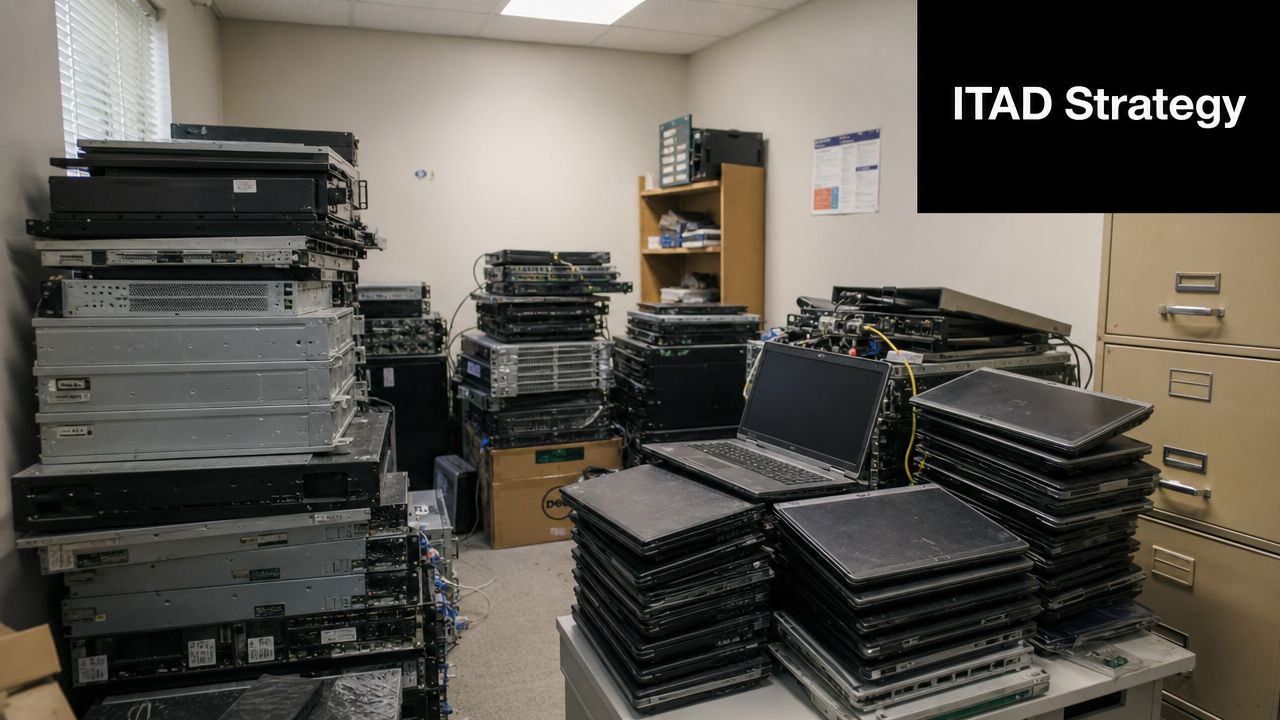
You're probably looking at a closet, cage, or back room with retired laptops, failed drives, old switches, and maybe a few servers nobody wants to touch until the next audit. That pile doesn't look strategic. It looks like deferred cleanup.
But that's the trap.
Old equipment holds risk long after it stops creating value. A misplaced laptop, an undocumented drive, or a recycler with weak downstream controls can turn a routine refresh into a security incident, a compliance problem, or a reputation issue your team has to explain later. That's why how to choose an ITAD vendor in Georgia step by step has less to do with hauling equipment away and more to do with controlling exposure.
A good ITAD program closes three gaps at once. It protects data, documents custody, and gives your organization a defensible record of what happened to each asset. It can also recover value from reusable devices, but only after the security and compliance pieces are locked down.
Beyond Disposal A Strategic Approach to ITAD in Georgia
Georgia companies usually start the ITAD process for practical reasons. Storage is full. A lease return is coming up. A merger left duplicate hardware in two offices. A data center refresh pushed aging gear into a holding area.
The mistake is treating that backlog as a disposal task. It's really an end-of-life control point. If you hand assets to a vendor that can't prove custody, destruction, and final processing, you haven't eliminated risk. You've outsourced uncertainty.
That shift in mindset matters more than any price quote. A low bid can look attractive until you ask basic questions about serialized reporting, transport controls, or certificates of destruction and get vague answers back. Teams that approach ITAD as risk management usually buy better service and avoid expensive surprises.
For Georgia organizations, the strongest starting point is to define success before you contact vendors. If your assets contain regulated data, your threshold should be higher. If your equipment still has resale potential, you also need a vendor that can separate reusable assets from scrap without weakening controls.
Practical rule: If a vendor can remove equipment quickly but can't show what happens next, they're solving your space problem, not your risk problem.
A useful mindset reset is to review why ITAD services matter for Georgia companies before issuing an RFP or requesting quotes. It helps frame the decision around chain of custody, data handling, and audit readiness instead of truck scheduling alone.
Navigating Compliance and Certifications in Georgia
The first filter is simple. If a vendor can't document its certifications and compliance approach, stop there.
The global backdrop explains why this matters. The world generated 62 million metric tons of e-waste in 2022, and only 22.3% was formally collected and recycled. Annual generation is projected to reach 82 million metric tons by 2030, according to the Global E-waste Monitor summary cited here. For a Georgia business, that means your retired equipment enters a waste stream with real leakage risk unless your vendor can document custody and downstream handling.
Start with certifications that prove process discipline
Ask for current certification documents, not logos on a website.
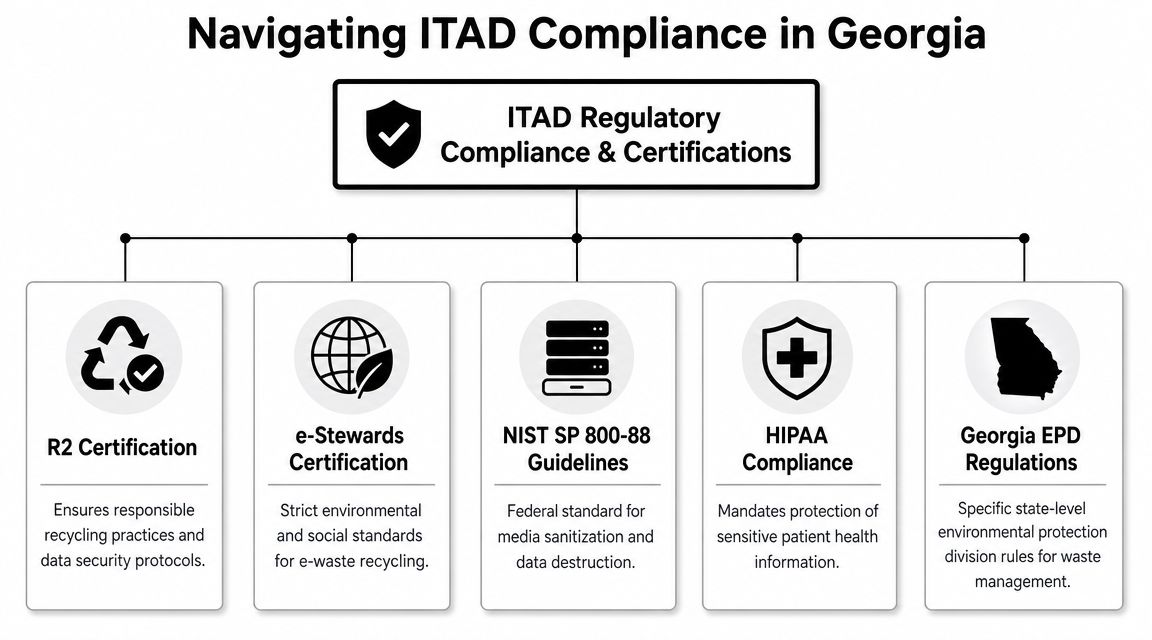
- R2v3 or e-Stewards: These certifications are useful because they push accountability past the loading dock. You want proof that the vendor controls recycling practices, data-bearing devices, and downstream vendors.
- Documented data-destruction standards: If the vendor says it follows NIST SP 800-88, ask how that appears in actual operating procedures and reporting.
- Evidence of downstream transparency: A serious ITAD vendor should be able to explain where non-remarketable material goes and how that path is documented.
A short review of R2-certified ITAD providers in Georgia can help you separate baseline compliance from marketing language.
Match the vendor to your regulatory environment
Different industries need different proof.
Healthcare teams should focus on how the vendor protects media that may contain patient data. Financial and consumer-facing organizations should pay attention to secure disposal obligations under frameworks such as the FTC Disposal Rule. Any enterprise with security governance requirements should ask whether sanitization methods align with NIST SP 800-88 and whether each asset can be traced by serial number.
Use this test in vendor calls:
| What to ask | What a strong answer sounds like |
|---|---|
| Can you provide current certifications? | Documents are provided promptly, with scope and expiration details |
| How do you track assets? | Serialized intake, custody records, and exception handling are defined |
| Who handles downstream recycling? | Named partners or documented process, not vague assurances |
| What reports do clients receive? | Certificates of destruction, recycling certificates, and asset-level reporting |
Compliance isn't the paperwork after the job. It's the operating model before the pickup.
Validating Secure Data Destruction Methods
For most IT managers, this is the decision inside the decision. You're not just choosing a recycler. You're choosing the method that makes data unrecoverable and the reporting that proves it.
IBM's 2024 Cost of a Data Breach Report put the global average breach cost at USD 4.88 million, and organizations with a fully deployed security AI and automation strategy saved an average of USD 2.22 million compared with those without it, as cited in this ITAD vendor selection summary. In practice, that turns retired drives into a financial risk question, not a disposal detail.
Wiping versus shredding
Both methods have a place. The wrong choice is using one method for every device regardless of media type, reuse goals, or compliance requirements.
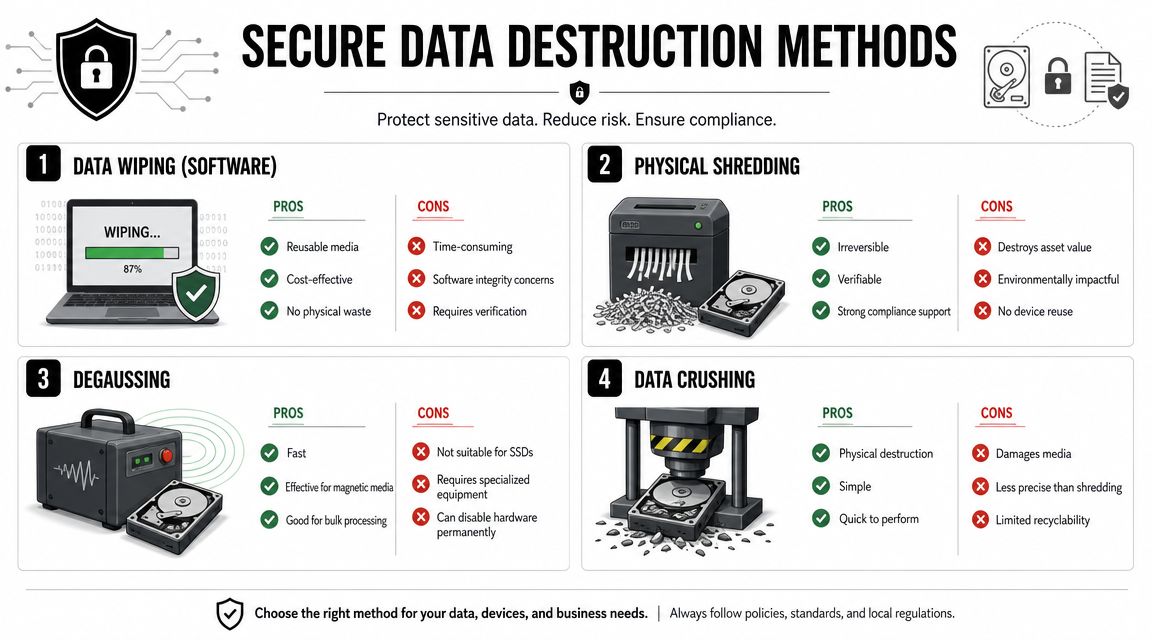
- Software wiping: Best when the asset may be reused or resold and the media supports validated sanitization. Ask how the vendor verifies completion and handles failures.
- Physical shredding: Best when the risk profile is high, the device is damaged, or reuse isn't worth the exposure. It destroys value, but it also removes ambiguity.
- Degaussing and crushing: These can fit specific workflows, but the vendor should explain when they're appropriate and where they aren't.
On-site versus off-site destruction
On-site destruction gives your team direct visibility. It can make sense for highly sensitive assets or internal stakeholders who need witnessable handling.
Off-site destruction can work well too, but only when transport, intake, storage, and reporting are tightly controlled. That means sealed handling, serialized asset tracking, and auditable records from pickup through final outcome. If you're building your review process around the federal sanitization standard, this NIST SP 800-88 overview is a useful reference point.
If the vendor can't show you a sample certificate of destruction before the job, assume the reporting won't improve after the job.
A proper certificate should identify the asset or batch in a way your auditors can use, state the destruction method, and tie back to the chain of custody. Generic paperwork creates false comfort.
Security teams that think beyond disposal often borrow lessons from incident response. If your organization operates internationally or coordinates with overseas legal teams, this resource on expert advice on cyber incidents in Israel is a useful example of how legal and technical response planning intersect. The same mindset applies here. Documentation is part of the control, not a side issue.
Evaluating Logistics Liability and Value Recovery
Once security controls are defined, look at the mechanics. A vendor can have solid certifications and still create problems through weak pickup procedures, poor reconciliation, or sloppy contract language.
Logistics tells you how disciplined the vendor really is
Ask how assets move from your floor to the vendor's processing stream. You want clear answers on pickup windows, packaging expectations, transfer documentation, urgent jobs, and exception handling when counts don't match.
The strongest vendors can describe the handoff in operational detail. Who signs at pickup. How assets are labeled. What happens if an unlisted device appears. How discrepancies are escalated. That's where you see whether process discipline is real.
One practical option in Georgia is asset recovery services, where the provider combines pickup, serialized processing, data destruction options, and resale evaluation for eligible equipment. That model works when the controls are strong enough to protect custody while still preserving remarketing value.
Liability transfer is earned through documentation
Your organization doesn't reduce exposure because a truck left the site. It reduces exposure when the contract, custody records, insurance coverage, and destruction reporting line up.
Review these contract points closely:
- Chain of custody terms: The SLA should define when custody transfers and how that transfer is recorded.
- Exception handling: Missing items, damaged media, or count mismatches need written procedures.
- Insurance and indemnity: Procurement and legal should confirm the vendor's coverage fits the job type.
- Reporting deliverables: Certificates and reconciliation reports should be named in the contract, not added later by email.
Value recovery is worth pursuing, but not at the expense of control
Good ITAD vendors don't scrap everything by default. They identify devices that can be wiped, tested, and remarketed, then return value through a buyback or credit model.
That said, value recovery only works when the intake audit is accurate and sanitization is defensible. If a vendor talks a lot about payouts but very little about asset tracking, you're hearing a sales pitch, not an operating model.
Key Vendor Questions and Critical Red Flags
Most bad ITAD decisions don't come from one dramatic failure. They come from small gaps that nobody pushed on during vendor review.
Vendor-selection frameworks consistently warn against treating ITAD as a simple logistics purchase. Missing chain-of-custody documentation, unclear downstream recycling paths, weak SLA language, and unverifiable certifications are common red flags because they undermine auditability and make it harder to defend your decisions later, as noted in this vendor selection criteria overview.
Questions worth asking in the first meeting
Use direct questions. Don't ask whether the vendor is secure. Ask how the process works.
- How do you document chain of custody from pickup to final disposition?
- Can you provide sample certificates of destruction and recycling?
- Which data-destruction methods do you use for different media types?
- How do you handle assets that fail wiping or arrive damaged?
- What does your SLA say about pickup timing, urgent requests, and exceptions?
- Who are your downstream recycling partners, and how do you monitor them?
- Can you provide references from organizations with similar compliance needs?
- What public business and legal information can you share for due diligence?
A structured vendor due diligence checklist helps procurement, IT, and compliance teams score these answers consistently instead of relying on whoever sounded most confident on the call.
Red flags that usually predict trouble
Some warning signs show up early.
Vendors that answer every question with “we handle that” usually don't handle it well enough for audit scrutiny.
Watch for these patterns:
- Vague certification claims: They mention standards but don't send documents.
- No sample reporting: They promise certificates later but won't show examples now.
- Unclear downstream path: They can't explain where non-reusable material goes.
- Thin SLA language: The contract says pickup and processing will happen, but not how, when, or with what records.
- Pricing that's too simple: Flat pricing can hide costs around drives, packing, urgent service, or reporting extras.
- Weak reference quality: They provide references that don't match your industry, scale, or compliance exposure.
If you hear evasive answers before signature, expect worse after pickup.
Your Georgia ITAD Vendor Evaluation Scorecard
A vendor review gets easier when you stop asking, “Who can take this equipment?” and start asking, “Who can prove control at every handoff?” That's the difference between a cleanup vendor and a risk-management partner.
Use a scorecard. It keeps the decision grounded when quotes, timing pressure, and internal stakeholders start pulling in different directions.
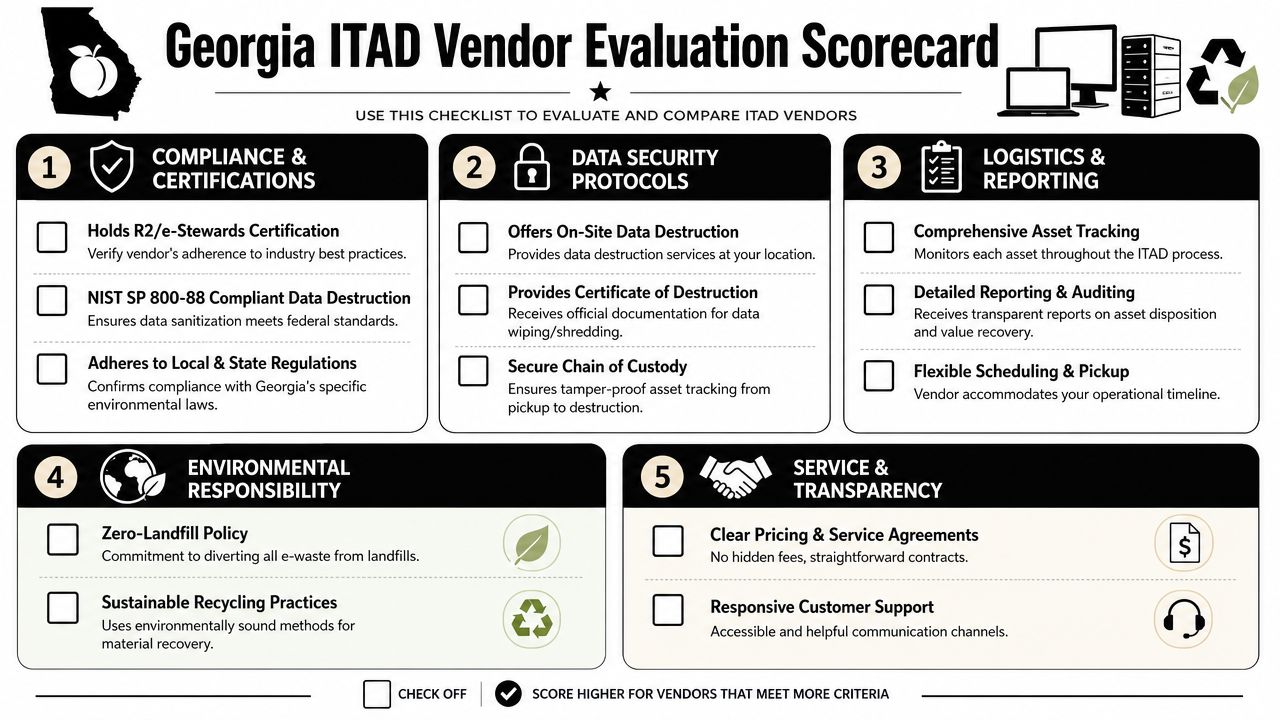
Score each vendor on these categories
| Category | What to verify |
|---|---|
| Compliance and certifications | Current R2 or e-Stewards documentation, stated sanitization standard, relevant regulatory awareness |
| Data security protocols | On-site and off-site options, media-specific destruction methods, sample certificates, serialized tracking |
| Logistics and reporting | Pickup process, reconciliation workflow, exception handling, asset-level reports |
| Environmental accountability | Downstream transparency, documented recycling path, clear handling of non-remarketable materials |
| Service and transparency | Clear pricing, usable references, business documentation, responsive communication |
A practical pass fail test
A vendor should pass all of these before you compare commercial terms:
- Provides certification proof
- Explains chain of custody clearly
- Shows auditable destruction records
- Defines SLA terms in writing
- Can support both risk reduction and value recovery where appropriate
If one vendor has a lower price but fails any of those checks, the cheaper quote usually becomes the more expensive decision.
Choose the vendor you can defend in front of legal, compliance, security, and finance. That's the real test.
How to choose an ITAD vendor in Georgia step by step comes down to this. Start with certifications. Validate destruction methods. Test logistics and liability language. Review value recovery realistically. Then score vendors side by side so the decision doesn't drift into guesswork.
If your team needs a documented, business-focused ITAD process in Georgia, contact Beyond Surplus for certified electronics recycling and secure IT asset disposal.


