

For any business owner, IT manager, or facility manager, the question of what happens to sensitive data on retired company hard drives is a major security concern. The official framework for ensuring that data is permanently and irretrievably destroyed is NIST Special Publication 800-88.
This publication serves as the definitive guide for securely sanitizing electronic media, setting the gold standard for secure data destruction and IT asset disposal across all commercial sectors. Understanding its principles is fundamental for protecting your business from data breaches during the equipment lifecycle.
What Is NIST SP 800-88 and Why It Matters to Your Business
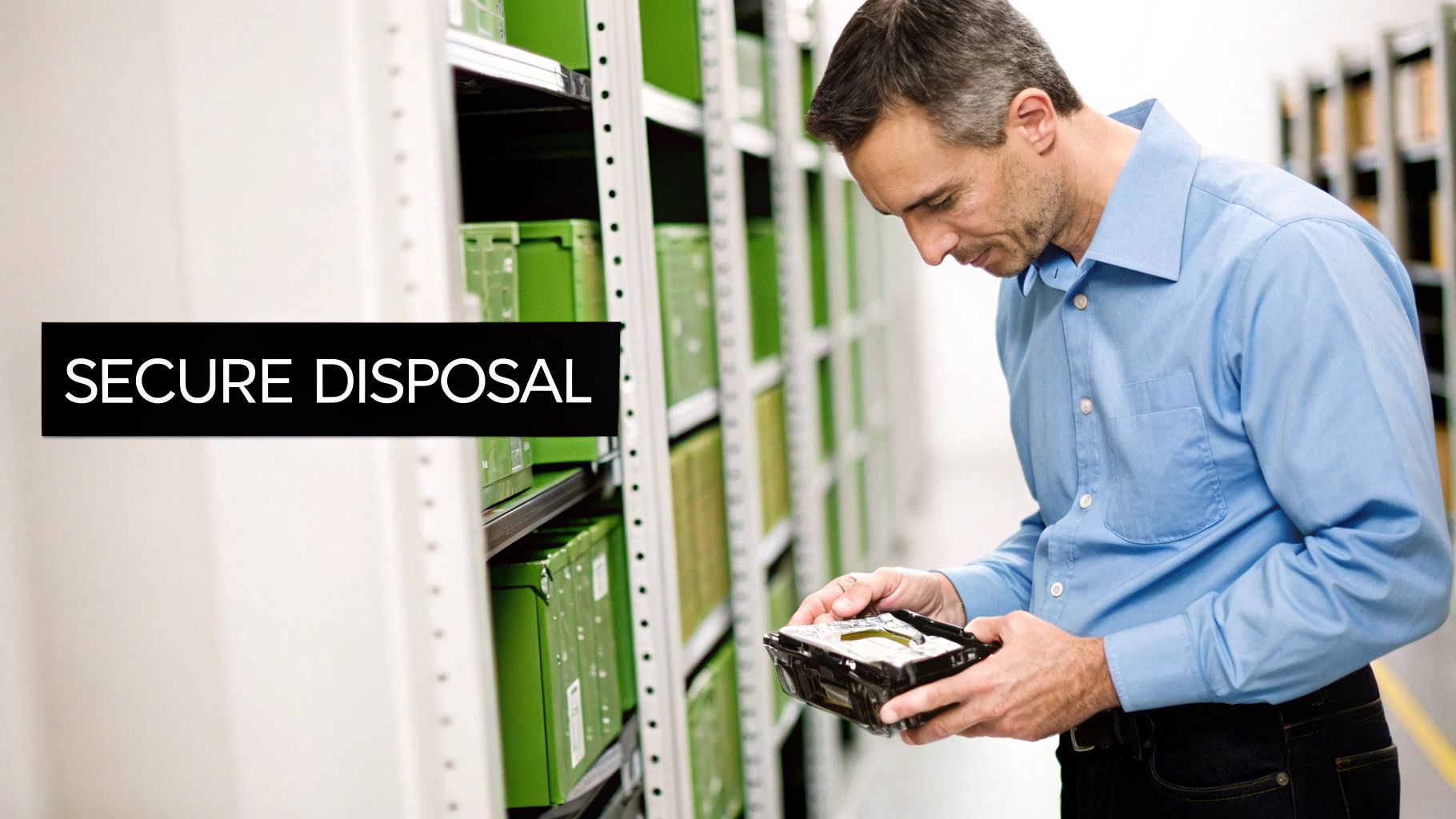
Imagine your company’s retired hard drives, servers, and laptops as unlocked filing cabinets filled with confidential customer data, financial records, and proprietary trade secrets. You wouldn't simply leave them unattended. That is precisely the risk that NIST SP 800-88 is designed to mitigate. It provides a master framework for permanently eliminating that information before any IT asset leaves your company's control.
This is not just a dense technical manual; it is a practical framework for protecting your business from the types of data breaches that cause financial and reputational damage. The standard outlines proven, verifiable processes for media sanitization, ensuring data cannot be reconstructed after a device is recycled, resold, or disposed of.
The Gold Standard for Secure IT Asset Disposal
Originally developed for U.S. federal agencies, NIST SP 800-88 was quickly adopted as the benchmark for data security in the private sector. Today, it is a cornerstone of corporate governance, IT risk management, and compliance with data privacy regulations worldwide.
Its value lies in its structured, risk-based approach. The guide provides:
- Clear Methodologies: It defines specific, actionable techniques for sanitizing all types of electronic storage media.
- Risk-Based Decisions: It helps your business match the appropriate sanitization method to the sensitivity of the data being handled.
- Verification Procedures: It emphasizes the critical importance of proving and documenting that the sanitization process was successful.
Evolution to Address Modern Enterprise Technology
The data storage landscape evolves rapidly. The original 2006 publication was updated with a critical new version, Revision 1, in 2014. This revision was significant because it addressed newer technologies that had become standard in enterprise environments, particularly Solid-State Drives (SSDs). Traditional drive-wiping methods are ineffective on SSDs, and the updated standard directly tackles those unique challenges.
NIST SP 800-88 is now the global benchmark for enterprise data sanitization. Industry reports show that over 75% of large enterprises in North America and Europe rely on it as their primary guideline, especially in heavily regulated sectors like finance, healthcare, and legal services.
By adhering to these guidelines, your organization is not just satisfying a compliance requirement. You are building a defensible, auditable process to protect against costly data breaches. Understanding what data sanitization truly means is the first step toward a secure and compliant IT asset disposal program. Ultimately, NIST SP 800-88 empowers your business to make strategic decisions that safeguard your company’s most critical asset: its information.
The Three Levels of Data Sanitization Explained
At the core of NIST SP 800-88 is a powerful concept: not all data sanitization is equal. The standard organizes data destruction into three distinct levels—Clear, Purge, and Destroy—each offering a different degree of security tailored to specific business needs.
Consider it like removing information from a whiteboard. You could simply wipe it (Clear), scrub it with a special chemical to make the original writing impossible to see (Purge), or you could physically smash the board into irreparable pieces (Destroy). The appropriate method depends entirely on the sensitivity of the information and the intended future of the asset.
Level 1: Clear
The Clear method is the first level of data sanitization. It uses logical techniques to erase data in all user-addressable storage locations. The most common technique is overwriting the storage media with new data, typically a pattern of ones and zeros, which obscures the original information.
This approach is suitable for low-risk scenarios where an IT asset is being reused internally and remains under the organization's control. For example, when reassigning a company laptop from one employee to another, a Clear-level sanitization is generally sufficient.
It is designed to protect against simple, non-invasive data recovery tools. However, it is not intended to withstand sophisticated, laboratory-level forensic attacks.
Level 2: Purge
The Purge method elevates data security significantly. It utilizes logical or physical techniques to render data recovery infeasible, even with state-of-the-art laboratory equipment. When a device is purged, the objective is to protect against the most advanced recovery efforts.
This method is essential when devices containing sensitive, confidential, or proprietary information are leaving your organization's direct control. Common Purge techniques include:
- Secure Erase: A command embedded in the firmware of modern hard drives (HDDs) and solid-state drives (SSDs). It forces the drive to reset itself to its factory state, erasing all data, including from physically inaccessible areas.
- Degaussing: A process for magnetic media like HDDs and tapes. It employs a powerful magnet to disrupt the magnetic domains where data is stored, instantly rendering it unreadable.
- Cryptographic Erase (CE): A technique where the media is sanitized by destroying the encryption key. Without the key, the encrypted data remains as indecipherable ciphertext.
"Purging data is the point of no return for information recovery. Once a drive is purged according to NIST SP 800-88 guidelines, the data is gone for good, allowing the physical device to be safely resold, donated, or recycled without risk."
This is the required level of sanitization when your business seeks to recover value from retired IT assets through resale while ensuring ironclad data security.
Level 3: Destroy
When there is zero tolerance for data survival, the Destroy method is employed. This is the ultimate form of data sanitization, rendering the storage media completely and permanently unusable. It is the most direct approach when the device has no resale value and data security is the paramount concern.
Destruction methods are final and include:
- Shredding: The most common commercial method, where hard drives and SSDs are fed into industrial shredders that grind them into small, unrecognizable fragments.
- Pulverizing: A technique that involves repeatedly crushing the media with force until it is reduced to powder.
- Incineration: This method involves burning the media at extremely high temperatures to completely destroy it.
Destroy is the required method for devices that have failed a Purge attempt or for media containing the most highly classified corporate or government information. It provides the highest possible level of assurance that data can never be recovered. Our comprehensive guide to data destruction provides further details on these methods and their applications.
NIST SP 800-88 Sanitization Methods at a Glance
This table provides a direct comparison of the Clear, Purge, and Destroy methods, breaking down the techniques, level of protection, and typical business use cases.
| Method | Technique(s) | Data Protection Level | Typical Business Use Case |
|---|---|---|---|
| Clear | Software Overwriting, Factory Reset | Moderate | Re-issuing a laptop to another employee within the same company. |
| Purge | Secure Erase, Degaussing, Cryptographic Erase | High | Reselling or donating used corporate servers that once held sensitive data. |
| Destroy | Shredding, Pulverizing, Incineration | Highest (Absolute) | Disposing of a failed hard drive from a financial database server. |
Understanding these three distinct levels is the first and most crucial step in developing an IT asset disposal strategy that effectively manages risk and meets compliance obligations.
Choosing the Right Sanitization Method for Your Business
Selecting the appropriate sanitization method under NIST SP 800-88 is a strategic decision that balances data sensitivity, hardware value, regulatory compliance, and asset disposition goals. Making the correct choice is critical for minimizing risk and ensuring your data destruction process is both secure and cost-effective.
The process begins by answering key questions: How sensitive is the data on the device? Is it a modern SSD or an older magnetic hard drive? Does the business intend to resell the equipment to recover value, or is it destined for physical destruction? The answers form the basis of a robust and defensible data disposition policy.
A Framework for Decision Making
A logical workflow should guide the decision-making process. The primary driver is always the confidentiality level of the data, followed by the intended disposition of the physical asset. For instance, a hard drive from a public-facing kiosk requires a different sanitization protocol than a server drive that stored protected health information (PHI).
Regulatory requirements are also a major factor. If your business is subject to frameworks like HIPAA, GDPR, or Sarbanes-Oxley (SOX), the "Purge" or "Destroy" methods are often the only compliant options for media that contained regulated data. This ensures that even advanced forensic tools cannot recover the information, providing a strong defense against compliance violations.
This decision tree offers a simplified view of how to select the right method based on asset reuse potential and data sensitivity.
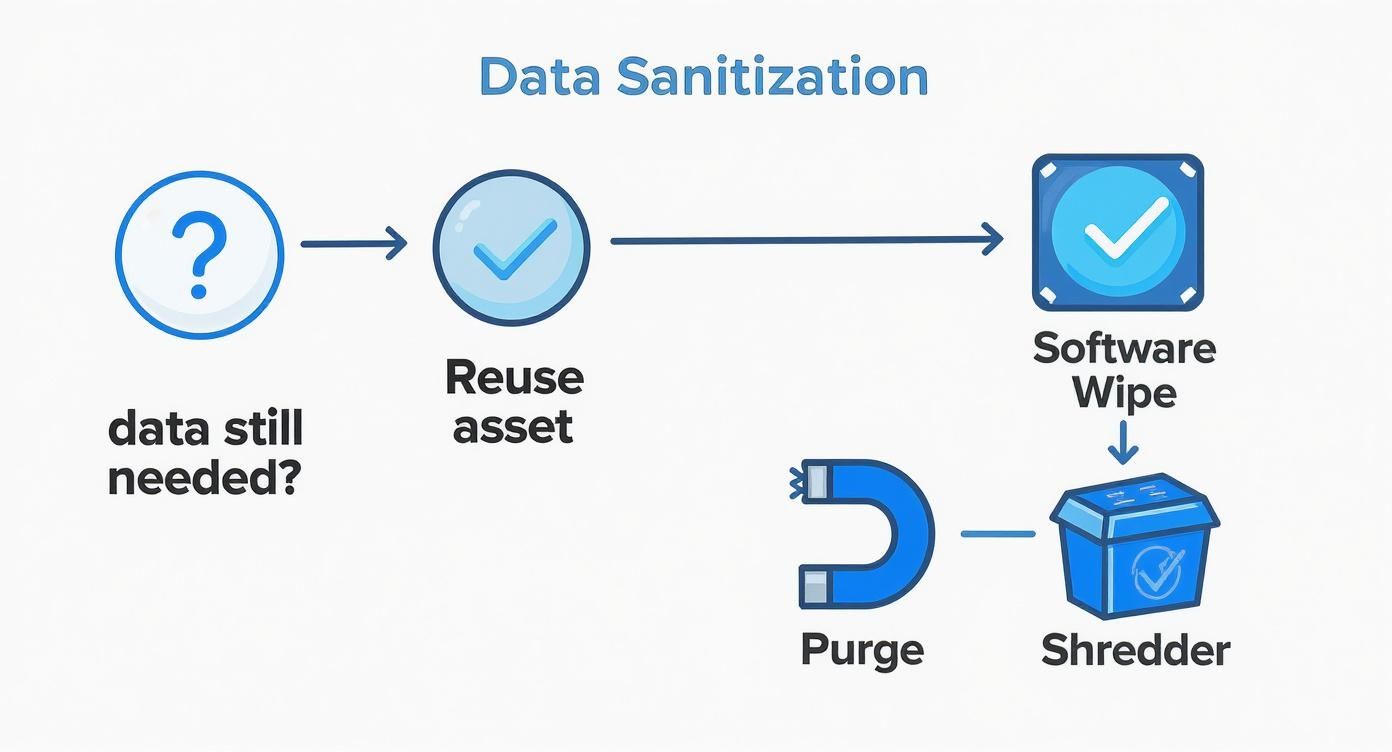
As shown, the decision to reuse an asset directs the choice toward either Clear or Purge. Destruction is the final option, reserved for assets with no reuse value or for drives that have failed the sanitization verification process.
Key Factors for Your ITAD Policy
When developing your internal policy based on NIST SP 800-88, your decision-making checklist must address several critical factors. Each one helps justify the chosen method and creates a clear, auditable trail for every retired asset.
Your evaluation should always include:
- Data Sensitivity: Is the data public, internal-use-only, confidential, or legally protected? Higher sensitivity mandates more robust methods like Purge or Destroy.
- Media Type: The storage technology dictates the effective sanitization methods. Simple overwriting (Clear) is sufficient for many traditional HDDs, but SSDs require firmware-based commands like Secure Erase (Purge) due to their architecture.
- Asset Value and Reuse: If an IT asset retains significant monetary value, a non-destructive method like Purge enables secure resale or donation. The Destroy method eliminates any possibility of value recovery.
- Chain of Custody: If a third-party vendor will handle the device, a secure, documented chain of custody is essential, especially when assets are transported off-site for wiping or shredding.
A well-defined policy eliminates guesswork and ensures procedural consistency. It empowers your IT team to make the correct decision every time, transforming a complex technical choice into a standardized, low-risk business process aligned with NIST SP 800-88 guidelines.
A structured approach is essential for maintaining compliance and data security. For a deeper look at real-world applications, you can explore various secure data destruction methods that align with the NIST framework. Partnering with a certified ITAD provider ensures these decisions are executed correctly, providing Certificates of Destruction for a complete and auditable compliance record.
Putting NIST SP 800-88 Into Practice in Your Organization
Understanding the theory behind NIST SP 800-88 is essential, but successful implementation requires translating that knowledge into a structured, operational framework. This involves creating a formal IT asset disposal (ITAD) strategy that converts the standard’s guidelines into concrete, repeatable actions for your organization. This strategy serves as your roadmap for ensuring every retired device is handled correctly and consistently.
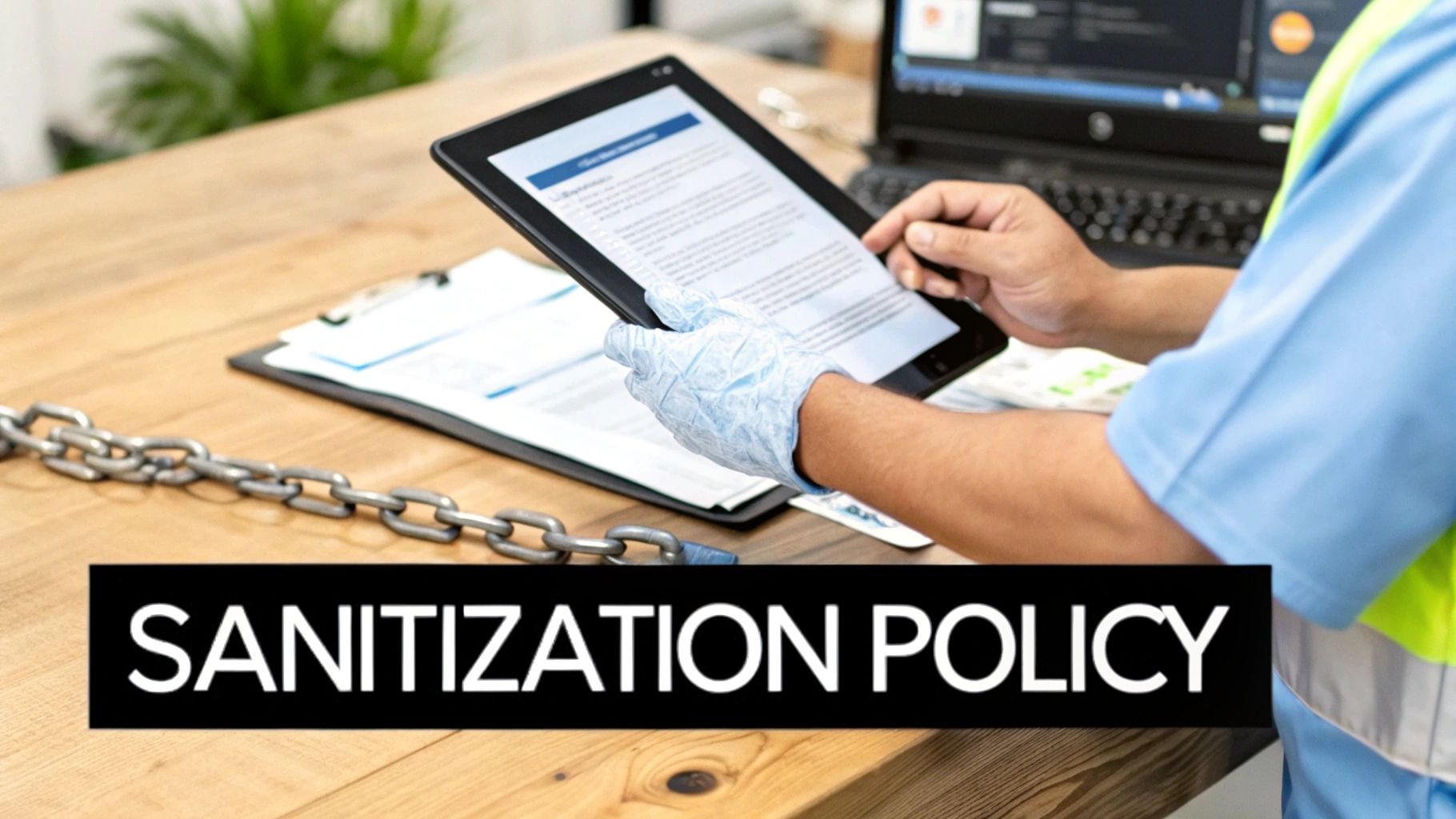
A successful rollout begins with a formal media sanitization policy. This document should be the cornerstone of your ITAD program, clearly defining procedures, assigning responsibilities, and specifying the documentation required to prove compliance. This is not about bureaucracy—it is about removing ambiguity so your team can execute with confidence.
Creating a Formal Media Sanitization Policy
Your policy is the central playbook for corporate data disposition. To be effective, it must be specific, actionable, and tailored to your company’s unique risk profile and regulatory obligations.
Essential components of a robust policy include:
- Roles and Responsibilities: Clearly define who is accountable for each stage of the ITAD process—from IT staff identifying an asset for retirement to department heads providing sign-off and the engagement of third-party vendors.
- Asset Categorization: Not all assets are equal. Implement a system to classify them based on the data they contain. A finance department server holding PII requires a stricter protocol than a conference room monitor.
- Method Selection Criteria: Document which NIST method (Clear, Purge, or Destroy) will be applied to each category of asset and data type. This decision framework should be a direct application of the principles discussed previously.
- Verification Procedures: Every sanitization attempt must be verified without exception. Your policy should specify the approved tools and methods for verification and outline the procedure for failed attempts (e.g., a second Purge attempt or immediate move to Destroy).
Maintaining a Bulletproof Chain of Custody
From the moment an asset is decommissioned, its journey must be meticulously tracked. A strong chain of custody is non-negotiable, providing an unbroken, auditable trail of who handled the asset, its location, and the actions performed on it.
This unbroken chain of custody is your defense against loss, theft, and unauthorized access. It ensures that every device is accounted for from your facility to its final disposition, whether that's resale, recycling, or destruction.
This documentation is a critical element of a comprehensive IT asset disposition plan. You can learn more about how this fits into the broader lifecycle management by exploring what IT asset disposition entails.
The Critical Role of Documentation and Certification
In the world of regulatory compliance, if it isn't documented, it didn't happen. Documentation is your ultimate proof of adherence to NIST SP 800-88. For every asset sanitized, you must obtain and retain a Certificate of Data Destruction.
This is a legally significant document that must include:
- The unique serial number of the asset.
- The specific sanitization method used (e.g., NIST 800-88 Purge).
- The date and time of the sanitization.
- The signature of the technician or authorized vendor who performed the service.
This certificate officially transfers liability and serves as your definitive record for audits and legal inquiries. Partnering with a certified ITAD vendor like Beyond Surplus bridges the gap between policy and practice. Our services align directly with NIST standards, offering certified data wiping (Clear/Purge) and on-site shredding (Destroy) to ensure flawless implementation.
For organizations requiring a comprehensive solution, working with vendors offering specialized e-waste recycling and data destruction services is key to a secure and compliant program.
The High Stakes of Compliance and Data Security

Adherence to NIST SP 800-88 is more than just good IT practice; it is a critical component of a company's legal, financial, and reputational defense. In the view of regulators and courts, this standard has become the de facto benchmark for "reasonable care" in data sanitization. Failure to meet this standard is no longer a technical oversight—it is a significant business liability.
Major data protection laws such as GDPR in Europe, HIPAA in healthcare, and CCPA in California all mandate that organizations protect sensitive information throughout its lifecycle. While these regulations may not name NIST SP 800-88 explicitly, its methods are what auditors and legal experts look for to verify a robust data security program.
The Link Between NIST and Regulatory Compliance
If a data breach occurs due to the improper disposal of a retired server or laptop, investigators will immediately scrutinize the data sanitization methods used. Following NIST guidelines provides a defensible position, proving your organization took credible, industry-recognized steps to destroy the information. Without this proof, demonstrating compliance becomes a nearly impossible task.
The influence of NIST SP 800-88 is global. The standard has been referenced in over 150 national and international data protection laws. By 2025, it is projected that over 70% of multinational corporations will have formally integrated NIST 800-88 into their data governance policies.
The Real-World Consequences of Non-Compliance
The penalties for improper data disposal are severe and extend far beyond financial fines. The consequences can create a ripple effect that impacts a company for years.
- Steep Financial Penalties: Fines for data breaches can be substantial. Under GDPR, penalties can reach up to €20 million or 4% of a company's global annual revenue, whichever is higher.
- Reputational Damage: News of a data breach can erode customer trust instantly. A company perceived as careless with personal information will face challenges retaining customers, attracting business partners, and hiring top talent.
- Legal Action and Lawsuits: In addition to regulatory fines, organizations often face costly class-action lawsuits from individuals whose data was exposed.
Consider a healthcare provider that resells retired servers without properly sanitizing the drives according to NIST Purge standards. If the new owner discovers thousands of patient records, the provider could face millions in HIPAA fines, a wave of lawsuits, and irreparable damage to its reputation.
This is not a hypothetical scenario. Real-world incidents demonstrate that data sanitization is a core pillar of corporate risk management. Adhering to NIST SP 800-88 is a key part of any robust plan; for a broader perspective on protecting digital assets, review these Cyber Security Risk Management | Essential Strategies & Tips.
Ultimately, the documentation provided by a certified ITAD partner is your evidence of compliance. A detailed Certificate of Destruction serves as your auditable record, proving you met the industry's highest standard and fulfilled your legal duty to protect sensitive data.
Answering Your Questions About NIST SP 800-88
Implementing NIST SP 800-88 often raises practical questions for business and IT leaders. Here are clear, straightforward answers to the most common inquiries from businesses working to adopt this essential data sanitization standard.
Is NIST SP 800-88 a Mandatory Requirement for All Businesses?
The short answer is no—NIST SP 800-88 is not a federal law applicable to every private company. It is, however, the universally accepted "gold standard" for data destruction.
While it is a mandatory requirement for U.S. federal agencies, its power in the private sector comes from its status as a benchmark for "due diligence." Regulations like HIPAA and GDPR require organizations to take reasonable measures to protect data, without specifying the exact methods. Following NIST 800-88 is how a business demonstrates it has met that obligation. Adherence to the standard is a company's best defense against liability and a non-negotiable best practice for preventing data breaches from retired IT assets.
What Is the Difference Between DoD 5220.22-M and NIST SP 800-88 Clear?
This is a common point of confusion. The DoD 5220.22-M standard is an obsolete data wiping method from the 1990s that required multiple overwrite passes. It was designed for the older, less dense hard drive technologies of that era.
The modern NIST SP 800-88 Clear method is based on significant advances in drive technology. It recognizes that for any hard drive manufactured after 2001, a single, verified overwrite is sufficient to render data unrecoverable with software tools. NIST is the current, more efficient, and scientifically validated standard, making the outdated multi-pass DoD method unnecessary for today's storage media.
How Does NIST SP 800-88 Address Solid-State Drives?
This is one of the most critical updates in Revision 1 of the standard. The document explicitly states that traditional overwriting (the Clear method) is often ineffective on Solid-State Drives (SSDs). This is due to SSD architecture features like wear-leveling and over-provisioning, which can leave data fragments in inaccessible areas that overwriting software cannot reach.
For SSDs, NIST SP 800-88 strongly recommends the Purge method. The primary technique for this is using the drive's built-in ATA Secure Erase command. This command instructs the drive's controller to reset all memory cells to their factory state, effectively and instantly erasing all data.
If the Secure Erase command cannot be successfully executed and verified, NIST is unequivocal: the only remaining compliant option is the Destroy method, meaning physical shredding or pulverization to guarantee complete data elimination.
How Can I Verify My ITAD Vendor Follows NIST SP 800-88?
Verification is paramount. Accepting a vendor's claim at face value is insufficient for an audit and exposes your organization to risk. You must take specific steps to ensure your IT Asset Disposition (ITAD) partner is genuinely adhering to the standard.
A vendor's processes must be transparent and their documentation auditable. True compliance is not a marketing claim; it is a verifiable, documented process that protects your organization from liability.
Here’s a checklist to verify a vendor's adherence:
- Ask for Process Details: Request a detailed breakdown of their sanitization procedures. A qualified partner should clearly explain how their services align with NIST Clear, Purge, and Destroy methods for different media types.
- Demand a Certificate of Data Destruction: This is non-negotiable. For every asset processed, your vendor must provide a serialized Certificate of Data Destruction. This document is your official, auditable proof of compliance and should list the asset's serial number, the exact sanitization method used, and the date of completion.
- Check for Industry Certifications: Look for respected, third-party audited certifications like R2 (Responsible Recycling) or e-Stewards. These certification frameworks mandate that vendors adhere to NIST SP 800-88 as a core component of their data security standards, providing an additional layer of assurance.
By asking the right questions and requiring proper documentation, you can confidently select a partner who not only understands NIST SP 800-88 but also implements it correctly, safeguarding your organization's data and reputation.
Navigating NIST compliance is a critical part of a secure IT asset disposition strategy. For businesses seeking a certified partner to manage the process, Beyond Surplus offers expert electronics recycling and secure data destruction services that align with the highest industry standards. Contact us today to ensure your IT assets are handled securely and responsibly.


