Data sanitization is the process of deliberately, permanently, and irreversibly removing or destroying the data stored on a memory device. While deleting a file or formatting a drive might seem sufficient, these methods often leave data recoverable. True data sanitization ensures that information is gone for good, rendering it completely unreadable and unable to be reconstructed, even with advanced forensic tools.
For businesses, this isn't just a technical task; it's a critical component of risk management and IT security. It's the final, definitive step in the data lifecycle that protects your company from breaches, ensures regulatory compliance, and safeguards your reputation.
Why Your Business Must Prioritize Data Sanitization
When a server, laptop, or hard drive reaches the end of its useful life, the hardware itself is of minimal concern compared to the sensitive information it contains. The real risk lies in the corporate files, customer records, financial data, and intellectual property stored within. Improper disposal of these IT assets is a leading cause of data breaches.
For any modern organization, failing to manage this final stage of the IT lifecycle isn't a minor oversight—it's a critical security failure. Data sanitization is the essential business practice that ensures your data is completely unrecoverable, protecting your organization from the devastating consequences of a breach.
Understanding the Financial and Reputational Stakes
The fallout from a data breach caused by retired IT assets is severe and immediate. Beyond the substantial regulatory fines and potential legal action, there are costs associated with notifying every affected client. The long-term damage to your company's reputation can erode customer trust for years, handing a significant advantage to your competitors.
Effective data sanitization is a core part of any responsible IT Asset Disposition (ITAD) strategy. By integrating certified data destruction into your asset retirement process, you transform a potential liability into a secure, documented, and compliant procedure. To understand how this fits into the broader lifecycle of your equipment, explore our guide on what IT asset disposition is.
The Growing Demand for Secure Data Destruction
The market reflects the urgency. The global data destruction industry was valued at approximately $10.18 billion and is expanding rapidly. This growth is driven by the exponential increase in data creation, a rise in identity theft, and stricter government regulations mandating secure data disposal. You can read more about the growth of the data destruction market on openpr.com.
Ultimately, data sanitization provides a verifiable and auditable conclusion to your data's lifecycle. It serves as documented proof that you have fulfilled your legal and ethical obligations to protect sensitive information, acting as an essential shield against the financial and reputational damage that follows a data breach.
Before we dive deeper, it's important to clarify common terms like "deleting," "erasing," and "sanitizing." While they may sound interchangeable, in the context of data security, their meanings are vastly different.
Data Deletion vs Data Erasure vs Data Sanitization
| Method | Process | Security Level | Recoverability | Business Use Case |
|---|---|---|---|---|
| Data Deletion | Removes pointers to data, marking space as available. The data still exists. | Low | High (Easily recoverable) | Freeing up space on a device you will continue to use. |
| Data Erasure | Overwrites data with random 0s and 1s, making original data harder to access. | Medium | Low (Possible with forensics) | Preparing a device for reuse within the same secure environment. |
| Data Sanitization | Makes data completely unrecoverable through overwriting, degaussing, or destruction. | High | None (Impossible) | Complying with regulations when retiring or reselling IT assets. |
Understanding these distinctions is the first step toward building a truly secure ITAD program for your business. While simple deletion is adequate for non-sensitive personal files, only full sanitization meets the stringent compliance and security standards modern businesses must adhere to.
Choosing The Right Data Sanitization Method
Knowing that you need to sanitize data is the first step; selecting the right method for your specific business needs is the critical next one. The optimal approach depends on the type of storage media, your company's security requirements, and whether the asset will be reused or destroyed.
There are three primary, industry-recognized methods for data sanitization. Each offers a different level of security and is suited for specific business scenarios. It is crucial for IT and risk managers to understand which tool is appropriate for each situation.
This simple decision tree illustrates the core choice: are you merely deleting files, or are you truly sanitizing the device for business purposes?
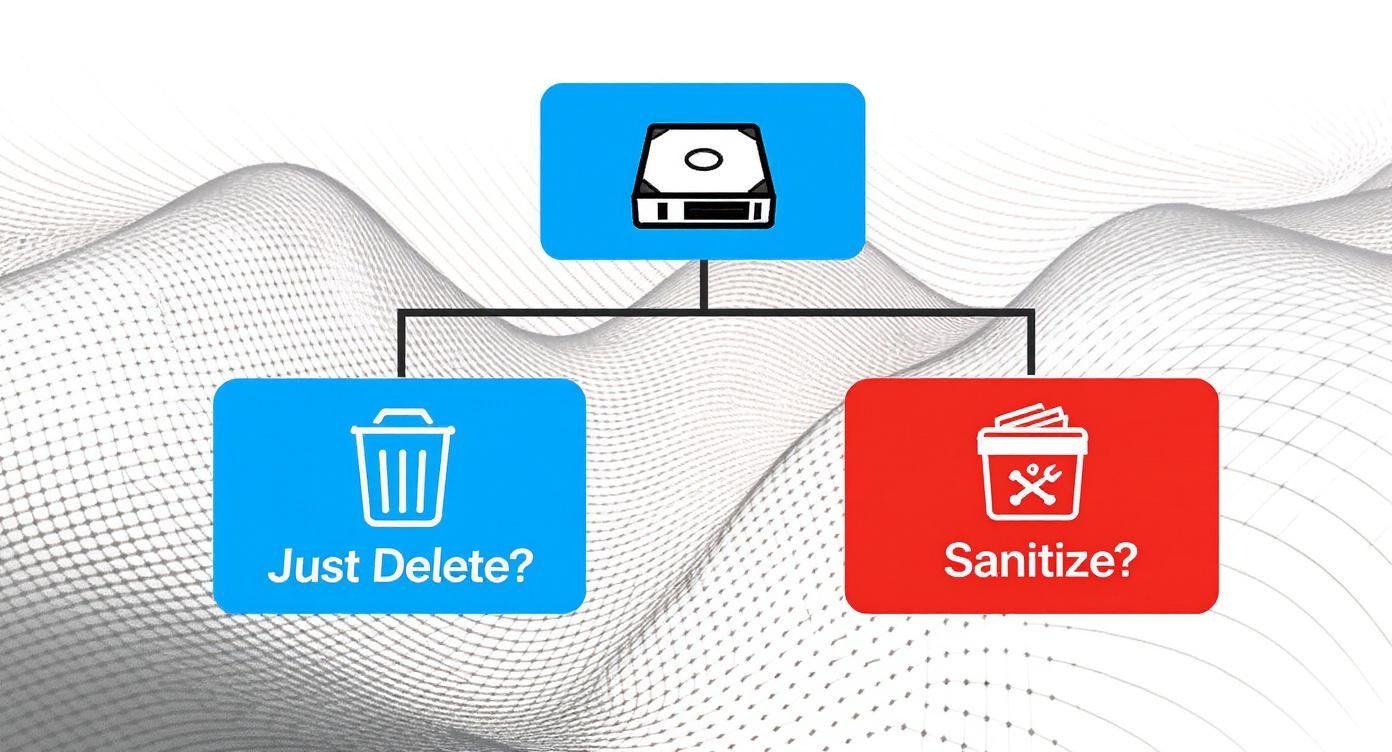
As you can see, the path you choose has significant security implications. Deleting is a superficial action; sanitization is the only process that guarantees data is permanently destroyed.
Logical Overwriting For Asset Reuse
Logical overwriting, also known as wiping or clearing, is a software-based process. Specialized tools write patterns of ones and zeros over every sector of a storage device, effectively obliterating the original data. This renders the data unrecoverable using any standard software tools.
This method is the ideal solution when your business plans to redeploy assets internally, resell them for value recovery, or return them at the end of a lease. The primary advantage is that the hardware remains fully functional. The downside is that the process can be time-consuming, especially for high-capacity drives, and it is ineffective on damaged media with unreachable sectors.
For organizations focused on maximizing the ROI of their IT investments, logical overwriting is essential. It enables the secure resale of equipment, turning a potential data risk into a revenue stream while maintaining full compliance.
This process is a fundamental part of our secure data destruction services, providing businesses with a certified and fully auditable solution for their end-of-life IT assets.
Degaussing For Magnetic Media
Degaussing is a more forceful method. It involves exposing magnetic storage media—such as traditional Hard Disk Drives (HDDs) and legacy magnetic tapes—to an extremely powerful magnetic field. This process instantly and permanently neutralizes the magnetic domains on the drive's platters where data is stored, wiping everything in seconds.
Degaussing is an incredibly fast and effective way to purge data from compatible media. However, it renders the hard drive completely inoperable, eliminating any possibility of reuse. Critically, this method is completely ineffective on Solid-State Drives (SSDs), which do not use magnetic storage.
While it's a hyper-secure solution for the right media, it's very specific. For everyday consumer devices, you need different tactics. For example, knowing how to totally wipe an iPhone is critical before selling it, as degaussing simply wouldn't apply.
Physical Destruction For Ultimate Security
When dealing with highly sensitive data, or if the storage device is obsolete, damaged, or an SSD, physical destruction is the most definitive and secure option. This involves shredding, crushing, or pulverizing the device until the storage platters or memory chips are reduced to small fragments, making data recovery physically impossible.
Physical destruction provides the highest level of security and complete peace of mind. It is the preferred method for government agencies, healthcare organizations, and financial institutions that operate with zero tolerance for risk. The clear disadvantage is that the asset is permanently destroyed, eliminating any potential for reuse or resale value.
Comparing Data Sanitization Methods
Choosing the right method requires balancing security needs, asset value, and media type. To simplify this decision for your business, here is a breakdown of how the three core methods compare.
| Method | Description | Best For | Key Advantage | Key Disadvantage |
|---|---|---|---|---|
| Logical Overwriting | Software-based process that writes over existing data. | HDDs & SSDs intended for reuse, resale, or lease return. | Preserves the hardware for value recovery. | Can be time-consuming; ineffective on damaged media. |
| Degaussing | Powerful magnetic pulse that erases magnetic storage. | HDDs and magnetic tapes requiring fast, secure erasure. | Extremely fast and highly effective for magnetic media. | Renders HDDs unusable; does not work on SSDs. |
| Physical Destruction | Shredding or pulverizing the physical storage device. | All media types, especially SSDs and damaged drives. | Highest level of security; guarantees data is unrecoverable. | Destroys the asset, eliminating any resale value. |
Each method plays a vital role in a comprehensive IT asset disposition strategy. The key is to match the technique to the specific business situation to ensure your data is protected without unnecessarily destroying asset value.
Making Sense of Key Data Sanitization Standards
Adhering to data sanitization standards is not just a technical best practice; it is a fundamental aspect of corporate governance. It protects your brand, builds client trust, and ensures legal compliance. These standards provide a clear framework to ensure that when an IT asset is retired, its data is verifiably and legally destroyed.
Without a firm grasp of these regulations, a company risks more than just fines; it gambles with brand reputation, legal challenges, and customer confidence. This is why partnering with a certified ITAD vendor is an essential investment in risk management.
The Gold Standard: NIST SP 800-88
In the United States, the most authoritative document on this subject is the National Institute of Standards and Technology (NIST) Special Publication 800-88, "Guidelines for Media Sanitization." This publication is the industry playbook and serves as the foundation for nearly all corporate and government data destruction policies.
NIST SP 800-88 defines three clear, actionable methods for sanitization:
- Clear: This method uses logical, software-based techniques to overwrite data. While a standard "read" command will not find anything, it is best suited for assets that will be reused within your organization, where the risk level is low.
- Purge: This is a more advanced method that uses physical or logical techniques to make data recovery infeasible, even with state-of-the-art laboratory tools. Degaussing a hard drive is a prime example. This method is used for more sensitive data.
- Destroy: This is the most definitive form of sanitization. It renders the storage media completely unusable and physically incapable of being repurposed through methods like shredding, pulverizing, or incineration. This is the only option for damaged media or exceptionally sensitive data.
Understanding this framework is the first step. You can explore this topic further in our ultimate guide to data destruction and its importance.
Rules of the Road for Your Industry
In addition to NIST guidelines, many industries are governed by specific regulations that mandate how retired equipment must be handled. These rules carry severe penalties, making proper data sanitization a mission-critical compliance task.
The North American market for data sanitization is substantial, holding about a 38% share of the global market. This is largely driven by stringent data privacy laws like HIPAA and CCPA, which compel businesses to invest in secure destruction methods aligned with federal standards like NIST 800-88. You can find more insights on the North American data destruction market trends on researchnester.com.
Adhering to these regulations is non-negotiable. A failure to properly sanitize a single device can trigger a full-scale compliance audit, resulting in fines that can reach millions of dollars, alongside mandatory public disclosure of the breach.
Key industry-specific regulations include:
- HIPAA (Health Insurance Portability and Accountability Act): For healthcare entities, all electronic Protected Health Information (ePHI) must be rendered unreadable, undecipherable, and impossible to reconstruct upon device disposal.
- FACTA (Fair and Accurate Credit Transactions Act): This applies to any business handling consumer credit information, requiring "reasonable measures" to protect against unauthorized access during disposal, as defined by the FTC Disposal Rule.
- SOX (Sarbanes-Oxley Act): Publicly traded companies must protect the integrity of financial records, a responsibility that extends to the secure disposal of those electronic records to prevent fraud.
- GLBA (Gramm-Leach-Bliley Act): Financial institutions are required to have a security plan that protects the confidentiality of consumer information, including during the disposal process.
Navigating these complex requirements is about turning them into real-world security protocols. A certified ITAD partner brings the expertise to ensure your data sanitization practices meet and exceed every standard applicable to your business.
Verification and Certification: If You Can't Prove It, It Didn't Happen
In the realm of business data security, the task is incomplete until the documentation is finalized. Performing the data sanitization is only half the process—the other half is creating an auditable, legally defensible record that proves it was done correctly. This final step is what distinguishes a professional ITAD partner from a simple electronics recycler.
This is where a Certificate of Data Destruction (CoDD) becomes one of the most critical documents in your compliance framework. It is more than a receipt; it is your official proof that your organization has met its legal and ethical duties to protect sensitive data, effectively transferring that liability away from your business.
What Makes a Certificate Legally Sound
A vague or incomplete certificate is worthless in a compliance audit. To be legally defensible, a CoDD must contain specific, detailed information that creates a clear and unbroken chain of evidence. This documentation serves as your primary defense if your data handling practices are ever questioned.
A compliant certificate must include:
- Unique Serial Numbers: Every asset—hard drive, server, or laptop—must be individually tracked by its unique serial number.
- Method of Sanitization: The document must specify how the data was destroyed (e.g., overwriting, degaussing, or physical shredding) and reference the standard used, such as NIST SP 800-88 Purge.
- Date and Location of Destruction: This pinpoints precisely when and where the sanitization took place.
- Chain of Custody Details: This includes the names and signatures of the technicians who handled and processed the assets.
- Statement of Transfer of Liability: A formal declaration that the ITAD vendor assumes full responsibility for the assets upon taking possession.
This level of detail is non-negotiable and provides the necessary proof of due diligence. Learn more about the critical components of a certificate of destruction and its importance for your business.
Maintaining an Unbroken Chain of Custody
The principle of a secure chain of custody is the backbone of the professional IT asset disposition process. It is the chronological, documented record that tracks your equipment from the moment it leaves your facility to its final destruction. Every transfer and handling event is logged.
An unbroken chain of custody is the narrative that proves your assets were secure at every single point. Any gap in this documentation creates a potential liability, leaving your organization exposed to claims of improper data handling.
This meticulous tracking ensures there are no opportunities for assets to be lost, stolen, or accessed by unauthorized individuals. It is the operational foundation that makes the final Certificate of Data Destruction a trustworthy and legally binding document. Professional ITAD services like Beyond Surplus deliver this transparent, auditable trail, providing your organization with complete peace of mind and bulletproof compliance documentation.
Choosing Between On-Site and Off-Site Sanitization
A key decision in your IT asset disposition strategy is determining where the data sanitization will occur. Should every hard drive be wiped or shredded before it leaves your premises? Or is it secure to transport them to a specialized, off-site facility?
There is no single correct answer. The best choice depends on your organization's specific security policies, compliance requirements, and operational constraints. It involves weighing your risk tolerance against your budget and the types of assets being retired.
The Case for On-Site Data Sanitization
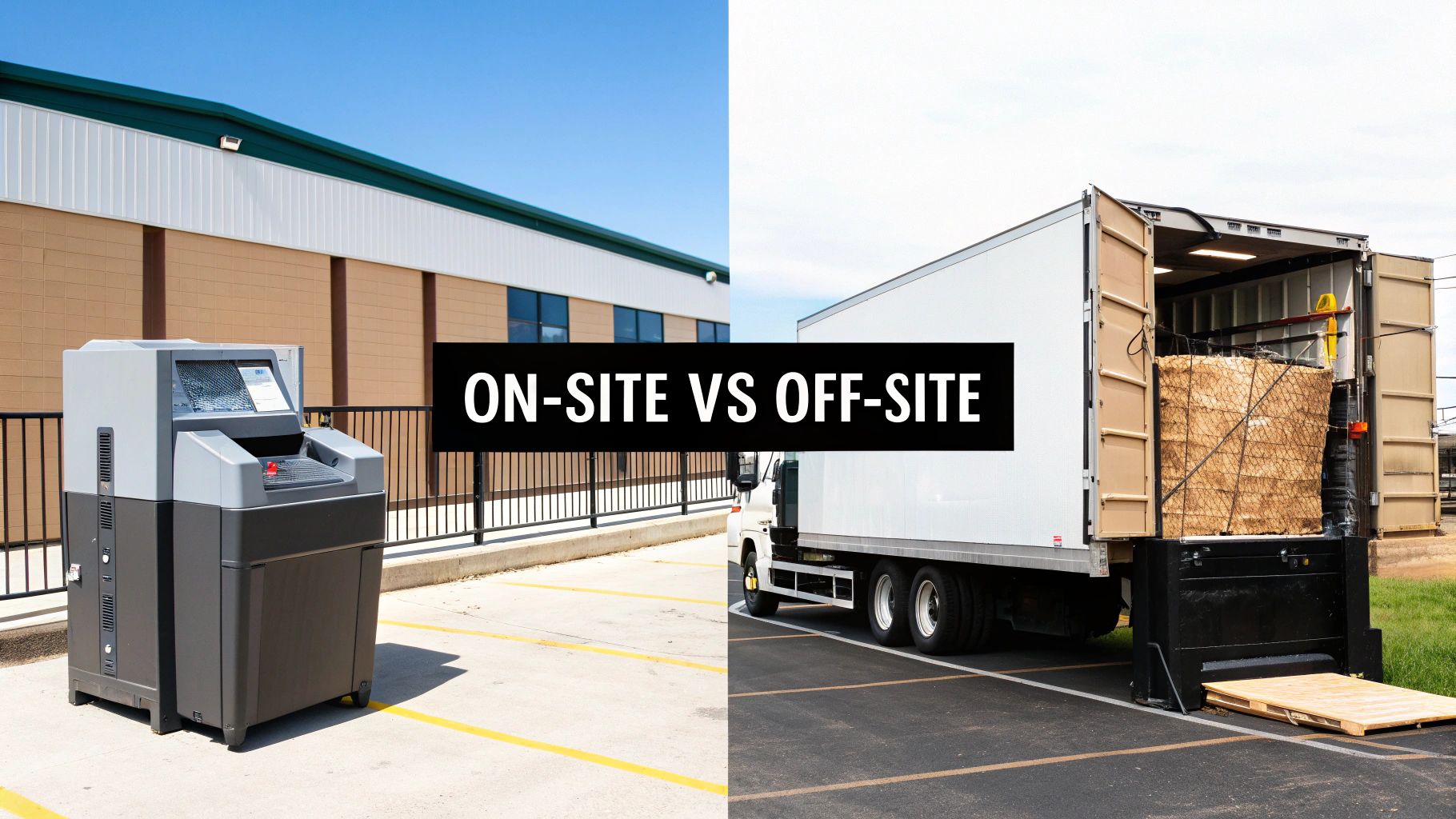
For businesses in highly regulated sectors such as finance, healthcare, or government, on-site data sanitization is often the preferred option. Its primary benefit is complete control and direct oversight. Your security team can witness the entire process, from inventory verification to final shredding.
This approach ensures an unbroken chain of custody with zero transportation risk, eliminating the possibility of data exposure en route. It provides immediate proof that your security protocols were followed to the letter, which is critical when dealing with proprietary intellectual property or classified data.
To meet these stringent security needs, Beyond Surplus offers expert on-site shredding and data destruction services, bringing certified sanitization directly to your business location.
Here's why it's a top choice for high-security environments:
- Maximum Security: Data is destroyed before it ever leaves the security of your facility.
- Direct Witnessing: Your team can verify the entire destruction process firsthand.
- Immediate Compliance: It satisfies the most stringent regulatory requirements for a secure chain of custody.
The Case for Off-Site Data Sanitization
While on-site services offer unparalleled security, off-site data sanitization provides significant advantages in efficiency, scale, and cost-effectiveness. For large-scale IT refresh projects or data center decommissioning, transporting assets to a secure, specialized facility is often the most practical solution.
A certified ITAD partner uses secure, GPS-tracked vehicles and locked containers to transport your assets to a facility designed for high-volume processing. This is not only more budget-friendly but also allows for detailed sorting and potential value recovery from reusable components—a benefit lost with on-site shredding.
The Data Sanitization as a Service market, now valued around $1.42 billion, demonstrates how many organizations trust expert partners to handle this process securely. This trend is driven by the need for certified professionals who can manage vast quantities of data in compliance with standards like NIST 800-88.
Here’s where off-site services excel:
- Cost-Effectiveness: It is typically a more affordable option, especially for large volumes of equipment.
- Scalability: It is better equipped to handle hundreds or thousands of assets simultaneously.
- Operational Efficiency: It frees up your internal team and clears valuable space at your facility.
The choice between on-site and off-site sanitization is fundamentally a risk management decision. The more sensitive the data, the stronger the argument for on-site destruction, where you maintain absolute control from start to finish.
Ultimately, working with a trusted ITAD partner helps you determine the right approach. They can help you implement a hybrid model that provides the perfect balance of security and efficiency for your business.
Building Your Company's Data Sanitization Policy
Understanding the principles of data sanitization is important, but translating that knowledge into consistent, enforceable action requires a formal, documented policy. A successful program is not based on good intentions; it is built on a clear set of rules that govern the entire lifecycle of your IT assets.
Without a policy, you leave critical security decisions to chance, relying on individual employees to make the right choice when an asset is retired. A robust policy serves as your organization’s blueprint for secure IT asset disposition, eliminating guesswork and ensuring everyone understands their role in protecting company data.
Core Components of an Effective Policy
An effective data sanitization policy must be both detailed and actionable. It needs to clearly define procedures, assign responsibilities, and set firm expectations for every stage of the asset retirement process.
Your policy should specify:
- Asset Inventory and Tracking: A mandatory process for logging all data-bearing assets by serial number from acquisition to disposal.
- Data Classification: A system to categorize data by sensitivity (e.g., Public, Internal, Confidential). This classification determines the required level of sanitization.
- Defined Sanitization Methods: Clear guidelines specifying which techniques (e.g., NIST 800-88 Purge or Destroy) are required for each data classification and media type.
- Roles and Responsibilities: Explicitly state who is responsible for initiating, executing, and verifying the sanitization process.
- Third-Party Vendor Requirements: A non-negotiable checklist of certifications (like R2v3 or e-Stewards) and security protocols that any ITAD partner must meet.
Integrating Your Policy into a Larger Security Framework
A strong data sanitization policy should not exist in isolation; it must be an integral part of your company's overall information security framework. As you develop your policy, consider how it aligns with the broader goals of building an Information Security Management System. This strategic approach ensures your end-of-life data protection is consistent with your comprehensive security posture.
The greatest risk is a policy that exists only on paper. A certified ITAD partner like Beyond Surplus moves your policy from a document to a consistently executed, fully audited security protocol, providing the verification needed to prove compliance.
Partnering with an expert is the most effective way to ensure your policy is implemented correctly every time. A certified ITAD vendor provides the specialized equipment, certified processes, and auditable documentation needed to transform your policy from a document into a reliable and legally defensible security practice.
Common Questions About Data Sanitization
Even with a solid understanding of the methods and standards, practical questions often arise. Here are answers to the most common inquiries from business and IT managers to help you make secure decisions for your retired IT assets.
Is Formatting a Hard Drive Good Enough?
No. This is one of the most common and dangerous misconceptions in IT asset disposal. Formatting a hard drive only removes the file system's pointers to the data, making it invisible to the operating system. The actual data remains on the drive and can be easily recovered with widely available software tools.
True data sanitization, as defined by NIST SP 800-88, does not hide data—it destroys it. It either overwrites every bit with random characters or physically demolishes the storage media, making recovery impossible. Formatting offers a false sense of security; proper sanitization provides verifiable proof of destruction.
How Is Sanitizing an SSD Different From an HDD?
Sanitizing a Solid-State Drive (SSD) is fundamentally different from sanitizing a traditional Hard Disk Drive (HDD). HDDs store data on magnetic platters, which can be sanitized through overwriting or degaussing.
SSDs use flash memory and complex wear-leveling algorithms that distribute data across the drive to extend its life. Consequently, standard overwriting software can miss data stored in over-provisioned areas or bad blocks that the drive has isolated.
For SSDs, there are two reliable sanitization options for businesses:
- Cryptographic Erasure: This method leverages the drive's built-in encryption to instantly render all data unreadable by destroying the encryption key. It is fast and effective for modern SSDs that support this feature.
- Physical Destruction: Shredding the drive into small fragments is the only foolproof method to guarantee data is destroyed, especially for older SSDs or those without reliable cryptographic erase capabilities.
What Is a Certificate of Data Destruction and Why Do I Need It?
A Certificate of Data Destruction (CoDD) is your official, legally defensible document proving that your data was permanently destroyed in accordance with industry standards. For any business focused on compliance and risk management, this document is essential.
It serves as your audit trail, demonstrating due diligence in protecting sensitive information and formally transferring the liability for that destruction to your certified ITAD partner. If you face an audit or legal inquiry, the certificate is your evidence of proper disposal. Without it, you have no verifiable proof.
Can We Sanitize Data In-House?
While technically possible, in-house data sanitization is fraught with risk and hidden costs. It requires a significant investment in specialized, validated equipment and software, substantial labor costs, and a rigorous internal audit process to ensure no device is missed.
The biggest problems with DIY sanitization are the lack of third-party verification and the fact that your company retains 100% of the liability if a single drive is handled improperly. Partnering with a certified specialist provides auditable proof and, most importantly, transfers that risk away from your business.
For a certified, fully managed approach to data sanitization that guarantees compliance and protects your business, trust the experts. Contact Beyond Surplus today to learn more about our secure data destruction services.