

When a data center shutdown date is already on the calendar, IT departments often focus on production cutover, lease obligations, and uptime risk. Then the retired telecom stack shows up as a second project hiding inside the first one. Routers, switches, optics, racks, copper and fiber cabling, UPS units, PDUs, storage shelves, drives, and cooling components all need a disposition path that protects data, preserves value, and leaves an audit trail someone can defend later.
That's where data center telecom equipment recycling usually goes wrong. Teams treat it like bulk removal. It isn't. A proper decommissioning project is a controlled asset-transfer process with security, logistics, environmental handling, and financial recovery all tied together. If one part fails, the rest gets expensive fast.
The strongest projects start early, separate reuse from scrap before equipment leaves the floor, and maintain documentation from rack position to final certificate. That applies to obvious assets like servers and firewalls, but also to the infrastructure many operators overlook until the last week.
Phase One The Strategic Decommissioning Plan and Asset Inventory
Late planning destroys options. By the time a crew is unbolting hardware without a tested manifest, the organization has already lost part of the resale opportunity and increased the odds of documentation gaps.
Industry ITAD guidance says recovery-rate success depends on planning 6 to 12 months before retirement, and benchmarks suggest recovery potential is often 80 to 90% in the first year when assets are captured early and documented with serial numbers, according to Reconext's guidance on data center IT asset recycling.

Build the project before you touch the equipment
A decommissioning plan needs more than an equipment list. It should define scope, site constraints, cutover dependencies, security ownership, loading access, insurance requirements, packaging rules, and the exact point where liability transfers from your team to the downstream provider.
Use a written runbook that includes:
- Site scope: Every room, cage, MDF, IDF, storage area, and staging zone involved.
- Asset classes: Servers, switches, routers, optics, appliances, UPS systems, batteries, cabling, racks, PDUs, CRAC-related components, and spare parts.
- Roles: Who approves sanitization, who releases gear, who signs manifests, and who receives certificates.
- Project gates: Cutover complete, production validation complete, asset release approved, removal window open.
- Disposition path: Reuse, resale, refurbishment, parts harvest, or material recycling.
For complex shutdowns, I want the inventory effort to start while systems are still live. That gives the operations team time to reconcile what the CMDB says against what's bolted into racks and sitting on shelves.
Operational rule: If the first complete asset manifest appears after de-installation starts, the project is already behind.
Triage on paper first
Not every retired asset belongs in the shred bin or scrap gaylord. The first triage should happen before anyone books trucks. Start with three buckets.
Resale or redeployment candidates
Recent-generation servers, enterprise switches, branded optics, storage shelves, and network appliances usually deserve testing and sanitization before recycling is considered.Refurbishment or parts recovery candidates
Gear with partial defects, incomplete rails, cosmetic wear, or missing transceivers may still have secondary-market value through repair or component harvesting.Recycling-only assets
Damaged boards, obsolete cabling with no reuse path, broken rack accessories, mixed metal, batteries, and heavily worn infrastructure should move directly into compliant recycling streams.
The manifest is the control point
A real manifest isn't “40 servers and some network gear.” It should include serial number, asset tag, make, model, configuration, media presence, condition, rack location, and intended disposition. If an item doesn't have a trackable record, it becomes a chain-of-custody problem later.
This is also the point where many teams decide whether they need a specialized de-installation partner. A provider handling a full data center decommissioning process should be able to work from your manifest, add receiving verification, and return item-level documentation after processing.
Don't forget mixed infrastructure
The highest-risk omissions are rarely the headline assets. They're the supporting components that get stripped out quickly at the end.
Include these in the opening inventory pass:
- Cabling: Copper trunks, patch panels, fiber jumpers, ladder rack drops, and underfloor runs.
- Power gear: UPS modules, batteries, PDUs, whips, and related distribution hardware.
- Physical infrastructure: Cabinets, containment parts, blanking panels, rack PDUs, rails, and mounts.
- Cooling-related assets: Removable control boards, sensors, and electronic subassemblies tied to cooling equipment.
Teams that inventory only servers and storage usually end up with loose material, unclear ownership, and weaker recovery results.
Executing Secure Data Sanitization and Destruction
The biggest mistake in telecom and data center disposition is assuming shredding is the only safe answer. It isn't. In many environments, standards-based sanitization meets security requirements and preserves resale value that physical destruction would erase.
Industry guidance also stresses traceability. The best practice is complete documentation and certificates for 100% of data-bearing assets, and that matters since only 22.3% of global e-waste was formally collected and recycled in 2022, as discussed by Data Center Knowledge in its analysis of the e-waste risk facing data centers.
Choose the method based on media and outcome
Security teams should choose sanitization by device type, policy requirement, and intended disposition. If the hardware has reuse value, start with the least destructive method that still satisfies your control standard.
| Method | Best For | Security Level | Allows Resale? | Compliance |
|---|---|---|---|---|
| Standards-based wiping | Reusable drives and systems that remain functional | High when validated and documented | Yes | Appropriate when policy allows sanitization with auditable records |
| Cryptographic erase | Self-encrypting media and devices managed under encryption controls | High when keys are properly destroyed and recorded | Yes | Useful where encryption-based sanitization is accepted |
| Degaussing | Magnetic media that won't be reused | High for supported media types | No, in most cases | Common where reuse is not required and magnetic media is present |
| Physical destruction | Failed media, damaged devices, or assets restricted from resale | Highest practical final-state assurance | No | Appropriate when policy or asset condition requires destruction |
A policy that sends every drive to shredding often satisfies security, but it also collapses value recovery for otherwise marketable equipment. That trade-off should be deliberate, not automatic.
Standards-based wiping and cryptographic erase
For live enterprise programs, these are often the first-choice methods. Standards-based wiping, including workflows aligned with NIST 800-88, keeps hardware intact and can support reuse, redeployment, donation, or resale when verification logs are complete.
Cryptographic erase works well when the device and management controls support it. Destroy the encryption keys, document the action, and keep the device eligible for downstream value recovery.
For teams reviewing procedures, NIST SP 800-88 data sanitization guidance is often the baseline reference used in ITAD programs and internal security reviews.
Equipment only holds resale value if the sanitization record is strong enough for audit and strong enough for the next owner.
When degaussing or shredding makes sense
Some assets should never leave intact. Failed drives, unsupported media, damaged units that can't be verified, and devices governed by stricter destruction mandates belong in a destruction workflow. That can be on-site or off-site, but the method needs to match the media type.
Physical destruction should also be selective. Destroy the data-bearing component, not necessarily the entire server, chassis, or appliance. I've seen organizations scrap complete units when a controlled drive pull would have preserved the rest of the asset for refurbishment.
Serialized evidence matters more than slogans
A compliant sanitization process produces records someone can audit months later. At minimum, keep:
- Device identity: Serial number, asset tag, make, model, and media type.
- Method used: Wipe, cryptographic erase, degauss, or physical destruction.
- Execution details: Date, operator, system used, and exception notes.
- Proof package: Certificates, logs, manifests, and any witness records for on-site work.
If a provider says “everything was destroyed” but can't tie that claim to item-level records, the client is left carrying the risk.
Separate data-bearing from non-data-bearing assets early
This sounds basic, but it controls the entire floor process. Pull drives and removable media first where policy allows. Tag data-bearing devices clearly. Stage non-data-bearing equipment separately so removal crews don't mix audited assets with bulk infrastructure.
That one discipline prevents rushed calls at the loading dock and makes it far easier to reconcile final certificates against the original manifest.
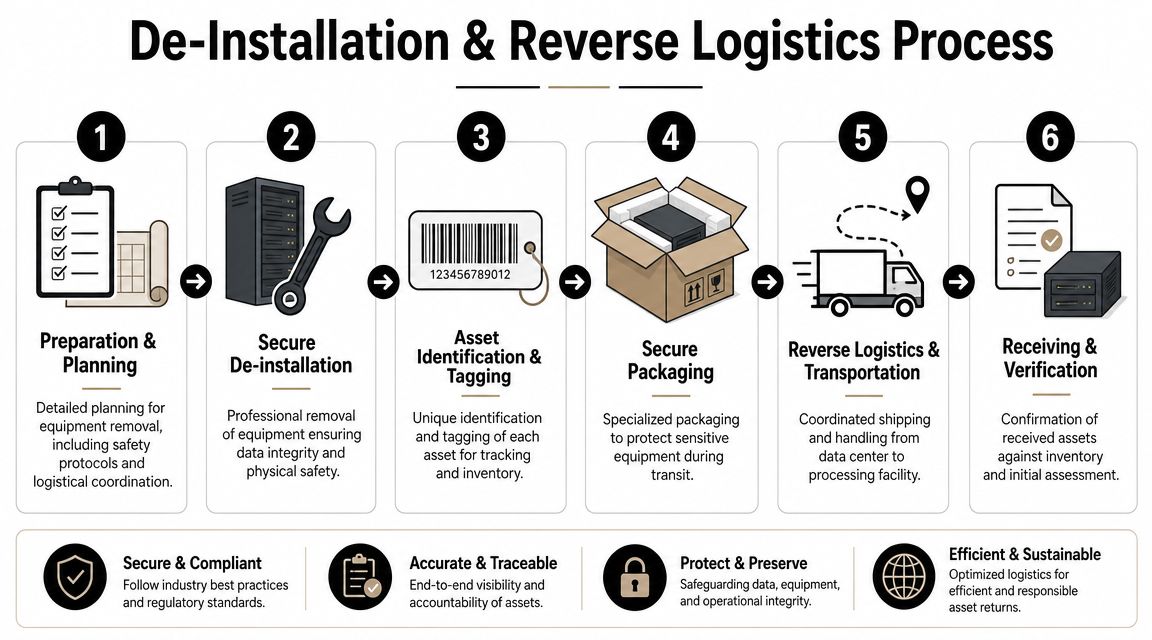
Managing De-Installation and Reverse Logistics
De-installation is where planning turns physical. This phase fails when teams confuse “disconnecting equipment” with controlled removal. The floor crew needs sequence, packaging standards, staging zones, and a custody process that survives handoffs.
Control the floor before the first rack is opened
Start with a site walk. Confirm access paths, freight elevator rules, dock scheduling, after-hours windows, badging, pallet staging space, and whether batteries or hazardous components need separate containment. Then freeze the removal sequence.
A typical sequence looks like this:
- Release approval: Operations confirms gear is out of production.
- Device verification: Team checks asset tags and serials against the manifest.
- Media handling: Data-bearing items follow the approved sanitization route.
- Physical removal: Technicians de-rack, disconnect, and protect equipment.
- Staging and pack-out: Assets move into labeled pallets, cases, or carts by disposition path.
- Load and transfer: Driver signs against the outbound manifest before departure.
Chain of custody has to survive movement
A clean audit trail doesn't stop at the server room door. Every transfer point matters. Rack to cart. Cart to pallet. Pallet to truck. Truck to receiving dock. Receiving to processing.
That's why reverse logistics needs serialized packing lists and signed manifests. If the project just uses handwritten pallet notes and bulk counts, reconciliation gets weak fast. For organizations outsourcing removals, IT asset removal services should include documented pickup, transport coordination, and receiving verification rather than simple hauling.
Field note: The loading dock is where undocumented assets disappear into “miscellaneous equipment.” Don't let that label exist.
Non-obvious assets create the messiest closeouts
The easy part is removing obvious compute gear. The harder part is mixed infrastructure that accumulates across years of adds, moves, and changes.
Handle these deliberately:
- Cabling: Pull copper and fiber by zone, not by random cut-and-drop. Mixed cable piles slow downstream sorting and destroy traceability.
- Racks and accessories: Keep doors, rails, shelves, and blanking panels grouped to preserve reuse potential.
- Power systems: Segregate UPS batteries and battery-bearing components from general electronics immediately.
- Cooling-related electronics: Remove boards, controllers, and sensors with labels intact where practical.
Receiving closes the loop
The project isn't complete when the truck leaves. It's complete when the processor confirms what arrived, notes exceptions, and reconciles intake against your outbound manifest.
That receiving report should identify shortages, overages, damaged items, and any serial mismatches while the shipment is still fresh enough to investigate. Without that step, custody looks clean on paper but breaks in practice.
Maximizing Value Recovery Through Buyback and Resale
Most organizations still budget decommissioning as a cost center. That mindset leaves money on the floor. Functional telecom and data center hardware should be evaluated as inventory first and scrap second.
The market signal is clear. The global electronics recycling market for data centers was estimated at $5.4 billion in 2024, with servers accounting for 42% of revenue, according to Market Intelo's data center electronics recycling market report. That doesn't mean every retired asset is valuable. It means value recovery is too important to leave out of the process.

Reuse beats recycling when the asset still works
Material recycling has a place. But for working switches, routers, servers, branded optics, storage arrays, and rack accessories in usable condition, refurbishment and resale usually produce a better business result than immediate shredding or smelting.
That decision depends on triage quality. If assets are removed carefully, sanitized properly, and kept complete with rails, bezels, power supplies, and transceivers, the remarketing path stays open. If crews mix models, lose accessories, or damage ports during extraction, the same gear can fall from reusable inventory into scrap value quickly.
What buyers actually look at
Secondary-market pricing isn't driven by a single factor. Buyers and ITAD remarketing teams usually review a mix of condition, generation, configuration, and completeness.
The equipment most likely to justify remarketing review includes:
- Enterprise servers: Especially units with current-enough processors, memory, and intact drive caddies.
- Network switches and routers: Managed gear from recognized enterprise lines tends to hold value longer than generic edge hardware.
- Optics and modules: Branded transceivers, line cards, and network modules can retain standalone demand.
- Storage systems: Shelves, controllers, and high-capacity enclosures may have reuse appeal if configuration is documented.
- Rack infrastructure: Cabinets, intelligent PDUs, and related accessories can sometimes move through reuse channels when condition is solid.
Build the buyback process into the project
A workable buyback flow is straightforward when it starts early:
Identify candidates during inventory
Mark likely remarketing assets before de-installation.Preserve value during removal
Keep kits complete. Protect faceplates, rails, and connectors.Sanitize to the right standard
Use a method that meets policy without destroying resale potential unnecessarily.Test and grade Functional testing, cosmetic grading, and configuration checks determine the actual outlet.
Settle with clear reporting
Credits, purchase terms, and exceptions should be traceable back to specific assets or lots.
One option in this category is a structured telecom equipment buyback program, where retired network and data center assets are assessed for resale value before being routed to recycling-only streams.
Scrap is the last value state, not the default one.
Don't let recycling language hide a resale decision
I see this often in procurement and facilities conversations. Everything leaving the site gets called “recycling,” even when half the shipment should have been remarketed. That language problem turns into a process problem. If the internal team assumes all disposition paths are equivalent, nobody protects the assets that matter.
A disciplined program separates these outcomes clearly: redeploy what still fits internal needs, resell what the market wants, harvest parts where practical, and recycle what no longer has a viable second life.
Ensuring Compliance with Certificates and Reporting
If the paperwork is weak, the project is weak. Data center telecom equipment recycling isn't finished when equipment is processed. It's finished when you have defensible records showing what left the site, how it was handled, and where liability transferred.

The two certificates that matter most
For most enterprise decommissioning projects, the key closeout documents are the Certificate of Data Destruction and the Certificate of Recycling. They serve different purposes, and both need enough detail to survive an audit.
A solid Certificate of Data Destruction should include:
- Asset identification: Itemized serial numbers or another defensible item-level reference.
- Method: Wipe, cryptographic erase, degauss, shred, crush, or other approved process.
- Date and location: When and where destruction or sanitization occurred.
- Authorized party: The certified provider or responsible operator who executed the work.
A Certificate of Recycling should document the downstream disposition of non-reusable materials and confirm that the retired equipment entered a compliant recycling stream rather than uncontrolled disposal.
The audit trail needs supporting records
Certificates aren't enough by themselves. They should be backed by the project file.
Keep these records together:
- Outbound asset manifest
- Pickup and transport documents
- Receiving reconciliation
- Exception reports
- Weight or processing records where applicable
- Final certificates
If an auditor, legal team, customer, or regulator asks you to prove what happened to a specific firewall, drive, or switch, you should be able to trace it without rebuilding the story from email threads.
Review the certificates before you file them
Too many teams accept generic one-page letters that say a vendor “recycled the material responsibly.” That isn't useful if there's no itemization, no method listed, and no tie back to the original shipment.
A strong template for a certificate of destruction document should show the level of specificity you need. If the final paperwork doesn't identify the assets clearly enough for your internal controls, ask for corrected documentation before closing the project.
Compliance records aren't administrative leftovers. They are the evidence that the disposition process happened as approved.
Mixed-asset projects need mixed reporting
One reason telecom-heavy data center shutdowns create confusion is that the shipment may include reusable servers, shredded drives, recyclable cabling, batteries requiring special handling, and racks going through a separate outlet. Expect more than one report type.
That's normal. What matters is that the records fit together and allow you to reconcile the whole project from release to final disposition.
A Checklist for Selecting Your ITAD Vendor
A scrap hauler removes material. An ITAD partner manages risk. Those are different services, even when the truck looks the same at pickup.
That distinction matters because the formal global recovery rate remains low. The Global E-waste Monitor 2024 reports that only 22.3% of e-waste was documented as properly collected and recycled in 2022, with a projected decline to 20% by 2030 if current trends continue, according to the Global E-waste Monitor 2024. If your vendor cannot explain downstream controls, your equipment might vanish into that problem.
What to verify before award
Use a hard checklist. If a provider resists basic diligence, that tells you enough.
- Certifications and scope: Ask which certifications they hold and which locations or subcontractors are covered by them.
- Data handling controls: Confirm whether they support on-site services, standards-based wiping, physical destruction, and item-level reporting.
- Chain of custody: Require manifests, signed transfer records, and receiving reconciliation.
- Downstream transparency: Ask where commodities, batteries, cable, and mixed electronics go after primary processing.
- Insurance coverage: Verify general liability, workers' compensation, and data-breach-related coverage where relevant.
- Mixed infrastructure capability: Make sure they can handle more than servers. Racks, cabling, UPS systems, and related electronics shouldn't become an afterthought.
Questions that separate operators from marketers
Ask direct questions in plain language:
- What happens to a failed drive that can't be wiped?
- How do you document custody from pickup through processing?
- Can you return item-level destruction records?
- How do you handle batteries and cable separate from general electronic scrap?
- What documentation do you provide at receiving, at processing, and at closeout?
A qualified vendor will answer clearly. A weak one usually responds with broad sustainability language and very little process detail.
Price should be reviewed last
Cheap pickup can become expensive disposition. If the provider underbids by stripping out reporting, secure handling, testing, or downstream controls, you haven't saved money. You've moved cost into audit exposure, missed buyback value, and future cleanup work.
The right vendor is the one whose operating model matches your risk profile and asset mix. That is especially true for multi-site operators, regulated organizations, and any decommissioning event with heavy telecom infrastructure.
Common Data Center Recycling Pitfalls to Avoid
The most expensive mistakes are usually procedural, not technical. They happen when a team assumes end-of-life work can be improvised.
The repeat offenders
Waiting until the shutdown week
Late starts compress sanitization, inventory cleanup, and resale review into a rushed removal window.Treating all assets as scrap
That destroys recovery on hardware that could have been redeployed, refurbished, or sold.Ignoring non-data assets
Cabling, PDUs, racks, batteries, and cooling-related electronics often become undocumented leftovers.Breaking chain of custody during movement
Assets get mislabeled, mixed, or lost when floor handling and transport records don't match.Accepting vague certificates
Generic letters don't defend your team in an audit or customer review.Choosing a vendor on haul-away price alone
Low-cost removal without secure processing and reporting usually shifts risk back to the client.
The project usually fails long before the recycler touches the equipment. It fails when the operator skips controls at inventory, sanitization, or handoff.
A disciplined data center telecom equipment recycling program is built the same way a strong production environment is built. Clear ownership. Verified records. Controlled change. No blind spots in the handoffs.
When you need a documented path for decommissioning servers, network gear, cabling, racks, storage, and data-bearing devices, contact Beyond Surplus for certified electronics recycling and secure IT asset disposal.


