

You're probably sorting through school options, commute maps, and home listings all at once, while trying to keep the rest of family life normal. That pressure is real. The wrong move in Atlanta isn't usually the obvious one, it's choosing a house that looks right on paper and then punishes you every weekday morning.
Atlanta Relocation Guide for Families starts with a simple rule, buy for the daily routine, not for the weekend tour. Atlanta is a large, growing metro, with the Atlanta Regional Commission saying the 11-county region added about 64,400 residents from April 2024 to April 2025, and projecting about 1.8 million more residents by 2050. That kind of growth matters because it keeps pressure on housing, schools, roads, and services, which is exactly what families feel after the moving truck leaves. For broader city context, Atlanta is already a major U.S. market, not a small regional town, with a 2020 census population of 498,715 and the metro at about 6.3 million in 2020, as summarized in the Atlanta city guide from Extra Space Storage's Atlanta overview (city guide overview).
Building Your 90-Day Relocation Roadmap
A family move gets messy fast when everyone starts looking at houses before the priorities are clear. One parent is focused on schools, another on commute time, and somebody else is worried about whether the garage will fit everything. That's how people end up compromising in the wrong place and paying for it every day after the move.
Start with the non-negotiables
Give yourself a 60 to 90 day planning horizon and define three filters before you tour anything, housing, school, and commute. Use those as the first pass, because if a property misses any one of them, it's not a serious contender. A practical Atlanta relocation workflow is to shortlist 3 to 5 neighborhoods, visit them at different times of day, secure housing, then line up utilities, address updates, and essential services in advance (Atlanta relocation guide magazine).
Practical rule: If you can't explain why a neighborhood works for your school plan and commute plan in one sentence, you're not ready to make an offer.
Use the weekends like a consultant
Treat Saturday and Sunday as fieldwork. One visit in daylight tells you almost nothing about traffic, noise, or parking, and a second visit during the weekday rush usually changes the picture. That matters in Atlanta because the city spreads out, and the right home on a map can still be a bad fit in real life.
One small but useful resource while you're juggling family logistics is cherishable 1st birthday gift picks, especially if your move overlaps with a child's milestone and you need a fast, thoughtful idea without adding another errand. For a deeper city-level overview, bookmark this Atlanta relocation and living guide.
Lock the moving company at the right time
Don't wait until the last minute to hire movers. By the time you're packing everyday items, the good crews are often already booked, and your options narrow fast. Put the moving company decision inside the same planning window as neighborhood selection, because the move date should support the home search, not create new pressure.
Analyzing Atlanta Housing and Living Costs
Atlanta's budget story is better than many families expect, but it still demands discipline. The city is not cheap, and anyone selling it as a bargain is oversimplifying. At the same time, it's still relatively affordable compared with national benchmarks, which is why careful buyers can get real value here.
The clearest headline is that one relocation guide places Atlanta's cost of living at about 3.9% below the national average, with the largest savings in housing and goods and services (Atlanta cost of living guide). Other relocation sources in the search set place the city roughly 2–3% below the national average, and those figures point in the same direction, Atlanta gives families some breathing room, but not enough room for sloppy budgeting. A 2023 median household income figure in the results of around $81,938 helps explain why many households can still make the market work, but that doesn't erase the need to plan carefully.
| Metric | Atlanta Average | National Context |
|---|---|---|
| Cost of living | About 3.9% below average | National average baseline |
| Home price | Around $420,000 median, with other sources listing $404,861 and $385,000 | Varies by market and region |
| 1BR rent | Roughly $1,600 to $1,710 | Higher or lower depending on metro |
| Household income | Around $81,938 in 2023 | Helps frame budget fit |
Housing prices deserve the most attention because they shape everything else. The data in the search set shows why dated, sourced numbers matter, one source reports a median home price around $420,000, another puts metro-area average home prices near $404,861, and another cites $385,000 (Atlanta housing cost guide). That spread tells you not to shop with vague assumptions. Price moves by neighborhood, metro area, and timing, so compare the exact property type you want, not the city average in isolation.
If you want a stronger baseline before touring homes, use this Atlanta cost of living breakdown to frame your search with fewer surprises.
Navigating School Zones and Education Options
“Good schools” is lazy advice in metro Atlanta. It sounds reassuring, but it can lead you straight into the wrong attendance zone, the wrong commute, and a house that works for nobody in the family.

Verify the exact attendance zone
The smarter move is address-level verification. School district names are too broad, and even within the same suburb, boundaries can shift enough that two nearby homes feed into different schools. One Atlanta relocation source explicitly warns families to check the specific attendance zone, not just the district or county, because ratings and boundaries can vary sharply within the same area (attendance zone guidance).
That distinction matters more than people admit. A family can fall in love with a street, then discover the school assignment changes on the next block. If you're moving with children, the address should be checked against the school zone before you get emotionally attached to the house.
Balance school quality against commute reality
The best school on paper can still be the wrong choice if the commute is punishing. Parents need to think in tradeoffs, not slogans. A slightly less celebrated zone with a sane school run and shorter drive can be the better family decision.
Check the school zone first, then check the commute. If those two don't work together, keep moving.
For a useful local perspective on balancing housing and education decisions, see this Atlanta home buying guide. Use it alongside your own map work, not instead of it.
Use a tighter decision framework
Here's the filter I'd use:
- Confirm the address, then verify the school assignment through the district.
- Map the commute, not just the distance.
- Compare housing cost, because a better school zone can come with a higher price.
- Visit at different times, especially on a school day and during rush hour.
That process is slower than browsing neighborhood rankings, but it's also more honest. Families don't need a generic “top suburb” list. They need the exact zone, the exact drive, and the exact cost.
Selecting the Right Neighborhood for Your Lifestyle
Atlanta works best for families when the neighborhood matches the way they live. If your household wants walkability and restaurants, don't force a sprawling suburban setup. If you want space, yard room, and easier parking, don't pay for a lifestyle you won't use.
Build a shortlist of three to five
Start with a tight list, not a giant spreadsheet of possibilities. Three to five neighborhoods is enough to compare tradeoffs without drowning in options. The useful questions are simple, does the area shorten the commute, does it fit the school plan, and does the housing cost still make sense.
Neighborhood character matters too. Some families want an urban feel with more activity and mixed-use convenience. Others want quieter streets, more separation, and less day-to-day friction. Atlanta has enough variety that you don't need to compromise on lifestyle, but you do need to be realistic about what each area gives up.
Visit like you live there already
Don't just drive through on a sunny afternoon. Go back during school drop-off time, lunch time, and evening traffic. That gives you a better read on congestion, parking, and how the area feels when people are using it.
The city-level neighborhood guide at best Atlanta neighborhoods for families is useful as a starting point, but it should not be your final answer. Use it to narrow the field, then let your own commute tests and school-zone checks decide.
Best practice: If a neighborhood only looks good when you're standing in a model home, it's not the right neighborhood.
Compare lifestyle before status
Families often get pulled toward places with a strong reputation, then discover the daily routine doesn't fit. A larger yard can matter more than a trendy address. A shorter school run can matter more than walkability. The right choice is the one that lowers stress after the keys are in your hand.
Executing a Flawless Move Day Strategy
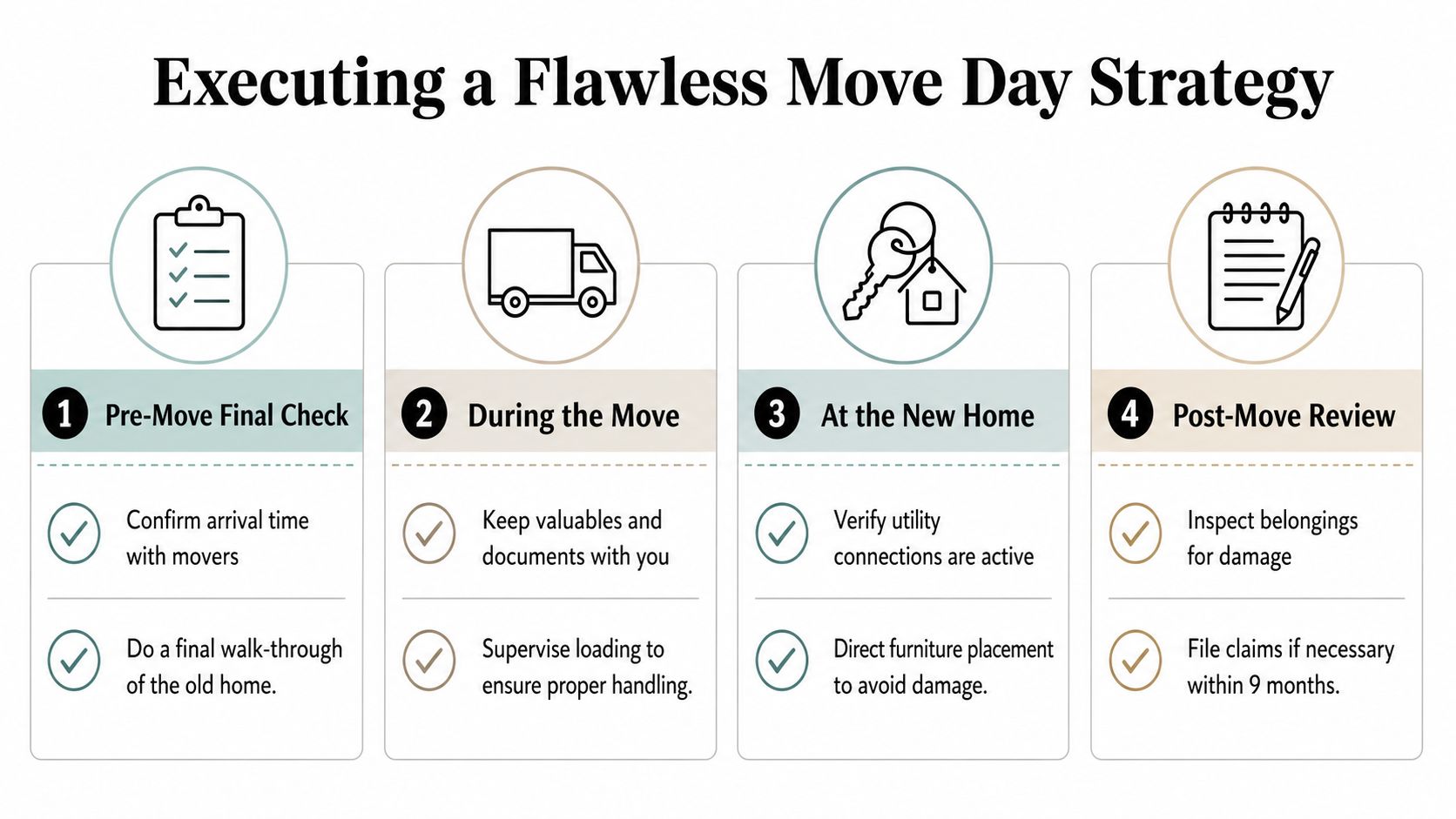
Move day is where families lose money if they get casual. Boxes get mislabeled, the truck arrives late, or someone forgets which items need to stay within reach. Use a moving checklist and treat the day like a controlled handoff, not a casual loading session.
Control the paperwork and the truck
Before loading starts, verify the mover's USDOT number against the confirmation paperwork. Then check the bill of lading and the inventory list after you have looked over the boxes and marked any missing items or damage. Keep your copy with you, because that paper trail matters if anything goes wrong later.
Families also need a First Open, Load Last box. Put essentials there, things like toiletries, chargers, basic clothes, school papers, and a few comfort items for the kids. It should be the last box on the truck and the first box you open in the new house.
Clear the house before the movers arrive
Clear closets, the garage, the attic, and the basement before the crew shows up. That advice sounds obvious until you are standing in a half-packed room at 7 a.m. with nowhere to stage anything. The more you prep, the less likely you are to slow the movers down or leave behind items hidden in storage spaces.
If you are moving furniture that needs setup on arrival, use furniture delivery and assembly advice before move day so you know what needs disassembly, protection, and reassembly.
Protect the family schedule
Arrange childcare and pet coverage before the truck shows up. That one decision removes a lot of chaos, because movers need clear hallways and you need room to focus on paperwork, calls, and last checks. A move goes better when the adults can stay on task without also managing snacks, naps, and escapes from the front door.
Settling In and Managing Secure IT Disposal
A new Atlanta home should feel usable right away. Start with the basics, utilities, the nearest grocery store, urgent care, and the fastest route to the pharmacy. Get those in place before the boxes take over the rooms. That routine matters more than decorative setup because it keeps daily life moving while you are still sorting everything else out.
Families with children should handle safety before they start opening boxes in the kitchen, office, and play areas. Use a room-by-room safety checklist and walk each space before you unpack. That catches exposed cords, unstable furniture, and other problems before the kids start using the house like it is already finished.
Old electronics deserve the same attention as the rest of the move. Laptops, routers, phones, printers, and office gear can still carry sensitive data, so secure IT disposal belongs on the first-week list. If you are clearing out old computers during the move, use this secure computer recycling guide for Atlanta to decide what to keep, wipe, or recycle.
Remote work households need to treat device disposal like document disposal. Delete what you can, confirm data destruction for anything that cannot be fully wiped, and keep a simple record of what left the house. That discipline reduces clutter and lowers the risk of bringing private files, passwords, or old account data into a new address.
Beyond Surplus handles electronics recycling and secure IT asset disposal for families and businesses that need a documented process. If your Atlanta move includes old computers, office equipment, or other tech that should not end up in a landfill or a storage room, visit Beyond Surplus to review service options and schedule the next step.


