
You're replacing laptops after a lease cycle. A server room cleanup is tied to a cloud migration. A clinic office has old copiers, phones, and desktops stacked in a back room because nobody wants to be the person who sends out a device with recoverable data still on it. That's the point where electronics recycling in Atlanta, GA for businesses stops being a recycling question and becomes an operations question.
Most Atlanta companies don't struggle with finding someone to “take the stuff.” They struggle with choosing a process they can defend later. IT wants drives handled correctly. Compliance wants documentation. Facilities wants the equipment moved without disrupting the office. Procurement wants a scope that matches the quote. If those teams aren't aligned, old equipment lingers far too long.
A lot of local guidance falls short. Many Atlanta resources focus on drop-off locations, but they don't explain the difference between basic recycling and a business-ready IT asset disposition workflow with chain-of-custody, data destruction, and liability transfer, a gap that matters under the FTC Disposal Rule's requirement for reasonable procedures to protect consumer information, as noted by Beyond Surplus on business e-waste laws.
Table of Contents
- Introduction to Business Electronics Recycling in Atlanta
- Understanding Recycling and IT Asset Disposition for Businesses
- Atlanta Regulatory Landscape and Compliance Requirements
- Secure Data Destruction Options and Certification Explained
- Logistics Pickup and Service Options for Atlanta Businesses
- How to Choose a Vendor Pricing and Sustainability Reporting
- Your Step by Step Preparation and Compliance Checklist
Introduction to Business Electronics Recycling in Atlanta
A typical Atlanta refresh project rarely involves just a few laptops. It's usually a mix of desktop computers, docking stations, network switches, access points, tablets, phones, printers, drives, and equipment with hidden storage. In healthcare and finance, even a retired copier can create risk if nobody treats its internal storage like a data-bearing asset.
Why this sits with IT and compliance
Global electronics waste reached 62 billion kilograms in 2022, or about 7.8 kilograms per person worldwide, and only 22.3% was formally collected and recycled in an environmentally sound way, according to the Global E-waste Monitor 2024. That report also says e-waste generation is rising by about 2.6 million tonnes each year and is projected to reach 82 million tonnes by 2030. For a business, those numbers matter because disposal is no longer a janitorial afterthought. It's a measurable risk area tied to data security, compliance, and environmental reporting.
Practical rule: If an asset ever held customer, patient, student, employee, or financial data, treat its exit like a controlled process, not a cleanout day.
What business teams usually need to decide
Atlanta organizations usually have three immediate questions:
- What's leaving the building: Not just laptops and monitors, but servers, firewalls, VoIP phones, storage arrays, badge systems, and medical or lab equipment with electronics inside.
- How data will be handled: Wiping, purge-level sanitization, or physical destruction.
- What proof will be retained: Serial-number reporting, chain-of-custody records, certificates, and final disposition documentation.
That's the difference between “recycling” and an audit-ready workflow.
Understanding Recycling and IT Asset Disposition for Businesses
Basic recycling answers one question. How do we keep equipment out of the general waste stream? IT asset disposition, or ITAD, answers three more. How do we secure the data, document the handoff, and record the final outcome?
Recycling removes material. ITAD manages risk.
If you put obsolete keyboards and damaged monitors on a pallet for pickup, standard recycling may be enough. If you're retiring laptops from a finance office or replacing multifunction copiers in a medical group, standard recycling isn't enough on its own. Those assets require a documented path from your custody to final disposition.
Think of it this way:
- Recycling is like hauling construction debris to the right processor.
- ITAD is like handling company records in sealed boxes with a sign-off at every transfer point.
That sign-off trail matters because liability doesn't disappear when the truck leaves.
What counts as business e-waste
Commercial electronics recycling in Atlanta often includes:
- User devices: laptops, desktops, tablets, phones, thin clients
- Infrastructure gear: servers, switches, racks, UPS units, storage hardware
- Office systems: printers, copiers, scanners, telecom equipment
- Specialized equipment: medical devices, lab equipment, testing systems
- Media and components: hard drives, SSDs, backup devices, memory-bearing boards
A good ITAD scope also accounts for embedded storage. Teams often focus on hard drives and forget copier drives, SSD modules in appliances, or flash storage in mobile devices.
The proof package businesses should expect
A business disposition project should end with records, not assumptions. That usually means asset-level identification, chain-of-custody detail, data destruction evidence where required, and confirmation of recycling or remarketing outcomes.
For a deeper operational framework, this complete IT asset disposition guide for businesses in 2026 is a useful companion.
A recycler helps move equipment. An ITAD process helps your company prove what happened to each sensitive asset.
Atlanta Regulatory Landscape and Compliance Requirements
Atlanta businesses operate in a legal environment that's less about a simple statewide recycling mandate and more about how you document disposal, data protection, and downstream handling.
What federal rules change the process
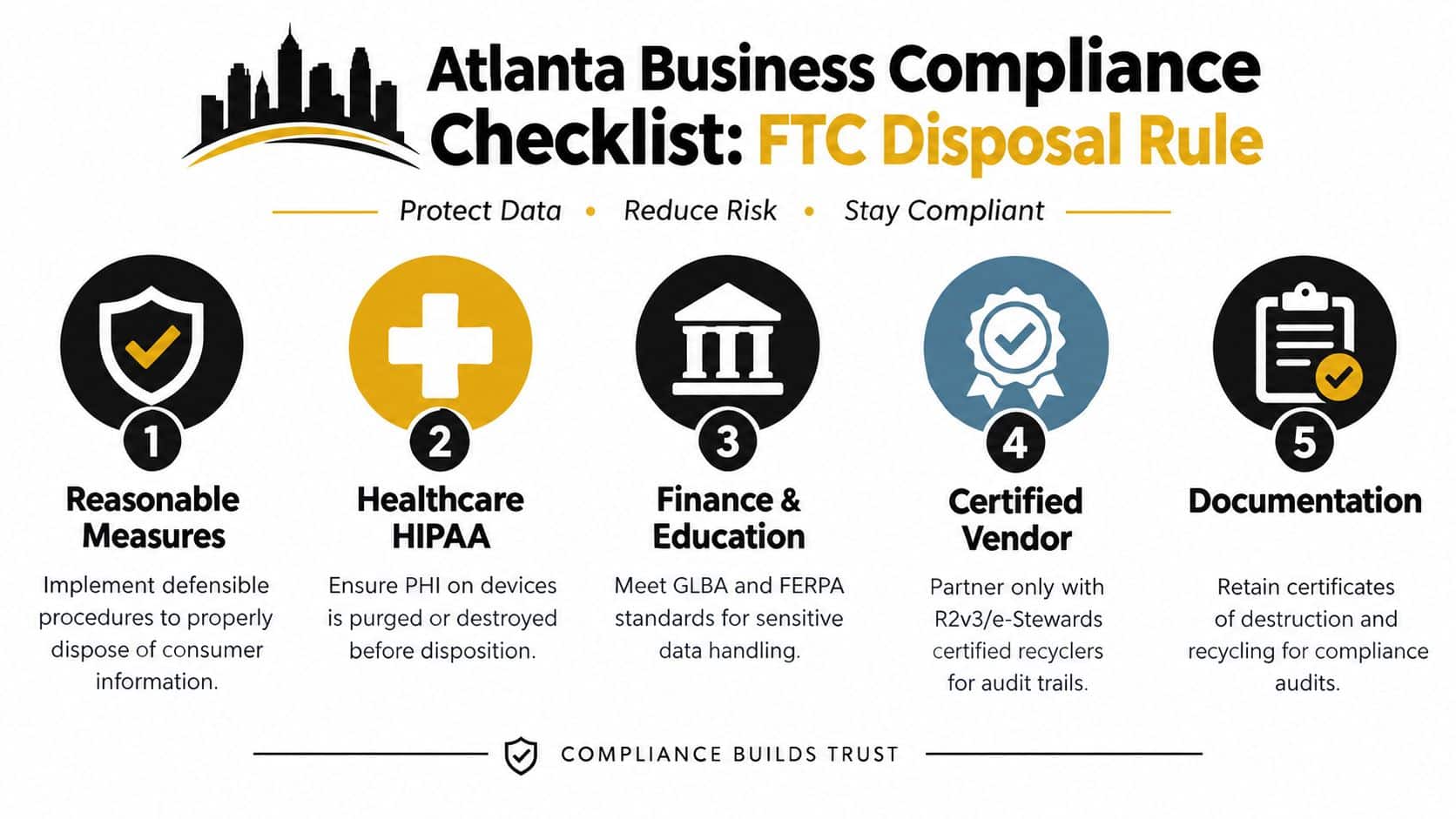
For data-bearing devices, the most defensible approach is to treat sanitization as a documented control. The FTC Disposal Rule requires “reasonable measures” so consumer information can't be read or reconstructed, and retained records should include the chosen method, asset identifiers such as serial numbers, chain-of-custody logs, and final disposition evidence, as explained in this guide to what businesses should know about e-waste laws.
That's why factory resets alone aren't enough for end-of-life business devices. A reset may prepare a device for the next user internally, but it doesn't create the external evidence package compliance teams need when assets leave the organization.
What Georgia law means in practice
Georgia does not have a statewide electronics recycling law or landfill ban for ordinary businesses, according to this overview of Georgia e-waste laws. But that doesn't mean mixed electronics should be treated like ordinary office trash.
The practical issue is that hazardous components inside e-waste still fall under solid-waste and hazardous-waste rules. Batteries, PCB-containing assemblies, CRT-related material, and mixed electronics streams require tighter segregation, downstream control, and transport documentation, as detailed in this Georgia data destruction and e-waste compliance guide.
What auditors and internal reviewers will ask for
Most internal reviews come back to a short list:
- Inventory evidence: What assets left, and can you match them to serial numbers or internal tags?
- Method selection: Which devices were wiped, which were destroyed, and why?
- Transfer records: Who touched the load, when was it released, and where did it go?
- Final documentation: Certificates, weight tickets, and downstream reporting.
The detailed local context is covered in this Atlanta e-waste laws business compliance guide.
Secure Data Destruction Options and Certification Explained
Not every device needs the same sanitization method. The right control depends on the data, the device, and whether the equipment will be reused, resold, or scrapped.
Clear, purge, and destroy
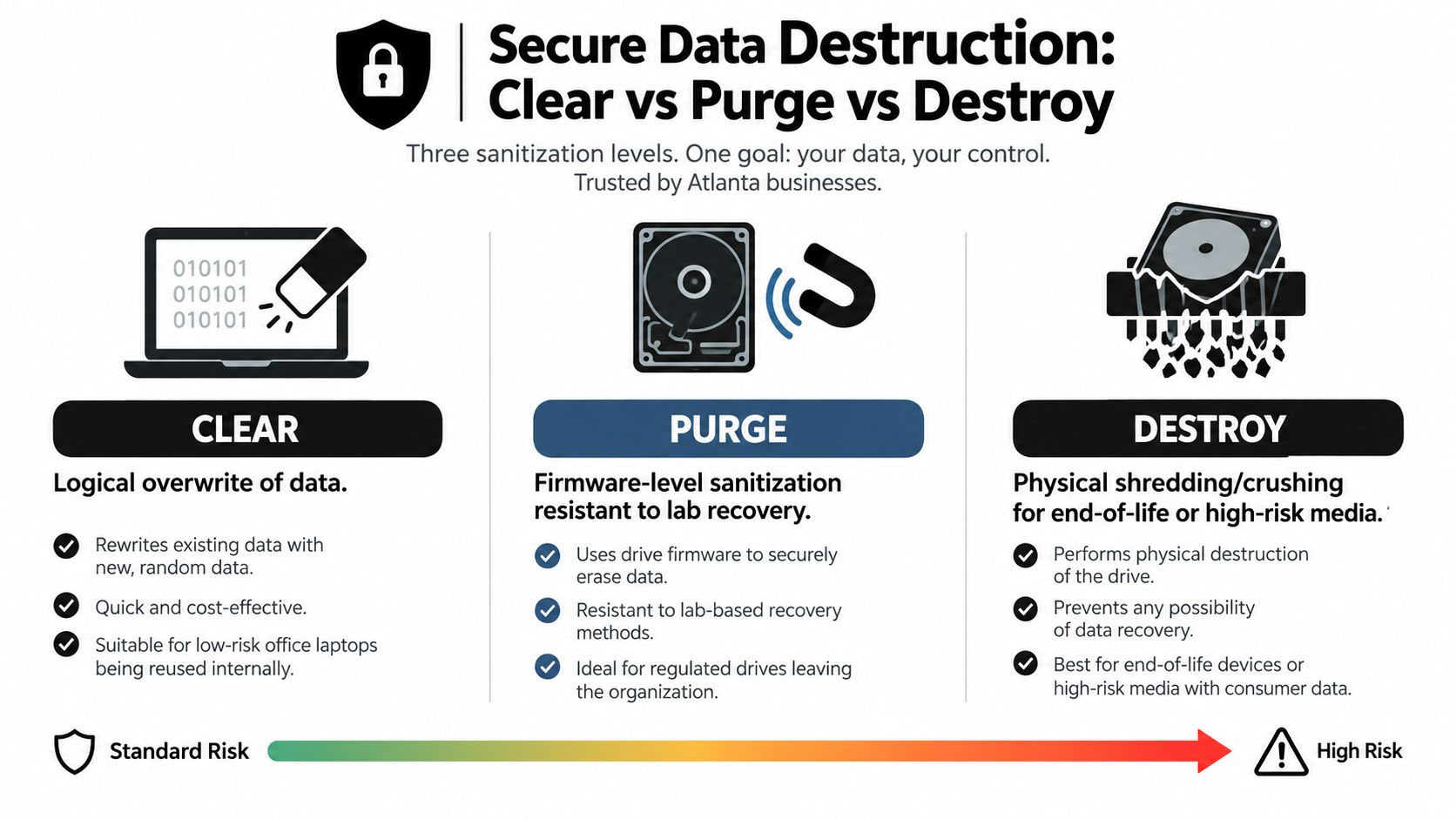
Clear is a logical overwrite approach. It can fit lower-risk scenarios, such as standard office laptops staying within a controlled corporate environment.
Purge is stronger. It's used when media is leaving the organization and you need sanitization that resists more advanced recovery attempts.
Destroy is physical destruction. It fits end-of-life media, failed drives that can't be wiped, and assets that held sensitive consumer, patient, financial, or regulated information.
Why factory reset isn't the same thing
A factory reset is a user function. It's designed to restore default settings. It isn't the same as verified wiping or physical destruction, and it usually doesn't produce documentation you can retain for an audit file.
That's especially important for equipment people forget about, including:
- Copiers and printers with internal storage
- Phones and tablets issued to employees
- Network appliances with saved credentials or logs
- Medical and lab systems with embedded memory
What a certificate should support
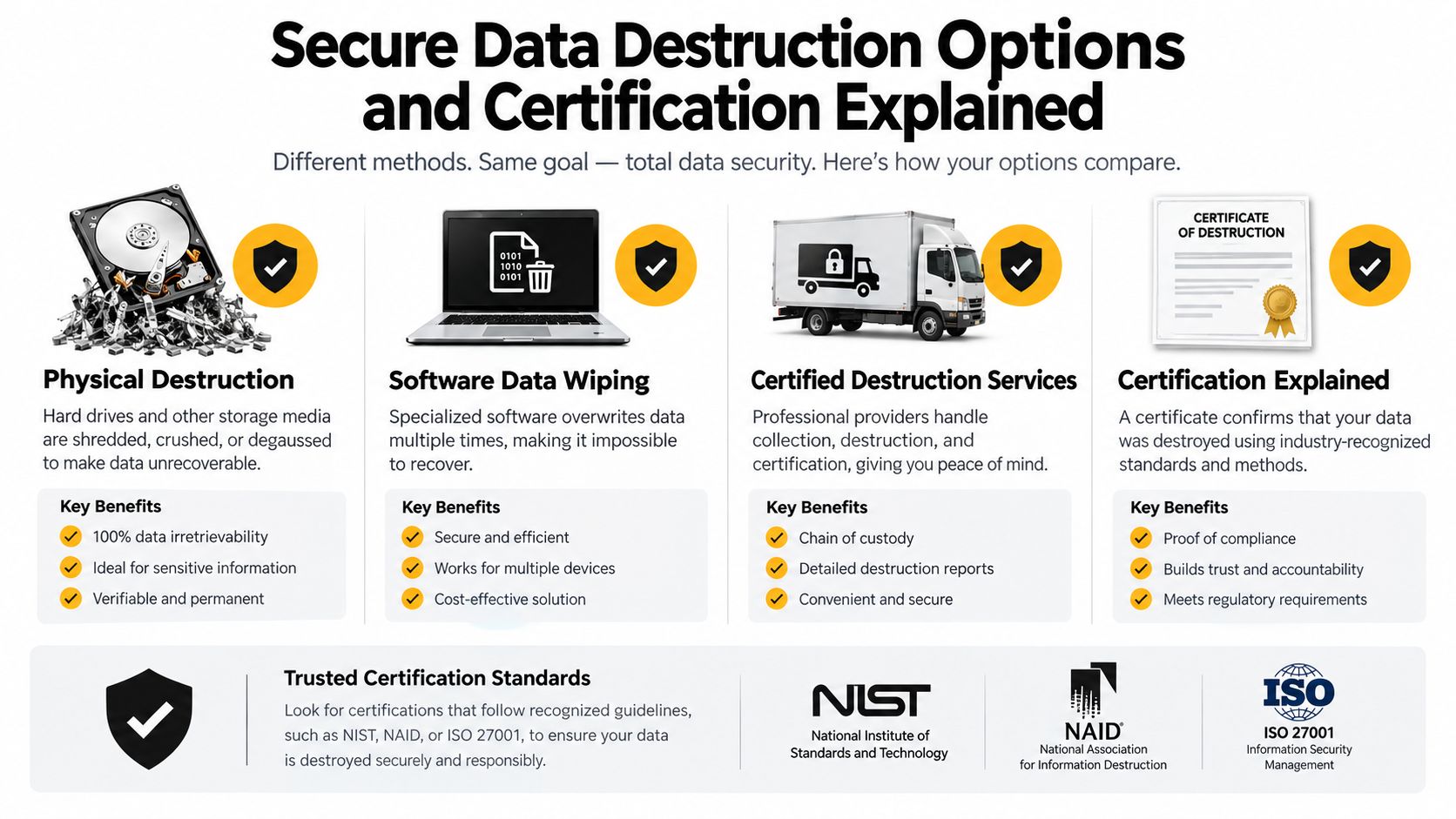
A certificate matters when it matches the operational record behind it. On its own, a one-page summary doesn't answer enough questions.
A complete evidence package should tie back to:
- the sanitization method used
- serial numbers or other asset identifiers
- chain-of-custody logs
- final disposition records
This certificate of data destruction explainer helps procurement and compliance teams evaluate whether a vendor's documentation is useful.
If a vendor can't tell you how they document wiped assets versus destroyed assets, pause the project and ask more questions.
Logistics Pickup and Service Options for Atlanta Businesses
Once policy is clear, the next failure point is logistics. Equipment doesn't become compliant because it's ready to leave. It becomes compliant when the pickup method, packaging, handoff, and reporting all match the risk level.
What pickup looks like for business loads
A normal commercial workflow starts with inventory and scope review. Then the vendor matches the service level to the load. A few pallets from a single office need one kind of scheduling. A multi-site refresh across Atlanta offices needs another. A data center decommission needs de-installation, rack pull, and controlled staging.

Choosing the right service path
Use bulk pickup when you have volume, multiple departments involved, or data-bearing assets that shouldn't sit in a public drop-off queue. Use de-installation when the equipment is still mounted, cabled, or integrated into production space.
Some Atlanta businesses also need nationwide coordination. In those cases, a provider may use a dedicated fleet for local work and transportation partners for broader coverage. The key is that chain-of-custody doesn't break when the route gets more complex.
A local example is Atlanta e-waste pickup, which outlines business collection options for equipment removal.
What to confirm before scheduling
Before pickup day, confirm these details in writing:
- Site readiness: Is equipment boxed, palletized, tagged, or still installed?
- Asset category: Are there laptops and servers only, or also batteries, copiers, and specialized equipment?
- Handoff point: Lobby, loading dock, cage, suite, or raised-floor environment.
- Documentation timing: Will chain-of-custody start onsite, and when will final reports be issued?
The smoothest pickups happen when IT, facilities, and the recycler agree on the exact handoff point before the truck arrives.
One more point causes confusion in Atlanta. Business pickups, small business drop-off, and mail-in options aren't the same service. Commercial readers should choose the path that matches custody and documentation needs, not just convenience.
How to Choose a Vendor Pricing and Sustainability Reporting
The best vendor decision usually comes from a side-by-side review of security controls, operational fit, and reporting quality. Price matters, but a low quote can become expensive if records are thin or scope assumptions are wrong.
What to verify before comparing quotes
The EPA maintains a certified electronics recyclers resource to help organizations identify qualified downstream processors, and it notes participation by recognized stewardship systems such as Call2Recycle for batteries and cell phones. That's useful for vetting battery handling and downstream alignment.
Here's a practical comparison grid.
| Evaluation Criteria | What to Verify | Why It Matters |
|---|---|---|
| Chain of custody | Pickup records, signed transfers, asset tracking | Shows who controlled the load at each step |
| Data destruction | Wiping, purge, or destruction options and evidence | Matches the method to your risk profile |
| Downstream handling | Certified recycler alignment and battery stewardship routes | Reduces exposure from poor downstream processing |
| Reporting package | Certificates, serial-number lists, weight tickets, final summaries | Supports audits, legal review, and internal reporting |
| Scope clarity | Packing, palletizing, de-installation, labor, and access assumptions | Prevents quote disputes on pickup day |
| Value recovery | Whether reusable assets are bought back or remarketed | Helps offset disposition cost where equipment still has value |
For a structured review process, this vendor due diligence checklist is helpful.
Pricing usually follows scope, not just weight
In business electronics recycling, pricing often changes based on labor, de-installation, packaging condition, hazardous components, reporting requirements, and whether any devices retain resale value. IT buyback can make sense for newer laptops, servers, and network equipment. Pure recycling is more common for damaged, obsolete, or incomplete gear.
One Atlanta-based option is Beyond Surplus, which handles electronics recycling, secure data destruction, IT buyback, product destruction, and multi-site logistics for business customers. That's useful when a single project includes both scrap equipment and reusable assets.
Sustainability reporting should be usable internally
Environmental reporting is most helpful when it's operationally specific. Compliance teams need defensible records. Sustainability teams need clear disposition outcomes. Procurement needs vendor consistency. A vendor that can provide transparent chain-of-custody and downstream reporting makes all three groups easier to satisfy.
Your Step by Step Preparation and Compliance Checklist
If your team has equipment waiting in storage, start with control and sequence.
A practical checklist for Atlanta businesses
- Build the inventory first. Record asset type, location, and serial number or internal tag wherever possible.
- Classify by data risk. Separate general peripherals from data-bearing devices and identify anything with embedded storage.
- Choose the sanitization method. Assign clear, purge, or destroy based on sensitivity and whether the asset will be reused or scrapped.
- Segregate special streams. Pull out batteries and any hazardous or specialized components so they aren't mixed into a general electronics load.
- Pick the right logistics path. Bulk pickup fits larger office clears, de-installation fits active environments, and facility drop-off or mail-in may work for smaller controlled lots.
- Collect the evidence package. Retain chain-of-custody logs, certificates, serial-number reports, and final recycling documentation in the same compliance file.
Questions worth asking before release
- Who signs the assets out?
- Which assets require physical destruction?
- Are copiers, phones, and other embedded-storage devices included?
- Where will final records be stored for later review?
Atlanta business electronics recycling works best when it's treated as part of IT governance, not just surplus removal.
Beyond Surplus provides business electronics recycling, secure IT asset disposal, certified data destruction, product destruction, and logistics support for Atlanta organizations and multi-site companies nationwide. If you need an audit-ready process for computers, servers, storage devices, medical equipment, or office electronics, visit Beyond Surplus to schedule pickup or review service options.


