

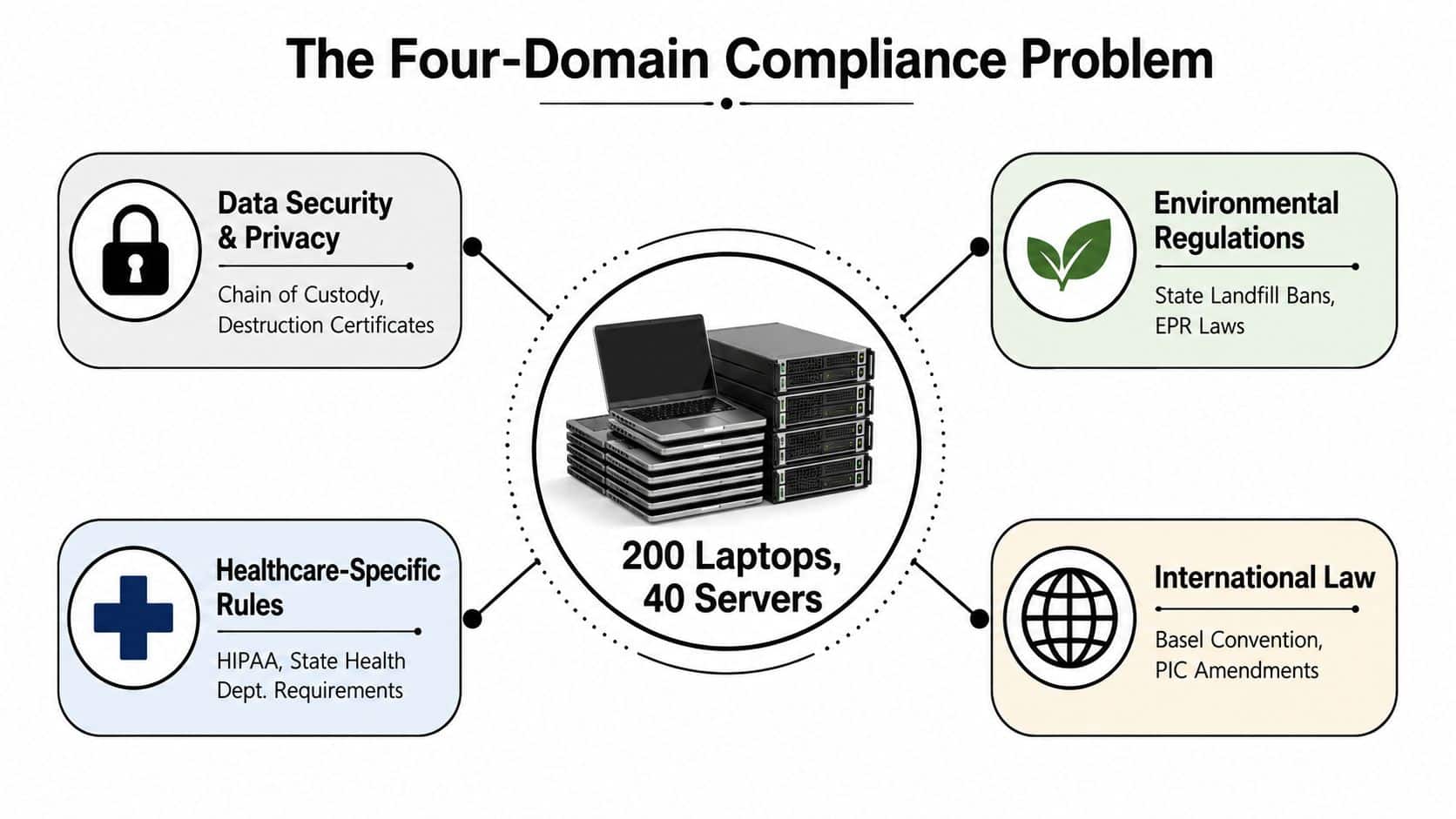
Friday afternoon, an IT director approves the retirement of 200 laptops and 40 servers from a regional healthcare company. The equipment leaves the server room, but the compliance obligation doesn't leave with it. Before Monday, the project may involve recycling requirements, data privacy controls, hazardous-waste determinations, and cross-border shipping rules.
That's the practical answer to what businesses should know about e-waste laws: electronics disposal is no longer one recycling task. It's a coordinated ITAD process that must prove where assets went, what happened to their data, how regulated components were handled, and whether any equipment crossed a border lawfully.
Table of Contents
- Why E-Waste Compliance Is Now a Four-Domain Problem
- The U.S. Federal Baseline for Electronics Disposal
- State-Level Rules That Actually Drive Operations
- Data Destruction Standards and Chain-of-Custody Records
- The Basel Convention Shift Most U.S. Businesses Miss
- Vendor Certification and ITAD Contract Language
- Enforcement Realities and Penalty Exposure
- A Practical Compliance Checklist for IT Directors
Why E-Waste Compliance Is Now a Four-Domain Problem
The healthcare company's retired equipment creates four separate questions. Recycling law determines whether the laptops, servers, monitors, and networking equipment entered a compliant processing channel. Data privacy law determines whether storage media was wiped or destroyed before reuse, resale, or recycling. Hazardous-waste law affects certain components and discarded equipment. Cross-border shipping law determines whether assets or e-waste can leave the United States.
The global scale explains why regulators and auditors are paying closer attention. The world generated 62 billion kilograms of e-waste in 2022, or 7.8 kilograms per person, while only 22.3% was formally collected and recycled in an environmentally sound manner, according to the Global E-waste Monitor 2024. Roughly 48 billion kilograms was not documented as properly recycled, and the problem is increasing by about 2.6 million tonnes per year. The same source projects 82 million tonnes by 2030, a 33% increase from 2022.
One vendor cannot erase every obligation
A recycler may process material responsibly, but the business still needs to define the scope of work, approve data-destruction methods, classify assets, and retain evidence. A certificate without serial-number reconciliation is weak evidence. A “global recycling partner” statement without shipment-level documentation is weaker still.
Healthcare, finance, government, education, and cloud operators face overlapping expectations from privacy, environmental, procurement, and security stakeholders. A documented ESG reporting approach for Atlanta businesses can support sustainability reporting, but it doesn't replace asset-level disposition records.
Practical rule: Treat every decommissioning project as four linked workstreams, not as a truckload of obsolete electronics.
The U.S. Federal Baseline for Electronics Disposal
Federal rules establish the floor. Your compliance checklist should begin with classification, then move to data protection, handling, and documentation.
The EPA's electronics stewardship guidance explains that some electronics can be excluded from RCRA solid-waste definitions only when regulatory conditions are met. That means a business still needs a hazardous-waste determination and a compliant handling path for equipment or components that don't qualify for an exclusion. Universal-waste considerations can apply to items such as mercury-bearing devices, cathode ray tubes, and certain electronic components.
The data question is separate. The FTC Disposal Rule requires covered businesses to take reasonable measures so consumer information cannot be read or reconstructed. That obligation connects electronics disposition directly to written data-security controls, documented wiping or destruction, and verified custody. The EPA universal-waste framework is useful background, but it isn't a substitute for reviewing the applicable state requirements.
Build the federal checklist in sequence
Identify the asset and its contents. Record device type, serial number, storage media, condition, and likely regulatory category.
Determine the data method. Decide whether the media can be sanitized effectively or must be physically destroyed.
Confirm the processing route. Establish whether the equipment will be reused, resold, dismantled, recycled, or handled as regulated waste.
Retain evidence. Keep pickup records, chain-of-custody logs, certificates, weight tickets, and downstream documentation.
| Domain | Governing Rule | Core Obligation | Required Documentation |
|---|---|---|---|
| Environmental handling | RCRA and EPA electronics guidance | Make a hazardous-waste determination and use a compliant route when required | Classification records, shipping documents, processor records |
| Consumer information | FTC Disposal Rule | Prevent information from being read or reconstructed | Written disposal procedures, destruction or wiping certificates |
| Stewardship | EPA electronics stewardship guidance | Use responsible management and documented processing practices | Vendor diligence, recycling records, downstream evidence |
| Contract oversight | Business procurement controls | Define responsibility across the disposition chain | Scope of work, insurance, audit rights, indemnity terms |
Federal requirements don't prescribe one universal recycling certification for every project. They do require reasonable controls and demonstrable due diligence. State rules, industry contracts, and internal security standards often raise the operating requirement beyond that federal baseline.
State-Level Rules That Actually Drive Operations
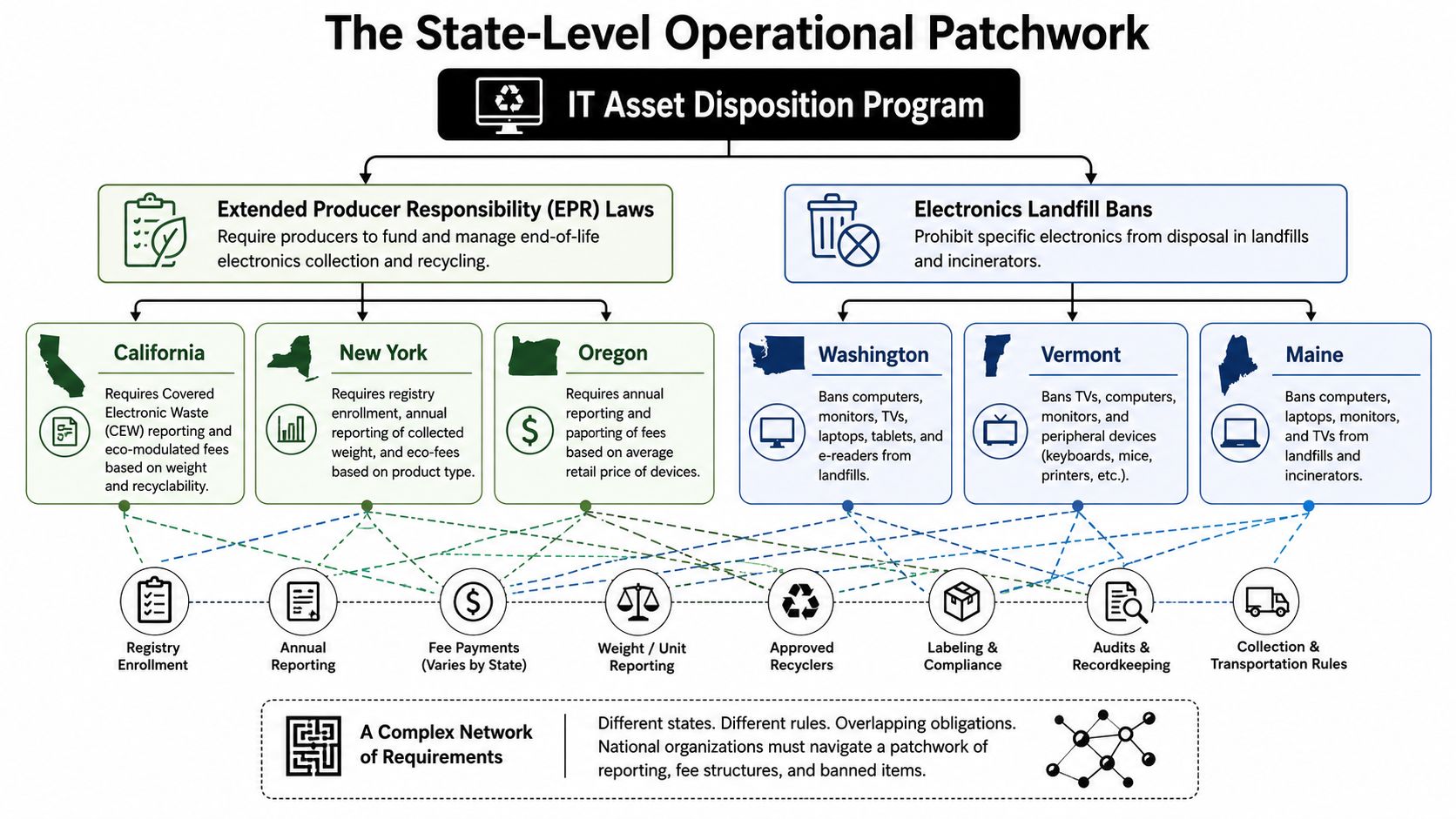
State law usually determines what happens at the loading dock. Extended producer responsibility programs, electronics landfill bans, collection obligations, and reporting rules create an operational patchwork that national businesses can't manage with one generic disposal policy.
Covered categories often include laptops, monitors, televisions, tablets, printers, and related business electronics. Some programs shift collection funding toward manufacturers, importers, or distributors. Retailer take-back requirements can affect sales channels, while landfill restrictions can make disposal through commercial trash unlawful for covered equipment.
What procurement teams should require
State programs may dictate the recycler certification standard, downstream tracking process, and reporting format. R2v3, e-Stewards, and RIOS can be relevant certifications, but the certificate alone isn't the entire control. Procurement should verify the actual facility, scope, downstream partners, data-security process, and insurance.
For companies operating in Georgia, the Georgia electronics recycling and ITAD compliance overview can help frame local requirements. Multistate programs need a jurisdiction matrix that records:
- Covered equipment: Identify which device categories are regulated in each operating state.
- Collection responsibility: Confirm whether the manufacturer, distributor, retailer, or business funds the route.
- Landfill restrictions: Block ordinary trash disposal for covered electronics.
- Reporting evidence: Retain weights, certificates, vendor records, and downstream confirmations.
- Vendor qualifications: Verify certifications and facility authorization before pickup.
The contract should reflect the strictest applicable operational requirement when a single vendor serves several states. Don't let a vendor place that burden back on your facilities team after equipment has already been collected.
Data Destruction Standards and Chain-of-Custody Records
Data destruction has two defensible paths. Software-based sanitization preserves the possibility of reuse when the media is healthy and the method can address the data. Physical destruction is appropriate when the media can't be reliably sanitized, the device is damaged, or the sensitivity tier demands destruction.
NIST SP 800-88 Rev. 1 organizes sanitization around Clear, Purge, and Destroy. The right choice depends on the media type, data sensitivity, reuse plan, and technical verification. A simple delete command or operating-system reformat isn't a defensible sanitization record.
Match the method to the asset
A laptop destined for refurbishment may receive a documented wipe, followed by verification and a certificate. A failed solid-state drive may require physical destruction because flash-storage behavior can make conventional overwriting unsuitable. Servers with high-sensitivity workloads may require witnessed shredding or another approved destruction method.
The NIST 800-88 data destruction guidance provides a useful framework, but your policy should also define who approves exceptions and how failed sanitization attempts are escalated.
Make the record prove the event
A certificate of data destruction should identify the device by serial number or controlled lot, state the method used, identify the technician or facility, include the date, and reference the applicable standard. A certificate of recycling should connect the same asset population to the final processing route.
Chain of custody should capture every handoff:
- Pickup: Record serial numbers, quantities, condition, and the releasing employee.
- Transport: Document the carrier, custody transfer, date, and receiving location.
- Processing: Record the sanitization or destruction event and responsible technician.
- Downstream disposition: Identify the processor and final material route.
- Closeout: Reconcile the original inventory against certificates and exceptions.
A certificate is useful only when it ties a specific asset to a specific action and a controlled chain of custody.
Without that trail, the business may struggle to show when control transferred or whether a downstream breach, improper disposal event, or unlawful export occurred after pickup.
The Basel Convention Shift Most U.S. Businesses Miss
The most overlooked exposure for U.S. companies is the assumption that “recycling” ends the compliance analysis. It doesn't when used electronics or e-waste cross an international border.
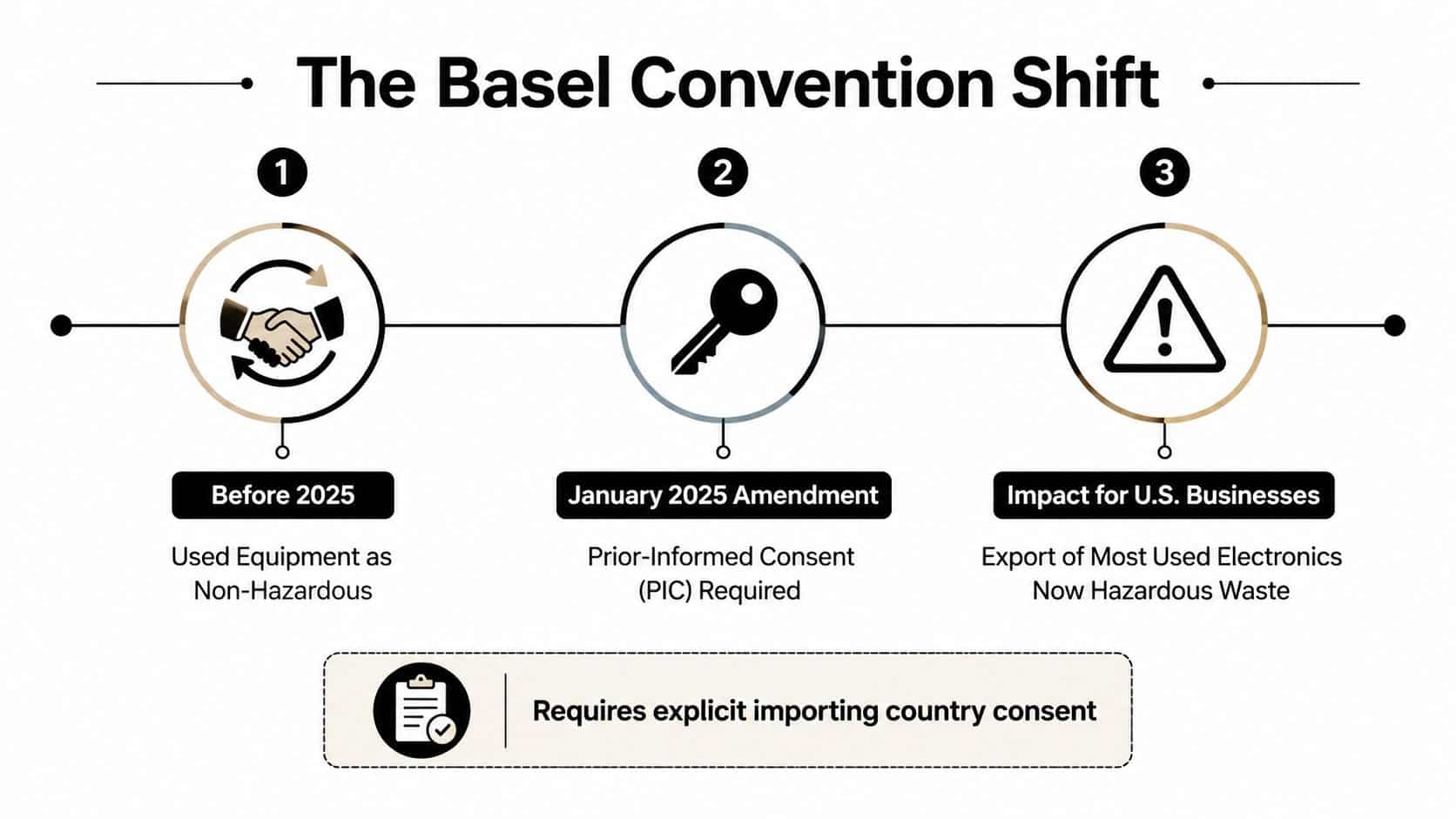
The Basel Convention amendments took effect on January 1, 2025 and require prior informed consent for transboundary movement of e-waste, including hazardous and non-hazardous electronic waste, according to the Basel Convention e-waste amendments. A shipment can't lawfully move on a bill of lading alone. The state of export must notify the importing state and applicable transit states in writing, and movement can proceed only after the required written consent is received, as described in the Basel Convention PIC FAQ.
“The recycler handles exports” isn't enough
The exposure may sit with a downstream broker or foreign processor, but the generator remains traceable as the origin of the shipment. Your vendor's contract needs more than a broad promise to recycle globally. It should identify the route, classify the assets, allocate PIC responsibilities, and require evidence before export.
Ask for written confirmation of domestic processing when export isn't necessary. If export is proposed, require the destination-country review, transit analysis, consent records, shipping classifications, and copies of relevant notifications. Refuse vague language that gives the vendor freedom to redirect assets without your knowledge.
The legal treatment can change depending on whether equipment is classified as reusable product, non-hazardous waste, or hazardous waste. Asset triage before export therefore matters as much as the choice of recycler. The certified e-waste recycling service overview should be evaluated alongside your own route controls, not used as a replacement for them.
Vendor Certification and ITAD Contract Language
Certification is a screening tool, not a complete risk-transfer mechanism. R2v3 and e-Stewards indicate that a processor maintains documented environmental and data-security management systems. Their requirements and approaches to downstream labor and export controls differ, so procurement should review the actual certification scope and facility coverage.
For media destruction, NAID AAA or comparable documented destruction controls can address a narrower question: whether the provider operates a controlled media-destruction program. It doesn't automatically resolve hazardous-waste classification, export compliance, insurance, or the disposition of non-data-bearing equipment.
Put the risk allocation in writing
Your ITAD agreement should name the receiving facility and restrict subcontracting to approved, qualified parties. It should require serial-level or controlled-lot certificates, complete chain-of-custody records, audit rights, site-inspection rights, and insurance that includes environmental and cyber liability where appropriate.
The contract should also address downstream violations directly. Require indemnification for applicable RCRA and Basel violations, define the liability cap, and carve out willful noncompliance, fraud, confidentiality failures, and unauthorized subcontracting where your counsel considers those provisions appropriate.
| Risk Domain | Required Contract Clause | Acceptable Evidence |
|---|---|---|
| Data security | Approved sanitization and destruction methods | Device-level certificates, method records, technician identification |
| Environmental handling | Compliant classification and processing route | Facility credentials, manifests, downstream records |
| Cross-border movement | Written PIC responsibility and route approval | Consent records, destination review, shipment documents |
| Subcontracting | Prior written approval for downstream parties | Named facility list, certification verification |
| Financial exposure | Insurance, indemnity, and defined liability carve-outs | Current insurance certificates and executed agreement |
| Auditability | Record retention and inspection rights | Audit reports, chain-of-custody logs, reconciliation files |
The lowest bid often removes the controls you'll need after something goes wrong.
Compare total risk, not just pickup price. A cheaper vendor may offer fewer records, weaker insurance, or opaque downstream routing. Those savings disappear quickly when your team has to reconstruct inventory, answer an auditor, or investigate a data exposure.
Enforcement Realities and Penalty Exposure
Enforcement usually arrives through one of three channels. State environmental agencies can act under authorized RCRA programs and state electronics statutes. The FTC can act when covered businesses fail to protect consumer information during disposal. Contracts and insurance can create a third channel when a vendor's downstream failure triggers indemnity, breach claims, or insurer recovery actions.
State environmental enforcement commonly focuses on improper handling, unauthorized disposal, missing records, or unlawful shipments. The consequences may include per-violation fines, remediation orders, corrective-action requirements, and, in serious cases, criminal referral. The exact outcome depends on the jurisdiction and facts, so don't build a compliance program around assumed penalty amounts.
Data failures carry a different profile
A missing recycling certificate may create an audit and reputational problem. A disposal failure involving documented consumer records can create a direct privacy and security event, with regulatory investigations, contractual disputes, notification obligations, and potential civil claims. The FTC Disposal Rule's core standard is practical: consumer information must not be readable or reconstructable after disposal.
Basel-related failures add route risk. Shipments without the required prior informed consent can be delayed, returned, or exposed to enforcement in the countries involved. The Basel Convention status information confirms the expanded control framework for electronic and electrical waste.
| Enforcement Channel | Typical Trigger | Penalty Profile | Primary Risk Type |
|---|---|---|---|
| State environmental agency | Improper disposal, classification, or handling | Fines, remediation, corrective orders, possible referral | Environmental and operational |
| FTC | Consumer information remains readable or reconstructable | Investigation, consent requirements, remediation, privacy exposure | Data security and regulatory |
| Contract and insurance | Vendor or downstream processor violates obligations | Indemnity disputes, coverage issues, civil claims | Financial and commercial |
| Importer or transit country | Shipment moves without required consent or documentation | Delay, return, seizure, penalties, route disruption | Cross-border and logistics |
Treat enforcement as a probability-weighted operating cost. Preventive diligence, serialized records, and controlled routing cost less than reconstructing a failed disposition after regulators or customers ask questions.
A Practical Compliance Checklist for IT Directors
Before the next refresh cycle, give procurement and facilities a disposition brief that covers all four domains. Start before the equipment reaches the loading dock.
Scope the project before selecting a vendor
Inventory every asset, including storage media, monitors, printers, servers, networking gear, medical equipment, and laboratory equipment. Assign a data-sensitivity tier, determine whether reuse is realistic, and flag components that may need special handling, such as CRTs or lithium batteries.
For any international route, check the destination and transit countries before approving export. Classify the shipment correctly, determine whether PIC applies, and require the vendor to document the route rather than describing it as a generic global program.
Test vendor claims
Verify R2v3 or e-Stewards status through the applicable certified-vendor directory, not only through a PDF supplied by the bidder. Request evidence of data-destruction capabilities, such as NAID AAA or NAID-EMSSP where relevant, along with insurance certificates, facility information, and a sample downstream-subcontractor list.
Require the vendor to represent compliance with applicable Basel obligations. If the provider won't identify the receiving facility or refuses to explain export controls, remove it from consideration.
Control execution and closeout
Your agreement should require:
- Serialized pickup records: Capture serial numbers, quantities, condition, and custody signatures at collection.
- Method-specific destruction evidence: Require certificates showing whether each device was wiped, purged, shredded, degaussed, or otherwise destroyed.
- Downstream accountability: Include approved subcontractors, audit rights, and indemnification for unauthorized exports or environmental violations.
- Hazardous-component segregation: Separate regulated components according to the applicable state and federal handling route.
- Final reconciliation: Match the original inventory to certificates, weight tickets, reuse reports, and exceptions.
- Retention controls: Keep records for the period required by applicable privacy, environmental, contractual, and audit obligations.
Beyond Surplus provides business electronics recycling, secure data wiping, hard-drive shredding, IT asset recovery, product destruction, data-center decommissioning, and certificates supporting documented disposition. Use its capabilities as you would any provider, by matching the service scope, facility controls, downstream route, and contract terms to your organization's risk profile.
Compliance is complete only when the asset inventory, data action, environmental route, and shipment record all agree.
Beyond Surplus can coordinate secure IT equipment disposal, certified electronics recycling, data destruction, and documented chain of custody for commercial projects. Visit Beyond Surplus to discuss a compliant disposition plan for laptops, servers, medical equipment, laboratory equipment, or a full data-center decommissioning.


