

A decommissioned laptop is sitting beside your loading dock. IT says it was wiped. Compliance wants evidence. The ITAD provider says the device is ready for transport, but nobody can answer a basic question: what does “secure” mean for this asset, its data, and its next destination?
That disagreement is exactly where NIST 800-88 Data Destruction Standards Explained becomes practical. NIST SP 800-88 Revision 1, titled Guidelines for Media Sanitization, was published in December 2014 and officially released on December 18, 2014. NIST later withdrew Revision 1 on September 26, 2025, when Revision 2 became its successor standard. The framework remains important because it established the enterprise vocabulary of Clear, Purge, and Destroy, while the newer revision shifts more attention toward governance, risk decisions, verification, and accountability.
Table of Contents
- What NIST 800-88 Actually Decides for You
- Clear, Purge, and Destroy in Plain Language
- Matching Sanitization Methods to Each Type of Media
- How NIST 800-88 Maps to Compliance Frameworks You Already Follow
- Verification, Sampling, and the Audit Trail You Need
- On-Site vs Off-Site Data Destruction Workflows Compared
- Common Misconceptions That Put Compliance at Risk
- Implementation Checklist and Next Steps for Your Program
What NIST 800-88 Actually Decides for You
The first decision isn't which software to run. It's whether the media can be reused, transferred, or destroyed without exposing information to an unacceptable recovery risk.
NIST SP 800-88 is guidance, not a regulation by itself. In practice, organizations use it as a recognized decision framework when building disposal policies, assessing vendors, and preparing evidence for auditors. Its 64-page operational format also reflects its purpose as a working guide rather than a short policy statement, as documented in the NIST publication record.
Start with four questions:
- What information is stored? Consider business records, employee information, financial data, health information, credentials, and system configurations.
- What type of media holds it? A laptop, server, SSD, NVMe device, copier, mobile device, removable drive, or cloud environment may require a different treatment.
- Who will control the media next? Internal reassignment, vendor processing, resale, donation, lease return, and end-of-life destruction create different risk conditions.
- What proof will the organization need? A completed action without a reliable record is difficult to defend.
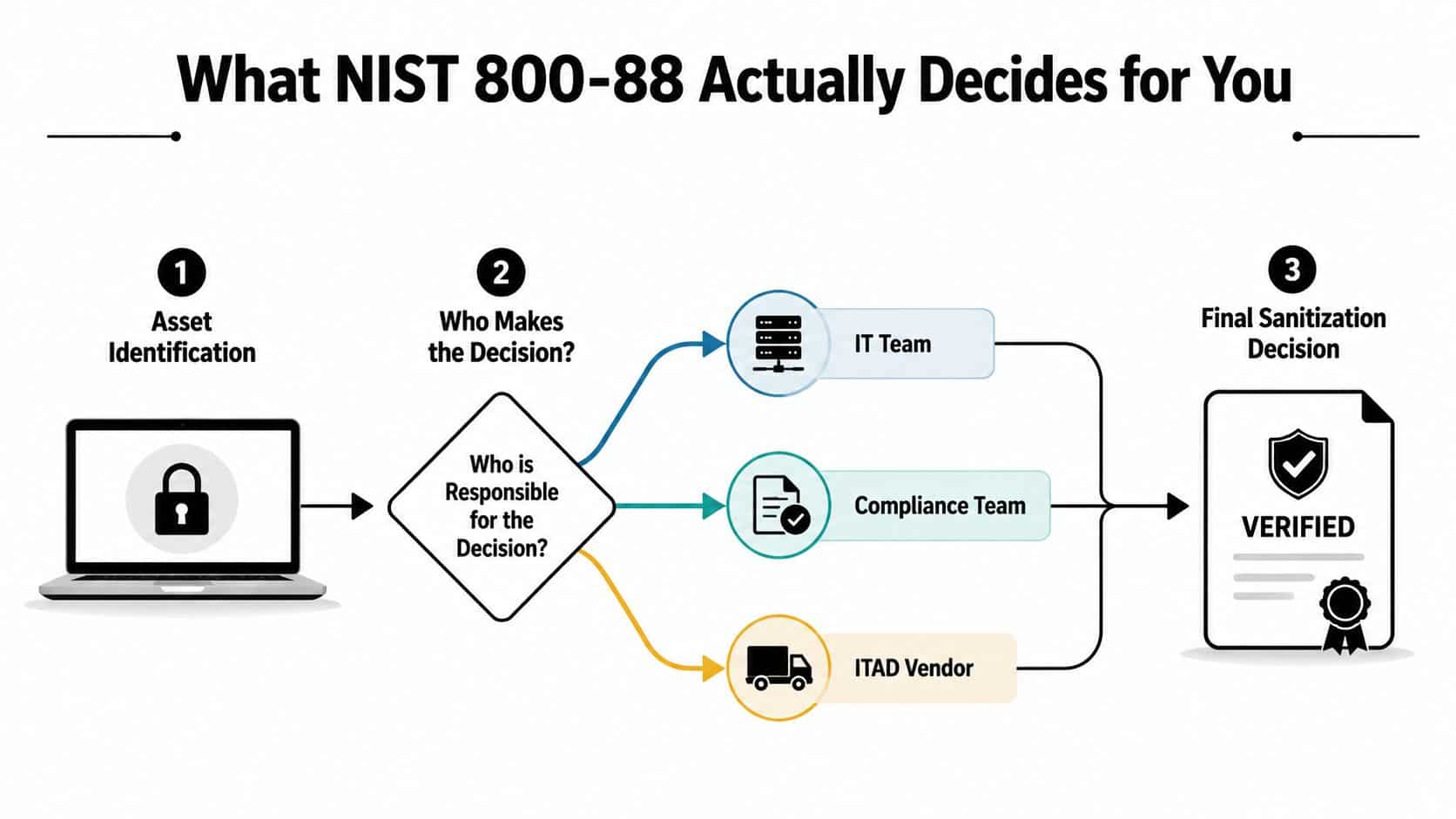
Revision 2 changes the management conversation. Rather than centering the program on a long list of device-specific wiping commands, NIST emphasizes an enterprise media sanitization program aligned with broader security standards. It also expands the discussion from electronic media to information storage media, including logical and cloud environments. The current guidance references standards such as IEEE 2883, NSA specifications, or an organizational standard for technical implementation. See the NIST SP 800-88 Revision 2 overview for the program-level direction.
Practical rule: Decide the acceptable residual recovery risk before selecting the tool, command, vendor, or destruction machine.
Clear, Purge, and Destroy in Plain Language
Think of the three outcomes as destinations, not as a simple ladder of “better” and “worse.”
Clear is similar to returning a company vehicle to an internal pool. The vehicle is prepared for another authorized employee, but it remains within a controlled environment. NIST defines Clear as protection against simple, noninvasive recovery. It can suit a device that stays within the organization or moves to a trusted internal user, provided the data classification and policy allow that risk.
Purge is closer to preparing a device for a capable laboratory inspection. The process must make recovery infeasible even with state-of-the-art laboratory techniques, while preserving the medium in a reusable state. That distinction matters when a laptop, server drive, or storage device will leave organizational control for resale, refurbishment, donation, or another external disposition path. NIST's explanation of these recovery thresholds appears in its media sanitization guidance.
Destroy physically eliminates the storage medium's ability to store information. NIST describes Destroy as rendering recovery infeasible while making the media unusable for storage. It's the appropriate outcome when reuse isn't required, when the media cannot be reliably sanitized, or when the organization's risk decision demands physical elimination.
| Category | Data Recoverability | Typical Reuse Path |
|---|---|---|
| Clear | Protects against simple, noninvasive recovery | Internal reuse under controlled custody |
| Purge | Recovery must be infeasible with state-of-the-art laboratory techniques | External transfer, resale, refurbishment, or reuse |
| Destroy | Recovery is rendered infeasible and the media becomes unusable | No reuse, physical destruction, or end-of-life processing |
The choice depends on data sensitivity and future custody, not merely whether the device is an HDD, SSD, or laptop. A low-risk internal reassignment and a confidential drive leaving the company shouldn't receive the same decision just because both are laptops.
For a plain-language explanation of the underlying process, review Beyond Surplus's guide to data sanitization. The important operational point is that NIST 800-88 defines the required outcome. Your organization still needs a documented method, approval path, and verification record that achieve it.
Matching Sanitization Methods to Each Type of Media
A single wiping method across every device class creates avoidable gaps. Storage architecture determines whether a technique reaches the areas where information may remain, while the data classification and disposition plan determine the required outcome.
Magnetic hard disk drives
Traditional HDDs store information on magnetic platters with addressable locations. Depending on the organization's approved standard, teams may use firmware-level commands such as Secure Erase or an approved software overwrite process. The method must be selected and verified against the intended Clear or Purge outcome, rather than chosen because it's familiar.
SSDs and NVMe devices
SSDs and NVMe devices use flash storage, wear leveling, remapped blocks, and over-provisioned areas. A normal file overwrite may not reach every physical cell that previously held data. Revision 2 places greater emphasis on appropriate cryptographic erase conditions and organizational verification requirements, while NIST's FAQ warns that valid cryptographic erase has strict preconditions, including current FIPS 140 compliance. Read the NIST Revision 2 FAQ before treating a cryptographic erase claim as sufficient.
Mobile devices
Mobile equipment requires a device-aware process. A factory reset alone shouldn't automatically be treated as a universal sanitization answer. The team must account for encryption, key handling, device management controls, and the required Clear, Purge, or Destroy outcome.
Optical, USB, and removable media
Small removable media can be difficult to inventory and verify consistently. For optical discs, USB devices, memory cards, and similar items, Destroy is often the practical route when reuse isn't required or when the media cannot be reliably validated.
| Media Type | Recommended Method | Notes |
|---|---|---|
| HDD | Approved overwrite or firmware-assisted sanitization | Match the method to the Clear or Purge decision and verify completion |
| SSD | Valid cryptographic erase or an approved destructive method | Wear leveling and hidden areas make ordinary overwriting unreliable for higher-risk data |
| NVMe | Device-specific sanitize capability or approved destructive method | Commands and validation depend on the organization's chosen technical standard |
| Mobile device | Managed erase, encryption-aware reset, or destruction | Confirm that the process meets the required outcome |
| Optical or removable media | Destroy when reuse isn't required | Physical processing removes uncertainty about residual data |
For magnetic media, Beyond Surplus's degaussing resource can help teams understand where magnetic erasure fits. The working sequence is simple: identify media, match it to the approved sanitization method, then document the choice.
How NIST 800-88 Maps to Compliance Frameworks You Already Follow
Auditors rarely ask only whether a device was wiped. They ask whether the organization had a reasonable process, assigned responsibility, controlled third parties, and retained evidence.
The FTC Disposal Rule is concerned with reasonable measures for handling consumer information during disposal. A NIST-aligned program gives the organization a structured way to decide how media is sanitized, who performs the work, and how the result is documented. For healthcare organizations, documented Clear, Purge, or Destroy decisions can support device and media controls under the HIPAA Security Rule. Financial institutions can use the same evidence model to support the disposal and oversight expectations associated with the GLBA Safeguards Rule.
State privacy and breach laws may add their own obligations. Georgia organizations, for example, should have counsel and compliance personnel assess how their sanitization records support the organization's response and documentation duties under applicable state law. NIST doesn't replace those legal requirements. It supplies a defensible operational vocabulary for executing them.
| Framework | Requirement | NIST 800-88 Action | Documentation Needed |
|---|---|---|---|
| FTC Disposal Rule | Use reasonable measures when disposing of information | Select and execute Clear, Purge, or Destroy based on risk | Asset record, method, verification, custody history |
| HIPAA Security Rule | Protect electronic protected health information on devices and media | Apply the outcome required by the data and disposition decision | Device identifiers, authorization, sanitization result, certificate |
| GLBA Safeguards Rule | Maintain safeguards for sensitive customer information and service providers | Define method rules and vendor controls within the sanitization program | Approval record, provider controls, chain of custody, verification |
| Applicable state law | Address state-specific privacy and breach obligations | Apply consistent, risk-based media handling | Retained evidence tied to the affected asset and process |
Revision 2 strengthens this mapping because it treats sanitization as a program governance issue, not a one-time technician task. The policy should state who classifies media, who approves exceptions, what methods are authorized, how failed events are handled, and what evidence the organization retains.
A certificate supports compliance only when it connects an identifiable asset to a defined method, a verification result, and a controlled chain of custody.
Verification, Sampling, and the Audit Trail You Need
A wipe log says an action was attempted. Verification supports the stronger conclusion that the intended sanitization result was achieved.
NIST SP 800-88 Revision 1 requires verification for each technique within Clear and Purge, except degaussing, as described in the NIST Revision 1 document. Organizations may verify every event or use representative sampling, but the choice should be defined in policy and matched to risk.
Choosing a verification model
For high-value or regulated media, many organizations choose verification of every sanitization event. For homogeneous batches, representative sampling may be appropriate if the devices share relevant characteristics, such as model, firmware, method, and processing conditions. NIST's sampling guidance recommends pseudorandom locations across the addressable space and says sampling should ideally be performed by personnel who weren't involved in the original sanitization action, reducing conflicts of interest. See the NIST sampling summary for the detailed hard-drive sampling mechanics.
Building the record
A defensible audit trail should connect:
- Asset identity: Asset tag, manufacturer, model, serial number, and storage type.
- Sanitization action: Clear, Purge, or Destroy outcome, method, tool, and tool version.
- Personnel record: Operator, verifier, date, time, and required signatures or approvals.
- Exception handling: Failed commands, damaged media, rerouting decisions, and final disposition.
- Custody evidence: Pickup, container, transport, receiving, processing, and handoff records.
- Certificate linkage: A certificate of destruction or sanitization tied to the exact asset identifiers.
Certificate of destruction documentation should be retained where the compliance team can retrieve it, not buried in an inaccessible vendor portal.
On-Site vs Off-Site Data Destruction Workflows Compared
On-site and off-site destruction can both support a NIST-aligned program. The right choice depends on media sensitivity, volume, facility constraints, and how much custody risk the organization is willing to manage.
On-site processing
An on-site workflow keeps the asset at the customer's facility while the provider performs approved wiping or physical destruction. The sequence typically looks like this:
- IT identifies and stages the assets.
- The provider reconciles serial numbers and condition.
- Sanitization or destruction occurs in an agreed secure area.
- A customer representative can witness the process.
- Records and certificates connect the completed action to each asset.
This model minimizes transit exposure and gives stakeholders immediate visibility. It can require scheduling, floor space, power, access controls, and a higher event-specific cost. It may also be impractical for large batches or facilities without room for equipment and secure staging.
Off-site processing
Off-site processing moves assets to a controlled ITAD facility. The provider should reconcile the inventory at pickup, use sealed containers, record every handoff, protect the load during transportation, and issue serialized processing records after arrival. Secure transport controls, including signed custody transfers and appropriate vehicle tracking, are central because the risk shifts from the processing room to the movement between locations.
Off-site facilities can support batch throughput, specialized shredding or degaussing equipment, and consolidated reporting. The trade-off is deferred witness verification and greater dependence on the provider's custody controls.
| Decision Factor | On-Site | Off-Site |
|---|---|---|
| Transit exposure | Limited before destruction | Must be controlled through documented transport |
| Witnessing | Immediate, if scheduled | Usually completed through records and later reporting |
| Facility needs | Customer provides secure workspace | Provider manages processing infrastructure |
| Best fit | Highly sensitive assets or live environments | Larger volumes and recurring disposition programs |
For Atlanta-area enterprises, compare providers on their actual custody workflow, media-specific methods, verification process, reporting, and handling of failed assets. This comparison of on-site and off-site ITAD services in Georgia provides a useful starting point for that evaluation.
Common Misconceptions That Put Compliance at Risk
The most dangerous disposal assumptions sound reasonable until an auditor asks for the supporting record.
“Physical destruction means verification can be skipped”
Destroy renders the media unusable, but the organization still needs to show which asset was destroyed, when it was processed, who handled it, and how the result connects to the certificate. Verification and custody evidence protect against mix-ups, unprocessed items, and incomplete inventory reconciliation.
“A familiar overwrite routine is automatically compliant”
NIST Revision 2 removed most prescriptive technique tables and points organizations toward IEEE 2883, NSA specifications, or an approved organizational standard. The question isn't whether a technician ran a familiar routine. It's whether the selected method achieves the required residual recovery outcome and whether the organization can prove it.
“SSDs work like spinning disks”
They don't. Flash storage can use wear leveling, remapped blocks, and areas that ordinary software can't address. A process that reaches visible files or logical blocks may not establish the required Purge result for an SSD or NVMe device.
“Encryption makes sanitization unnecessary”
Cryptographic erase can be useful, but NIST's Revision 2 FAQ identifies strict preconditions, including current FIPS 140 compliance. The team must verify that the encryption architecture and key destruction process meet the organization's approved standard.
“Degaussing works on every storage device”
Degaussing applies to magnetic media. It isn't a universal answer for SSDs, NVMe devices, optical media, or other nonmagnetic storage. NIST's newer guidance also warns that some destructive techniques, including pulverizing and shredding, can be ineffective for medium- and high-security categories because modern storage density can leave recoverable fragments.
Review your last disposal event. Can you identify the asset, data classification, chosen outcome, exact method, verifier, custody transfers, and certificate? If one answer is missing, the weakness is in the program record, not merely in the paperwork.
For additional context, see common hard-drive destruction myths and compare those assumptions with your written policy.
Implementation Checklist and Next Steps for Your Program
A practical rollout starts with inventory and ends with evidence. Treat the program as an operating process owned by named people, not as a vendor promise attached to a pickup order.
Establish the decision rules
Begin by listing every information storage medium in the environment. Include laptops, servers, storage arrays, removable media, mobile devices, copiers, network equipment, and cloud or virtualized environments where applicable.
Then classify the information and assign a minimum outcome:
- Clear: Approved for controlled internal reuse when the risk decision permits it.
- Purge: Required when recovery must be infeasible under advanced laboratory techniques and the medium will remain reusable.
- Destroy: Used when the medium won't be reused or the organization requires physical elimination.
Document who can approve exceptions. A policy that names the outcome but not the decision owner leaves technicians and vendors to resolve risk inconsistently.
Build the operating package
Use a working checklist that connects each activity to an owner, evidence, and a pass or fail condition.
| Task | Owner | Evidence Required | Pass Criterion |
|---|---|---|---|
| Inventory media classes | IT asset management | Reconciled asset register | Every data-bearing asset has an identifier |
| Classify information | Data owner and security | Classification record | Sensitivity and retention status are documented |
| Assign outcome | Security and compliance | Approved decision matrix | Clear, Purge, or Destroy is justified |
| Select method | Sanitization lead or ITAD provider | Method and tool record | Method matches media and required outcome |
| Process assets | Authorized technician | Event log and custody record | Each asset follows the approved workflow |
| Verify results | Independent verifier or defined sampling team | Verification result | Evidence supports the intended sanitization outcome |
| Issue certificates | ITAD provider and records owner | Certificate linked to asset IDs | Certificate matches inventory and disposition |
| Review exceptions | Security and compliance | Exception and remediation log | Failed or uncertain assets are rerouted |
| Monitor program | Program owner | Review record and corrective actions | Policy remains aligned with technology and risk |
Roll out in controlled stages
Use the first part of the program to validate media inventory and classification rules. Select one asset class for a pilot, test the handoff process, confirm that certificates contain the required fields, and resolve failures before expanding to other device types.
After the pilot, train IT, facilities, procurement, and receiving staff. Their responsibilities differ. IT may approve the method, facilities may control the staging area, procurement may manage the vendor contract, and records personnel may retain certificates and custody documents.
For Atlanta and nationwide enterprise programs, Beyond Surplus offers certified data wiping, on-site hard-drive shredding, off-site ITAD processing, electronics recycling, and documentation tied to asset disposition. Its service options can support the transition from a written NIST policy to a repeatable pickup, processing, verification, and reporting workflow.
If your organization is retiring laptops, servers, SSDs, medical equipment, or data-center hardware, Beyond Surplus can help coordinate secure on-site or off-site data destruction and documented IT asset disposition. Contact the team to review your media classes, custody requirements, and certificate-of-destruction expectations before the next asset leaves your facility.


