

A data destruction certificate is a per-device record documenting the sanitization method, serial number, date, location, and responsible party for each storage asset. NIST SP 800-88 Rev. 2 says organizations should complete one certificate for each storage device they sanitize.
Could your organization prove exactly what happened to every retired drive, rather than produce a document saying a batch was destroyed? A certificate matters because it records the last controllable step before disposition, but it isn't the entire compliance file. Auditors and legal reviewers usually need the certificate connected to inventory, custody, verification, exception, and final disposition records.
For enterprise ITAD programs, that distinction changes how teams select vendors, structure pickups, and retain evidence. A strong process covers data center decommissioning, laptop disposal, medical equipment disposal, laboratory equipment disposal, product destruction, computer recycling, and secure e-waste management without treating data-bearing media as an anonymous part of the load.
Table of Contents
- What Is a Data Destruction Certificate
- Required Fields and Documentation Standards
- Data Destruction Certificate vs Certificate of Recycling
- Chain of Custody and How It Connects to the Certificate
- Legal and Compliance Implications
- NIST Sanitization Categories and Certificate Documentation
- How Organizations Obtain Data Destruction Certificates
- Common Mistakes and Audit Red Flags
- Quick Reference Certificate Best Practices
What Is a Data Destruction Certificate
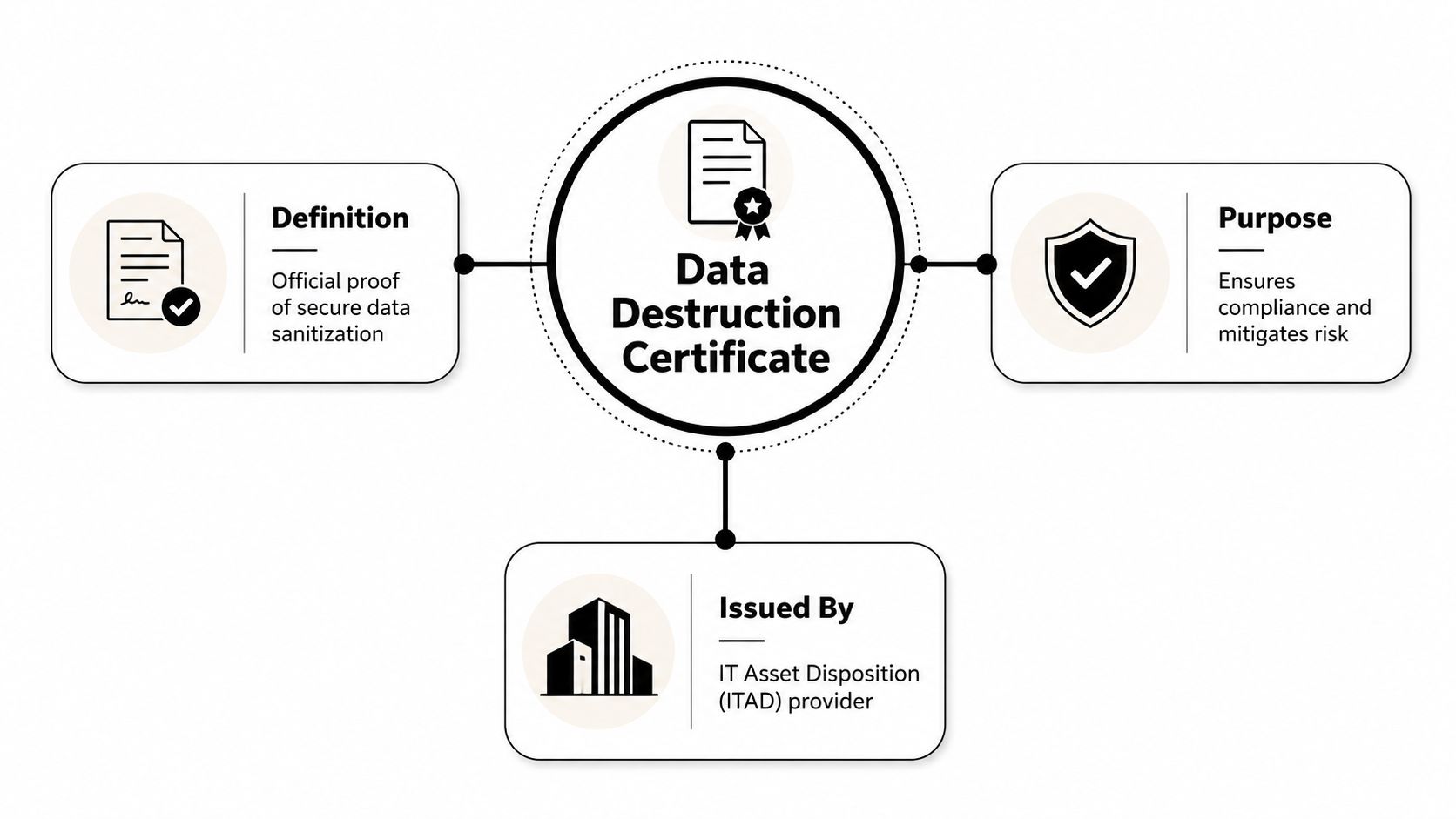
What should an auditor see when a storage asset leaves your facility? In plain language, a data destruction certificate is an official, device-level record showing how a specific storage medium was sanitized and who was accountable for the work.
It isn't a generic receipt for electronic waste pickup. The record should identify the manufacturer, model, serial number, sanitization method, verification method, date, location, and signature of the responsible personnel. The NIST SP 800-88 Rev. 2 guidance states that a certificate of sanitization should be completed for each information storage medium sanitized, according to organizational policy.
Why the record matters
The certificate creates a defensible paper trail at the point where your organization loses direct control of the asset. It can support internal audits, third-party oversight, chain-of-custody reviews, and inquiries about whether reasonable disposal measures were followed.
The document also records the outcome selected for that asset. NIST groups media sanitization into Clear, Purge, and Destroy, with the appropriate choice depending on media type, information sensitivity, and whether the device will be reused or disposed of. A hard drive prepared for internal redeployment may require a different treatment from a failed SSD containing regulated information.
Practical rule: If the certificate can't be mapped to a serial number, it can't provide strong evidence about that individual device.
A certificate is most useful when it connects operational work to a broader IT asset disposition process. That process may include secure electronic waste pickup, serialized inventory, controlled transport, data wiping or physical destruction, recycling documentation, and final disposition reporting. Organizations evaluating certificate requirements can also review Beyond Surplus's certificate of destruction service as part of their vendor comparison.
Required Fields and Documentation Standards
A certificate should allow an independent reviewer to answer a simple question, which asset was processed, by what method, when, where, and under whose responsibility? NIST SP 800-88 Rev. 2 provides the strongest anchor for structuring that record at the device level.
The fields auditors verify
Serialized asset identification comes first. Record the manufacturer, model, serial number, and, where available, the internal asset tag. For mixed loads, the record should distinguish hard disk drives, SSDs, tapes, mobile devices, servers, and other storage media rather than grouping them under a broad equipment description.
The sanitization method must be specific. The certificate should identify whether the asset was processed through Clear, Purge, or Destroy, and should reference the applicable procedure or standard. A statement such as “data removed” doesn't tell an auditor whether the method matched the media type or the organization's disposal policy.
Verification details show how the provider confirmed the result. For logical sanitization, that may involve documenting the verification process and outcome. For physical destruction, the record should describe the destruction method and connect it to the asset inventory.
Date and location establish when and where the work occurred. These details help reconcile the certificate with pickup records, facility logs, transport documentation, and internal retirement tickets.
Responsible personnel and witnesses provide accountability. Authorized signatures, names, roles, or equivalent authentication details identify the people responsible for approving, performing, or witnessing the process.
Why batch language fails
A generic statement such as “about 200 drives destroyed” is weak evidence because it doesn't identify the individual assets. The NIST certificate requirements emphasize one record per storage device, including device-level identifiers and audit details.
Audit test: Start with a serial number in the asset register and trace it through intake, custody, sanitization, certificate issuance, and final disposition.
Procurement teams should request a sample certificate before signing a service agreement. Compare its fields with your asset inventory and ask how exceptions, unreadable serial numbers, failed sanitization attempts, and missing devices are recorded. A practical reference for internal review is Beyond Surplus's destruction certificate format.
Data Destruction Certificate vs Certificate of Recycling
These documents often arrive together, but they don't prove the same thing. A data destruction certificate addresses information security. A certificate of recycling addresses the physical and environmental disposition of equipment.
The first document should show that data-bearing media underwent an identified sanitization or destruction process. The second confirms that equipment or materials entered an identified recycling or recovery pathway. Neither document should be treated as a substitute for the other.
Two different compliance questions
| Document | Primary question answered | Typical evidence |
|---|---|---|
| Data destruction certificate | Was data on the identified storage asset sanitized or destroyed? | Serial number, method, verification, date, location, signatures |
| Certificate of recycling | What happened to the physical equipment or material after processing? | Equipment or load identification, recycling disposition, processing record |
A laptop can be recycled responsibly while its storage media documentation remains incomplete. Conversely, a drive can be destroyed securely while the organization still needs separate evidence showing how the remaining equipment was handled.
The distinction becomes important during computer recycling, data center decommissioning, and medical equipment disposal. A retired server may contain multiple data-bearing components, while a medical device may include storage that must be tracked separately from non-data-bearing assemblies. A laboratory equipment disposal project can create the same separation between information security evidence and environmental disposition records.
Organizations should connect both records through a shared asset list, project reference, or custody identifier. That approach makes it easier to demonstrate that the media listed on the destruction certificate belongs to the equipment covered by the recycling record.
For a document focused on environmental and physical disposition, review Beyond Surplus's recycling certification service. The operational goal is not to create more paperwork. It's to ensure each document answers a different question without leaving a gap between data security and responsible electronics recycling.
Chain of Custody and How It Connects to the Certificate
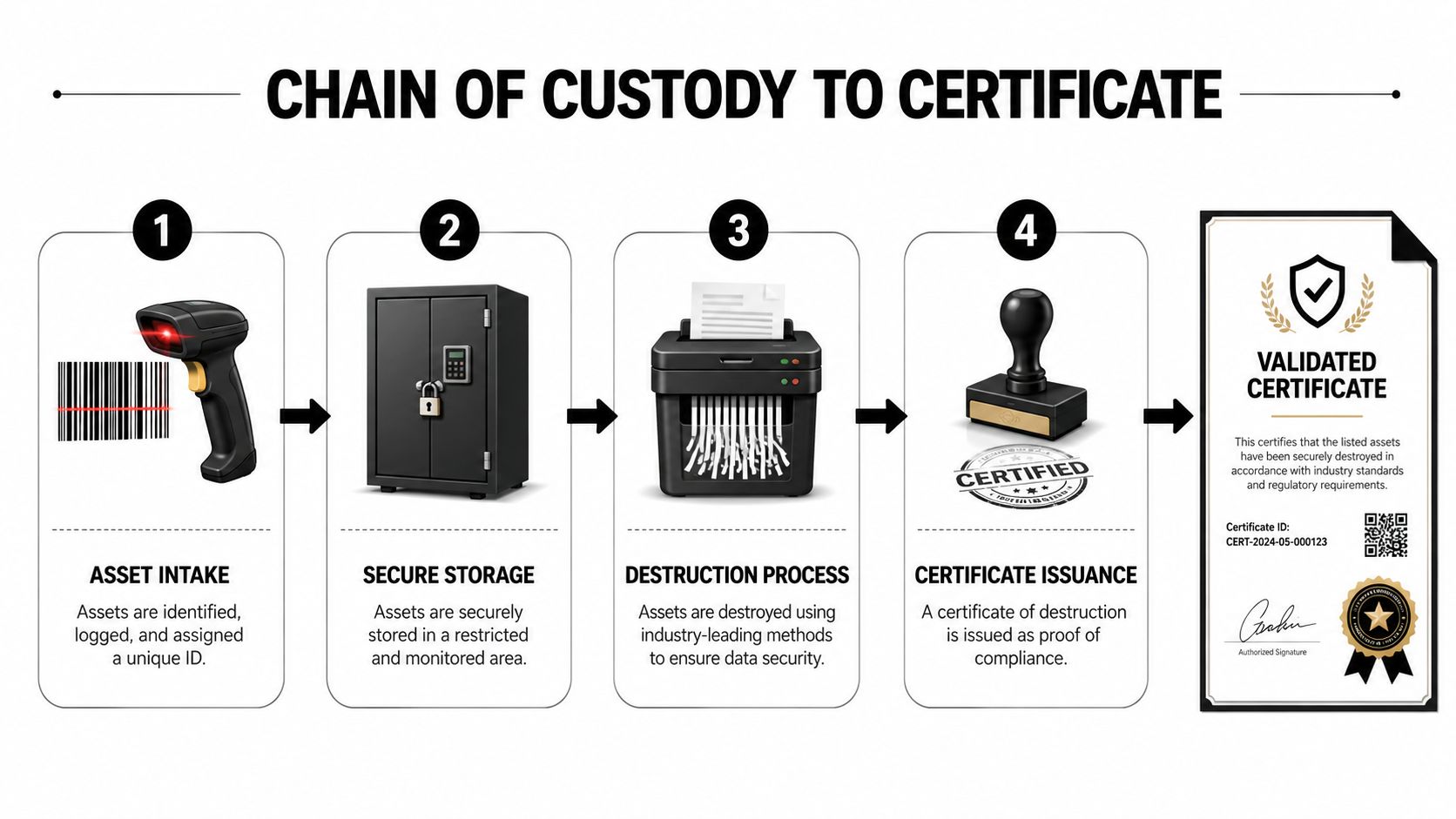
A certificate becomes credible when the organization can show how the asset reached the destruction point. Chain-of-custody documentation is the chronological, unbroken record that follows an asset from collection through transfer, processing, data destruction, and final disposition.
The custody record should begin at intake. Staff scan or record the asset, confirm its condition and identifiers, and note the person or organization transferring custody. Each subsequent handoff should preserve the connection between the physical item and the serialized record.
Building an unbroken record
A workable custody file usually includes:
- Intake evidence: The original asset list, pickup documentation, condition notes, and serial capture.
- Transfer evidence: Vehicle, carrier, facility, or employee handoff records showing who controlled the assets.
- Processing evidence: Secure storage records, work orders, destruction logs, and exception reports.
- Certificate linkage: A certificate identifier, asset list, method, date, location, and responsible signatures.
- Final disposition: Recycling, resale, reuse, or other disposition documentation tied back to the same assets.
Independent ITAD guidance describes this record as a chronological trail from collection to final disposition and notes that certificates may include a unique verification ID, asset list, methods used, and destruction date. Organizations designing controlled evidence areas may also find this evidence storage room design guide useful when planning secure intake and records handling.
The certificate should not appear as an isolated PDF detached from the project file. Its serial numbers should reconcile with the intake inventory, and its date and location should align with processing records. If an asset is missing, unreadable, or diverted to another method, the exception should be visible rather than omitted.
A practical custody workflow can be documented through Beyond Surplus's chain-of-custody documentation. The provider's procedures should give your team enough information to reconstruct what happened without relying on informal emails or memory.
Legal and Compliance Implications
Secure disposal is a compliance responsibility, not merely a technical preference. Under the FTC Disposal Rule, businesses and individuals that maintain consumer reports or records for a business purpose must take appropriate measures to dispose of sensitive information. The rule has been in force since 2005, making secure disposal a compliance issue across industries rather than only an IT department concern. The FTC Disposal Rule provides the governing reference.
A certificate supports the evidence of reasonable measures, but it doesn't transfer responsibility away from the organization that controlled the data. If a vendor mishandles a device, the original organization can't assume that a certificate alone eliminates its obligations.
How regulated teams use the evidence
Financial institutions commonly pair destruction certificates with serialized inventories, witness signatures, destruction timestamps, and custody records. Those materials help demonstrate that the organization selected and followed a reasonable disposal process under applicable safeguards obligations.
Healthcare organizations face a similar operational need when equipment may contain protected health information. A certificate can document the treatment of a storage asset, but the broader record should show authorization, custody, method selection, verification, and final disposition. The certificate is evidence within the control framework, not the complete framework.
Government agencies, manufacturers, schools, and enterprise operators also need policies that define who can approve destruction, which media types require physical destruction, how exceptions are escalated, and where records are retained. The policy should match the organization's risk profile and contractual obligations.
Liability remains with the data-controlling organization until the information is permanently destroyed.
The evidence requirements can extend beyond U.S. rules when an organization serves international customers or operates across jurisdictions. Teams reviewing privacy obligations may use this resource on GDPR compliance for business for broader context, while keeping the destruction certificate tied to the actual media and process.
Government guidance outside the United States can be more prescriptive about physical destruction evidence. UK secure-sanitization standards, for example, require destruction to reduce media to particles of 6 mm or less, and require the achieved particle size to be verified and recorded on the destruction certificate. That requirement illustrates why a certificate should document the actual method and verification result rather than rely on a general declaration.
NIST Sanitization Categories and Certificate Documentation
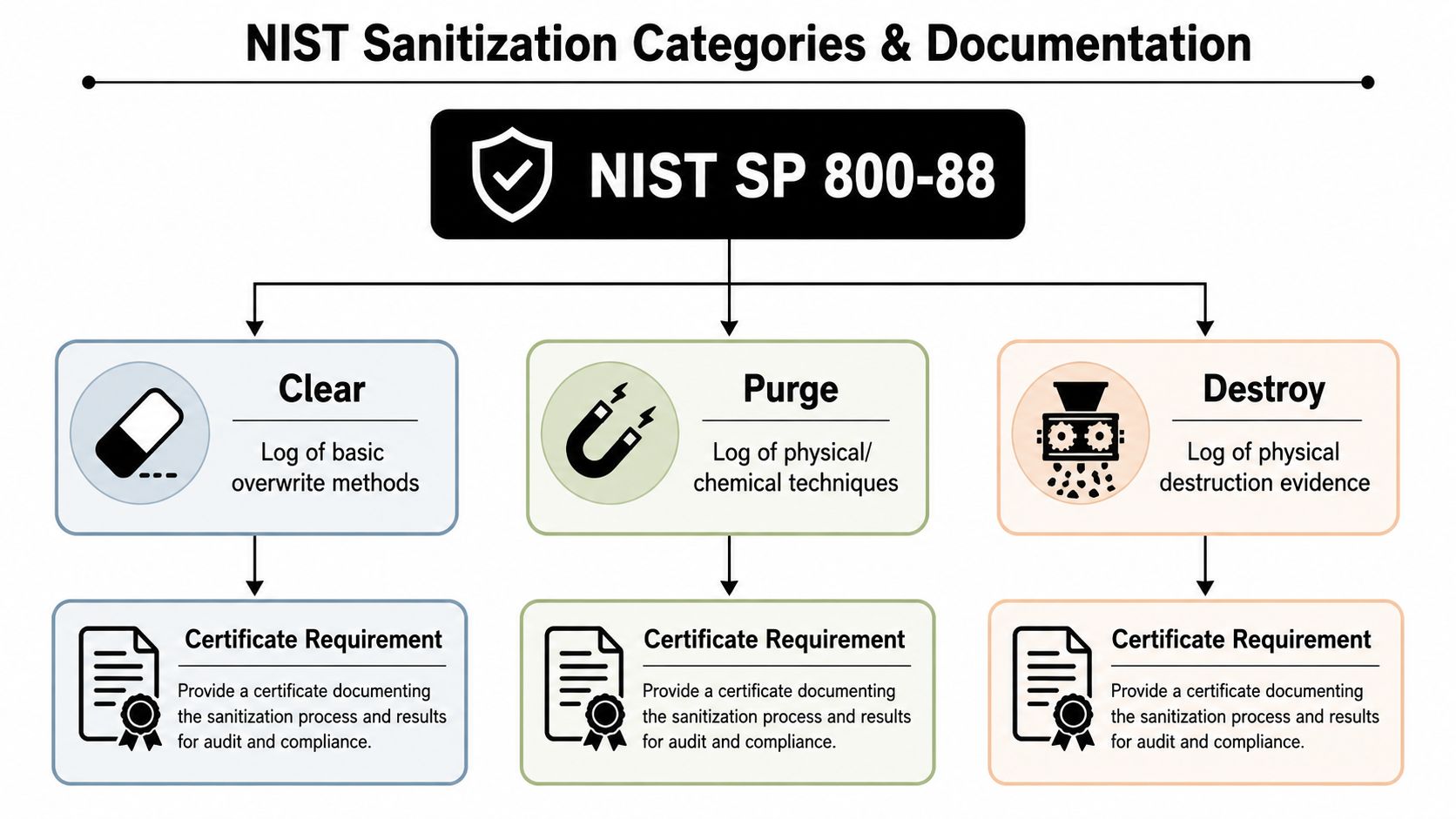
NIST SP 800-88 gives organizations three outcomes to document, Clear, Purge, and Destroy. The category selected should reflect the media type, data sensitivity, and intended disposition. A certificate that names only “wiping” leaves too much ambiguity because everyday language doesn't establish the assurance level or the technical approach.
Clear
Clear uses logical techniques to address user-accessible storage locations. It may fit assets that remain within an organization's controlled environment when policy permits that outcome. The certificate should still identify the asset, procedure, verification method, date, location, and responsible personnel.
Purge
Purge uses logical or physical techniques intended to make recovery infeasible using state-of-the-art laboratory methods. It requires careful method selection, particularly for SSDs and flash media, where device architecture can affect how sanitization reaches stored data.
The record should identify the purge technique or approved procedure and show how the result was verified. If the device is being released outside the organization's control, the certificate should make the stronger method visible to a reviewer.
Destroy
Destroy physically destroys the media. The certificate should describe the destruction method and connect the result to the specific serial number or asset identifier. For hard drives, SSDs, tapes, and failed storage, physical destruction may be selected when policy, sensitivity, condition, or disposition requirements make reuse inappropriate.
Method selection must reach the certificate
The method should never be chosen only because it is convenient for the vendor. Start with the information classification, identify the media, determine whether the device will be reused or destroyed, and then document the selected NIST category.
NIST SP 800-88 Rev. 2 is the controlling reference for NIST media sanitization guidance. Its framework helps procurement and security teams ask the right questions, but each organization still needs a policy that defines acceptable outcomes for its own data and assets.
A mixed-device project should not receive one undifferentiated statement. SSDs, tapes, mobile devices, and traditional hard drives may require different methods and different verification records. The certificate should preserve those distinctions.
How Organizations Obtain Data Destruction Certificates
The process starts before the pickup. A business should define the assets in scope, identify data-bearing media, classify the information, and tell the ITAD provider whether the project requires Clear, Purge, or Destroy outcomes.

What to request before service
Ask the provider for a sample certificate, custody workflow, exception process, and asset reconciliation method. Confirm that the final report will include individual serial numbers where available, the exact method applied, verification details, date, location, and responsible personnel.
On-site destruction can reduce transport exposure and may support direct observation, but it requires suitable space, equipment, safety controls, and scheduling. Off-site processing can provide controlled facility operations and specialized equipment, but the custody trail must clearly document collection, transport, receipt, secure storage, processing, and certificate issuance.
The provider should also explain how it handles assets with missing or damaged labels. A process that removes unidentifiable items from the certificate creates a reconciliation problem. The exception log should show what happened, who reviewed it, and how the asset was ultimately resolved.
The operational sequence
- Inventory the load: Record serial numbers, asset tags, device types, locations, and any special handling requirements.
- Transfer custody: Capture the handoff from your staff to the provider or transportation partner.
- Secure the assets: Restrict access while items await sanitization, destruction, resale, or recycling.
- Process each medium: Apply the approved method and record verification or destruction details.
- Reconcile the records: Compare processed assets with the original inventory and document exceptions.
- Issue the evidence package: Deliver the per-device certificate with custody, intake, exception, and final disposition records.
Beyond Surplus provides commercial ITAD services that include secure data destruction, hard drive shredding, certified data wiping, electronics recycling, product destruction, IT equipment disposal, and data center de-installation. It coordinates logistics through its own fleet and transportation partners and serves business projects across the contiguous United States. The certificate should be delivered as part of the completed compliance file, not as a replacement for that file.
Common Mistakes and Audit Red Flags
The biggest mistake is assuming the certificate alone satisfies an audit. Auditors may also request chain-of-custody records, intake reports, exception logs, and final disposition documents, as outlined in recent certificate guidance.
Other warning signs include:
- Batch-only descriptions: “About 200 drives destroyed” doesn't identify the individual assets and is weak evidence.
- Missing method detail: “Data erased” doesn't show whether Clear, Purge, or Destroy was used.
- No verification record: A claimed sanitization without a documented verification method leaves the result difficult to defend.
- Unresolved exceptions: Missing serial numbers, failed drives, and unprocessed items should appear in an exception log.
- Mixed-media ambiguity: SSDs, tapes, mobile devices, and traditional drives shouldn't be grouped when their methods differ.
- Disconnected paperwork: A certificate that can't be reconciled with intake and transport records creates a custody gap.
Cloud-era decommissioning adds another control question. Even when a physical device isn't the only storage location, the organization still needs a documented process for retiring hardware, terminating access, and preserving the evidence required by its policy and contracts. A paper certificate can't prove controls that were never defined.
Quick Reference Certificate Best Practices
Use this checklist when reviewing an ITAD provider, writing procurement requirements, or preparing for an internal audit.
| Requirement | Standard or Regulation | Best Practice |
|---|---|---|
| Per-device identification | NIST SP 800-88 Rev. 2 | Record manufacturer, model, serial number, and asset tag where available. |
| Sanitization category | NIST SP 800-88 Rev. 1/2 | Identify Clear, Purge, or Destroy for each media type. |
| Verification | Organizational policy and NIST guidance | Record how the result was checked and whether it passed. |
| Custody trail | ITAD chain-of-custody practice | Link intake, transfers, processing, and final disposition to the same asset record. |
| Destruction evidence | FTC Disposal Rule | Retain the certificate with inventory, signatures, timestamps, and related records. |
| Environmental disposition | Recycling documentation | Keep the recycling certificate separate from, but linked to, the destruction certificate. |
| Mixed-device handling | Media-specific sanitization controls | Avoid generic batch statements for SSDs, tapes, mobile devices, and other media. |
| Retention and retrieval | Internal policy and contractual duties | Store certificates and supporting records together in a controlled, searchable location. |
Review records for completeness before closing the project. The strongest compliance workflow can retrieve a certificate from a serial number, show every custody transfer, explain every exception, and connect the destroyed media to final disposition.
Beyond Surplus provides commercial electronics recycling, secure IT asset disposal, certified data wiping, hard drive shredding, product destruction, and ITAD logistics with documentation designed for audit review. Visit Beyond Surplus to discuss a serialized data destruction and recycling program for your organization.


