

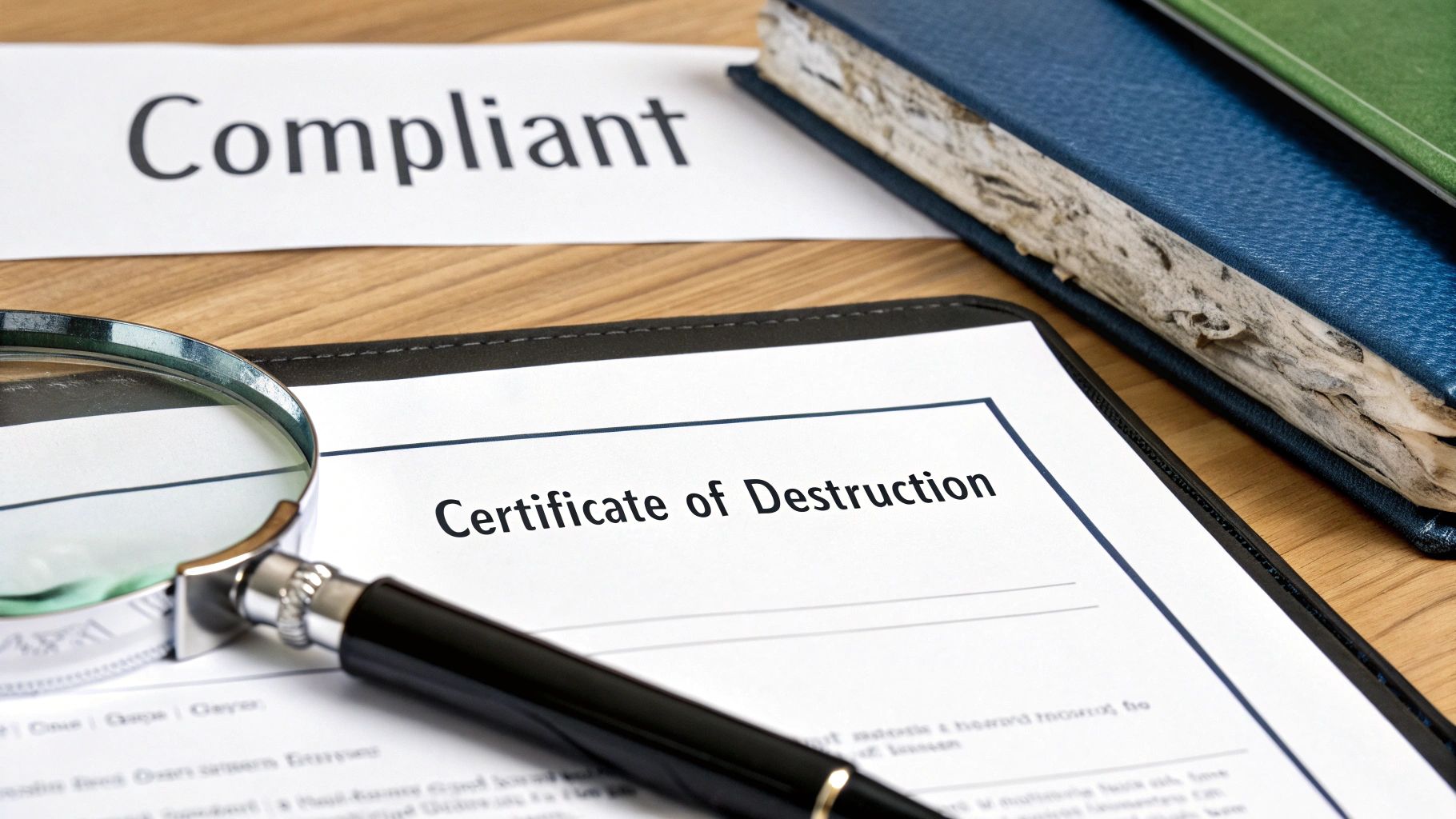
A compliant destruction certificate format is your official, auditable proof that sensitive business assets—and the data they held—are gone for good. For IT and facilities managers, this document is the final, critical link in the chain of custody. This certificate is what formally transfers liability, protecting your organization from the legal and financial repercussions of a data breach by proving you executed due diligence.
Without a properly formatted certificate, your company cannot produce the tangible evidence needed to satisfy auditors, regulatory bodies, or your internal compliance team. A weak or incomplete document leaves a dangerous gap in your data security and IT asset disposal (ITAD) process, creating unnecessary risk for your business.
What Goes Into a Compliant Destruction Certificate
At its core, a certificate of destruction is more than just a receipt. It's a legally defensible document that tells the complete story of a business asset's end-of-life journey. It must clearly answer the who, what, where, when, and how of the entire IT asset disposal process. Every field on that certificate serves a purpose in building a transparent and verifiable record for your enterprise.
Key Elements of an Audit-Ready Certificate
For a certificate to hold up under the scrutiny of an audit, it must contain several non-negotiable data points. These are essential components that work together to create a rock-solid record for commercial compliance. If even one of these is missing, the entire document's validity can be questioned, putting your business at risk.
Here’s a breakdown of the critical data that transforms a simple piece of paper into a defensible compliance document for your company.
Core Components of a Defensible Destruction Certificate
| Field Name | What It Covers | Why It's Essential for Business Compliance |
|---|---|---|
| Unique Certificate ID | A specific tracking number for the certificate itself. | Prevents duplication and ensures it can be easily referenced in any business audit. |
| Detailed Asset Description | A complete list of items destroyed, including make, model, and unique serial numbers. | Provides granular proof of exactly which business assets were destroyed, leaving no room for ambiguity. |
| Client Information | The full legal name and address of the organization whose assets were destroyed. | Clearly identifies the owner of the data and assets at the time of destruction for your business records. |
| Destruction Vendor Details | The name, address, and contact info of the certified ITAD partner that performed the service. | Establishes the responsible third party and their credentials for performing the work for your enterprise. |
| Method of Destruction | A precise description of the process used, like NIST 800-88 Purge or on-site shredding. | Details the specific compliance standard met (e.g., HIPAA, FACTA) for data sanitization. |
| Date and Location | The exact date and physical address where the destruction took place. | Creates a definitive timeline and geographical record for the chain of custody. |
| Authorized Signatures | Signatures from personnel at both the client and vendor organizations. | Serves as a formal attestation from both parties that the information is accurate and the service was completed. |
These fields are the bedrock of a certificate you can count on. The format itself has evolved, driven by stricter regulations and industry best practices for commercial IT asset disposal. Today, the expectation for business-to-business services is complete transparency.
For a deeper look into our own documentation and process, you can review Beyond Surplus's approach to the Certificate of Destruction.
Aligning Your Certificate With Major Compliance Mandates
A certificate of destruction isn't just an internal document for your records—it's your proof of compliance for external regulations that govern your business. Various laws and industry standards don't just dictate that you have to destroy data, but also how you prove you did it. If your certificate can't stand up to scrutiny, your entire IT asset disposal process could be considered indefensible during an audit.
Regulations are the "why," and the specific fields on your certificate are the "how." The Health Insurance Portability and Accountability Act (HIPAA), for example, places a massive emphasis on protecting patient health information (PHI). A simple receipt from a recycler won't suffice for any healthcare-related business. HIPAA's strict rules directly influence the need for detailed asset tracking by serial number and witness signatures, creating a solid, verifiable chain of custody for any device that ever handled PHI.
Connecting Legal Requirements to Certificate Fields
Different regulations focus on different aspects of the destruction process, and your business documentation needs to reflect that. Understanding this connection is the key to creating an audit-proof paper trail.
- HIPAA: This is all about patient privacy. Your certificate must prove that devices holding electronic PHI were sanitized or destroyed so the data is completely irretrievable. This means you need to explicitly state the destruction method used.
- FACTA (Fair and Accurate Credit Transactions Act): The goal here is to prevent identity theft. FACTA requires businesses to destroy consumer information properly. Your certificate should list the types of media destroyed, like "customer credit reports" or "employee financial records."
- GDPR (General Data Protection Regulation): With its famous "right to be forgotten," GDPR emphasizes accountability. A GDPR-compliant certificate should document the specific data categories destroyed and confirm the process was finished on time, proving your organization is accountable.
A solid certificate of destruction is your business's first line of defense in an audit. It should answer an auditor's questions before they're even asked, clearly showing you followed the legal frameworks for your industry.
Broader Compliance and Industry Standards
Beyond specific laws, you also have industry standards that shape best practices for destruction documentation. These frameworks often provide the technical "how-to" for meeting your legal obligations.
The global demand for compliant IT asset disposal has exploded, with the number of destruction certificates issued now topping 1 million every year. This growth has helped standardize what a good certificate looks like for businesses, often referencing frameworks like NIST, ISO/IEC, and GDPR right on the template.
Following guidelines like NIST SP 800-88 is non-negotiable for most organizations. Your certificate should reference the specific sanitization method, such as "NIST 800-88 Purge." You can learn more about how we align our own processes with these critical standards in our overview of the NIST SP 800-88 standard.
And for a wider view, it's also helpful for businesses to start understanding SOC compliance and how frameworks like it impact the entire data lifecycle, including destruction.
Real-World Examples of Destruction Certificate Templates
Theory is one thing, but seeing how a destruction certificate looks in a real-world business context is crucial. The details that matter most on a certificate change based on how the data was destroyed. Physically shredding a hard drive requires a different set of verifiable details than wiping it with software.
Let's break down two distinct templates for commercial ITAD. These examples will show you the nuanced information needed for each process, so you can confidently evaluate vendor documents for your business.
Certificate of Hard Drive Shredding Example
When you physically destroy a business asset, the certificate’s job is to prove the media is gone—forever. The document focuses entirely on the physical chain of custody, the specific equipment used, and the final, shredded state of the material. This document is your definitive proof that a hard drive was turned into tiny, irrecoverable pieces of metal and plastic.
A solid shredding certificate for your business will always include:
- Destruction Equipment Details: This isn't just "a shredder." It should list the make, model, and serial number of the machine. This is non-negotiable for audit trails, as it proves certified, properly functioning equipment did the job.
- Final Shred Size: The certificate must state the final particle size, whether it's 2mm or 10mm. This detail is directly tied to compliance standards like NAID AAA, as some regulations mandate a specific shred size to guarantee data is unrecoverable.
- Witness Attestation: The names and signatures of the people who physically watched the destruction take place. This adds a crucial layer of human verification, confirming the process happened just as described.
- Photo or Video Evidence Log: While the photos themselves aren't usually on the certificate, the document should reference an accompanying log of visual proof, typically tied to a unique job or project number.
This intense focus on the physical process is everything. For businesses that need to prove complete, irreversible physical elimination of IT assets, our secure hard drive destruction services deliver this exact level of detailed, audit-ready documentation.
Certificate of Data Erasure Example
On the other hand, a certificate for data erasure (or "wiping") certifies that the data is gone, but the physical drive is still perfectly intact and can be reused. Here, the burden of proof shifts from the physical to the digital. The document focuses on the software, the standards, and the verification methods used to sanitize the media.
Key fields you’ll only find on a data erasure certificate include:
- Erasure Software Information: The certificate has to name the software used—like Blancco or KillDisk—and its specific version number. This is critical because different software versions are certified to meet different security standards for enterprises.
- Sanitization Standard Applied: This field clearly states the guideline that was followed, such as "NIST 800-88 Purge" or "DoD 5220.22-M." For proving regulatory compliance for your business, this is arguably the single most important detail on the page.
- Verification Method: It must describe how the erasure was double-checked. You’ll often see phrases like "100% sector-by-sector verification" or a final checksum value. This confirms the overwrite process didn't miss anything.
- Drive Health Status: Since the drive is meant for reuse, the certificate often includes post-erasure diagnostics. This might note the drive's S.M.A.R.T. status, its overall health, and whether any bad sectors were remapped.
The core difference is simple: a shredding certificate proves the container is destroyed, while an erasure certificate proves the contents have been forensically removed, leaving the container viable for reuse in a business environment.
Physical vs Digital Destruction Certificates at a Glance
To make the distinction even clearer, this table breaks down the unique information required for each type of destruction certificate for commercial clients.
| Information Field | Essential for Hard Drive Shredding | Essential for Data Erasure |
|---|---|---|
| Asset Serial Number | Yes | Yes |
| Date & Time of Destruction | Yes | Yes |
| Witness Signatures | Yes | No (Optional) |
| Shredder Model & Serial Number | Yes | No |
| Final Shred Particle Size | Yes | No |
| Erasure Software & Version | No | Yes |
| Sanitization Standard (e.g., NIST) | No | Yes |
| Verification Method | No | Yes |
| Post-Erasure Drive Health | No | Yes |
Understanding these key differences helps your business choose the right data destruction method and, just as importantly, demand the right kind of proof for your specific security, compliance, and operational needs.
Why Chain of Custody Is the Backbone of Your Certificate
A destruction certificate might be the final chapter in your business's IT asset story, but its credibility is built long before anyone signs on the dotted line. That story begins with a solid chain of custody—the chronological paper trail that documents and validates the entire disposal process. Without this unbroken record, your certificate is just a piece of paper making claims your business cannot back up.
A shaky chain of custody makes your final certificate vulnerable to questioning during an audit. It’s the meticulous tracking that transforms a standard document into an irrefutable, legally defensible record of destruction for your enterprise.
This infographic shows how documentation differs for the two main destruction methods, shredding and erasure, and how a robust chain of custody supports both for business needs.
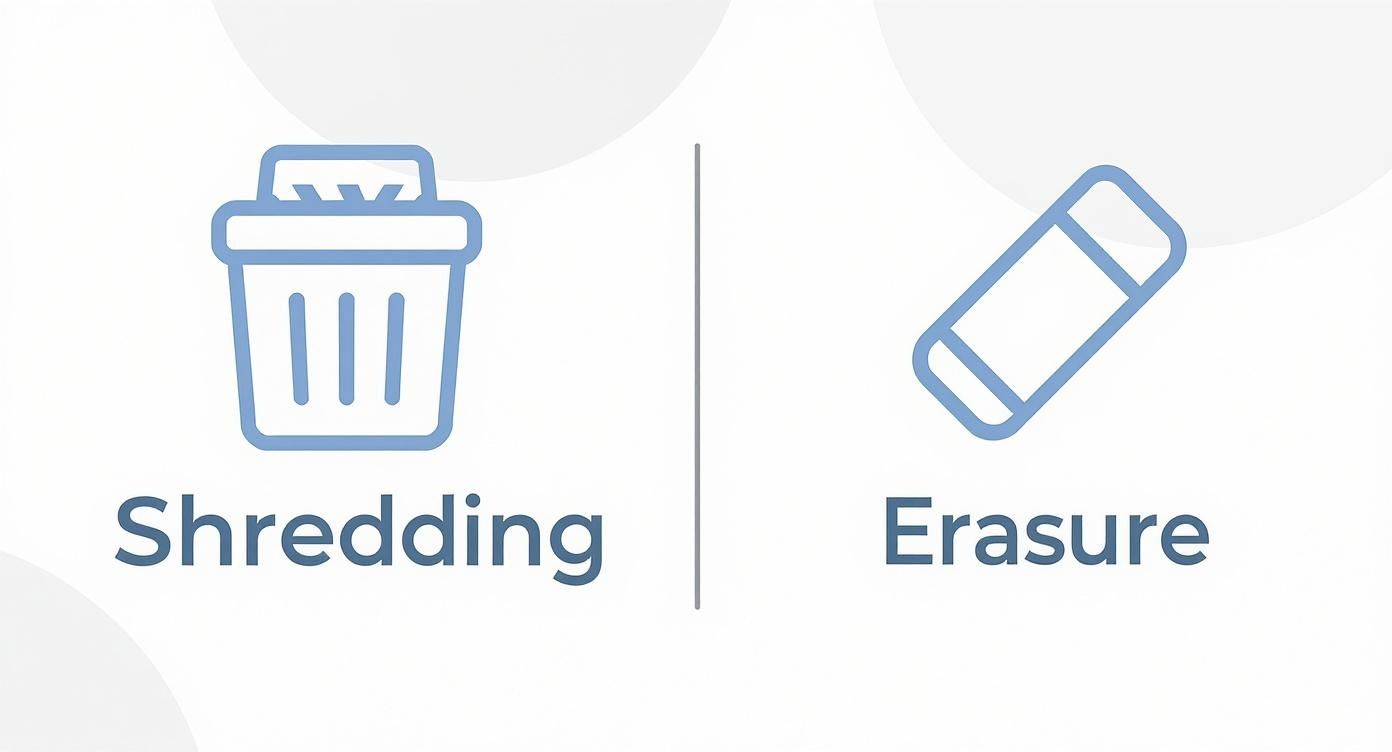
You can see that while both methods demand rigorous tracking, the specific evidence documented on the certificate changes to prove either physical elimination or digital sanitization, both crucial for business ITAD.
Tracing the Asset Journey from Start to Finish
A professional ITAD partner like Beyond Surplus documents every single touchpoint, making sure no business asset is ever lost, misplaced, or compromised. We capture this journey through a series of interlocking documents that build on one another, creating a seamless and transparent narrative from your business's door to our facility.
This commercial process typically includes:
- Initial Pickup Logs: This is where it all starts. We record the date, time, location, and a full manifest of all business assets being collected from your facility, often verified by scanning every serial number.
- Secure Transport Manifests: Once your assets are loaded onto a secure vehicle, a transport manifest is created. This document tracks the equipment from your door to our processing facility, ensuring a secure handoff for your enterprise assets.
- Facility Intake Reports: Upon arrival, every single asset is scanned again and reconciled against the original pickup log. This critical step confirms that everything we collected has arrived safely and is accounted for.
The real power of a chain of custody for your business is in its continuity. An unbroken, documented trail from your office to the final point of destruction is what gives your Certificate of Destruction its true authority and legal weight.
Validating the Claims on Your Final Certificate
Every step in that chain of custody directly supports the claims made on your final certificate. When the document states that "Hard Drive XYZ, Serial #12345" was physically shredded on a specific date, the preceding logs prove exactly when and how that drive got to the facility. It creates a powerful, auditable record that leaves no room for doubt.
The industry is moving toward standardized destruction certificate formats for this very reason—the need for provable compliance for businesses. In fact, industry reports now show that over 70% of large enterprises use a certificate for every single destruction event. Many are even adopting modern formats with QR codes for instant record verification. This trend highlights how crucial a transparent chain of custody has become for commercial operations.
Ultimately, this meticulous record-keeping is a core piece of what IT Asset Disposition is. It transforms a simple disposal task into a secure, compliant, and fully documented process your business can trust.
How We Deliver Audit-Ready Destruction Certificates
Let's move from general advice to our specific, battle-tested process for business clients. At Beyond Surplus, we deliver peace of mind through documentation. A certificate is only as strong as the process behind it, and ours is built on a foundation of meticulous tracking and transparency for commercial needs.
We don't just issue documents; we deliver an audit-ready paper trail that stands up to the toughest scrutiny for your business. Our entire system is designed to eliminate guesswork and transfer liability away from your organization. It all starts the moment we arrive at your facility.
Proprietary Tracking from Door to Disposition
We use our own tracking technology that links every single business asset to your project from the very beginning. Each device—whether it's a server, laptop, or hard drive—is scanned and logged by its unique serial number. This creates a seamless, unbroken chain of custody that follows the asset from your business location to its final disposition.
This real-time tracking means there are no gaps in the record. When your final Certificate of Destruction is generated, every single asset listed is directly tied back to that initial scan, proving its journey and confirming its secure handling at every stage.
Our process is engineered to create an irrefutable link between the asset that left your facility and the final destruction event. This level of detail is what makes our documentation not just compliant, but truly defensible for your business.
Key Features of Our Client Reports
The final document your business receives is more than a simple certificate. It's a comprehensive report designed for compliance managers and IT auditors who need to see the details.
Our commercial reports consistently include:
- Granular Asset Lists: You get a detailed manifest listing every device by make, model, and, most importantly, serial number.
- Clear Destruction Method Notation: The certificate explicitly states the method used, whether it was physical shredding to a specific particle size or data erasure compliant with NIST 800-88 Purge.
- Direct Compliance References: We reference the specific industry standards met during the process, giving your compliance team the exact language they need for their records.
- Chronological Chain of Custody: The documentation package includes records of pickup, transport, and facility intake, validating the entire process from start to finish.
This meticulous approach ensures your business records are not just complete but also contribute positively to your overall compliance standing. Ensuring your certificates are ready for any scenario is crucial, especially when you're preparing for a DOT audit. We apply this same level of detail to our secure and sustainable product destruction services, providing the same audit-ready proof for branded goods or prototypes. Our goal is simple: provide documentation that answers an auditor’s questions before they even ask.
Common Questions About Destruction Certificates
Even with a clear process, a few practical questions always come up when businesses manage IT asset end-of-life. We get these all the time from IT managers and business owners. Here are the answers to the most common queries to help your business stay on top of its compliance duties.
How Long Should Our Business Keep Certificates of Destruction on File?
This isn't a one-size-fits-all answer; it depends on your industry and internal governance policies. A good rule of thumb for most general business records is to retain them for 3 to 5 years.
However, if your business is in a field governed by stricter mandates like HIPAA or SOX, that requirement can stretch much longer—often 6 to 7 years, or in some cases, indefinitely. The key is to always align your retention policy with the most stringent regulation that applies to your business. We always recommend digital storage for long-term retention. It makes them easy to find during an audit and protects them from getting lost or damaged.
Is a Certificate of Destruction Different from a Certificate of Erasure?
Yes, and this is a critical distinction for any business. They certify two completely different outcomes for your IT assets, so it's important to know which one you need.
- A Certificate of Destruction confirms the physical media—like a hard drive or SSD—has been completely destroyed. This usually means shredding or degaussing, which makes the device and its data permanently unrecoverable.
- A Certificate of Erasure, on the other hand, verifies that the data on a drive has been forensically overwritten using certified software, typically following standards like NIST 800-88. This process sanitizes the drive, but the physical hardware is left intact and can be reused or resold.
Each certificate format will have different technical details specific to the method used. One focuses on physical finality, while the other is all about digital sanitization for your business assets.
Can Our Business Get a Certificate for Destroying Things Other Than Hard Drives?
Absolutely. A Certificate of Destruction is a vital tool for creating a legal record of disposal for any item that holds sensitive business information or represents your brand. This practice isn't just for data-bearing media.
We've created certificates for everything from company ID badges and product prototypes to branded merchandise, recalled products, and even old employee uniforms. The destruction certificate format is flexible enough to accommodate these business needs.
The core principle is always the same. The certificate must accurately describe what was destroyed, the specific method used, the date it happened, and the authorized people who witnessed or performed it. This documentation creates an auditable trail that proves your business handled the disposal securely and responsibly, protecting your brand and intellectual property.
Contact Beyond Surplus for certified electronics recycling and secure IT asset disposal. We provide meticulously detailed, audit-ready documentation for every asset your business retires to ensure compliance and protect your organization. Learn more at https://www.beyondsurplus.com.


