

2025-2026 has been a defining period for ESG compliance. The EU reduced mandatory ESRS datapoints by 57% and the full mandatory-plus-voluntary set by 68%, while global regulatory fragmentation continues to make evidence management more important than report production alone.
What changed when regulators simplified ESG rules instead of expanding them? Many compliance teams are still using older templates, collecting broad sustainability data, and treating the annual report as the main deliverable. That approach can leave an organization with too much irrelevant information and too little proof for the claims that matter.
The practical question is now narrower and harder: which ESG compliance requirements apply to this entity, at what date, and what operational evidence can defend the disclosure? That means tracking thresholds, assigning data ownership, preserving records, and connecting environmental and social metrics to financial reporting workflows.
Table of Contents
- Understanding the Current ESG Compliance Landscape
- Comparing Major ESG Frameworks and Regulations
- Building an Operational Compliance Strategy
- Sector-Specific ESG Obligations and Requirements
- Common Pitfalls and Compliance Misconceptions
- Practical Compliance Checklist and Next Steps
Understanding the Current ESG Compliance Landscape
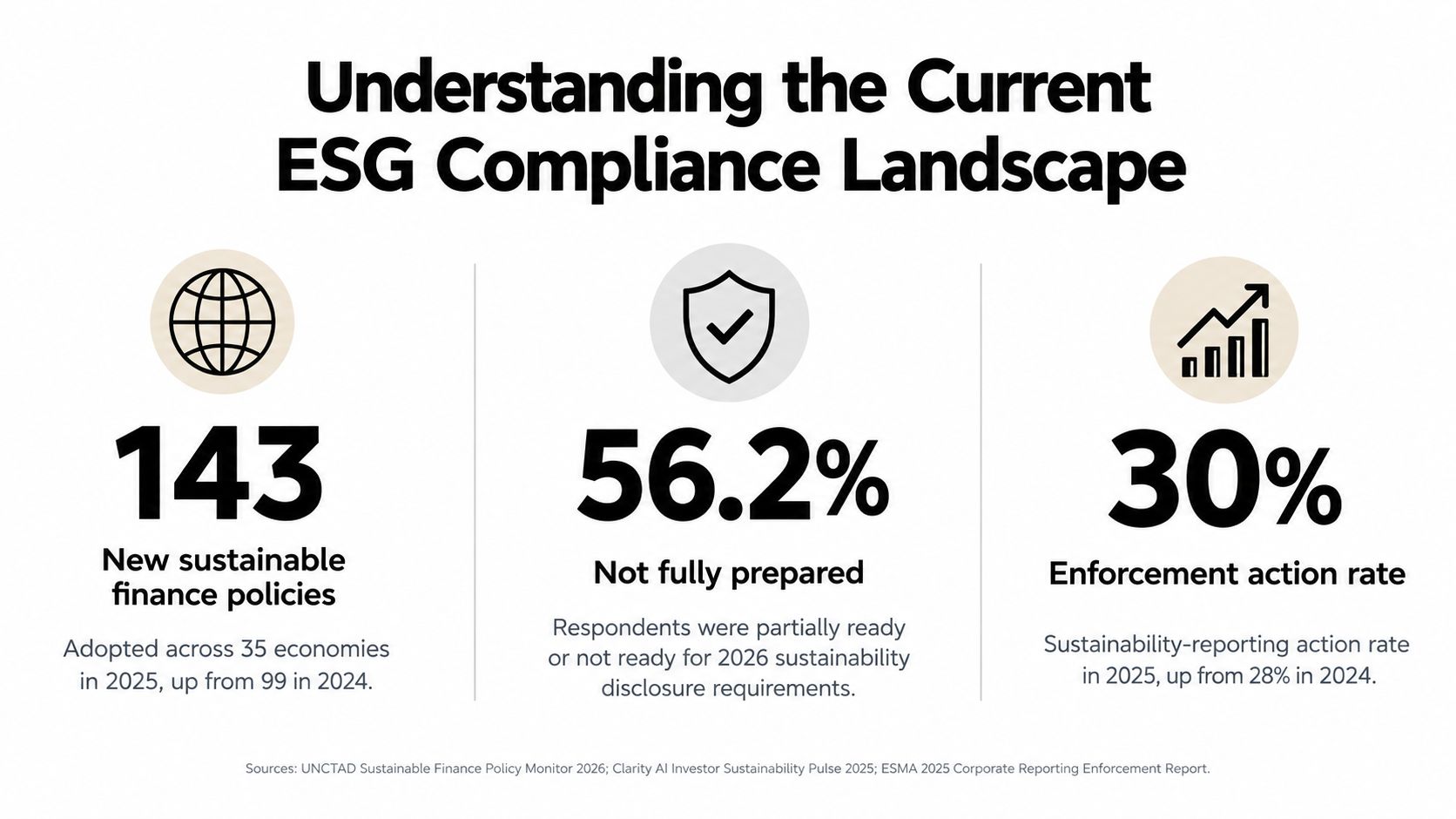
The EU's 2025 Omnibus process changed the direction of ESG reporting. It reduced the number of mandatory ESRS datapoints by 57% and reduced the combined mandatory and voluntary set by 68%, according to KPMG's analysis of the EU sustainability reporting changes. Simplification doesn't mean that compliance is now easy. It means companies must distinguish between legal obligations, value-chain requests, and information that older templates may still collect unnecessarily.
For EU-facing organizations, recent guidance narrows the CSRD population to companies with more than 1,000 employees and turnover above EUR 450 million, with reporting through ESRS in the management report, according to EY's 2026 technical summary. Non-EU groups can also fall within scope when the relevant EU subsidiary or branch and group turnover thresholds are met. That requires legal-entity tracking, not a single group-level sustainability profile.
Scope is only the first decision
A defensible program begins by classifying every request:
- Mandatory disclosure: Information required by a law or reporting standard applicable to the entity.
- Counterparty expectation: Data requested by a customer, lender, investor, or procurement team, even when the request isn't itself a statutory obligation.
- Internal management information: Metrics used to manage risk but not necessarily disclosed externally.
- Unsupported legacy collection: Fields retained because an old questionnaire or spreadsheet still contains them.
The last category creates unnecessary workload and can introduce contradictions. A supplier may submit one emissions figure to procurement, another to finance, and a third to a sustainability platform because nobody has documented the source, owner, calculation method, or reporting boundary.
Practical rule: A smaller evidence set with clear ownership is more defensible than a larger dataset nobody can reconcile.
The current situation also varies by jurisdiction. The EU has been simplifying and postponing parts of CSRD, CSDDD, and EUDR, while U.S. states continue introducing disclosure and product-related requirements, creating overlapping obligations for multinational firms, as described in Harvard Law School Forum's review of ESG regulatory shifts. A practical program therefore needs an applicability register, effective dates, entity scope, evidence standard, and responsible owner for each requirement.
For operational teams, that may include records for energy use, waste streams, equipment retirement, supplier attestations, data destruction, transportation, and recycling outcomes. A business assessing local implications can also review ESG reporting trends for Atlanta businesses when technology disposition forms part of its environmental reporting.
Comparing Major ESG Frameworks and Regulations
The SEC, CSRD, and IFRS S1 don't ask the same materiality question. Treating them as interchangeable creates gaps, especially when a finance team assumes that a topic omitted under one framework can automatically be omitted everywhere.
The SEC climate rule focuses on climate-related risks that have materially affected, or are reasonably likely to materially affect, business strategy, results of operations, or financial condition. It also addresses board oversight, management's role, risk-management processes, and material climate-related targets or goals, according to the SEC's final rule announcement. The rule has faced legal and regulatory developments, so organizations should confirm its current applicability before relying on a filing timetable.
CSRD uses double materiality. An organization considers both how sustainability matters affect the business and how the business affects society and the environment. For non-EU companies, major reporting summaries identify EU net turnover above €150 million for two consecutive years, together with at least one large or listed EU subsidiary or branch, as a route into scope under the broader CSRD framework, while newer 2026 guidance narrows the operative scope for EU-facing organizations. Companies must therefore document which version of the rules and which scope test they applied.
IFRS S1 takes a financial-materiality approach. The entity discloses material sustainability-related risks and opportunities that could reasonably be expected to affect its prospects. Information is material when omitting, misstating, or obscuring it could influence decisions by primary users of general-purpose financial reports, as set out in the issued IFRS S1 requirements.
ESG Framework Comparison
| Framework | Materiality Approach | Key Disclosure Requirements | Reporting Timeline |
|---|---|---|---|
| SEC climate rule | Financial materiality | Material climate risks, board oversight, management processes, and certain material targets. Scope 1 and Scope 2 emissions apply to specified filers only when material. | Confirm current applicability and filing status before setting the reporting calendar. |
| CSRD and ESRS | Double materiality | Sustainability impacts, risks, opportunities, governance, strategy, targets, emissions, and financial effects of severe weather where applicable. | Large listed entities prepared ESRS reports for fiscal years beginning in 2024, with first reports released at the beginning of 2025. |
| IFRS S1 | Financial materiality | Material sustainability-related risks and opportunities linked to prospects, cash flows, access to finance, and cost of capital. | Apply the standard according to the entity's adopted reporting framework and jurisdiction. |
For emissions, the distinction is operationally important. Under the SEC rule, large accelerated filers and accelerated filers disclose Scope 1 and Scope 2 emissions only when material, while smaller reporting companies and emerging growth companies aren't required to provide those disclosures unless materiality applies, according to Deloitte's SEC rule summary.
CSRD and ESRS can require a broader value-chain view. The first mandatory CSRD-compliant reports were released at the beginning of 2025 for large listed entities reporting for fiscal years beginning in 2024, and CSRD requires total gross Scope 3 emissions, including significant categories, in metric tons of CO2e, according to EY's CSRD Barometer. Teams should also understand universal waste requirements when technology, batteries, lamps, or other regulated materials enter an ESG evidence process.
Building an Operational Compliance Strategy
A report is an output. Compliance depends on the records behind it.
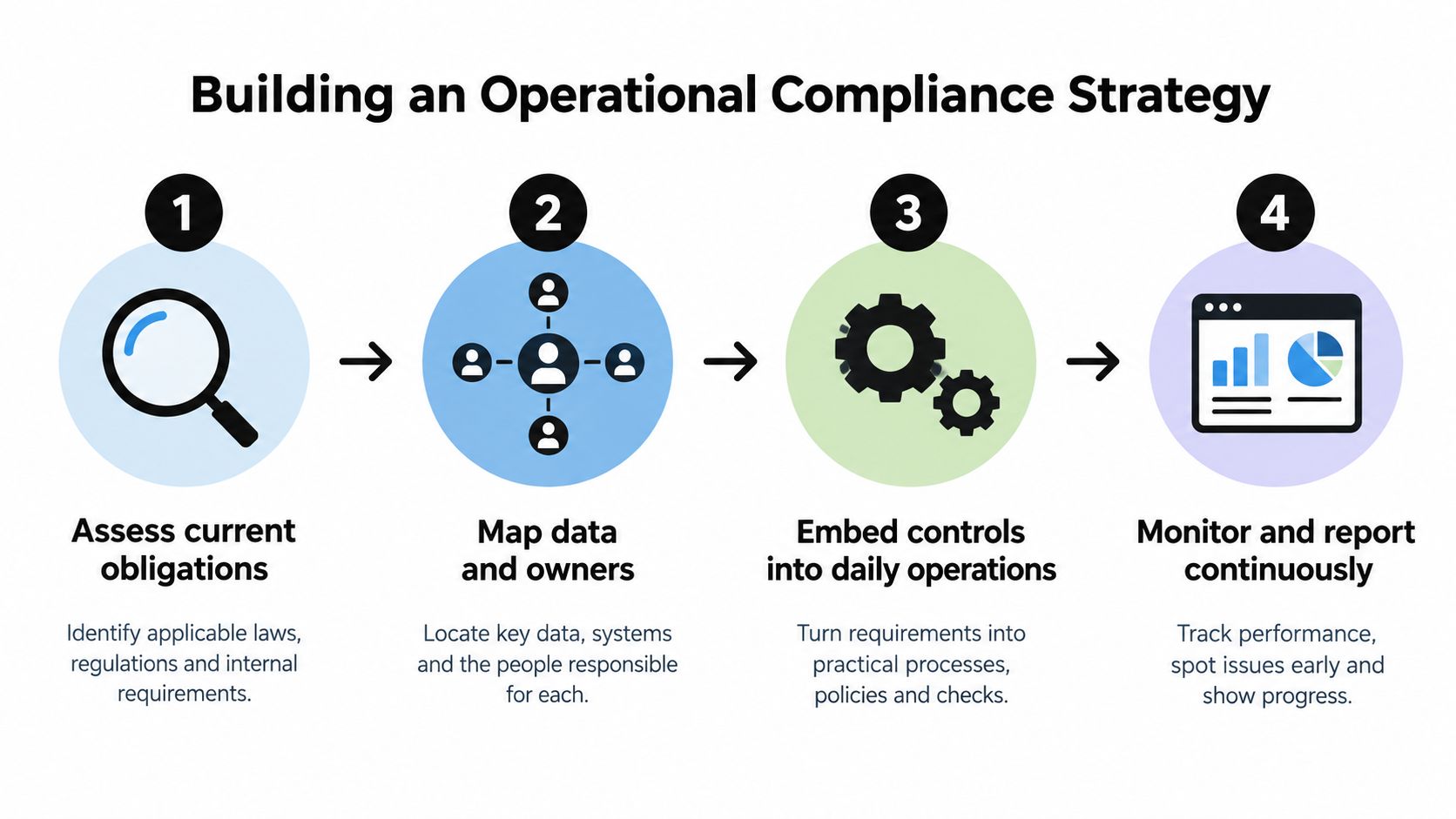
Organizations need a process that captures evidence continuously across procurement, facilities, finance, product claims, and supply-chain operations. That process should show where a figure came from, who reviewed it, what period it covers, which entities are included, and how the figure connects to a disclosure or business decision.
Start with the reporting boundary
First, create an entity and activity inventory. Include subsidiaries, branches, facilities, leased sites, outsourced operations, suppliers, and assets that create relevant environmental or social data. Record the jurisdiction, legal entity, turnover status, employee status, business activity, and applicable reporting framework.
Second, map each metric to a named owner. “Operations” isn't an owner. Assign responsibility to a facilities manager, procurement lead, controller, HR representative, logistics manager, or sustainability specialist. Each owner should understand the source system, review frequency, calculation method, and escalation route for missing information.
Third, embed controls into daily work. A retired laptop, server, medical device, or laboratory instrument can generate evidence relevant to asset inventory, waste management, data security, chain of custody, and environmental claims. The record should identify the asset or load, the party receiving it, the treatment route, the certificate issued, and the approval or exception history.
Preserve evidence that survives scrutiny
A useful evidence register includes:
- Source records: Invoices, utility records, transport documentation, supplier submissions, asset lists, and transaction reports.
- Methodology records: Boundary decisions, emission factors, estimation methods, exclusions, and changes from the prior period.
- Control records: Reviewer names, approval dates, exception logs, corrective actions, and access history.
- Claims records: The exact sustainability statement, its supporting evidence, approval status, publication location, and expiry or review date.
- Disposition records: Certificates of recycling or destruction, chain-of-custody documentation, and records showing how equipment or materials were handled.
ESG data governance must also connect operational metrics to financial reporting. Under IFRS S1, teams need to consider whether a sustainability matter affects cash flows, access to finance, or cost of capital across short, medium, and long-term horizons. A data lake won't solve that problem by itself. Finance and operational owners must agree on how evidence becomes a controlled disclosure.
The same principle applies to claims. ESMA's 2025 principles emphasize that sustainability claims should be accurate, accessible, substantiated, and up to date, as summarized in current global ESG compliance guidance. Businesses that manage technology retirement as part of their ESG controls can use IT recycling practices that support ESG reporting as one operational reference point.
Sector-Specific ESG Obligations and Requirements
A healthcare provider, bank, and public agency may all retire computers, but their evidence priorities differ.
A healthcare organization must protect patient and employee information while managing medical equipment disposal. A retired workstation can carry protected data. A diagnostic device may contain storage media, batteries, chemicals, or components that require controlled handling. The compliance file should connect asset identification, approved data destruction, transportation, downstream processing, and certificates to the responsible facility or department.
That evidence supports more than an environmental narrative. It can help demonstrate that the organization managed information risk, controlled vendors, and prevented unsupported claims about recycling or reuse. A healthcare procurement team should also verify whether an equipment vendor can provide records at the level required by the organization's privacy, environmental, and audit policies.
Finance needs materiality discipline
Financial institutions face close scrutiny over climate-related risks, governance, and risk management. The SEC rule requires relevant public companies to disclose material climate risks and related governance and management processes. Scope 1 and Scope 2 emissions are not automatically required for every reporting company, because the SEC treatment depends on filer category and materiality, as explained in the SEC emissions disclosure analysis.
For a bank or insurer, technology disposition can sit inside operational risk, vendor oversight, business continuity, and environmental reporting. Data center decommissioning records should show which systems were removed, how storage media was handled, who authorized the work, and how the final disposition was verified. A procurement questionnaire shouldn't be the only evidence that this process exists.
Public agencies need traceability
Government organizations operate under public accountability and formal procurement controls. Their records may need to show the chain from surplus identification to transport, destruction, recycling, reuse, or sale. The practical requirement is not just to state that assets were responsibly handled. It is to preserve the transaction record, approvals, vendor qualifications, certificates, and exceptions.
EU-facing organizations have another distinction to manage. CSRD reporting for applicable entities can require total gross Scope 3 emissions, including significant categories, while the SEC framework treats Scope 1 and Scope 2 emissions through a different materiality and filer analysis. Organizations should avoid importing one framework's assumptions into another.
Businesses managing operations in Georgia can review electronics recycling requirements for ESG programs when technology assets form part of their sector reporting, procurement controls, or supplier evidence.
Common Pitfalls and Compliance Misconceptions
Are you still treating ESG compliance as an annual checklist? That approach breaks down as reporting rules change. The EU's simplification process shows why. Older templates may request information that is no longer mandatory, while revised requirements can demand stronger evidence for a narrower group of disclosures. Compliance is becoming continuous evidence management, not a once-a-year writing exercise.
Before accepting any data request, ask four questions:
- Who is making the request? A regulator, customer, investor, auditor, or internal manager may have different authority and objectives.
- What rule creates the obligation? Record the provision, framework, jurisdiction, entity, and reporting period.
- What evidence supports the answer? Identify source documents, calculations, approvals, and exceptions.
- How long should the record remain available? Align retention with legal, contractual, audit, and internal risk requirements.
Environmental data isn't the whole program
CSRD reporting packages include governance, strategy, climate-related targets, emissions, and financial impacts of severe weather. An organization that reports recycling volumes but cannot show board oversight, risk ownership, or the financial relevance of climate exposure has an incomplete compliance record. Accurate environmental data does not compensate for missing governance evidence.
A vendor statement also falls short of substantiation. “All materials are recycled responsibly” does not show what happened. A defensible record identifies the material, quantity or asset population, processing route, downstream party, certificate, and review date. Apply the same standard to claims about reuse, recovery, carbon reduction, secure destruction, and responsible sourcing.
A sustainability claim should be treated like a controlled business statement, not a marketing decoration.
Data lineage often fails during routine spreadsheet work. A team exports data, overwrites the prior version, and loses the calculation history. Reviewers then cannot explain why a figure changed or confirm that the reporting boundary remained consistent. Keep version control, documented methodology, reviewer signoff, and exception handling with the underlying records. A polished dashboard cannot replace them.
Regulatory simplification does not remove supplier responsibility. Large customers may still request evidence, and value-chain expectations can exceed minimum statutory disclosure. Document which fields are legally required, contractually requested, available, or declined, along with the reason for each decision.
Organizations can test assumptions against practical guidance on common electronics recycling myths before writing procurement language or sustainability claims about asset disposition.

Practical Compliance Checklist and Next Steps
A defensible ESG program starts with an obligation register and an evidence process. The objective is to keep records that can support each disclosure, claim, and reported metric when a reviewer asks how the figure was produced.
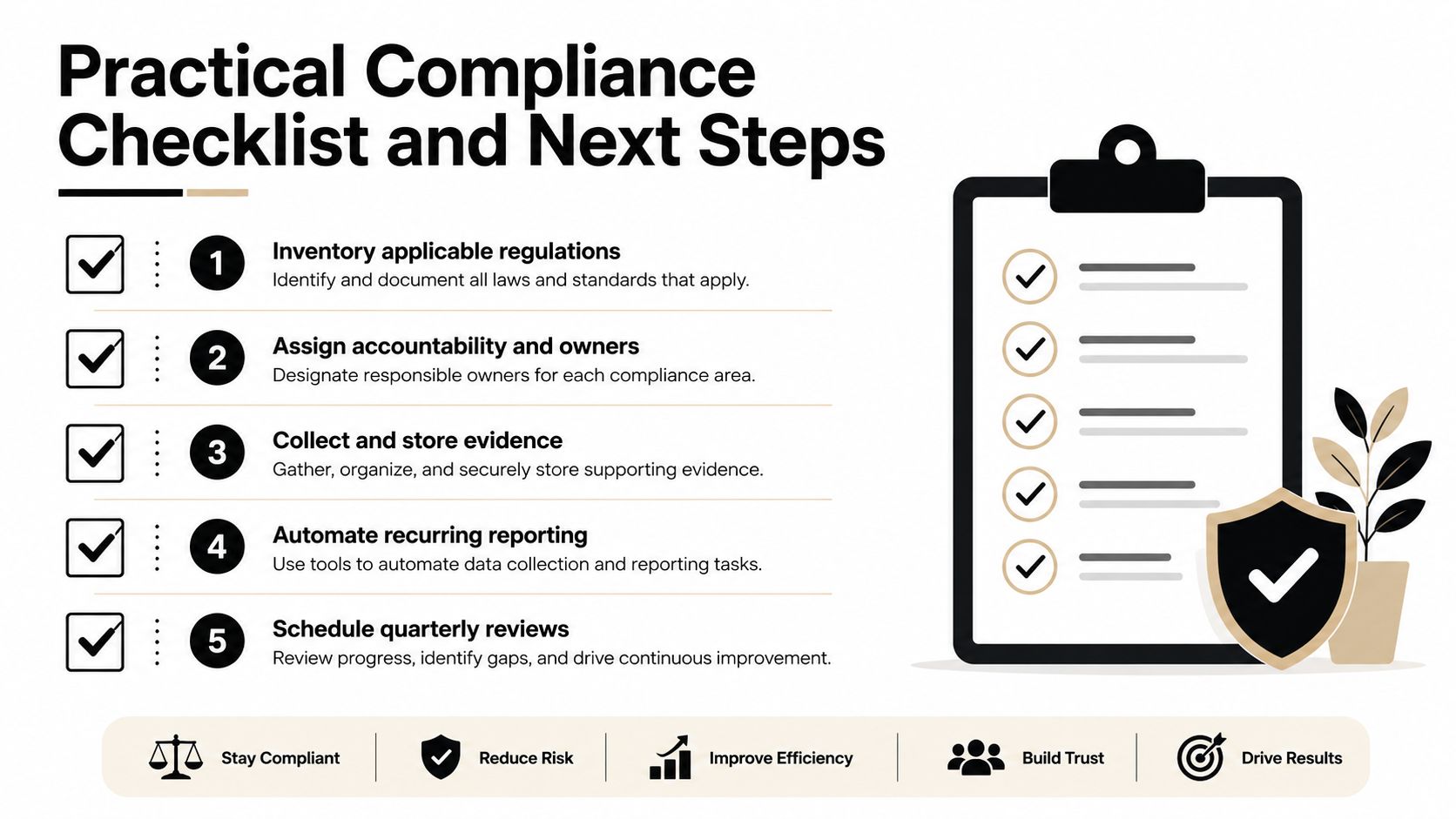
Use this operating checklist
- Inventory applicable regulations: Record each jurisdiction, legal entity, reporting framework, effective date, scope test, and disclosure requirement. Separate statutory duties from customer questionnaires and voluntary commitments.
- Assign accountability and owners: Name the executive sponsor, finance owner, operational data owner, reviewer, and escalation contact for every material metric.
- Collect and store evidence: Retain source records, calculation files, methodologies, certificates, approvals, exceptions, and claim substantiation in a controlled repository.
- Automate recurring reporting: Use system exports, workflow approvals, reminders, and version control for repeatable metrics. Automation must preserve the underlying record, not only generate a final number.
- Schedule quarterly reviews: Recheck legal developments, entity thresholds, reporting boundaries, supplier evidence, claims, data quality, and retention requirements.
Document the materiality assessment rather than treating it as a presentation exercise. Record the sustainability matters considered, stakeholders consulted, risk and opportunity analysis, financial effects, time horizons, thresholds, exclusions, and approval. Under IFRS S1, connect material sustainability matters to the organization's prospects and to decisions made by primary users of general-purpose financial reports.
Multinational groups need jurisdiction-by-jurisdiction threshold tracking and entity-level consolidation logic. A parent-level summary can conceal a branch that changes reportability or a subsidiary using a different boundary. The compliance file should reproduce the group result from underlying entity records, with the source, calculation, reviewer, and any exception visible.
Make technology disposition auditable
Retired IT equipment requires records covering both security and sustainability controls. Capture the asset list, pickup or transfer record, chain of custody, data wiping or destruction result, recycling or destruction certificate, downstream documentation, and exception resolution. Link each record to the reporting period and the facility or business unit involved.
Beyond Surplus provides business IT asset disposition and electronics recycling services, including secure data wiping, hard-drive shredding, certificates of recycling or destruction, and chain-of-custody records. The service can support an organization's control framework when the organization defines required records, approval points, retention, and review responsibilities.
Review evidence before the reporting deadline. Start with one reporting boundary, one high-risk process, and one controlled evidence register. Expand the process only when the applicability assessment identifies a real requirement or a defensible business need.
For business IT equipment disposal, data center decommissioning, secure data destruction, and electronics recycling, Beyond Surplus can provide documented processing and chain-of-custody records that support operational ESG controls. Visit Beyond Surplus to discuss a commercial pickup and evidence process aligned with your organization's compliance requirements.


