

For businesses across Georgia, ESG (Environmental, Social, and Governance) is no longer a peripheral concern; it is a core component of modern corporate strategy. For your end-of-life IT equipment, an ESG-focused approach to electronics recycling provides a clear framework to manage assets, mitigate significant risks, and enhance your brand's reputation. This is especially true for companies looking to align with professional standards for ESG electronics recycling Georgia.
Why ESG Is a Core Component of Modern IT Asset Management for Georgia Businesses
ESG has become a practical, day-to-day operational necessity for IT leaders, CFOs, and sustainability officers across Georgia—from Atlanta's tech hubs to statewide manufacturing facilities. The connection between your company's retired servers, laptops, and networking equipment and serious business risks is direct and undeniable. Improperly managing this e-waste exposes your organization to regulatory fines, data breaches, and significant reputational damage.

Therefore, the question is not if your business should implement an ESG-aligned electronics recycling plan, but how quickly it can be established. The sheer volume of e-waste underscores this urgency.
In 2022, the world generated 62 million tonnes of e-waste, an 82% increase from 2010, and this figure is projected to rise another 32% by 2030. With only 22.3% of this waste properly recycled in 2022, an estimated $62 billion in recoverable materials was lost. These global statistics reflect a local trend that directly impacts the need for certified ITAD services for every enterprise in Georgia. For further details, consult the Global E-waste Monitor 2024 report.
Connecting ITAD to Your ESG Goals
A robust IT Asset Disposition (ITAD) program serves as the bridge between your outdated technology and your corporate ESG objectives, making responsible practices measurable and tangible. Just as carbon accounting has become essential for tracking emissions, a formal ITAD process is critical for managing your technological footprint.
A strategic approach in this area is not merely about compliance; it delivers tangible benefits across your entire organization. The table below outlines how each ESG pillar connects directly to your electronics recycling efforts.
How ESG Pillars Shape Your IT Asset Disposition
| ESG Pillar | Relevance to Electronics Recycling | Key Business Implication |
|---|---|---|
| Environmental | Ensures toxic materials from retired electronics do not end up in landfills. It also recovers valuable resources, feeding them back into the manufacturing supply chain. | Reduces your company's carbon footprint, helps meet sustainability targets, and strengthens your brand's environmental credentials. |
| Social | Guarantees that recycling partners adhere to fair labor laws and do not export hazardous e-waste to developing nations where it can harm local communities. | Protects your company from association with unethical labor practices, enhancing your reputation as a responsible corporate citizen. |
| Governance | Provides a transparent, auditable trail, including Certificates of Destruction and Recycling, proving compliance and secure data management. | Mitigates legal and financial liability from data breaches or environmental non-compliance, reassuring investors and stakeholders. |
By integrating these practices into your operations, you transform a potential liability into a strategic asset. These principles are also fundamental to the circular economy for electronics in Georgia, creating a system where old technology is repurposed instead of discarded.
Navigating Georgia’s E-Waste Regulations and Data Security Mandates
Many Georgia businesses are surprised to learn there is no single, comprehensive state law governing electronics disposal. Instead, the responsibility falls squarely on your organization to comply with a framework of federal regulations. Your corporate liability does not end when old equipment leaves your facility.
The primary regulation to be aware of is the Resource Conservation and Recovery Act (RCRA). This federal law governs the management of solid and hazardous waste. Since many electronics—from laptops to data center servers—contain materials like lead and mercury, they can be classified as hazardous waste under RCRA. This makes landfill disposal not just poor practice, but illegal.
Equally critical is data security. The FTC Disposal Rule is explicit: any business handling consumer information must dispose of that data securely and permanently. Simply deleting files is insufficient; the rule requires concrete measures to ensure data is irrecoverable.
Transferring Liability Through a Certified ITAD Partnership
This complex regulatory landscape is why selecting an IT Asset Disposition (ITAD) partner is a strategic decision to protect your business. When you engage a certified recycler, you legally transfer the environmental and data security liability for your retired assets to them through a fully documented process.
A certified partner provides a complete chain-of-custody paper trail that includes:
- Certificates of Recycling: Proof that e-waste was managed in compliance with all environmental laws, protecting you from potential RCRA violations.
- Certificates of Data Destruction: Legal evidence that all data was securely destroyed, satisfying the FTC Disposal Rule and shielding you from data breach litigation.
This documentation is your primary defense in an audit and the foundation of a sound governance strategy. While businesses must adhere to various Georgia state-specific regulatory requirements, managing e-waste and data risk is an often-overlooked component.
Practical Compliance for Georgia Enterprises
Understanding these rules is the first step. The goal is to transition your company from a position of unmanaged risk to one of documented, verifiable compliance. A certified ITAD program functions as a specialized insurance policy against costly data breach lawsuits and environmental penalties.
A common mistake is assuming responsibility ends when a recycler picks up IT assets. Without certified documentation proving proper handling and data destruction, the original owner—your business—remains liable for any subsequent environmental damage or data leak.
Working with a certified expert like Beyond Surplus ensures every step, from pickup to final processing, is executed correctly. This proactive approach transforms a regulatory burden into a clear demonstration of your company's commitment to best practices. To understand how we secure your sensitive information, learn more about our comprehensive data security services in Georgia. This partnership is the most effective way to ensure your organization meets all legal standards.
Uncovering the Financial Benefits of ESG-Aligned Recycling
An ESG-focused electronics recycling program for your Georgia business is more than a compliance measure—it is a powerful financial tool. By moving beyond viewing old equipment as a disposal cost, you can unlock significant economic benefits, starting with transforming retired hardware into a new revenue stream.

The most immediate financial benefit comes from IT Asset Value Recovery (ITAVR). End-of-life servers, laptops, networking gear, and other enterprise hardware often retain considerable market value. Instead of paying for their destruction, a certified partner can securely refurbish and resell these assets, converting a former expense into income.
Monetizing Retired IT Assets
While the process is straightforward, it requires specialized expertise. A certified ITAD provider will assess your inventory of retired electronics to identify items that can be securely wiped and remarketed. This methodical approach ensures you receive the maximum possible return from assets that might have otherwise been written off.
This is a key component that makes ESG electronics recycling Georgia a smart business decision. It shifts the IT lifecycle from a linear path ending in disposal to a circular one that recaptures value. You can explore our dedicated asset recovery services in Georgia to see how we maximize value for our clients.
Strengthening Brand and Investor Appeal
Beyond direct revenue, a transparent and certified recycling process significantly enhances your brand's reputation. In an era where investors and enterprise clients scrutinize ESG performance, demonstrating a commitment to responsible e-waste management makes your company more attractive.
A strong ESG profile can lead to:
- Increased Investor Confidence: ESG-focused investors are more likely to support companies with clear, documented sustainability practices.
- Enhanced Customer Loyalty: B2B clients increasingly prefer partners who share their commitment to corporate responsibility, providing a competitive advantage.
- Improved Brand Equity: A public commitment to ethical practices builds trust and goodwill.
The market for responsible recycling is expanding rapidly. North America is poised to lead the global electronic waste recycling market, driven by regulations like RCRA and a developed infrastructure. With U.S. industry revenue projected to reach $28.1 billion by 2024, the demand for certified services is clear. This growth is fueled by the staggering 6.92 million tonnes of e-waste generated annually in the U.S. alone, making certified partners indispensable. You can read more about this growing market on cognitivemarketresearch.com.
A proactive ITAD program is a powerful form of risk mitigation. The cost of a single data breach or environmental non-compliance fine can be catastrophic. A certified ESG recycling strategy effectively neutralizes these threats, protecting your bottom line from unforeseen expenses.
How to Select the Right ITAD Partner in Georgia
Choosing the right IT Asset Disposition (ITAD) partner is a critical decision for any Georgia business committed to its ESG goals. This selection directly impacts your data security, environmental compliance, and brand reputation. An unqualified vendor can expose your company to significant fines and data breach risks, whereas a certified partner acts as a shield against these liabilities.
The vetting process must be methodical, focusing on verifiable credentials, not just marketing claims. Your objective is to find a partner who provides an unbroken, auditable chain of custody for every asset, from pickup to final disposition. This ensures a secure, transparent transfer of liability.
Non-Negotiable Certifications to Demand
Certifications are the cornerstone of a trustworthy ITAD partnership. They serve as independent, third-party validation that a recycler adheres to the strictest standards for environmental safety, data security, and ethical operations. For any business serious about ESG electronics recycling Georgia, these credentials are not optional—they are mandatory.
Key certifications to look for include:
- R2 (Responsible Recycling): This certification establishes a strong baseline, ensuring the provider follows best practices for electronics recycling, covering environmental protection, worker safety, and data security.
- e-Stewards: Often considered the industry's gold standard, e-Stewards certification includes a strict no-landfill, no-export policy for hazardous e-waste, guaranteeing your assets are not shipped overseas.
- NAID AAA: For data security, this is the most critical certification. A NAID AAA certified vendor has passed rigorous, unannounced audits of their hiring, security, and destruction processes, providing the highest assurance of secure data handling.
A vendor lacking these core certifications is a major red flag. It indicates they have not been independently audited to meet the industry's essential requirements for secure and responsible processing, leaving your business exposed to all associated risks.
A Practical Vetting Checklist for Georgia Businesses
When evaluating potential ITAD vendors, a structured approach is essential. Asking the right questions upfront will quickly distinguish true professionals. To better understand how a certified partner manages the entire asset lifecycle, review our overview of ITAD services in Georgia.
Use this checklist to guide your conversations and ensure all critical areas are covered before making a final decision.
Your ITAD Vendor Vetting Checklist
| Evaluation Criteria | What to Look For | Why It Matters for ESG & Compliance |
|---|---|---|
| Data Destruction Methods | Do they offer on-site and off-site shredding and certified data wiping? Can they explain the appropriate use case for each method? | This demonstrates a deep understanding of data security and provides the flexibility to meet specific compliance needs, such as HIPAA or PCI-DSS. |
| Downstream Auditing | Request proof of how they manage their downstream partners. How do they ensure these partners are also certified and compliant? | You are legally responsible for your e-waste "to the end." A credible partner will have a transparent, documented process for auditing their entire recycling chain. |
| Chain of Custody | Do they provide detailed, serialized asset reports? Will you receive formal Certificates of Destruction and Recycling? | This documentation is your legal proof of compliance. Without it, you have no defense in an audit and cannot verify you have met your ESG goals. |
| Logistics and Security | Do they use their own fleet or vetted, professional partners? Are their trucks GPS-tracked? Are their facilities secure with controlled access? | Secure logistics are non-negotiable for preventing data breaches during transit. A professional operation ensures end-to-end security. |
Thoroughly reviewing these points helps you compare vendors and identify a partner who understands the stakes and has the systems in place to protect your organization.
Implementing Your ESG Electronics Recycling Program
Let's transition from planning to execution. A well-structured ESG electronics recycling program transforms the challenge of managing old IT equipment into a secure, efficient, and manageable process for Georgia businesses.
The first step is a comprehensive internal inventory. Before scheduling a pickup, create a clear record of all assets, documenting the type, model, and serial number for each device. This list, whether it includes data center servers or stored laptops, is the foundation for tracking and maintaining a complete chain of custody.
Next, segregate your inventory. Group devices by type and, more importantly, by the sensitivity of the data they contained. This determines the required handling for each piece of equipment. For example, a server that processed sensitive financial data requires a more rigorous data destruction protocol than an office printer.
Building Your Custom ITAD Plan
A true ITAD partner functions as a consultant, not just a hauling service. They should collaborate with you to develop a custom plan tailored to your specific inventory and security requirements. This ensures logistics are built around your operations, minimizing business disruption.
The vetting process can be broken down into three critical steps: verifying certifications, confirming security protocols, and demanding thorough reporting.
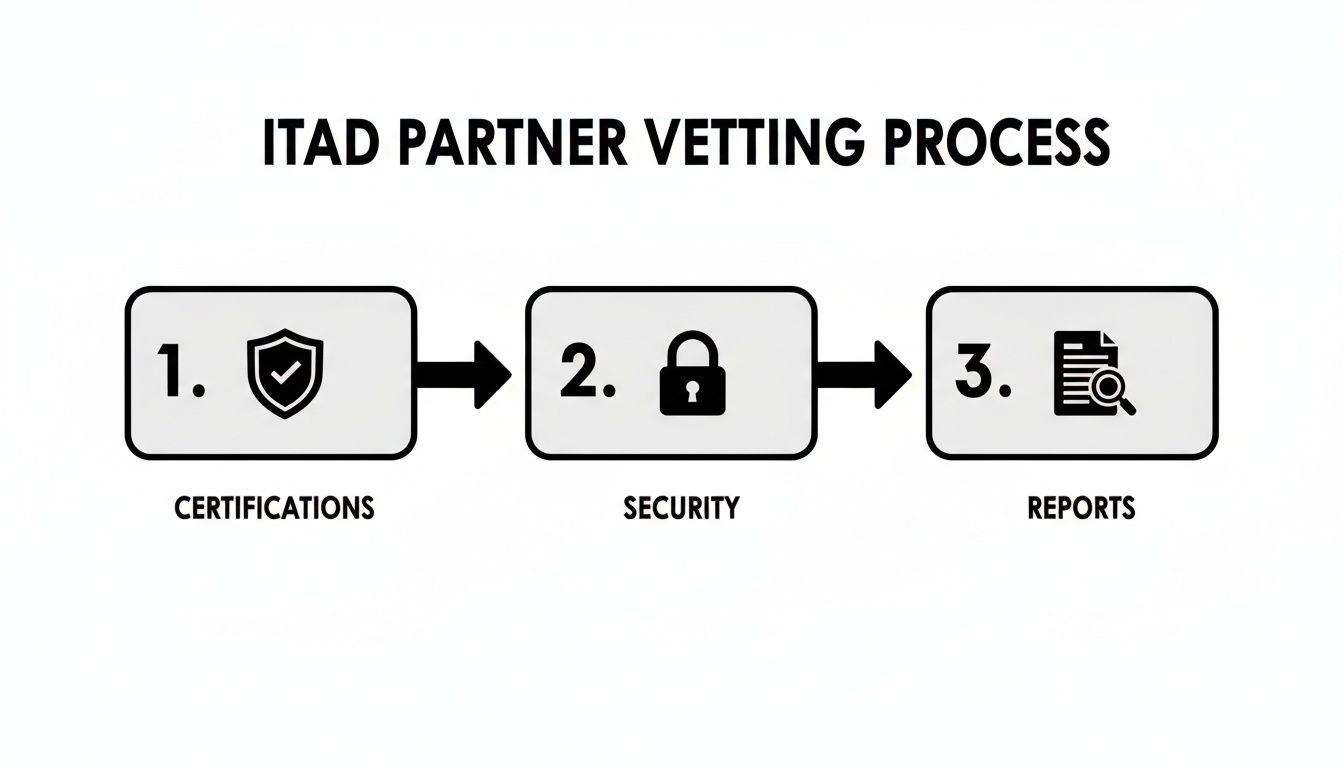
This flowchart highlights that a trustworthy partner must deliver on all three pillars: certifications, security, and reporting are non-negotiable for a compliant, risk-free service.
During the planning phase, you will finalize the specifics:
- Defining Data Sanitization Levels: Decide which assets will be wiped and which will be physically shredded. Certified data wiping is ideal for assets with resale value, while on-site shredding is best for devices with highly sensitive information.
- Scheduling Secure Logistics: Coordinate a pickup time that suits your schedule. A professional provider will use their own fleet or vetted partners to ensure secure transport from your Georgia facility.
- Confirming Documentation Requirements: Clearly state the paperwork you need, including serialized asset lists and Certificates of Destruction, which are vital for internal governance and ESG reporting.
This level of detailed planning elevates the process from a simple disposal task to a strategic asset management function. For businesses managing high volumes of equipment, understanding the logistics of bulk electronics recycling in Georgia is essential for a seamless process.
The most successful electronics recycling programs are built on clear communication and meticulous planning. A well-documented inventory and a pre-defined data destruction strategy eliminate guesswork and ensure every asset is handled according to your company's security and compliance standards.
Finally, utilize the documentation provided by your ITAD partner. The detailed reports and certificates are not just for filing; they provide the concrete, measurable data needed for your sustainability reports. This is how you demonstrate your commitment to responsible ESG electronics recycling Georgia practices and turn your efforts into a verifiable success.
The Future of Corporate E-Waste Responsibility
The corporate technology landscape is constantly evolving, and the nature of e-waste is changing with it. For businesses in Georgia, this presents both new challenges and opportunities, making a forward-thinking IT Asset Disposition (ITAD) strategy more critical than ever. It is no longer sufficient to manage today's retired assets; you must prepare for what is next.
Two major trends are reshaping the e-waste stream. First, the large-scale migration to cloud services is triggering a wave of data center decommissioning projects, resulting in massive volumes of servers and high-end hardware reaching their end-of-life simultaneously. Second, the proliferation of Internet of Things (IoT) devices in manufacturing, logistics, and office environments is creating a new, complex stream of electronics that will require secure disposal.
Preparing for New E-Waste Streams
These trends underscore why a proactive, ESG-focused strategy is essential. The global electronics recycling market is projected to grow from $43.2 billion in 2025 to $147.9 billion by 2035, driven by ESG pressures from investors and expanding regulatory frameworks.
A robust strategy must encompass all of your company's technology assets, both current and future. You can gain deeper insights into these trends and their financial impact in this investment recovery playbook.
A proactive approach to ESG electronics recycling in Georgia is the key to navigating this complex future. It ensures your organization remains compliant, secure, and competitive, transforming a potential liability into a strategic advantage.
Common Questions from Georgia Businesses
When establishing an ESG electronics recycling Georgia program, several key questions consistently arise. Clear answers are essential for moving forward with confidence and ensuring organizational compliance.
How Can We Be Absolutely Sure Our Data Is Destroyed?
This is the most critical question for any organization. Your ITAD partner must provide a legal Certificate of Data Destruction for every data-bearing device. This document serves as your official audit trail and the legal proof that transfers liability away from your company.
The certificate should list the serial numbers of the destroyed assets and specify the destruction method used—certified data wiping or physical shredding. A vendor's inability to provide this is a significant concern.
What Kind of Business Equipment Do You Actually Take?
While many associate electronics recycling with computers and laptops, a commercial ITAD partner handles a much broader range of corporate assets. We process nearly any device with a plug or battery.
This includes:
- Standard Office IT: Laptops, desktops, servers, monitors, printers, and phones.
- Data Center Hardware: Network switches, server racks, UPS systems, and storage arrays.
- Specialized Equipment: Medical devices, laboratory instruments, and industrial electronics.
We are equipped to manage everything from a small office cleanout to a large-scale data center decommissioning project.
Do We Have to Haul All Our Old Equipment to You?
Transporting large volumes of electronics is a logistical challenge for most businesses. That is why we offer secure, professional pickup services across Georgia and nationwide. Our logistics team coordinates a pickup time that minimizes disruption to your operations.
Our team manages the entire process, including palletizing, shrink-wrapping, loading, and secure transport. This creates a seamless handoff while maintaining a documented chain of custody from your facility to ours. A reputable partner simplifies the process, turning a complex problem into a streamlined solution.
When you require a partner that delivers certified, transparent, and secure ESG-focused solutions, trust Beyond Surplus. We assist Georgia businesses in responsibly managing their end-of-life IT assets, ensuring data security and compliance are maintained throughout the entire process. Schedule your business pickup today.


