

A voluntary recall notice lands before the first outbound wave leaves the dock. Saleable pallets, last night's store returns, and an open marketplace listing still share one SKU. Retail product recall disposal services only matter after that inventory is frozen. Procurement, retail operations, and IT need a record that units left commerce. A weight ticket that says "destroyed" does not do that job. Destruction is the right path only when rework or lawful recovery cannot be defended.
Table of Contents
- When Recalled Inventory Is Still in Your Building
- Running a Chain of Custody From Quarantine to Certificate
- Checking Legal Duties Before the Truck Leaves
- Choosing Destruction or Value Recovery
- Proving the Recall Actually Worked
- Closing the File and Booking Certified Disposal
When Recalled Inventory Is Still in Your Building
The morning the notice hits, a regional distribution center is already moving product. A picker scans a pallet that matches the recalled SKU. A store return from yesterday sits on the same inbound lane. A marketplace order is still open because nobody pulled the listing. Leaders have not yet named which lots and serials are in scope, which buildings still hold units, or who may ship them.
That call belongs to retail, manufacturing, procurement, and operations in the first hours, not after a carrier is booked. Map stores, warehouses, and freight still on the road. Revoke release rights for every location that can still push the goods out. Speed without segregation puts mixed freight back on a pick face or into a secondary channel.
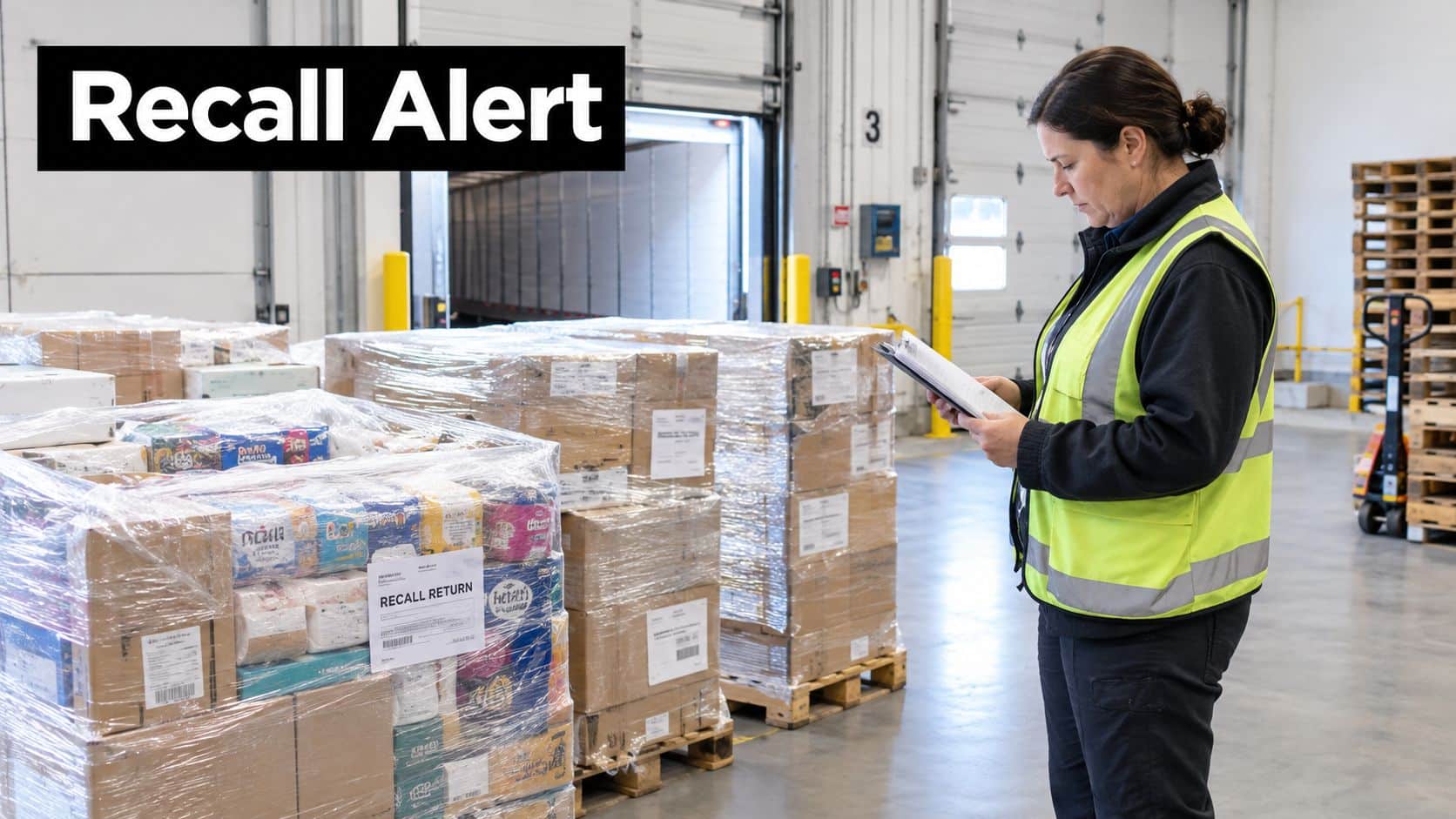
This volume is routine, not a rare crisis. In fiscal year 2024, the U.S. Consumer Product Safety Commission annual performance report shows 333 voluntary recalls covering approximately 41 million consumer-product units, compared with 308 recalls and 97 million units in fiscal year 2023. That same year, CPSC sent 2,969 regulatory-violation notices requiring recalls or other protective actions. 166 of those 333 completed recalls used the Fast-Track program, and 98.08% of Fast-Track recalls started within 20 days of a company report.
What you lock before a truck is booked
Practical rule: Stop redistribution before you choose a disposal vendor.
Disposal sits beside repair, replacement, and refund. The short clock makes quarantine and proof more urgent than a brochure.
- Identifiers: Lock SKU, lot, and serial before anyone consolidates pallets.
- Population: Count stores, distribution centers, and in-transit units so a later certificate has something to match.
- Authority: Name who can release the SKU. Everyone else is on hold.
Teams that already run retail store electronics recycling still need a hold that ordinary returns cannot bypass. The morning's job is to keep the goods from moving.
Running a Chain of Custody From Quarantine to Certificate
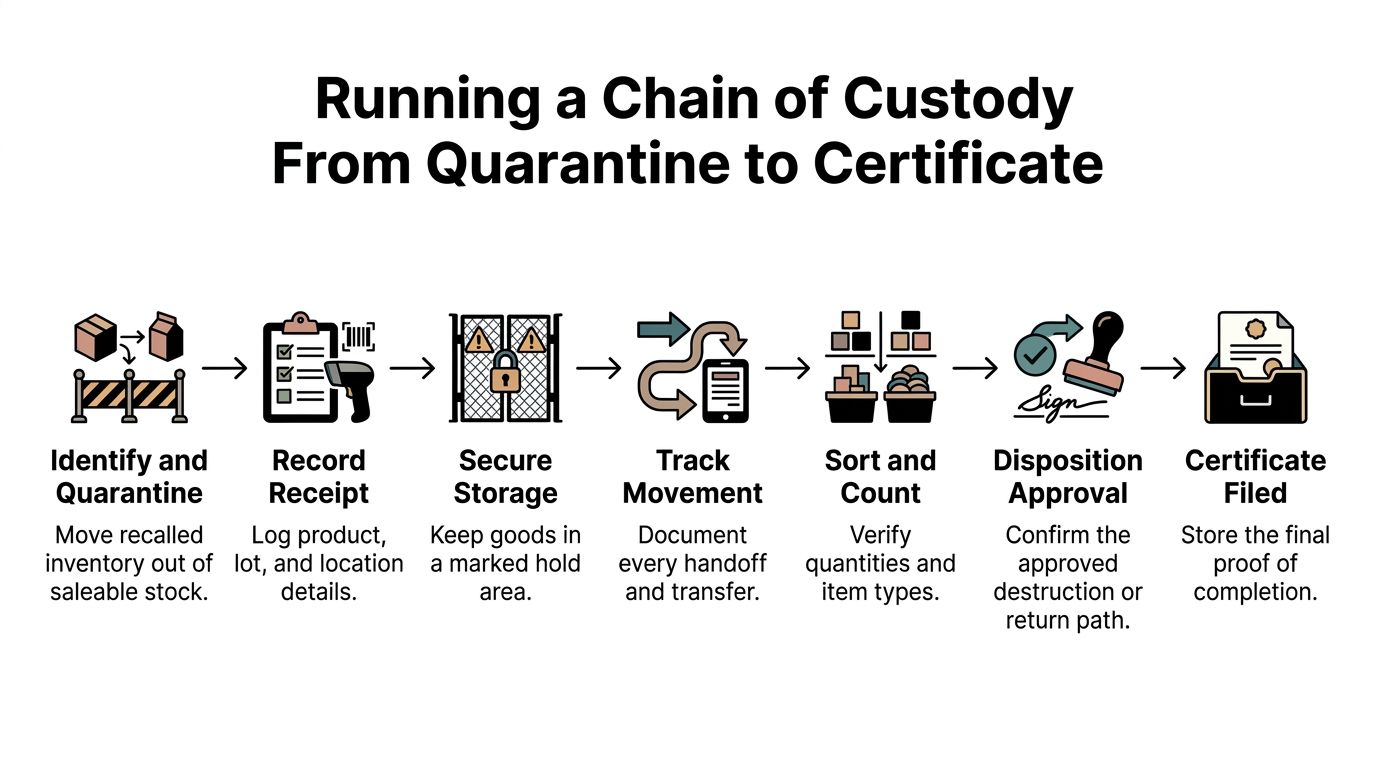
Once the SKU is frozen, treat every unit as evidence. A loose "recall cage" that shares an aisle with good stock will fail the first audit. The sequence below is what you hand a 3PL and a disposal contractor the same day.
Identify affected stock by SKU, lot, serial number, and quantity. Quarantine it away from saleable inventory and unrelated returns. Mark every carton or pallet with the recall identifier and the handling rule. When the regulator requires destruction, get that approval in writing before the load moves. Give the contractor written bans on commingling, salvage, resale, and any destination you did not authorize. Witness or otherwise verify the destruction. Then reconcile destroyed counts against units returned, reworked, or still outstanding.
Why a mixed pallet breaks the file
One mixed pallet is enough to reopen the recall. A night shift combines two lots to fill a trailer. The transfer is a radio call, not a scan. The certificate later lists pounds, not product identity. Those units can still be sold, and the file cannot prove they were not.
The CPSC recall handbook tells recalling firms to keep product segregated throughout distribution and to monitor third parties that dispose of it. For off-site destruction, the handbook calls for clear instructions, prominent marking, and a certificate of destruction. For on-site work, the record should include the date and quantity destroyed, and an affidavit is preferred.
Hold the bar at 100% unit-level reconciliation, with an exception line for every unexplained variance. A percentage estimate is not a control.
What the same-day packet contains
- Hold labels: Recall ID and "do not ship, do not salvage" on every pallet, not on the dock door alone.
- Contractor instructions: Written bans on commingling, resale, and unauthorized destinations, signed before pickup.
- Count tie-out: Destroyed, returned, reworked, and open quantities that add back to the original population.
- Certificate test: Product identity, not weight alone. Pounds without SKU or lot fail the file.
Build that packet the way you already document chain of custody for IT asset disposal. Missing serials, undocumented transfers, and weight-only certificates are the gaps that leave recalled units available for resale.
Checking Legal Duties Before the Truck Leaves
A recall notice is not a waste determination, and it is not a data-sanitization plan. Warehouse control can be perfect and the shipment can still be unlawful if classification waits until the driver arrives. Three owners have to sign the same path before logistics books the load.
Product-safety instructions
The recalling firm or the regulator sets whether units go to repair, refund, rework, or destruction. Operations does not invent a remedy because the dock is full. If the notice is silent on destruction, do not treat silence as permission. Hold the pickup until that instruction is in writing and matches the labels already on the pallets.
Waste status for a non-household generator
A commercial generator has to decide whether the recalled material is hazardous waste. When it is, storage, treatment, transport, and disposal rules apply, and states may add tighter requirements. EPA hazardous-waste guidance is the pattern to follow before a mixed load is tendered. Recalled pesticides show how fast the status can change. Once the generator agrees to take part in the recall and decides to discard the product, that material can become regulated waste. Batteries, appliances, and connected devices need the same commodity-specific check. Do not book them on a general merchandise trailer and sort the rules later.
Data that can still be read
Any business that uses consumer reports for a business purpose, not only a credit bureau, falls under the FTC Disposal Rule. Disposal practices must be reasonable and appropriate so that information cannot be read or reconstructed. For electronic files and media, the FTC Disposal Rule guidance points to destruction or erasure as an appropriate safeguard. Vendor selection is part of the duty. Review an independent audit, check references, require a recognized trade-association certification, and look at the provider's information-security procedures.
Leaders who already track what businesses should know about e-waste laws should add one gate here. Product safety, environmental, and data owners sign one disposition path. Until they do, the truck stays in the yard.
Choosing Destruction or Value Recovery
Destruction is not automatically the strongest remedy. When a safe rework or diversion presents no safety concern and the regulator allows it, recovery can be the defensible path. The question is which disposition you can prove for that product category, not whether a shredder is on site.
For electronics and other IT-bearing goods, NIST Special Publication 800-88 separates three outcomes.
- Clear uses logical techniques, such as standard read and write commands or a supported factory reset, against user-accessible storage. It protects against simple, non-invasive recovery.
- Purge uses physical or logical methods that make laboratory recovery infeasible, and the media may still be reused.
- Destroy makes laboratory recovery infeasible and ends reuse of the media for storage.
Deleting files is not clearing. The IRS media sanitization guidelines note that deleted information can remain recoverable through disk, file-recovery, or data-scavenging utilities. Clearing has to stop that retrieval and resist keystroke recovery from standard input devices. The IRS cites firmware Secure Erase for ATA drives and degaussing as purge examples, and physical destruction, including disintegration, incineration, pulverizing, shredding, or melting, as the method that ends reuse.
How those outcomes map to a retail load
| Path | Use when | Record to keep |
|---|---|---|
| Certified wipe and buyback | The product may return to a lawful secondary market and Clear or Purge is enough | Serial list, method, date, and a data-destruction certificate |
| Physical shred or disintegration | Resale is banned or the device is high risk | Witness or verification note plus a certificate that names the product |
| Material recycling | Only after the unit is rendered unsellable | Downstream processor identity and a recycling certificate tied to the recall ID |
A commercial provider should be able to show transport it owns or partners across the contiguous United States, on-site or off-site drive shredding, certified wiping, certificates of recycling and data destruction, product destruction, and data-center de-install support. Beyond Surplus, an Atlanta-based IT asset disposition firm, fits that commercial profile for businesses, with chain-of-custody records aimed at duties such as the FTC Disposal Rule. Reject a vendor whose only deliverable is a weight ticket.
The same logic shows up outside electronics. Operators who browse DAF trucks for breaking already separate parts that can be reused from units that must be broken so they cannot return to service unidentified. Recalled inventory needs that same split.
Recycling after the unit is unsellable also answers a larger waste problem. The EPA's account of electronic waste calls e-waste the fastest-growing part of the U.S. municipal waste stream and cites an estimated 40 million metric tons generated worldwide each year in the Global E-waste Monitor's 2017 estimate, with less than 30% recycled. Pulling a defective product from sale does not, by itself, manage its end of life. Choosing between refurbish and recycle belongs in the same decision, which is why a written refurbish or recycle choice should sit in the recall file before the load leaves.
Proving the Recall Actually Worked
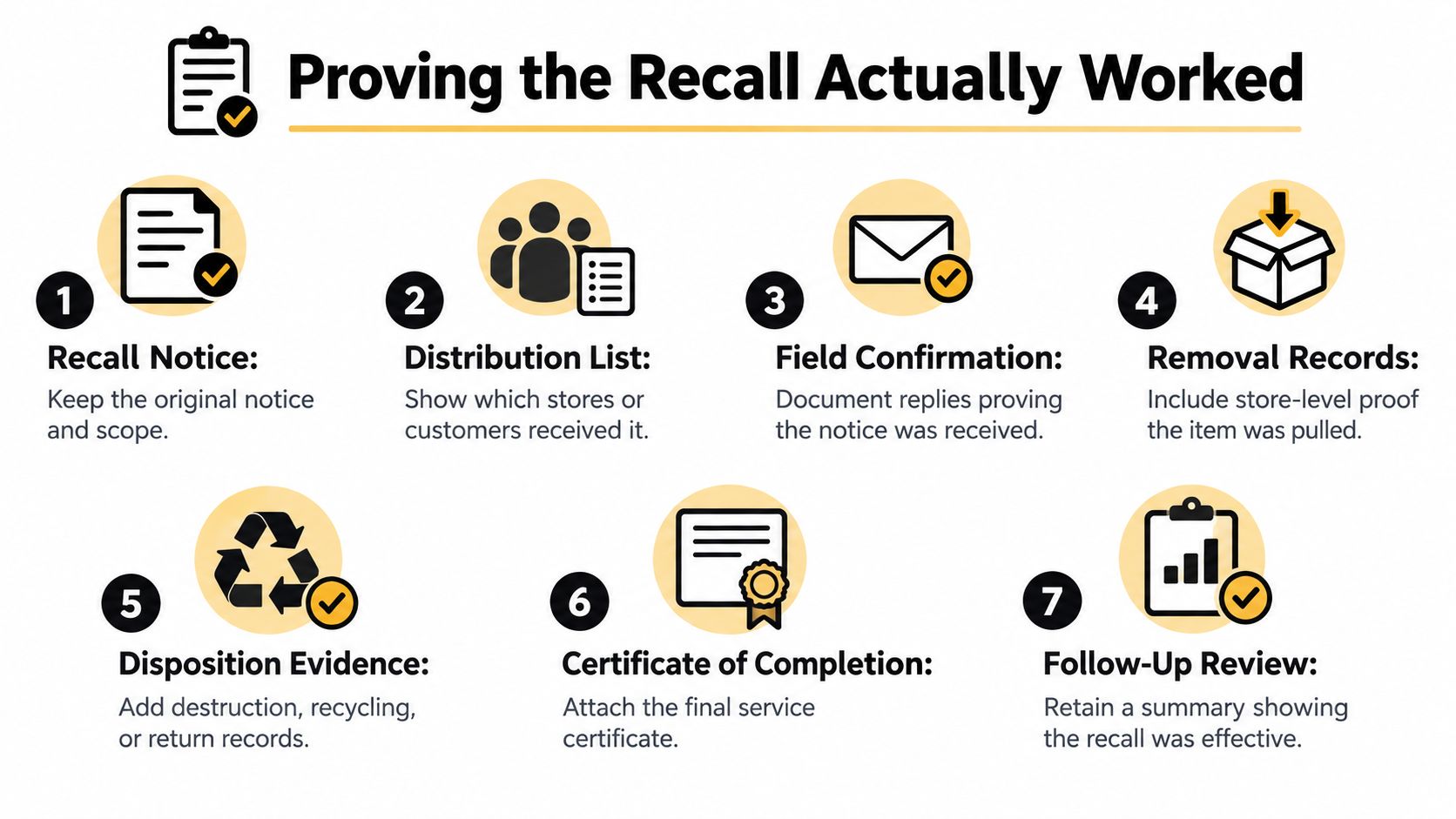
A certificate does not prove stores stopped selling the item. Effectiveness is a field record. It shows who was notified, how and when, who acknowledged, and how many units came back, were corrected, were destroyed, or remain open.
Ask the disposal vendor for product identifiers, quantity, date, location, method, and final disposition. A one-line "completed" note is not an audit pack. Investigate nonresponses. Send a second notice when the first instruction was ignored. Escalate before you call the recall effective.
When returns go back on the shelf
The failure mode is already documented in food retail, and the control transfers cleanly to electronics and general merchandise. During more than 4,000 retail checks after an infant-formula recall, the FDA's call for stronger recall compliance found that some retailers kept receiving or stocking recalled product, and some accepted customer returns and placed them back into inventory.
Translate that into store and marketplace controls.
- Quarantine returns: Recalled SKUs never reenter a pick face, a sales floor, or a resale bin.
- Block relisting: Marketplace and secondary-channel listings for the identifier stay down until the population is closed.
- Three buckets: Record products found on site, products already disposed of, and products sent back to suppliers.
- Variance owner: Every gap gets a name and a corrective note before the recall is called effective.
Photograph segregated cages. Match a serial sample to the certificate, not just the pallet count. Lot discipline from other industries helps here. Brewers who study how breweries track batch numbers treat the batch as the unit of truth from production through recall. Your electronics file should do the same with serial or lot, location, and quantity.
Keep that pack with your other compliance documentation. Auditors, insurers, and suppliers will ask for the notice, the distribution list, the acknowledgments, the removal records, and the disposition evidence together. The certificate is the last page, not the whole file.
Closing the File and Booking Certified Disposal
After the regulator's clock slows, the file still has to close. This is an audit, not another quarantine drill.
Match quantities by location to the original distribution list. Every exception needs an owner and a corrective note. Certificates must name the product, not only the weight. Data-bearing units need a sanitization or destruction record that states Clear, Purge, or Destroy. Downstream recycling or destruction partners must be identified, not described as "our vendor."
What stays in governance
Write the lesson while the event is fresh, especially if the next notice arrives on a Fast-Track timeline. Keep one standing rule. Returns of recalled SKUs cannot reenter pick faces, store floors, or marketplace listings. Put that rule in the warehouse management system and in the returns desk script so a new shift does not undo the recall.
What to ask for on the first call
Schedule a commercial pickup only after the three sign-offs from classification are in the file. On that call, request chain-of-custody records, a certificate of recycling or destruction that names the product, and a data-destruction certificate for every media-bearing unit. Ask who transports the load, where destruction happens, and how variances will be reported. If the answer is a single weight ticket, do not book the truck.
U.S. business teams should treat that document list as the pickup order. Product destruction, electronics recycling, and secure IT asset disposal belong in one commercial scope when the goods are recalled devices, not in three unrelated tickets.
Beyond Surplus provides commercial pickup, documented chain of custody, product destruction, and certificates of recycling and data destruction for recalled electronics and IT assets. If your recall file still has open quantities or weight-only paperwork, visit Beyond Surplus and ask for a certified pickup that ties each unit to its final disposition.


