

A pallet of retired laptops leaves your loading dock with a signed pickup receipt. Three weeks later, the ITAD provider reports that two pallets were merged during transport, and the serialized manifest no longer matches the equipment received. Nobody can immediately show which devices were in which container, who handled them between locations, or whether every drive reached sanitization.
That scenario exposes the purpose of Chain of Custody for IT Asset Disposal. It isn't a final certificate or a generic inventory spreadsheet. It's a continuous, evidentiary trail that follows every laptop, server, drive, mobile device, and networking component from removal through reuse, recycling, sanitization, or destruction. The physical controls and the records must agree at every handoff.
For a typical ITAD workflow, that can mean five to eight handoffs, including collection, staging, pickup transfer, transport, facility intake, processing, destruction or sanitization, and final documentation, as described in chain-of-custody ITAD guidance. The common failure modes are predictable: identity loss, custody gaps, undocumented destruction, and missing liability transfer.
Table of Contents
- What Chain of Custody Really Means for Retired IT Equipment
- The Core Elements of an Auditable Record
- Compliance Drivers Behind Documented Custody
- Required Documents and Evidentiary Items
- Roles, Responsibilities, and Control Points
- Closing the Pickup to Arrival Gap
- How a Provider Like Beyond Surplus Transfers Liability
- Checklist and Audit Tips for Your Next Disposal Project
What Chain of Custody Really Means for Retired IT Equipment
An inventory list tells you what your organization owns. A chain-of-custody record tells you what happened to each asset after it left production. That difference matters because retired equipment may still contain regulated data, saved credentials, customer records, intellectual property, or system histories.
The chain begins at removal, not when a downstream recycler opens the box. Independent guidance aligned with NIST recommends logging each handoff, using serialized tags and tamper-evident seals, reconciling the pickup inventory against the sealed shipment, and verifying the same manifest at receipt before processing begins, as outlined in NIST-aligned asset disposal guidance.
Physical custody and documentary custody
Physical control answers, “Where is the equipment?” Documentary control answers, “Can we prove where it was, who handled it, and what happened next?” A sound program requires both.
Consider a decommissioned server with several internal drives. The host serial may identify the server, but each drive needs its own controlled record if it's removed, destroyed, reused, or processed separately. A vague entry such as “server equipment received” leaves an auditor unable to connect a specific storage component to a sanitization result.
The record should remain reconstructable from either direction. Starting with a destruction certificate, an auditor should be able to trace backward to the processing event, facility intake, transport container, pickup manifest, and original owner. Starting with the client's asset tag, the auditor should be able to trace forward to the final disposition.
Practical rule: If a transfer can't be tied to an asset identifier, a timestamp, and a named custodian, treat it as an uncontrolled event until corrected.
ISO 22095 provides a broader framework for selecting and applying custody models. The model matters because regulated environments may need stronger identity preservation and physical segregation across transport, storage, and processing, as explained in the ISO 22095 chain-of-custody framework.
The Core Elements of an Auditable Record
A defensible record is built at the asset level. It should contain enough information for someone outside the project team to recreate the device's path without relying on memory or verbal explanations.
Start with the asset identity: unique asset ID, asset tag, manufacturer, model, serial number, media type, and data classification. Then add the event details, including pickup date and time, origin, destination, named custodian, vehicle or container identifier, seal number, arrival timestamp, receiving custodian, and condition on arrival.
The record auditors can actually follow
Processing fields complete the chain. Record the processing queue, selected sanitization or destruction method, tool version or equipment model where applicable, verification result, exception notes, processing timestamp, technician, and final disposition pathway.
The record should also preserve supporting evidence. A signature without a manifest, a certificate without a serial match, or a timestamp with no corresponding transfer event is weak proof. Fields without corroboration are decoration.
| Field | What It Captures | Supporting Evidence |
|---|---|---|
| Asset identity | Asset tag, make, model, serial, and media type | Barcode scan, source inventory, intake record |
| Custody event | Who released and received the asset | Signed transfer record, authenticated system event |
| Transport control | Vehicle, container, seal, origin, and destination | Bill of Lading, seal log, photographs, route evidence |
| Facility intake | Arrival time, condition, and reconciliation result | Receiving scan, discrepancy report, intake signature |
| Processing outcome | Method, technician, verification, and exceptions | Sanitization report, destruction log, equipment record |
| Final disposition | Reuse, resale, recycling, or destruction pathway | Certificate, downstream record, disposition report |
Maintain one authoritative record rather than separate spreadsheets owned by IT, facilities, procurement, and the vendor. A system that connects certificates to the original serial record is more defensible than a folder of disconnected PDFs. For organizations that need a structured evidence trail, Beyond Surplus audit trail reporting illustrates the type of reporting an ITAD program should make available.
Compliance Drivers Behind Documented Custody
Compliance is won at the evidentiary layer. Regulators, customers, and legal teams don't accept “the vendor said it was destroyed” as a complete answer. They need proof that connects the device, the handler, the method, the date, the location, and the result.
The FTC Disposal Rule requires businesses to take reasonable measures to protect consumer information in disposed records and devices. A defensible ITAD file should therefore show that the information was rendered unreadable or inaccessible and that the disposal party was competent to perform the work, consistent with the FTC Disposal Rule requirements.
What each compliance regime needs to prove
HIPAA requires a more complete relationship record when protected health information is involved. The Business Associate Agreement, workforce training evidence, controlled handling procedures, and destruction certificate should work together to demonstrate protection of PHI through final disposition. A certificate alone doesn't establish that every handler followed the required process.
For financial institutions, GLBA safeguards expectations extend to service-provider oversight. Custody documentation gives the organization evidence that its processor followed defined controls rather than receiving an informal instruction to “recycle the old equipment.”
State requirements add another layer. California's CCPA and CPRA, New York's SHIELD Act, Massachusetts 201 CMR 17.00, and the Texas Identity Theft Enforcement Act each create disposal and information-security considerations that can affect how an organization documents retired equipment.
Evidence beats assurance
A compliance review should be able to answer several direct questions:
- Which device held the data? The serial number and asset tag should identify it.
- Who controlled it? Each transfer should name the releasing and receiving custodian.
- What method was used? The record should specify sanitization, shredding, degaussing, or another approved method.
- Did the method work? Verification outcomes and exceptions should be recorded.
- Where is the final proof? The certificate and disposition record should link back to the originating asset.
That linkage is what turns disposal activity into compliance evidence.
Required Documents and Evidentiary Items
Auditors generally expect the documentation package in chronological order. Start before removal, not after the shipment reaches the processor.
The pre-removal manifest should list asset tags, manufacturer serial numbers, device descriptions, media components, origin location, and condition notes. The organization's authorized representative should sign it before equipment leaves controlled staging. If drives are removed from host devices, create a clear parent-child relationship between the host serial and each drive serial.
Build the package around the custody events
The carrier record comes next. A signed Bill of Lading or carrier waybill should identify the shipment, origin, destination, container count, seal numbers, carrier, driver, and transfer time. The chain-of-custody form should then record every change in possession, including date, time, custodian name, signature, asset identifiers, condition, and exception notes.
The Certificate of Data Destruction is a separate evidentiary item. It should identify the device or media, destruction method, date, location, responsible technician, and outcome. Where sanitization is used, specify the selected method and verification result rather than relying on a broad “wiped” statement. A certificate of data destruction should be traceable to the same serial-level record used at pickup.
A Certificate of Recycling closes the environmental and disposition side of the file. Add downstream vendor records, weight tickets, material reports, and serial reconciliation when available. These records help show that the equipment entered an approved final pathway rather than disappearing into an unknown mixed load.
| Document | What It Must Capture | Compliance Question It Answers |
|---|---|---|
| Pre-removal manifest | Serial numbers, asset tags, locations, condition, authorization | What exactly left the organization? |
| Bill of Lading | Carrier, driver, container, seal, origin, destination, transfer time | Who controlled the shipment in transit? |
| Chain-of-custody form | Each handoff, custodian, signature, timestamp, exception | Was custody continuous? |
| Destruction certificate | Asset, method, technician, date, location, result | Was data handled as required? |
| Recycling certificate | Final pathway, processor, reconciliation, downstream evidence | Where did the material ultimately go? |
Seal logs, GPS breadcrumbs, intake photos, and sanitization field reports strengthen the package because they corroborate the central record.
Roles, Responsibilities, and Control Points
Chain of custody fails when ownership is ambiguous. A contract may name an ITAD provider, but the operational question is more precise: who controls the asset at each physical point, and what evidence proves the transfer?
The asset owner controls staging, inventory accuracy, release authorization, and the condition of the shipment before pickup. The ITAD provider controls secure transport arrangements, receiving, storage, processing, sanitization, destruction, final disposition, and downstream accountability. The carrier holds a narrower role, but it remains critical during the movement between facilities or trucks.
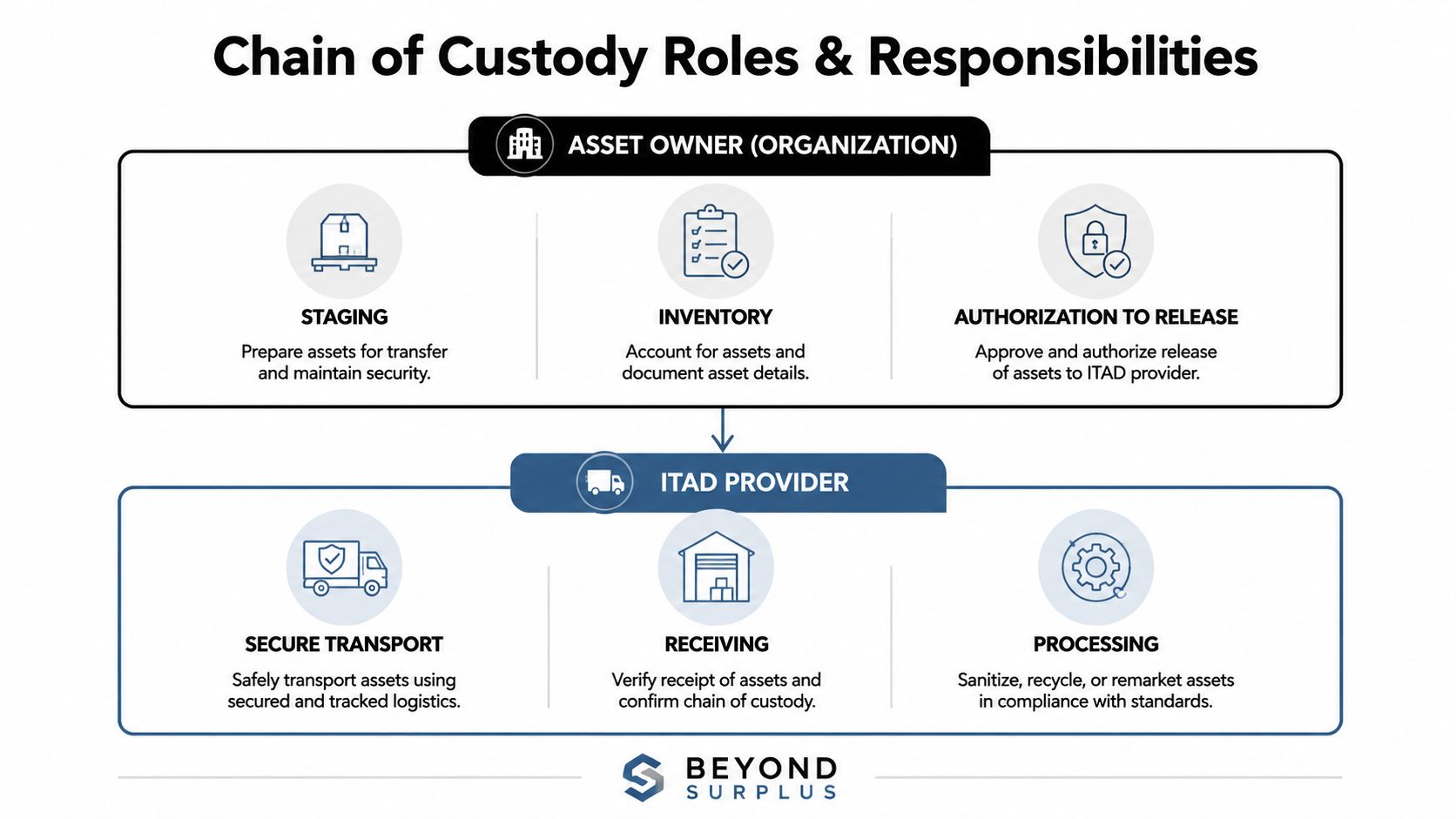
Assign evidence to every control point
At the staging room door, the owner confirms the serialized inventory and authorizes release. The pickup representative signs for the shipment, and the record receives a timestamp. At the loaded truck, the carrier confirms container condition and seal numbers through the waybill or transfer form.
At the receiving dock, the provider scans the shipment, records arrival, verifies seals, and documents any discrepancy before opening containers. At the sanitization station, the processing technician records the selected method, asset identity, verification outcome, and exception status.
The downstream recycler handoff needs the same discipline. Record the recipient, transfer time, material or asset identifiers, and final pathway. A handoff without a signature or authenticated confirmation is a custody break, not a minor administrative omission.
For vendor evaluation, use a structured ITAD vendor due diligence checklist that tests these control points directly. Ask who signs, where the timestamp lives, and how exceptions are escalated.
Closing the Pickup to Arrival Gap
The truck door isn't the end of chain of custody. It's where many programs stop collecting meaningful evidence.
The weakest period usually begins when a pallet is wrapped at the client site and ends when the receiving team reconciles barcodes at the ITAD facility. During that window, mixed loads, intermediate stops, temporary staging, vehicle changes, and damaged packaging can make liability unclear even when final destruction is properly certified.
Control the shipment before departure
Require a serialized pre-transport inventory and reconcile it against the receiving manifest before the vehicle leaves. Place each controlled container under a tamper-evident seal, record the seal number, and photograph the sealed condition. The driver's identity, vehicle assignment, transport mode, and departure time should be captured in the same shipment record.
GPS or route evidence adds an independent account of the transit window. It doesn't replace signatures, but it can help establish whether the vehicle followed the expected route and whether unexplained stops require investigation. Secured vehicles matter for the same reason. Transport is a control environment, not a gap between two facilities.
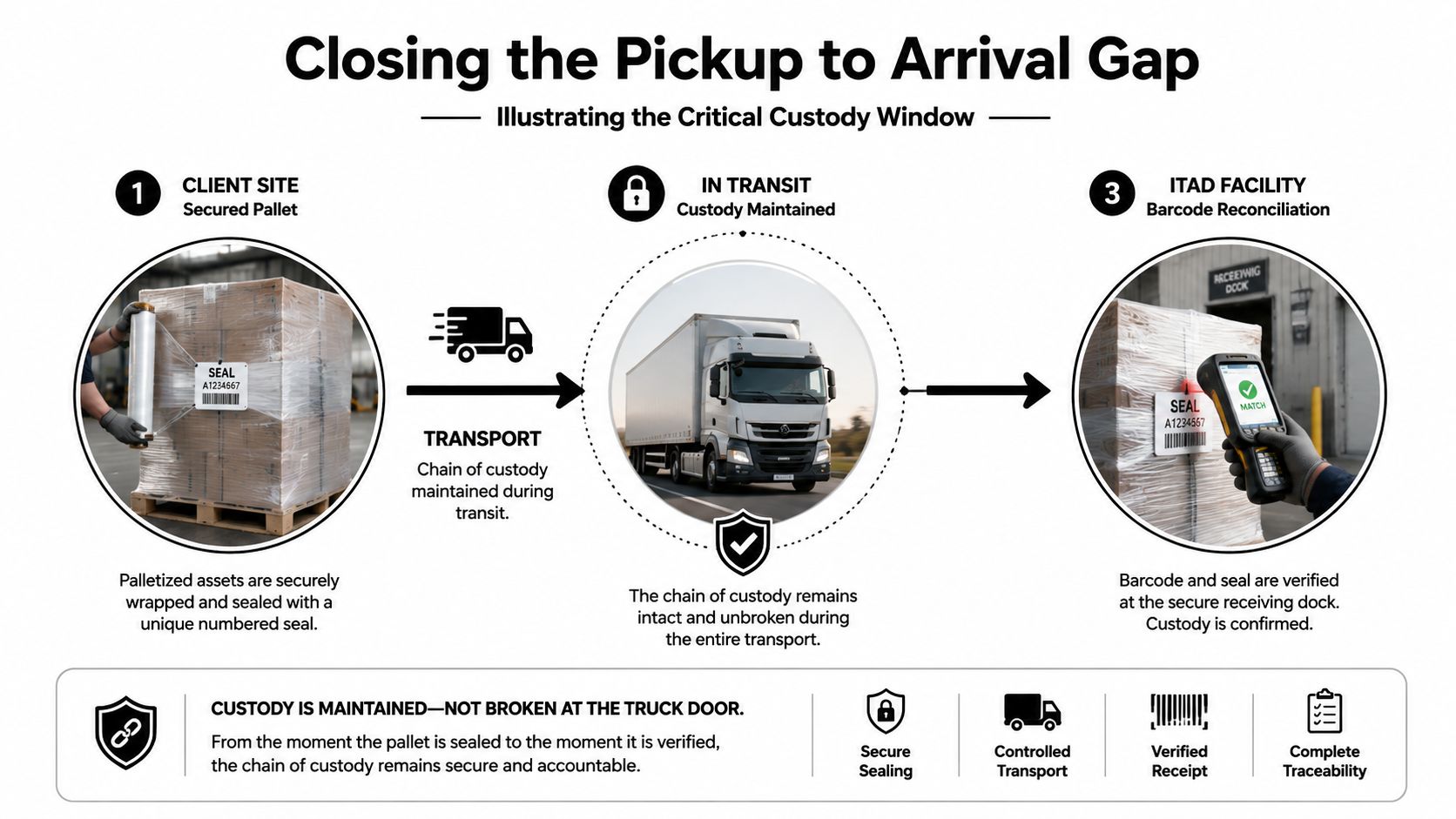
Reconcile immediately at arrival
The receiving team should verify the manifest, container count, seal condition, and serial inventory before any device enters sanitization or destruction. If a seal is broken or an asset is missing, quarantine the shipment and escalate the discrepancy before processing continues.
Transport control: A sealed container, photographed before departure, tracked during transit, and reconciled at arrival provides stronger evidence than a pickup receipt followed by a generic destruction certificate.
Organizations retiring data center equipment should demand the same discipline for racks, drives, components, and loose media. Data center logistics coordination should preserve identity and custody through removal, staging, transport, receiving, and processing.
How a Provider Like Beyond Surplus Transfers Liability
Liability transfer isn't a single signature. It's a sequence of controlled handoffs that narrows uncertainty at each stage.
The first handoff is the signed work order, which defines the services, approved disposition paths, data-handling requirements, and responsibilities. The second is the sealed manifest, which establishes what the provider is expected to receive. The third is secured-facility acceptance, where the provider confirms receipt, reconciles the shipment, and records exceptions. The fourth is the certificate of destruction or final disposition record, which documents the completed outcome.
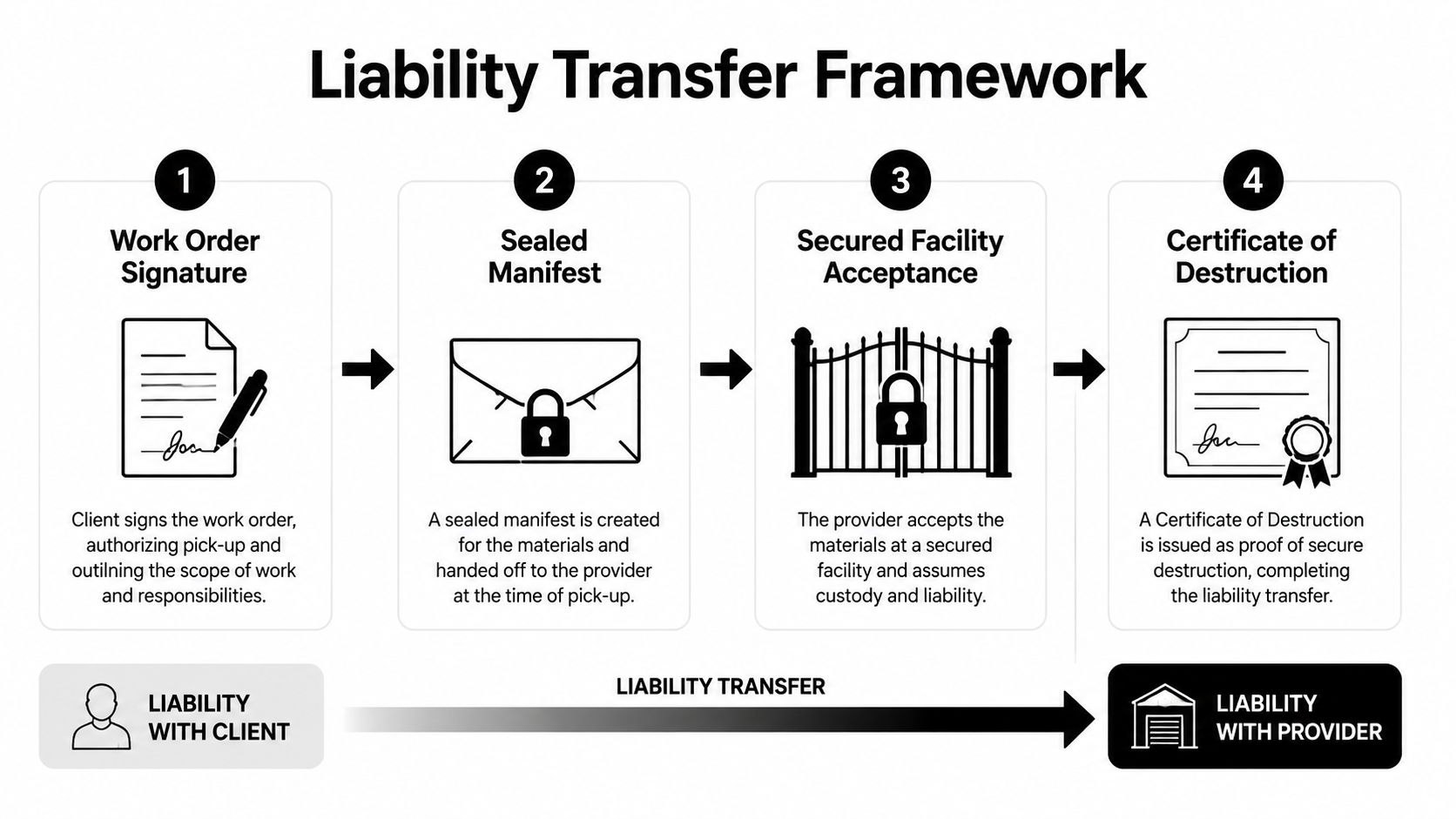
What the customer should receive
A provider should be able to supply serialized pre-transport manifests, tamper-evident seal records, receiving reconciliation, processing logs, and certificates aligned with the agreed security and environmental requirements. For customers evaluating data destruction documentation, the certificate of destruction title should connect the certificate to the asset record rather than presenting an untraceable batch statement.
Beyond Surplus documents asset movement from pickup through internal transfers, transport, facility intake, sanitization, destruction, recycling, resale, and final reporting. That makes the provider's role visible without asking the customer to reconstruct the entire chain from scattered internal records.
A concrete example makes the distinction clear. A regional healthcare network retired 1,200 laptops and received an FTC-ready evidence package within 72 hours, closing the matter with a single submission. Those figures are part of the stated scenario, not a general performance guarantee, but the operational lesson is useful: a complete package lets the customer answer an auditor with linked records instead of explanations.
The provider doesn't erase the owner's obligations. The owner still needs accurate inventory, proper authorization, and a contract that defines responsibilities. But a disciplined processor can assume operational custody with evidence that makes the transfer defensible.
Checklist and Audit Tips for Your Next Disposal Project
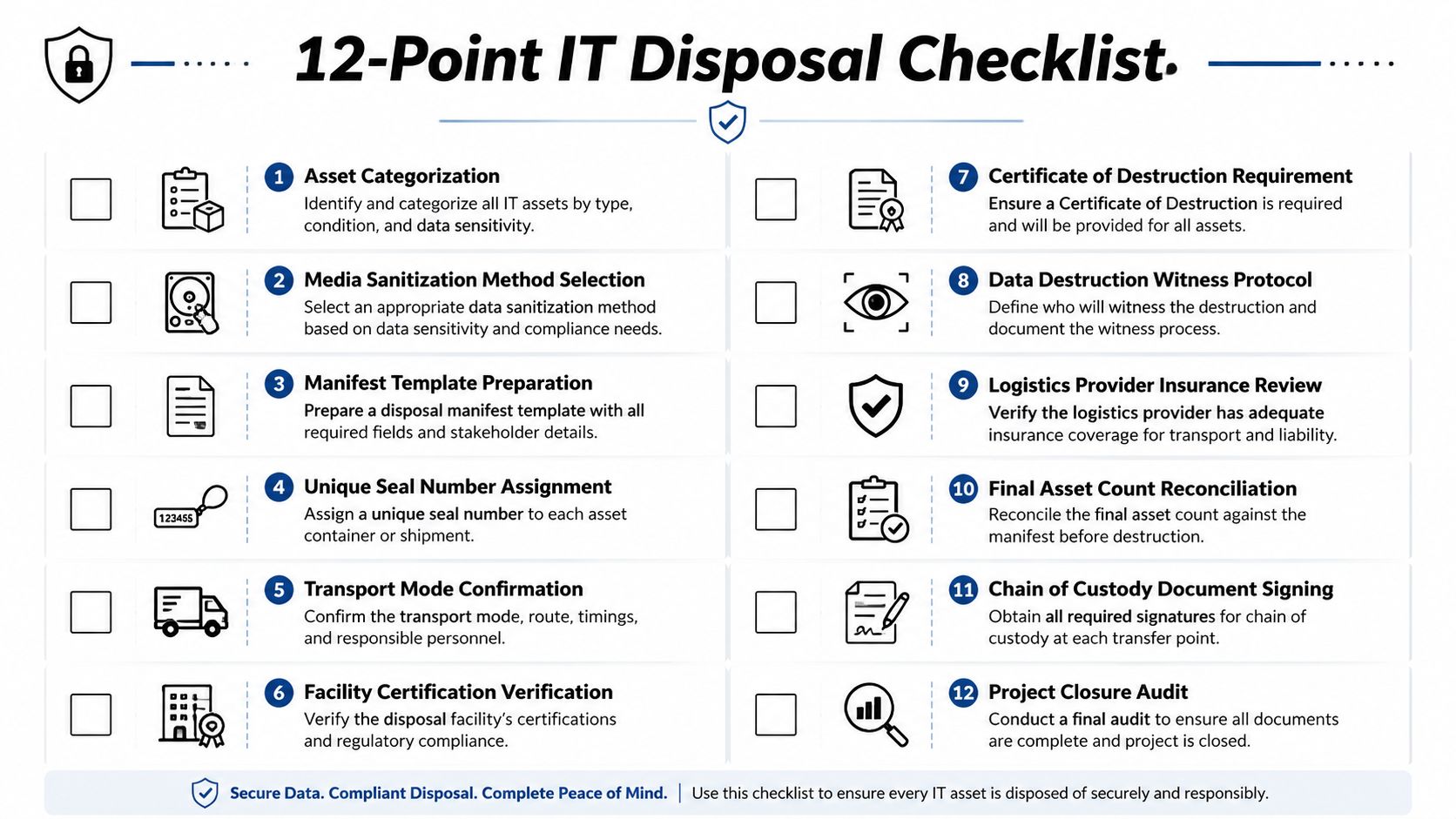
Use this checklist before approving an ITAD project or renewing a provider agreement. Each item should produce a record, not merely a verbal confirmation.
- Asset categorization: Separate laptops, servers, drives, mobile devices, networking equipment, and components. Ask whether the vendor can track each category at serial level.
- Media sanitization method selection: Match Clear, Purge, degaussing, or physical destruction to the media and risk. Require the method to appear on the final record.
- Manifest template preparation: Include asset tag, serial number, media type, location, condition, and authorized release. Review a blank template before signing the contract.
- Unique seal number assignment: Require a seal number for each controlled container and request a photo or video showing application and condition.
- Transport mode confirmation: Identify the carrier, vehicle controls, driver, route evidence, and intermediate-stop procedure.
- Facility certification verification: Confirm relevant facility controls and ask how certifications are kept current.
- Certificate of destruction requirement: Specify asset identity, method, date, location, technician, and verification outcome.
- Data destruction witness protocol: Define when an owner representative may witness or review destruction and how that observation is recorded.
- Logistics provider insurance review: Confirm coverage, exclusions, custody responsibility, and incident-notification obligations.
- Final asset count reconciliation: Require serial reconciliation at intake and before final disposition reporting.
- Chain-of-custody document signing: Name the person responsible for every handoff and define what happens when a signature is missing.
- Project closure audit: Review missing fields, exceptions, certificates, downstream records, and unresolved discrepancies before closing the work order.
Three controls for the next renewal
For a 2026 contract review, confirm that certificates include NIST 800-88 method codes, request NAID AAA audit summaries, and test the provider's incident response in writing. These checks reveal whether the vendor's controls work under pressure, not just whether the sales proposal sounds complete.
The broader market shows why this discipline matters. The global ITAD market was valued at USD 20.5 billion in 2022 and is projected to grow at a 6.8% CAGR from 2023 through 2030, according to ITAD industry market data. Global e-waste reached 62 million metric tons in 2022, with IT equipment accounting for 7%, while formal IT-asset recycling reached 22.3% globally. In the United States, e-waste totaled 6.9 million metric tons in 2022, and 45% came from IT assets. Chain-of-custody records help organizations prove that retired equipment followed an accountable path through reuse, recycling, sanitization, or destruction rather than entering an unknown stream.
Beyond Surplus provides commercial IT asset disposal, secure data wiping, hard-drive shredding, electronics recycling, product destruction, IT buyback, and data center decommissioning with serialized chain-of-custody documentation. Visit Beyond Surplus to arrange a business pickup, define your required evidence package, and create a defensible path from collection through final disposition.


