

An IT manager opens a storage room after a hardware refresh and finds retired laptops, servers, phones, hard drives, networking equipment, and specialized devices stacked behind newer inventory. The equipment may be obsolete to operations, but it can still contain sensitive data, retain resale value, or create environmental and compliance exposure. A responsible Corporate Electronics Disposal Guide must address the full lifecycle, from inventory and logistics to data destruction, value recovery, recycling, and vendor oversight.
The scale makes informal handling a poor business decision. The world generated 62 million tonnes of e-waste in 2022, equal to about 7.8 kg per person, while only 22.3% was formally collected and recycled in an environmentally sound manner, according to the Global E-waste Monitor 2024. Corporate disposal needs more than a truck and a receipt. It needs a documented process that protects information, supports compliance, controls downstream risk, and identifies equipment that can be reused or recovered.
Table of Contents
- The Hidden Risks in Your IT Storage Closet
- Navigating the Regulatory Minefield of E-Waste
- Secure Data Destruction Methods That Eliminate Risk
- Establishing an Unbreakable Chain of Custody
- Selecting the Right ITAD Vendor A Strategic Guide
- Maximizing Value and Sustainability
- Sector-Specific Disposal Protocols and Checklists
The Hidden Risks in Your IT Storage Closet
The storage closet often becomes the last stop in an unmanaged asset lifecycle. A laptop is replaced, a server is removed from a rack, or a hard drive is swapped during maintenance. Someone labels the equipment “old,” moves it out of sight, and assumes the risk has ended.
It hasn’t. Retired assets remain connected to the company through the data they contain, the asset records attached to them, and the decisions made about their final destination. A forgotten drive may hold customer records, employee information, credentials, intellectual property, or regulated data. A decommissioned server may also contain storage media that staff assume was wiped because the system was taken offline.
Disposal is a risk management function
Improper handling can expose a business to data breach investigations, contractual disputes, environmental liability, and reputational damage. The risk doesn’t depend on whether the equipment still powers on. It depends on whether the organization can prove that it controlled the asset and applied an appropriate disposition method.
A practical review should ask:
- What assets exist: Build an inventory that includes laptops, desktops, servers, phones, networking equipment, removable media, medical devices, and laboratory equipment.
- What data they hold: Classify assets according to the sensitivity of the information stored on them.
- Who controls the process: Assign responsibility across IT, security, facilities, procurement, legal, and sustainability teams.
- What evidence exists: Require records showing collection, sanitization or destruction, recycling, resale, and final disposition.
Practical rule: “Out of sight” is a storage condition, not a disposal control.
The data security risks of improper computer disposal are easiest to manage before equipment leaves the facility. Treat every retired device as an accountable business asset until a verified disposition record closes the lifecycle.
Navigating the Regulatory Minefield of E-Waste
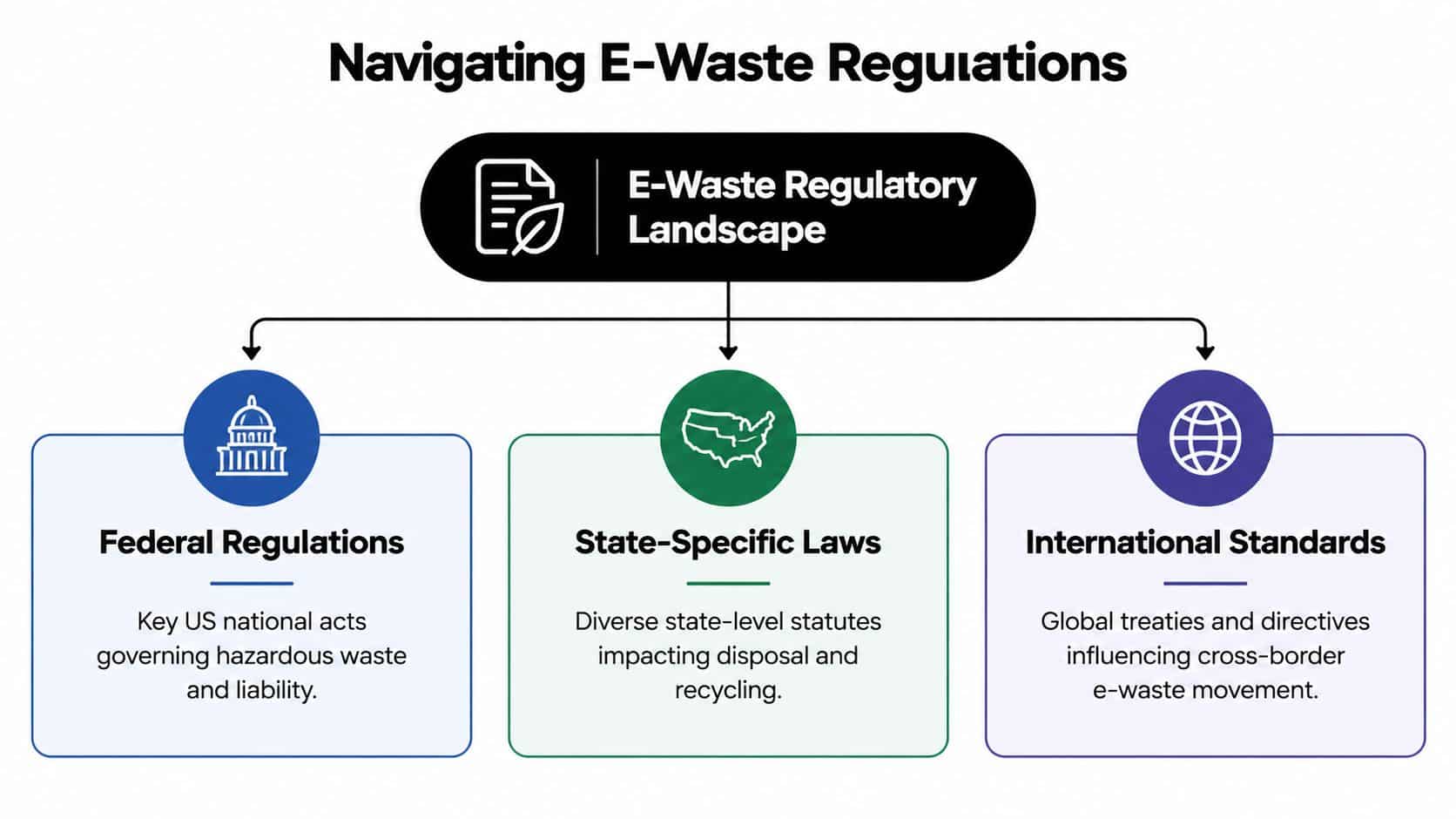
A retired laptop can trigger obligations across privacy, environmental, transportation, and industry rules. The applicable requirements depend on the asset, the information it contains, the organization’s sector, and where the equipment is collected, shipped, and processed. Treat compliance as part of the full disposition lifecycle, alongside data destruction, logistics, value recovery, and vendor management.
Start with the federal layer
At the federal level, review requirements covering information disposal, hazardous materials, transportation, and environmental responsibility. The FTC Disposal Rule matters when retired equipment contains consumer report information. A disposal policy should specify how the company identifies that data, who authorizes destruction, and which records demonstrate that the process occurred.
Federal rules set the compliance conditions. The operating program must translate them into inventory controls, secure handling, approved vendors, documented transportation, and evidence retention. Those controls also support later audits and help establish accountability when assets pass between internal teams and service providers.
Add industry-specific safeguards
Healthcare organizations need procedures for equipment that may contain protected health information, or PHI. This can include workstations, diagnostic equipment, mobile devices, storage systems, and removable media used in clinical operations. Each asset should connect to an approved sanitization or destruction method, with records retained for compliance review.
Financial institutions must protect account information, transaction records, internal reports, and other confidential data. Education organizations should account for student information and equipment distributed across departments, campuses, and remote locations. The workflow should follow the organization’s information classification policy, rather than applying one treatment to every device.
Map state obligations by location
Companies with offices, warehouses, clinics, branches, or data centers in multiple states need location-level controls. Equipment may be collected in one state, consolidated in another, and processed elsewhere. Procurement and compliance teams should confirm the rules for each location, then verify the vendor’s transportation plan and downstream processing route.
Europe’s regulatory history shows why collection and reporting belong in the disposition plan. The EU first legislated on e-waste through the original WEEE Directive in 2003, later establishing a minimum collection target of 65% of the average weight of electrical and electronic equipment placed on the market in the previous three years, or alternatively 85% of WEEE generated. The European Court of Auditors report on electronic waste documents this framework, which places collection, recovery, and reporting at the center of responsible disposal.
For a practical overview, review what businesses should know about e-waste laws. The operating standard is direct: identify applicable rules, assign ownership, control the vendor pathway, document each handoff, and retain evidence that supports the company’s compliance position.
Secure Data Destruction Methods That Eliminate Risk
Secure disposal isn’t a single technique. The correct method depends on the storage medium, data sensitivity, intended outcome, and whether the asset will be reused. A laptop prepared for resale requires a different treatment from a failed solid-state drive containing highly sensitive information.
NIST SP 800-88 defines three media sanitization categories, Clear, Purge, and Destroy. Clear uses logical techniques such as overwriting user-addressable storage. Purge uses physical or logical techniques that make recovery infeasible using state-of-the-art laboratory methods. Destroy makes recovery infeasible and prevents further storage use, according to NIST SP 800-88 Revision 1.
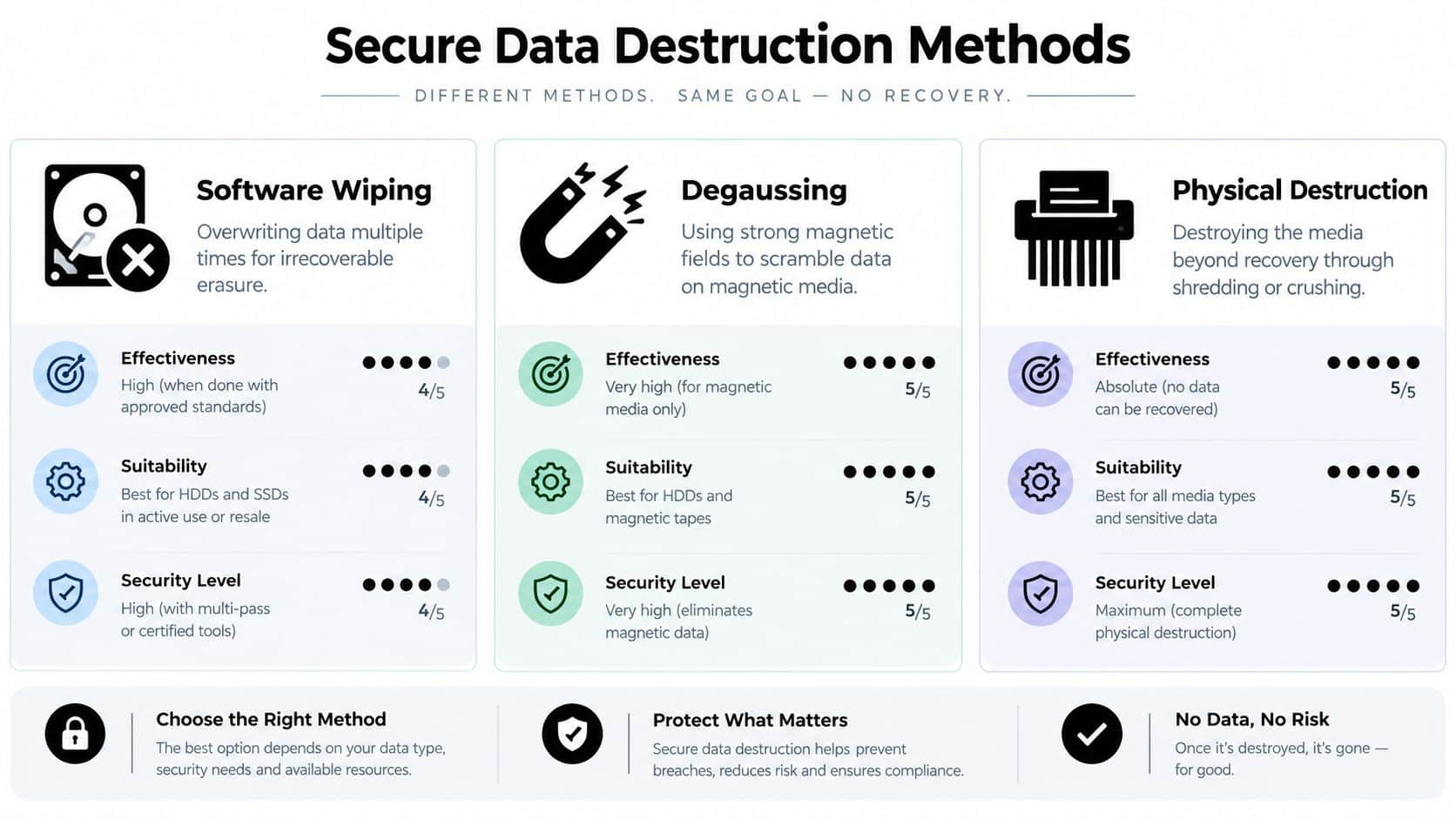
Software-based wiping
Certified software wiping can suit functional laptops, desktops, servers, and drives that will be reused or remarketed. The process should identify the drive correctly, execute an approved sanitization procedure, verify the result, and produce an asset-level record.
Simple deletion doesn’t meet that standard. Deleting files, emptying a recycle bin, or reinstalling an operating system may leave recoverable information. Wiping also requires care with modern storage technologies, including solid-state drives, where traditional overwriting assumptions may not apply to every storage area.
Degaussing
Degaussing uses a strong magnetic field to disrupt data on compatible magnetic media. It isn’t a universal answer for mixed corporate fleets. Solid-state storage, optical media, and other nonmagnetic formats require a different method, and a degaussed drive generally won’t support resale or reuse.
A vendor should explain exactly which media the equipment supports and how it verifies the outcome. Convenience shouldn’t determine the sanitization decision.
Physical destruction
Shredding, crushing, or another validated destruction method is appropriate when media will permanently leave operational control, when the data sensitivity is high, or when reuse isn’t justified. NIST’s guidance treats destruction as the route that prevents further storage use. For optical media and disintegrated material, the standard specifies residues reduced to nominal edge dimensions of 5 mm and surface area of 25 mm2, as described in the NIST media sanitization publication.
The decision framework should match method to outcome:
- Reuse: Use a validated Clear or Purge process that supports resale and produces a certificate.
- High-risk media: Use Purge or Destroy when laboratory recovery concerns or policy requirements demand stronger assurance.
- Mixed or failed media: Segregate devices and apply the method suitable for each storage type instead of processing the fleet as one category.
The NIST SP 800-88 data destruction standards provide useful questions for evaluating vendor procedures and certificates.
Establishing an Unbreakable Chain of Custody
A certificate issued at the end of a process can’t repair a broken custody trail at the beginning. The organization needs to know what happened from the moment an asset was identified for removal until its final disposition was recorded.
Chain of custody connects the physical movement of equipment with an auditable record. It should show who released the asset, who collected it, how it was transported, where it was received, what treatment it received, and what happened afterward. That record reduces ambiguity during an internal review, customer inquiry, insurance investigation, or regulatory audit.
Build the record before pickup
Start with a serialized inventory. Capture asset tags, serial numbers, device type, location, condition, and data-bearing status. If the vendor receives mixed equipment, the handoff should reconcile the shipment against the inventory before processing begins.
A strong program also defines exception handling. Missing serial numbers, damaged devices, mismatched quantities, and assets discovered after pickup should enter a documented resolution process rather than disappear into an administrative gap.
Demand disposition evidence
The documentation package should reflect the services performed:
- Serialized asset report: Shows the equipment received and creates a reference for each unit.
- Certificate of data destruction: Identifies the sanitization or destruction result for data-bearing media.
- Certificate of recycling: Records responsible material processing for equipment that isn’t reused.
- Resale or recovery report: Separates value recovery from recycling and explains the financial treatment.
- Exception record: Documents discrepancies, rejected assets, or downstream decisions requiring review.
Global e-waste controls remain uneven. Neutral industry data indicates that only about 22% of global e-waste is formally collected and recycled, making documentation, chain of custody, and certified treatment as important as the recycler itself, according to industry data on electronic recycling and e-waste management.
A vendor’s certificate is useful only when the underlying asset trail is complete enough to trust.
The chain of custody for IT asset disposal should therefore be treated as a control system, not a paperwork exercise. Procurement teams should review sample reports before awarding work and confirm how long records remain available.
Selecting the Right ITAD Vendor A Strategic Guide
The lowest quote rarely represents the lowest total risk. A vendor can charge less by limiting reporting, using unclear downstream channels, or treating every device with the same disposal method. A defensible selection process evaluates security, environmental controls, logistics, insurance, reporting, and recovery potential together.
ITAD vendors commonly use physical shredding, software-based wiping, and degaussing. The appropriate choice depends on the storage media and compliance requirements, not just convenience, as discussed in coverage of data erasure services and ITAD methods.
Test the vendor’s controls
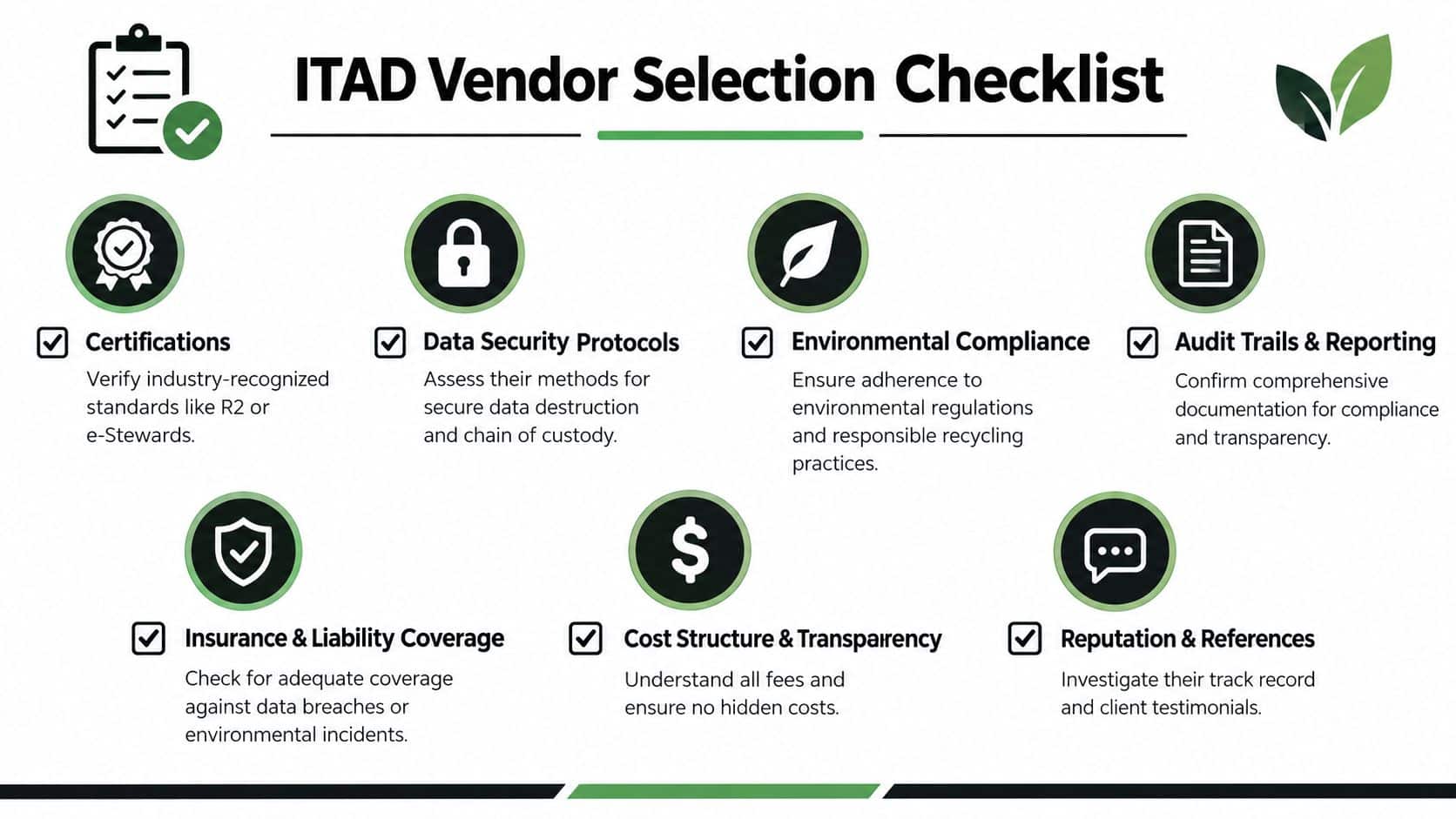
Ask for evidence instead of accepting general assurances. An RFP should request certifications such as R2v3 or e-Stewards, descriptions of data sanitization procedures, sample certificates, downstream management policies, and details about facility security.
The vendor should explain how it handles laptops, servers, phones, solid-state drives, removable media, medical equipment, laboratory equipment, and product destruction projects. A technically credible answer will distinguish the media types and describe when reuse is possible and when destruction is required.
Review liability and reporting
Insurance deserves direct attention. Confirm coverage relevant to data breaches, pollution incidents, transportation, and general liability. Ask whether the policy limits and exclusions align with the value and sensitivity of the project.
Reporting should be specific enough for an auditor to follow. Look for serialized asset lists, disposition codes, destruction certificates, recycling certificates, recovery summaries, and exception reports. If a vendor can’t provide a sample reporting package before the contract is signed, procurement should treat that as a warning.
A practical scorecard can include:
- Security: Sanitization methods, verification, access controls, and custody procedures.
- Environmental compliance: Certifications, facility practices, downstream oversight, and prohibited pathways.
- Operational capacity: Pickup coordination, data center decommissioning, equipment sorting, and project management.
- Commercial transparency: Pricing assumptions, recovery credits, transportation charges, and treatment fees.
- Accountability: Insurance, references, audit rights, escalation contacts, and record retention.
The ITAD vendor due diligence checklist can help procurement and IT teams turn these questions into a consistent evaluation.
Maximizing Value and Sustainability
A corporate disposal program should classify equipment by both condition and business value. Laptops, servers, networking devices, and specialized systems may support secure refurbishment or redeployment. Damaged or obsolete hardware may instead require material recovery or destruction through an approved process.
This classification affects the financial outcome. Recovering value can offset service costs, improve inventory reconciliation, and give finance teams a reliable view of residual assets. It also keeps usable equipment out of a destructive pathway and connects disposal decisions with procurement, security, and sustainability objectives.
Put reuse before material recovery
Use a defined decision sequence for every asset:
- Identify the asset: Confirm the model, configuration, serial number, condition, and ownership.
- Protect the data: Apply a validated Clear, Purge, or Destroy method that matches the risk and intended disposition.
- Assess residual value: Decide whether refurbishment, resale, internal redeployment, donation, or parts recovery is appropriate.
- Recycle the remainder: Route equipment without a practical reuse option through an approved recycling process.
- Document the result: Record the final disposition and retain the supporting certificate or report.
Reuse depends on controls, not just market demand. Before resale, verify sanitization, remove company identifiers where appropriate, resolve licensing concerns, and approve the commercial channel. The reseller should also explain how it handles returned, rejected, or unsold equipment. Without that visibility, the organization may transfer risk to an unknown downstream party.
Sustainability requires evidence
Environmental performance must be traceable to specific assets and processing steps. A recycling certificate should identify the equipment and treatment pathway, rather than state that materials were recycled. Ask how the vendor handles hazardous components, downstream processors, export controls, and rejected material.
Europe’s original WEEE Directive, introduced in 2003, established a model in which producers and organizations plan for collection, recovery, and reporting instead of treating electronics as a removal task, according to the European Court of Auditors analysis. The same principle applies to U.S. corporate programs. Sustainability claims carry more weight when policy, asset records, approved vendors, verified processing, and retained evidence connect clearly.
The strongest programs align secure information handling, financial recovery, and responsible material management. Treat disposal as an operating function across the full asset lifecycle, with controls that protect compliance, cash recovery, and environmental accountability together.
Sector-Specific Disposal Protocols and Checklists
The same pickup process won’t meet the needs of a hospital, bank, university, manufacturer, or government agency. Each sector should translate its information policy and operational risks into asset-specific instructions.

Healthcare organizations
Healthcare teams should flag equipment that may contain PHI before collection. That includes workstations, servers, mobile devices, diagnostic systems, printers, removable media, and medical equipment with embedded storage.
- Identify PHI exposure: Ask clinical engineering and IT teams whether the device stored, displayed, transmitted, or cached patient information.
- Separate device categories: Don’t process a medical device as ordinary office equipment without confirming its storage and decontamination requirements.
- Approve the method: Match wiping, purging, or physical destruction to the medium and the organization’s risk policy.
- Retain evidence: Keep serialized records and certificates connected to the relevant asset or project.
Finance and regulated business
Financial organizations should map disposal to internal information classifications and applicable obligations. Storage media from trading systems, employee workstations, branch equipment, and backup environments may require different treatment.
Require dual review for high-risk assets, document custody changes, and reconcile collected equipment against the approved inventory. Procurement should also verify vendor insurance, incident escalation, downstream controls, and reporting quality before authorizing recurring work.
Schools and universities
Education institutions often manage distributed equipment across classrooms, offices, libraries, laboratories, residence operations, and research environments. The inventory must account for departmental ownership and equipment that moves between campuses or programs.
- Coordinate locations: Give each site a handoff procedure and a responsible contact.
- Protect student data: Classify devices used by students, faculty, admissions, finance, and research teams.
- Handle laboratories separately: Laboratory equipment may contain data, chemicals, components, or specialized parts requiring a specific disposition path.
- Close the loop: Reconcile every shipment, record reuse or recycling, and retain certificates for institutional records.
A written standard operating procedure should define who authorizes removal, who verifies the inventory, which methods are approved, and who reviews the final reports. That consistency matters during office relocations, data center decommissioning, fleet refreshes, and large-scale facility cleanouts.
Beyond Surplus provides business IT asset disposition, electronics recycling, secure data wiping, hard drive shredding, product destruction, logistics coordination, and documentation such as certificates of recycling and data destruction. Visit Beyond Surplus to discuss a controlled disposal program for laptops, servers, medical equipment, laboratory equipment, data center assets, and other corporate electronics.


