

A retired server room rarely looks finished when the project plan says it is. Decommissioned laptops remain stacked beside the rack, external auditors request proof that storage was sanitized, and the finance team asks why obsolete equipment is still on the books. Meanwhile, security leaders need confidence that a device leaving the building won't become a data exposure.
Secure asset recovery for enterprise IT is an operating program, not a truck appointment. It connects inventory, classification, pickup, transportation, data destruction, resale, recycling, certificates, and audit review. The strongest programs give every hand-off a written acceptance test, so a missing serial number or destruction record stops the workflow instead of becoming an explanation after an incident.
Table of Contents
- Why Secure Asset Recovery Is Now a Board-Level Program
- Building the Policy and Asset Inventory Foundation
- Choosing On-Site or Off-Site Data Destruction Methods
- Chain of Custody and Transportation Security
- Selecting Vendors and Locking Down Contracts
- Value Recovery, Recycling, and Compliance Paperwork
- Post-Process Audit and Continuous Improvement
Why Secure Asset Recovery Is Now a Board-Level Program
Enterprise retirement decisions now affect more than the IT department. A retired laptop may contain employee records, a server may hold regulated information, and a network appliance may preserve configuration data or intellectual property. The organization still carries the operational and reputational consequences after those assets leave the loading dock.
The scale of the market reflects that change. One 2026 market summary estimates the global IT asset disposition market at USD 17.5 billion in 2025, rising to USD 40.1 billion by 2035, with an 8.9% CAGR. It also places data destruction at about USD 5 billion in 2025, and identifies destruction as the leading segment that year. These figures are reported in the ITAD market summary, and they reflect a practical shift, enterprises increasingly formalize retirement, sanitization, resale, and recycling rather than treating equipment as ordinary waste.
Fragmented handling creates the opposite result. One local recycler collects laptops, another vendor shreds drives, a facilities contractor moves pallets, and nobody owns the complete evidence file. That arrangement can appear inexpensive until an auditor asks which serial number was destroyed, who transported it, and when the certificate was issued.
Board-level test: If security, finance, legal, and sustainability can't all use the same asset disposition record, the program isn't integrated.
Executive sponsorship should establish ownership across IT operations, information security, procurement, finance, legal, and environmental reporting. Useful measures include asset dwell time, unresolved inventory exceptions, certificate delivery, recovered value, and non-conforming hand-offs. A practical ESG and IT recycling framework also connects material recovery with defensible reporting, without allowing sustainability goals to weaken data controls.
Building the Policy and Asset Inventory Foundation
No vendor should touch enterprise hardware until the organization has decided what each asset is, who controls it, and what evidence the final disposition requires. Start with a written policy that assigns decision rights for reuse, resale, donation, recycling, and destruction.
Define data classes in business language. A workable matrix can include personally identifiable information, protected health information, payment card data, proprietary intellectual property, export-controlled material, and equipment with no data-bearing function. Then map each class to a sanitization tier. The device type alone isn't enough. An encrypted SSD and an unencrypted backup tape may require different controls even if both are listed as storage media.
Establish the inventory baseline
Capture each asset at serial-number level, including laptops, servers, mobile devices, storage media, printers, laboratory equipment, medical equipment, and networking hardware. Record the assigned custodian, physical location, ownership status, encryption state, condition, and intended disposition. A barcode scan at removal is more reliable than a spreadsheet updated after the truck departs.
The initial control set should produce three artifacts:
- Approved asset list: The exact equipment authorized for the work order.
- Classification matrix: The data category, sanitization method, and evidence standard for each tier.
- Authorized recipient register: The employees, vendors, carriers, processors, and downstream buyers permitted to receive assets.
Use an exception log for missing tags, disputed ownership, failed encryption checks, and equipment discovered outside the approved list. A documented IT asset lifecycle management process helps connect acquisition records with retirement decisions, rather than creating a separate disposal spreadsheet that quickly loses context.
Data classification and sanitization tier mapping
| Data Class | Examples | Sanitization Tier | Minimum Evidence |
|---|---|---|---|
| Restricted regulated data | PHI, consumer records, payment data | Verified purge or physical destruction | Serial-level method record, verification log, certificate |
| Confidential enterprise data | Source code, designs, contracts, credentials | Verified purge, or destruction where required | Asset record, tool result, reviewer approval |
| Internal operational data | Standard business files and configurations | Controlled clear or purge | Sanitization result and custody record |
| No data-bearing function | Monitors, empty chassis, keyboards | Inventory and material disposition control | Pickup record and recycling documentation |
Choosing On-Site or Off-Site Data Destruction Methods
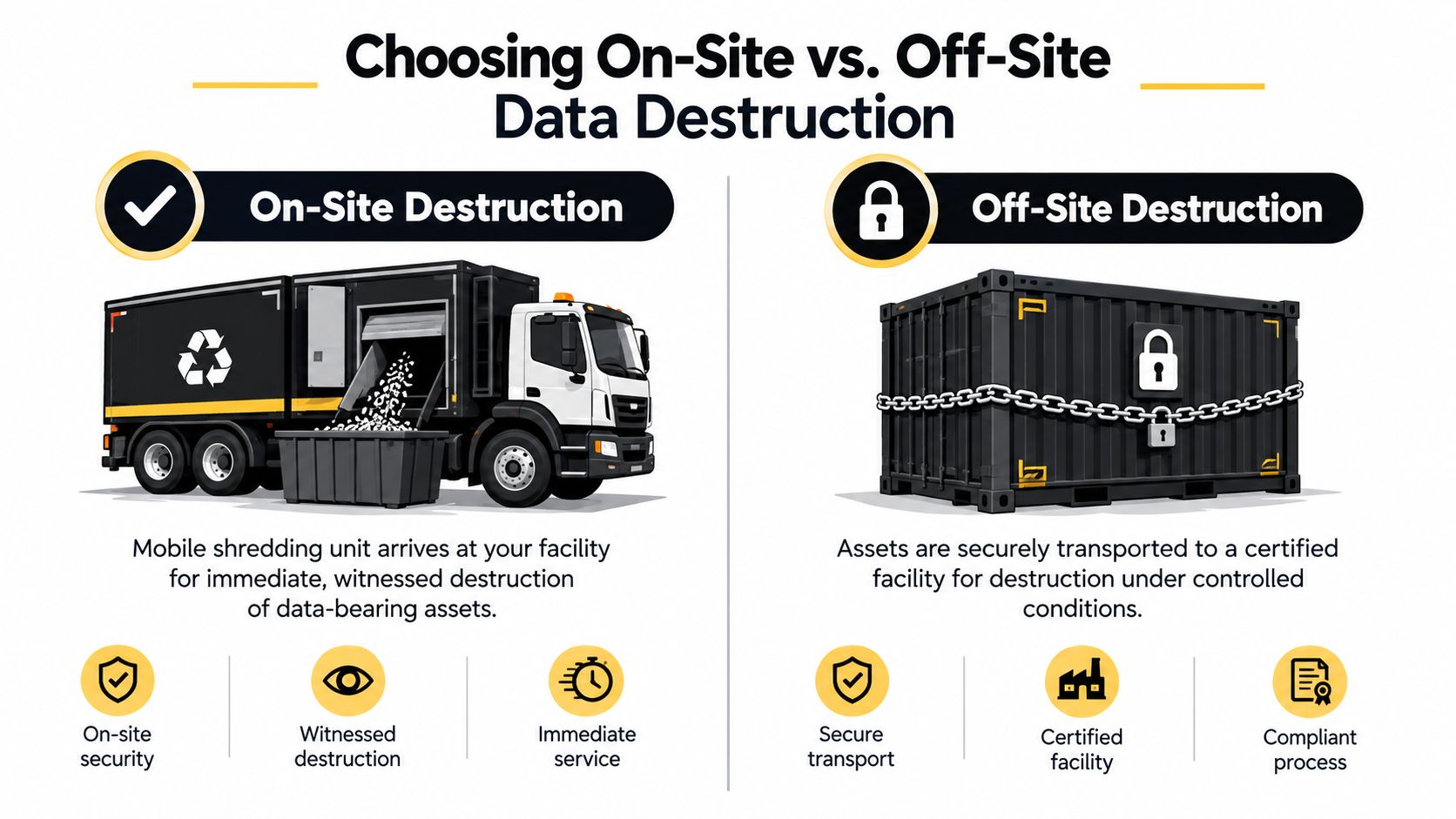
The right destruction route depends on data sensitivity, media type, facility constraints, volume, and evidence requirements. On-site processing keeps high-risk media within the controlled premises. Off-site processing can handle larger flows efficiently, but only when transportation and receiving controls are strong enough to preserve custody.
On-site options may include mobile shredding, degaussing, and witnessed NIST SP 800-88 Clear or Purge procedures. The loading dock should capture serialized media tags before the asset enters the mobile unit. This works well for regulated environments, sensitive product development areas, and facilities where the business doesn't want storage media to leave before destruction.
Off-site processing requires more than a locked truck. The vendor should reconcile barcodes at pickup, use sealed containers, document the driver and manifest, and confirm intake at a monitored facility. NIST SP 800-88 Destroy can be performed there, with video controls, weight verification, and media-level records. A hybrid route often makes operational sense, for example, shredding SSDs on-site while sending lower-risk HDDs to a certified facility.
Match the method to the media
Firmware Secure Erase shouldn't be accepted automatically for older SSDs. Controller behavior, overprovisioned areas, and remapped blocks can prevent a simple completion message from proving complete sanitization. Degaussing can remove data from suitable magnetic media, but it may leave little audit evidence unless the operator records the device, process, and result. Shredding also requires a particle-size specification that matches the enterprise policy.
NIST recommends verification whenever sanitization is applied, followed by representative sampling with a separate validation tool from a different developer on at least 20% of sanitized media items. Its guidance also calls for pseudorandom coverage across the addressable space, with each subsection receiving at least two non-overlapping reads. For hard drives, the method describes roughly 1,000 conceptual subsections, producing coverage of at least 10% of the media, including the first and last addressable locations. These requirements appear in NIST SP 800-88 Revision 1.
Require these acceptance terms in writing:
- Serialized media list reconciled before processing.
- Method, operator, tool, and result recorded.
- Verification completed for every sanitization event.
- Independent sampled validation documented.
- Failed items quarantined, not released into resale or recycling.
- Certificate tied to specific serial numbers, not only a batch weight.
For a practical decision model, compare on-site and off-site ITAD services against the policy, not against a generic price list.
Chain of Custody and Transportation Security
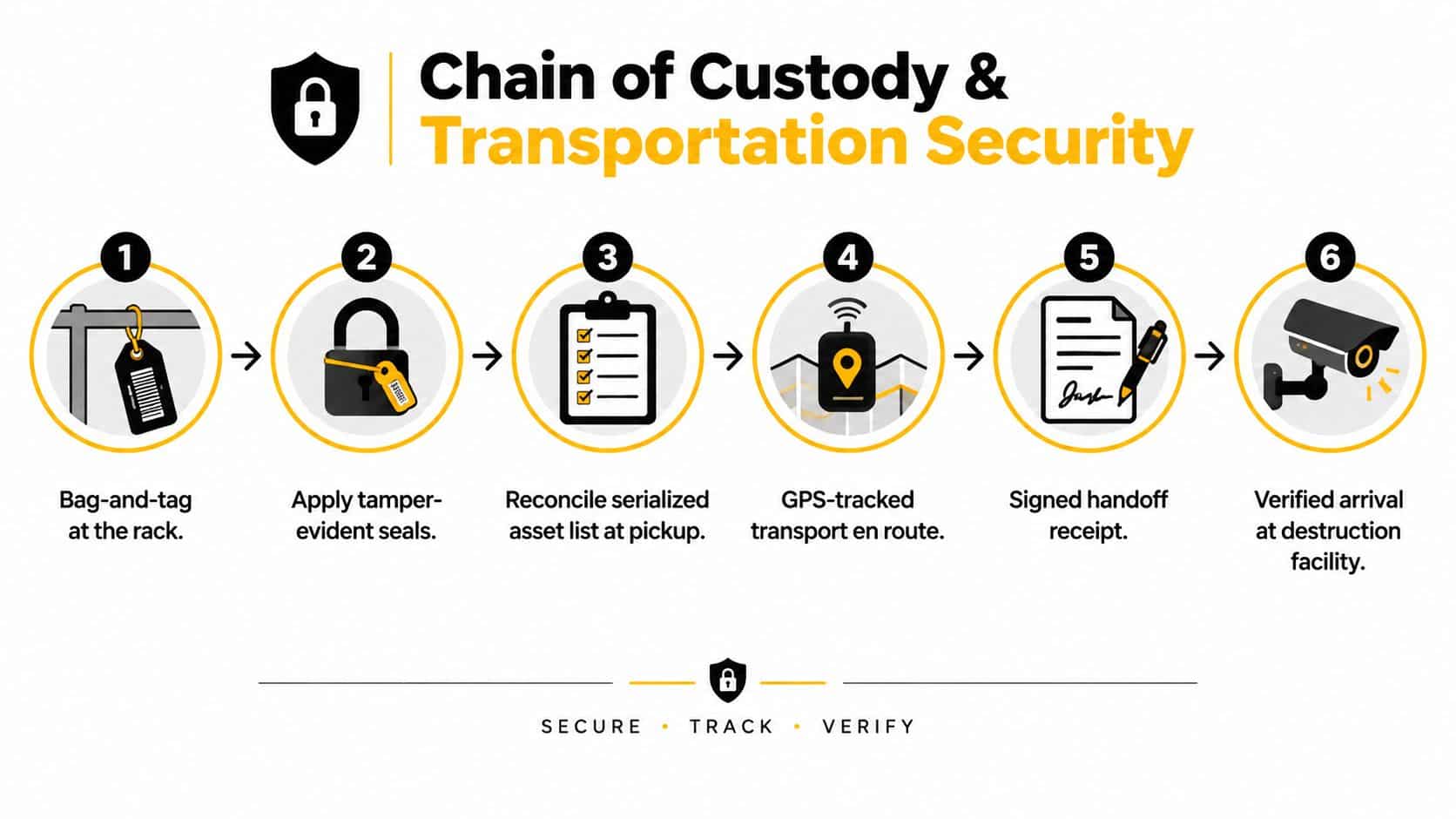
A chain of custody is credible only when each transfer produces an artifact. “The pallet was collected” isn't enough. The record needs to show what was collected, how it was sealed, who accepted it, where it traveled, and when the receiving facility confirmed arrival.
Use a numbered sequence at the facility:
- Bag and tag at the rack. Record the asset tag, serial number, custodian, and location.
- Apply tamper-evident seals. Capture the seal ID on the container or pallet record.
- Reconcile at pickup. Compare the serialized list with the physical load before the carrier signs.
- Track the route. Use controlled transport and GPS visibility appropriate to the data class.
- Obtain the driver manifest. The driver signs for the exact containers and assets accepted.
- Confirm receipt. The destruction facility records seal condition, intake time, discrepancies, and responsible receiver.
Treat missing evidence as a stop condition
Each checkpoint should create a specific artifact, such as an asset tag record, seal ID, bill of lading, weigh ticket, pickup manifest, or intake log. If a pallet arrives with a broken seal or an unexplained serial mismatch, quarantine the load and open an exception. Don't let a vendor substitute a later email for a missing contemporaneous record.
Real failures are mundane. A pallet can be swapped at a shared dock, a vehicle can take an unapproved detour, or a tote can sit overnight with an undisclosed subcontractor. Single-custodian transport is preferable when the classification warrants it. Two-person pickup teams are appropriate when staff apply chained seals or handle large mixed-media loads.
The chain-of-custody process for IT asset disposal should be detailed enough that an internal reviewer can reconstruct the movement without interviewing the driver. That is the standard that survives scrutiny.
Selecting Vendors and Locking Down Contracts
A vendor presentation often emphasizes trucks, software, and certificates. Enterprise buyers should score what happens when a load is disputed, a subcontractor loses an item, or a certificate doesn't match the inventory.
Compare providers on these dimensions:
- Process evidence: Can the vendor show the actual custody workflow, exception procedure, and sample records?
- Certification status: Identify named NAID AAA or R2v3 certifications, scope, facility, and audit dates. Don't accept an unqualified logo.
- Insurance: Review coverage for loss, breach, pollution, transportation, and professional liability. The limit should be considered against the risk, not accepted as a standard form.
- Subcontractor control: Require disclosure of every downstream carrier, processor, and remarketing party involved in the flow.
- Relevant references: Ask for accounts with comparable regulated data, distributed locations, data centers, healthcare operations, finance, or government work.
Vendor contract clauses must-haves versus nice-to-haves
| Clause Area | Must-Have for Enterprise | Nice-to-Have / Weak Substitute |
|---|---|---|
| Destruction evidence | Serial-specific certificates and process records | Batch certificate based on weight |
| Audit rights | Access to relevant facility records and processing areas | Vendor-selected summary report |
| Incident notice | Defined notice window measured in hours | “Prompt” notice with no deadline |
| Liability | Indemnification that survives termination and meaningful remedies | Broad disclaimer or low liability cap |
| Subcontracting | Prior approval, disclosure, and flow-down obligations | Open-ended permission to subcontract |
| Data breach | Cooperation, preservation, investigation, and costs clearly assigned | General confidentiality language |
Per-record liquidated damages may be appropriate where the risk and legal review support them. So can a right to audit the destruction site, defined incident escalation, and indemnification that survives contract termination. A force majeure clause shouldn't erase notification duties, and a liability cap below the value of the information requires explicit executive acceptance.
Use a vendor due diligence checklist before award, then attach the approved workflow and evidence examples to the contract. Procurement should treat the agreement as an incident-response document that has been rehearsed, not as a checkbox completed after the commercial terms are settled.
Value Recovery, Recycling, and Compliance Paperwork
Value recovery and compliance must share one disposition file. Resale, refurbishment, and recycling are different operational paths, but they all begin with the same controlled inventory and data decision.
A resale lot needs asset-level condition and test records, a secure wipe or destruction certificate, and a buyer record. Refurbishment requires custody through the next user or approved channel. Recycling requires material disposition information, weight records, and documentation from the downstream processor. If those records sit in separate systems, finance may see a credit while security can't prove what happened to the drive.
The environmental context is substantial. The Global E-waste Monitor 2024 reports 62 million tonnes of e-waste in 2022, equal to about 7.8 kilograms per person worldwide, while only 22.3% was documented as formally collected and recycled in an environmentally sound manner. It says approximately US$62 billion in recoverable natural resources remained unaccounted for. A separate Global E-waste Monitor projection puts annual generation at 82 million tonnes by 2030 if current trends continue, and says generation is increasing five times faster than documented recycling.
Asset outcome to required documentation
| Disposition Path | Required Documentation | Owner |
|---|---|---|
| Internal redeployment | Sanitization result, functional test, reassignment record | IT asset manager |
| Resale or remarketing | Serial-level wipe certificate, test report, buyer record, credit memo | Finance and ITAD owner |
| Refurbishment | Component history, downstream custody, final disposition | Operations and compliance |
| Certified recycling | Processor record, weight ticket, material disposition report | Sustainability and facilities |
| Product destruction | Authorization, serialized destruction record, certificate | Legal, security, and operations |
The difficult decisions happen at the boundary. An enterprise may wipe and resell an SSD, physically destroy a drive after invalidating active SED keys, or harvest components from a chassis before sending the remaining material to a recycler. Each choice needs documented approval and a clear data rationale.
A clean packet reconciles the original asset list, pickup manifest, sanitization records, destruction certificates, recycling documents, resale proceeds, and regulated-data attestations. Value without evidence is not a saving. It is a future audit finding.
Post-Process Audit and Continuous Improvement
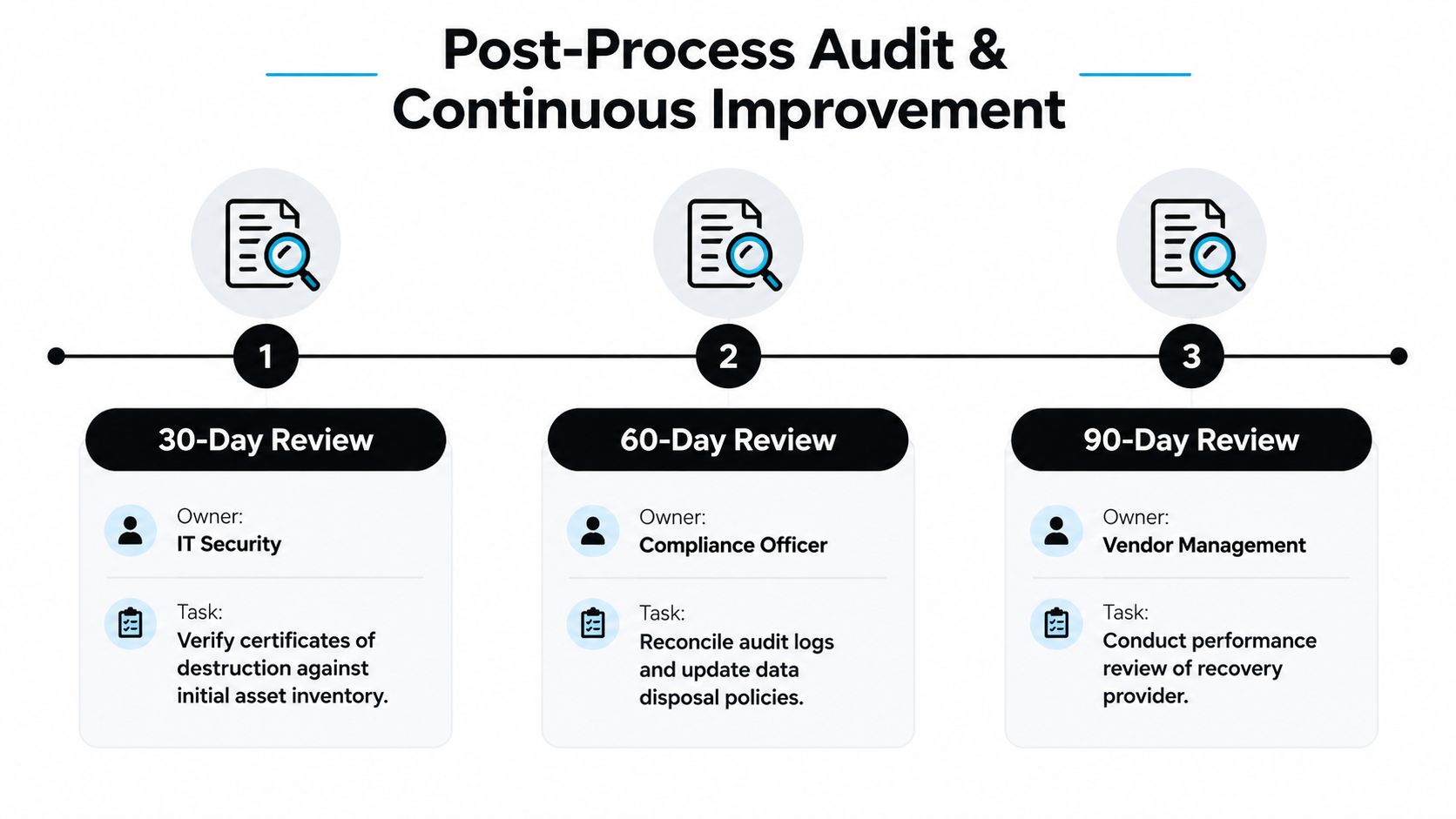
Certificates are vendor deliverables, not proof that the enterprise performed its own control review. Assign an owner, define a review window, and reconcile the completed file against the original inventory before closing the work order.
At the 30-day review, IT security should compare every destruction certificate with the approved asset list, pickup manifest, and exception log. Missing serials, duplicate records, unexplained substitutions, and certificates issued for unapproved items should remain open until resolved.
At the 60-day review, compliance should examine audit logs, validation results, policy exceptions, and downstream documentation. The team can use forensic tools to sample wiped drives according to the approved risk methodology. Any discrepancy should trigger contractual escalation and preservation of the affected asset or record.
At the 90-day review, vendor management should assess service performance, subcontractor changes, certificate timing, transport incidents, value recovery, and corrective actions. The purpose isn't to create another report. It's to change the next refresh cycle, inventory workflow, custody procedure, or contract where the evidence shows a weakness.
Keep the operating review measurable
Track dwell time, value-recovery yield, non-conformance events, certificate delivery time, inventory reconciliation, and unresolved exceptions. Trend review matters more than a single favorable result. A recurring missing-seal issue points to a pickup control problem, while delayed certificates may indicate an intake or vendor-system bottleneck.
The FTC Disposal Rule requires businesses and individuals that maintain or possess consumer reports and records for a business purpose to use appropriate measures when disposing of information. The FTC describes methods such as burning, pulverizing, or shredding paper, and destroying or erasing electronic files or media so information can't be read or reconstructed, as explained in its Disposal Rule guidance. Its broader guidance says disposal can include discarding, abandoning, selling, donating, or transferring a medium containing consumer information, and permits contractors when the business performs due diligence, as detailed in the FTC business guidance on disposal.
Hold a quarterly lessons-learned review and write approved changes back into the policy, inventory, transportation, and contract controls. That cadence turns secure asset recovery into a repeatable enterprise capability rather than a scramble at the end of every hardware refresh.
Beyond Surplus provides business IT asset disposition, secure data wiping, on-site or off-site hard-drive shredding, electronics recycling, value recovery, product destruction, and data center de-installation support with documented custody records and certificates. Visit Beyond Surplus to discuss a written recovery workflow for your enterprise assets, including pickup, sanitization, destruction, recycling, and audit-ready closeout.


