

You're six hours from a live migration. The old environment has to be cleared, new equipment is arriving in sequence, facilities is managing power and cooling, and security wants proof that every retired drive was handled correctly. The trucks are only one part of the problem. Data center logistics determines whether equipment arrives in the right order, whether energized assets remain controlled, and whether the final paperwork withstands an audit.
For business and enterprise IT teams, the program now runs in both directions. New servers, storage arrays, networking equipment, transformers, switchgear, and generators move toward production. Retired hardware moves through secure collection, data destruction, resale, recycling, and documented disposition. This playbook treats logistics as an operational control system, not pallet-in and pallet-out hauling.
Table of Contents
- Why Data Center Logistics Is Now a Strategic Program
- The Seven Workstreams Inside a Modern Logistics Program
- Scoping, Risk Assessment, and Asset Inventory
- Transport Planning, Staging, and Energized Equipment
- Secure Data Destruction and Chain of Custody
- Vendor Selection, Compliance, and Cost Optimization
- Execution Checklist and Metrics That Keep the Program on Track
Why Data Center Logistics Is Now a Strategic Program
Consider a 5,000-square-foot enterprise refresh. Over one weekend, 800 servers, three SANs, and 14 racks leave the facility while 22 racks of new equipment arrive. A freight provider can move the pallets, but that provider alone won't manage shutdown dependencies, rack sequencing, secure staging, drive sanitization, installation access, or certificate reconciliation.
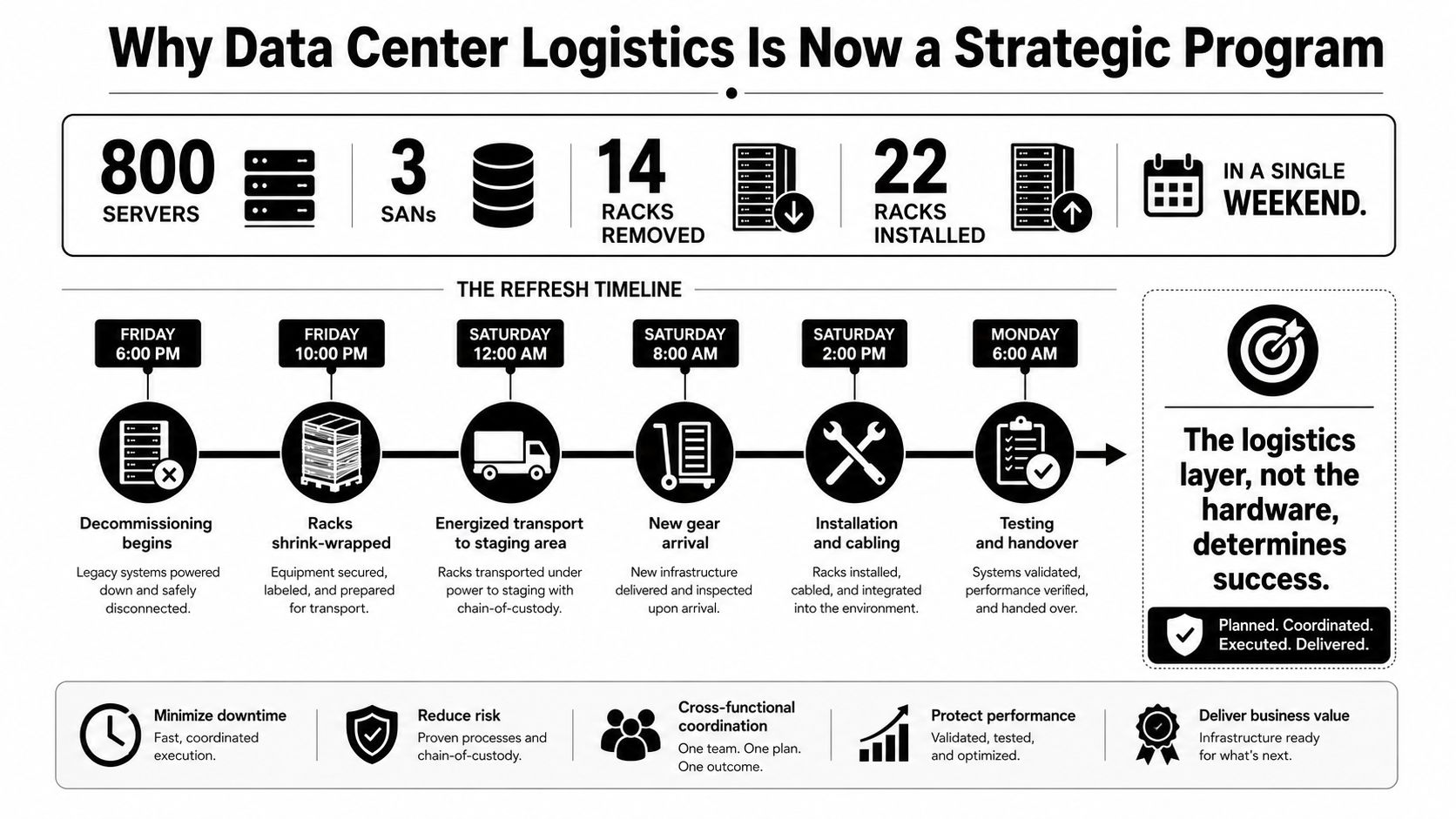
The old model treats logistics as a facilities task. The current model connects procurement, infrastructure, security, compliance, facilities, finance, and an IT asset disposition partner around one move board. Each group needs a reliable answer to a different question:
- IT operations: Which asset moves next, and what dependency must be preserved?
- Facilities: Does the route support the cabinet weight, power sequence, cooling demand, dock schedule, and elevator limits?
- Security: Where is each storage device, who handled it, and which destruction method applies?
- Finance: Should the organization redeploy, resell, recycle, or destroy the asset?
- Compliance: Can the team produce a complete record from removal through final disposition?
The market reflects this broader scope. One independent estimate values the global data center logistics market at USD 17.4 billion in 2025, rising to USD 18.6 billion in 2026 and projected to reach USD 34.1 billion by 2033, implying a 9.1% CAGR from 2026 to 2033. The same estimate identifies North America as 38.7% of global revenue in 2025, transportation as the largest service category at 36.5%, and electrical devices as the largest device type at 68.2%. These figures come from Grand View Research's data center logistics market estimate.
Practical rule: Scope the move as a program with physical, electrical, security, and financial workstreams. A freight line item won't capture the real exposure.
This matters especially as operators manage hybrid environments, AI-related infrastructure demand, and formal sustainability reporting. Electrical equipment can become the schedule constraint before servers are even ready to ship. Reporting requirements also make the downstream fate of retired equipment part of the project record. An IT director who plans only the inbound move can still face delays, storage charges, destruction backlogs, and unresolved assets after the cutover.
For market context on regional infrastructure demand, review this analysis of major IT investments coming to Atlanta. The operational lesson is simple: the logistics layer, not the hardware purchase, decides whether the migration finishes cleanly.
The Seven Workstreams Inside a Modern Logistics Program
A serious program runs seven workstreams in parallel. They don't carry equal schedule risk, and the bottleneck often sits outside transportation.
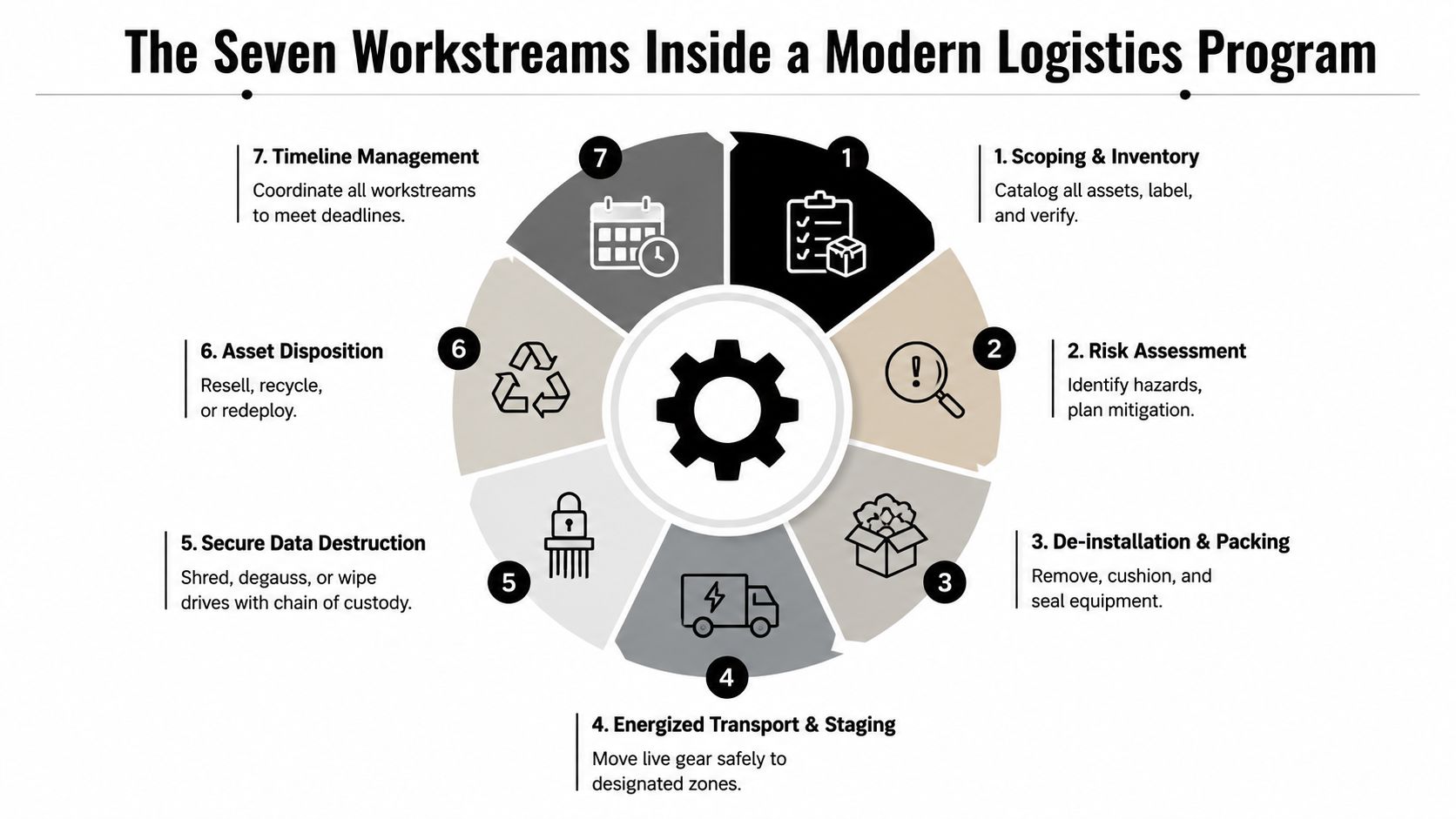
Scoping and inventory
Start with the asset universe, not the truck count. Missing serial numbers, unknown lease ownership, and incomplete rack elevations prevent accurate labor, packaging, insurance, and disposition planning. The bottleneck is usually inventory confidence.
Risk assessment
Identify handling hazards, data classifications, site restrictions, and business dependencies. A rack containing regulated information needs a different custody plan from a decommissioned test appliance. The critical path issue is often an unapproved mitigation plan.
De-installation and packing
Technicians disconnect, label, remove, cushion, and seal equipment. Storage arrays, dense servers, and fragile components need packaging matched to their construction and destination. A crane window, dock restriction, or missing lift plan can stop the move before a carrier arrives.
Energized transport and staging
Some equipment moves while powered, or requires temporary power and network access during staging. The schedule depends on safe sequencing, facilities approval, and a controlled route.
Secure data destruction
The destruction provider must absorb the sanitization queue. If the partner can't process drives as they arrive, retired assets accumulate in secure storage and the disposition schedule expands.
Chain-of-custody documentation
Every handoff needs an accountable record. The weak point is certificate turnaround or an incomplete manifest, not necessarily a missed delivery.
Downstream disposition
Redeployment, resale, recycling, and product destruction each require different handling and evidence. Finance often waits for inventory reconciliation before recognizing recovery value or closing an asset record.
The Beyond Surplus vendor due diligence checklist offers a useful starting point for testing provider capability before mobilization. Keep ownership inside the program office. Facilities can support access and building controls, but it shouldn't inherit a security-sensitive reverse-logistics process as a side task.
Scoping, Risk Assessment, and Asset Inventory
Vendors can't quote accurately from a cabinet count alone. Give them the physical and operational inputs that determine labor, equipment, routing, packaging, and custody requirements.
Build the scope from the site outward
Provide rack elevations, make and model for each asset, cabinet weight, power draw, cooling dependencies, network ports in use, and active lease or warranty status. Include dock hours, elevator capacity, loading restrictions, union labor rules, security check-in procedures, and any requirement for escorted access.
Then create a risk register. Classify assets by data sensitivity and identify obligations connected to GDPR, HIPAA, or SOX where applicable. Separate physical risks, such as batteries, unstable racks, confined corridors, and overhead work, from information risks, such as unencrypted drives or equipment with unclear ownership.
Tag assets at the device level. Rack-level labels aren't enough when servers split across resale, redeployment, recycling, and destruction pathways. A usable inventory includes:
| Field | Why It Matters | Example Value |
|---|---|---|
| Asset tag | Connects the physical device to the business record | DC-04218 |
| Serial number | Supports custody, reconciliation, and disposition proof | Vendor serial |
| Hostname | Links hardware to the configuration record | Application host |
| Data classification | Determines the handling and sanitization path | Restricted |
| Sanitization method | Establishes the approved destruction or wiping action | Certified wipe |
| Destination | Prevents routing ambiguity after removal | Secure processing |
| Lease or warranty status | Protects contractual and recovery rights | Active lease |
| Condition | Supports resale, redeployment, or recycling decisions | Tested, cosmetic wear |
Before movement, reconcile the list against the configuration management database. Resolve duplicates, missing records, and assets that appear in the CMDB but not on the floor. Beyond Surplus describes inventory optimization as part of its broader inventory optimization service, but the control belongs to your organization regardless of provider.
Start custody with a clean inventory. You can't repair an ambiguous asset record after the device disappears into a mixed pallet.
The final pre-migration check should produce a signed baseline. Freeze changes after approval, record exceptions separately, and require the move team to scan or verify each asset at removal. That discipline makes later certificate and recovery reconciliation much faster.
Transport Planning, Staging, and Energized Equipment
Transport planning fails when teams define a route without defining the operating condition of the equipment. A powered storage array isn't ordinary freight, and a temporary staging area isn't a parking lot.
Design three controlled zones
Create a receiving area for inbound inspection and logging, a de-install corridor for outbound removal, and a secure holding zone for high-value or sensitive assets. Keep energized equipment away from public corridors and unattended access. If a temporary lab needs power or network connectivity, facilities must approve the capacity and sequencing before equipment arrives.
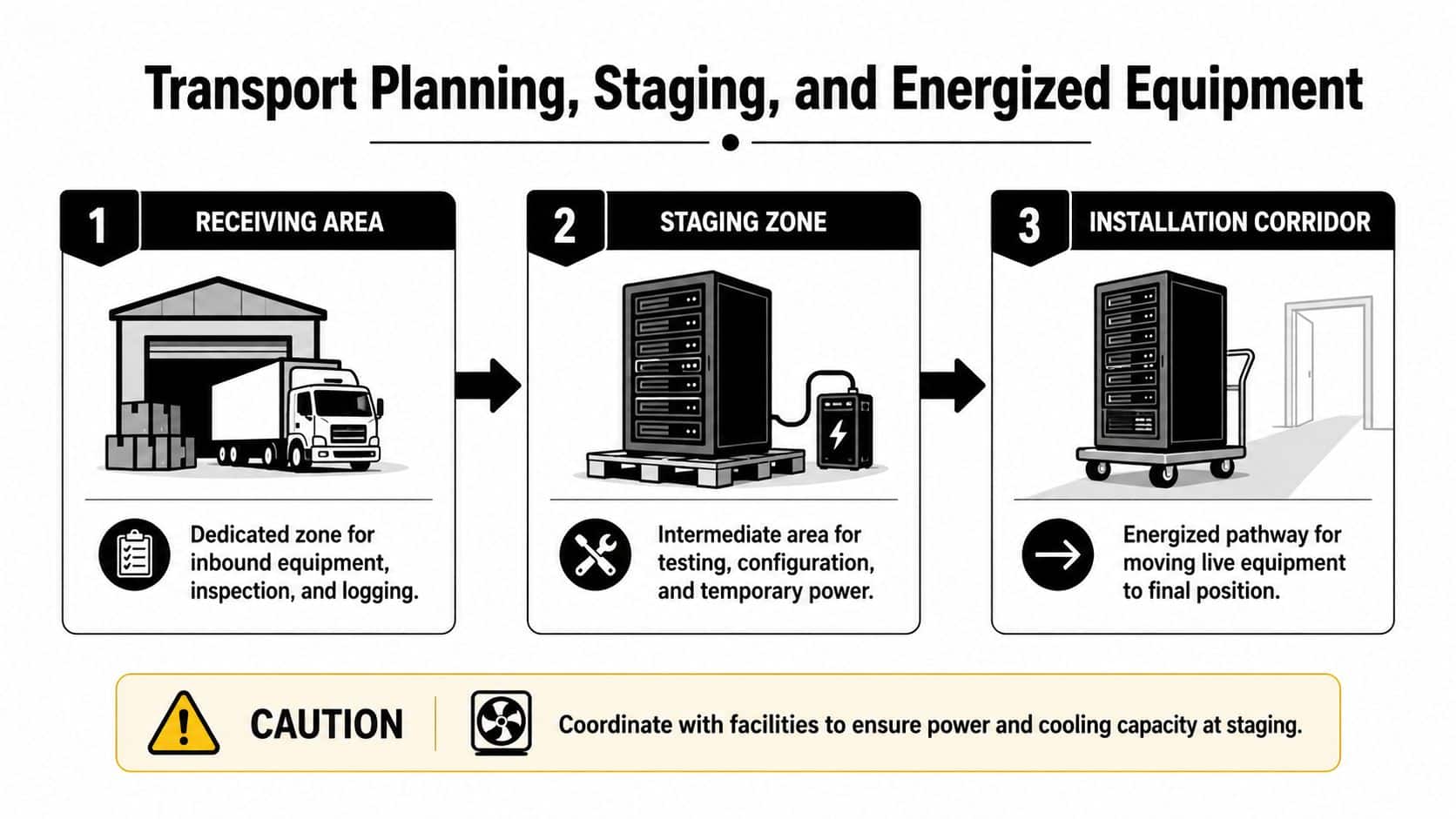
Specify containment by asset type. Use vibration-rated racking for storage arrays, ESD-safe packaging for exposed boards and motherboards, and climate-controlled transport when sensitive legacy equipment requires it. The correct packaging decision costs less than discovering transit damage during installation.
Run a checkpoint protocol that a coordinator can audit:
- Loading verification: Match the manifest, serials, seals, and condition to the departure record.
- Arrival verification: Check seals, record exceptions, and confirm the receiving location.
- Condition audit: Inspect equipment before uncrating and photograph visible damage.
- Staging release: Confirm power, cooling, network access, and installation order.
- Final placement: Reconcile the device against the rack plan before handover.
The route also needs contingencies for peak-hour restrictions, elevator limits, dock conflicts, and failed lifts. Move assets from rack to pallet to crate without backtracking. Every extra touch creates another opportunity for damage, mislabeling, or a custody discrepancy.
Teams planning a broader technology move can also review planning IT relocation for offices for adjacent relocation considerations. For a data center, adapt those principles to energized pathways, restricted access, and equipment-specific handling.
Electrical equipment deserves early attention. Recent reporting says 30% to 50% of planned 2026 U.S. data center capacity could slip or cancel because of electrical equipment shortages, while large power transformers average about 128 weeks of lead time and some medium-voltage switchgear is sold out through 2028, according to Omni Logistics' 2026 data center logistics analysis. Those figures are projections and market observations for the cited period, but the planning implication is immediate: reserve, stage, and sequence transformers, switchgear, and generators as infrastructure-critical assets.
Secure Data Destruction and Chain of Custody
Data destruction is the highest-liability point in the reverse flow. A drive leaving the rack without a recorded identity, approved method, and accountable handoff creates a security exposure, even when every pallet arrives on schedule. Treat energized equipment staging, reverse logistics, and custody paperwork as one control program.
Match the method to the data
Set the destruction tier before de-installation. Logical sanitization may fit approved general-purpose servers. Magnetic media may require degaussing or shredding. Solid-state drives containing sensitive information may require a destructive process. Security and compliance teams should approve the method against the data classification and applicable obligations.
The FTC Disposal Rule covers organizations that use consumer reports, including large and small organizations. It requires proper disposal of consumer report information to prevent unauthorized access or use and became effective on June 1, 2005, as explained in the FTC rule guidance.
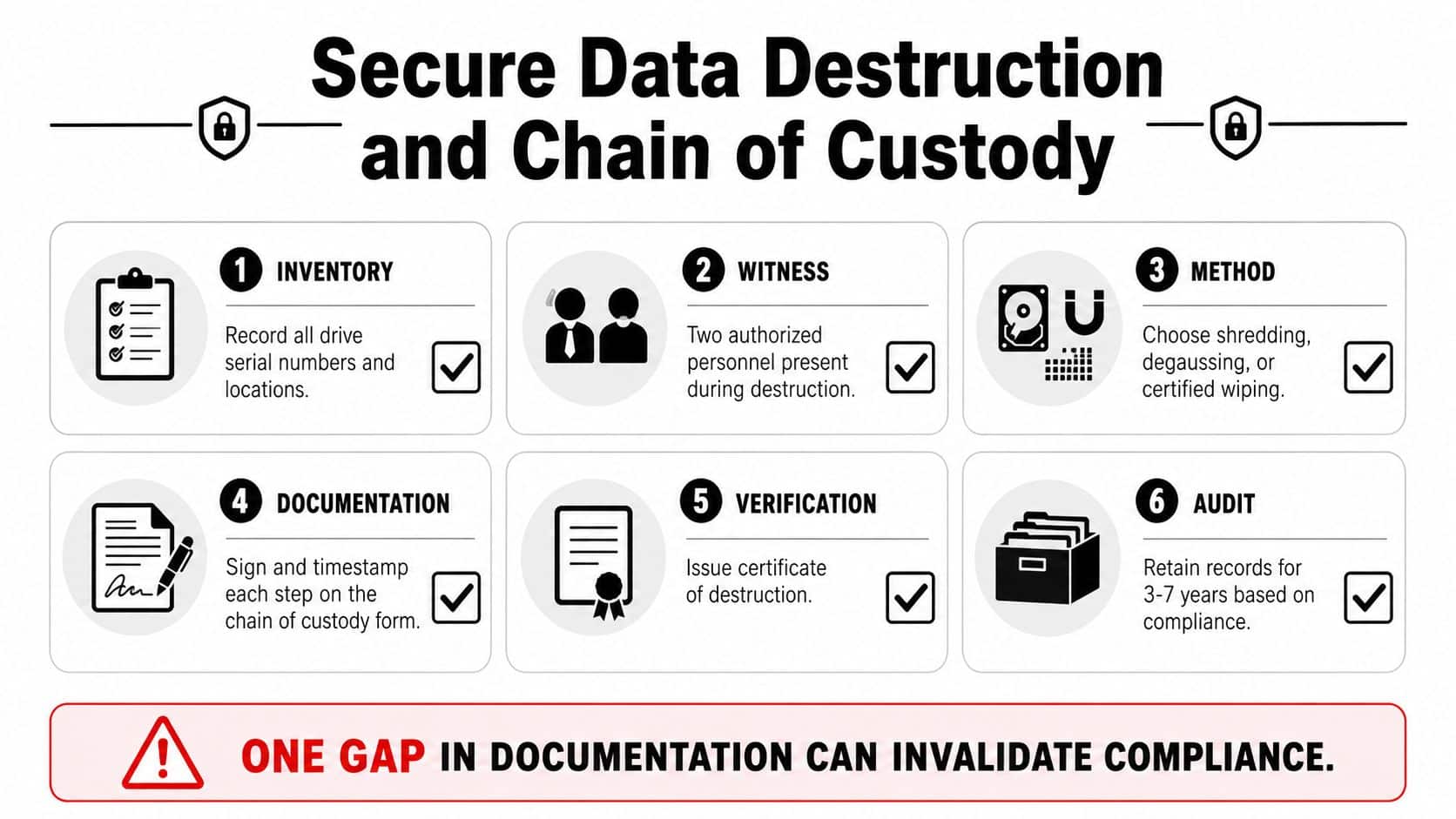
Maintain a continuous, tamper-evident record for every drive or storage device, from rack removal through certificate issuance. Each transfer should capture:
- Identity: Asset tag, drive serial number, and source location.
- Custodian: Person or organization accepting responsibility.
- Event: Removal, transport, storage, destruction, or release.
- Time: Signed or electronically recorded timestamp.
- Condition: Seal status, damage, or other exception.
- Outcome: Destruction certificate, recycling record, or approved reuse status.
Use dual control for high-security events, with two authorized personnel witnessing the process. Require the provider to show how its NIST 800-88 procedures meet your requirements, then request raw audit logs alongside final certificates. For equipment approved for reuse, sanitization evidence serves as the device's passport. Without that record, the asset should not return to production.
For a detailed framework, review our guide on chain-of-custody documentation.
Reverse logistics requires the same discipline as outbound movement. A benchmarking report based on 55 enterprises and more than 1.6 million processed assets found that 53.2% relied on a third party for data destruction, 31.9% encrypted drives, and 23.4% formatted drives before disposal. The figures appear in Cascade Assets' 2025 ITAD benchmarking report. The report also identifies centralized collection, serialized tracking, consolidated return points, damage-free receiving, and documented handoffs as operating benchmarks. Use those controls to connect removal, temporary storage, destruction, reuse, and final disposition without a custody gap.
Vendor Selection, Compliance, and Cost Optimization
Don't select a logistics partner from the lowest per-unit quote. Compare what the price includes, what evidence the provider supplies, and how quickly it can handle exceptions.
Pressure-test the offer
Ask each candidate for certification status, including R2v3 or e-Stewards, and verify the scope behind the certification. Then test operational readiness with questions about technician coverage, secure storage, destruction capacity, vehicle control, incident response, and certificate delivery.
| Criteria | High-Risk Indicator | Preferred Standard |
|---|---|---|
| Operational capability | Freight-only service with no de-install or staging plan | Integrated removal, packing, transport, and receiving |
| Data security | Generic wiping language and no serial-level record | Approved methods, tracked custody, and auditable certificates |
| Environmental controls | Unclear downstream processors | Documented recycling and disposition pathways |
| Incident response | No defined lost-shipment or breach procedure | Written escalation, investigation, and notification process |
| Visibility | Weekly summary emails only | Status by asset, exception log, and milestone reporting |
| Pricing | Bundled fees with unclear assumptions | Line-item scope for labor, storage, transport, destruction, and recovery |
| Recovery value | One disposal price for every asset | Separate resale, redeployment, recycling, and destruction pathways |
Local and national providers create different trade-offs. A local partner may offer tighter site response and shorter transit exposure, while a national consolidator may offer broader coverage and volume economics. Neither model is automatically cheaper. Compare the full cost of storage, weekend surcharges, partial loads, expedited transport, packaging, destruction, and unresolved exceptions.
Treat compliance as a deliverable
Request references for migrations with similar equipment and site constraints. Ask specifically how the vendor handled damaged assets, missing serials, delayed certificates, failed wipes, and equipment that changed from resale to destruction.
Beyond Surplus is one example of a provider offering secure data destruction, IT equipment disposal, electronics recycling, IT buyback, product destruction, data center de-installation, and logistics coordination for business customers. Its service model includes certificates of recycling and data destruction, with pickup available for organizations across the contiguous United States through its own fleet and transportation partners.
The right vendor gives your IT director an accountable asset status, not merely a truck status.
Execution Checklist and Metrics That Keep the Program on Track
A 90-day execution plan keeps the migration from becoming a collection of urgent requests. Assign one owner to the move board, one owner to custody records, and one decision-maker for exceptions.
Pre-mobilization from week 1 through week 4
Complete the scope, inventory reconciliation, risk register, route survey, packaging plan, vendor kickoff, and facilities sign-offs. Freeze the approved asset list, identify lease and warranty constraints, confirm destruction methods, and reserve staging capacity. Require a written escalation path before the first technician enters the room.
Live execution from week 5 through week 10
Run daily move-board reviews. Track inbound arrivals, de-install progress, staging dwell, installation readiness, custody exceptions, damage, and certificate queues. Log every deviation rather than allowing verbal workarounds to disappear after the shift.
Post-project review from week 11 through week 13
Reconcile the physical inventory, CMDB, destruction certificates, recycling records, resale reports, and financial recovery. Close every exception with an owner and due date, then transfer the operating procedure to steady-state IT and facilities teams.
The Beyond Surplus server decommissioning checklist can support the retirement side of this handoff. Your coordinator should instrument at least these metrics:
- Units per shift, separated by removal, staging, and installation.
- Staging dwell time, measured from receipt to release.
- Chain-of-custody exception rate, by handoff and asset type.
- Destruction certificate turnaround, from receipt through issuance.
- Cost per asset retired, separated by disposition pathway.
- Damage and rework count, tied to location and handling event.
- Inventory reconciliation status, including unresolved serials.
- Recovery value realized, compared with the approved disposition plan.
Set alert thresholds before execution begins. Hold a weekly war room for unresolved exceptions, and escalate any issue that threatens the cutover, custody integrity, or certificate closeout. A basic program records movement. A managed program predicts bottlenecks. A mature program carries the lessons, templates, and exception history into the next refresh without rebuilding the control system from scratch.
Beyond Surplus provides business-focused data center de-installation, secure equipment transport, certified data destruction, electronics recycling, IT asset recovery, and disposition documentation. Visit Beyond Surplus to plan a controlled reverse-logistics program that protects your migration timeline, chain of custody, and recovery objectives.


