

A server decommission is underway, the recycler is booked, and the audit request arrives: show exactly where the cardholder data went. The team has a spreadsheet showing that several drives were formatted, but no verified sanitization report, no destruction record, and no evidence covering backup media or storage replicas. The equipment may be gone, yet the compliance question remains open.
PCI DSS data destruction best practices start before a device reaches a loading dock. IT teams need to know where payment data exists, which retention obligation applies, what destruction method fits the media, and how each decision will be demonstrated to an assessor. PCI DSS v4.0.1 treats destruction as part of account-data protection, not as routine housekeeping, and its operational expectation is clear: cardholder data must be rendered unrecoverable when it's no longer needed for business or legal reasons. PCI DSS v4.0.1 is the active reference point because PCI DSS v4.0 was retired on 31 December 2024.
Table of Contents
- Why PCI DSS Data Destruction Demands More Than File Deletion
- Understanding PCI DSS v4.0.1 Destruction Requirements
- Choosing Between Technical Wiping and Physical Destruction
- Building a Compliant Destruction Workflow
- Selecting and Contracting with ITAD Vendors
- Managing Retention Controls and Backup Destruction
- Audit-Ready Checklists and Documentation Templates
Why PCI DSS Data Destruction Demands More Than File Deletion
During a routine PCI DSS assessment, an auditor asks for destruction evidence from decommissioned payment servers. The IT team produces a recycling manifest and explains that the drives were reformatted before a general e-waste vendor collected them. The auditor then asks for serial-number-level records, the sanitization method, verification results, and proof that backup copies were handled. The answers are incomplete, so the organization must investigate whether cardholder data remained recoverable.
That failure doesn't begin at the recycler. It begins when the organization treats deletion as an event instead of a governed lifecycle. A quick format may remove a file index while leaving underlying content accessible. Standard operating-system deletion can also be reversible, which is why PCI DSS guidance calls for dedicated secure deletion or destruction methods that make recovery impossible. PCI-focused destruction guidance explains why a device's disappearance isn't evidence that its data was destroyed.
The forgotten copies create the audit gap
Payment data rarely lives in one production database. It may also appear in retired RAID members, exported reports, staging environments, log stores, snapshots, backup tapes, and archives maintained by another team. A decommission checklist that covers only the primary server can therefore produce a clean-looking asset record while leaving the actual data map unfinished.
Auditors typically want to understand four decisions:
- What was identified: Which systems, devices, and media contained cardholder data?
- Why destruction was triggered: Which retention rule, business decision, or legal requirement made the data eligible for disposal?
- How the method was selected: Why was wiping, cryptographic erasure, degaussing, or physical destruction appropriate for that media?
- What proves completion: Which records connect the asset, method, date, verifier, and responsible party?
Practical rule: If the team can't trace a data-bearing asset from inventory through final disposition, the destruction process isn't audit-ready.
Reformatting is not a control
Formatting, emptying a recycle bin, or deleting a database record may be useful administrative actions, but they don't by themselves establish that cardholder data is unrecoverable. SSDs introduce additional complexity because wear-leveling can place data across flash cells that ordinary overwrite routines don't address consistently. RAID and backup systems create a separate problem, since destroying one component doesn't necessarily remove copies held elsewhere.
The upstream governance question is the one many programs skip: what must be destroyed, when must it be destroyed, and how will the organization prove it? A retention schedule, data-store inventory, approved method matrix, and verification record answer that question before equipment leaves company control.
Understanding PCI DSS v4.0.1 Destruction Requirements
A retired payment server may still have cardholder data in production storage, snapshots, backup media, and archives. Treating the server's disposal as the destruction event leaves the organization unable to explain what happened to those other copies. PCI DSS v4.0.1 links storage protection, retention, and disposal. Electronic media containing cardholder data must be destroyed when it is no longer needed for business or legal reasons, and the data must be rendered unrecoverable. The current PCI DSS standard should anchor the control design.
Retention governance decides when destruction is permitted. Sanitization determines whether recovery remains possible. Owners, procedures, and evidence must cover both decisions across active systems, backups, and archives.
What assessors expect to see
PCI DSS records should identify the media, including a serial number or asset tag, the method used, the date, and the person or vendor responsible. A certificate without a device identifier is weak evidence because it does not show which asset was processed. An asset list without a verification result is incomplete as well.
| PCI DSS Requirement | What Auditors Expect | Common Misconception | Compliance Gap |
|---|---|---|---|
| Account-data protection | Cardholder data is rendered unrecoverable on the underlying media | Deleting files or emptying recycle bins is enough | Recoverable remnants may remain |
| Retention governance | Documented rules identify when stored data is no longer required | Every backup can be kept indefinitely | No defensible destruction trigger |
| Media destruction | A method appropriate to the media is executed and recorded | Any recycler's intake receipt proves destruction | Method, scope, and responsibility remain unclear |
| Verification and evidence | Records connect assets, method, date, and responsible party | A vendor invoice is sufficient | The organization can't prove completion |
For a practical explanation of how sanitization choices relate to recognized media-handling practices, review the NIST 800-88 data destruction standards.
Retention comes before disposal
A defensible program records retention periods and destruction triggers before data reaches end of life. A trigger may be the expiration of a documented business need, the end of a legal retention obligation, or completion of a system retirement process. Legal holds require an exception record. They should not suspend destruction for every system or backup.
The control should also distinguish data reduction from destruction. PCI guidance defines truncation as permanently removing part of an electronically stored PAN, while masking conceals digits during display or printing. For display use cases, the PCI Security Standards Council's masking and truncation guidance explains the permitted presentation approach. Masking does not replace destruction after stored data exceeds its retention period.
Choosing Between Technical Wiping and Physical Destruction
Method selection should follow the media, data classification, reuse objective, and evidence requirement. There isn't one universal treatment for a mixed fleet of HDDs, SSDs, NVMe drives, tapes, and mobile devices.
Technical wiping can preserve residual asset value and support reuse, but only when the device is functional, the tool supports the media, and verification is recorded. Cryptographic erasure can suit encrypted storage when the encryption design and key-management process support it. Degaussing applies to magnetic media, such as suitable hard drives and tapes, but it isn't a solution for flash storage.
Physical destruction removes reuse value but provides a direct endpoint for devices that are failed, damaged, unknown, highly sensitive, or unsuitable for reliable sanitization. Hard-copy cardholder materials also require destruction when no longer needed, with methods such as cross-cut shredding, incineration, or pulping that prevent reconstruction, according to PCI DSS media-disposal guidance.
Match the method to the device
- HDDs: Secure wiping may work when reuse is planned and verification is available. Degaussing or destruction may be preferable for high-risk or failed units.
- SSDs and NVMe drives: Traditional overwriting can leave uncertainty because of flash-management behavior. Use a supported cryptographic-erasure process where appropriate, or physically destroy the media.
- Backup tapes: Degaussing can suit magnetic tape, while physical destruction provides a clear final state when the media is no longer needed.
- Mobile devices: Use a manufacturer-supported sanitization process with verification, or destroy the storage component when the device can't be reliably sanitized.
- Failed or unidentified media: Don't force a software process onto hardware that can't report reliable results. Isolate and destroy it through a documented method.
Audit lesson: A successful software command isn't the same as verified sanitization. The report must identify the asset and show that the result was checked.
NIST guidance emphasizes verification every time sanitization is applied. For high-confidentiality devices, it also calls for sample-based verification, including forensic recovery testing for logical wipes and physical inspection of shred output when destruction is used. NIST SP 800-88 Rev. 2 provides the verification foundation.
For SSD-specific trade-offs, teams can compare secure SSD destruction methods before approving a fleet-wide procedure.
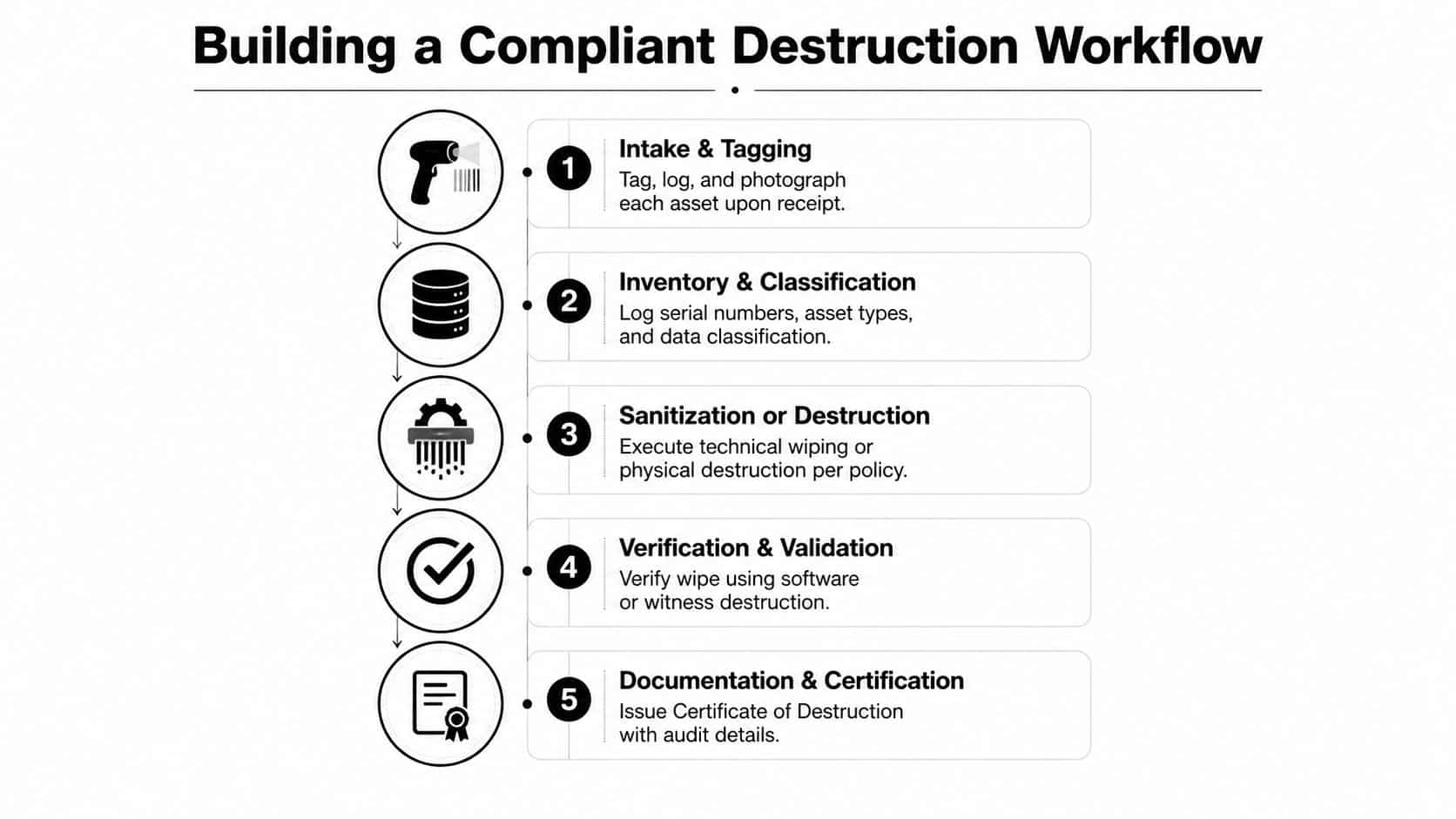
Building a Compliant Destruction Workflow
A compliant workflow begins when the organization decides that an asset or data store has reached disposition, not when a vendor arrives. The control owner should freeze the relevant inventory, identify associated copies, and prevent untracked movement while the method and destination are approved.
Intake and reconciliation
At intake, tag each asset and record its serial number, asset tag, media type, location, data classification, and condition. Photographing the device and its identifying label can resolve disputes later, especially when multiple servers or drive trays look alike. Reconcile the physical count against the source inventory before transfer.
The chain of custody should identify every handoff:
- Internal release: The asset owner signs the release, records the date and time, and confirms the approved disposition.
- Transport handoff: The logistics provider signs for the sealed container or manifest. Record the seal identifier and vehicle or route details used by the organization.
- Facility receipt: The destruction facility confirms the manifest, checks seals, and reports exceptions before processing.
- Sanitization or destruction: The technician records the method, equipment, authorization, and asset identifiers.
- Verification: A second party reviews wipe results or witnesses and inspects the destruction output.
- Certification: The provider issues the destruction record, and the organization updates its asset and data-retention systems.
- Exception closure: Missing, damaged, or mismatched items receive an investigation record and owner sign-off.
Evidence at the control points
The most important reconciliation occurs before processing. If the manifest lists a drive that isn't physically present, or the facility receives an unlisted drive, stop the workflow and resolve the discrepancy. Processing an incorrect set of assets can leave a real data-bearing device outside the certificate.
On-site destruction can provide direct witness evidence, while off-site processing can work when sealed transport, documented receipt, serialized records, and approved facility controls preserve the chain. GPS-tracked transport logs may strengthen the record, but they don't replace asset-level reconciliation or a destruction certificate.
A Certificate of Destruction identifies the data-bearing media and confirms the destruction or sanitization event. A Certificate of Recycling documents material processing or recycling and doesn't, by itself, prove that cardholder data was rendered unrecoverable. Keep both when applicable, but don't treat them as interchangeable.
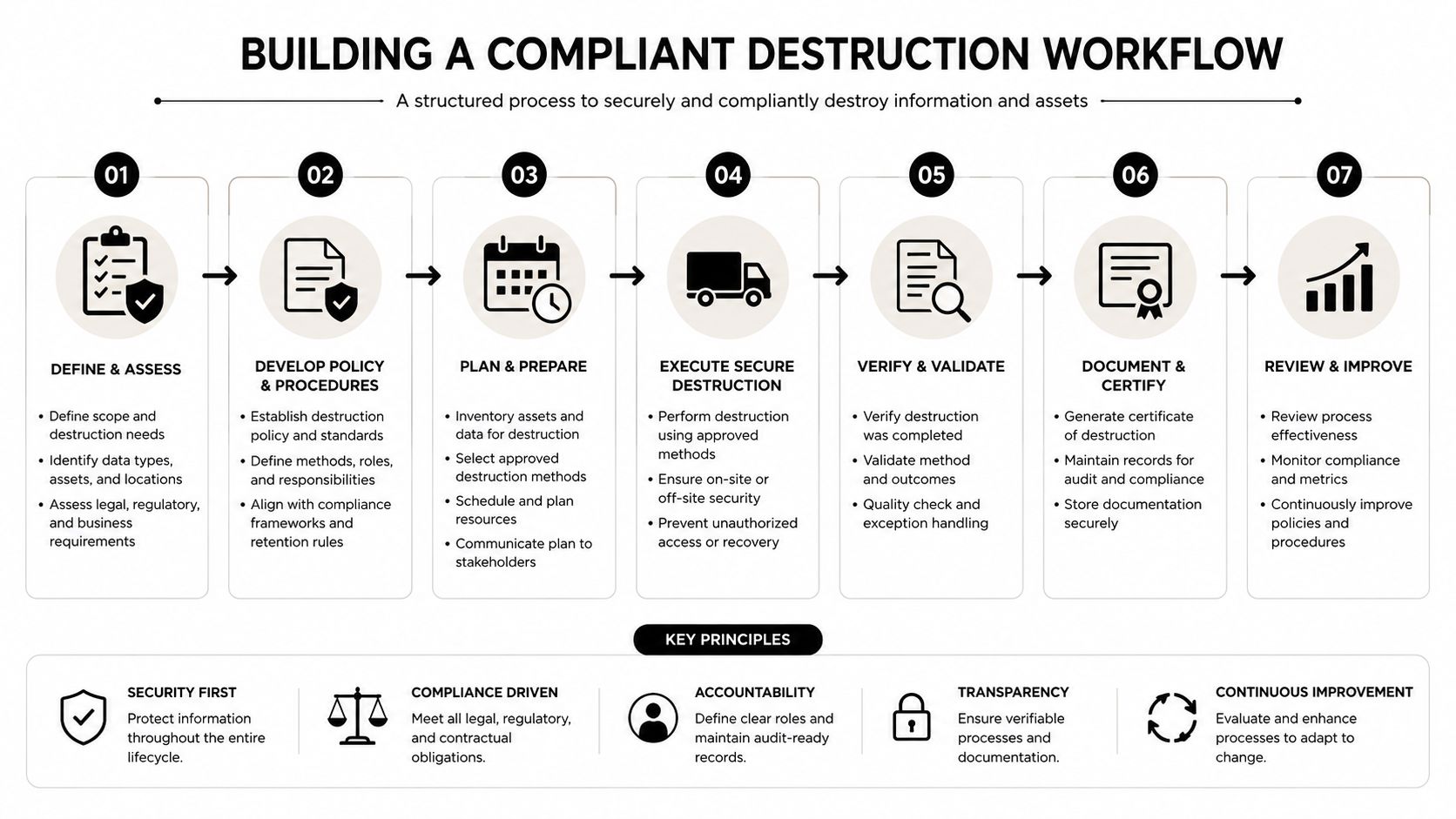
The chain of custody for IT asset disposal should be designed so an assessor can follow the asset without relying on informal explanations.
Selecting and Contracting with ITAD Vendors
An IT asset disposition vendor sits inside the PCI control environment. Procurement must assess the provider like any security-sensitive supplier. A weakness at a subcontracted facility can leave the organization unable to prove where cardholder-data-bearing media went, who handled it, and when destruction occurred.
Evaluate the vendor's documented sanitization processes, media tracking, personnel training, facility scope, and audit support. Processes should align with applicable NIST sanitization practices. Certifications such as NAID AAA or R2v3 help frame due diligence, but they do not replace review of the actual workflow, covered locations, subcontractors, and sample certificates.
Contract terms that matter
The agreement should define what the vendor may receive, access, transport, store, sanitize, destroy, or recycle. Put these requirements in writing:
- Subcontractor disclosure: No transfer to an undisclosed facility or processor.
- Incident response: Defined notification deadlines, escalation contacts, and information-sharing duties.
- Insurance and indemnification: Coverage and responsibility must reflect the data risk.
- Right to audit: The customer may review relevant records, facilities, and controls.
- Evidence delivery: Serialized certificates and exception reports follow an agreed process.
- Environmental handling: Materials move through documented downstream channels.
Contract language should also assign ownership during collection, transit, intake, staging, processing, and exception handling. A low bid can conceal weak tracking, unverified degaussing equipment, or uncontrolled storage. In one realistic failure pattern, a retailer learns during assessment that its vendor sent drives to an undisclosed, uncertified subcontractor. The retailer cannot produce a complete custody trail, so the finding covers vendor oversight as well as media destruction.
Multi-party ITAD projects need the same custody discipline as any complex facility transition. The Pacific Mobile Structures Knife River project provides context for assigning ownership across parties when assets, locations, and responsibilities change.
| Evaluation Area | What to Verify | Red Flags |
|---|---|---|
| Certifications and scope | Current certification, covered locations, and relevant service scope | Certification applies to another facility or service |
| Facility controls | Restricted access, intake procedures, surveillance, and media segregation | Unsecured staging or unclear visitor controls |
| Personnel | Role-based training and background-check process | No documented personnel controls |
| Destruction evidence | Sample serialized certificates and exception workflow | Generic certificates with no asset identifiers |
| Downstream partners | Named subcontractors and documented approvals | “Recycling partner” with no identity or oversight |
| Contract protection | Audit rights, notification duties, insurance, and indemnification | Vendor disclaims responsibility after handoff |
Use a structured vendor due-diligence checklist before awarding work. Repeat the review when the provider changes facilities, subcontractors, processing methods, or evidence formats. Auditors commonly examine whether the contract, approved vendor scope, shipment records, exceptions, and destruction certificates describe the same control boundary.
Managing Retention Controls and Backup Destruction
The hardest destruction question is often not how to shred a drive. It's how to prove that cardholder data was removed from production, replicas, snapshots, logs, tapes, and archives that follow different retention rules.
Create a data-store register with one owner for each location. Include production databases, staging systems, read replicas, backup jobs, cloud snapshots, exported files, application logs, and physical media. Assign each store a retention class, an approved business or legal rationale, a destruction trigger, and a verification record.
Backups need an explicit exit path
Backup rotation doesn't automatically equal destruction. The team should identify which backup sets contain cardholder data, determine when each set becomes eligible for disposal, and record the event that removes it from the backup catalog and physical or cloud storage. The same logic applies to archives that aren't mounted regularly but remain accessible.
Replication can create a quiet exception. A primary database may be retired while a read replica retains older records because replication cleanup and storage cleanup are managed by different owners. Map dependencies before approving system retirement, then require each owner to confirm completion.
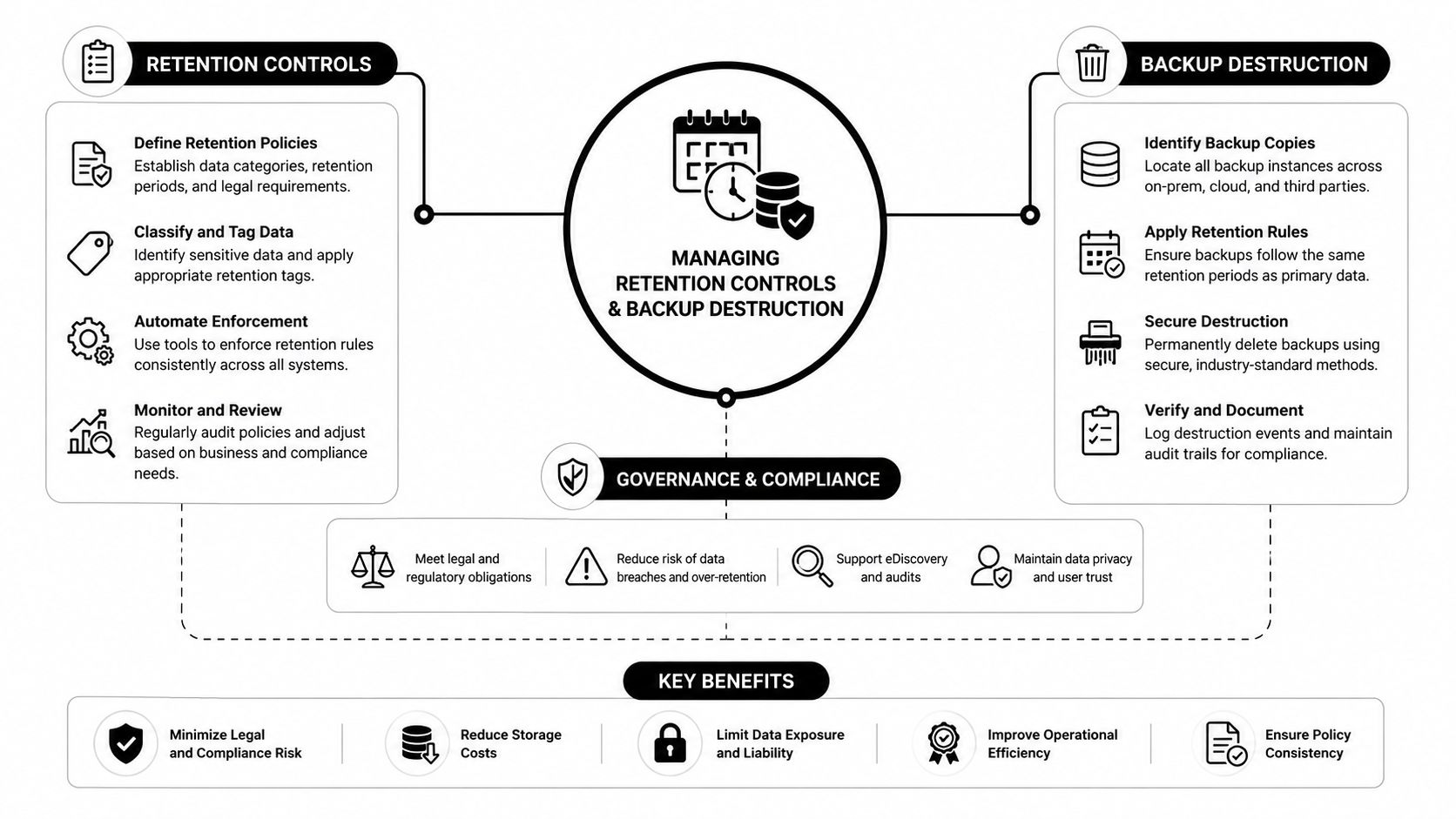
Legal holds require a documented exception that identifies the affected data, the hold owner, the reason destruction is paused, and the release condition. That exception shouldn't become a blanket excuse to retain unrelated payment data. Recent compliance guidance emphasizes the governance challenge of verifying destruction across active systems, backups, and archives with different retention obligations.
Audit-Ready Checklists and Documentation Templates
A useful evidence package lets an assessor trace the decision from retention trigger to final verification.
Pre-destruction inventory
Record the asset tag, serial number, media type, physical location, owner, data classification, last-known cardholder-data exposure, approved method, and retention trigger. A second reviewer should sign before release.
Chain-of-custody transfer
Include releasing and receiving names, signatures, timestamps, container or seal identifiers, transport details, facility receipt, and exception notes. Attach available route or GPS records, then require a second-party reconciliation against the manifest.
Certificate of Destruction
The certificate should state the asset identifiers, destruction method, date, facility location, responsible technician and credentials, verification method, and any exceptions. Keep it separate from a recycling certificate, because material recycling doesn't establish data sanitization. The Certificate of Data Destruction explained provides a useful reference for reviewing certificate content.
Evidence index
Map each record to the applicable PCI DSS v4.0.1 control, including account-data protection, media sanitization, retention governance, and incident-response documentation. Include the policy version, approval record, vendor qualification file, inventory reconciliation, verification report, certificate, and exception closure. No workflow should advance without the required second-party sign-off.
Beyond Surplus provides business-focused IT asset disposition, secure data wiping, on-site or off-site hard-drive shredding, chain-of-custody documentation, and serialized Certificates of Data Destruction for retired equipment. Visit Beyond Surplus to coordinate a documented destruction workflow for servers, drives, backup media, and other data-bearing IT assets.


