

A finance, healthcare, or technology company can retire thousands of devices without noticing a documentation gap. The problem appears later, when an auditor, regulator, client, or security team asks a simple question: What happened to this specific hard drive, laptop, server, or medical device after your business released it? An invoice and a recycling receipt may show that equipment left your facility, but they may not prove who handled it, when it was processed, or what happened to its data and materials.
That's why a Certificate of Recycling matters. Properly prepared, it connects serialized assets to pickup records, custody transfers, processing activity, data destruction, and final disposition. It supports secure e-waste management, IT equipment disposal, computer recycling, data center decommissioning, laptop disposal, product destruction, and other commercial ITAD services with evidence a business can retrieve during an audit.
Table of Contents
- The Audit Scenario That Changes Everything
- What a Certificate of Recycling Actually Is
- Legal and Compliance Drivers for Businesses
- What to Look for on a Valid Certificate
- How to Obtain Verify and Retain Certificates
- Common Misconceptions About Recycling Certificates
- Beyond Surplus Certified Recycling and Compliance Support
The Audit Scenario That Changes Everything
A mid-sized financial services firm receives a regulatory inquiry after a third-party data breach. Investigators trace compromised records to hard drives the company recycled eighteen months earlier. The IT director searches the vendor folder and finds invoices, a work order, and a generic thank-you email confirming that the equipment was collected.
What's missing is more important. The company can't produce serial-number-level destruction records, signed custody transfers, a processing date, or documentation identifying the facility that handled the drives. It knows the equipment left the building, but it can't prove what happened afterward.
The inquiry quickly expands. The company may need to demonstrate that it took appropriate measures to dispose of sensitive information under the FTC Disposal Rule. Clients may question whether contractual security obligations were met. Internal counsel must assess notification and liability exposure. The security team has to explain why the business relied on a collection receipt instead of a controlled ITAD record.
Practical rule: A pickup record proves movement. It doesn't prove compliant disposition.
The counterfactual is straightforward. If the firm had maintained an asset-specific Certificate of Recycling, a Certificate of Data Destruction, and a chronological chain-of-custody record, it could have shown which drives were collected, who received them, when they were destroyed, and which facility completed the work. That documentation wouldn't erase every legal obligation, but it would give the company a defensible record of due diligence and a clearer basis for assigning responsibility to the provider at the documented processing event.
Businesses preparing for inspections often use structured My Safety Manager audit prep help to organize evidence before an inquiry arrives. The same discipline applies to electronics recycling. A searchable audit trail reporting process should connect the physical asset to its final record, not stop at the loading dock.
What a Certificate of Recycling Actually Is
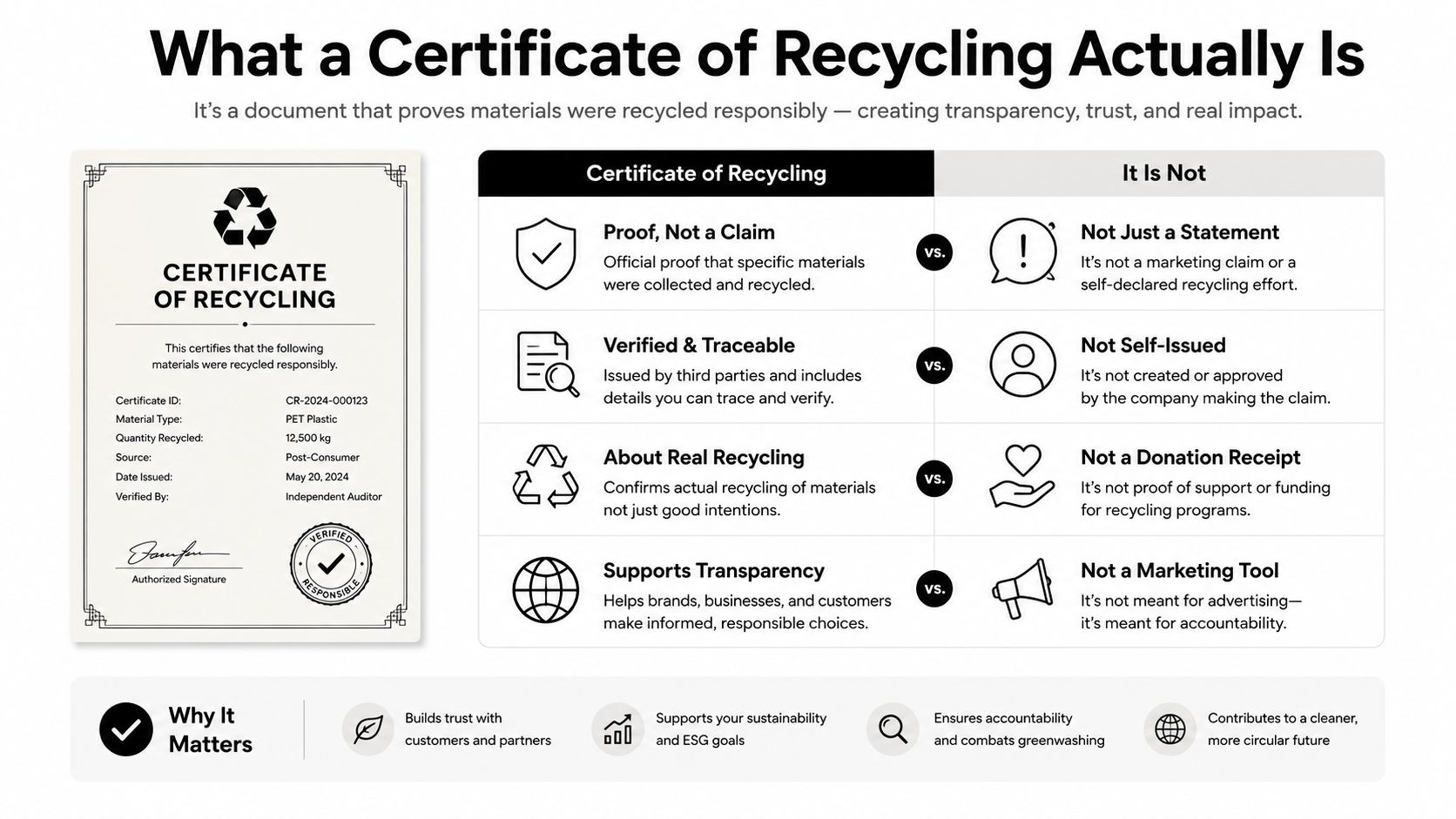
A Certificate of Recycling, or CoR, is a formal record issued by an ITAD or recycling provider that identifies equipment received and documents its processing or final disposition. It's stronger than a generic recycling receipt because it can tie the transaction to specific assets, a defined facility, a processing date, and a documented downstream outcome.
The difference matters. A weight ticket may confirm that a shipment contained a certain category or amount of material. It usually doesn't identify every laptop, server, drive, or asset tag in that shipment. For enterprise compliance, the question is rarely only how much material was recycled. The question is whether the business can reconcile each retired asset with its internal ITAM or ERP records.
Asset-specific and batch documentation
An asset-specific certificate lists individual equipment identifiers, such as serial numbers, asset tags, device types, makes, or models. It works well for data-bearing equipment, regulated devices, leased hardware, and assets subject to client or contractual controls.
A batch or lot-level certificate summarizes grouped material under a work order. It may be appropriate for certain non-data-bearing commodities or mixed material streams, but it offers less traceability when the business must prove the disposition of a particular device.
A defensible certificate package generally identifies:
- The processed equipment: Device description, serial number or asset tag where applicable.
- The provider and facility: Legal entity, processing location, and relevant certification scope.
- The processing event: Receipt or processing date and the disposition method.
- The downstream outcome: Additional processor, reuse path, recycling result, or destruction record where applicable.
- The authorization: Responsible operator or authorized signatory.
The certificate also has to be distinguished from a Certificate of Data Destruction. Recycling documentation addresses the equipment and material disposition. A destruction certificate addresses the removal of information from storage media, including the media type, sanitization method, location, device identity, and responsible operator. Businesses handling data-bearing electronics often need both records to close the environmental and information-security sides of the transaction. A detailed explanation of that distinction is available in this guide to Certificates of Data Destruction.
Legal and Compliance Drivers for Businesses
A Certificate of Recycling becomes valuable when it supports a documented disposal program. The FTC Disposal Rule applies to businesses and individuals that maintain or possess consumer reports and related records for a business purpose. It requires appropriate measures for disposing of sensitive information derived from those records, which makes a controlled, recorded end-of-life process more defensible than informal deletion or an undocumented haul-away.
Healthcare organizations and financial institutions face additional obligations around sensitive information, contractual controls, and internal governance. A certificate doesn't replace a privacy program, breach response plan, or sector-specific policy. It gives those programs a verifiable record showing that a defined disposal event occurred.
Recognized recycling standards strengthen the provider side of the evidence. The U.S. EPA recognizes e-Stewards and R2 as accredited electronics recycling standards, both of which use third-party certification frameworks for responsible electronics recycling and reuse. R2v3 also emphasizes serialized tracking, secure transportation, tamper-resistant packaging, lifecycle tracking, and certified downstream vendors. The practical question isn't whether a vendor displays a certification logo. It's whether the certification applies to the site and processing path that handled the business's equipment.
Environmental reporting creates another reason to retain detailed records. Guidance discussing GRI 306 expectations emphasizes serial-number-level chain-of-custody documentation that connects each device to its disposal method, technician, date, and facility. A batch certificate showing only total weight recycled isn't sufficient on its own for that level of documentation.
| Regulation or standard | Applies to | Documentation requirement | Penalty for non-compliance |
|---|---|---|---|
| FTC Disposal Rule | Businesses handling consumer reports and related records | Appropriate, documented disposal measures for sensitive information | Regulatory and legal exposure |
| R2 and e-Stewards | Electronics recyclers and ITAD providers | Controlled processing, responsible downstream handling, and documented custody | Weak vendor defensibility and client risk |
| Internal security and privacy policies | Enterprises, healthcare, finance, government, and other data-intensive organizations | Evidence that retired equipment followed approved disposition procedures | Audit findings, contractual disputes, and remediation |
| ESG and waste reporting controls | Organizations reporting environmental performance | Records that substantiate responsible recycling and disposition claims | Unsubstantiated reporting and governance concerns |
Businesses can use certified e-waste recycling services to align material processing with documented provider controls. The certificate is most useful when it references the exact event, facility, and method rather than merely stating that recycling was intended.
What to Look for on a Valid Certificate
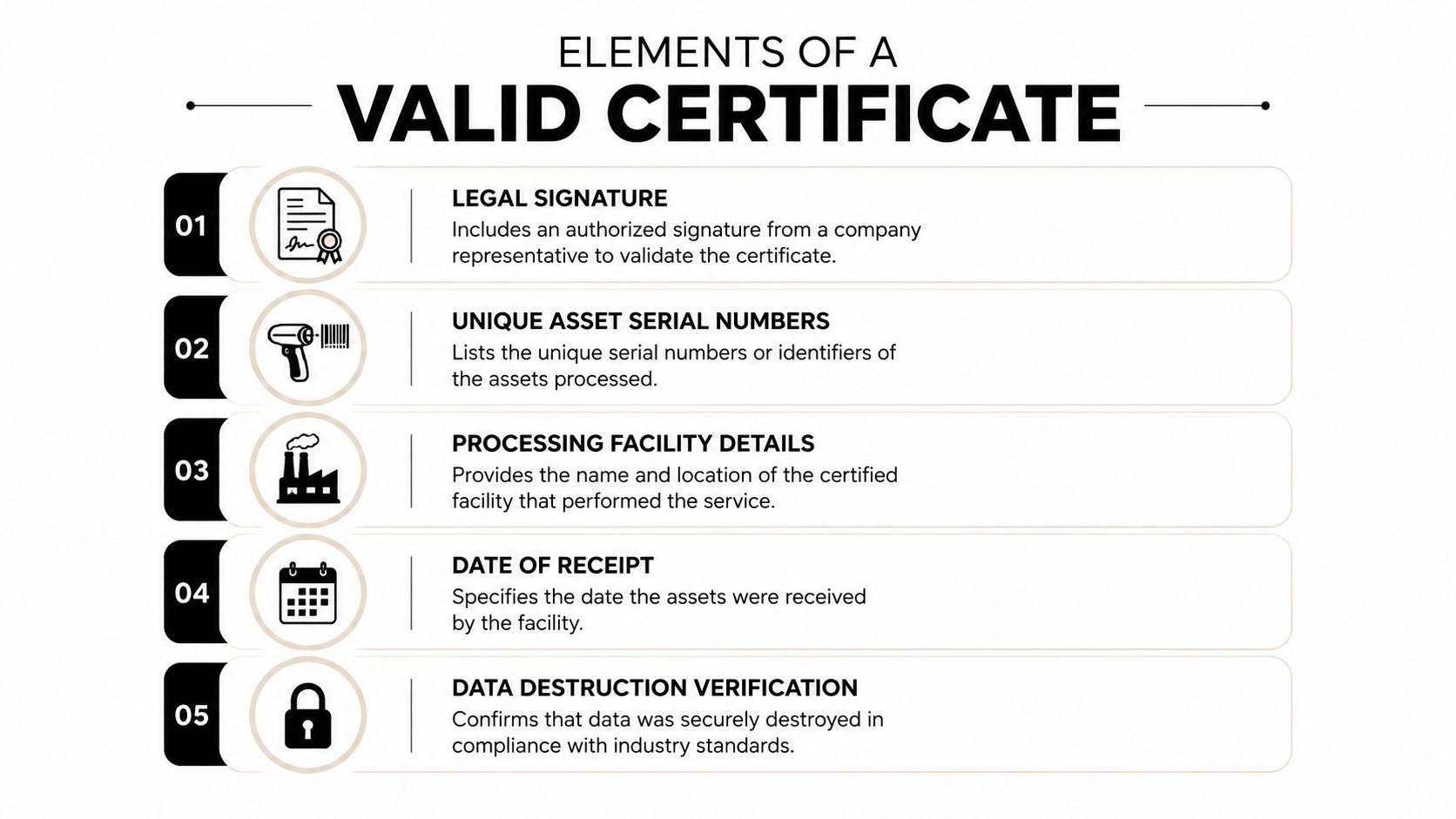
A valid certificate should allow a reviewer to reconstruct the asset's journey without relying on memory or informal vendor explanations. Start with identity. If the document doesn't identify the equipment, it may prove that some material was processed, but it won't reliably prove that the company's specific devices were included.
The defensible certificate checklist
Use the following checklist before accepting a certificate into the compliance archive:
- Unique certificate number: The record should have a reference that links it to the work order, shipment, or project.
- Asset detail: Serialized equipment should list serial numbers, asset tags, device types, or other identifiers.
- Processing date: The record should show when the provider received or processed the equipment.
- Facility information: Identify the actual processing location and the certification scope that covers it.
- Disposition method: State whether the equipment was recycled, reused, dismantled, shredded, wiped, degaussed, or handled through another defined path.
- Custody evidence: Retain pickup details, transfer dates, handlers, signatures, and transportation records.
- Downstream identification: Identify downstream processors when equipment or materials move beyond the primary provider.
- Data destruction verification: For storage media, connect the destruction record to the device and method used.
- Authorized approval: Include a responsible operator or authorized signatory.
The difference between asset-specific and batch documentation is a risk decision, not just a formatting preference. A batch record may be adequate for a shipment of clearly separated, non-sensitive material. It becomes a weak choice when the shipment contains hard drives, laptops, servers, or equipment assigned to named employees, customers, patients, or projects.
A certificate should answer what was processed, where it was processed, when it was processed, who handled it, and what happened next.
Red flags include missing serial numbers, vague descriptions such as “electronics,” no processing location, no downstream information, and a certificate issued before the provider can reconcile the inventory. A practical Certificate of Recycling format can help procurement and compliance teams compare vendor documentation before signing an engagement.
Businesses also benefit from maintaining accurate equipment records before disposal. For readers building or improving an asset register, this resource on IT asset management for UK SMBs provides useful context on inventory discipline, even though certificate requirements vary by organization and jurisdiction.
How to Obtain Verify and Retain Certificates
Treat certificate management as an operating procedure that starts before equipment leaves the building. The strongest records result from coordinated work between IT, facilities, procurement, security, and the recycling provider.
1. Set requirements before selecting a provider
Ask prospective vendors for a redacted sample certificate package. The sample should show how the provider handles serialized inventories, custody transfers, data destruction, facility identification, and downstream processing. Confirm whether the provider's certification applies to the site doing the work, not merely to a parent company or another location.
Put documentation requirements in the statement of work. Specify the required asset fields, processing records, destruction evidence, signatories, delivery format, and escalation process for inventory discrepancies. A vendor that can describe its process clearly before pickup is easier to evaluate than one that promises to “send paperwork later.”
2. Build the inventory and record the handoff
Export the relevant asset list from the organization's ITAM or ERP system. Include serial numbers, asset tags, device types, locations, and any data-bearing status. Record the collection date, pickup location, carrier or handler, and receiving party.
Chain-of-custody documentation should follow the asset chronologically through collection, transfer, processing, data destruction, and final disposition. It should identify each handler, custody change, unique identifier, and confirmation of handoff. This is what turns a certificate package into an auditable sequence rather than a standalone receipt.
3. Reconcile the completed records
When the provider issues the certificate, compare it with the original inventory. Investigate missing assets, duplicate serial numbers, unexpected substitutions, and devices that appear on a destruction record but not on the pickup manifest. Confirm that the processing facility and downstream parties match the engagement terms.
For data-bearing devices, match the Certificate of Recycling with the Certificate of Data Destruction. Recycling alone doesn't establish that information was securely sanitized or destroyed. The records should agree on the device identity and processing event.
4. Archive the package for retrieval
Store the certificate, asset manifest, pickup receipt, custody records, destruction certificate, downstream proof, and relevant vendor credentials together. Use searchable naming conventions based on the project number, work order, facility, and processing date. Limit editing rights, maintain backups, and test retrieval with a sample audit request.
Retention periods should follow the organization's industry requirements, contracts, privacy obligations, and records policy. Some businesses retain compliance records for several years, while specific regulatory or contractual rules may require longer or shorter periods. Don't adopt a universal timeframe without checking the rules that apply to your organization.
A practical lifecycle looks like this:
- Contract: Define certificate and custody requirements.
- Inventory: Reconcile equipment before pickup.
- Transfer: Document each handoff and transport event.
- Processing: Record recycling, reuse, sanitization, or destruction.
- Verification: Compare final records with the original asset list.
- Archive: Store the complete package in a controlled repository.
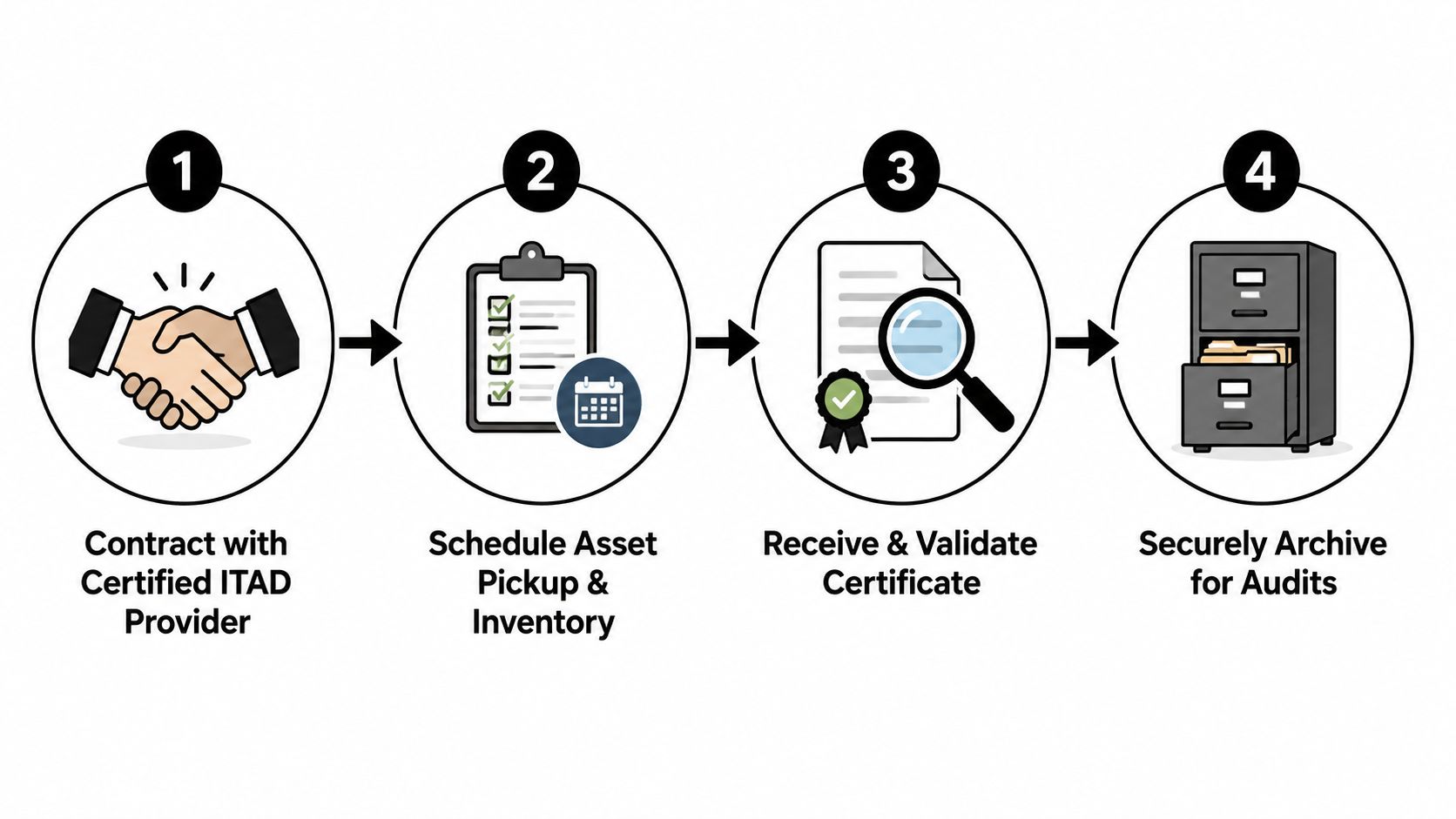
A structured compliance documentation workflow helps teams make certificate retrieval part of normal asset retirement instead of an emergency response task.
Common Misconceptions About Recycling Certificates
A certificate isn't an automatic liability shield. It protects the organization only to the extent that the document accurately covers the assets, provider, facility, processing method, and custody trail in question. If a vendor certificate omits serialized equipment or excludes the downstream processor that handled the material, its value may be limited during an investigation.
Another misconception is that a recycling certificate resolves every data-security obligation. It doesn't. If an organization later discovers that sensitive information was exposed, the certificate won't eliminate applicable breach assessment, notification, investigation, or remediation duties. It can support the organization's account of what it did, but it can't replace a complete security and privacy response.
Receipts are not evidence packages
A weight-based receipt confirms a transaction at a high level. It generally doesn't establish that a particular hard drive was destroyed, that a particular laptop entered a controlled reuse path, or that a downstream processor met the required standard.
Nor is a certificate needed only for large decommissioning projects. A single device can contain sensitive business, employee, client, patient, or applicant information. The documentation should match the risk of the asset, not the size of the shipment.
Vendor accreditation also needs verification. A certified parent organization doesn't automatically prove that every facility, subcontractor, or downstream processor operates within the same certification scope. Ask what the certification covers, which site performed the work, whether downstream vendors are certified where required, and whether the certificate identifies the actual processing event.
The dangerous assumption: Having a document is not the same as having defensible documentation.
Genuine risk transfer depends on a complete sequence. The business identifies the asset, transfers custody to a qualified provider, receives evidence of processing, confirms data destruction where applicable, and retains the records. False security appears when a company files a generic certificate without reconciling the inventory or checking the provider's downstream path.
Beyond Surplus Certified Recycling and Compliance Support
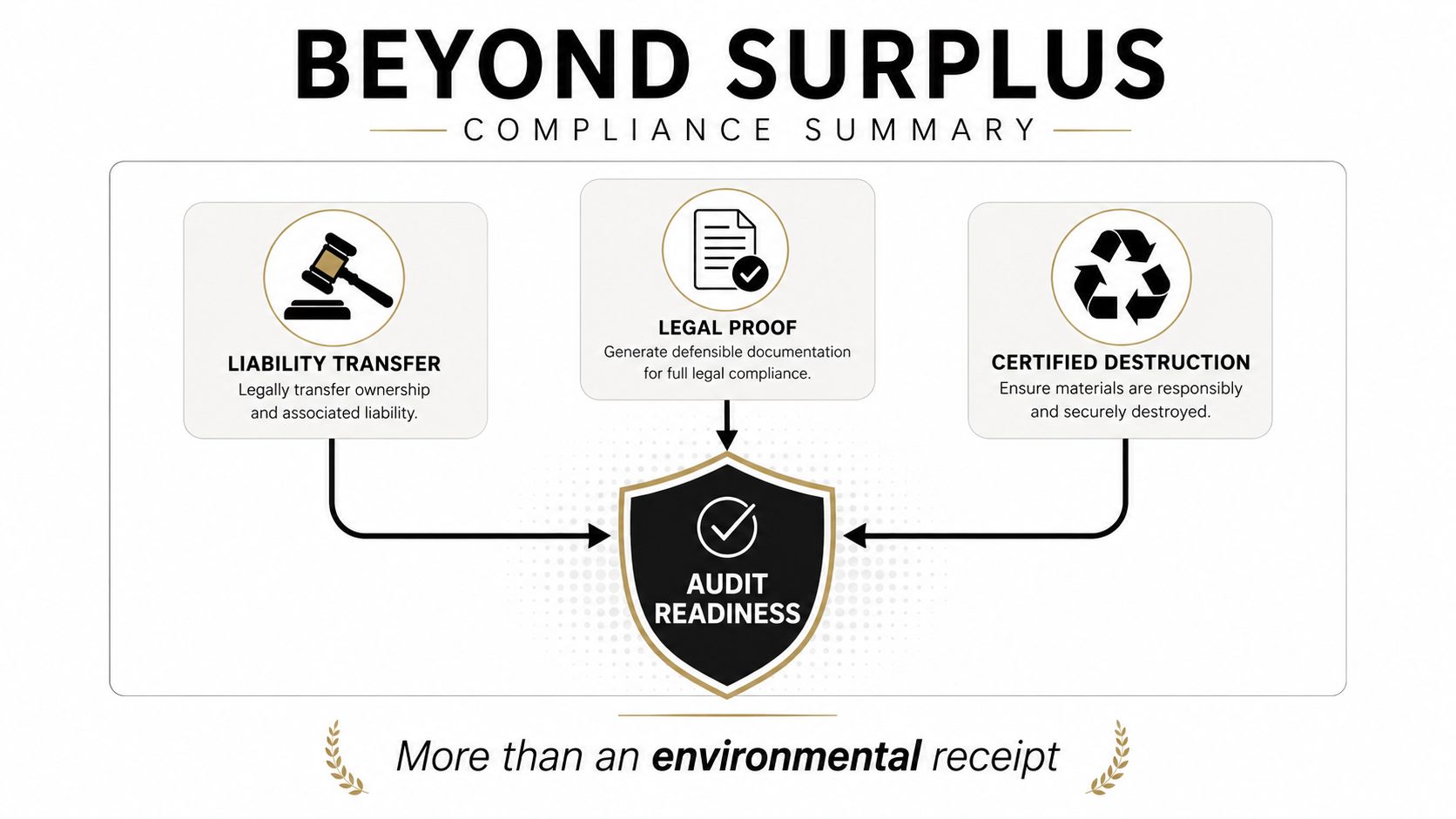
A Certificate of Recycling is more than an environmental receipt. It can serve as a liability-transfer and audit-readiness record when it connects serialized assets to documented custody, certified processing, data destruction, and final disposition. That evidence supports the organization's compliance program, internal controls, client commitments, and environmental reporting.
The practical standard has three parts:
- Compliance alignment: The disposition process should reflect applicable privacy, environmental, contractual, and internal policy requirements.
- Defensible documentation: Records should identify the equipment, handlers, dates, facilities, methods, and downstream outcome.
- Controlled retention: The complete package should remain searchable and available when an auditor, client, regulator, or legal team asks for it.
Beyond Surplus provides commercial electronics recycling and ITAD services with project documentation that can include serialized asset tracking, chain-of-custody records, Certificates of Recycling, and Certificates of Data Destruction. Businesses can evaluate the documentation before engagement by requesting a sample certificate package and confirming how the provider handles pickup, secure processing, downstream records, and archive delivery.
Contact Beyond Surplus to arrange certified electronics recycling, secure IT equipment disposal, data destruction, or enterprise ITAD support with documentation tied to your assets. Request a compliance consultation or sample certificate package before your next pickup, so your records are ready before an audit or inquiry occurs.


