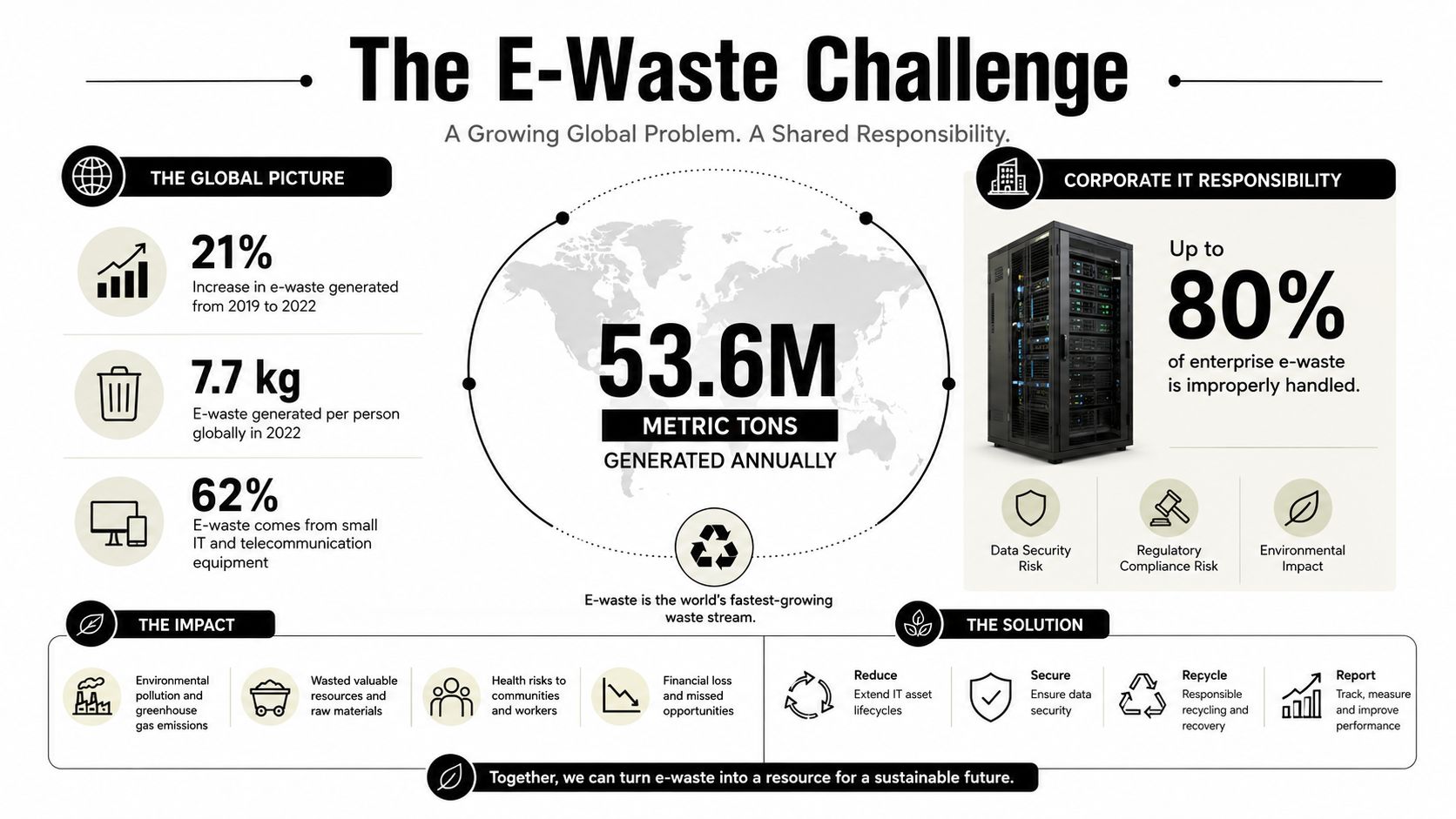
In 2022, the world generated a record 62 billion kg of e-waste, equal to 7.8 kg per person, yet only 22.3%, or about 13.8 billion kg, was documented as formally collected and recycled in an environmentally sound manner, according to the Global E-waste Monitor 2024. For enterprise IT directors, that gap changes the question from “Where can we send old equipment?” to “Can we prove what happened to every asset, every storage device, and every downstream material?”
Why Certified E Waste Recycling Matters for Enterprises
Certified e waste recycling is a risk-management control, not just a sustainability preference. Retired laptops, servers, networking equipment, medical devices, and laboratory systems may contain confidential information, regulated data, proprietary research, or components requiring controlled environmental handling. Once those assets leave a company's facility, weak documentation can leave the organization unable to demonstrate responsible disposition.
The scale of the problem makes informal disposal especially difficult to defend. Global e-waste increased from 34 billion kg in 2010 to 62 billion kg in 2022, while the same UN-backed reporting projects 82 million tonnes by 2030, with formal recycling growing much more slowly than generation, as reported by the Global E-waste Monitor 2024. More equipment is entering end-of-life streams, but much of it still moves through undocumented channels.
Certification turns handoff into evidence
A recycler's certification doesn't automatically eliminate every risk. It does establish an audited operating framework that can support chain-of-custody controls, data sanitization, environmental management, worker safety, and downstream accountability. The practical distinction is significant. A general scrap handler may accept equipment, while a certified electronics processor should be able to document intake, processing, reuse decisions, materials recovery, and final disposition.
Enterprises should also separate legitimate sustainability reporting from promotional language. A useful resource on how organizations can avoid greenwashing in PR is valuable because environmental claims need supporting records, not just attractive messaging.
The handoff should produce records such as serialized asset inventories, pickup documentation, certificates of recycling, and certificates of data destruction where applicable. Those records help procurement, legal, security, and environmental teams answer the same question with evidence: who handled the equipment, what process was used, and where did the material go?
For organizations evaluating local providers, Atlanta certified electronics recycling options illustrate the type of operational detail buyers should investigate before approving a vendor. The label matters, but the scope, audit evidence, and downstream controls matter more.
Table of Contents
- Certification turns handoff into evidence
- What Certified Electronics Recycling Actually Means
- Comparing R2v3 and e-Stewards Certification Standards
- How to Verify a Certified E Waste Recycler
- Data Sanitization Standards Within Certified Recycling
- Compliance and Liability Implications for Businesses
- Building a Certified ITAD Program for Your Organization
What Certified Electronics Recycling Actually Means
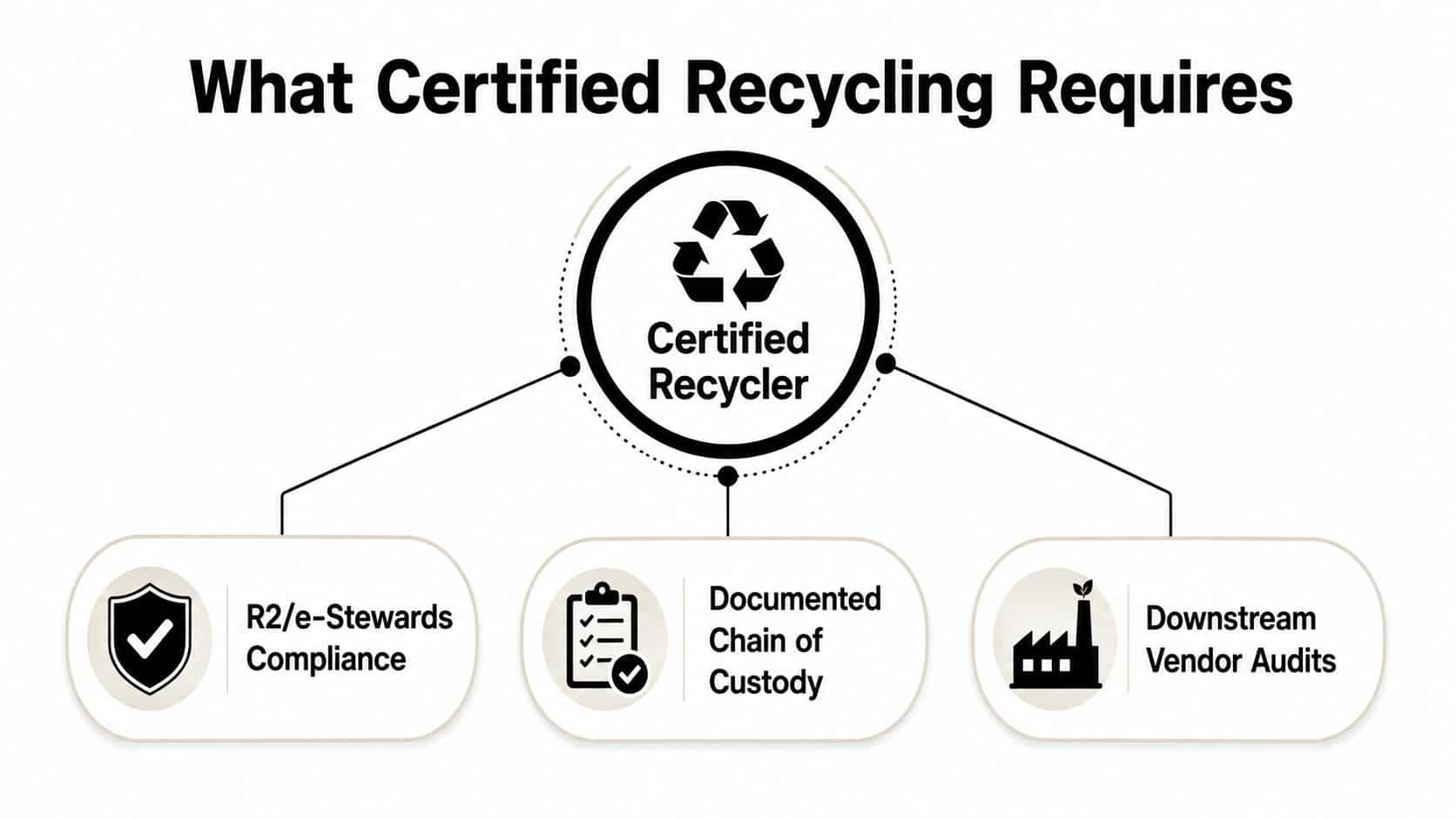
The U.S. EPA recognizes certified electronics recycling as a third-party audited process and identifies R2 and e-Stewards as the two accredited certification standards for electronics recyclers, according to the EPA's certified electronics recycler guidance. That definition separates certification from a recycler's own claim that it follows responsible practices.
The operational controls behind the label
A credible certified facility should demonstrate controls across the asset lifecycle:
- Intake and identification: Equipment enters a controlled process with inventories, serial numbers, condition records, and ownership information.
- Data security: Storage media receives a documented treatment based on the media type, asset disposition, and customer requirements.
- Reuse and recovery: Functional equipment may be tested, repaired, or remarketed, while non-reusable material moves into recovery streams.
- Downstream accountability: Vendors receiving components or commodities are evaluated and managed so assets don't disappear into unverified channels.
- Final documentation: The customer receives records that connect the original shipment to its completed disposition.
This is why certified electronics recycling differs from a basic collection service. A collection provider might transport equipment without controlling what happens afterward. An audited processor should maintain documented procedures, employee responsibilities, facility controls, and vendor oversight.
Certification scope deserves close review
Certification applies to a facility and defined activities, not necessarily to every service a company advertises. An organization may promote nationwide pickup while performing processing at a specific site or using transportation and downstream partners. Procurement teams should confirm the certified location, the covered processes, and whether data sanitization, testing, repair, materials recovery, and product destruction fall within the relevant scope.
The Beyond Surplus recycling certification information can help buyers understand the questions to ask about certified recycling, documentation, and downstream processing. The same questions should be put to every candidate vendor, regardless of brand familiarity.
Practical rule: Treat a certification logo as the beginning of verification, not the conclusion.
Comparing R2v3 and e-Stewards Certification Standards
The EPA recognizes both R2 and e-Stewards, but an enterprise shouldn't select a vendor by logo alone. The organization's security requirements, environmental policy, export position, reuse strategy, and reporting needs should determine which standard, or combination of controls, fits the program.
R2v3 is the current revision of the Responsible Recycling standard. It brings together data security, environmental protection, worker health and safety, downstream accountability, testing and repair, and materials recovery. Its integrated structure is useful for ITAD programs that need one audited framework spanning reuse and recycling.
e-Stewards places strong emphasis on preventing irresponsible international movement of hazardous electronic waste and on rigorous environmental accountability. Buyers with strict ESG policies or heightened concern about export pathways may place greater weight on the standard's approach to downstream destinations and material control.
R2v3 vs e-Stewards Certification Comparison
| Criteria | R2v3 | e-Stewards |
|---|---|---|
| Primary framework | Responsible Recycling controls covering data security, environmental and worker safety, reuse, recovery, and downstream accountability | Electronics recycling controls with a strong focus on environmental protection and responsible global material management |
| Data sanitization | Covers logical and physical sanitization within the certified recycling framework | Includes rigorous data security expectations within responsible electronics processing |
| Reuse and repair | Explicitly addresses testing, repair, and reuse pathways | Supports responsible disposition while emphasizing strict environmental controls |
| Materials recovery | Covers recovery processes and downstream vendor management | Requires controlled handling of materials through approved pathways |
| Export considerations | Provides a controlled framework for downstream management and approved processing | Applies a particularly strict position on hazardous e-waste exports to developing countries |
| Best procurement fit | Enterprises seeking an integrated ITAD framework with operational flexibility | Organizations prioritizing stringent environmental and international material controls |
| Verification priority | Confirm certificate scope, facility, process coverage, and downstream approvals | Confirm certificate scope, facility, destination controls, and environmental requirements |
The comparison isn't a substitute for reviewing the actual certificate and audit scope. A vendor can hold a recognized certification while offering services that fall outside the certified facility or process. IT directors evaluating what R2 certification means should connect the standard to their own contract requirements, especially for data-bearing assets, data center decommissioning, and multi-location logistics.
How to Verify a Certified E Waste Recycler
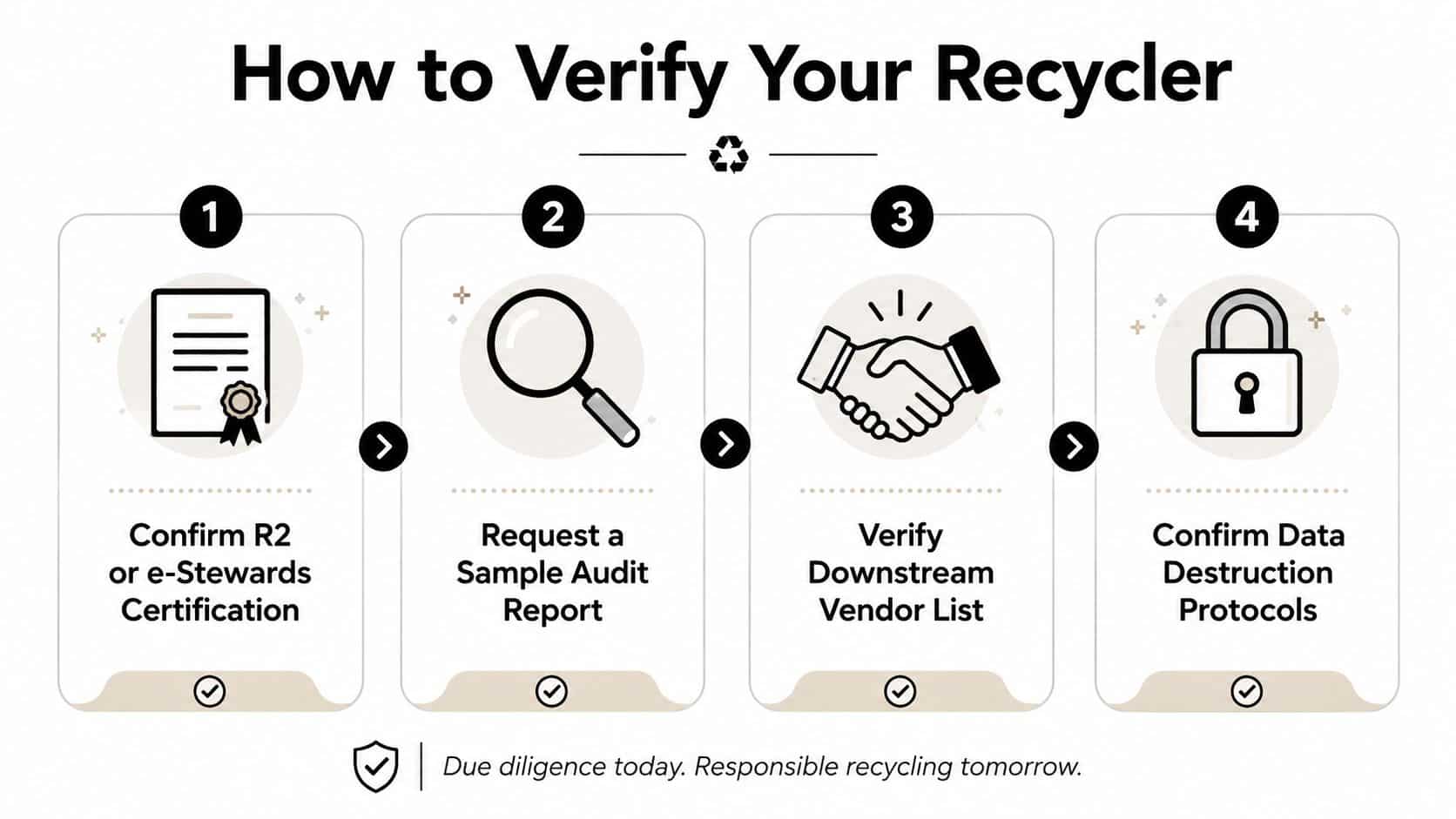
A certification logo on a website isn't enough. Before signing an agreement, verify that the certificate is active, applies to the facility that will process the equipment, and covers the services your organization requires.
A procurement checklist that holds up under review
- Confirm the certification: Request the current R2 or e-Stewards certificate. Match the legal entity, physical facility, certificate status, and certified activities against the applicable certification directory.
- Review the scope: Check whether the site handles data sanitization, physical destruction, testing and repair, materials recovery, or product destruction. Don't assume a service listed in a sales proposal is covered by the certificate.
- Request audit evidence: Ask for an audit summary or other shareable evidence showing how the facility manages security, environmental controls, worker safety, and downstream providers.
- Trace the downstream chain: Request the categories of downstream vendors, approval procedures, and documentation used to track materials after the primary processor receives them.
- Validate customer records: Ask for sample certificates of recycling, data destruction records, serialized tracking reports, and chain-of-custody forms.
- Check commercial protections: Verify insurance, transportation controls, incident-notification obligations, subcontractor requirements, and retention of compliance records.
Red flags during vendor review
Vague answers about final destinations are a serious warning sign. So is a refusal to explain how storage media are identified, how failed sanitization is handled, or which facility performs processing.
A low price can also conceal a narrow service scope, unapproved subcontracting, weak inventory controls, or limited documentation. Compare the complete operating model rather than the pickup charge. The vendor due diligence checklist can help procurement and IT security teams standardize this review before a contract is awarded.
Data Sanitization Standards Within Certified Recycling
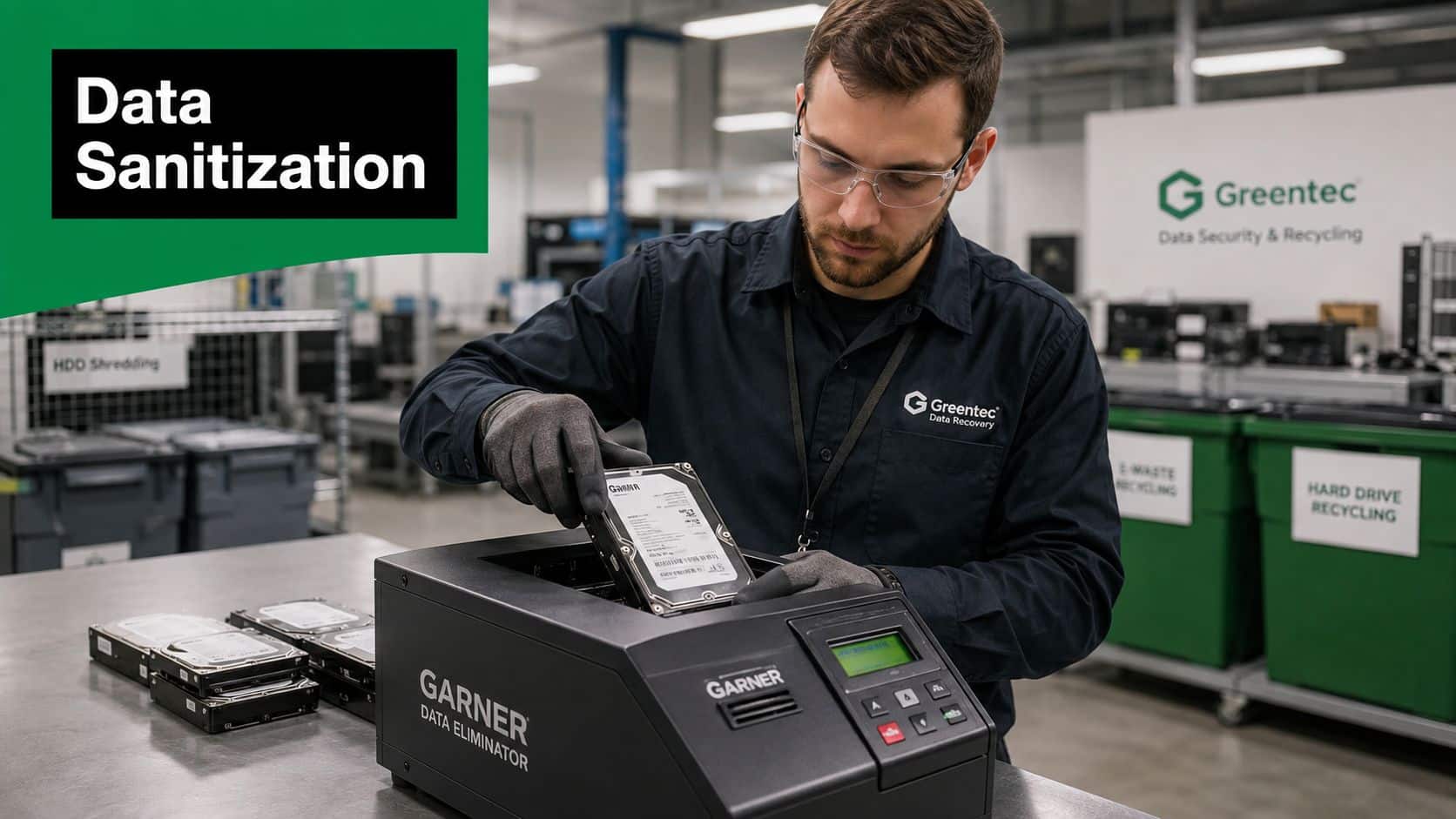
Data sanitization is often the most underestimated control in an electronics recycling program. Physical possession of a hard drive doesn't equal data destruction, and a recycling certificate doesn't necessarily prove that every storage device received the correct treatment.
Certified recyclers are expected to use formal sanitization controls aligned with NIST SP 800-88 and, in some programs, IEEE 2883-2022, as described in this overview of certified e-waste recycling and NIST controls. Appendix B-style requirements include a written data sanitization plan and enhanced physical security for facilities performing sanitization.
Method selection must match the media
A written plan should distinguish among hard disk drives, solid-state drives, removable media, mobile devices, servers, and equipment containing embedded storage. Logical sanitization may be appropriate for some reusable devices, while physical destruction may be required where the media cannot be reliably sanitized or where policy requires destruction.
The process should record:
- Asset identity: Serial number, tag, device type, and storage media details.
- Sanitization method: The method selected and the reason it fits the media.
- Operator and verification: The person or system performing the work and the result of the process.
- Disposition status: Reuse, resale, component recovery, or destruction.
- Customer evidence: A report or certificate connecting the completed action to the asset inventory.
Enhanced physical security matters because sanitization facilities handle the organization's most sensitive material. Controlled access, secure staging, surveillance, and restricted movement reduce the opportunity for substitution, loss, or unauthorized access. A NIST SP 800-88 data sanitization program should therefore be evaluated as an operational capability, not as a phrase in a proposal.
Security requirement: Require serialized evidence for every data-bearing asset, including exceptions and failed processing attempts.
Compliance and Liability Implications for Businesses
Businesses often assume liability ends when a carrier collects retired equipment. It doesn't end automatically. The organization may still need to demonstrate that it selected a qualified provider, protected data during transport and processing, and used a lawful environmental disposition pathway.
The FTC Disposal Rule is relevant to records containing consumer information, while healthcare organizations must account for protected health information under HIPAA. State e-waste requirements can impose additional obligations, and the applicable rules depend on the equipment, location, industry, and transaction structure.
Documentation supports defensible transfer
Certificates of recycling and data destruction are useful because they create an auditable record of completed services. They don't excuse poor vendor selection or replace a contract, but they can support a documented compliance position when paired with inventories, pickup records, sanitization logs, and downstream controls.
Environmental liability also extends beyond the first processor when a vendor uses poorly controlled subcontractors. If equipment reaches an unverified handler, the original owner may face difficult questions about due diligence, destination control, and the basis for claiming responsible recycling.
The EPA's certified electronics recycler guidance emphasizes independent auditing and specific electronics management standards. Enterprises should incorporate those expectations into RFPs and agreements rather than accepting a generic sustainability statement.
Brand exposure is another practical concern. A company that cannot explain where its retired servers or laptops went may struggle to defend environmental claims, customer commitments, or internal ESG reporting. Certification helps, but only when the business verifies scope and preserves the records.
Building a Certified ITAD Program for Your Organization
A durable ITAD program connects security, logistics, environmental compliance, and value recovery before equipment leaves the building. Start with an asset inventory that identifies ownership, location, serial numbers, data-bearing components, condition, and intended disposition.
Use a vendor scorecard with clear decision gates:
- Certification: Active R2 or e-Stewards status and a scope that matches the work.
- Sanitization: Written procedures aligned with applicable NIST controls, method selection by media type, and serialized reporting.
- Logistics: Secure pickup, shipment tracking, multi-site coordination, and controlled staging.
- Downstream management: Documented approval and oversight of downstream processors.
- Disposition options: Testing, repair, reuse, IT asset recovery, materials recovery, and product destruction.
- Records: Certificates, inventories, chain-of-custody documents, and incident procedures retained for audit needs.
Contracts should require advance notice of certification changes, approval for material subcontracting, defined documentation standards, and prompt incident escalation. For data center decommissioning, add de-installation sequencing and infrastructure logistics. For medical or laboratory equipment disposal, identify protected data and potentially hazardous components before the pickup is scheduled.
Beyond Surplus offers business electronics recycling, secure data destruction, IT equipment disposal, IT asset recovery, product destruction, data center de-installations, and coordinated nationwide pickup for organizations. Its stated process includes certificates of recycling, secure data destruction, and processing through R2 downstream vendors, which should be evaluated alongside the same documentation and scope requirements applied to any ITAD provider.
Contact Beyond Surplus to discuss certified electronics recycling, secure data destruction, IT equipment disposal, and coordinated ITAD logistics for your organization. Request a documented disposition plan for office equipment, data center assets, medical technology, laboratory equipment, or multi-location technology rollouts.