

An R2-certified recycler gives an Atlanta business a documented chain of custody, certified data destruction, regulatory compliance support, and zero-landfill downstream processing tied to a globally audited standard. In 2019, the world generated 53.6 million metric tons of e-waste, but only 17.4% was formally recycled properly, so the recycler you choose matters long before the first truck pulls away Global E-waste Monitor data cited here.
Atlanta IT teams know the moment. A server room refresh starts, storage drives pile up, the data center closeout gets scheduled, and somebody asks who's signing off on the old laptops after pickup. That's when a recycling decision stops being about convenience and becomes about whether the vendor can protect your data, support your audit trail, and keep your liability from following the asset.
Why Atlanta Businesses Are Rethinking Electronics Recycling
The typical Atlanta refresh is messy. A facilities manager wants the floor cleared, an IT director wants the disks handled correctly, and procurement wants a clean invoice and a defensible contract. If the recycler can't show what happened to every device, the pickup isn't a solution, it's a risk transfer with no proof.
That's why R2 certification keeps coming up in enterprise conversations. It gives businesses a system for reuse, recycling, downstream oversight, and documented handling, instead of a vague promise that “everything will be taken care of.” In a metro like Atlanta, including business corridors in Smyrna, the key question isn't whether to recycle. It's whether the vendor can protect the company if an asset resurfaces, data leaks, or an auditor asks for records.
What R2 changes for ITAD decisions
R2 gives the buyer a way to separate serious processors from collectors who only offer pickup. A certified recycler is expected to run a controlled process, not just accept equipment and hope for the best. That matters when you're retiring mixed fleets of laptops, servers, storage arrays, and mobile devices, because one uncontrolled device can create a problem your team didn't budget for.
Practical rule: if the vendor can't explain custody, destruction, and downstream movement in plain English, don't assume the paperwork exists.
For Atlanta IT leaders, that difference shows up in three places. First, the recycler should be able to document what came in. Second, it should be able to show how sensitive media was treated. Third, it should be able to prove where the material went after processing.
What R2 Certification Actually Requires
R2 is not a branding badge. It's an operating standard that forces a recycler to control reuse, recycling, data handling, and downstream vendors. That matters because informal recyclers can say they “shred drives,” but still leave you with no traceability if a regulator, customer, or auditor asks for proof.
The controls that matter
R2 Standard v3 is designed to reduce environmental impacts, improve worker health and safety, protect the recycling chain through vetting and oversight, and help customers maintain data security Intertek's overview of R2. In plain language, that means the recycler must treat used electronics as a managed process, not loose scrap. It also means your retired equipment shouldn't move through an unverified downstream path.
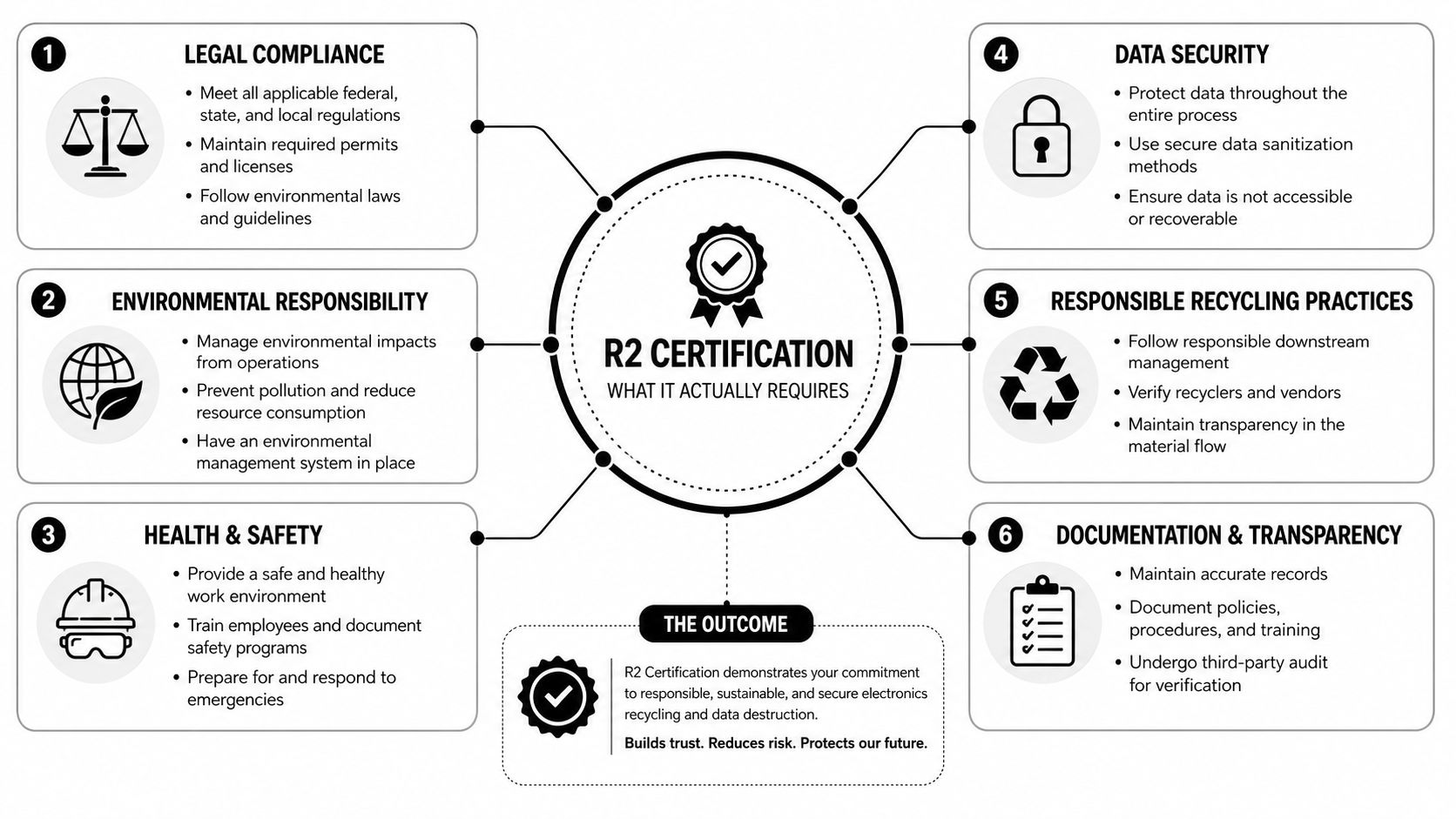
For an Atlanta business, the business outcome is simple. You get a recycler that must build process discipline around reused equipment, destroyed media, vetted vendors, and documented handling. That's a stronger control environment than a pickup-only operator that can't explain where the load goes next.
How the standard reads to a CFO
A CFO doesn't need the certification jargon. They need to know the recycler is required to document movement, protect data, and manage downstream risk. They also need to know the standard favors reuse-first outcomes when devices can safely be refurbished, which supports value recovery instead of pushing every asset straight into shredding.
That's the core distinction. R2 isn't “green recycling” in the abstract. It's a process framework that ties operational discipline to liability control, and that's exactly why enterprises use it for IT asset disposition.
Learn how Beyond Surplus describes R2 certification
Certified Data Destruction and Chain of Custody
Data destruction is where weak recyclers get exposed. A proper R2-certified workflow treats every device as a potential liability until the media is either wiped to standard or physically destroyed. That includes laptops, desktops, servers, mobile devices, and storage arrays, because the risk doesn't disappear just because the hardware looks old.
Wipe, shred, and document
For devices that can be reused, the recycler should use a certified sanitization process aligned to the media condition and disposition path. For end-of-life drives, physical destruction is the safer route. Atlanta businesses that want witness-level assurance should ask about onsite mobile shredding, because seeing the destruction happen at the loading dock removes a lot of uncertainty.
The paperwork matters just as much as the process. You should get serialized device records, timestamps tied to pickup, and a Certificate of Destruction that identifies media type and final treatment. Without that, you're relying on trust instead of evidence.
The certificate is not administrative clutter. It's the document that shows your auditor where the responsibility moved.
The compliance value is even sharper when a device goes missing. If the recycler can't identify what was received and how it was handled, your team is left explaining a gap. With chain-of-custody records, the transfer is documented, and liability doesn't sit ambiguously with your staff.
Review chain-of-custody documentation expectations
The Real Cost Versus Value Tradeoff
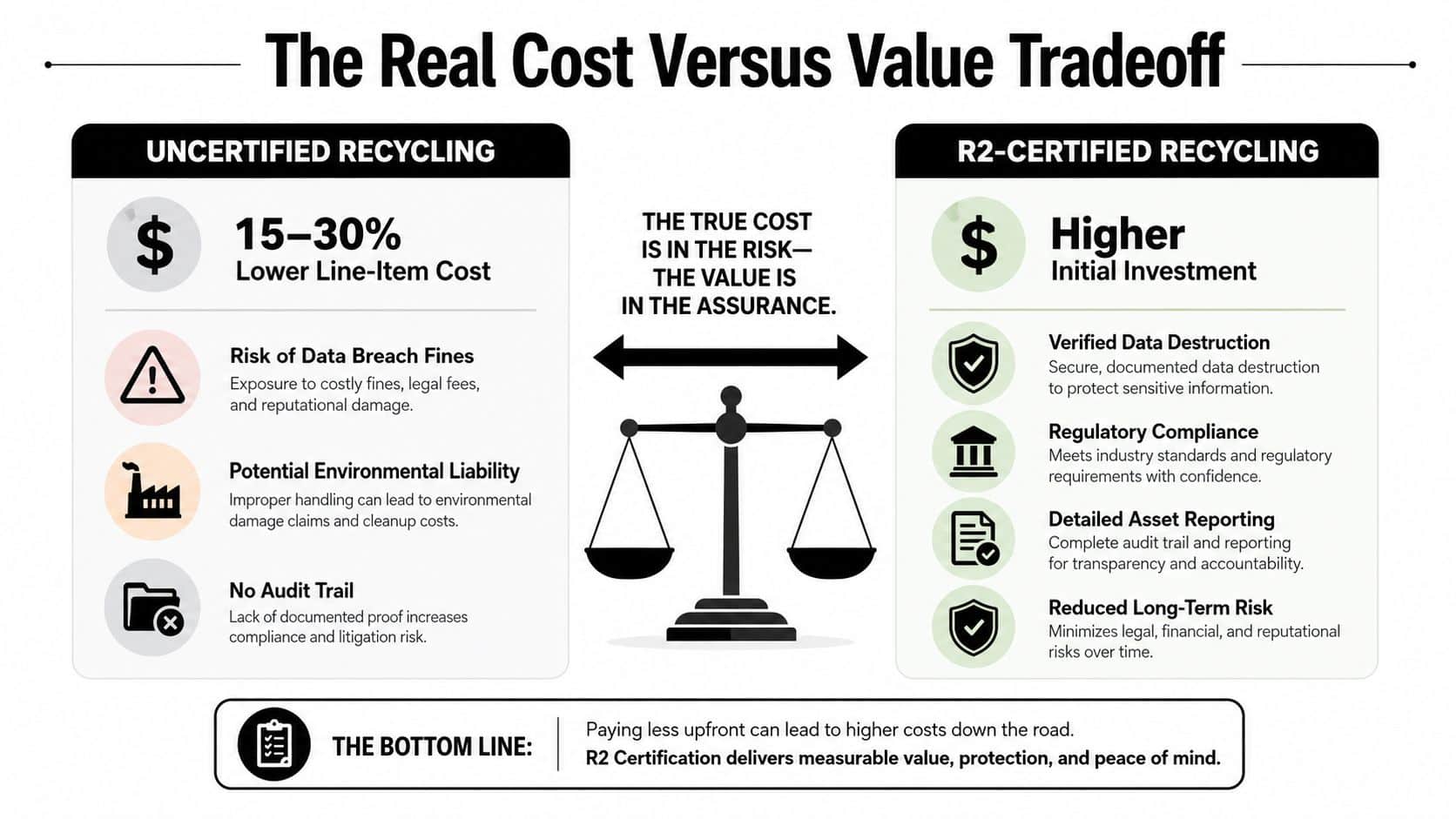
A lot of procurement teams stop at the sticker price. Certified recycling can cost 15-30% more than non-certified alternatives, and that's enough to trigger a reflexive “no” if the buyer is only comparing line items cost guidance referenced here. That's the wrong comparison.
Price is not the same as cost
The actual question is what one bad disposal event costs your business. One industry source pegs average breach remediation at $4.45 million per incident, and cites HIPAA-related penalties ranging from $100,000 to $1.9 million Mayer Alloys risk discussion. Even if your organization never hits those figures, the exposure is obvious. A cheap recycler with no audit trail can become an expensive mistake very quickly.
The upside procurement often misses
Certified processors also work harder to separate reusable assets from true scrap. That reuse-first approach can improve recovery value on laptops, servers, and components when there's still marketable life left. For mixed fleets, that means the recycler can sometimes return value instead of only charging a disposal fee.
The tradeoff is real, but the conclusion is clearer than most competitor articles admit. If your assets have residual value and your business has any meaningful data or compliance exposure, R2 certification can improve net recovery while lowering long-term risk. That's a better procurement decision than chasing the lowest invoice.
Regulatory Compliance Coverage You Can Document
Atlanta businesses don't need a recycler to be their compliance department. They need a partner that produces evidence their compliance team can use. R2 helps there because the documentation is built to support disposal controls, chain-of-custody records, and downstream accountability.
Where the paperwork helps
For consumer-information disposal, the FTC Disposal Rule expects reasonable measures to protect sensitive data. For healthcare, HIPAA device-and-media disposal requirements are the obvious pressure point. Finance teams also have to think about GLBA and PCI-DSS, and public-sector buyers face retention and disposal expectations that don't leave much room for vague vendor promises.
A good R2 partner should hand over a clean record set. That usually means pickup confirmation, serialized inventory or load records, destruction or recycling certificates, and documented downstream movement. Those records don't replace your internal policy, but they make your policy defensible.
| Regulation | Disposal Requirement | R2 Documentation Provided |
|---|---|---|
| FTC Disposal Rule | Secure disposal of consumer information | Pickup record, destruction certificate, chain-of-custody file |
| HIPAA | Protect device and media data from exposure | Sanitization or destruction records, serialized media logs |
| Finance | Controlled disposal of sensitive client and payment data | Audit-ready disposal certificates and vendor oversight records |
| Government and education | Retention-aware disposal with proof of handling | Documented receipt, processing, and downstream tracking |
See Atlanta e-waste recycling laws and best practices
What to hand to your auditor
If an auditor asks how retired devices leave your environment, you should be able to show the contract, the transfer records, and the final certificate set. That's what turns recycling from a logistics task into a defensible compliance control. It also makes internal reviews a lot less painful.
Service Models That Fit Atlanta Operations
The right R2-certified recycler doesn't force one logistics model on every client. It should match the way your business operates, whether that means a single office, a distributed footprint, or a decommissioned data center.
Pick the service model that matches the risk
Scheduled pickup works for offices and data centers that need a recurring cadence, especially when assets need to move anywhere in the contiguous United States. Onsite mobile hard drive shredding fits clients who want witnessed destruction at their location. Offsite wiping or shredding at a secure facility makes sense when the load can move under controlled transport and you want the recycler to handle processing in-house.
Mail-in programs help distributed teams, remote staff, and smaller asset batches. Drop-off at the Atlanta or Smyrna facility is useful for closeouts and smaller loads that don't justify a truck roll. Each of those models should still produce the same core output, serialized receiving, secure movement, and final documentation.
Operational rule: the transport method can change, but the custody record shouldn't.
Value-recovery services also belong in the conversation. Buyback can offset retirement costs when equipment still has resale value, and product destruction matters when branded goods, prototypes, or regulated materials can't be resold. Beyond Surplus offers these kinds of ITAD and destruction services for business clients, along with logistics coordination and certificate-based documentation, which is the level of control Atlanta buyers should expect from any serious partner.
Compare onsite and offsite ITAD services in Georgia
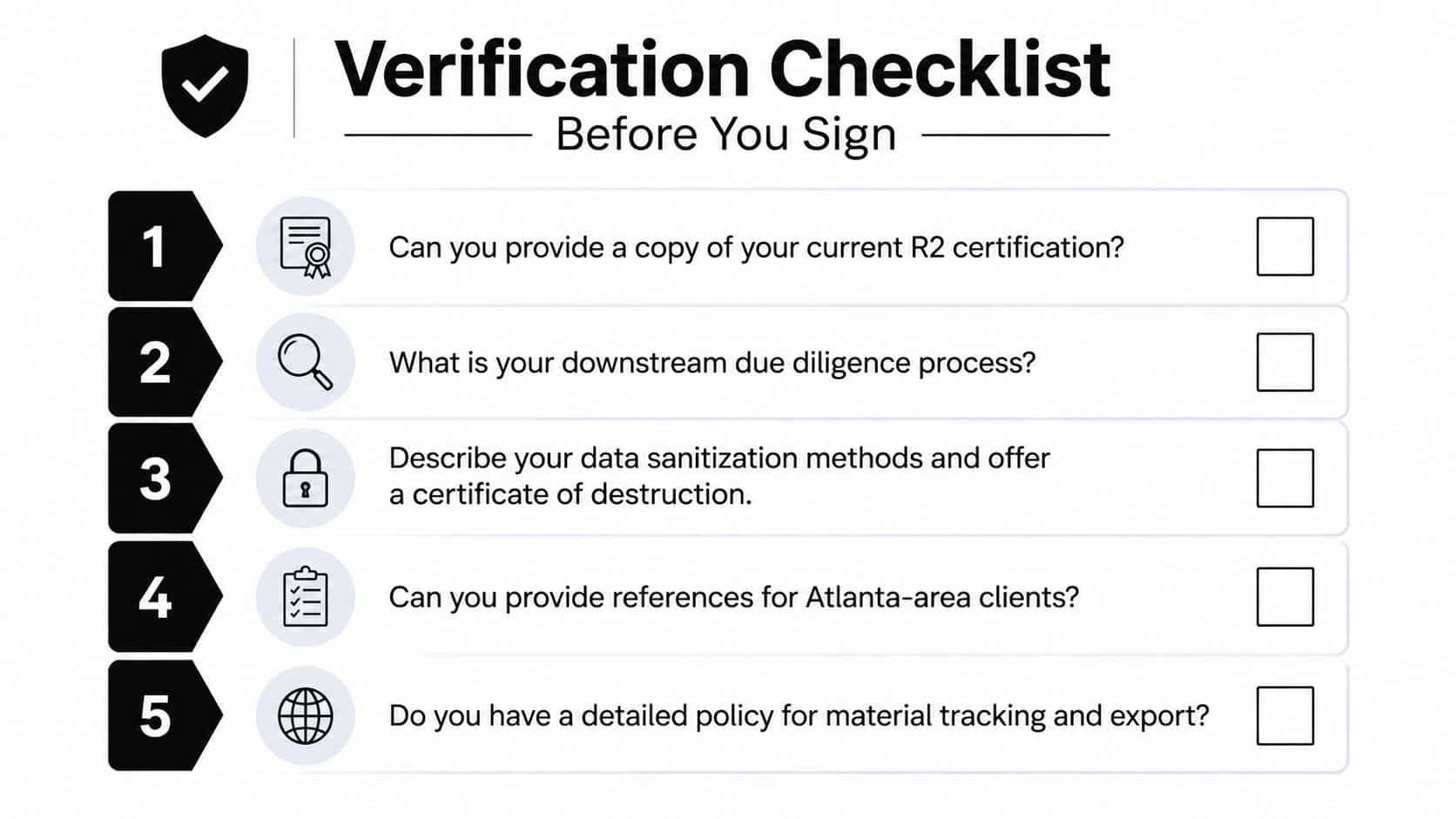
Verification Checklist Before You Sign
A certification claim is not enough. Ask for the documents that prove the claim still matters in practice.
Questions that separate real control from marketing
- Can you provide a current R2v3 certificate? The certificate should show the certifying body and scope, not just a logo on a website.
- Who are your downstream vendors, and how do you audit them? Downstream control is where weak programs fail, so this answer should be specific.
- Do you offer onsite witnessed shredding, and what report do I receive? You need serialized proof, not a generic invoice.
- What certificates do I get, and how fast? Delayed paperwork is a problem when auditors or legal teams are waiting.
- How is liability transferred in the contract? If the language is vague, the risk probably is too.
- Do you operate a zero-landfill policy, and can you document downstream recovery? If they claim it, they should be able to show it.
- What is your sanitization standard, Clear or Purge? The process should match the device and the intended reuse path.
What a good recycler will do
A serious recycler won't get defensive about these questions. They'll answer them fast and hand over the paperwork without a song and dance. That's the behavior you want before a laptop, server, or storage array leaves your custody.
Use a vendor due diligence checklist before you sign
Choosing an R2-Certified Partner in Atlanta
The benefit stack is straightforward. An R2-certified recycler gives your Atlanta business defensible data destruction, audit-ready compliance documentation, verified downstream processing, and usually stronger value recovery from reuse-first handling. Certification is the floor, not the ceiling.
The best ITAD partners also give you transparent logistics, clear pricing, and contract language that transfers liability. If you're vetting providers, use the checklist above and don't accept vague answers. Contact Beyond Surplus for certified electronics recycling and secure IT asset disposal, and compare every provider against the same paperwork standard.
Beyond Surplus handles certified electronics recycling, secure IT asset disposal, and documented data destruction for Atlanta-area businesses that need proof, not promises. If you're retiring IT equipment and want chain-of-custody records that support compliance and liability transfer, visit Beyond Surplus and start with the same checklist you'd use for any R2-certified provider.


