
You've just unplugged a tower, a laptop, a printer, and a cable bundle, and the equipment is now occupying valuable floor space. A search for electronics recycling near me produces plenty of map results, but proximity alone won't tell you whether a provider can protect data, document downstream handling, or accept commercial equipment.
For Atlanta-area residents and business teams, the right choice depends on three facts: how much equipment you have, whether it contains sensitive data, and what records your organization needs after pickup. The options below separate drop-off, mail-in recycling, and business pickup so you can choose a channel that fits the job instead of choosing the closest address.
Table of Contents
- What to Do First When You Search Electronics Recycling Near Me
- Preparing Devices, Data, and Accessories for Recycling
- Comparing Drop-Off, Mail-In, and Business Pickup Options
- Verifying Certifications and Chain of Custody
- Costs, Fees, and Value Recovery From Recycled IT Assets
- How Beyond Surplus Handles Residential and Business Recycling
What to Do First When You Search Electronics Recycling Near Me
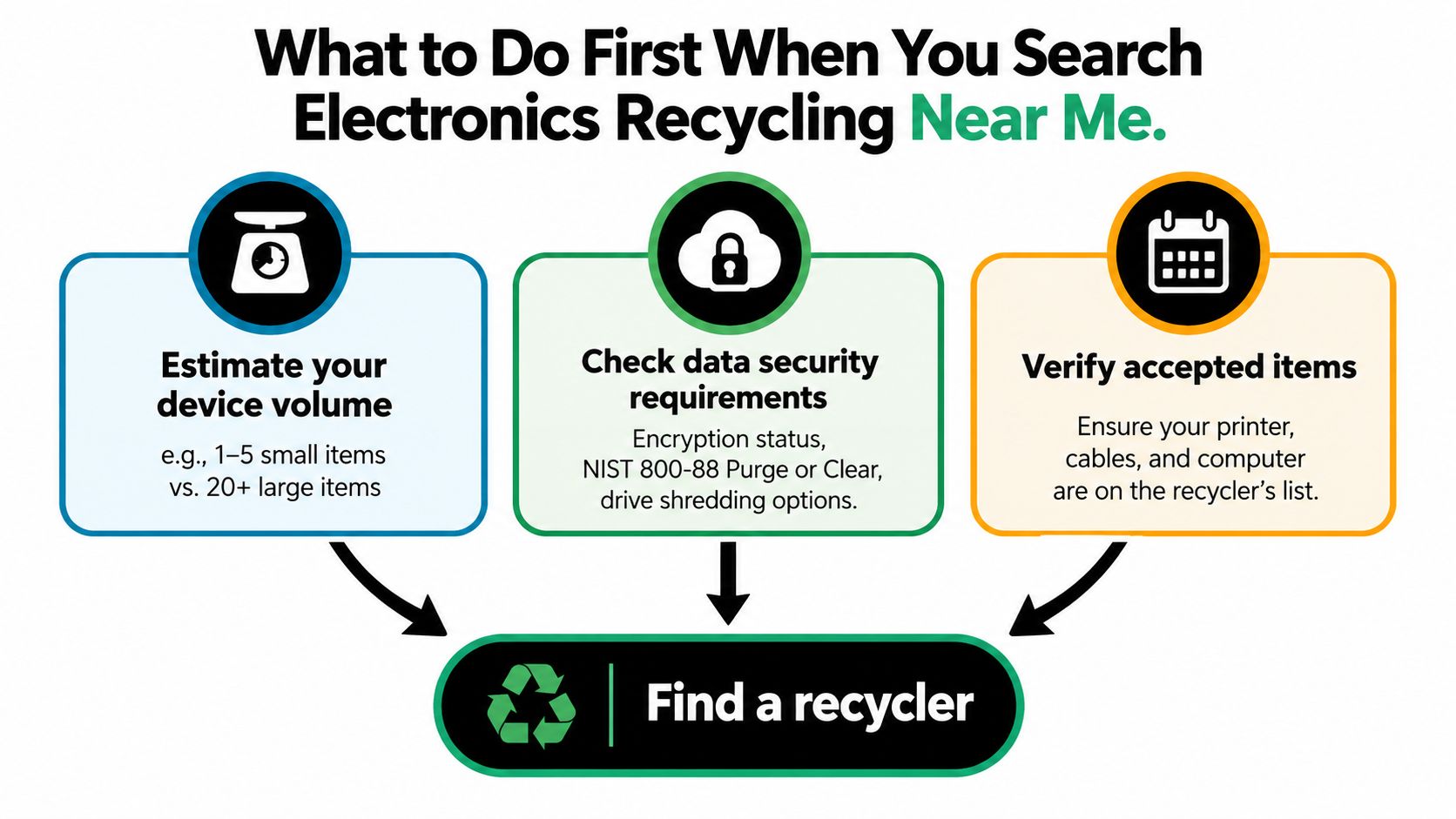
Start with a quick inventory. Count the devices, identify anything with storage, and decide whether your company needs an auditable transfer. A small group of loose keyboards and cables is a different assignment from a pallet of retired laptops or a server-room shutdown.
Answer three operational questions
How much equipment is leaving? Fewer than ten small items may fit a drop-off trip. One or two compact devices without drives can often move through a mail-in program. Pallets, mixed IT loads, recurring refreshes, and equipment from multiple departments call for business pickup.
Could the equipment contain sensitive information? Laptops, desktops, servers, multifunction printers, phones, removable media, and some medical or laboratory systems may retain data. If the answer is yes, select a vendor that can provide documented wiping or physical destruction, not a general junk-hauling service.
What paperwork must your organization retain? Procurement, compliance, facilities, and IT teams may need serialized intake records, weight tickets, certificates of recycling, and certificates of data destruction. Ask about those records before equipment is loaded.
Distance is the wrong primary filter. A nearby provider without R2v3, e-Stewards, or NAID AAA controls can expose your organization to data, environmental, and liability problems. A qualified provider farther away may be the safer commercial decision if it supplies verifiable chain-of-custody documentation and identifies its downstream processors.
The global recovery gap makes this distinction important. In 2022, the world generated 62 billion kilograms of electronic waste, or 7.8 kilograms per person, while only 22.3% was formally collected and recycled in an environmentally sound manner, according to the Global E-waste Monitor 2024. Your local choice contributes to a larger system, but the useful measure is verified processing, not a drop-off receipt alone.
Preparing Devices, Data, and Accessories for Recycling
Use this checklist before anything leaves your building. A disciplined preparation process reduces sorting delays, protects information, and makes the final records easier to reconcile.
Secure the data before transport
- Check encryption: Record whether full-disk encryption is enabled and confirm that your approved sanitization method matches the device.
- Sanitize storage: Use a documented NIST 800-88 Purge or Clear process where reuse is appropriate. Keep the method, operator, date, and asset identifier with the project file.
- Destroy failed media: Physical drive shredding or another approved destruction method is appropriate when a drive can't be reliably wiped, the device is damaged, or policy prohibits reuse.
- Reset connected devices: Sign out of cloud accounts, remove management locks, unpair Bluetooth accessories, and factory-reset phones and tablets.
- Preserve recovery value: If reuse or resale matters, remove non-OEM RAM or storage only when your asset plan calls for it. Don't strip components without recording what changed.
Beyond Surplus provides additional preparation guidance in its computer recycling preparation instructions. The practical rule is simple: never assume that powering down a device removes its data.
Separate equipment for a cleaner load
Bundle power cords, chargers, dongles, and cables by type. Mixed accessory boxes slow sorting and make it harder to determine which components belong with higher-value assets.
Set aside items that need dedicated handling, including lithium-ion battery packs, CRT glass, toner cartridges, and lithium button cells. Don't place loose batteries in a box with metal equipment, and don't treat toner or CRT material as ordinary office waste. Ask the recycler for packaging and acceptance instructions before loading.
Build the record while you pack
Photograph serial numbers and pallet contents. Assign an asset ID to every box, gaylord, or pallet, then attach that identifier to the pickup paperwork. At the dock, compare the count and labels with the driver's chain-of-custody form.
A strong file connects the physical shipment to the final certificates. It should show what left the building, who accepted it, where it went, and how the processor handled data-bearing equipment.
Comparing Drop-Off, Mail-In, and Business Pickup Options
The channel should match the material and the evidence your organization needs. Drop-off is convenient, mail-in works for limited eligible equipment, and business pickup is the correct route for volume or audit requirements.
| Factor | Drop-Off | Mail-In | Business Pickup |
|---|---|---|---|
| Cost structure | Often avoids shipping, but item fees may apply | Usually uses a prepaid or flat-rate shipping process | Quoted around volume, logistics, processing, and data services |
| Convenience | Immediate handoff at an approved site | Useful when equipment is compact and easy to package | Removes transportation and loading work from your team |
| Volume capacity | Suited to a small vehicle load | Suited to a limited number of small devices | Designed for pallets, mixed IT, recurring loads, and site projects |
| Supported items | Must be confirmed by location | Restricted by packaging, size, battery, and hazard rules | Can be scoped for servers, laptops, networking gear, peripherals, and specialized equipment |
| Documentation | May provide only a receipt | Can log serials if the program offers that service | Can return serialized intake, weight tickets, recycling certificates, and destruction certificates |
Where each channel works
Choose drop-off when the equipment is small, accessible, and not part of a controlled corporate retirement. A public site can be efficient for cables, keyboards, phones, and other accepted items, but confirm commercial intake rules first. Beyond Surplus lists electronics drop-off locations for people who need a local handoff.
Mail-in recycling fits compact, eligible equipment when the devices are wipeable, non-hazardous, and safely packaged. It breaks down with heavy servers, loose batteries, bulky monitors, or anything that requires a formal loading record.
Business pickup is the right answer for a data center decommissioning, healthcare equipment retirement, laboratory equipment disposal, office relocation, product destruction project, or recurring IT refresh. It also makes sense whenever the transaction must be auditable.
Practical rule: Use drop-off for convenience, mail-in for compact eligible items, and pickup for anything that carries data, volume, or accountability requirements.
Verifying Certifications and Chain of Custody
A legitimate IT asset disposition provider should prove how it controls environmental handling and data destruction. A website statement that says “responsibly recycled” isn't enough.
R2v3 and e-Stewards are facility-level standards associated with environmental, health, and safety controls in electronics recycling. NAID AAA Certification addresses secure data destruction and the sanitization process. ISO 14001 adds environmental management depth, while ISO 45001 addresses occupational health and safety. Those ISO credentials can strengthen a program, but they don't replace R2v3, e-Stewards, or NAID AAA when those controls are required.
Ask for records that follow the asset
| Certification or Document | What It Covers | How to Verify |
|---|---|---|
| R2v3 | Responsible recycling controls at the certified facility | Check the facility in the certifier's public registry |
| e-Stewards | Environmental and downstream responsibility requirements | Confirm the facility and scope in the public directory |
| NAID AAA | Audited secure data destruction practices | Verify current certification and covered services |
| Serialized intake | Make, model, serial number, and condition | Request a sample and compare it with your asset list |
| Weight tickets | Weight by container or shipment | Match tickets to pallet or box identifiers |
| Certificate of Recycling | Final disposition and processing record | Confirm serials, material categories, and processor details |
| Certificate of Data Destruction | Destruction record and method | Check the reference to NIST 800-88 Purge or Destroy where applicable |
Before signing a purchase order, request sample certificates, the names of downstream vendors, liability insurance details, and available downstream audit reports. Cross-reference the processing facility on the relevant certifier's registry. If a vendor refuses to identify the facility or cannot explain who performs destruction, stop the project.
The chain-of-custody guidance from Beyond Surplus is useful when you're building an intake and documentation requirement. Your contract should state who owns the assets at each transfer point and which certificates the vendor will deliver.
Costs, Fees, and Value Recovery From Recycled IT Assets
Recycling economics usually fall into three categories. First, mixed low-value equipment such as printers, keyboards, and monitors may carry a charge based on weight. Some programs waive that charge for clean, sufficiently large loads, but you must confirm the provider's policy.
Second, data-bearing equipment may receive a separate flat fee for hard drive or media destruction. That fee reflects handling, tracking, sanitization, physical destruction, and certificate production. A recycler shouldn't bury those services inside an unclear “processing” line.
Third, working commercial equipment may qualify for IT asset recovery. Enterprise servers, Cisco, Dell, HPE, and Meraki networking equipment, recent business laptops, and bulk memory can have resale value when configuration, condition, generation, and demand support remarketing. A mixed laptop lot may produce no recovery value and could require a disposal charge, while current enterprise infrastructure may generate a return after testing and resale.
Variables that move the quote include:
- Condition: Working, complete equipment is easier to remarket than damaged or locked hardware.
- Configuration: Processor, memory, storage, and networking specifications affect resale potential.
- Security status: Locked BIOS, management locks, or unclear encryption status can reduce reuse options.
- Lot composition: Clean, sorted assets are easier to process than mixed containers.
- Commodity content: Steel, copper, aluminum, gold, and palladium contribute to material value, but markets change.
For personal electronics questions, a guide to selling an outdated laptop for store credit can help explain the difference between consumer resale and commercial ITAD. Business buyers should request a quote sheet showing estimated recovery, processing charges, destruction fees, freight, and taxes.
Put a no-value, no-fee policy in writing if that is part of the offer. The business IT asset recovery guide from Beyond Surplus provides useful context for separating recycling costs from potential recovery proceeds.
How Beyond Surplus Handles Residential and Business Recycling
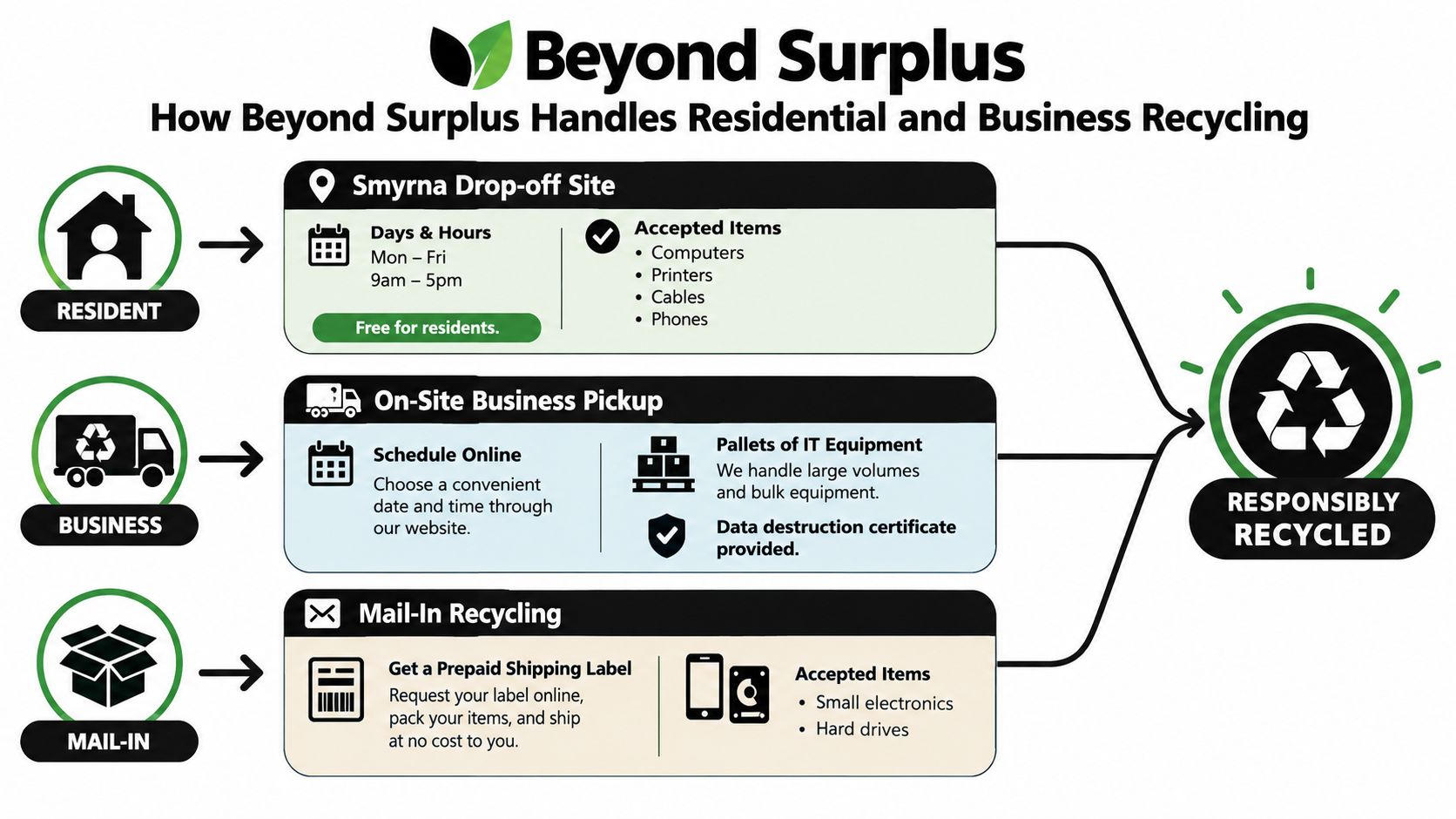
Beyond Surplus supports three service paths, and each one maps to a different operational need. Atlanta-area residents can use the Smyrna drop-off site for accepted electronics, while individuals outside the region can use mail-in recycling for select eligible items. Business and institutional customers can schedule managed pickup across the contiguous United States.
Atlanta-area drop-off
The Smyrna facility provides a local route for residents with accepted computers, printers, cables, phones, and similar electronics. Confirm current hours, accepted items, and any applicable charges before traveling, particularly for TVs, CRT glass, and loose batteries.
Mail-in service
For small quantities outside the Atlanta area, the mail-in option uses a prepaid label process for eligible items. Package the device securely, follow the acceptance rules, and retain the shipment record. Serial numbers are logged on receipt when the service applies, and a certificate is issued according to the program's documentation process.
Managed business pickup
Companies with pallets, recurring refreshes, data-bearing equipment, or specialized assets should request a managed pickup. Beyond Surplus coordinates on-site collection with its fleet or vetted logistics partners, records serialized inventory at the loading dock, uses locked transport, and provides an audit package that can include Certificates of Recycling and Certificates of Data Destruction.
That route fits offices, schools, healthcare providers, financial institutions, manufacturers, government agencies, data centers, and organizations handling medical or laboratory equipment. Review the business and residential electronics recycling services page, then call, request a quote, or schedule a pickup with the asset count, location, device categories, data requirements, and preferred completion date.
Beyond Surplus provides Atlanta-area drop-off, mail-in recycling for select items, and nationwide business pickup with secure data destruction, asset recovery, and documented downstream processing. For a compliant electronics recycling near me solution, prepare your inventory and data requirements, then visit Beyond Surplus to request a quote or schedule service.


