
A technology refresh has just finished. New laptops are in employees' hands, upgraded servers are running in the data center, and pallets of retired equipment are waiting in a storeroom. The devices may look inactive, but they're still financial assets. Every week they remain unprocessed can increase storage work, delay redeployment, complicate data security, and reduce the value available through resale.
That's why how businesses save money with IT asset recovery starts with a different question. Instead of asking, “How do we dispose of this equipment?”, finance and IT leaders should ask, “What value can we preserve, what cost can we avoid, and how quickly can we complete the process?”
Table of Contents
- Introduction Why Idle IT Equipment Quietly Costs You Money
- What IT Asset Recovery Really Means for Businesses
- How Value Recovery Turns Retired Assets Into Savings
- Hidden Cost Avoidance and Risk Reduction That Protects Budget
- Measuring ROI and Timing Your Recovery for Maximum Return
- Choosing the Right ITAD Partner and Streamlining Logistics
- Putting Savings Into Action With a Scalable Recovery Plan
Introduction Why Idle IT Equipment Quietly Costs You Money
A refresh can finish on Monday, yet its financial outcome may remain unsettled. Retired laptops, servers, switches, and storage devices often sit in a closet while teams decide whether to redeploy, resell, repair, or recycle them. During that pause, the equipment produces no value, while staff continue tracking, securing, moving, and reconciling inventory.
Timing functions like a sell-by date. Cascade's analysis of IT asset retirement value reviewed more than 59,000 used computers and reported resale value declining by about 3.5% per month. It also found that managing assets properly during disposition could reduce total cost of ownership by about 14%. The practical lesson is direct: equipment routed quickly to redeployment or a secondary market can retain more value than identical equipment left idle.
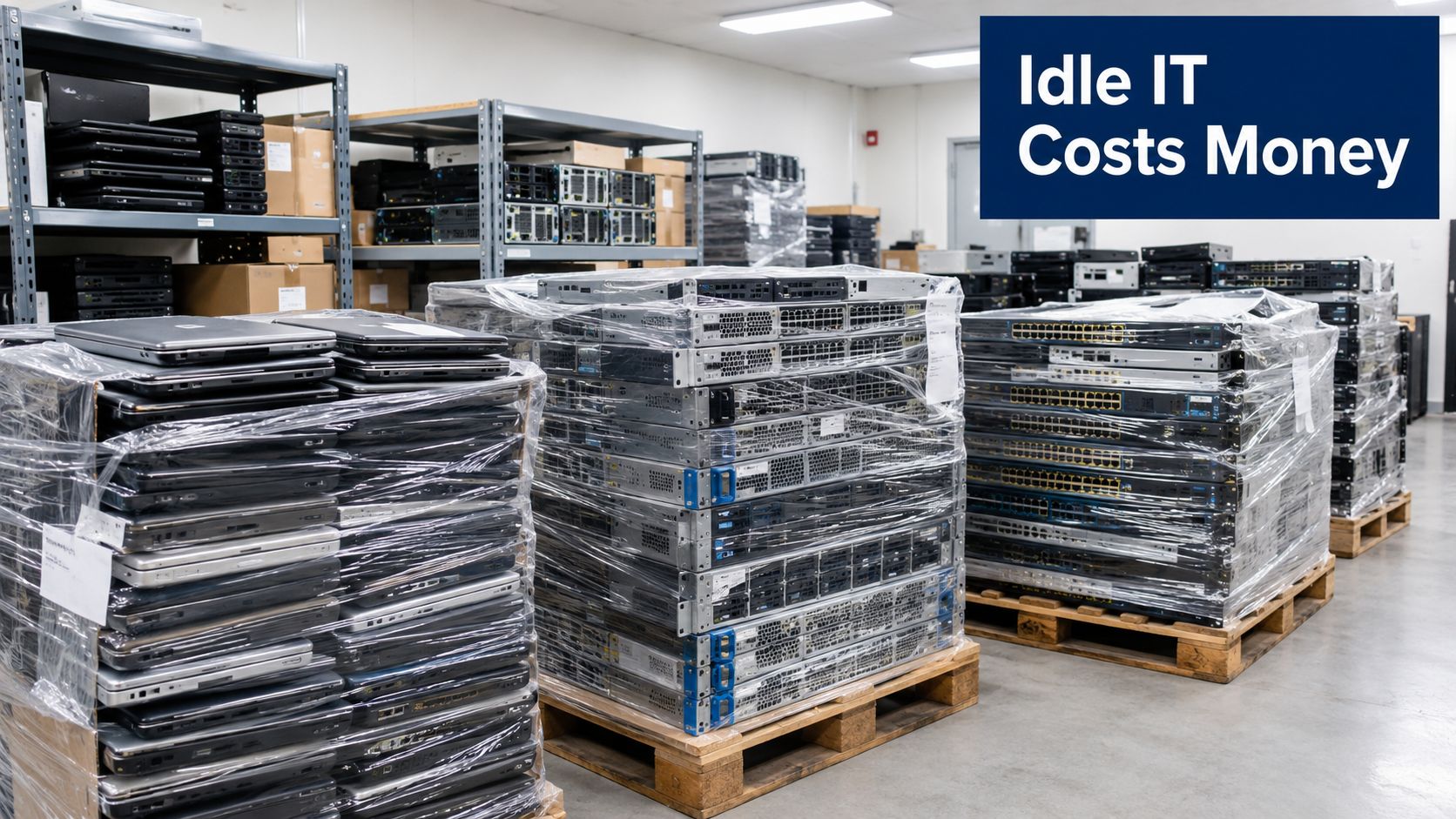
The financial loss extends beyond resale. Stored equipment takes up space, creates chain-of-custody questions, and may leave sensitive data without a completed disposition path. Specialized infrastructure can lose market appeal especially quickly when newer networking, storage, and accelerator equipment has active secondary-market demand. Tiering assets early helps teams send higher-value equipment through faster channels while directing low-value items toward appropriate recycling.
For IT leaders, recovery turns retirement into a controlled financial event. Finance leaders can compare proceeds and avoided costs with collection, sanitization, inspection, repair, logistics, and reporting expenses. Unreturned devices create another form of loss; this analysis of unreturned employee laptops offers relevant context.
Recovery choices therefore determine whether time preserves dollars or erodes them. The process, value recovery, cost avoidance, ROI, partner selection, and a repeatable refresh plan each address a different part of that outcome.
What IT Asset Recovery Really Means for Businesses
A server refresh is scheduled for Friday. By Monday, the retired equipment may already be worth less, while storage costs and data-security work continue. IT asset recovery gives that transition a financial sequence: identify what can retain value, protect the data, choose the right market path, and recycle only what has no practical reuse value.
Recycling focuses on recovering materials from equipment at the end of its useful path. Recovery examines the asset first, including its components, configuration, and potential buyers. A property handoff offers a useful comparison. Before demolishing a building, an owner checks whether another department can use it, whether a buyer wants it, or whether fixtures have salvage value. Technology retirement follows the same logic.
The controlled retirement lifecycle
A structured program usually follows these decisions:
- Inventory and identify. Record equipment, serial numbers, configuration, ownership, and condition.
- Secure the data. Choose a sanitization outcome that fits the storage media and data sensitivity.
- Assess reuse potential. Decide whether each item is suitable for internal redeployment, remarketing, repair, or parts harvesting.
- Match the channel. Send servers, switches, laptops, storage, and components through channels that understand their specifications and demand.
- Recycle residuals. Direct equipment with no practical reuse value to responsible downstream recycling.
- Document final disposition. Keep reporting, certificates, chain-of-custody records, and recovery results.
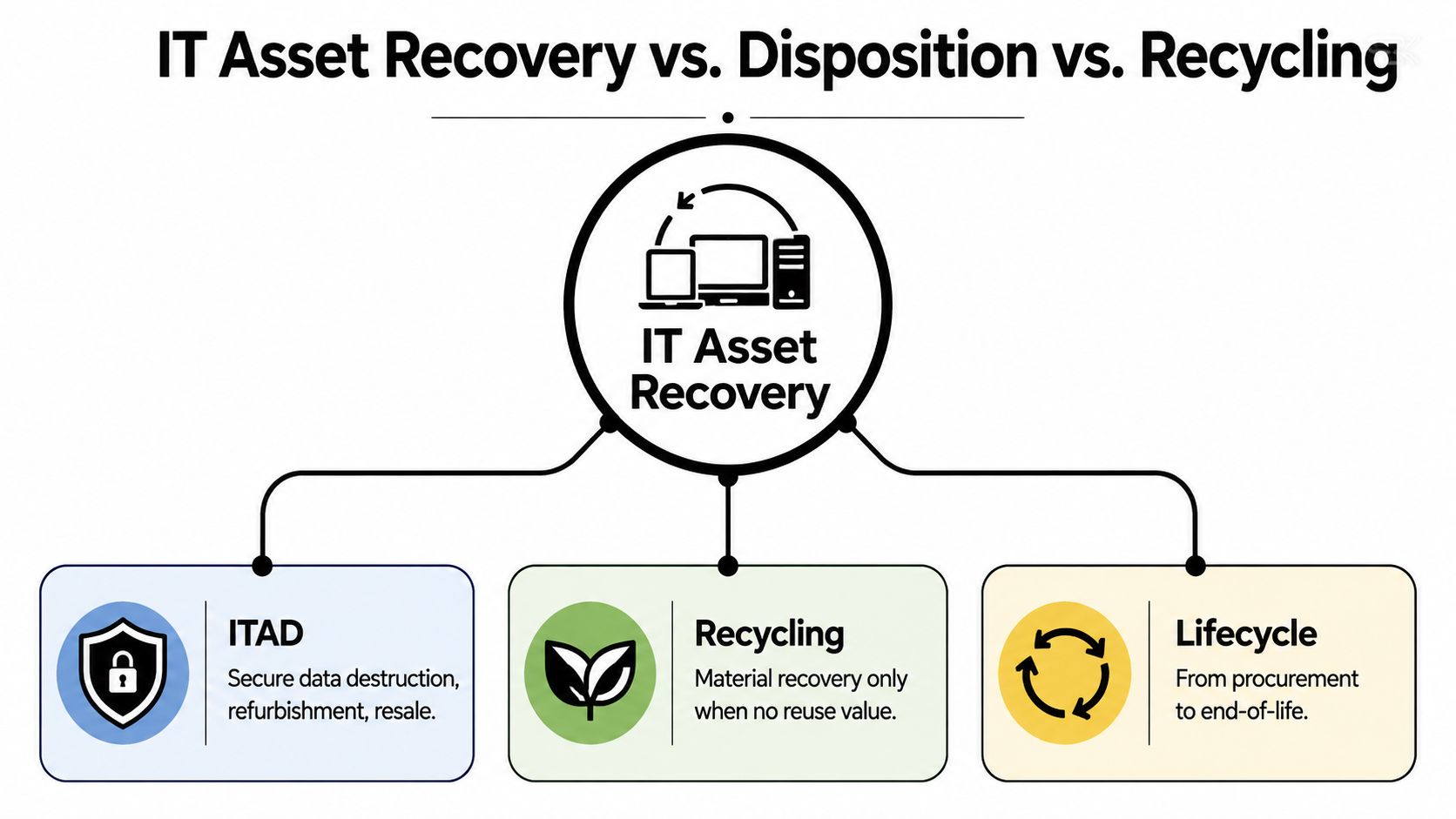
The order matters. Sending every device directly to recycling can erase resale, redeployment, or parts value. Iron Mountain's guidance on IT asset recovery and final disposition similarly separates equipment suitable for resale or redeployment from material that should be recycled after sensitive data is handled.
Why ITAD matters to finance
IT asset disposition, or ITAD, is the controlled retirement process that governs these choices. A guide to what ITAD covers helps define its role across IT operations, procurement, finance, compliance, facilities, and security.
A recycler may process material efficiently. An ITAD program also records which assets arrived, who handled them, how data was sanitized, where each item went, what value was recovered, and what confirms final disposition.
That evidence turns recovery into an accountable financial result. It also challenges the convenient assumption that destroying every device is safest. The appropriate path depends on data risk, condition, market demand, and company policy.
Practical rule: Recycle only after checking whether reuse, resale, parts recovery, or redeployment offers better financial value.
How Value Recovery Turns Retired Assets Into Savings
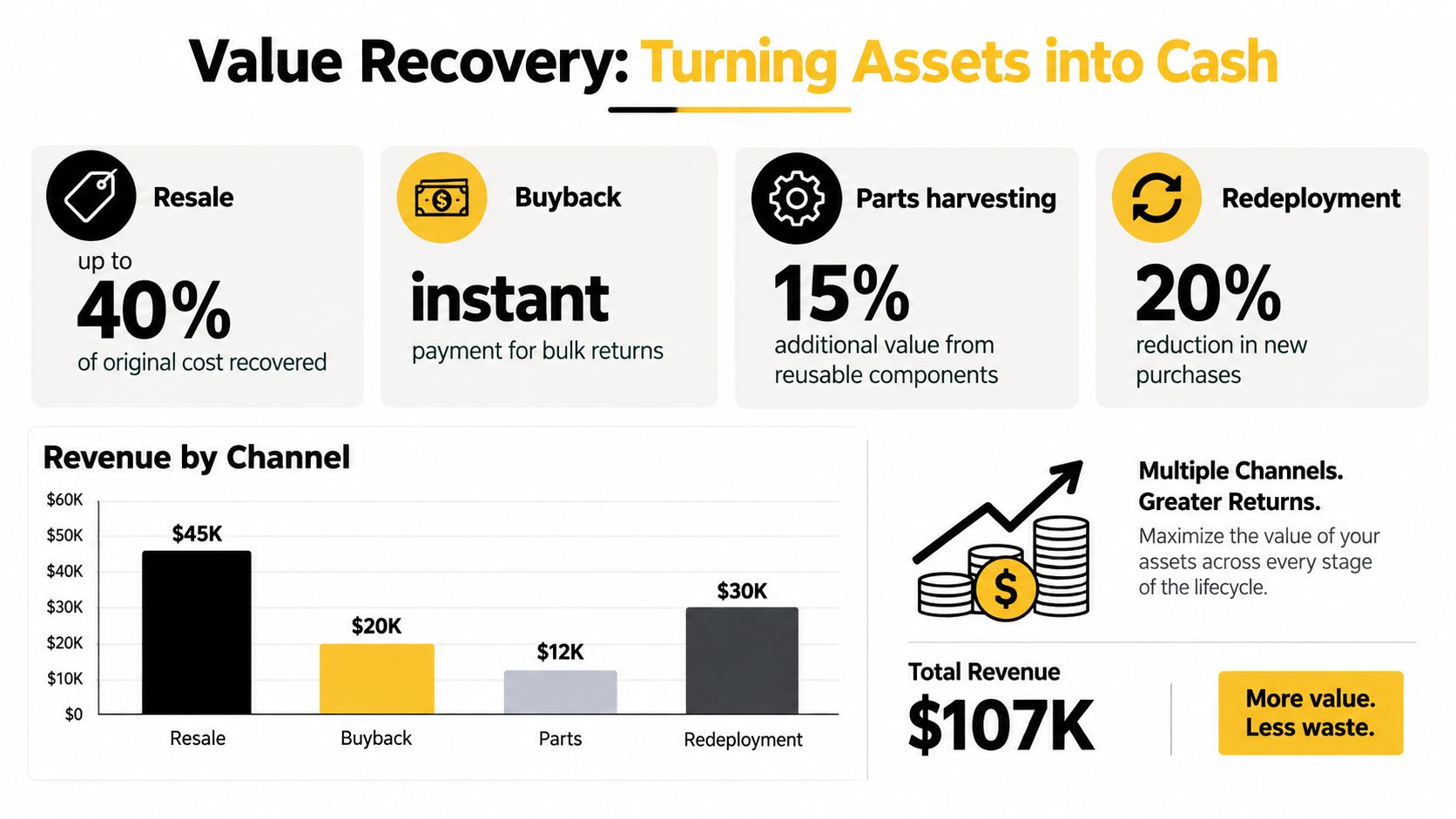
A server removed during a refresh can lose value every week it sits unclassified in storage. The financial result depends on what happens next: redeployment, resale, buyback, parts harvesting, or recycling. Treating recovery as a timed decision helps businesses preserve dollars instead of treating every retired device as a disposal cost.
Resale depends on asset class and timing
Different infrastructure categories retain different levels of secondary-market value. Equipment sent to market while demand remains active has a better chance of producing a return than equipment left in storage until configurations, warranties, or buyer interest decline.
| Asset class | Typical recovery range |
|---|---|
| Rack servers | 20% to 50% of original cost |
| Network switches | 15% to 40% of original cost |
| Storage arrays and SANs | 30% to 60% of original cost |
These ranges come from data center decommissioning and asset recovery guidance. They describe possibilities, not guaranteed proceeds. Condition, configuration, demand, warranty status, completeness, and remarketing channel all affect the outcome.
A server with sought-after processors, memory, or storage may earn more as a complete unit. Another may be worth more through parts harvesting. That choice should be made before the equipment is stripped or recycled. Businesses can also review this guide to recovering value from used business IT assets when setting recovery criteria.
Redeployment reduces replacement demand
Internal redeployment creates value without a conventional sale. A tested laptop could support a temporary worker, training room, backup workstation, or field operation. A network component could serve a lab or become a spare for an existing environment.
This benefit appears as avoided procurement, rather than cash revenue. Finance should record the replacement purchase the business no longer needs, while IT confirms that the equipment meets performance, security, and support requirements.
Channel selection changes the outcome
Generic processing can leave money on the table. High-demand servers, network gear, storage systems, and specialized components need buyers who understand configurations and remaining market life. Faster identification and routing help preserve marketable condition, while the right sanitization method can protect data without unnecessarily limiting resale options.
A recovery program creates savings in two forms: cash from resale and costs the business no longer needs to incur through redeployment or parts reuse.
The broader e-waste stream shows why asset tiering matters. The world generated 62 million metric tons of e-waste in 2022, while only 22.3% was formally collected and recycled. That stream contained 31 billion kilograms of metals, with about 19 billion kilograms viably recovered and approximately USD 28 billion in metals recovered across management routes, as summarized in The Global E-waste Monitor 2024. For an individual company, the practical lesson is clear: classify equipment early, protect data appropriately, and separate recoverable assets from genuine residual waste.
Hidden Cost Avoidance and Risk Reduction That Protects Budget
A server sits in a storeroom awaiting approval. During that delay, the company pays for space, handling, tracking, and eventual shipping, while its resale window narrows. IT asset recovery therefore works as a timed financial lever. The speed of intake, the asset's tier, and the chosen sanitization method influence whether the business recovers value or absorbs avoidable cost.
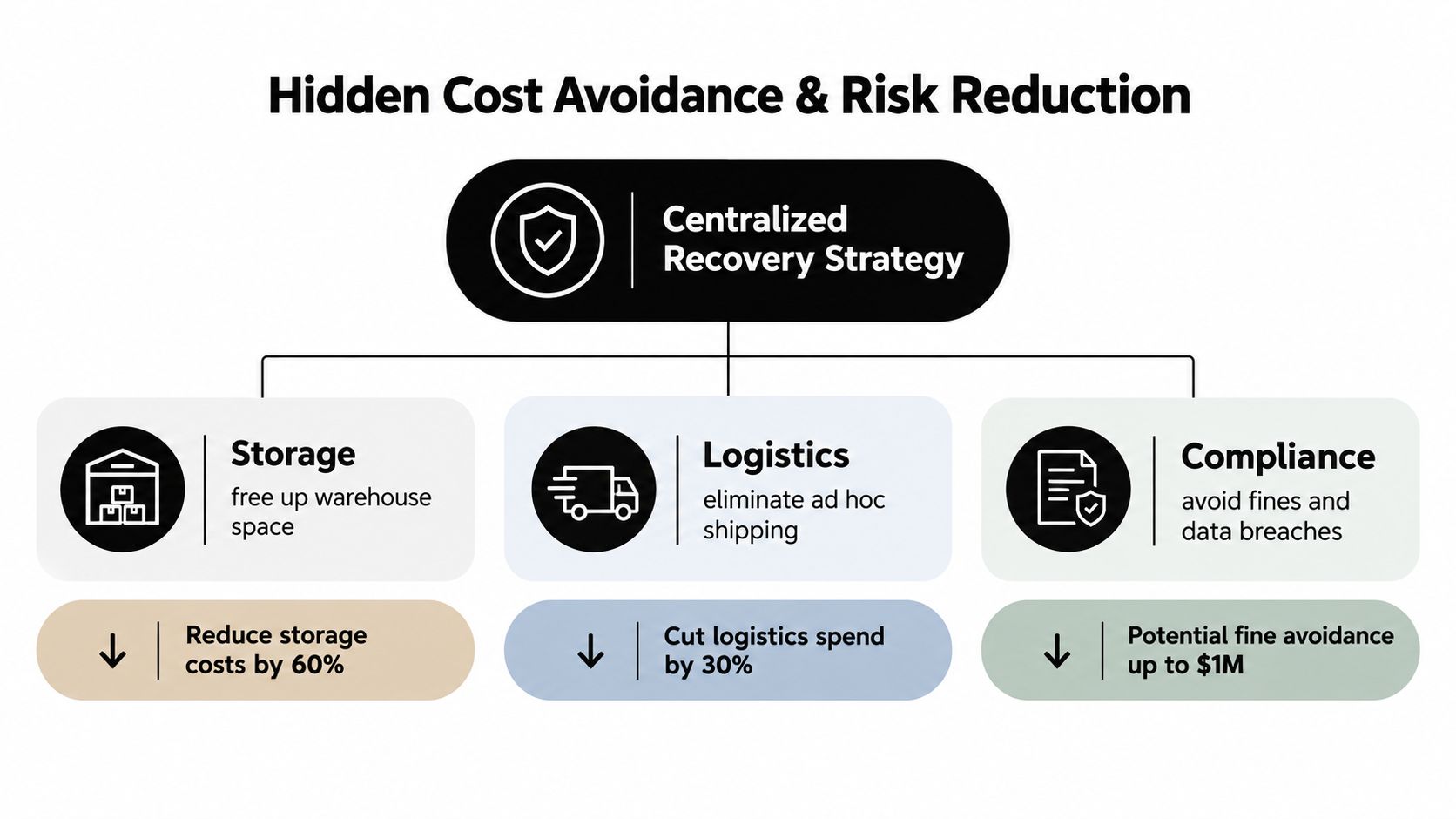
Centralization versus ad hoc handling
An ad hoc process can appear inexpensive. A facilities employee stores equipment, an IT technician collects drives, a shipping clerk sends boxes, and a manager chases missing records. Each task seems small, yet duplicated labor, separate freight arrangements, storage pressure, and inconsistent controls draw from the budget.
A centralized workflow assigns clear ownership for pickup, intake, data sanitization, condition assessment, disposition, and reporting. Teams can consolidate shipments, schedule de-installations, and provide finance with one recovery report instead of scattered emails and spreadsheets. The result is easier cost allocation and fewer handoffs where assets or records can be lost.
Sanitization is a value decision
Sanitization is also a pricing decision. Certified software erasure commonly adds $10 to $30 per drive, while physical destruction or degaussing costs more, according to IT asset recovery cost guidance. Wiping can preserve reuse and return $50 to $300 per drive in secondary-market value. Shredding removes reuse value, but it may suit high-risk media or strict compliance requirements.
NIST SP 800-88 distinguishes outcomes such as Clear, Purge, and Destroy. The appropriate choice depends on the media, the data, and the intended disposition. Destroying every drive can increase processing cost and eliminate resale value. Wiping without validating the result can leave the company exposed. A tiered policy matches protection to risk, rather than applying the most expensive method to every asset.
Documentation protects the business
The FTC Disposal Rule covers businesses and individuals that use consumer reports for a business purpose. It requires reasonable disposal practices that prevent unauthorized access to or use of consumer-report information. The FTC lists shredding, burning, pulverizing, destroying, or erasing paper and electronic media so information cannot be read or reconstructed, and permits a qualified destruction contractor after due diligence. The FTC's disposal guidance explains these requirements.
Certificates of data destruction, recycling certificates, serialized asset reports, and chain-of-custody records do not create resale revenue. They provide evidence that the organization controlled disposition, followed its policy, and can account for each device. That evidence can limit the financial impact of disputes, failed audits, and undocumented data exposure.
Measuring ROI and Timing Your Recovery for Maximum Return
A recovery program needs its own scorecard. Tracking only the amount paid by a buyer misses avoided purchases, handling expenses, storage demands, and the value lost when equipment waits for approval.
Start with a simple calculation:
Net recovery value = resale proceeds + avoided procurement + parts or redeployment value, minus collection, sanitization, repair, logistics, and reporting costs.
Use the same categories for each refresh cycle so finance can compare outcomes over time. IT should also track the interval between decommissioning and final disposition, because timing affects the available market.
Compare assets by financial sensitivity
| Asset Class | Typical Recovery Range | Time Sensitivity |
|---|---|---|
| Rack servers | 20% to 50% of original cost | Move quickly because age and demand affect resale |
| Network switches | 15% to 40% of original cost | Prompt routing helps preserve marketability |
| Storage arrays and SANs | 30% to 60% of original cost | Configuration and demand can shift over time |
| Current-generation networking gear | 50% to 70% of new purchase price when retired within 12 months of OEM end-of-sale | Highly time-sensitive |
| GPUs | 60% to 70% within 18 months | Specialist handling matters |
| Generic versus specialist channels | Specialist channels may yield 3 to 5 times the value of generic channels | Channel selection is critical |
The infrastructure figures come from recent data center asset recovery analysis. That analysis also describes a market where AI and cloud environments create short recovery windows for certain assets. Treat those figures as category-specific guidance, not a promise for every device.
Build an evidence-based review
A monthly or quarterly review should ask:
- Which asset classes produced the strongest net value?
- How long did each category remain idle?
- Which items required repair or parts harvesting?
- Which sanitization path preserved the most reuse?
- Did the chosen channel reach the right buyers?
- How much internal procurement did redeployment replace?
Storage planning deserves attention too. Businesses that are holding retired equipment while awaiting decisions may benefit from reviewing a guide to self-storage market trends, particularly when facilities teams are evaluating space pressure and inventory turnover.
Condition data supports better decisions. A documented equipment condition assessment process can separate resale-ready hardware from repair candidates and recycling residuals before items are mixed together.
Choosing the Right ITAD Partner and Streamlining Logistics
A data center decommissioning can lose value while equipment waits for pickup, testing, or a buyer. The right ITAD partner treats recovery as a timed financial process, not just a transport job followed by a recycling receipt. Procurement and finance teams should assess the full operating model before comparing per-device prices.
Ask what happens from pickup to final report
A capable provider should explain:
- Chain of custody: How are assets identified, counted, secured, and transferred?
- Data sanitization: Which media receive Clear, Purge, or Destroy treatment?
- Condition assessment: Who decides whether equipment is resold, repaired, redeployed, harvested, or recycled?
- Remarketing reach: Can the provider connect servers, switches, storage, and specialized components with suitable buyers?
- Reporting: Will the business receive serialized records, certificates, and recovery results?
- Logistics coverage: Can the provider coordinate office pickups, data center de-installations, freight, and site-specific requirements?
Centralized retrieval, certified wiping, inspection, and minor repair may cost roughly $100 to $300 per device, according to independent IT asset recovery guidance. Evaluate that expense against preserved resale value and removed internal labor, rather than against an unstructured disposal quote. Speed matters most for equipment with active demand. Lower-tier assets may justify simpler processing, while higher-value hardware may warrant faster testing and targeted remarketing.
Match service depth to asset risk
On-site wiping or destruction can suit facilities where equipment must be secured before departure. Off-site processing can work better when a provider has secure intake, testing, repair, and remarketing capacity. The lower-cost option depends on site access, equipment volume, data sensitivity, and required turnaround.
Beyond Surplus provides secure data wiping, hard drive shredding, IT equipment disposal, buyback, product destruction, data center de-installations, and logistics coordination, with certificates supporting recycling and data destruction. Organizations comparing providers can use this ITAD hiring question guide to structure vendor discussions.
The lowest quote isn't necessarily the lowest cost. Compare total recovery results, documentation, internal labor reduction, data controls, and the time required to return assets to the market.
Putting Savings Into Action With a Scalable Recovery Plan
When a refresh is approved, an unopened server or stored laptop begins losing value while it waits for a decision. A scalable recovery plan treats that timing as a financial lever, connecting procurement, IT security, facilities, finance, and the ITAD provider before equipment reaches storage.
Use this sequence:
- Create an accurate inventory. Record location, serial number, configuration, owner, and condition.
- Set sanitization tiers. Define when certified wiping meets requirements and when physical destruction is required.
- Prioritize time-sensitive assets. Route high-demand networking, storage, server, and accelerator equipment quickly, before market demand changes.
- Separate value paths. Decide independently among resale, redeployment, parts harvesting, and recycling.
- Measure net results. Report proceeds, avoided purchases, handling and sanitization costs, and final disposition evidence.
- Review each cycle. Adjust collection timing, packaging, channel selection, and refresh planning based on results.
The financial effect builds across each cycle. Value recovery produces proceeds or avoids new purchases. Centralized handling reduces coordination work. Tiered sanitization protects data without sending every asset to destruction. Reporting gives finance and compliance teams evidence of outcomes.
Organizations that manage retired technology as inventory make decommissioning more predictable and partly self-funding. Earlier decisions preserve more resale opportunity, while clear routing keeps lower-value equipment from consuming disproportionate labor.
Beyond Surplus coordinates secure IT asset recovery, electronics recycling, data destruction, buyback, and data center de-installation services. Visit Beyond Surplus to discuss a plan for sensitive-data controls, final-disposition records, and value preservation.


