

A laptop refresh rarely ends when the replacement devices arrive. The old equipment may be spread across offices, data centers, employee homes, storage rooms, and contractor locations. Each device still carries data, ownership history, transport risk, and possible resale value. Treating that inventory like a dumpster run creates avoidable gaps. Enterprise IT asset recovery is the controlled system that brings those assets back, protects information, determines their next use, and preserves evidence of what happened.
Introduction to Enterprise IT Asset Recovery Today
An IT director may start with a straightforward request: remove retired laptops, servers, networking equipment, or medical devices before the next deployment begins. The operational reality is more demanding. Someone must confirm what exists, identify who has it, arrange return logistics, choose an appropriate sanitization method, and document every handoff before the equipment reaches resale, redeployment, parts harvesting, or recycling.
That's why recovery belongs in the broader IT lifecycle management process, not in a last-minute disposal ticket. The process connects security, procurement, finance, facilities, compliance, and sustainability. A recovered laptop might support redeployment, while a failed storage device may require destruction. The organization needs a defensible record for both decisions.
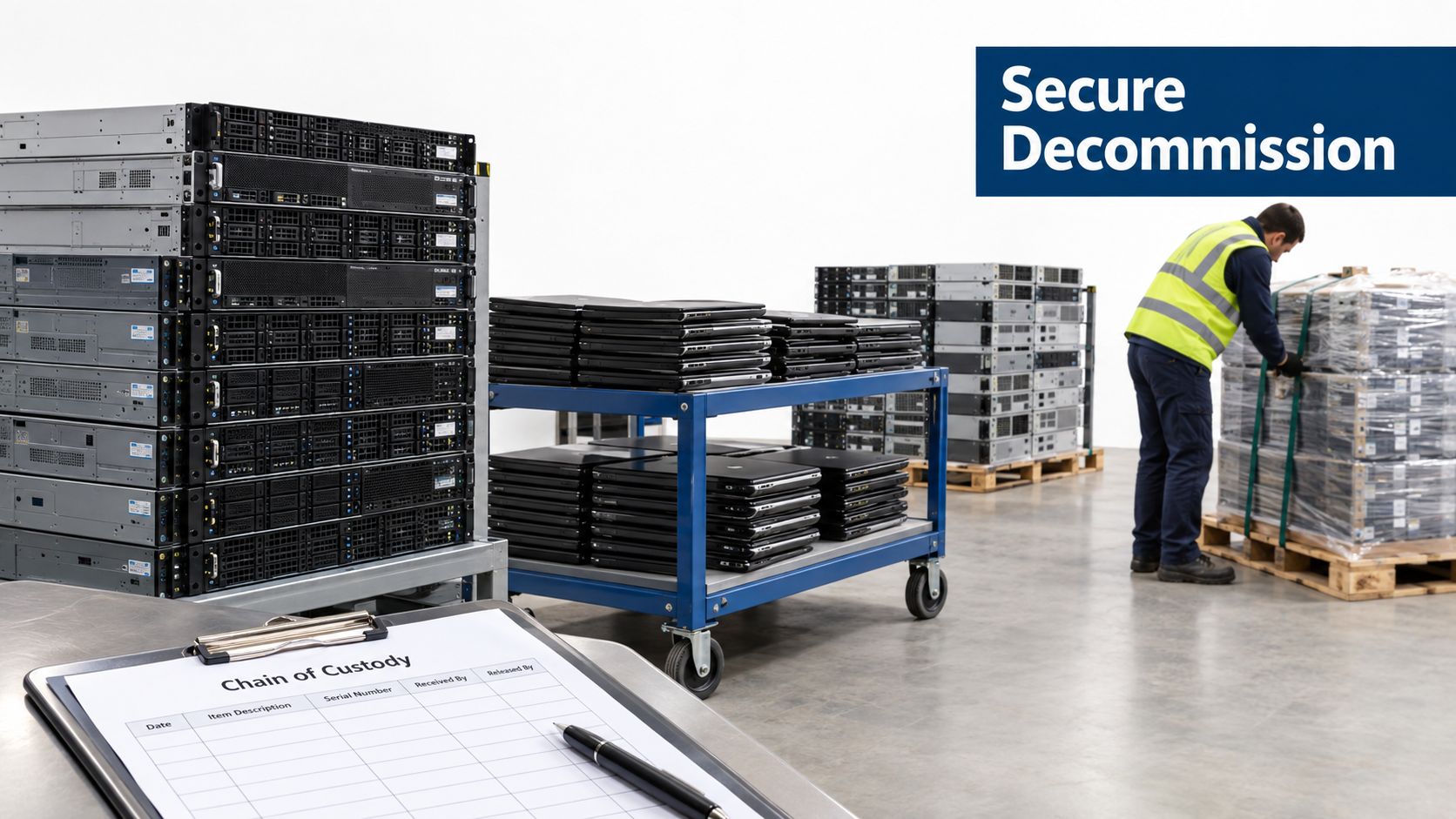
The situation IT leaders inherit
A refresh project often exposes weaknesses that routine operations hide. Asset records may not match physical equipment. A departing employee may still hold a laptop. A server may contain drives that were removed from the original configuration. A recycling receipt may confirm weight, but not which serial-numbered devices were sanitized.
This guide treats recovery as a chain-of-custody and value-decision system. It explains the terminology, the end-to-end workflow, the choice between resale and recycling, vendor evaluation, and the measurements that tell leadership whether the program is working.
Practical rule: An asset isn't recovered merely because a carrier picked it up. It's recovered when the organization can account for it, protect its data, and document its final disposition.
Table of Contents
- The situation IT leaders inherit
- What Enterprise IT Asset Recovery Really Means
- Why Businesses Invest in Recovery Now
- How the End to End Recovery Process Works
- Choosing Between Resale Redeployment and Recycling
- How to Select a Vendor and Avoid Costly Pitfalls
- Measuring Success and Planning Your Next Steps
What Enterprise IT Asset Recovery Really Means
Enterprise IT asset recovery is the managed return and disposition of business technology after it leaves active use. It includes retrieval, identification, custody tracking, data sanitization, grading, repair, redeployment, resale, parts recovery, and recycling. E-waste recycling is one possible endpoint, not the definition of the entire program.
A useful analogy is a library. The library knows which member checked out a book, when it should come back, and whether the book can return to circulation or needs repair. If the book disappears, the library has a custody problem. Businesses face the same problem with laptops, servers, phones, storage media, switches, routers, laboratory equipment, and other data-bearing or value-bearing assets.
The recovery lifecycle
A practical recovery model follows this sequence:
- Establish custody: Record the asset, assigned user or site, condition, and responsible business owner.
- Arrange return: Give employees, contractors, facilities teams, or project leads clear instructions and shipping or pickup options.
- Receive and reconcile: Compare the physical shipment with the manifest and resolve missing or unexpected items.
- Assess the next path: Determine whether the equipment should be repaired, refurbished, redeployed, remarketed, harvested for parts, or recycled.
- Complete security controls: Apply the sanitization outcome appropriate to the media and its data sensitivity.
- Document disposition: Retain device-level records, certificates, and financial or environmental reporting.
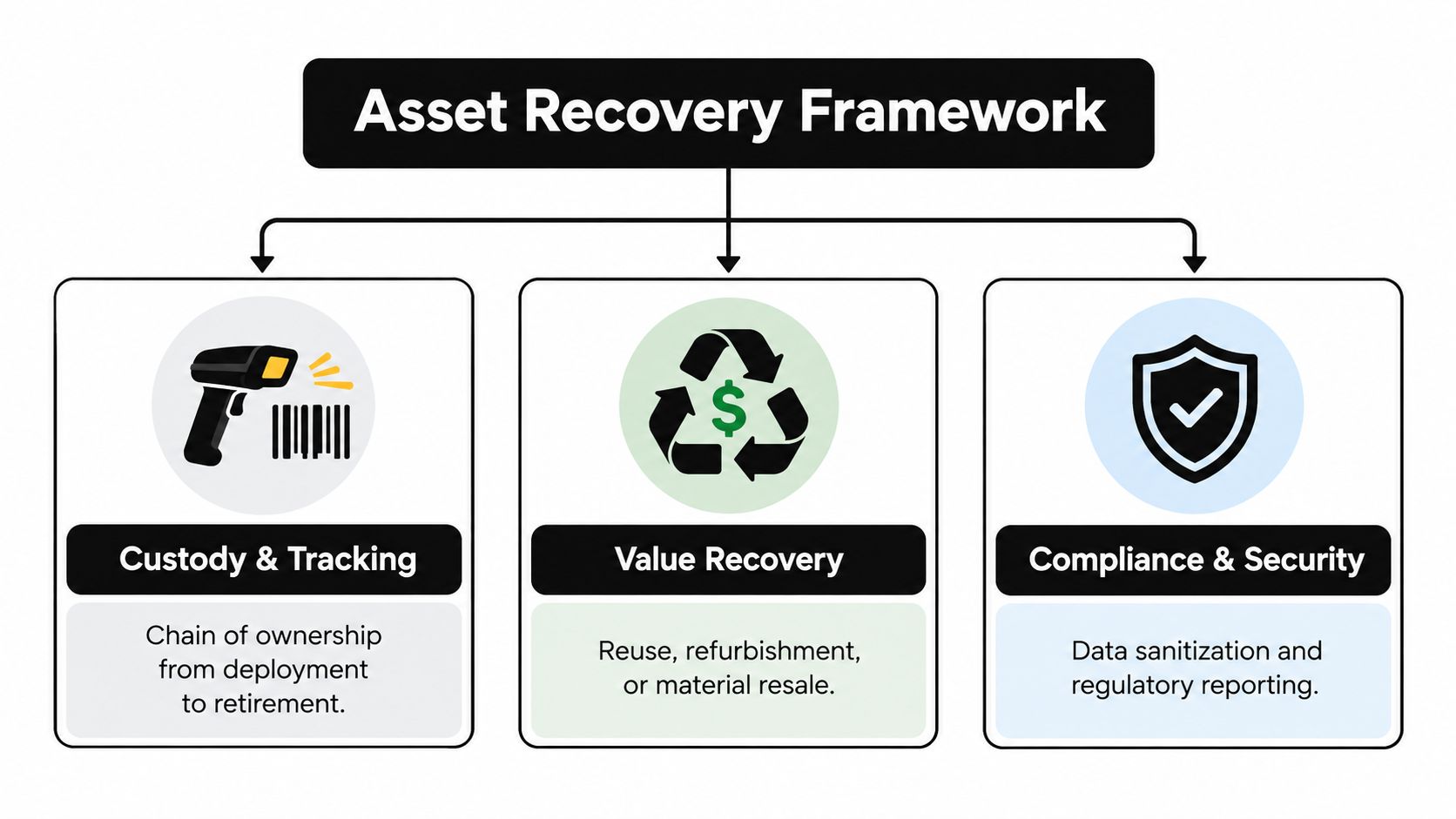
The term ITAD, or IT asset disposition, usually describes the controlled end-of-use services around technology. Recovery is the operational bridge that brings equipment into that disposition process. Lifecycle management is the wider discipline, covering planning, procurement, deployment, support, refresh, retirement, and post-use decisions.
The distinction matters to different stakeholders. Security needs evidence that data-bearing media was handled correctly. Finance needs a credible valuation and a transparent settlement. Operations needs predictable removal and storage. Compliance needs records that connect the asset to its final outcome. A mature program gives each group the same underlying facts rather than separate spreadsheets.
For a practical view of controlled custody, data destruction, and value recovery, review secure asset recovery for enterprise IT.
Why Businesses Invest in Recovery Now
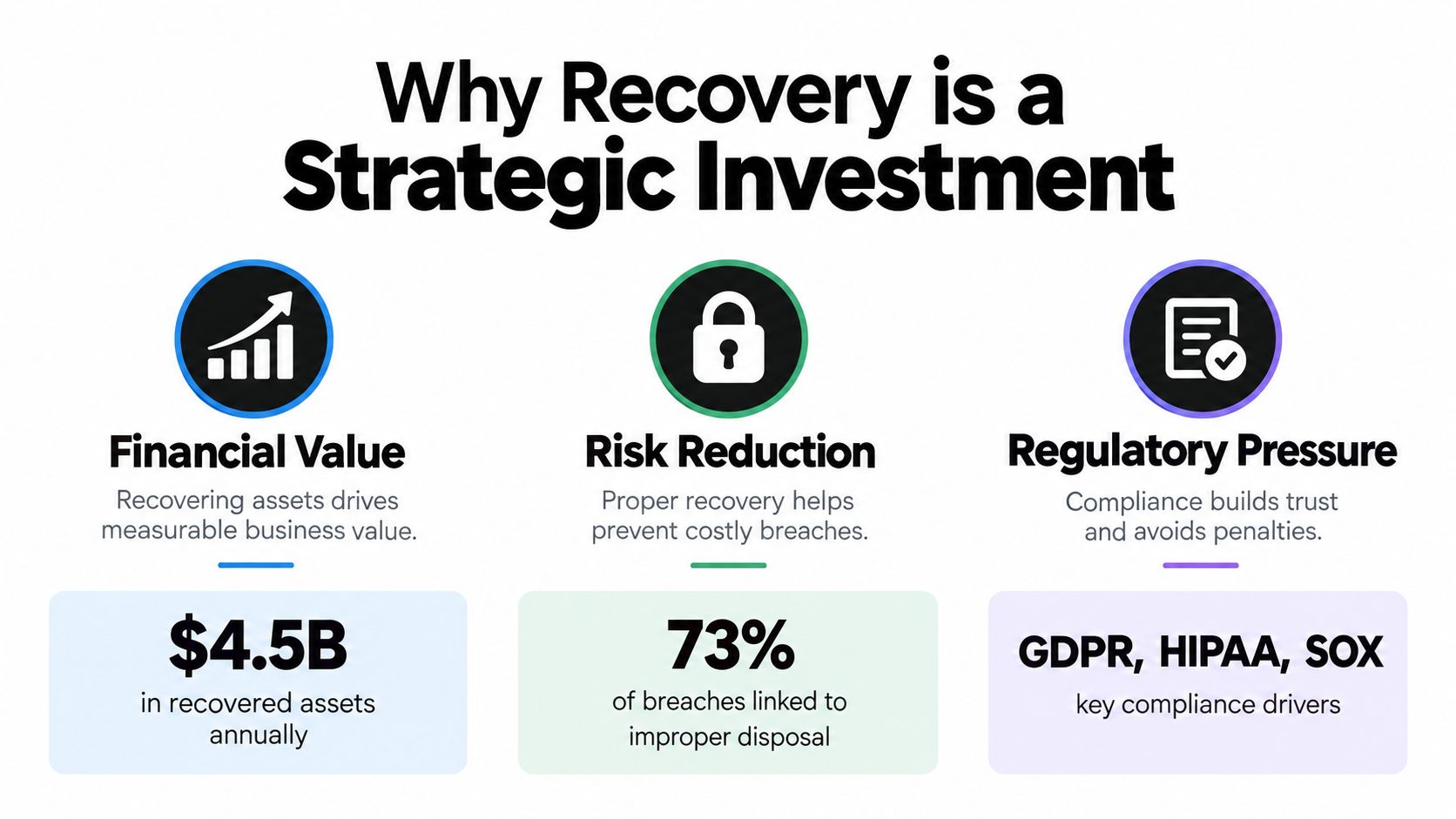
The business case rests on three connected outcomes: recovering value, reducing exposure, and meeting disposal obligations. An organization that focuses only on recycling may miss resale proceeds. An organization that focuses only on resale may overlook data risk. A program earns leadership support when it manages both sides without sacrificing evidence.
The environmental scale makes the issue difficult to treat as a minor facilities task. The world generated 62 billion kg of electronic waste in 2022, equal to 7.8 kg per person, while only 22.3% was formally collected and recycled in an environmentally sound manner, according to the Global E-waste Monitor 2024. The same report projects annual generation will reach 82 billion kg by 2030, so enterprise recovery systems must scale alongside equipment replacement and data center refreshes.
Financial value and operational control
Retired technology isn't automatically worthless. A working laptop may be suitable for redeployment or remarketing. A server may have usable components. Networking hardware may have demand in a secondary market. Conversely, a damaged device can consume more handling, testing, storage, and transport effort than its expected proceeds justify.
The economic opportunity is substantial at global scale. The monitor estimates that about USD 62 billion in recoverable natural resources went unaccounted for in 2022, a figure that helps explain why organizations connect recovery with value recapture rather than viewing it only as environmental housekeeping. A separate ITAD market estimate places the formal market at USD 17.5 billion in 2024 and projects USD 29.54 billion by 2030, with a 9.2% CAGR. Those figures describe market context, not a guaranteed return for an individual company.
Risk and compliance
Data-bearing devices remain a security concern until the organization applies and verifies the correct sanitization outcome. The FTC Disposal Rule guidance says businesses that maintain or possess consumer information for a business purpose must take reasonable measures to protect it from unauthorized access or use during disposal. Examples include destroying or erasing electronic files or media so the information can't be read or reconstructed, and businesses may use a qualified destruction contractor as part of their due diligence.
This turns recovery documentation into a compliance artifact. A certificate alone doesn't replace sound process, but a missing record makes the process difficult to defend. Leadership should fund recovery as a combined security, financial, operational, and compliance control.
How the End to End Recovery Process Works
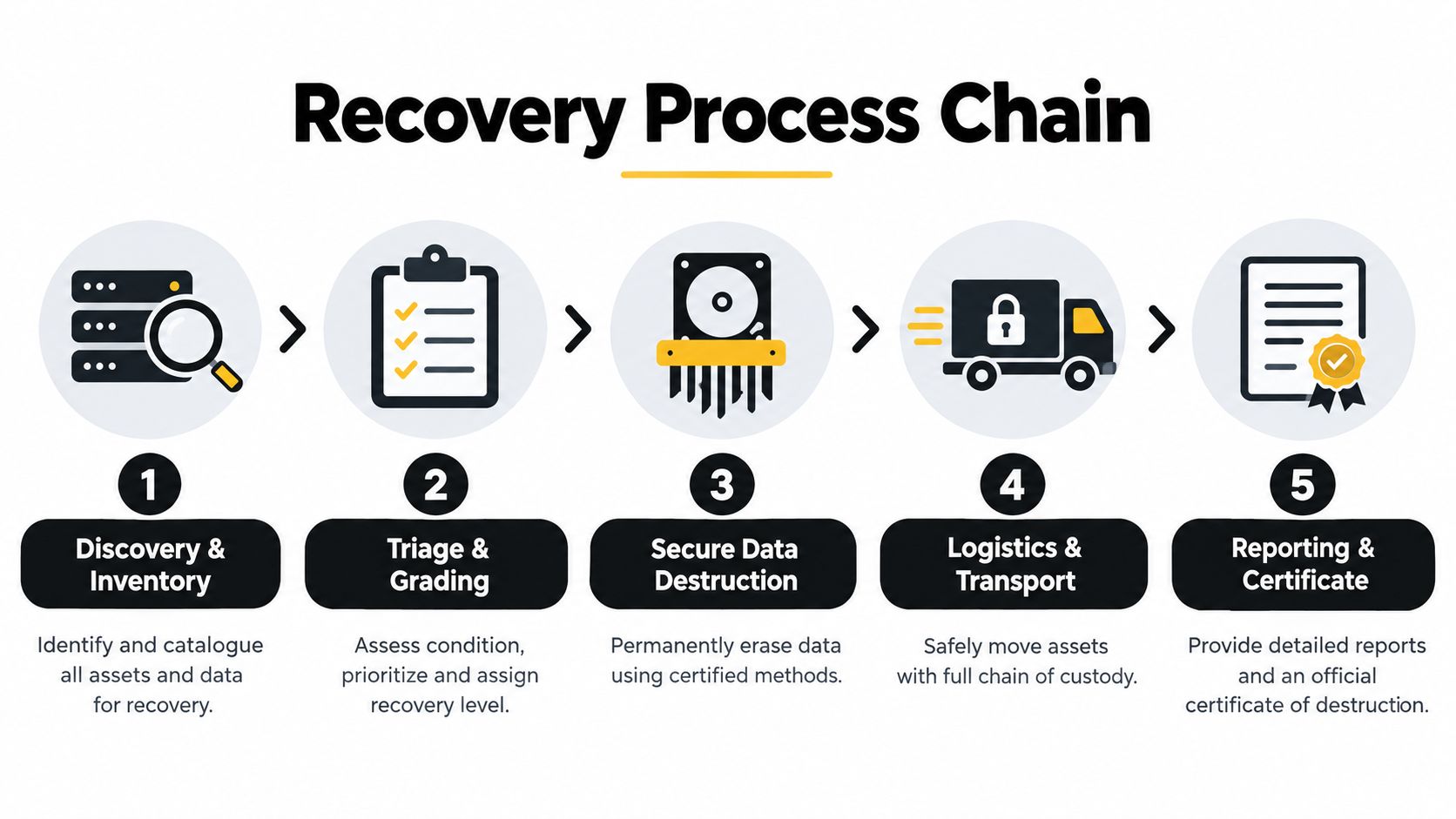
A reliable program behaves like a linked chain. If inventory is incomplete, custody records become unreliable. If triage happens before data security decisions are clear, valuable equipment may be mishandled. If sanitization evidence is missing, resale or recycling can create an audit problem.
Start with discovery and inventory
Record serial numbers, asset tags, model details, assigned users, locations, media types, and known condition. Compare the inventory with procurement, endpoint management, CMDB, warehouse, and employee-offboarding records. Don't assume a static asset register reflects reality. Physical reconciliation is what identifies missing, duplicated, or unrecorded equipment.
For dispersed teams, the return workflow should identify the user, issue instructions, arrange shipping or pickup, monitor progress, and record receipt. Exception handling belongs in the design from the start. A device that isn't returned shouldn't disappear into a status field marked “pending.”
Triage before disposition
At intake, separate equipment by condition, data sensitivity, media type, completeness, and likely market demand. A functional laptop with a healthy configuration may follow a different path from a damaged drive or a server with uncertain history. Grading should produce a documented recommendation, not an informal warehouse opinion.
NIST SP 800-88 Rev. 2 defines media sanitization as a process that makes access to target data infeasible for a given level of effort. It distinguishes Clear, Purge, and Destroy, allowing the organization to match the method to reuse, resale, recycling, or destruction. In practical terms, reusable drives may receive logical wiping, while damaged, obsolete, or highly sensitive media may require Purge or physical Destroy. Stronger assurance can reduce the opportunity for redeployment or resale, so security and value decisions must be made together.
Sanitize before release
NIST guidance ties sanitization to disposal, release from organizational control, and release for reuse. That means the control point should occur before the asset leaves controlled custody. Per-asset records should connect the serial number or media identifier to the method, date, operator or system, result, and certificate or equivalent evidence.
NIST also describes verification as an essential confidentiality step. Where practical, verify every sanitization event. When full verification isn't feasible, representative sampling should use pseudorandom locations across the media's addressable space, with each sampled subsection covered by at least two non-overlapping locations and verification covering at least 10% of the media. Secondary validation should use a separate tool from a different developer on a random subset, as detailed in NIST SP 800-88 sanitization guidance.
Control logistics and close the record
Use a manifest at pickup, sealed containers or other appropriate controls, tracked transport, and receiving reconciliation. The final report should show what happened to every item, including exceptions. Certificates of data destruction and recycling support compliance and help demonstrate that the organization transferred or closed its responsibility through a documented process.
Choosing Between Resale Redeployment and Recycling
The right question isn't “Can we sell this?” It's “Which path produces a defensible business outcome after testing, sanitization, handling, storage, transport, and administrative effort?” Recovery should test higher-value options first, but recycling remains appropriate when repair, refurbishment, redeployment, remarketing, or parts harvesting no longer makes economic or operational sense.
A practical decision sequence
Start with redeployment when the equipment meets internal technical, security, warranty, and support requirements. Redeployment can avoid a new purchase, but only if the device fits the user's needs and the organization can support it.
Choose repair or refurbishment when a predictable intervention can restore function without consuming disproportionate labor or parts. Use remarketing when the model has identifiable demand, the grade is clear, and expected proceeds justify the downstream work. Consider parts harvesting when complete resale is unlikely but components retain practical value.
Recycling becomes the responsible endpoint when equipment is nonfunctional, obsolete, unsafe, uneconomical to repair, or unlikely to sell. The organization should still require controlled processing and evidence. Illinois' electronics program collected approximately 9.7 million pounds of covered devices from collection sites and events in 2024, providing a concrete example of the scale regulated electronics collection can handle, as reported in the Illinois 2024 electronics recycling summary.
Value Recovery Path Decision Matrix
| Disposition Path | Best For | Value Potential | Sanitization Needed |
|---|---|---|---|
| Redeployment | Supported equipment that meets internal requirements | Avoided replacement cost | Clear or stronger outcome based on risk |
| Repair or refurbishment | Recoverable devices with practical service needs | Increased usability and resale potential | Appropriate verified sanitization |
| Remarketing | Functional, identifiable equipment with market demand | Secondary-market proceeds | Verified sanitization before release |
| Parts harvesting | Equipment with useful components but weak complete-unit demand | Component value | Sanitization for every data-bearing medium |
| Recycling | Failed, obsolete, unsafe, or uneconomical equipment | Material recovery | Clear, Purge, or Destroy as required |
A sound valuation model includes testing, grading, parts, labor, storage, transport, channel fees, and exception management. The refurbish or recycle decision guide can help teams frame that choice without assuming every retired asset deserves the same treatment.
How to Select a Vendor and Avoid Costly Pitfalls
Vendor selection should test the complete operating model, not just the advertised recycling rate or buyback estimate. Ask bidders to show how they handle an asset from the first return request through final reporting. A polished proposal is less useful than a process that survives missing equipment, damaged media, remote workers, and incomplete manifests.
What an RFP should require
Request evidence for the following capabilities:
- Serial-level tracking: Confirm that intake, sanitization, movement, disposition, and reporting connect to the individual asset.
- Chain-of-custody controls: Ask who signs for equipment, how shipments are sealed or tracked, and how exceptions are escalated.
- Sanitization decisions: Require a clear method-selection process for different media types, conditions, and sensitivity levels.
- Verification records: Ask whether the vendor verifies every device where practical, uses representative sampling when necessary, and performs independent secondary validation.
- Disposition transparency: Require grading logic, valuation methodology, resale channels, recycling pathways, and treatment of non-market equipment.
- Retrieval operations: Confirm how the vendor contacts dispersed employees and contractors, monitors returns, and handles nonresponsive or incomplete returns.
- Compliance evidence: Specify certificates or equivalent records for data destruction and recycling, along with retention and delivery expectations.
The retrieval gap deserves special attention. An enterprise can have excellent downstream destruction and recycling while still failing to recover devices from remote users. Return instructions, shipping labels, scheduled pickups, reminders, escalation ownership, and receipt confirmation should be part of the service design.
The FTC permits businesses to conduct due diligence and hire document destruction contractors, but the business still needs reasonable measures and oversight. Use the questions to ask before hiring an ITAD company to compare vendors on control quality rather than sales language.
Vendor test: Ask the bidder to demonstrate how one serial-numbered laptop moves through intake, sanitization verification, disposition, and final reporting. If the answer relies on disconnected systems, the audit trail may be weaker than the proposal suggests.
Measuring Success and Planning Your Next Steps
A recovery program should produce evidence that security, finance, operations, and sustainability teams can use. Track return completion, inventory reconciliation, time to disposition, value recaptured, evidence completeness, exception closure, and disposition by pathway. These measures show whether the program controls risk and makes sensible value decisions, rather than merely moving equipment out of a building.
Start with a focused internal review:
- Reconcile a current retired-asset population against physical locations and assigned users.
- Identify which media types require Clear, Purge, or Destroy.
- Define the records security and procurement need before approving a vendor.
- Set escalation rules for missing devices and incomplete returns.
- Review whether resale candidates are economical after testing and logistics.
Use best practices for enterprise asset retirement to turn those checks into a repeatable operating standard. Data center teams can begin with a rack-by-rack decommission plan, while regulated organizations should involve security, privacy, legal, and procurement before equipment moves.
Beyond Surplus provides business ITAD services that connect secure data destruction, logistics, value recovery, electronics recycling, and certificates of recycling and data destruction. Visit Beyond Surplus to discuss a controlled recovery plan for laptops, servers, networking equipment, data center assets, and other commercial technology.


