

The shutdown window is approved, the racks are scheduled for removal, and the facilities team is waiting for a clean handoff. Then someone finds an unlisted storage shelf, a forgotten switch, or a leased server whose return requirements were never documented. That's how a routine data center retirement becomes a security, compliance, and value-recovery problem.
The best practices for retiring data center hardware start well before the first cable is disconnected. A disciplined program combines asset discovery, data classification, certified sanitization, serialized chain of custody, responsible disposition, and post-project auditing. It also treats retirement timing as part of capital planning, especially as AI infrastructure changes refresh economics.
Table of Contents
- Why Retiring Data Center Hardware Needs a Playbook Now
- Inventory and Risk Assessment Before You Touch Anything
- How to Choose the Right Data Destruction Method
- Chain of Custody Documentation and Compliance Controls
- Logistics Value Recovery and Vendor Selection in Practice
- Post Retirement Auditing Reporting and Continuous Improvement
Why Retiring Data Center Hardware Needs a Playbook Now
A data center decommissioning project rarely fails because a technician can't remove a server from a rack. It fails because the organization starts with physical removal instead of lifecycle control. An asset register may omit a storage array in a remote cabinet, a network device held for standby use, or drives embedded in equipment that nobody classified as data-bearing. Once those assets leave the floor without a documented disposition path, security and audit teams have fewer facts to work with.
The hardware market has also moved faster than traditional refresh planning. One industry report says typical enterprise server refreshes have shifted from 5 to 7 years to 4 to 5 years, while GPU servers used for AI workloads have compressed to 18 to 36 months, a 60% to 70% reduction in useful deployment time. The report estimates the global data center decommissioning market at $12.95 billion in 2026, up from $9.5 billion in 2021, a 36% increase in four years. These figures are detailed in the report on AI-driven hardware lifecycles.
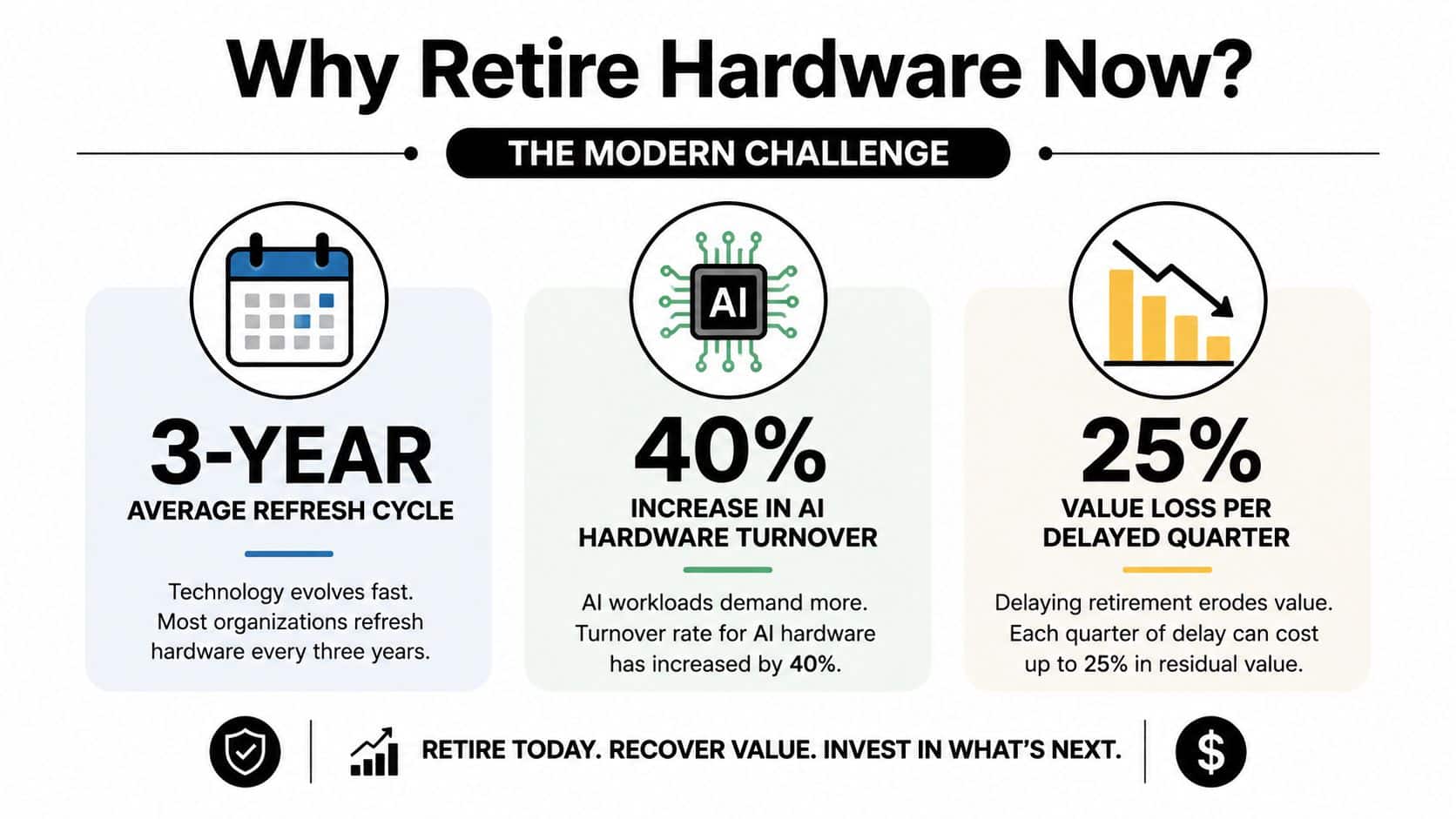
Retirement is now a capital planning decision
Waiting for formal end of life can erode resale value while newer product generations enter the market. That doesn't mean every older server should be rushed out of service. It means procurement, finance, infrastructure, and ITAD teams should decide earlier whether equipment will be redeployed, sold, refurbished, harvested for parts, or recycled.
AI procurement makes that decision more urgent. Accelerated infrastructure can become commercially outdated before it becomes physically unreliable. Reporting cited in coverage of AI-related electronic waste projects that AI-driven equipment retirement could generate up to 13 million metric tonnes of e-waste per year by 2030. The projection reinforces a practical point: retirement capacity belongs in the infrastructure roadmap, not in a last-minute cleanup ticket.
Operational rule: Treat the retirement date as a managed lifecycle milestone. Don't wait until a lease deadline or replacement delivery forces a rushed disposition decision.
A mature program works at scale because it gives every asset an owner, every storage device a sanitization method, every handoff a record, and every final disposition a certificate. Organizations planning a regional project can also review data center decommissioning trends in Atlanta for a local planning perspective.
Inventory and Risk Assessment Before You Touch Anything
The first physical action in a data center retirement should be documentation, not disassembly. Build a complete inventory while equipment is still installed, powered, labeled, and connected. Once technicians begin pulling cables and moving chassis, relationships between assets become harder to reconstruct.
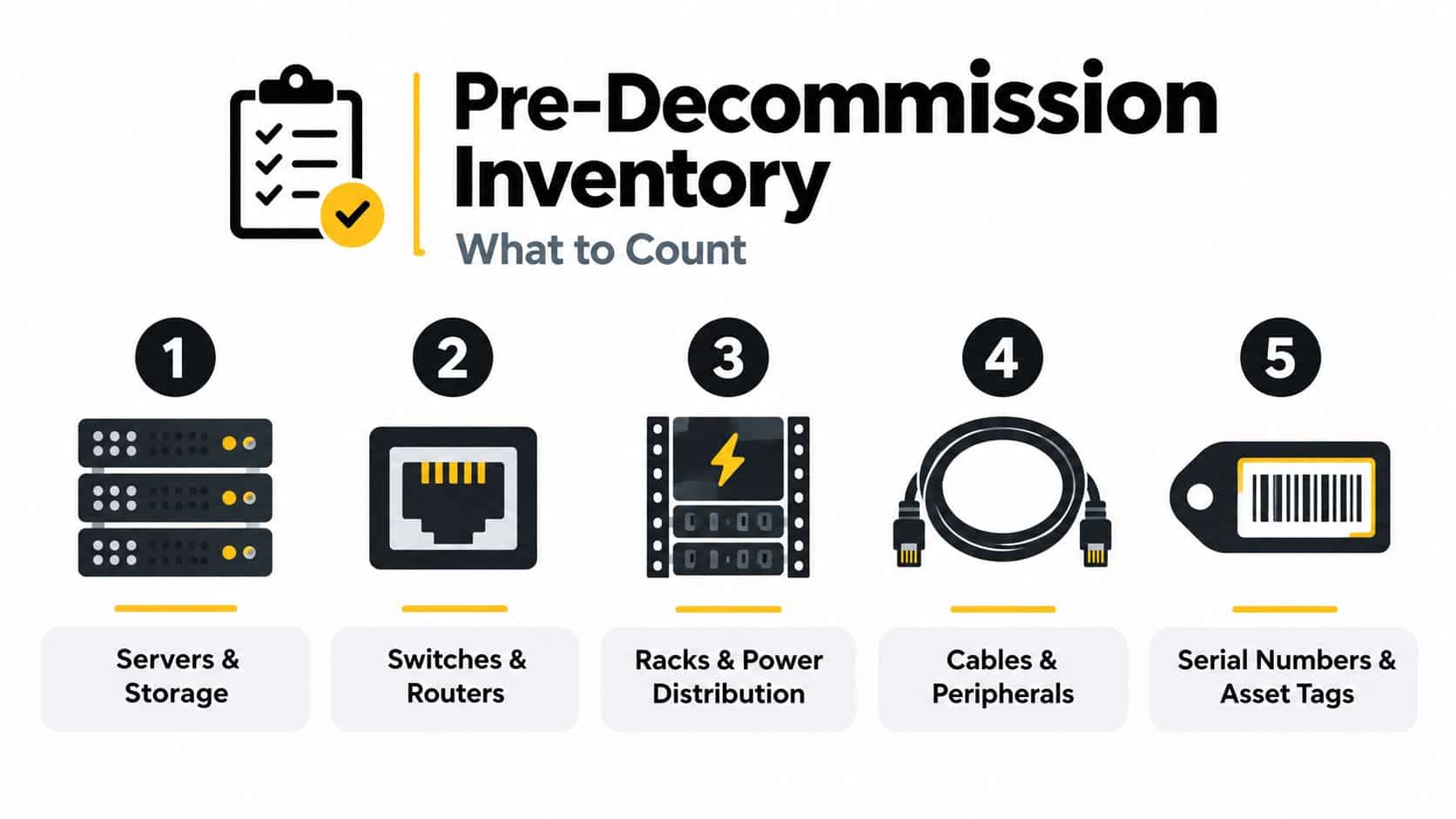
The inventory must extend beyond obvious computing equipment. Include:
- Servers and storage: Record make, model, serial number, configuration, drive count, and storage locations.
- Network equipment: Capture switches, routers, firewalls, load balancers, and spare units.
- Racks and power: Include racks, PDUs, UPS equipment, power supplies, and associated distribution hardware.
- Cabling and peripherals: Track fiber, copper, console devices, KVM equipment, trays, rails, and small accessories.
- Obscure or remote assets: Check staging areas, backup rooms, remote cabinets, inventory cages, and equipment awaiting repair.
- Ownership status: Identify owned, leased, financed, consigned, and vendor-managed equipment separately.
This broader scope reflects the data center equipment retirement inventory guidance, which calls for a full asset inventory before equipment is touched. The inventory defines authority, sequencing, and sign-off responsibilities, which helps prevent missed assets and audit gaps.
Classify risk before selecting disposition
Record the highest sensitivity an asset ever handled, not only what appears to be on it today. A server that currently runs a public application may previously have hosted sensitive databases. A drive that looks empty may retain recoverable information. The historical data classification should drive the sanitization method and the level of verification required.
Create a disposition record for each serialized asset with fields such as:
- Asset identity: Manufacturer, model, serial number, asset tag, and location.
- Data-bearing components: Internal drives, removable media, embedded flash, and storage within appliances.
- Sensitivity history: The highest sensitivity level associated with the device.
- Disposition path: Redeploy, resale, refurbishment, parts recovery, recycling, return to lessor, or destruction.
- Approval status: Business owner, security, compliance, finance, and facilities sign-off where applicable.
- Exception status: Missing labels, damaged serial plates, unknown ownership, or discrepancies.
Field lesson: An inventory isn't complete because every rack has a line item. It's complete when every component can be reconciled to an owner, a data decision, and a final disposition.
Use the inventory to sequence work. Separate active equipment from retired equipment, identify dependencies before shutdown, and isolate data-bearing assets early. A practical data center decommissioning checklist can help teams organize those controls before de-installation begins.
How to Choose the Right Data Destruction Method
NIST Special Publication 800-88 Rev. 2, published in September 2025, is the current federal guidance for media sanitization. It establishes the operational baseline for making access to target data infeasible for the required level of effort and organizes the decision around media type, sensitivity, and the intended reuse or disposal plan. The NIST SP 800-88 Rev. 2 publication should be the reference point for security, compliance, and ITAD teams aligning their procedures.
The three core outcomes are Clear, Purge, and Destroy. They aren't interchangeable labels for “wipe the drive.” Clear uses logical techniques intended to prevent ordinary recovery. Purge applies stronger methods designed to make recovery infeasible at a more advanced level. Destroy physically renders the media unusable and eliminates the reuse option for that component.
| Media Type | Reuse Plan | Recommended Method | Verification Requirement |
|---|---|---|---|
| Magnetic HDD | Reuse is permitted after successful sanitization | Clear or Purge, based on sensitivity and approved procedure | Confirm completion, record serial number and method, and issue a certificate |
| Magnetic HDD | No reuse planned | Destroy when sensitivity or risk requires physical elimination | Record destruction event, asset identity, and final disposition |
| SSD and NVMe | Reuse planned | Purge is typically required, subject to the device and approved technique | Verify the method and result, then reconcile the certificate to the serial number |
| Embedded flash | Reuse is planned or uncertain | Purge or Destroy is typically required | Document the specific component, method, verification, and exception handling |
| Any storage media | Disposal or unknown destination | Destroy when sanitization cannot be reliably verified | Preserve evidence of physical destruction and downstream disposition |
Why flash storage changes the decision
SSDs, NVMe devices, and embedded flash use controller-level behavior that can leave data outside the areas addressed by simple overwrite operations. For that reason, NIST's revised guidance indicates that Purge or Destroy is typically required for these media when resistance to state-of-the-art recovery matters. A generic file deletion, quick format, or unverified overwrite doesn't establish an acceptable result.
The process should identify hidden storage before equipment leaves the rack. Check blade systems, storage controllers, appliance modules, cache devices, diagnostic media, and removable components. Teams often sanitize the obvious hard drives while overlooking flash embedded in a controller or network appliance.
Verification closes the control loop
A defensible workflow includes asset discovery, data classification, sanitization, verification, certificate generation, and record retention. Certificates should connect the method and result to the specific asset identity, not merely to a shipment or batch.
The practical comparison is simple:
- Use Clear when the media and sensitivity assessment support logical sanitization and the device will be reused under an approved process.
- Use Purge when the media requires stronger recovery resistance, particularly for supported SSD, NVMe, and flash workflows.
- Use Destroy when reuse isn't needed, sanitization can't be verified, the media is damaged, or the risk assessment calls for physical elimination.
Teams evaluating flash-specific options can compare secure SSD destruction methods before setting the project standard.
Chain of Custody Documentation and Compliance Controls
The highest-risk period often starts when equipment leaves the rack and ends when the organization receives verified destruction or disposition records. A documented chain of custody controls that interval through defined handoffs. Every transfer should identify the asset, the person releasing it, the recipient, the time, and the recorded condition.
Start with the serialized inventory log. Reconcile it with the removal manifest before loading, then match that manifest to the transport record, receiving report, sanitization log, and final disposition certificate. Record exceptions at the point of discovery. A missing serial number, damaged label, unsealed container, or count discrepancy should never be reconstructed later from memory.
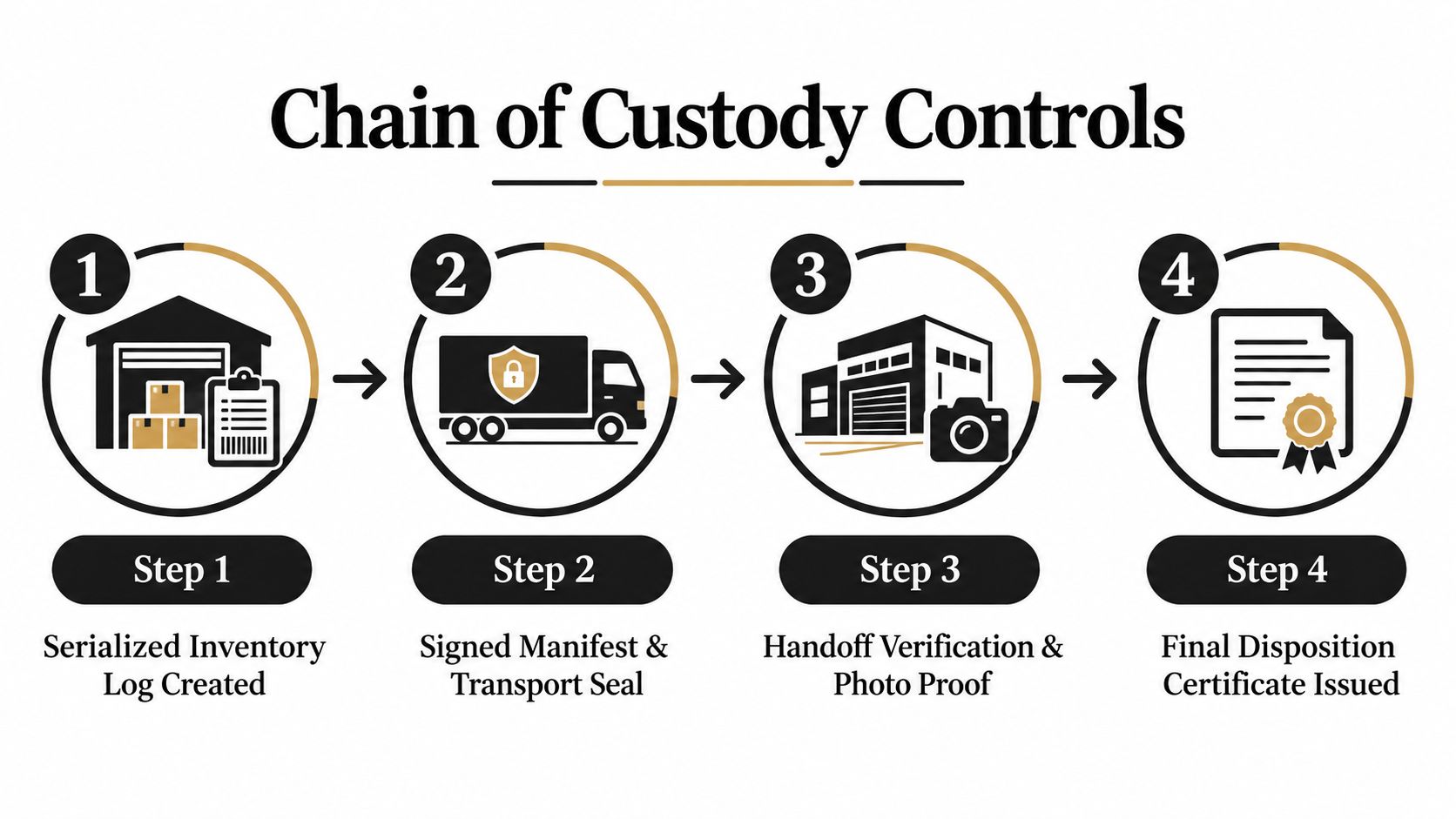
Build evidence at every handoff
The record set should make sense to an auditor who did not attend the project. Chain of custody documentation guidance can help teams define the fields and approvals required for each transfer.
Maintain:
- Release records: Identify the person authorizing removal and the assets released.
- Transport records: Connect the manifest to the vehicle, carrier, seal, destination, and receiving party.
- Receiving records: Confirm counts, condition, photos, and exceptions when the shipment arrives.
- Sanitization records: State the media type, method, operator or system, verification result, and asset identity.
- Disposition records: Document resale, reuse, parts recovery, recycling, lessor return, or destruction.
- Certificates: Retain data destruction and recycling certificates with the reconciled asset list.
The FTC Disposal Rule requires reasonable and appropriate practices for consumer-report information to prevent unauthorized access or use. It identifies burning, pulverizing, or shredding paper records, destroying or erasing electronic files or media so they cannot be read or reconstructed, and performing due diligence when hiring a destruction contractor. The FTC Disposal Rule guidance provides a useful baseline for vendor review and destruction records.
Audit standard: If a certificate cannot be matched to a serialized asset, it proves less than teams assume.
Plan for destination and jurisdiction controls
Retirement planning now has to account for AI-driven refresh cycles and cross-border compliance. Equipment may still have recovery value before technical end of life, yet reuse-first decisions can create routing and documentation obligations across jurisdictions. Basel Amendment adoption and the EU's updated Waste Shipment Regulation, including the Digital Waste Shipment System starting May 21, 2026, are making e-waste classification, routing, and records stricter. The trend is discussed in 2026 ITAD logistics coverage.
Classify equipment and destinations before pickup. Confirm whether each shipment is for reuse, repair, parts recovery, or recycling, then identify the records required at origin, during transport, and at the receiving facility. Where local capacity is limited, approve destinations in advance. Do not move equipment first and resolve routing questions afterward.
Logistics Value Recovery and Vendor Selection in Practice
A sound disposition strategy separates security decisions from market decisions. First determine how each asset will be sanitized and controlled. Then assess whether the sanitized equipment has a realistic reuse, resale, refurbishment, or parts-recovery path. Combining those decisions too early creates pressure to choose a cheaper process that doesn't match the data risk.
De-installation sequencing matters. Remove equipment in a way that protects active systems, preserves asset identity, and avoids mixing data-bearing devices with general material. Label each item before it leaves the rack, photograph unusual configurations, and package fragile components according to their physical characteristics. Racks, PDUs, cabling, rails, and accessories should remain tied to the inventory rather than becoming untracked bulk material.

Resale and recycling solve different problems
Resale can preserve value when equipment remains supportable, complete, testable, and commercially relevant. It requires accurate configurations, reliable grading, secure data treatment, and a buyer channel that can handle the hardware legally and operationally. A resale decision shouldn't override a required destruction method for storage media. In some cases, the chassis can be recovered while the drives are destroyed or replaced.
Recycling becomes the appropriate route when equipment is damaged, obsolete, incomplete, uneconomical to test, or unsuitable for responsible reuse. Certified downstream processing helps separate recoverable material from components requiring controlled handling. Reuse-first doesn't mean export-first. Cross-border restrictions and destination controls can create delays, documentation burdens, and value leakage, so a nearby compliant route may outperform a distant buyer even when the headline offer looks attractive.
Vet the provider, not just the quote
A capable ITAD partner should explain how it handles the entire chain, not only provide a pickup price. Ask for:
- Security controls: Sanitization methods mapped to media type and sensitivity, with verification and certificates.
- Inventory discipline: Serialized tracking, receiving reconciliation, exception logs, and disposition reporting.
- Downstream transparency: Names or documented categories of downstream processors and destination controls.
- Environmental controls: Responsible recycling practices and clear reporting on final material handling.
- Logistics ownership: Defined responsibility for packing, transport, seals, insurance, and incident escalation.
- Commercial terms: Clear valuation methodology, fees, liability transfer, revenue share, and treatment of unmarketable assets.
The contract should state when custody and liability transfer, what happens when an asset doesn't match the manifest, how destruction exceptions are handled, and when final certificates are delivered. For organizations evaluating a buyback path, the data center equipment buyback guide provides a useful framework for comparing recovery options.
Post Retirement Auditing Reporting and Continuous Improvement
A project isn't complete when the last pallet leaves the facility. It's complete when the organization can reconcile the original inventory to every final outcome, verify that no exception remains unexplained, and retrieve the evidence without reconstructing the project from emails.
Start the closeout audit with the serialized asset list. Match each item to a sanitization record, disposition record, lease return, internal redeployment record, or documented exception. Review certificates for correct serial numbers, methods, dates, receiving details, and final status. The audit trail and reporting resource can support that record-retention approach.
Turn findings into procurement controls
The audit should also examine where the process broke down:
- Inventory quality: Which assets were missing, duplicated, or discovered late?
- Data visibility: Were hidden storage components and historical sensitivity identified before removal?
- Vendor performance: Did transport, receiving, sanitization, and reporting match the contract?
- Value recovery: Which assets reached resale or reuse before their residual value window narrowed?
- Environmental reporting: Can the organization document recycling and downstream outcomes?
- Planning accuracy: Did procurement and infrastructure teams allow enough time for disposition?
AI-driven refresh cycles make those answers financially relevant. Retirement timing should influence purchase terms, redeployment assumptions, warranty decisions, storage architecture, and future ITAD capacity. A repeatable review converts one decommission into better lifecycle planning for the next one.
Beyond Surplus coordinates commercial IT asset disposition, secure data wiping, hard-drive shredding, electronics recycling, buyback, logistics, and data center de-installation with serialized chain-of-custody records and certificates. Visit Beyond Surplus to plan a secure, auditable retirement for your organization's servers, storage, networking equipment, and related infrastructure.


