

A reliable data center decommissioning checklist must control ownership, asset visibility, data destruction, movement, environmental processing, documentation, and final validation from project start through closure. Enterprise decommissioning typically takes 12 to 18 months, so treating it as a rushed equipment removal project creates avoidable security, compliance, and financial exposure.
A facility consolidation may look straightforward from the loading dock. Inside the building, however, servers, storage devices, networking equipment, batteries, cooling components, racks, cabling, and records all have different owners, risks, destinations, and documentation requirements. A successful shutdown coordinates IT operations, facilities, compliance, legal, finance, procurement, and a qualified IT asset disposition partner.
This seven-step sequence gives business and enterprise teams a practical control framework. It covers approvals, inventory, environmental assessment, sanitization, chain of custody, logistics, and post-completion validation. It also accounts for value recovery, specialty recycling, data center de-installation, secure electronics recycling, certificates, and nationwide business pickups.
Beyond Surplus supports organizations with secure data destruction, data center de-installations, logistics coordination, electronics recycling, IT equipment disposal, and documented disposition services. The objective isn't just to empty a data hall. It's to prove that every asset was handled according to its risk, ownership, environmental requirements, and final disposition.
Table of Contents
- 1. Secure Approvals from Compliance, Legal, and Finance Leadership
- 2. Conduct a Full IT Asset Inventory and Documentation Audit
- 3. Conduct an Environmental and Hazardous Material Assessment
- 4. Establish a Secure Data Destruction and Sanitization Protocol
- 5. Implement Real-Time Tracking and Chain-of-Custody Documentation
- 6. Develop a Detailed Logistics and Transportation Plan
- 7. Verify Vendor Certifications and Conduct Post-Completion Audit and Certification
- 7-Point Data Center Decommissioning Checklist Comparison
- Close the Loop With Evidence
1. Secure Approvals from Compliance, Legal, and Finance Leadership
Equipment shouldn't leave the facility until the people accountable for risk, contracts, and financial records have approved the plan. Compliance needs to assess regulatory and policy requirements. Legal needs to review vendor terms, insurance, confidentiality obligations, and liability transfer. Finance needs to confirm asset accounting, recovery treatment, disposal costs, and any lease or contract implications.
Start by giving each stakeholder a clear project package. Include the scope, proposed schedule, asset categories, risk assessment, data destruction methods, vendor agreements, insurance documentation, and expected deliverables. Ask each group to define its acceptance criteria in writing rather than relying on a general approval.
Make ownership explicit
A project charter should identify who owns each workstream and who can authorize a change. Include IT infrastructure, security, facilities, procurement, finance, legal, compliance, and the ITAD provider. If the site is leased or colocated, add the landlord or facility operator where necessary.
A healthcare organization may require compliance review of data destruction procedures and legal confirmation of vendor insurance before pickup. A financial services team may need finance approval for recovered equipment value and compliance approval for the evidence required during an audit. These aren't administrative formalities. They determine how the project will be designed.
Practical rule: No asset should enter a removal queue until its owner, destination, data risk, and approval status are recorded.
Schedule a formal readiness briefing before physical work begins. Document approvals in an email trail or signed memo, record exceptions, and identify the person authorized to pause work. Early involvement prevents a vendor from arriving with an approved truck but an unapproved process.
2. Conduct a Full IT Asset Inventory and Documentation Audit
Inventory connects security, logistics, finance, and value recovery. Record every server, storage device, switch, router, rack, power component, battery, cooling unit, and other equipment in scope. For each item, capture the serial number, asset tag, manufacturer, model, location, condition, ownership, operational status, warranty status, and whether it stores data.
A walk-through cannot establish a reliable baseline by itself. Reconcile physical findings against procurement systems, configuration databases, service tickets, lease schedules, and finance records. This review can identify equipment replaced but still listed, assets assigned to another business unit, and devices that continue to support an application or network dependency. Resolve those exceptions before assigning a removal date.
Build destination-based categories
Group each item by its approved disposition path:
- Secure destruction: Data-bearing devices that cannot be sanitized for reuse, damaged media, and assets with unacceptable recovery risk.
- Sanitization and recovery: Functional servers, storage, networking equipment, and components that may retain value after verified data removal.
- Specialty processing: Batteries, cooling equipment, lamps, circuit boards, and materials requiring dedicated environmental handling.
- Reuse or donation: Approved equipment with a documented recipient and ownership transfer.
- Facility closeout: Racks, cabling, PDUs, UPS interfaces, and other infrastructure included in the handback scope.
Use barcode scanning or an asset management platform to limit manual entry errors. Photograph each asset or rack position when condition, damage, modifications, or security seals could affect handling. Record the proposed destination, data treatment, owner, and required evidence in the same asset record. That record links downstream security controls with environmental routing and helps finance assess recovered value.
For large or changing environments, involve an experienced ITAD provider during the assessment. Beyond Surplus provides inventory optimization services that can help establish a cleaner asset baseline before removal begins. Freeze the final inventory before pickup, then document every approved change so the removal queue and final disposition report remain aligned.
3. Conduct an Environmental and Hazardous Material Assessment
A data center includes more than computing hardware. Before dismantling, identify batteries, cooling systems, legacy components, cabling, and building materials that require regulated or specialist handling. Document each material's location and condition, then assign an approved processing route.
Assess lead-acid and lithium batteries, mercury-containing components, cadmium-bearing parts, refrigerants, and suspected asbestos-containing materials. A general electronics recycler may not accept every stream. Battery banks and cooling systems can require specialist contractors, while suspected asbestos requires qualified assessment and a controlled stop-work decision.
Separate waste streams before removal
Create a material register linking each item to its handling requirements. Record photographs, location, estimated quantity, owner, removal method, transporter, and final certificate. Physically segregate hazardous components from general e-waste, and label them before the first pickup.
A legacy cooling system may contain refrigerant requiring certified recovery. Older cable-tray insulation may need investigation before technicians disturb it. If a crew encounters suspected asbestos, consult guidance on when to stop work for asbestos and follow applicable site and jurisdictional controls.
Require records from every downstream processor. Environmental certificates, recycling records, and manifests should identify the material stream and processing outcome. Confirm that each vendor's qualifications match its scope. An electronics recycler may not handle refrigerants, batteries, or building remediation, so assign those streams to qualified contractors.
Include reuse and value recovery in the environmental plan. Refurbishing functional equipment can preserve utility, while controlled material recovery prevents inappropriate disposal. Record the selected route for each category so the final report shows what left the building and how it was processed. Keep these records with the project evidence, allowing environmental outcomes, logistics, and recovered value to be reconciled after removal.
4. Establish a Secure Data Destruction and Sanitization Protocol
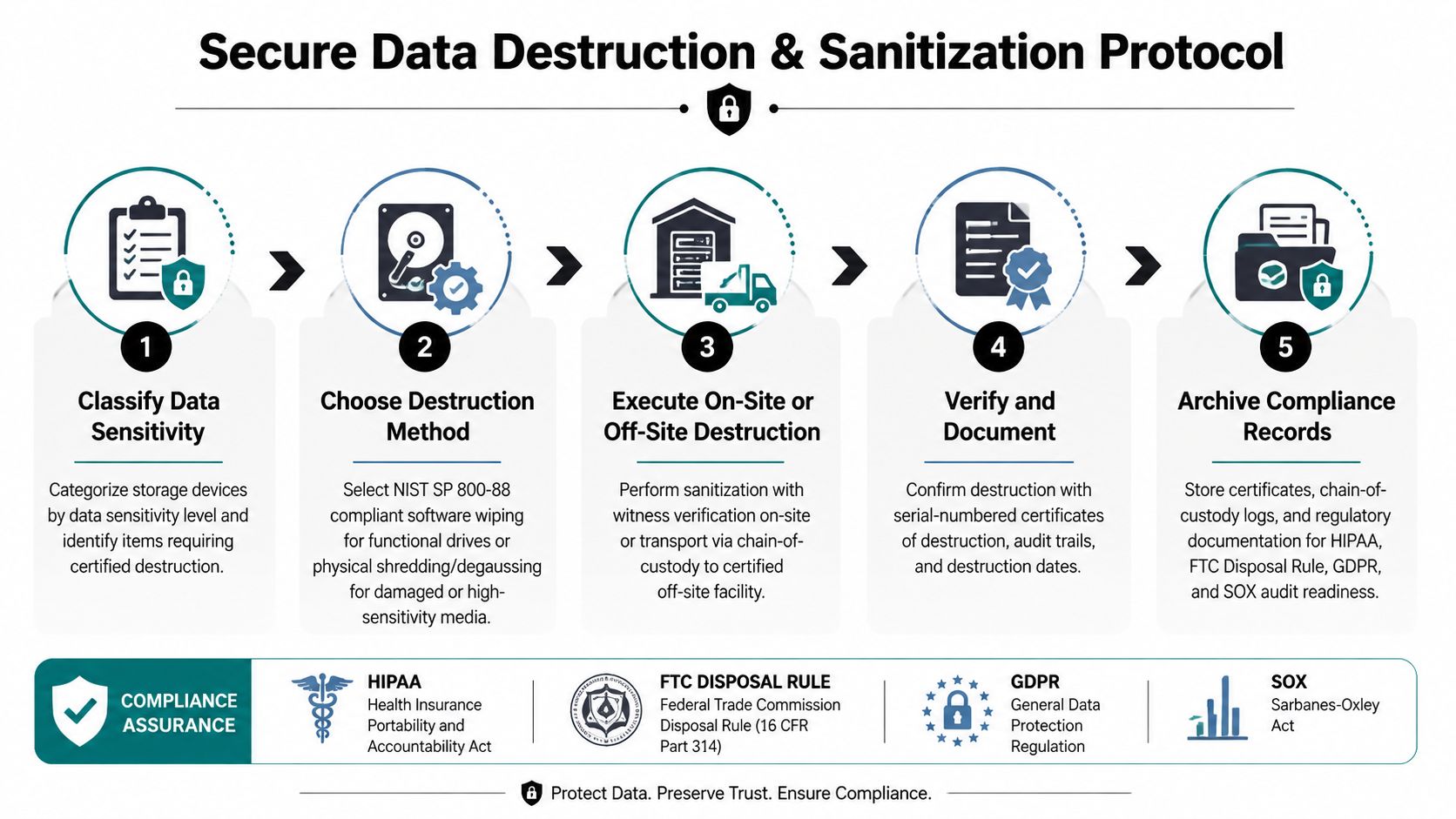
Data destruction must be designed by media type, data sensitivity, device condition, and intended disposition. NIST Special Publication 800-88 formalized three sanitization methods, Clear, Purge, and Destroy, and recommends deciding the disposal method based on information confidentiality before media leaves service. The original guidance was first published in September 2006 and officially withdrawn on December 22, 2014, while later revisions show that sanitization guidance remains a living control area. NIST's current publication page provides the updated reference point.
For reusable equipment, software-based sanitization may preserve resale or redeployment value when the method is appropriate and verified. Damaged, failed, or high-sensitivity media may require physical destruction. The decision belongs in the project policy, not at the loading dock.
Match evidence to the method
Create a destruction matrix that identifies:
- Media type: Hard disk drives, solid-state drives, removable media, embedded storage, and storage arrays.
- Required method: Clear, Purge, or Destroy, based on risk and technical capability.
- Execution location: On-site or at a controlled processing facility.
- Verification approach: Full verification or representative sampling.
- Required records: Serial number, method, date, operator, witness where applicable, and certificate.
NIST guidance permits verification of every sanitization event or representative sampling of a selected subset. It also recommends, where possible, that sampling be performed by personnel who weren't involved in the original sanitization action. The NIST SP 800-88 Rev. 1 document explains these verification approaches.
For sampling procedures, archived NIST guidance describes pseudorandom sample locations across addressable space. For hard drives using LBA addressing, it suggests a minimum of one thousand subsections, with two non-overlapping samples in each subsection covering at least 5% of that subsection, resulting in at least 10% overall media coverage across the subsections. The archived NIST summary describes that approach.
Document the verification method, not just the statement that wiping occurred. NIST SP 800-88 Rev. 2 materials emphasize recording whether verification used full verification or quick sampling. Beyond Surplus's explanation of NIST 800-88 data destruction standards can support the policy and vendor review process.
5. Implement Real-Time Tracking and Chain-of-Custody Documentation
Control requires more than a label. The organization must be able to show where an asset was, who handled it, when custody changed, and how it reached final disposition. Scan every device at removal, staging, vehicle loading, receipt, processing, and completion.
Digital tracking creates a time-stamped event history and simplifies reconciliation compared with handwritten manifests. Use barcode or RFID labels where practical, and require reports that can be exported into asset management or audit systems.
Record every handoff
A defensible chain-of-custody record should include:
- Asset identity: Serial number, asset tag, model, and parent-child relationship when components are removed from a rack or chassis.
- Physical evidence: Photos showing rack position, condition, seals, packaging, and loading.
- Custody event: Releasing person, receiving person, date, location, and purpose.
- Transport record: Vehicle or shipment reference, destination, and delivery confirmation.
- Disposition result: Sanitized, destroyed, refurbished, resold, recycled, or sent for specialty processing.
Reconcile the digital record with the physical count at every checkpoint. A missing scan requires investigation before the next handoff. This control matters in mixed-ownership environments, where one rack can contain equipment assigned to several departments or customers.
Use chain-of-custody documentation to organize evidence across pickup, processing, and final disposition. Require recycling and destruction certificates that reference the relevant serial numbers.
A certificate records the outcome. The complete custody trail supports the outcome by showing each transfer, checkpoint, and disposition decision. That evidence also helps connect secure handling with accurate inventory reconciliation and recovery reporting.
6. Develop a Detailed Logistics and Transportation Plan
Plan removal around operational dependencies, facility constraints, and the intended disposition route. Before scheduling a truck, confirm that application owners, network teams, facilities, security, and the ITAD provider agree on shutdown timing, data transfers, backups, access paths, and equipment ownership.
Start with a site assessment. Record loading dock access, elevator capacity, floor protection, escort rules, staging areas, packaging requirements, security controls, vehicle type, and pickup windows. Fully populated racks, batteries, fragile networking equipment, and cooling components require different handling methods.
Set the removal sequence
Create a schedule that separates equipment approved for early removal from systems requiring a maintenance window or final validation. After-hours work can limit operational disruption, but staffing, facility access, and escalation coverage must be confirmed. Document the selected window and its operational rationale.
Use the following transport instructions:
- Packaging: Specify shock protection, labels, sealed containers, and tamper-evident controls where required.
- Vehicle needs: Match capacity, lift-gate requirements, secure compartments, and environmental controls to the equipment.
- Visibility: Record GPS tracking, pickup and delivery confirmations, and exception alerts.
- Site safety: Define PPE, battery handling, rack movement, cable removal, and approved travel paths.
- Multi-site coordination: Assign destinations, consolidate compatible pickups, and maintain separate manifests for each facility.
Assign technicians who understand rack hardware, energized infrastructure, fragile components, and controlled access. A general courier may transport equipment, but may not be equipped for data center de-installation. Beyond Surplus coordinates data center logistics across pickup, transportation, de-installation, and disposition requirements.
For national programs, consolidate movements only when the resulting manifests remain traceable. Compare transport savings with reconciliation effort, certificate timing, and the risk of mixing assets from different facilities. The approved plan should connect each movement to its facility, destination, handling requirements, and final disposition.
7. Verify Vendor Certifications and Conduct Post-Completion Audit and Certification
Closeout starts with reconciliation. Compare the approved inventory with every asset the vendor processed, then match each record to its final disposition, certificate, and payment or disposal entry. Missing serial numbers, unexplained count changes, and open facility obligations require documented resolution before acceptance.
Check vendor qualifications before work begins. Confirm that each certification covers the contracted service, processing location, and downstream activity. Review insurance, subcontractor controls, audit rights, exception handling, and the records the contract requires the vendor to provide. Use this vendor due diligence checklist to structure the review.
Create one closeout file with these control groups:
- Asset reconciliation: Approved inventory, serial-level disposition records, and unresolved variances.
- Security evidence: Sanitization or destruction method, verification record, certificates, and witness records when required.
- Environmental evidence: Recycling certificates, hazardous-material records, and downstream processor documentation.
- Financial evidence: Recovery proceeds, disposition value, disposal charges, and accounting adjustments.
- Facility evidence: Restoration photographs, cable-removal records, landlord approval, and handback documents.
- Governance evidence: Approvals, exceptions, incidents, contracts, insurance, and final acceptance.
Request R2, e-Stewards, ISO 14001, or SOC 2 documentation only where it matches the project's requirements. Verify certificate scope and validity before equipment leaves the facility.
An operational guide recommends retaining destruction certificates with serial numbers, environmental compliance certificates, chain-of-custody records, restoration photographs, and vendor contracts for at least 7 years. The published decommissioning guidance supports making retention an explicit checklist control.
Hold a post-completion review with compliance, IT, facilities, finance, and the vendor. Record corrective actions, owners, due dates, and the approval that closes the project. The final certification should state whether inventory, data security, environmental handling, logistics, recovery value, and site restoration all reconcile.
7-Point Data Center Decommissioning Checklist Comparison
| 🔄 Implementation Complexity | ⚡ Resource Requirements | 📊 Expected Outcomes | 💡 Ideal Use Cases | ⭐ Key Advantages |
|---|---|---|---|---|
| High, multi‑stakeholder coordination, formal sign‑offs (2–4 weeks) | Executive time (compliance, legal, finance), formal documentation, stakeholder meetings | Regulatory sign‑off, reduced rework, executive accountability | Regulated industries, SOX/HIPAA audits, high‑risk disposals | Prevents compliance delays, ensures contractual protections |
| Medium–High, physical audits at scale, detailed cross‑referencing | IT staff, asset management software, barcode scanners, time | Complete asset baseline, chain‑of‑custody, identified resale candidates | Data center migrations, large consolidations, audit prep | Prevents loss, enables value recovery, audit support |
| Medium, requires specialist assessment and segregation planning | Environmental consultants, trained handlers, hazardous disposal contracts | Hazard inventory, compliant segregation, reduced environmental liability | Legacy equipment sites, UPS/batteries, refrigerants, asbestos cases | Avoids EPA penalties, protects personnel, supports ESG reporting |
| Medium, method selection and scheduling (on‑site/off‑site) | Certified destruction vendors, wiping/shredding tools, chain‑of‑custody records | Certified data destruction, audit certificates, eliminated recovery risk | PHI/PII media, regulated records, end‑of‑life storage devices | Eliminates breach risk, provides legal/compliance proof |
| Medium, tech setup and process discipline for real‑time updates | Barcode/RFID, tracking software, trained staff, photo evidence | End‑to‑end visibility, audit‑ready trails, theft prevention | Multi‑site decommissions, high‑volume projects, SOX/HIPAA audits | Unbreakable audit trail, real‑time status, simplifies reconciliation |
| Medium, routing, scheduling, and equipment handling planning | Logistics vendor/fleet, GPS tracking, specialized packaging, coordination | Minimized downtime, secure transit, consolidated shipments | Nationwide consolidations, heavy/fragile hardware moves, climate‑sensitive assets | Reduces disruption, protects asset value, transparent transport tracking |
| Medium, documentation review and reconciliation after completion | Audit time, vendor cooperation, records management, certification collection | Final compliance proof, validated destruction/recycling, financial reconciliation | Project closeouts, regulatory audits, vendor due‑diligence | Confirms vendor compliance, transfers liability, permanent audit record |
Close the Loop With Evidence
A data center decommissioning project isn't complete when the last rack crosses the loading dock. It's complete when the organization can demonstrate that every asset was identified, approved, moved, sanitized or destroyed, processed through the correct environmental channel, and assigned a final accountable disposition.
Begin closeout with the original inventory, not the vendor's final spreadsheet. Reconcile each serial number and asset tag against pickup scans, custody events, processing records, destruction certificates, recycling certificates, resale records, and specialty-material documents. Investigate every unmatched item. A missing record may indicate a data-security issue, an accounting gap, an ownership dispute, or a simple scanning error, but the project team needs evidence before it can classify the exception.
The final review should also confirm that applications, network connections, licenses, scheduled jobs, DNS records, monitoring integrations, and access paths were retired according to the approved shutdown plan. Facilities should confirm that racks, cabling, power equipment, cooling systems, and other infrastructure were removed or left in the condition required by the lease or handback agreement. Photographs and signed acceptance records are valuable when responsibility for restoration is later questioned.
Retain a defensible closeout package
Archive approvals, risk assessments, inventory exports, dependency records, method selections, verification results, chain-of-custody logs, transportation documents, environmental certificates, vendor certifications, financial recovery records, and final acceptance. The retention period should follow organizational policy and applicable obligations, with the operational guide cited above recommending 7 years for several core decommissioning records.
Use the closeout meeting to record lessons learned. Note which inventory fields were incomplete, where custody handoffs slowed down, which assets produced recoverable value, and which facility constraints affected the schedule. Those observations improve the next refresh, migration, lease exit, or site consolidation.
The market context reinforces why this discipline matters. One industry overview reports a $12.95 billion global data center decommissioning market in 2026, projected to reach $19.94 billion by 2032 at a 7.37% CAGR. The decommissioning market overview presents the work as a specialized operational program, not a one-time cleanup task. A separate industry summary reports the same market figures and connects demand with serialized inventory, secure sanitization, and auditable custody workflows. Its ITAD market discussion provides additional context for the growing need for formal lifecycle controls.
The next generation of projects also needs a stronger approach to dense AI and machine-learning hardware. GPU-heavy racks, specialized accelerators, high-power cooling dependencies, model artifacts, and mixed ownership components can require different segmentation, handling, valuation, and verification decisions than ordinary server retirement. Inventory should identify those dependencies, and the closeout package should show that associated workloads and data-bearing components were addressed.
Contact Beyond Surplus for certified electronics recycling, secure IT asset disposal, data center de-installation, data destruction, logistics coordination, and value recovery. The company supports business pickups across the contiguous United States and provides certificates and chain-of-custody records for enterprise disposition programs.
Beyond Surplus provides secure data destruction, data center de-installation, electronics recycling, IT asset recovery, logistics coordination, and documented IT equipment disposal for business and enterprise environments. Visit Beyond Surplus to plan a controlled data center decommissioning project and request service for your facilities.


