A server refresh rarely ends when the last rack is powered down. In an Atlanta colocation facility, the same project may involve active dependencies, unverified drives, batteries, network equipment, resale candidates, hazardous components, and pallets moving through several hands. A missing serial number or an incomplete transfer record can turn an efficient removal into a security, environmental, or contractual problem.
Atlanta's data-center market makes disciplined lifecycle management increasingly important. The region recorded 705.8 megawatts of net data-center absorption in 2024, leading the United States for that measure, and market reporting estimates approximately 1.82 gigawatts of installed capacity by early 2026. Fulton County accounted for at least 464 megawatts of operating capacity, with another 396 megawatts planned or under construction. These figures measure facility power, not discarded-electronics tonnage, but they show why Atlanta electronics recycling services must handle concentrated, recurring equipment transitions. (Atlanta data-center market reporting)
Table of Contents
- Planning and Scoping Your Decommission Project
- Secure Data Destruction Options and Verification
- Logistics, Chain of Custody, and Regulatory Compliance
- Choosing the Right IT Asset Disposition Partner
- Environmental Processing and Value Recovery
- Executing the Plan and Final Reporting
Planning and Scoping Your Decommission Project
A decommissioning crew arrives to remove a redundant server. The application owner hasn't approved the shutdown, the failover path hasn't been tested, and the asset list doesn't match the rack. That situation is avoidable when equipment retirement is managed as an engineering change rather than a cleanup appointment.
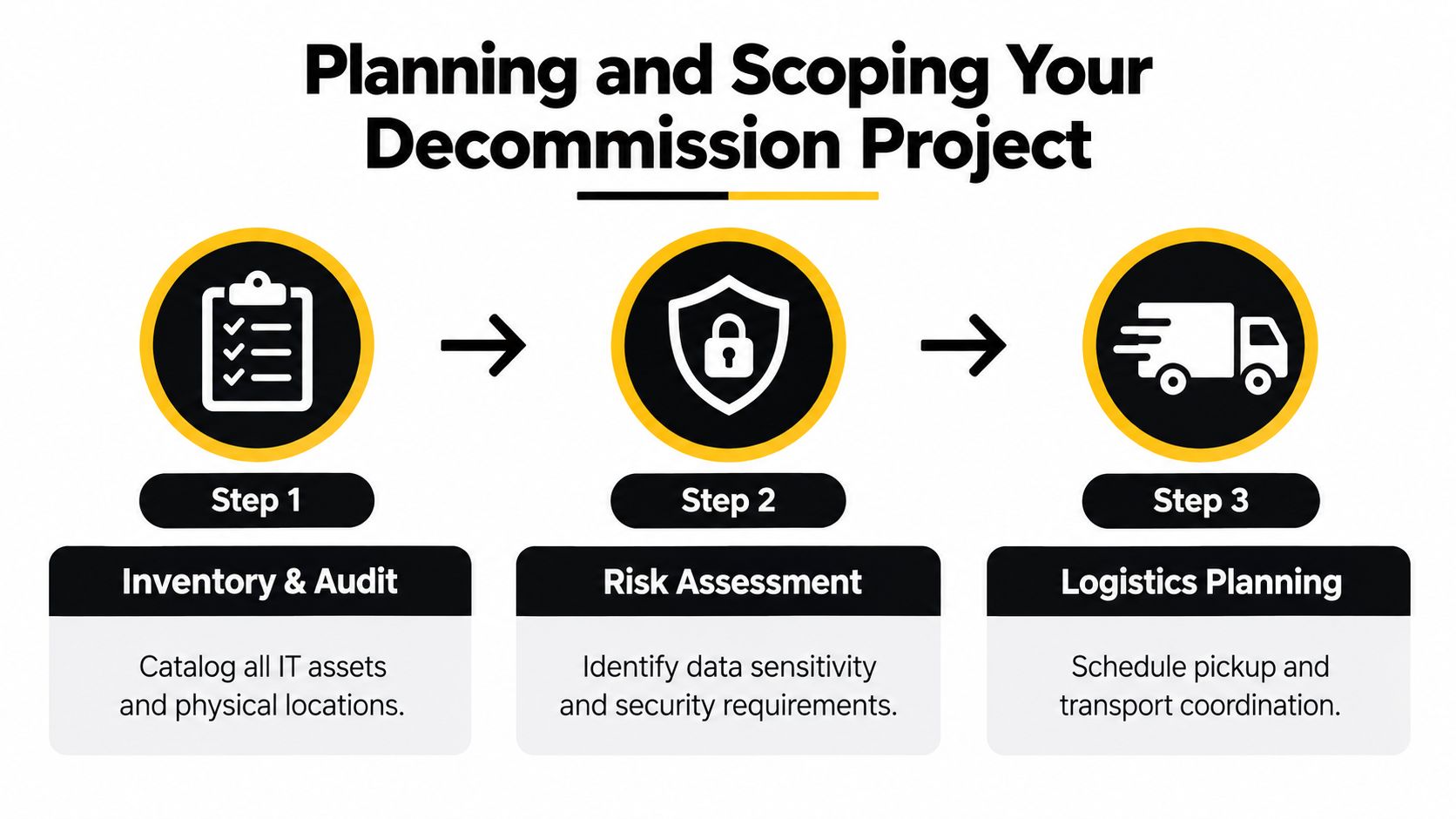
Start by freezing the asset list. Capture rack position, chassis identifier, component serial numbers, drive details, ownership, lease status, and current disposition. Reconcile the list against physical equipment before anyone disconnects a cable. Uptime Institute reports that underutilized or “comatose” servers commonly represent 20–30% of a company's installed server base, which makes inventory validation valuable before removal. (Uptime Institute guidance on server decommissioning)
Build the shutdown around dependencies
The project plan should identify more than hardware. It should account for:
- Power and redundancy: Confirm which feeds, PDUs, UPS systems, and redundant nodes support the target equipment.
- Network and storage: Map switch ports, SAN relationships, replication, backups, monitoring, and virtual-machine storage.
- Licenses and leases: Record software dependencies, hardware leases, ownership restrictions, and return obligations.
- Environmental conditions: Coordinate heat load, cooling, battery condition, spill controls, loading-dock access, and worker safety.
- Change approval: Obtain application-owner and facility approval before controlled shutdown and removal.
Photograph rack positions and label cables before disassembly. Count drives, memory modules, removable media, and hot spares as separate assets. A pallet quantity isn't an adequate substitute for a serialized record, especially when the same shipment contains reusable servers and failed storage devices.
The serialized workflow should follow a clear sequence:
- Freeze and reconcile: Match the approved asset register to rack, chassis, drive, and component serial numbers.
- Classify risk: Identify data sensitivity and decide whether each storage device is reusable, requires purge, or must be destroyed.
- Stage securely: Move equipment to a controlled area with restricted access and documented custody.
- Sanitize and verify: Complete the approved media process before resale, reuse, recycling, or transport.
- Record disposition: Link every asset to its method, operator, timestamp, verification result, transfer, and final outcome.
A useful data-center decommissioning checklist can help facility managers turn those controls into a repeatable project record. The same discipline used in a commercial construction handoff, including the broader planning principles described in Trail Star Development on franchise build-outs, applies here: define scope, coordinate dependencies, assign responsibility, and document completion.
Practical rule: Don't schedule the pickup until the inventory, shutdown approvals, staging location, and media disposition paths are all confirmed.
Secure Data Destruction Options and Verification
Data destruction isn't the same as electronics recycling. A server can be environmentally processed correctly and still create exposure if its storage media was never sanitized, while a drive can be securely destroyed without a complete record proving which asset it belonged to.
NIST SP 800-88 distinguishes three outcomes:
- Clear: Logical techniques, such as standard read and write commands or a factory-reset function, address user-accessible storage and ordinary, non-invasive recovery attempts.
- Purge: Physical or logical techniques make recovery infeasible with state-of-the-art laboratory methods while potentially preserving the medium for reuse.
- Destroy: The medium becomes unusable for future data storage, and recovery is infeasible with state-of-the-art laboratory methods.
NIST defines these as distinct outcomes, and purge has a higher recovery-resistance objective than ordinary clearing. (NIST SP 800-88 media sanitization guidance)
Match the method to the hardware
Reusable servers with healthy storage may enter a certified wiping and resale workflow. Failed drives, damaged media, and equipment with uncertain sanitization capability may require physical destruction. Encrypted media can support a purge decision when cryptographic erase is properly verified, but verification must occur before any subsequent clear or purge operation.
On-site shredding offers a direct control for high-risk media and can reduce uncertainty during transport. Off-site destruction may be appropriate when the processor has secure receiving, controlled access, documented transfers, and a verified destruction process. Neither option works if the operator cannot reconcile the destroyed item to the original serial number.
For non-destructive sanitization, use 100% serial-number reconciliation and per-device verification as the acceptance benchmark. NIST also recommends independent secondary verification by personnel who weren't responsible for the original sanitization. Software verification should sample pseudorandom locations across the addressable space, including reserved areas. The cited guidance specifies non-overlapping samples covering at least 5% of each subsection, with two samples providing at least 10% coverage. (NIST verification requirements)
Certificates should identify the asset ID, serial number, sanitization method, tool and version, operator, timestamp, verification result, final disposition, and custody transfer. A certificate listing only “one pallet of drives” doesn't prove what happened to a particular drive.
The practical comparison is straightforward:
| Situation | Suitable control | Evidence to retain |
|---|---|---|
| Reusable, functioning storage | Verified clear or purge | Serial-linked verification record |
| Failed or uncertain media | Physical destruction | Destruction record tied to serial number |
| Whole-rack removal | Asset-level segregation | Inventory, custody, and disposition report |
| Encrypted storage | Verified cryptographic erase where appropriate | Method, verification, and responsible operator |
Use a documented NIST SP 800-88 process to keep security decisions consistent across servers, laptops, storage arrays, and removable media.
Logistics, Chain of Custody, and Regulatory Compliance
A secure wipe performed correctly can still be undermined by an undocumented handoff. The physical path from rack to staging area, truck, processor, resale channel, or destruction point needs the same attention as the sanitization step.
Assign custody at every transfer. The loading-dock record should identify who released the equipment, who received it, when the transfer occurred, what assets moved, and whether the shipment was sealed or otherwise controlled. Photograph pallets and containers before departure, and retain signed transfer records rather than relying on an email confirmation.
Separate data security from material compliance
Data-bearing equipment isn't the only risk in a mixed load. Batteries, mercury-containing equipment, printed circuit boards, coolant fluids, and other components may follow different handling requirements. Federal rules can allow shredded printed circuit boards to qualify for a recycling exclusion only when mercury components and nickel-cadmium or lithium batteries are removed, managed separately, and documented. Intact batteries may be managed under universal-waste rules.
That means the pre-pickup inspection must identify battery condition, refrigerants or coolants, mercury-containing devices, CRT equipment, circuit boards, packaging needs, transporter qualifications, and downstream documentation. A “zero-landfill” statement alone doesn't establish component-level control.
For organizations that use consumer reports for a business purpose, the FTC Disposal Rule requires disposal practices that are reasonable and appropriate to prevent unauthorized access or use. The rule also makes contractor due diligence relevant, including documented destruction or erasure of electronic files and media. (FTC Disposal Rule guidance)
Build an item-level evidence trail
The chain-of-custody file should connect:
- Asset identity: Asset tag, serial number, equipment type, and physical location.
- Security action: Clear, purge, destroy, or another approved method.
- Responsible person: Operator, verifier, transporter, and receiving processor.
- Time and movement: Sanitization timestamp, transfer date, destination, and receipt.
- Final disposition: Reuse, resale, parts recovery, material recycling, or destruction.
- Exception handling: Missing media, damaged labels, rejected loads, and unresolved discrepancies.
Teams that need to understand how complex shipments move across facilities can consult this resource on routing and customs explained. The underlying principle is relevant even when equipment stays within the United States: every movement needs a defined origin, destination, responsible party, and supporting record.
A complete chain of custody for IT asset disposal should survive review by security, procurement, environmental, finance, and facility stakeholders. If those teams can't trace a device from rack position to final disposition, the process has a documentation gap.
Choosing the Right IT Asset Disposition Partner
The cheapest pickup is rarely the lowest-risk option if the vendor treats servers, batteries, drives, and cooling electronics as one undifferentiated load. Choose a partner that can separate security decisions from environmental processing and can demonstrate what happens after collection.
A recent DeKalb County data-center proposal specifically calls for a decommissioning plan covering recycling through recyclers certified to R2 or e-Stewards standards. (Reporting on the DeKalb County proposal)
Ask for evidence, not assurances
Evaluate a potential ITAD or electronics recycling provider against the actual project:
- Certification scope: Confirm whether R2 or e-Stewards certification applies to the relevant facility and processing activities.
- Security capability: Ask whether the provider performs on-site shredding, off-site shredding, certified wiping, or all three.
- Asset visibility: Require sample inventory reports, serial-level certificates, and exception reports.
- Material handling: Confirm processes for batteries, UPS equipment, boards, cooling components, and mixed loads.
- Transportation: Review owned fleet capacity, qualified partners, secure loading procedures, and transfer documentation.
- Recovery controls: Ask how reusable equipment is tested, graded, valued, and separated from material destined for recycling.
- Geographic reach: Verify whether the provider can support Atlanta facilities and multi-state enterprise projects without breaking the evidence trail.
Request a sample certificate before awarding the work. It should show more than a total weight or pallet count. It should demonstrate how an individual server, drive, switch, or battery is connected to a final disposition.
Use a vendor due diligence checklist during procurement, then validate the answers with site tours, certification records, insurance documentation, and a defined escalation process. Beyond Surplus is one Atlanta-based option that provides data destruction, IT equipment disposal, electronics recycling, buyback, product destruction, and data-center de-installation services for business customers. The selection decision should still rest on documented capability, project fit, and evidence quality.
Environmental Processing and Value Recovery
A retired data-center asset has two separate values. Its information-security risk must be controlled, and its hardware or material value should be assessed before it is sent to a processor. Reuse, resale, parts recovery, and material recycling are different outcomes and require different records.
The global scale explains why downstream discipline matters. The United Nations-backed Global E-waste Monitor reported 62 million metric tonnes of e-waste in 2022, equivalent to approximately 7.8 kilograms per person, and projects that global generation will reach 82 million tonnes by 2030. (Global E-waste Monitor)
Separate reuse from destruction
Tested servers, switches, storage enclosures, and power equipment may retain resale or parts value. That value disappears when a processor destroys equipment before checking condition, but pursuing resale without verified data destruction creates a different risk. The correct sequence is security classification first, functional testing second, valuation third, and downstream disposition last.
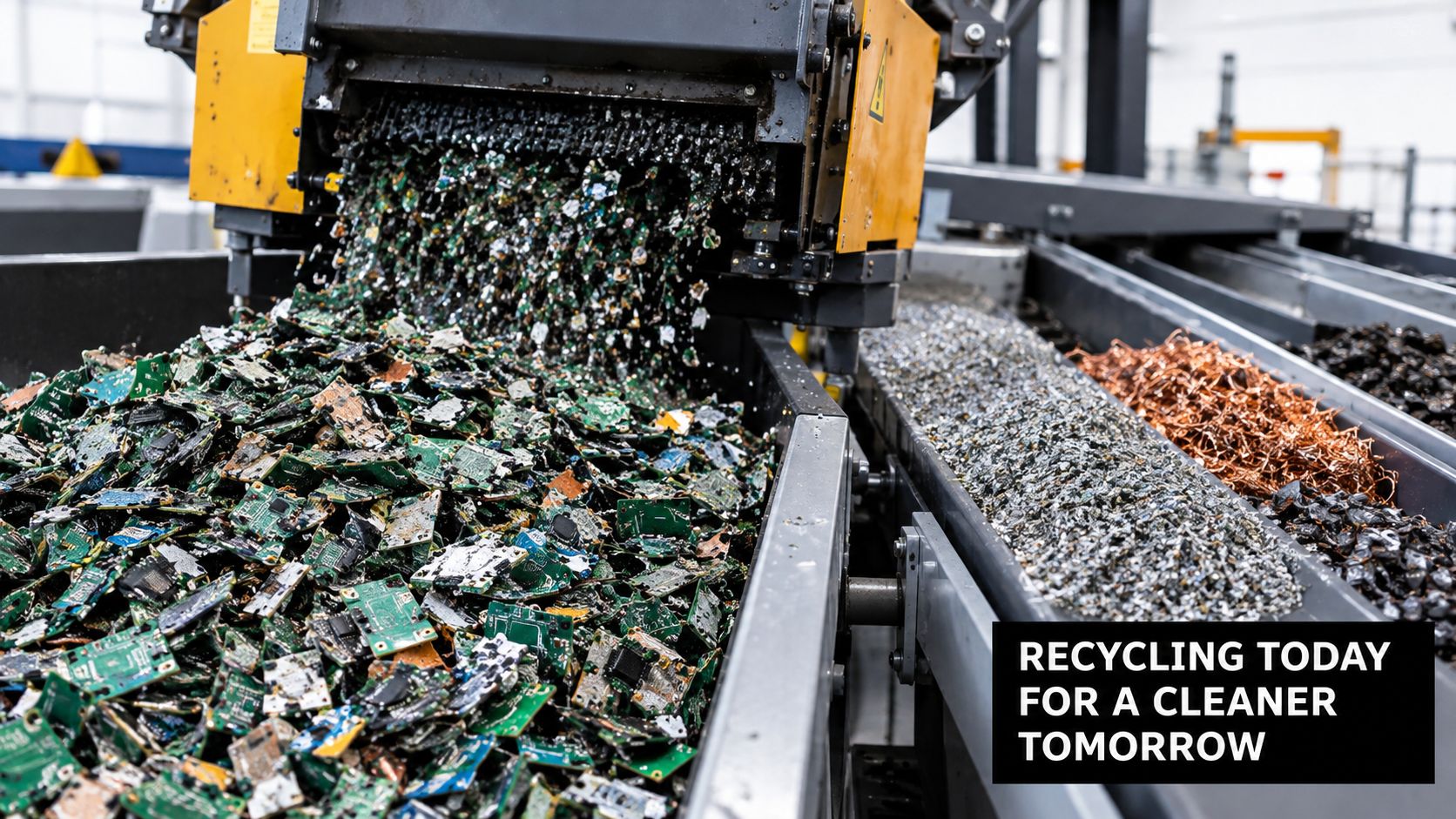
Non-reusable electronics should go to environmentally sound processors that profile the load before dismantling or shredding. Batteries and other regulated components need separate handling, while circuit boards and recoverable metals should enter documented material streams. This approach supports sustainability reporting without turning environmental claims into a substitute for regulatory evidence.
The Atlanta market's scale creates a steady opportunity for recovery, but facility power doesn't directly determine recycling tonnage or resale proceeds. A sound program measures recovery value per rack or kilogram, diversion rate, material category, and exception count rather than assuming every retired asset has the same economic outcome.
A circular economy approach to enterprise IT equipment works when security, valuation, and downstream processing remain connected. Sending equipment to landfill or an unknown broker may be simple, but it gives up recoverable value and weakens accountability.
Executing the Plan and Final Reporting
Execution starts with a locked inventory and ends only when every asset has a documented outcome. The project manager should schedule application approvals, controlled shutdown, removal, staging, media processing, functional testing, transport, and final reporting as separate milestones rather than treating them as one pickup window.
A practical closeout sequence is:
- Freeze the approved asset list and reconcile rack, chassis, drive, and component serial numbers.
- Obtain shutdown approval from application, network, storage, security, and facility owners.
- Photograph and label equipment before disconnecting cables or moving assets.
- Separate disposition paths for reusable, data-bearing, damaged, hazardous, and non-reusable equipment.
- Secure the load with signed custody transfers from staging through final receipt.
- Verify sanitization or destruction for each applicable storage device.
- Issue the final report with inventory reconciliation, certificates, exceptions, recovery results, and downstream documentation.
The acceptance review should target 100% serial-number reconciliation and complete custody records for every asset. Useful performance measures include sanitization pass rate, the percentage of assets with complete custody documentation, recovery value per rack or kilogram, diversion rate, and incident count.
A project is complete when the records prove what happened to each asset, not when the last pallet leaves the loading dock.
Atlanta operators can reduce downtime by assigning one owner for the asset register, one owner for application and facility approvals, and one owner for vendor evidence. Resolve missing drives, unmatched serials, failed sanitization, and damaged labels before closing the project. That discipline protects the organization after the equipment has left the building.
Beyond Surplus provides Atlanta data-center de-installation, secure data destruction, electronics recycling, IT equipment disposal, logistics coordination, and item-level reporting for commercial projects. Visit Beyond Surplus to discuss a controlled equipment retirement plan for your data center or colocation facility.