

An auditor asks for proof that a retired laptop was handled correctly, wiped or destroyed appropriately, and removed from service without exposing regulated data. If your team can't produce that record quickly, the disposal event becomes a liability review.
That's why chain of custody documentation matters in IT asset disposition. In enterprise environments, old laptops, failed drives, network gear, and decommissioned servers aren't just scrap. They're records of data risk, control failure, and potential legal exposure if the handoffs aren't documented from pickup through final disposition. A vague pickup receipt won't protect you when counsel, compliance, or internal audit wants the full asset history.
The High Stakes of IT Asset Disposition
A common failure point in ITAD isn't the destruction step. It's the missing paperwork between the office floor and the processor. A laptop leaves a branch office, gets loaded with other assets, moves through transport, lands at a downstream facility, and months later nobody can prove who had possession at each handoff.
That's how routine equipment retirement turns into a compliance problem.

For business teams managing remote devices, lease returns, and site consolidations, the issue usually starts upstream. Assets often disappear from accountability before they ever reach disposition. That's one reason unreturned company laptops create compliance risks. If you can't show where an asset went, you can't show where the data risk ended.
What's actually at risk
- Data exposure: Drives, SSDs, and embedded storage can still hold sensitive information long after a device is marked retired.
- Regulatory scrutiny: If an incident triggers review, your organization has to show handling discipline, not assumptions.
- Brand damage: Clients and employees lose confidence fast when retired equipment becomes a breach story.
- Liability disputes: Vendors, carriers, and downstream processors may each point to someone else if the handoff record is weak.
Practical rule: If a serial-numbered asset changes hands without a timestamped record, treat that as a control gap, not an administrative oversight.
Good ITAD programs don't rely on trust. They rely on records that hold up under pressure. That means documenting collection, transfer, storage, processing, and final disposition in a way legal, compliance, and security teams can all follow.
What Is Chain of Custody Documentation
In ITAD, chain of custody documentation is the formal record that follows an asset from collection through transport, processing, and final disposition. It exists to prove continuity. Not just that the asset was “picked up,” but who handled it, when they handled it, what they did, and where that action occurred.
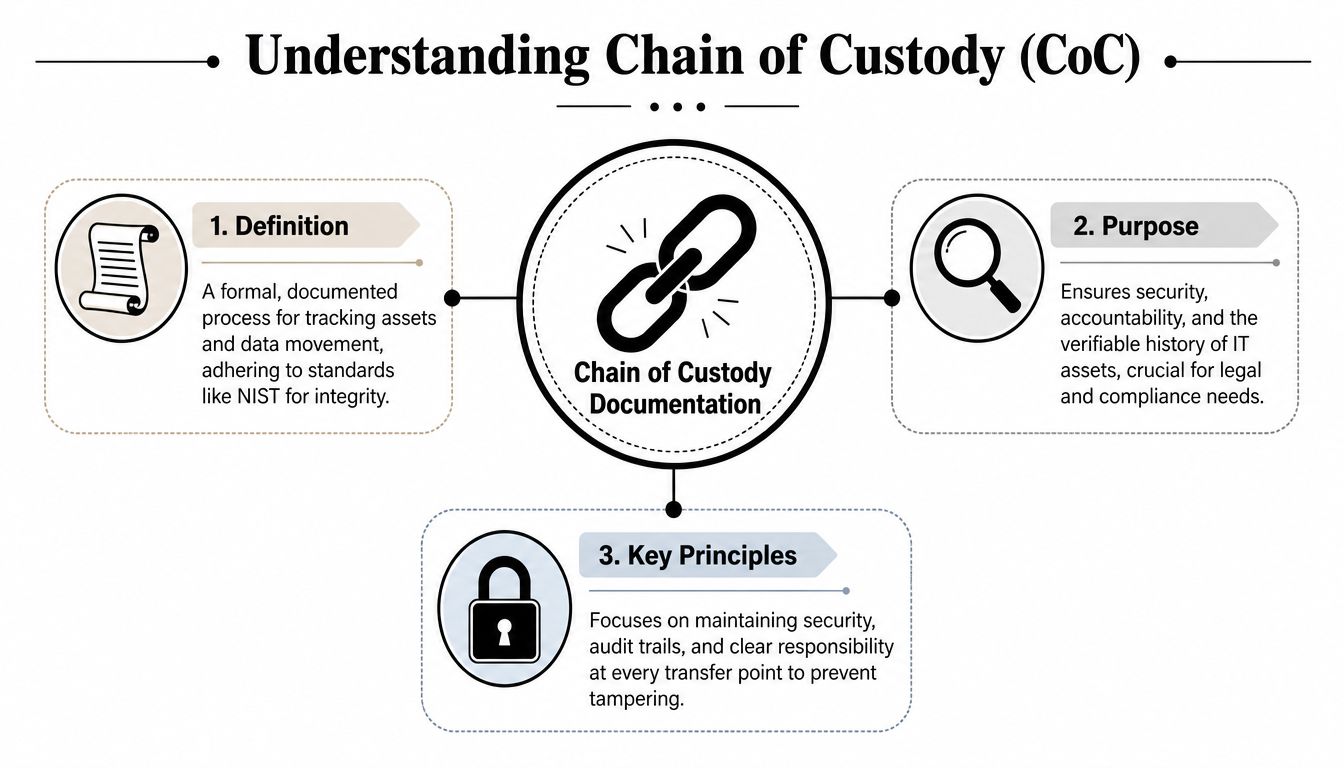
According to NIST, a chain of custody must document each person who handled evidence, the date/time of transfer, and the purpose. A defensible chain must answer four questions: Who performed the action, When it occurred, What changed, and Where the information resided. This ensures evidence is authentic and was not accessible for tampering, as summarized in this discussion of chain of custody under the NIST framework.
The four questions every record must answer
Who handled the asset
Names matter. Roles matter too. If a driver, warehouse receiver, destruction technician, or downstream processor touches the equipment, that person or authorized function needs to be visible in the record.
When the event occurred
A defensible record uses precise timestamps. “Received in the afternoon” isn't useful in an investigation. You need collection time, transfer time, intake time, and processing time recorded consistently.
What changed
Weak logs usually fail here. “Processed” says nothing. A usable entry states whether the asset was inventoried, moved to secure storage, data wiped, drive shredded, dismantled for recycling, or released for remarketing.
Where the asset resided
Location closes the loop. The record should identify the client site, vehicle custody, receiving dock, secure cage, processing line, or downstream facility involved at that stage.
A helpful way to think about this is the broader discipline of tracking product integrity. The same logic applies in ITAD. You are proving that custody remained controlled, visible, and attributable at every transfer.
A chain of custody record is only as strong as its weakest handoff.
If you want a practical example of how that applies in asset disposition, this overview of ITAD chain of custody in Georgia and why it matters is useful because it frames the record as a risk-control tool, not just a form.
Key Elements of an Ironclad CoC Record
A real CoC record is more than an inventory spreadsheet. It captures enough detail to verify the asset, validate the transfer, and defend the process later.
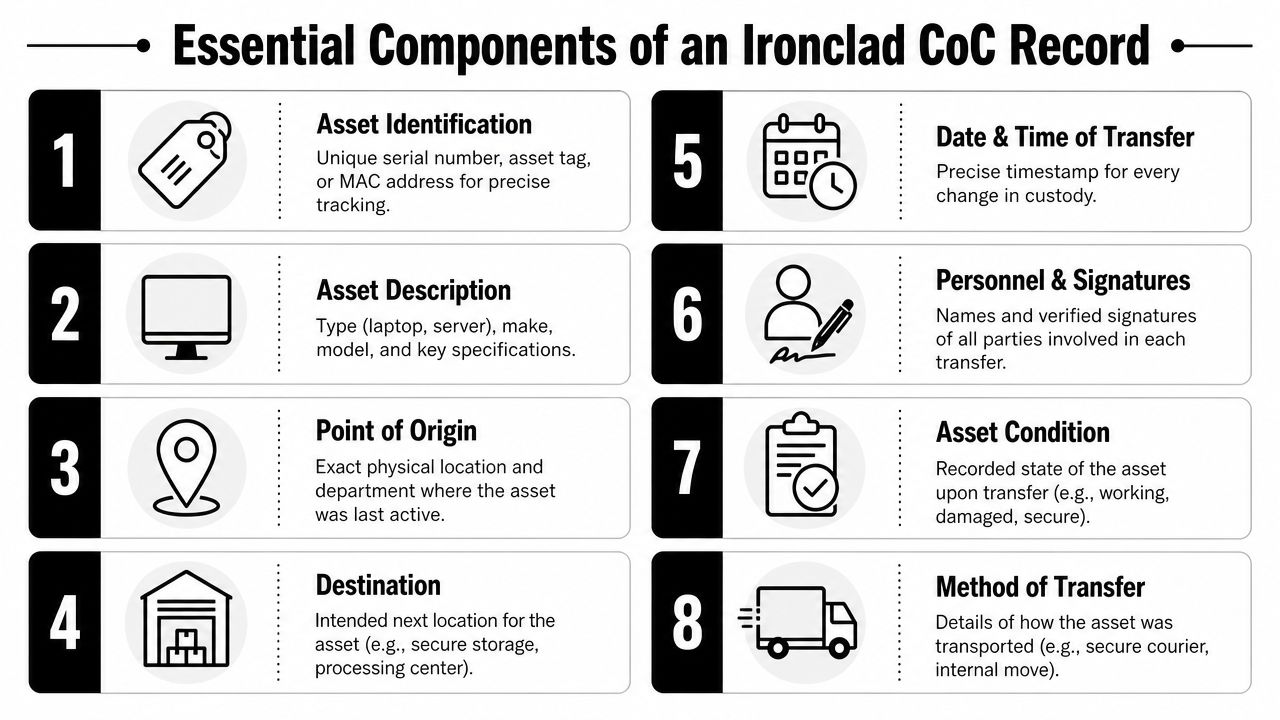
A typical CoC document requires specific data points like collection date/time, location, investigator names, media serial numbers, device model, storage capacity, and hash values for source drives and image files. Every transfer of charge requires a signature, date, and time to ensure integrity, as outlined in this guide on how to document chain of custody.
The non-negotiable fields
- Unique asset identifier: Serial number, asset tag, barcode, or another unique reference tied to that specific device.
- Asset details: Make, model, device type, and where relevant, media characteristics such as storage capacity.
- Collection record: Date, time, and physical location where custody began.
- Custodian details: Names and signatures for the releasing party and receiving party at each transfer.
- Condition notes: Whether the asset arrived sealed, damaged, powered, missing drives, or otherwise changed in status.
- Verification data for digital media: Hash values where forensic imaging or controlled digital verification applies.
- Transfer method: Internal move, secured vehicle, sealed container, courier route, or other documented transport method.
- Final disposition record: Data destruction, material recycling, remarketing release, or destruction certificate reference.
What works and what fails
A short comparison helps.
| Practice | Holds up | Fails under review |
|---|---|---|
| Asset identification | Serial number tied to a specific unit | “Box of laptops” |
| Transfer logging | Signature, date, time, recipient | Email saying “picked up” |
| Media verification | Hash values where applicable | Generic note saying “copied” |
| End-of-life proof | Documented destruction or recycling outcome | Verbal confirmation |
Some organizations are exploring more advanced traceability models, including serialized digital records and real world asset tokenization USA concepts, to reduce ambiguity across complex handoffs. The idea is sound. The record should travel with the asset history, not sit in disconnected spreadsheets.
Checklist test: If legal asked you to reconstruct one asset's full movement six months later, could you do it from the record alone?
For sensitive material, your documentation also has to close properly. A destruction certificate template is useful because it shows what the final record should contain when the chain ends with verified destruction rather than resale or recycling.
The CoC Journey in IT Asset Disposition
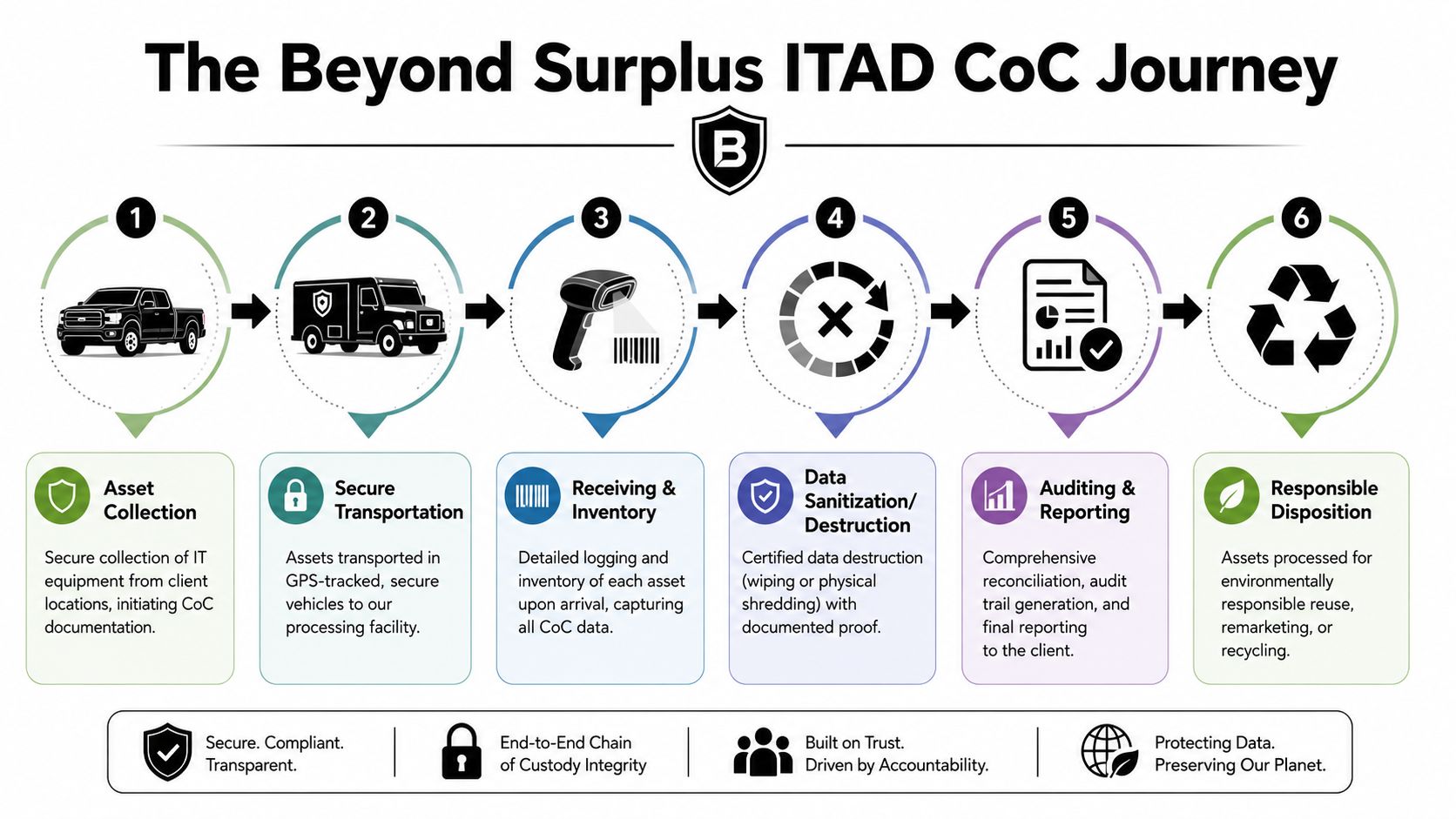
In real ITAD work, custody doesn't move in one clean step. It moves through pickup teams, vehicles, receiving staff, processing technicians, and reporting systems. Each stage either strengthens the record or weakens it.
On-site pickup
Custody starts at the client location. That's where teams should reconcile asset tags, serial numbers, counts, and release authorization before equipment leaves the premises. If bins or pallets are sealed, the seal reference should be captured at that moment, not added later from memory.
Secure transport
Transport is where undocumented gaps often appear. The equipment is no longer with the client, but it hasn't reached the processor. A disciplined program records vehicle departure, custody assignment, and intake expectation. If containers are signed or sealed, that condition should be verified again on arrival.
The most dangerous phrase in ITAD is “it was probably on that truck.”
Facility intake and inventory
When assets arrive, receiving staff should log them into the processing system against the pickup manifest. Exceptions matter here. Missing units, broken seals, extra devices, and mismatched serials should be documented immediately and escalated.
A strong intake process usually captures:
- Arrival time and receiving location
- Receiving custodian or team
- Manifest match or variance
- Asset condition at receipt
- Movement into secure holding or production
Data destruction and processing
This stage needs more than a broad status label. The record should show the method used. That could be logical sanitization, physical shredding, or another approved destruction path. For storage devices removed from parent equipment, the relationship between the device and the original asset should remain visible in the record.
For organizations new to the category, this overview of what IT asset disposition is gives useful context on how logistics, data security, and downstream processing fit together operationally.
Final disposition and reporting
The chain isn't complete when the truck unloads or when the drive is destroyed. It ends only when the record shows the last accountable event. That may be a certificate of data destruction, a recycling certificate, or documented release into approved remarketing.
CISA notes that effective CoC in critical infrastructure settings requires tamper-evidence serialization, unique asset identification, continuous electronic audit logging, access controls, and routine auditing to detect breaches in custody chains, as described in its guidance on chain of custody and critical infrastructure systems.
That's the operational standard worth aiming for. Not paperwork for its own sake. A complete, traceable asset history that survives audit, incident response, and legal review.
Why CoC Is Critical for Legal and Regulatory Compliance
A weak chain of custody doesn't just create uncertainty. It takes away your ability to prove that sensitive equipment was controlled properly.
In litigation or a regulatory inquiry, records need to show continuity. If the asset history has missing handlers, vague timestamps, or undocumented transfers, your organization may not be able to establish that the media remained secure and unaltered. That problem gets worse when disposal vendors, carriers, and downstream processors all maintain separate records.
Admissibility is a documentation issue
To ensure evidentiary admissibility in court, a rigorous CoC program must document seven data fields for every transfer, including unique identifiers, collector/recipient names, and precise date/time stamps. The absence of a complete CoC form that records every handoff renders digital or physical evidence inadmissible, as it fails to prove the evidence was not tampered with or "planted", according to the NCBI chapter on chain of custody procedures and requirements.
That principle matters well beyond criminal evidence. The same discipline supports disposal records used in internal investigations, breach response, and regulated data handling reviews.
Where compliance teams get exposed
- FTC Disposal Rule and FACTA matters: You need proof that data-bearing assets were handled and destroyed under controlled procedures.
- HIPAA environments: Covered entities and business associates need records that support secure handling of media containing protected information.
- PCI and log-sensitive operations: You need custody visibility that aligns with broader audit and security logging practices.
For teams reviewing their broader controls, a technical HIPAA and PCI log compliance guide is useful because it reinforces the same operational lesson. If access and handling events aren't logged consistently, you can't defend the process later.
Legal takeaway: Courts and regulators don't accept “we always do it this way” as proof. They accept records.
If your disposal process touches regulated data, the sanitization standard matters alongside the custody record. This summary of NIST SP 800-88 is relevant because it ties disposal documentation to recognized media sanitization practice.
How Beyond Surplus Delivers Defensible Documentation
The hardest custody problem in ITAD usually isn't pickup or shredding by itself. It's the handoff between parties. Client to carrier. Carrier to processor. Processor to downstream recycler. That's where unclear responsibility turns into dispute.
A commonly overlooked issue is third-party logistics. An FTC report found that 34% of ITAD liability disputes stem from ambiguous vendor handoffs, and 57% of leading ITAD firms now use advanced tracking or blockchain-based trails to automate handoff verification and reduce errors from manual logs, according to this discussion of chain of custody and third-party logistics challenges.
What a defensible partner process should include
A workable enterprise process should give you one continuous documentary trail across collection, transport, intake, processing, and final reporting. That includes:
- Defined handoff points: Every custody transfer should identify who released the assets and who accepted them.
- Asset-level traceability: Serial numbers, tags, or other unique identifiers should remain attached to the record through processing.
- Controlled downstream movement: If another party takes possession, the transfer record should show when responsibility moved and under what authority.
- Closure documents: Certificates of data destruction and recycling should complete the chain, not sit apart from it.
A specialized ITAD provider can reduce administrative risk. Beyond Surplus documents chain of custody through pickup coordination, processing records, and final certificates that help clients support compliance reviews and liability transfer. That matters most when internal teams don't want to reconcile separate logs from facilities, drivers, and processors after the fact.
What clients should ask before signing
Ask direct questions.
Who owns the record when assets leave your dock?
What document marks the transfer?
How are exceptions logged?
What proof do you receive when destruction is complete?
If a downstream vendor is involved, where is that handoff documented?
A credible answer won't be a sales promise. It will be a process description backed by sample documentation, named control points, and final certificates that match the original asset list.
The right ITAD relationship gives you more than removal service. It gives you an auditable record that can stand on its own years later.
Contact Beyond Surplus for certified electronics recycling and secure IT asset disposal backed by documented chain of custody, data destruction records, and enterprise-ready reporting.


