

Your Georgia office refresh is done. New laptops are deployed, old servers are powered down, and a stack of retired devices is waiting near the loading dock. That's the moment many IT directors start asking the right question: what happens to the data once those assets leave the building?
For Georgia businesses, that question isn't just operational. It touches security, compliance, audit readiness, and liability. Healthcare groups, financial firms, school systems, manufacturers, and government contractors all face the same exposure. If a device disappears in transit, if a hard drive is processed without documentation, or if final reporting doesn't match the original inventory, the problem isn't only the asset. It's the missing proof.
That's why ITAD chain of custody in Georgia matters. A real chain of custody gives you a traceable record from pickup through final disposition. It tells you who handled each asset, when they handled it, and what was done to it. If you're reviewing your own disposal process, this Georgia data destruction and ITAD compliance guide is a useful place to start.
The Hidden Risk in Your Retiring IT Assets
The risk usually starts in ordinary ways. A branch relocation leaves spare desktops in storage. A cloud migration retires racks of on-prem hardware. A laptop refresh turns one project into hundreds of devices that still contain email archives, saved credentials, customer records, employee files, and internal documents.
None of that equipment becomes harmless because it's obsolete.
Where businesses get exposed
The weakest point often isn't data destruction itself. It's the gap between your building and the processor. Devices get staged in unsecured areas. Pickup teams load mixed assets without reconciling them to an inventory. A pallet leaves the site, but nobody can later prove which serial numbers were on it.
If you can't match a specific device to a specific disposition event, you don't have control. You have assumptions.
That distinction matters in Georgia because many organizations operate under overlapping obligations. A hospital system has privacy pressure. A finance team has audit pressure. A federal contractor has documentation pressure. In each case, undocumented handling creates the same problem. You can't demonstrate due diligence after the asset leaves your custody.
What a paper trail actually protects
A proper chain of custody protects more than data. It protects the business position you may need later in an audit, legal review, insurance inquiry, or vendor dispute.
It should answer basic but decisive questions:
- Which asset moved from your site
- Who accepted it at pickup
- When each transfer happened during transport and processing
- What final action occurred such as sanitization, shredding, recycling, or remarketing
- What documentation supports that action
Without that record, retirement projects create avoidable ambiguity. With it, you can show control instead of trying to reconstruct events after the fact.
What Is an ITAD Chain of Custody
Think of chain of custody as the certified courier process for digital risk. If you were shipping high-value legal records, you wouldn't hand boxes to an unknown driver and hope for the best. You'd want itemized contents, named custodians, time-stamped handoffs, secure transport, and confirmation of delivery. IT assets require the same discipline, with one added complication: the value at risk is often the data, not the hardware.
A true ITAD chain of custody is an unbroken, device-level audit trail. It follows each asset from intake through final disposition.
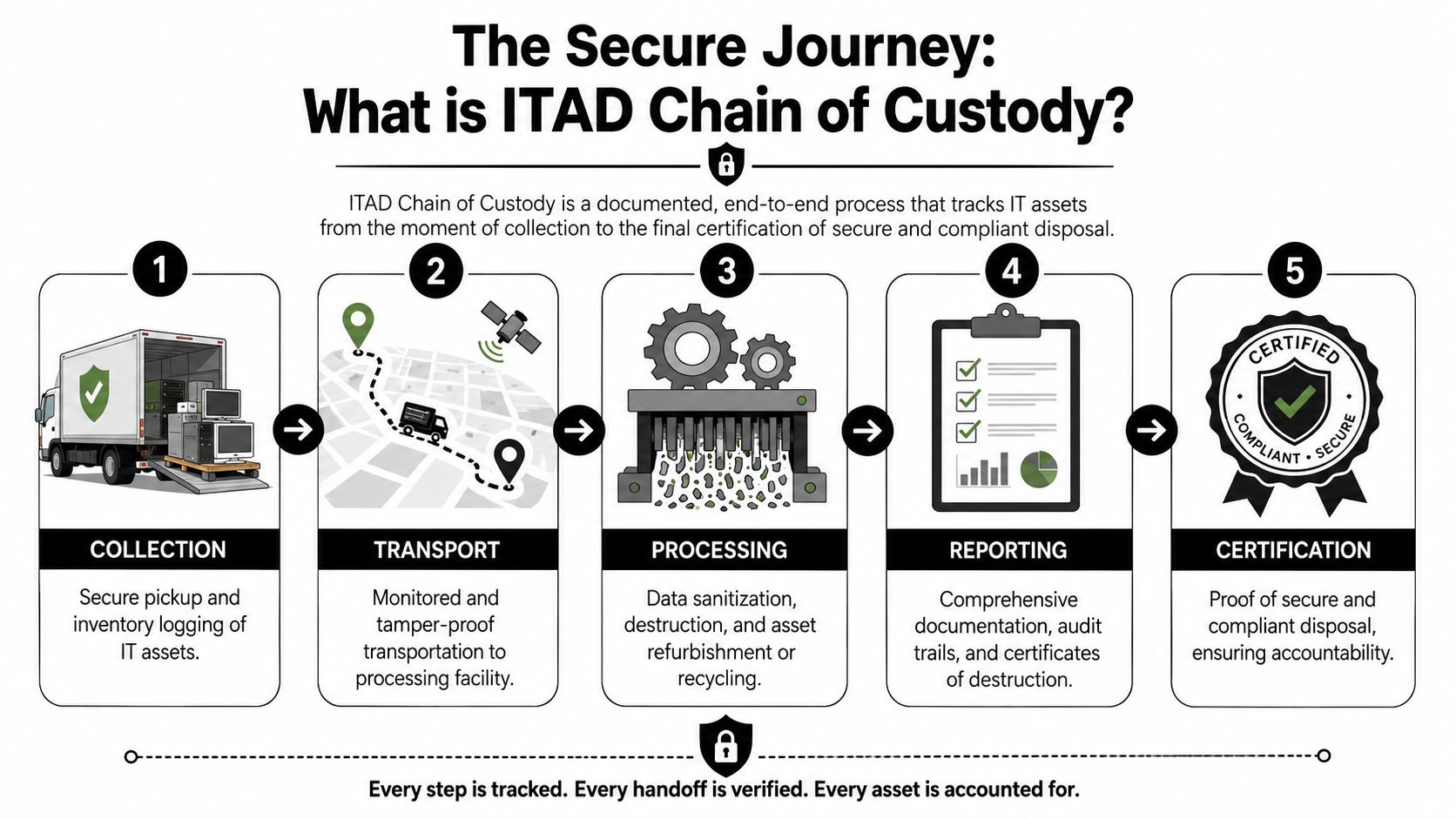
The records that matter
At a minimum, the record should document the who, what, when, and where of every material event. The most reliable programs track assets individually, not just by pallet or truckload.
A technically sound process should include:
- Asset identity through serial number, service tag, or another unique device identifier
- Custody transfers showing who released and who received the asset
- Timestamps for pickup, arrival, processing, and final disposition
- Transport details that show how the equipment moved offsite
- Storage conditions while the assets are staged or awaiting processing
- Final disposition status showing whether the item was wiped, shredded, recycled, or remarketed
According to guidance on chain of custody in ITAD from Synetic Technologies, strong implementations use unique barcodes or RFID labels at intake and reconcile every handoff against the original asset register to catch mismatches before devices leave the client's control.
What works and what doesn't
What works is simple, disciplined, and repeatable. Assets are scanned on-site. The pickup manifest matches the inventory. Exceptions are documented immediately. Final reporting ties back to original IDs.
What doesn't work is the loose version many companies accept by habit:
- Bulk counts without serials
- Unsigned handoffs
- Manual lists that never get reconciled
- Generic certificates that don't map to individual devices
Practical rule: If the vendor can't show you how one specific laptop moves from pickup to destruction record, the process isn't strong enough.
If you need a broader primer on disposition workflows, Beyond Surplus has a useful overview of what IT asset disposition means for business equipment.
Why Chain of Custody Is Critical for Georgia Businesses
For Georgia companies, chain of custody is where security practice meets business liability. Once an asset leaves your location, you need evidence that control didn't disappear with it.
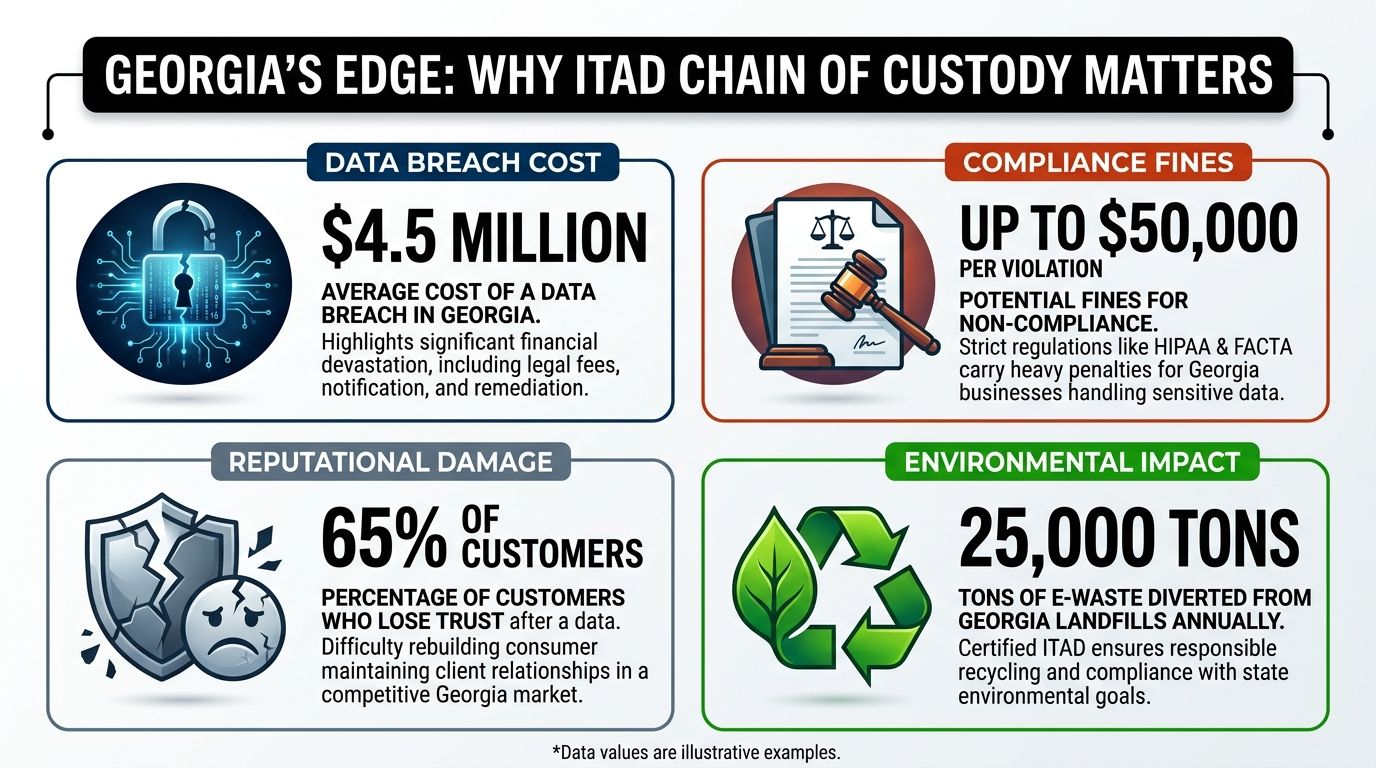
IBM's 2024 Cost of a Data Breach report found the global average breach cost reached USD 4.88 million, a 10% increase over 2023, while the United States average reached USD 9.36 million, as cited by Iron Mountain's IT asset lifecycle management page. Those numbers explain why disposal can't be treated as a warehouse cleanup task.
Why Georgia organizations feel this pressure directly
Georgia has a dense mix of regulated and audit-heavy sectors. That changes the disposal conversation.
A healthcare network needs to show that devices containing patient information were handled securely from pickup through destruction. A financial institution has to support internal controls and vendor oversight. A university must account for assets spread across departments and campuses. A government entity or federal contractor has to prove that custody didn't become informal once equipment moved offsite.
In each case, the issue isn't only whether data was destroyed. The issue is whether the organization can prove secure handling with records that hold up under scrutiny.
The liability shift many teams miss
A lot of internal teams assume outsourcing disposal transfers the risk automatically. It doesn't. Liability only becomes more manageable when the vendor process is documented well enough to demonstrate control, sanitization, and compliant destruction.
That's why chain of custody is foundational, not administrative. It's the evidence layer.
Consider the difference:
| Weak process | Defensible process |
|---|---|
| Driver takes mixed equipment with a rough count | Pickup manifest ties each asset to a device-level record |
| Processing report shows totals only | Final report maps original IDs to disposition outcomes |
| Certificate says “materials recycled” | Documentation shows sanitization or destruction path for each device |
| Missing asset discovered later | Exception appears at the handoff point |
The organizations that avoid ugly audit conversations are usually the ones that insisted on documentation before the truck ever arrived.
If you're evaluating your exposure, this overview of why ITAD services matter for Georgia companies connects disposal controls to broader compliance and governance concerns.
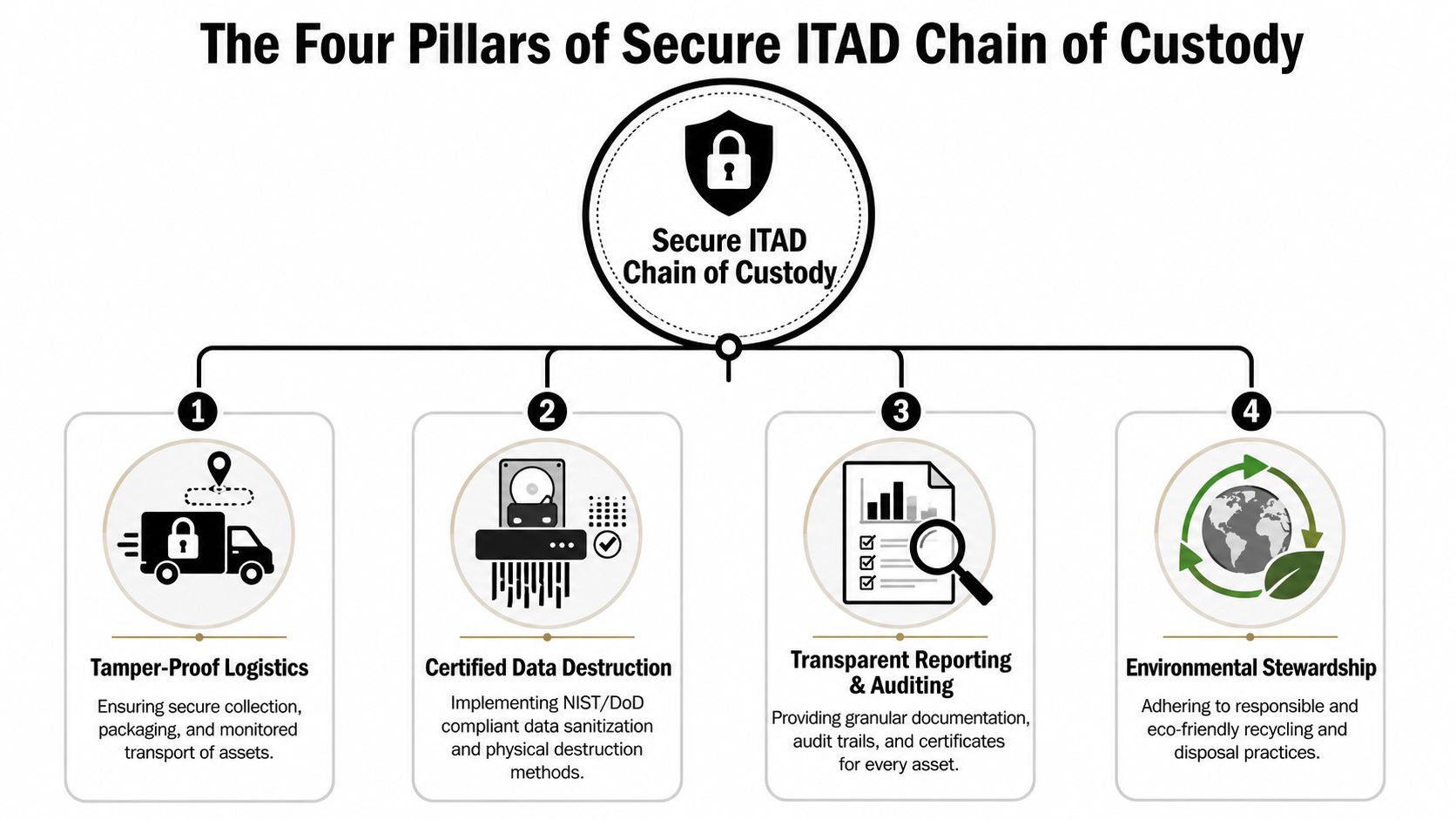
The Anatomy of a Secure Chain of Custody Process
A secure process isn't a single document. It's a sequence of controls that reinforce each other from the first scan to the final certificate.
The National Institute of Standards and Technology's SP 800-88 Rev. 1, published in December 2014, established the modern framework for media sanitization and emphasized retaining evidence of sanitization actions. As explained in this discussion of chain of custody and media sanitization, that evidence links pickup, wiping or shredding, and final reporting into one traceable record.
On-site inventory and serialization
The process starts before anything is loaded. Assets should be identified individually and matched against your internal disposition scope.
For some environments, that means scanning serial numbers from laptops and desktops. For others, it means validating server chassis, loose drives, network gear, and mobile devices against an asset register. If a tag is missing, the exception shouldn't be ignored. It should be logged and resolved before release.
Good intake control does two things at once. It reduces mistakes, and it creates the first defensible record in the custody chain.
Secure logistics and documented transfer
Transport is where many custody failures happen because it combines speed, physical movement, multiple personnel, and changing locations.
Strong logistics usually include:
- Signed transfer records at pickup
- Container or pallet controls that reduce tampering risk
- Time-stamped movement logs
- Reconciliation at arrival against the original pickup record
This is also where mixed-service jobs become risky. If a vendor is collecting reusable equipment, scrap electronics, and data-bearing media in one visit, controls have to stay aligned across all categories. Otherwise, the chain becomes vague right when accountability matters most.
Facility processing and data destruction
Once assets reach the processor, the documentation has to follow the device through every handling stage. A secure facility process separates intake, staging, sanitization, shredding, and downstream recycling into controlled steps.
What matters here isn't just that wiping or destruction happens. It's that the record shows:
- The method used
- The date of the action
- The technician or responsible party
- The verification result
That's the bridge between operational work and compliance proof. If a device is physically destroyed, the reporting should reflect that outcome. If it's sanitized for remarketing or redeployment, the verification has to be just as clear.
A certificate has value only when the underlying process can support it.
Final reporting and certification
The last stage is where many vendors oversimplify. A polished summary isn't enough if it can't be traced back to specific assets.
A useful final package typically includes a serialized inventory report, disposition outcomes, and certificates that support internal records retention. The best reports make audit prep easier because they remove guesswork. Your team shouldn't have to merge three spreadsheets and a pickup email to figure out what happened.
When those four pillars work together, chain of custody stops being a compliance talking point and becomes an operational control.
How Beyond Surplus Guarantees an Unbroken Chain of Custody
If you're comparing providers in Georgia, ask how their process works at the asset level, not how confident they sound in a sales call. The right answer should be operationally specific.
For example, Beyond Surplus ITAD services in Georgia describe a process built around pickup logistics, asset logging and inventory, secure data destruction, and final documentation that includes Certificates of Recycling and Data Destruction. Those are the kinds of controls business buyers should look for in any vendor relationship.
What a dependable provider should be able to show you
A provider with a mature chain-of-custody process should be able to walk you through:
- How assets are inventoried on-site before loading
- How handoffs are documented during pickup and transport
- How data-bearing devices are separated and processed
- How final reports tie back to the original inventory
- How liability transfer is supported through certificates and supporting records
That level of detail matters more than broad promises about security.
The practical standard to hold vendors to
In my experience, the best IT directors don't ask “Do you have chain of custody?” They ask, “Show me the exact record path for one server, one laptop, and one loose drive.” That question immediately reveals whether the vendor operates with process discipline or with generic paperwork.
A credible answer should describe actual handling steps, named documentation, and exception management. If the response stays high level, assume the controls do too.
One mention of a vendor's facility, trucks, certificates, or logistics model is useful. What matters more is whether the process gives your organization a clean audit trail you can defend later.
A Checklist for Vetting Your Georgia ITAD Partner
Most chain-of-custody failures don't begin with destruction. They begin with assumptions made during vendor selection.
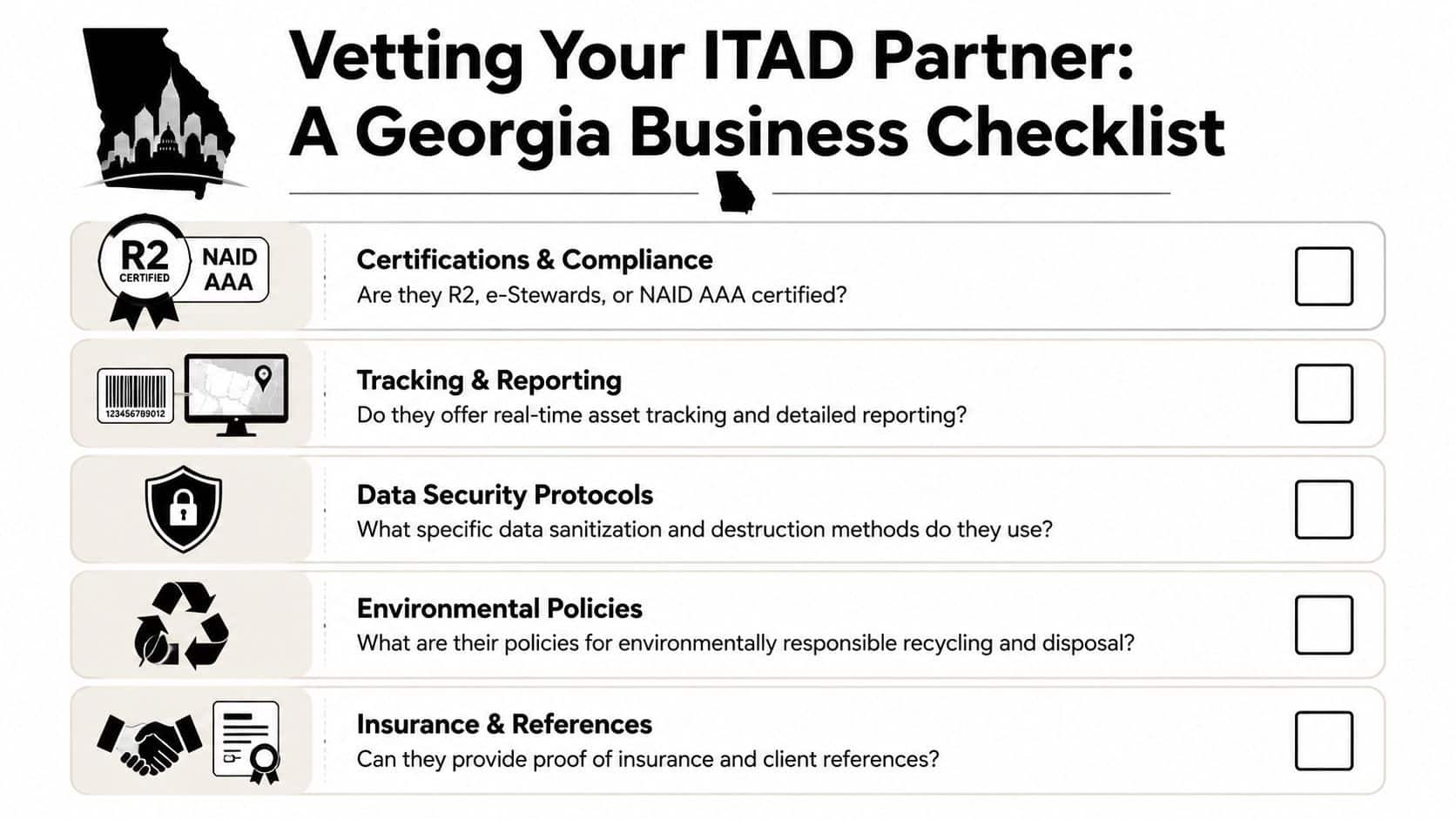
According to this review of common ITAD chain-of-custody gaps, problems often show up during loading-dock handoffs or multi-stop transportation when serial-number verification, signatures, and timestamps don't stay aligned. That's why your vetting process should focus on operational details.
Questions worth asking before you sign
Use this short list in every ITAD review:
On-site controls
Do you perform serialized inventory before loading, and how do you handle devices with missing or unreadable tags?Transfer discipline
Who signs custody at pickup, and what document records the handoff?Transport visibility
How do you keep asset records aligned if the route includes multiple stops or mixed-service collections?Processing proof
Does your final reporting show the original asset ID, the disposition method, and the verification result?Exception handling
What happens if a serial number doesn't match, an asset is damaged in staging, or a listed device is missing at arrival?Record retention
How long do you retain chain-of-custody and destruction records, and how are they retrieved during an audit or legal review?
Ask for sample documentation, not just verbal assurances. Good vendors can show their paperwork without hesitation.
For a broader procurement framework, this vendor due diligence checklist can help your team compare providers on process, reporting, and accountability.
If your organization is retiring laptops, servers, drives, or data center equipment in Georgia, work with a provider that can document every handoff and every outcome. Contact Beyond Surplus for certified electronics recycling and secure IT asset disposal.


