

A Georgia IT director can feel ESG the moment a retirement pile starts forming in a server room. The CFO wants a clean number for the annual report, the security team wants proof that drives are gone, and the facilities team wants the gear out of the way without creating a compliance mess. That's where How Georgia Businesses Are Meeting ESG Goals stops being a slogan and starts looking like a real operating decision, especially for companies handling laptops, servers, printers, and data-heavy equipment in Atlanta and Smyrna.
Table of Contents
- The Moment That Made ESG Real for a Georgia IT Director
- What ESG Means for Georgia Businesses
- The Environmental Pillar and Circular Electronics
- The Social Pillar and Workforce Accountability
- The Governance Pillar and Data Destruction
- A Secure ITAD Workflow in Practice
- Sector Strategies and KPIs Across Georgia
- A 90-Day ESG Action Plan for Georgia Organizations
The Moment That Made ESG Real for a Georgia IT Director
A mid-size Atlanta firm doesn't usually meet ESG in a boardroom first. It meets it in a stack of retired laptops, a dead printer fleet, and one server rack that has to leave the building before the next audit cycle. At that point, the question isn't whether the company supports sustainability. The question is who signs the paperwork, who tracks the asset serials, and who proves the data was destroyed.
That's the practical shift Georgia businesses are making. ESG is moving from broad intent to end-of-life execution, because retired IT hardware is one of the few places where environmental, social, and governance claims can all be documented in the same workflow. The process can support diversion from landfill, vendor accountability, and defensible data destruction in a way finance teams can verify.
Practical rule: if the asset leaves without a certificate, a chain-of-custody record, or a clear disposition path, it didn't help the ESG report much.
For teams trying to turn this into a quarterly KPI, the hardware pile becomes strategic. It can be inventoried, triaged for reuse, wiped or shredded, and sent into certified electronics recycling. That creates a usable trail for the ESG report and a cleaner answer when leadership asks what happened to the retired equipment.
Georgia firms don't need a philosophical debate at this stage. They need a repeatable process. That's why the rest of this article focuses on how the work gets done, what data gets captured, and where secure IT asset disposal fits into the larger ESG story. A useful starting point is the broader business transformation context in Atlanta, which is why many teams map their disposal process against their digital change plans, such as the overview at Beyond Surplus's Atlanta digital transformation page.
What ESG Means for Georgia Businesses
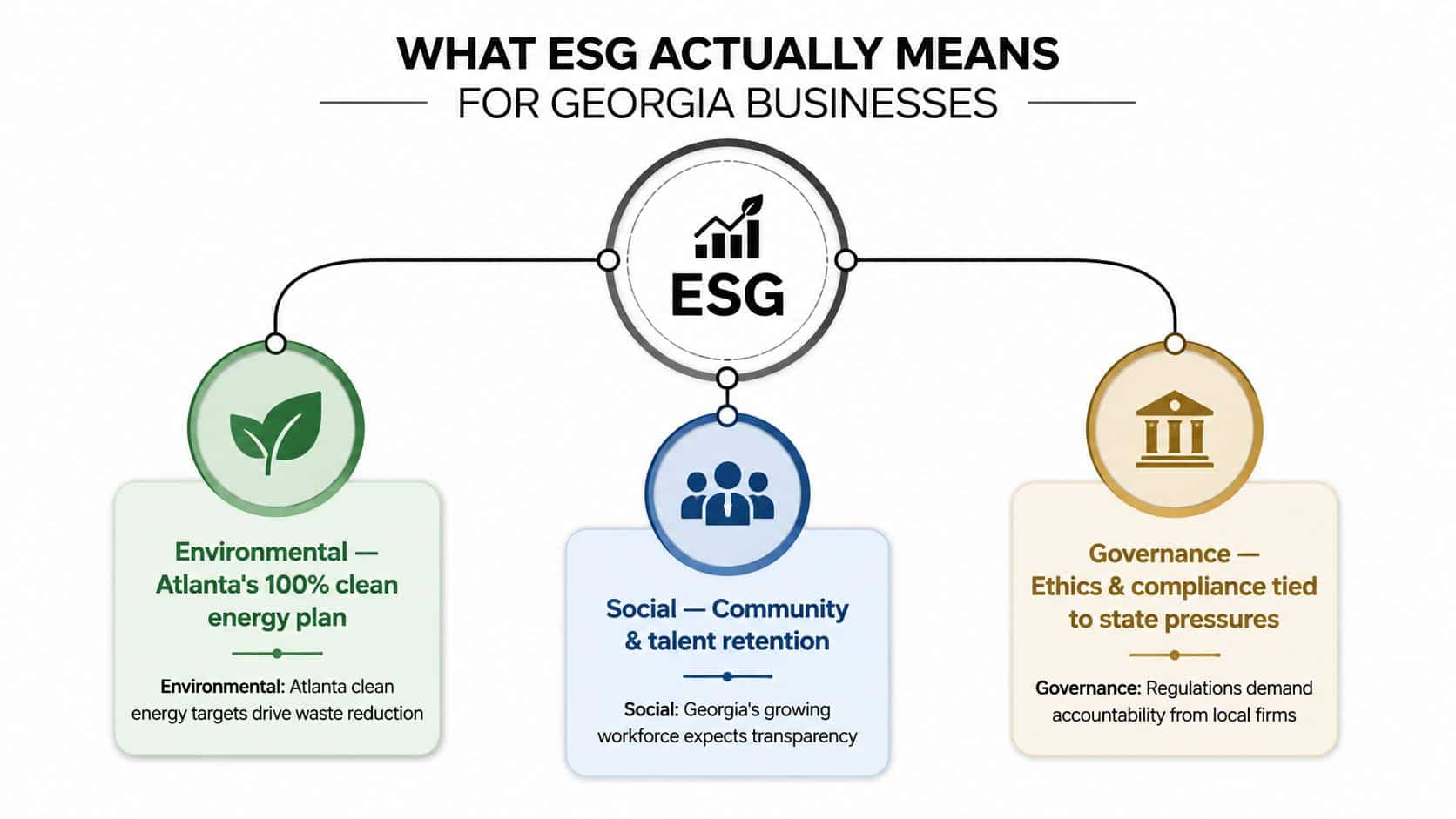
Environmental means measurable carbon and waste decisions
A Georgia company planning a hardware refresh cannot treat the environmental pillar as a slogan. Atlanta's sustainability goals include becoming a 100% clean energy community-wide by 2035 and reducing greenhouse gas emissions by 40% by 2030 Atlanta 100% clean energy and emissions reduction goals. At the state level, Georgia's climate commitment is tied to cutting greenhouse gas emissions by 35% below 1990 levels by 2030 UNDP Georgia transparency report.
That turns environmental performance into an operations decision. Which devices get reused. Which get recycled. Which move to certified downstream processors. For IT teams, those choices affect the company's waste profile and the credibility of any carbon narrative tied to refresh cycles, surplus inventory, or office relocations in Atlanta and Smyrna.
Social means workers, suppliers, and community access
Social ESG is about people, but the work shows up in vendor selection, labor practices, and access to reuse programs. A 2024 UN Global Compact Georgia report found that 6 companies had committed to the Living Wage objective under Forward Faster, directly benefiting over 10,200 employees UN Global Compact Georgia report. The same report showed five companies committed to Target 1 and one company committed to both Target 1 and Target 2.
That matters for IT disposal because refurbishment pathways and collection programs affect how value is shared. A recycling partner is not just a logistics vendor. It becomes part of the company's workforce footprint, supplier oversight, and community impact.
Governance means proof
Governance is the part that holds the rest together. It is the audit trail, serialized tracking, certificate set, and sign-off structure that lets environmental and social claims stand up under customer review, internal audit, and legal scrutiny. A disposal record has to show who handled the assets, where they went, and how the data was treated.
Georgia businesses that take ESG seriously usually take documentation seriously too. That is why Beyond Surplus's ESG trends and sustainable IT practices page belongs in the same conversation as energy goals and workforce commitments. The paperwork is part of the strategy, not an afterthought.
The Environmental Pillar and Circular Electronics
A retired server rack in Atlanta does not stop affecting ESG the moment it leaves the office. If it is handled well, it can move into reuse, parts harvesting, or certified recycling. If it is handled poorly, it turns into avoidable waste, extra risk, and weak reporting.
Why retired electronics belong in the environmental conversation
A laptop is more than an endpoint. It carries embodied materials, embedded energy, and a disposal choice that later shows up in ESG reporting. Georgia businesses that use certified electronics recycling and IT asset recovery create a documented path for equipment that still has value and a compliant path for equipment that does not.
The World Bank's firm-level analysis makes the measurement gap plain. It shows that Georgia firms still have room to build habits around innovation tracking and emissions monitoring, which makes disposal records more important than a lot of teams first assume World Bank analysis. That matters in practice because a disposal program often becomes the first place where companies can document what happened to aging devices instead of guessing after the fact.
Environmental reporting gets stronger when the disposal vendor can show where each device went, what was recovered, and what was recycled.
What IT leaders should track
A useful environmental dashboard for equipment disposition usually includes:
- Devices diverted from landfill, by asset class.
- Refurbishment or resale volume, where value recovery applies.
- Certified downstream routing, so the chain does not break.
- Carbon accounting inputs, tied to internal reporting methods.
Those data points do not appear by accident. They come from structured intake, serialized inventory, and certified processing. That is why circular electronics should sit inside the same ESG file as energy procurement and waste management, not off to the side as a facilities issue.
Atlanta teams and Smyrna teams face the same practical trade-off. The fastest disposal path is not always the cleanest one, and the cheapest vendor is not always the one that can document reuse, resale, and downstream recycling with enough detail for audit review. A circular economy electronics resource for Georgia businesses fits into that operating discussion because it focuses on what happens after the refresh cycle, not just on pickup day.
A good environmental program also keeps one eye on the asset value still sitting in the stack. A pallet of mixed equipment can contain working devices, repairable parts, and true end-of-life units, and those should not all be treated the same way. The right workflow separates them, records the decision, and supports both sustainability goals and finance expectations.
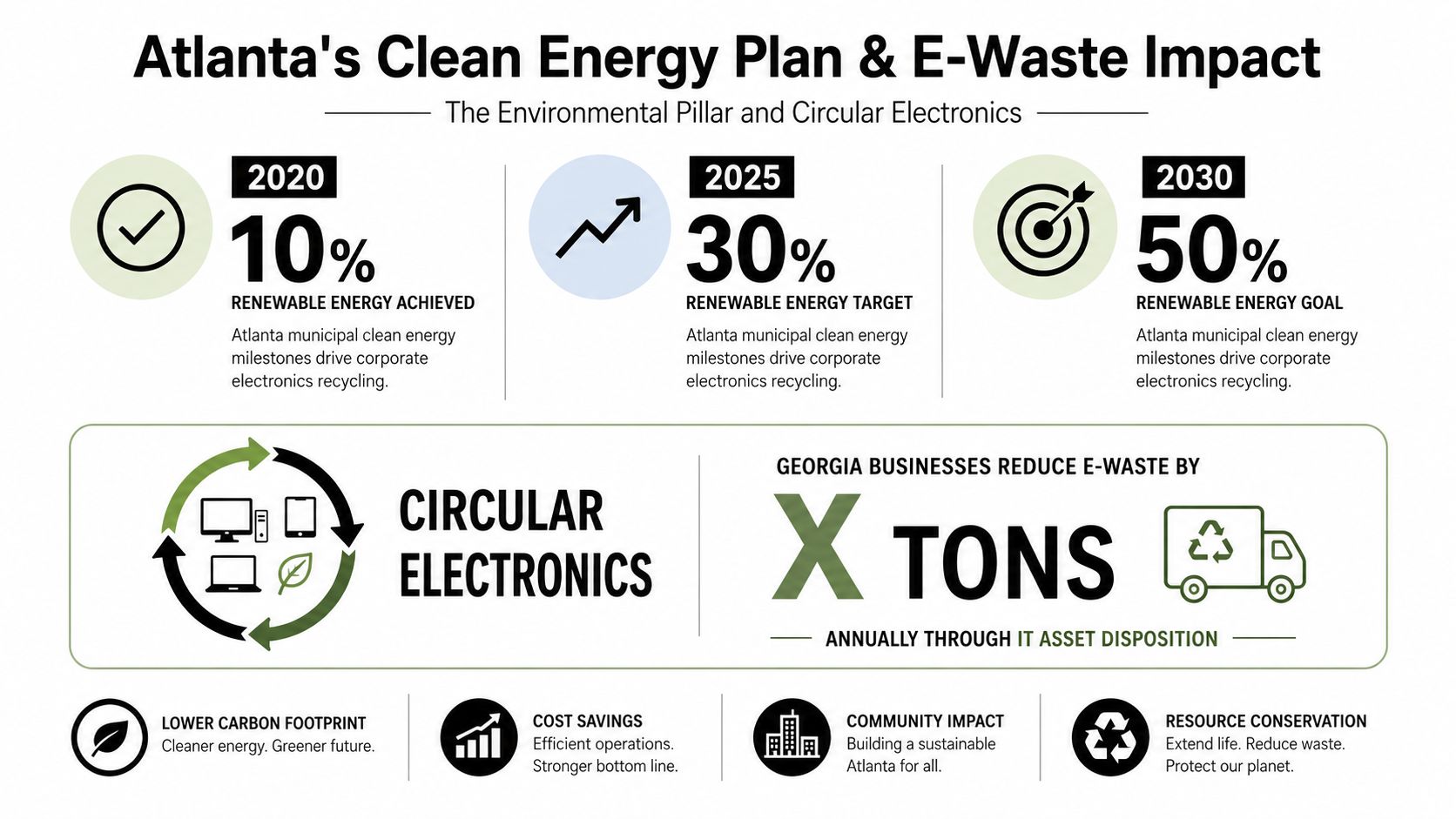
The clean energy goals Atlanta has set for the city provide a useful reference point for that discipline, and the operational lesson is simple. Build the disposition process so it can prove what was reused, what was recycled, and what left the system as waste. That is where environmental ESG stops being a slogan and becomes a file that stands up in front of procurement, audit, and leadership review.
The Social Pillar and Workforce Accountability
A Georgia IT director can have a clean recycling policy on paper and still miss the social pillar if the work behind it is weak. The test shows up in who handles retired laptops, how those workers are trained, and whether the process gives equipment a second use before it becomes scrap. For Georgia businesses, especially in Atlanta and Smyrna, social accountability starts at the vendor table and runs through every handoff.
Georgia's social ESG story gets more concrete when it moves out of broad statements and into workforce rules. The UN Global Compact Georgia material shows that companies are already acting on living wage commitments, and that lens applies to IT and recycling vendors too. Social impact is not just what a company says about the community. It is how it treats workers, suppliers, and the organizations that receive refurbished equipment.
Vendor selection is part of the social score
If a company outsources electronics recycling, the vendor's labor practices become part of the company's ESG profile. That includes how equipment is handled, whether workers are trained on safe procedures, and whether the process opens the door to reuse instead of forcing everything into disposal. In practical terms, social ESG means choosing a partner whose work supports responsible employment and transparent handling.
For IT and compliance teams, that also means looking at how the vendor documents staffing, access control, and processing discipline. A firm that can manage secure workflows and policy enforcement around sensitive assets has to prove it in the day-to-day work, not just in the proposal. Teams that need help hiring for compliance-heavy roles often look at adjacent tools and talent resources too, including the security compliance hiring page.
Community access matters in Atlanta and Smyrna
Social ESG also shows up in access. When organizations route usable equipment into refurbishment programs, schools and nonprofits can benefit from assets that still have productive life. That is not the same as a donation campaign, and it should not be described that way casually. It is a structured redistribution decision with compliance implications and a real community effect.
In Atlanta, that can mean retired office equipment getting a second life through controlled reuse instead of being sent straight to shredding. In Smyrna, it can mean a local business clearing storage space while helping a nearby organization receive equipment that still supports daily work. The environmental and social outcomes are connected, but the social value depends on whether the handoff is documented, lawful, and practical for the receiving group.
Georgia's SME guidance reinforces the need for practical execution, not just strategy language. The state's 2025 SME materials note that the UN Global Compact Network Georgia prepared ESG guidelines for small and medium-sized enterprises and trained companies on RBC/ESG principles Georgia SME strategy progress report. That matters because smaller businesses often do not have a sustainability department. They need workable instructions that can be built into procurement and vendor management.
The social pillar is easier to defend when the company can answer three questions cleanly. Who handled the devices? Who benefited from the process? Who can verify the labor and chain-of-custody trail? Those questions shape Beyond Surplus's social impact recycling approach just as much as they shape a broader ESG policy.
The Governance Pillar and Data Destruction
Governance is the part of ESG that keeps the rest from becoming vague marketing. If the company can't prove where the assets went or how the data was handled, the environmental and social claims don't hold up under review. That's especially true for IT leaders managing end-of-life laptops, servers, phones, and storage devices.
What defensible governance looks like
A solid ITAD governance process usually includes:
- Serialized intake, so every unit is tracked from pickup to final disposition.
- Certified data wiping or hard drive shredding, depending on the asset and risk profile.
- Certificates of recycling and data destruction, which support audit and compliance files.
- Chain-of-custody records, so the asset trail is complete.
Those controls matter because the FTC Disposal Rule expects companies to dispose of consumer information securely, and business teams often use the same discipline to support broader privacy obligations. When the vendor can document the process, it helps transfer operational liability away from the business and into a certified workflow.
Governance is where ESG stops being a claim and becomes a record.
Why board and audit teams care
Audit committees don't want a summary. They want evidence. Who approved the disposition? Which vendor touched the asset? Which devices were wiped, shredded, reused, or recycled? Those details let leadership sign off on ESG reporting with fewer blind spots.
This is also where legal and security teams meet. A resource like Coto & Waddington on startup security is useful because the same discipline that protects new systems also applies when old systems leave the building. If the governance model is weak at retirement, it's weak where it matters most.
Georgia companies that get governance right usually do one thing consistently. They treat data destruction documentation as part of the ESG evidence file, not just a security appendix. That's the difference between a clean narrative and a story that falls apart under a customer questionnaire. For teams standardizing that process, Beyond Surplus's secure data destruction guide fits directly into the control set.
A Secure ITAD Workflow in Practice
A workable ITAD program starts before the truck arrives. The asset list gets built, the devices get tagged, and the team decides what needs wiping, shredding, resale, or recycling. In Georgia businesses, that often means a pickup scheduled with a certified vendor using its own fleet or transportation partners, followed by intake that preserves serial numbers and condition notes.
The workflow that produces ESG evidence
Once the gear is in motion, the process usually follows a predictable order. Data-bearing devices are routed for certified wiping or hard drive shredding. Equipment with residual value can be assessed for IT buyback. The remainder goes through downstream certified recycling, with final documentation issued for the business file.
That workflow matters because each step generates a record leadership can use:
- Environmental records from diverted equipment and recycling outcomes.
- Social records from vendor handling, refurbishment, and reuse pathways.
- Governance records from chain-of-custody and destruction certificates.
A strong workflow also scales. The same structure works for data center decommissioning, medical equipment disposal, laboratory equipment disposal, and product destruction. The logistics change, but the reporting logic stays the same. A Smyrna SMB and a metro Atlanta enterprise can both use the same discipline, even if the asset mix is very different.
| Workflow Stage | ESG Pillar | Documented KPI |
|---|---|---|
| Asset inventory and pickup | Governance | Complete chain-of-custody trail |
| Data wiping or shredding | Governance | Certificate of data destruction |
| Reuse or buyback review | Environmental, Social | Value recovery or refurbishment path |
| Certified recycling | Environmental | Diversion from landfill |
| Final reporting | Governance | Audit-ready disposition summary |
That's why ITAD isn't a cleanup task. It's the operating engine behind the ESG story. The business gets the facility space back, the security team gets its proof, and the CFO gets a reportable process instead of a pile of loose ends.
Sector Strategies and KPIs Across Georgia
Healthcare, finance, education, manufacturing, and government
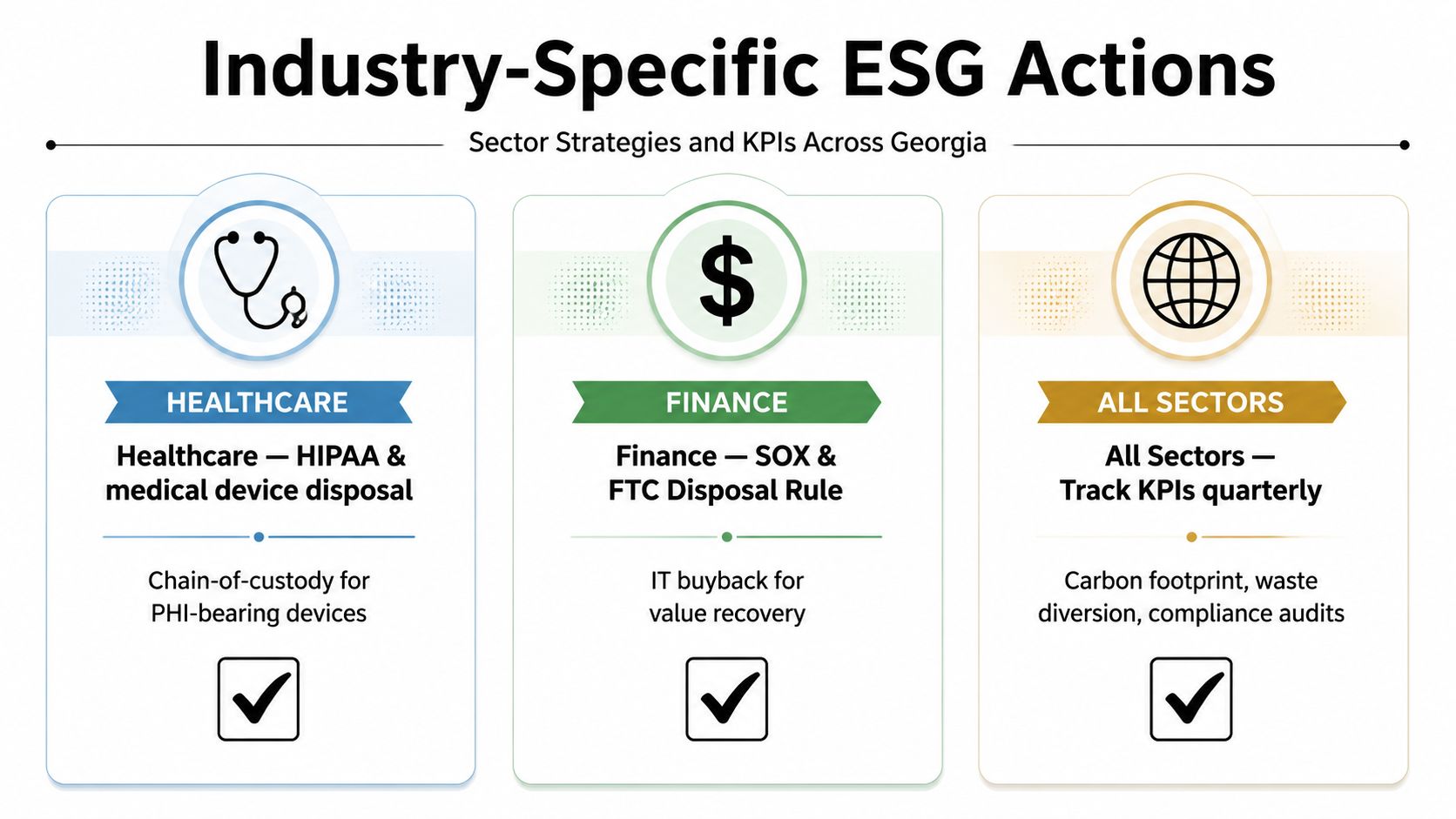
Healthcare teams usually care about HIPAA-aligned handling and medical device disposal, because PHI-bearing equipment can't leave on a guess. The KPI that matters most is a clean chain-of-custody record for regulated devices.
Finance teams focus on SOX discipline and the FTC Disposal Rule, then push for value recovery on still-depreciated endpoints. Their KPI is usually the percentage of retired equipment documented through buyback, wipe, or destruction.
Education and nonprofit organizations tend to care about bulk refresh programs. If the equipment can be refurbished, the benefit often shows up as more classroom technology getting reused instead of scrapped. Their KPI is the number of devices successfully redeployed or recycled with full paperwork.
Manufacturing and industrial firms need product destruction and serialized scrap audit trails. The main KPI is defensibility, because they're often judged on whether destroyed goods can be traced from pickup to final disposition.
Government and public sector teams usually write certification requirements into procurement language. R2v3 or e-Stewards language is common because it gives procurement and audit teams a clearer standard to hold vendors against. The KPI is contract compliance with the required processing standard.
The common thread
Each sector uses the same disposal backbone, but the reporting language changes. Healthcare calls it privacy risk reduction. Finance calls it control. Education calls it asset reuse. Manufacturing calls it destruction accountability. Government calls it procurement compliance.
That's why a single service model can serve all of them without flattening the differences. The logistics are similar, but the evidence file has to match the sector's risk profile. Georgia organizations that handle that well stop treating ITAD as a commodity service and start using it as a measurable control.
A 90-Day ESG Action Plan for Georgia Organizations
Days 1 to 30
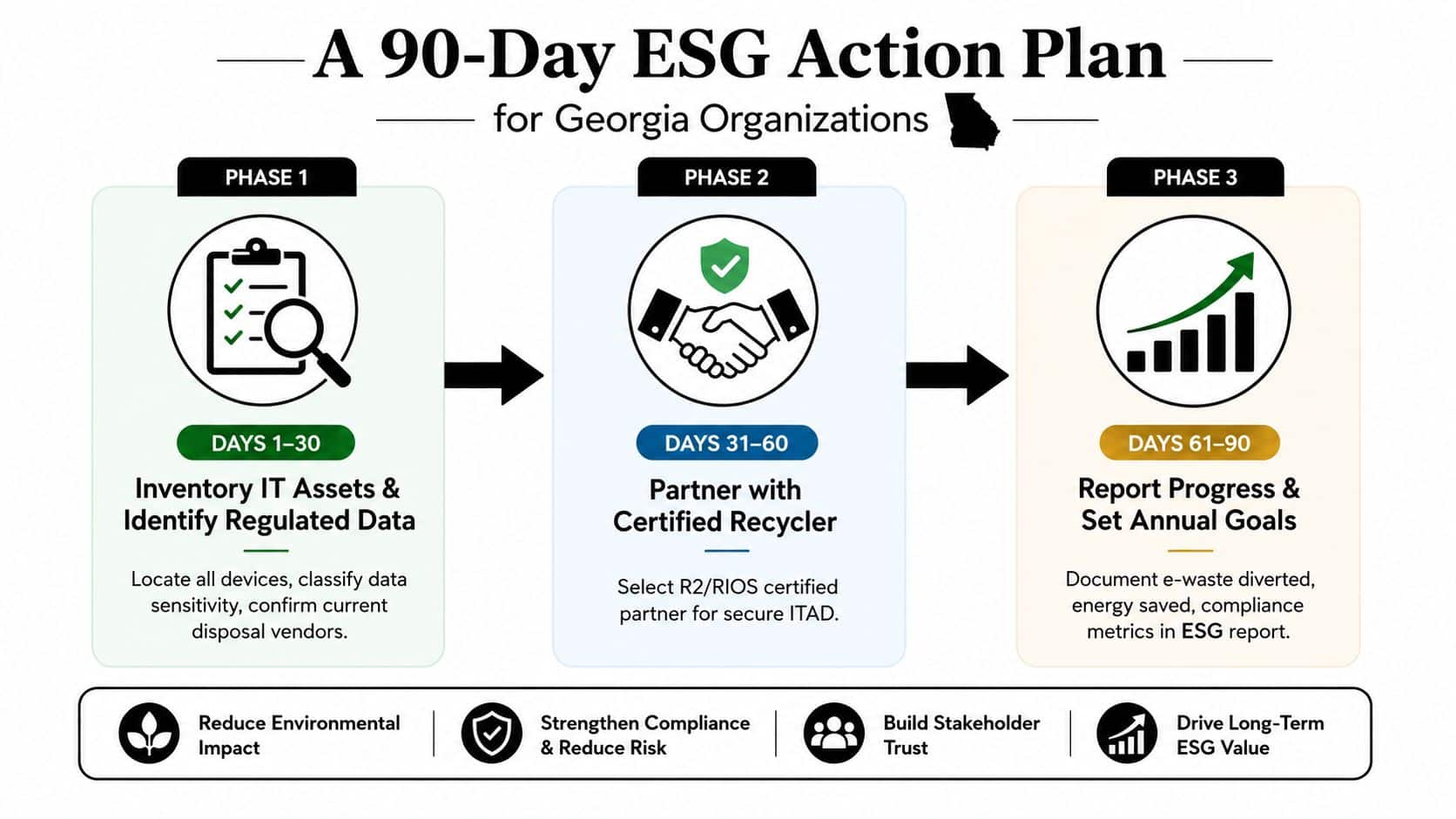
Start with a full inventory of retired and retiring IT assets. Identify which devices contain regulated data, which can be reused, and which need certified destruction. Then confirm whether your current vendors hold the certifications and documentation practices your auditors expect.
Days 31 to 60
Write the ESG metrics directly into your procurement and disposal process. Define how you'll track diversion, reuse, destruction, and documentation. Then schedule a secure pickup with a certified vendor such as Beyond Surplus so the process is tied to a real chain of custody.
Days 61 to 90
Close the loop. Collect certificates of recycling and data destruction, roll the figures into the ESG report, and document any value recovery from eligible equipment. If the numbers won't hold up in front of a CFO or audit committee, tighten the process before the next cycle.
The fastest way to get started is to use a single controlled workflow for everything leaving the building, then build the ESG report from that record. Contact Beyond Surplus for certified electronics recycling and secure IT asset disposal, and visit Beyond Surplus to schedule a pickup or request a customized proposal for your Georgia facility.


