

Atlanta's digital economy isn't constrained by demand, it's constrained by what the region can support. Georgia ended 2025 with 3.12 million internet users, 81.9% internet penetration, 3.05 million social media user identities, and 6.46 million cellular mobile connections, a footprint that shows broad digital reach and heavy multi-device usage, while 690,000 people still remained offline (DataReportal's Georgia digital profile). For Atlanta enterprise leaders, that combination changes the operating model. You can reach most customers and workers digitally, but you still have to design services, support, and retention workflows for the people and devices that sit outside the always-on assumption.
Table of Contents
- Atlanta's Digital Connectivity Profile by the Numbers
- The Data Center Construction Boom Reshaping Metro Atlanta
- The SMB Execution Gap South of I-20
- Public Sector Governance and Enterprise Compliance Alignment
- Hardware Refresh Cycles and IT Asset Disposal Challenges
- Strategic Recommendations for Atlanta IT Leaders
- Partnering for Secure and Sustainable IT Asset Disposition
Atlanta's Digital Connectivity Profile by the Numbers
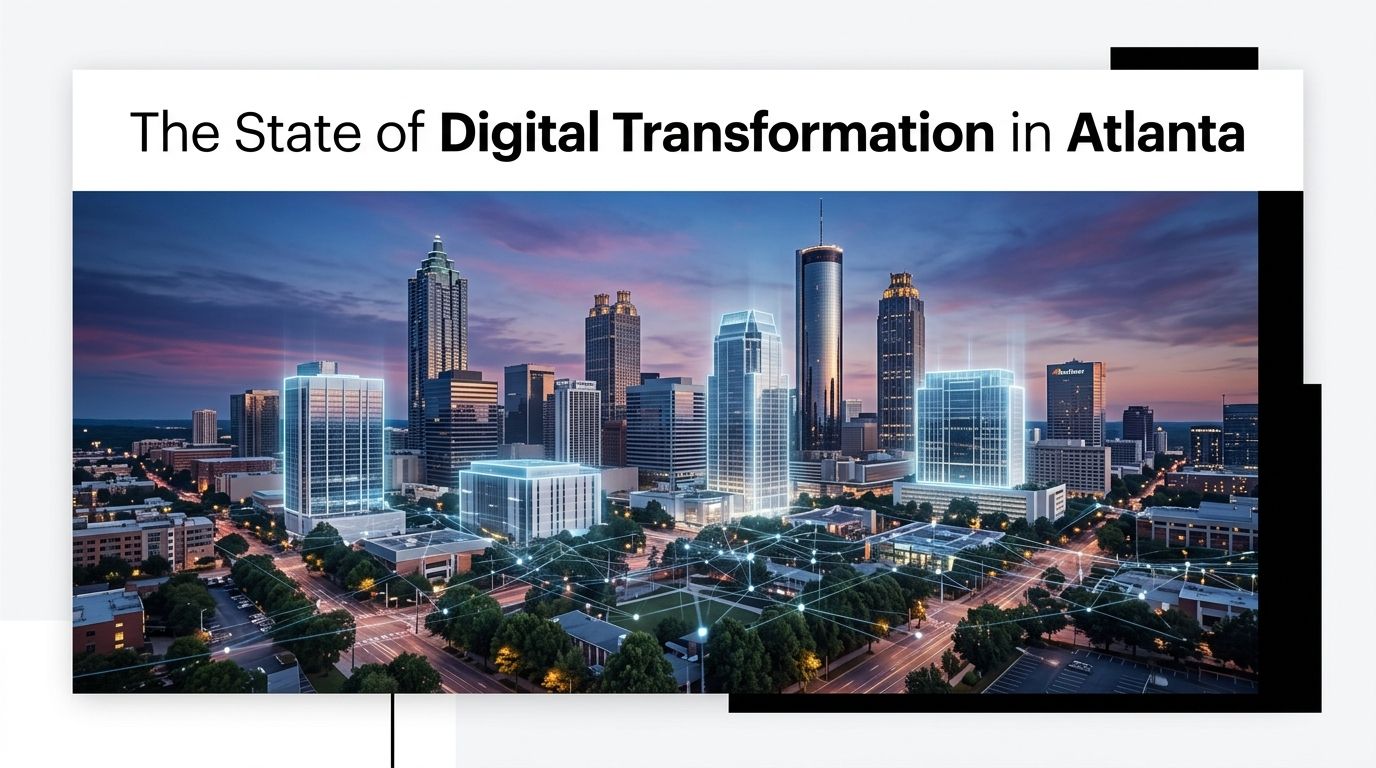
Georgia's connectivity profile sets both the ceiling and the floor for Atlanta's digital execution. 81.9% internet penetration gives the region a large reachable audience, but it also leaves a meaningful offline population that service design, onboarding, and support planning still have to account for. The 3.05 million social media user identities recorded in October 2025 show that social channels can still carry a substantial share of customer communication, while the 170% cellular connection rate points to a market where people routinely maintain more than one active mobile connection or device, as shown in DataReportal's Georgia report.
Reach is high, but assumptions still break
Atlanta businesses cannot treat digital transformation as a pure channel shift, because not every customer journey begins or ends on a connected device. A healthcare intake flow, procurement portal, or municipal service platform that assumes constant device access will frustrate users who are mobile but not always consistently reachable.
Practical rule: design every high-volume process for both the digitally fluent user and the user who needs a fallback path.
That matters for workforce tools too. Multi-device usage changes how IT teams think about identity, approvals, and endpoint support. A single employee may move between laptop, tablet, and phone, which means the core unit of management is not one device, it is the user's full access profile.
For Atlanta leaders, that scale also changes the economics of transformation. Broad connectivity makes automation and self-service realistic, but the offline minority still requires alternate handling for enrollment, delivery, and exceptions. That is where many rollouts fail, not in the technology stack, but at the edges where users fall out of the default digital path. For a local view of the industries tied most closely to this shift, see Beyond Surplus's Atlanta industry analysis.
The Data Center Construction Boom Reshaping Metro Atlanta
Metro Atlanta has become the country's hottest U.S. data center market since 2023, and the construction pipeline has roughly doubled every six months since mid-2023, according to CBRE tracking cited by GovTech (GovTech). That is not ordinary growth. It's compounding infrastructure buildout, the kind that changes how CIOs, colo buyers, and cloud architects plan around power, space, and interconnect timing.
Capacity is becoming a strategic constraint
Hyperscaler demand is part of the story, but it isn't the whole story. Low-latency connectivity and regional power and fiber availability are pulling more workloads into the metro, which means digital transformation teams now have to think like infrastructure planners. If the right facility isn't available, the modernization schedule slips, even if the application roadmap is ready.
Data center location is no longer a background procurement issue. It's a dependency that can delay migration, AI deployment, and disaster recovery work.
That has direct consequences for enterprise decision-making. Cloud-adjacent facilities matter more when teams are balancing performance, compliance, and proximity. At the same time, utility interconnect timing and competition for colocation space can reshape project sequencing, especially for firms that assumed Atlanta would always have enough capacity on demand.
What enterprise teams should watch
The winners in this environment are the teams that treat physical capacity as part of digital architecture.
- Plan power early. The electrical path is now part of the delivery plan, not a downstream detail.
- Build vendor alternatives. A single colo or interconnect option is too fragile when demand is accelerating this fast.
- Keep decommissioning aligned. Every new deployment creates retired hardware that has to leave the building cleanly and on schedule.
For a closer look at market conditions and infrastructure pressure, review Beyond Surplus's Atlanta data center overview. The broader point is that Atlanta's digital transformation is now bounded by the same things that shape any mature tech hub, power, land, fiber, and the speed at which those assets can be brought online.
The SMB Execution Gap South of I-20
The most useful question in Atlanta isn't whether digital transformation is happening. It's who can execute it. A Metro Atlanta Chamber-based report says 85% of local business leaders believe digital transformation is necessary, but only 42% feel their organizations are well equipped to execute it, with the gap described as especially sharp for SMBs south of I-20 (Infostream Global). That gap changes how leaders should interpret adoption headlines.
Awareness is not the same as readiness
Many smaller firms already understand the pressure to modernize. They just don't have the same buffer that large enterprises do. Capital is tighter, specialized talent is scarcer, and implementation time gets squeezed by day-to-day operations.
That's why cloud, AI, and automation often stall after the strategy deck. The tools are known. The operating model isn't. A firm may know it needs workflow automation, but if no one owns process redesign, data cleanup, and user training, the project becomes a software purchase instead of a transformation.
The geography matters
The mention of SMBs south of I-20 is important because it highlights a structural divide, not a branding issue. The challenge there is not a lack of ambition. It's a lack of spare capacity to absorb change. Larger firms can dedicate teams to migration, testing, and change management. Smaller ones often can't.
When adoption depends on one overextended IT manager, the technology plan is already underpowered.
That's why partnership models matter more than one-off software buys. Phased deployment, managed services, and reusable implementation playbooks are far more realistic than a big-bang modernization program. For Atlanta's smaller firms, the barrier isn't knowing what to buy, it's knowing how to absorb the change without breaking operations. A useful lens on that problem is Beyond Surplus's discussion of IT asset management trends for Atlanta SMBs.
Public Sector Governance and Enterprise Compliance Alignment
Atlanta's private sector doesn't modernize in a vacuum. The national policy environment has become more formal, and that changes what enterprises are expected to document, govern, and control. Across U.S. states and territories, 82% (46 of 56) had passed at least one executive order related to digital transformation since 2013, 58% (33 of 56) had enacted legislation regulating government use of AI since 2019, and 73% (41 of 56) had established a chief data officer position (The State of State Digital Transformation).
Governance is now part of the technology stack
That policy shift matters in Atlanta because enterprises here work alongside government contractors, universities, healthcare systems, and public institutions that are increasingly governed by data leadership, AI oversight, and service design expectations. Digital maturity now requires more than modern tools, it demands the ability to prove control through documented governance.
Georgia's own enterprise planning reinforces that point. The state has a formal Georgia Enterprise IT Strategic Plan, which signals structured IT modernization rather than ad hoc purchases. In practice, that means local vendors, large employers, and public-facing organizations are operating in an environment where governance discipline is visible and increasingly expected.
Georgia's GovTech record shows that the public portal already delivers over 700 fully transactional digital services, used by over 200,000 individual users and 1,500 business representatives; it also notes that more than 97% of taxpayers file online, 100% of state procurement auctions are online, and police-service reforms reduced manual transactions by 25–30% (World Bank case study). Those are operational signals, not slogans.
Atlanta firms that support public agencies or operate in regulated markets are already being measured against this standard. Governance is no longer a back-office control, it affects system design, vendor onboarding, data retention, and how quickly an organization can pass review. A practical reference point is Beyond Surplus's explanation of COSO framework controls, because it shows how control language maps to audit readiness and documented accountability.
Why enterprises should care
When public systems expect digital proof, private vendors and service partners have to match that standard. That changes onboarding, retention, audit readiness, and records management. It also changes procurement conversations, because compliance has to be built into the workflow instead of added after the rollout.
If your modernization plan can't survive a procurement audit, a records request, or an internal compliance review, it isn't finished.
For Atlanta leaders, governance alignment is now a competitive issue. The firms that manage data cleanly, document decisions well, and control automation responsibly will move faster when public-sector or regulated-sector opportunities arise.
Hardware Refresh Cycles and IT Asset Disposal Challenges
Atlanta's infrastructure buildout and AI adoption are producing a less discussed consequence, more hardware turns over sooner. Industry survey data show enterprise-wide AI adoption nearly doubled year over year, from 12% in 2025 to 24% in 2026. Even without overreading that figure, the direction is clear. Faster adoption means faster refresh, more retired endpoints, more decommissioned servers, and more storage media that has to be handled without leakage.
Modernization creates a disposal problem
Regulated sectors feel that pressure first. Healthcare, finance, government, and data center operators can't treat retired equipment as ordinary scrap. Every removed hard drive, SSD, router, or legacy workstation carries chain-of-custody risk until it is destroyed, wiped, documented, or transferred under a controlled process.
The risk isn't theoretical. Equipment that leaves a site without proper handling can create compliance issues, data exposure, and audit problems later on. The more aggressive the refresh cycle, the more those errors multiply. IT asset disposition has to sit inside the transformation plan, not at the end of it.
Secure decommissioning is part of the migration. If it starts after the new stack is live, the project is already behind.
What responsible lifecycle management looks like
A usable disposal program usually includes three things. First, chain-of-custody documentation that tracks assets from pickup through final processing. Second, certified data destruction for media that can't be reused. Third, a formal disposition path for equipment that still has recoverable value.
Environmental management and security overlap here. Obsolete equipment can't just be stored indefinitely, and it shouldn't be mixed into general waste streams. Atlanta organizations that plan the exit path early reduce on-site clutter, lower storage risk, and make audit preparation simpler.
For teams handling large refreshes, Beyond Surplus's secure IT asset disposal guidance for Atlanta companies is a relevant operational reference. The deeper lesson is that digital transformation produces a lifecycle burden, and the burden has to be designed for upfront.
Strategic Recommendations for Atlanta IT Leaders
Atlanta leaders need a plan that matches the region's new reality. The city has digital reach, growing infrastructure demand, uneven SMB readiness, and rising governance expectations. A generic modernization program won't survive all four pressures at once.
Build around constraints, not assumptions
Start with capacity planning. If your migration depends on colocation, low-latency interconnects, or cloud-adjacent compute, treat power, facility availability, and utility timing as core dependencies. Don't wait until procurement is complete to discover that the physical environment is the limiting factor.
Next, separate transformation by business segment. Large enterprise divisions can usually absorb more change at once. SMB units, satellite offices, and regional operations often need phased rollout, shorter training cycles, and tighter support windows. The execution gap described earlier is exactly why one-size-fits-all deployment fails.
Then hardwire governance into the roadmap.
- Define ownership early. Assign a named owner for data, AI review, and exception handling.
- Document controls. Keep enough evidence to satisfy audit, procurement, and records review.
- Select disposal partners before refresh begins. Device exit planning should happen alongside device purchase planning.
Finally, treat asset lifecycle as part of modernization design. If new systems require old systems to be retired, the decommissioning work needs schedule, custody controls, and exit criteria. Otherwise, the project creates hidden risk that shows up later in storage rooms, audits, and compliance reviews.
Partnering for Secure and Sustainable IT Asset Disposition
Atlanta's digital transformation is generating more than new applications and faster networks. It is also creating a steady flow of retired hardware that has to be handled securely, documented clearly, and processed responsibly. Certified IT asset disposition now sits inside enterprise risk management, because the risks do not end when a device leaves the rack.
Beyond Surplus supports that lifecycle with secure data destruction, electronics recycling, IT equipment disposal, data center de-installations, and IT buyback for recoverable assets, all of which fit the operational realities facing regulated and growth-focused organizations. A disposition partner should provide chain-of-custody records, certificates of recycling, and certificates of data destruction, since those documents help transfer liability and support compliance after assets leave the site. For Atlanta organizations working through refresh cycles, Beyond Surplus's disposition services for companies belong in the same planning track as cloud, AI, and infrastructure upgrades.
For enterprises, schools, healthcare providers, and government contractors, the decision is direct. If digital transformation is accelerating, end-of-life asset handling has to keep pace. Contact Beyond Surplus for certified electronics recycling and secure IT asset disposal, and build the disposal plan into the same calendar that governs your next refresh, migration, or decommissioning project.


