

A laptop refresh sounds routine until audit, legal, procurement, and security all ask different questions at once. Where are the retired devices? Who handled them? Were the drives wiped or shredded? Can you prove it? If your team manages end-of-life IT, those questions don't stay theoretical for long.
That pressure is growing. In the United States, the ITAD market is projected to grow from USD 12.39 billion in 2024 to USD 29.56 billion by 2033, at a 10.4% CAGR, driven by more e-waste, tighter regulation, and the need for data security, according to this U.S. ITAD market projection. As disposal volume rises, so does scrutiny.
Many IT leaders already deal with similar governance questions outside asset retirement. Nonprofits, for example, often face overlapping documentation and oversight demands, which is why resources on understanding Form 990 compliance can be useful for seeing how reporting discipline supports trust. In IT, the same idea applies to retired servers, laptops, and storage media.
COSO is particularly helpful. It gives you a structured way to define risk, assign responsibility, document controls, and show that your process works. For IT managers balancing security and operations, it can bring the same discipline to hardware disposition that companies expect in finance and procurement. That matters just as much in supply chain resilience planning as it does in the data center.
Introduction The Growing Pressure for IT Compliance
The daily reality for IT teams
An IT director might start the morning approving replacement laptops, spend lunch reviewing a vendor pickup list, and end the day answering whether a batch of decommissioned drives has defensible destruction records. None of those tasks sits neatly in one department. They cut across security, compliance, facilities, finance, and sustainability.
That's why end-of-life technology creates so much tension. A device can hold regulated data, residual resale value, and environmental liability at the same time. If one step breaks, the whole chain becomes hard to defend.
Practical rule: If your team can't show who handled an asset, what happened to its data, and how final disposition was recorded, your process is exposed even if the intent was sound.
Why governance matters before disposal happens
Most IT teams already have technical procedures. The harder problem is consistency. One site uses certified wiping, another uses ad hoc handoffs, and a third relies on spreadsheets no one fully trusts. COSO helps unify those moving parts into a control system people can follow and auditors can test.
That's why the framework matters beyond finance. It helps translate broad requirements into operational behaviors. For IT leaders, that means approved workflows, evidence retention, exception handling, and escalation paths that don't depend on tribal knowledge.
What Is COSO and Why It Matters for IT Leaders
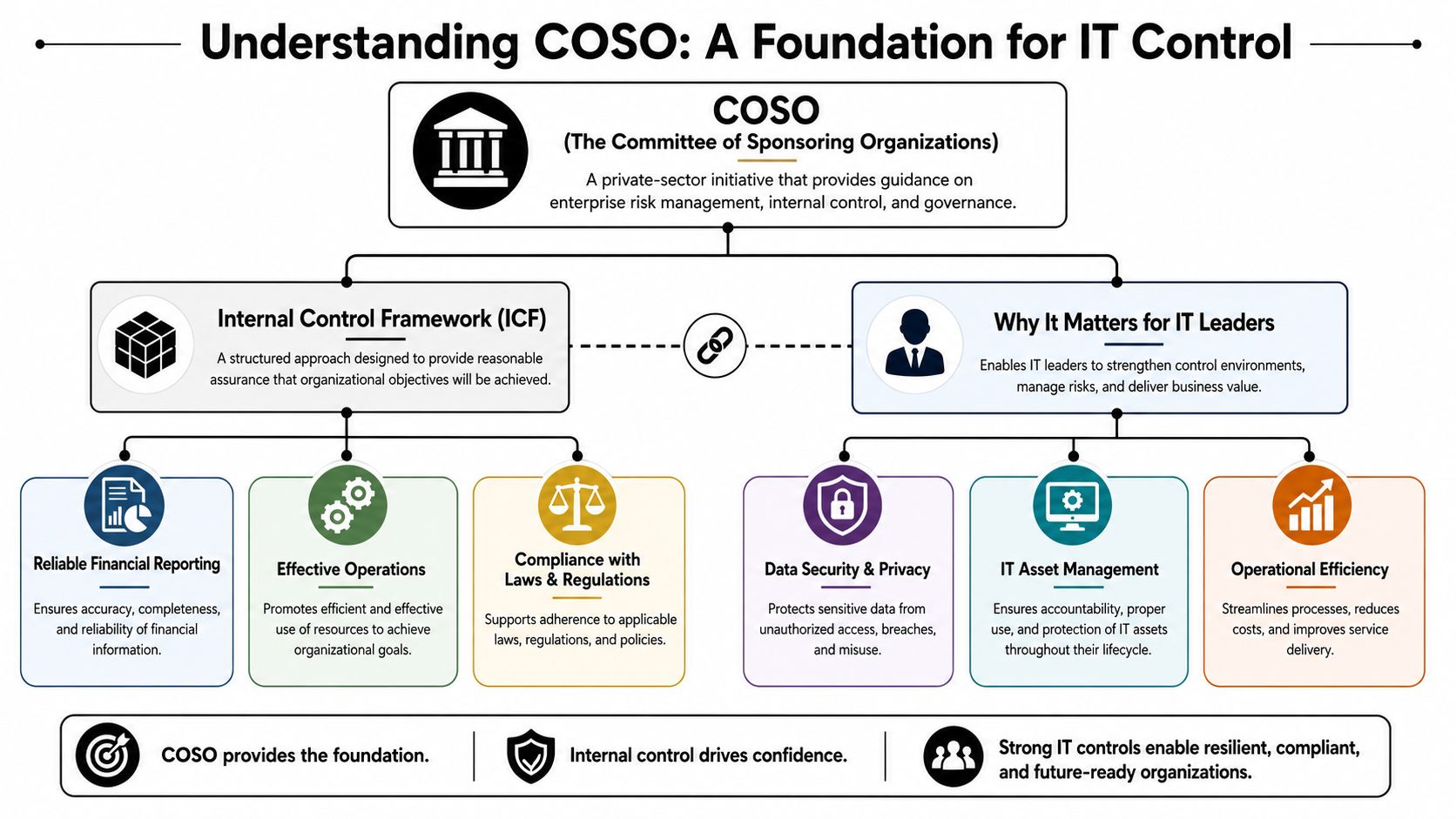
Think of COSO as the blueprint for a reliable control system. Not the building itself, and not the people doing the work, but the design standard that helps the whole structure hold together under pressure.
The Committee of Sponsoring Organizations of the Treadway Commission, or COSO, was established in 1985 and released its foundational Internal Control, Integrated Framework in 1992, refreshed in 2013. It is the primary basis for public companies to satisfy Section 404 of the Sarbanes-Oxley Act, and it is built on five core components and 17 principles, as summarized in this COSO framework overview.
Why IT managers should care
Some readers hear COSO and think, "finance controls." That's too narrow. COSO is really about whether an organization can set objectives, identify risk, put controls in place, and monitor whether those controls work.
For IT, that applies directly to:
- Data security: Preventing drives, SSDs, and mobile devices from leaving control without verified sanitization.
- Asset management: Making sure inventory records match physical devices throughout pickup, storage, and final disposition.
- Operational integrity: Standardizing how teams, vendors, and locations follow the same process.
A good way to think about it is this. Technical standards tell you how to perform a task. COSO helps determine whether the organization designed the right oversight around that task. That distinction matters when you're reviewing IT vendor management best practices and deciding whether your disposal process is merely operational or actually controlled.
COSO doesn't replace IT procedures. It makes those procedures defensible.
What is COSO in plain language
If someone asks, "What is COSO?" the simplest answer is: a framework for internal control and risk management that helps organizations operate reliably, report accurately, and comply with rules they can't ignore.
That's why boards, auditors, compliance teams, and IT leaders all end up using the same language around it.
Navigating the Two Core COSO Frameworks
A common source of confusion is that people say "COSO" when they mean one of two related frameworks.
Internal Control versus ERM
The first is the Internal Control framework. This framework is commonly referenced in audits and control design. It focuses on whether specific controls exist and operate effectively.
The second is Enterprise Risk Management, or ERM. COSO's ERM framework helps organizations identify events affecting their objectives, assess risk, and select responses aligned with their risk appetite. It isn't a regulation, but it is a widely used model for improving risk management systems, as explained in this COSO ERM framework summary.
A simple way to separate them
| Framework | Best way to think about it | Typical ITAD use |
|---|---|---|
| Internal Control | Tactical playbook | Chain-of-custody logs, asset verification, destruction evidence |
| ERM | Strategic game plan | Deciding how much disposal risk the company accepts and how vendors fit that model |
Internal Control asks, "Do we have the right checks?"
ERM asks, "Are we managing the right risks in the right way?"
That distinction becomes useful when you're aligning disposal controls to technical standards such as NIST SP 800-88 guidance. NIST can inform the sanitization method. COSO helps define the governance around approval, evidence, oversight, and exception management.
Why both matter
An IT manager usually lives closer to Internal Control. You're dealing with tickets, inventories, pickups, and proof. Senior leadership often operates closer to ERM. They care about exposure, tolerance, insurance, regulatory posture, and vendor dependency.
For organizations that manage grants or restricted funds, broader governance thinking can also help strengthen your CEF's compliance because the challenge is similar. Leadership needs a consistent model for deciding which risks deserve formal control and who owns the response.
The 5 Components and 17 Principles Explained
The COSO framework is built around five connected components. They work together, not as isolated checkboxes.
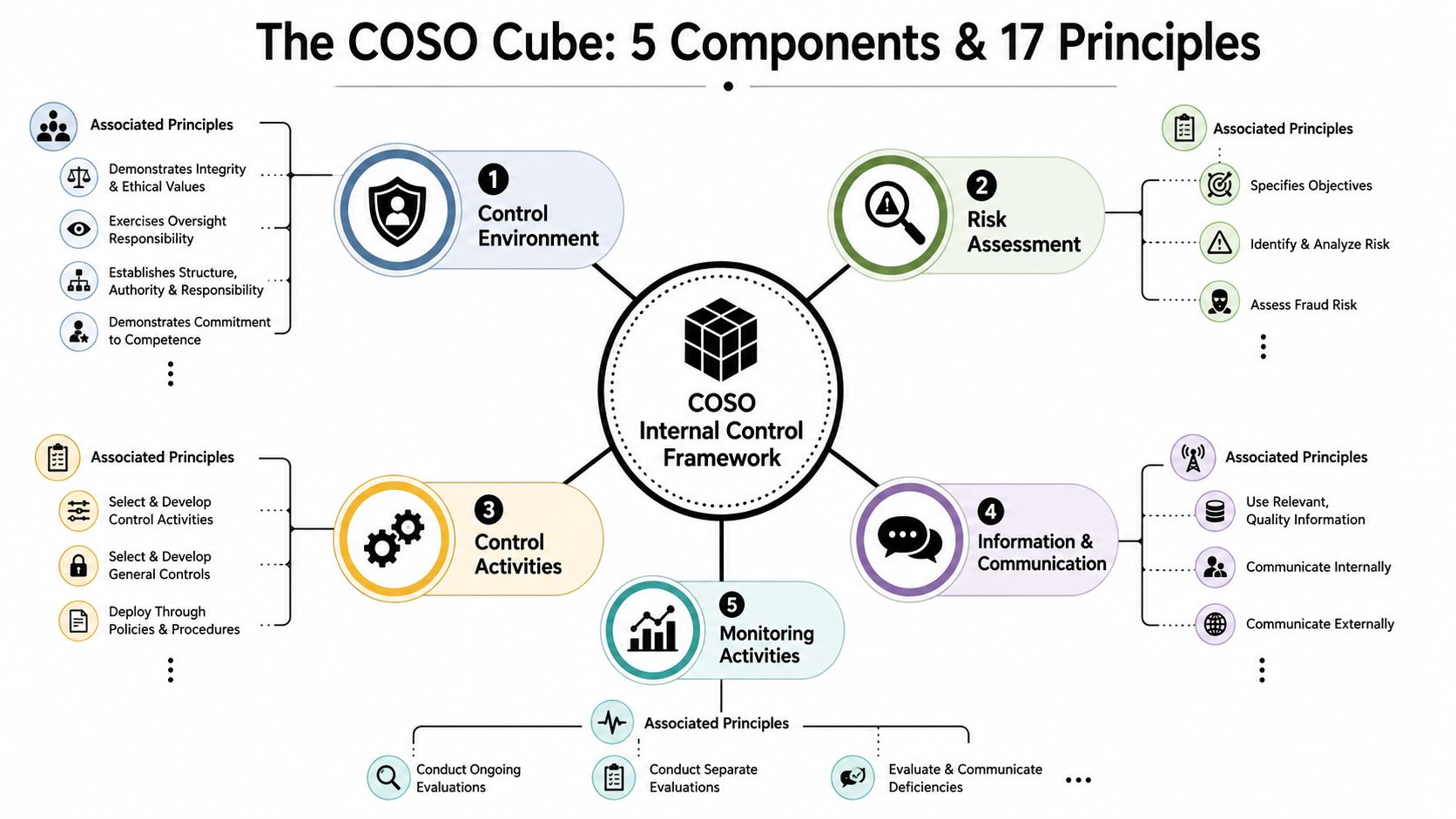
Control Environment
This is the tone of the organization. It covers accountability, authority, and expectations. In IT, that means leaders don't treat data destruction as an afterthought. They define who approves asset retirement, who releases equipment, and who reviews documentation.
If the culture says, "Just get old equipment out of the building," control weakness starts early.
Risk Assessment
Risk assessment asks what could stop the organization from meeting its objectives. In ITAD, risks include data exposure, missing assets, weak vendor oversight, and incomplete reporting.
A strong risk assessment doesn't stop at obvious cyber risk. It also asks whether process changes, office moves, acquisitions, or rushed refresh cycles could break disposal controls.
A retired server isn't low risk just because it's powered off. Risk follows the data until verified disposition is complete.
Control Activities
These are the concrete actions people perform. Examples include requiring asset tags at pickup, segregating approval duties, restricting access to stored devices, and matching destruction records to inventory lists.
IT teams often spend the majority of their time on this. But control activities only work well when the first two components are clear.
Information and Communication
Controls fail when teams don't have accurate information or don't share it. IT, procurement, legal, and facilities need the same asset status, not four conflicting versions. External communication matters too, especially when vendors provide destruction or recycling records.
Short, reliable reporting beats long, unclear reporting every time.
Monitoring Activities
Monitoring means checking whether controls still work after rollout. That can include reviewing sample transactions, investigating exceptions, and confirming that breakdowns are corrected.
A simple monitoring habit can reveal a lot:
- Match records: Compare sample asset lists to final disposition documents.
- Review exceptions: Investigate devices with missing serials or incomplete handoff records.
- Check timeliness: Make sure evidence arrives when expected, not weeks later.
- Escalate gaps: Route unresolved issues to the right owner, not just the busiest person.
The 17 principles sit underneath these five components. You don't need to memorize all of them to benefit from COSO. You do need to understand that COSO expects the system to be complete, connected, and functioning as designed.
Putting COSO into Practice in IT Asset Disposition
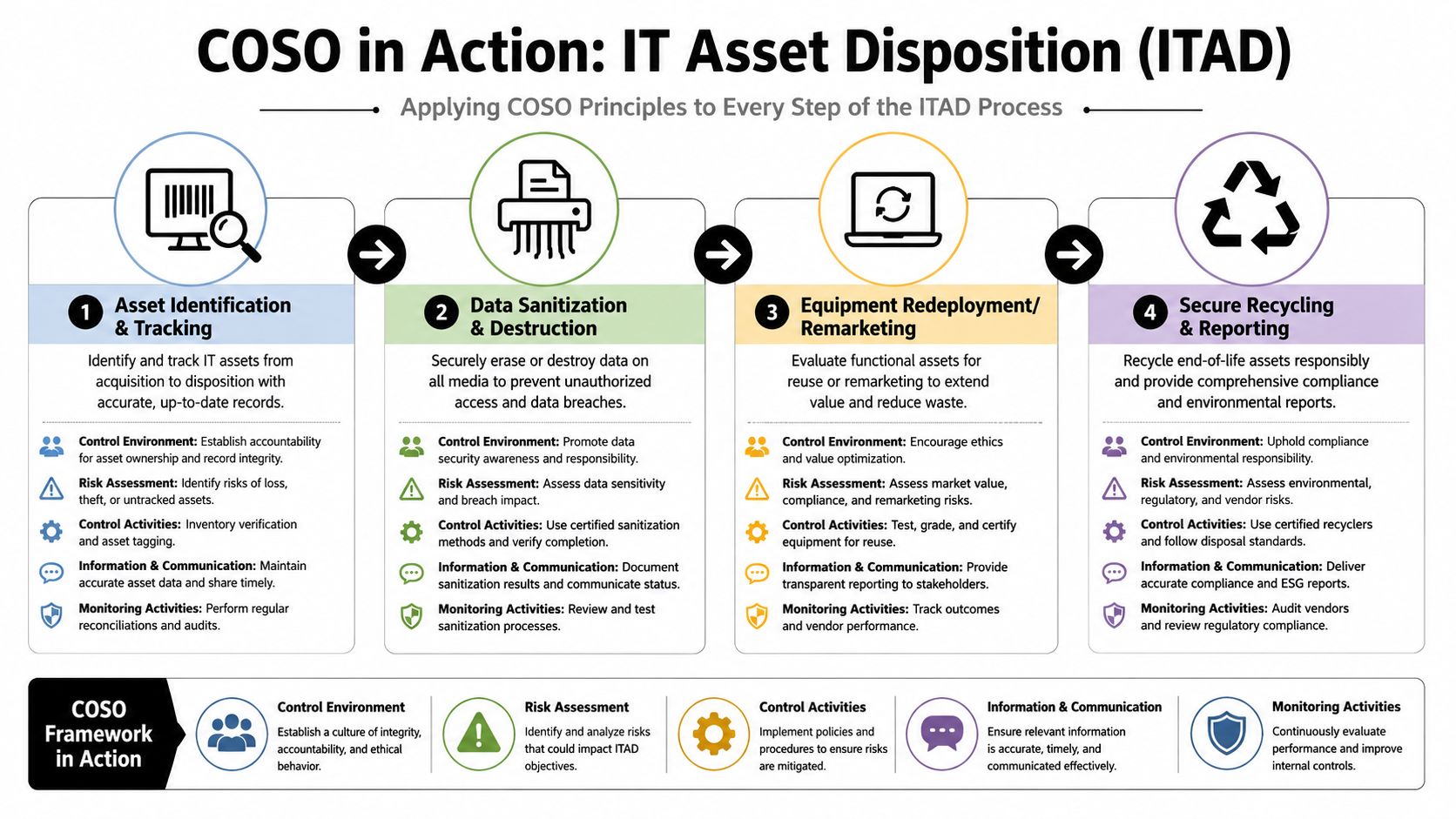
In contexts like ITAD, COSO demonstrates its real-world utility. Controls in ITAD have to survive movement. Devices leave desks, racks, storage rooms, loading docks, and often multiple custodians before final disposition.
Effective ITAD programs require that data-bearing components be physically separated, assets be accurately tracked throughout movement, and disposition outcomes be documented in a way that holds up under audit, according to this ITAD process guidance.
How the framework maps to the workflow
Take a standard disposal cycle.
Asset identification and tracking
Control starts before pickup. Teams need an inventory that identifies what exists, what contains data, and what requires special handling.Data sanitization and destruction
Risk assessment should identify which assets need certified wiping, which need shredding, and which require stricter handling because of regulated data.Redeployment or remarketing
Control activities matter here because assets intended for reuse can't bypass sanitization or approval.Secure recycling and reporting
Monitoring and communication come into play when final records, certificates, and downstream documentation are reviewed for completeness.
What a COSO-aligned ITAD control looks like
A good control isn't vague. It names the task, owner, evidence, and review step. For example:
- Before transport: Verify asset count and serial data against the release list.
- During custody transfer: Maintain signed handoff records and secure transport logs.
- Before resale or recycling: Confirm sanitization or destruction status for every data-bearing device.
- After completion: Retain auditable records that tie each device to its final outcome.
That's the practical value of a strong ITAD chain-of-custody process. It turns a potentially messy handoff into a controlled event with evidence attached.
The most common failure in ITAD isn't lack of effort. It's the gap between what the team believes happened and what the records can prove.
Auditing and Implementing Your COSO Aligned Controls
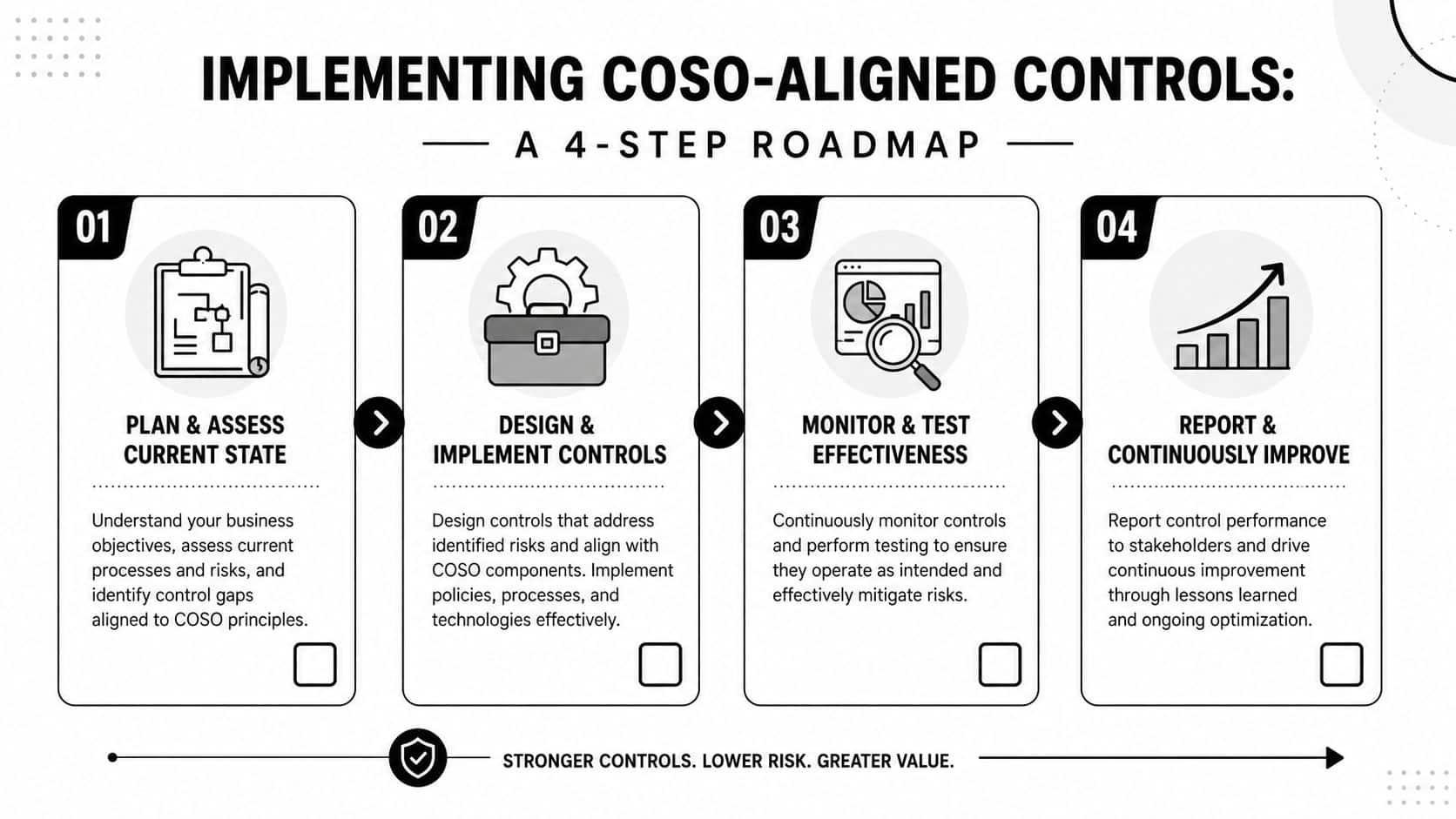
A workable COSO program doesn't begin with paperwork. It begins with a repeatable method. One practical model is planning, assessment, remediation, and testing.
COSO's 2023 sustainability reporting extension, known as ICSR, helps support ESG reporting for firms issuing certificates of recycling. Existing guidance often doesn't explain how ICSR principles map to recycling certificates or data destruction logs to validate e-waste disclosures, which is why this ICSR overview on sustainability reporting matters for compliance teams trying to connect operations to reporting.
A four-step roadmap
Plan and assess current state
Start with objectives. What must your disposal process achieve? Secure data handling, documented custody, compliant recycling, and defensible records are common goals.
Then assess reality. Review policies, inventory workflows, approval paths, and vendor documents. A vendor due diligence checklist is useful here because weak third-party review often creates hidden exposure.
Design and implement controls
Build controls around actual failure points. If serial mismatches happen at pickup, add verification at release. If certificates arrive incomplete, define required fields and a review owner. If some sites treat storage devices like scrap, separate data-bearing assets by process and container.
Monitor and test effectiveness
Testing should be simple enough to perform regularly.
- Sample assets: Match selected asset tags to destruction or recycling records.
- Trace custody: Review whether handoff records are complete from origin to final outcome.
- Inspect exceptions: Check how unresolved discrepancies were documented and closed.
- Confirm evidence retention: Make sure records are stored where audit or legal teams can retrieve them.
Report and improve
Control systems age. New hardware types, office consolidations, cloud migrations, and vendor changes all introduce new disposal risks. Reporting helps leadership see whether controls still align to the organization's objectives and sustainability commitments.
ICSR adds an important dimension here. If your company reports environmental metrics, the quality of recycling certificates and disposition logs matters beyond operations. Those records can support ESG reporting, but only if they are consistent, reviewable, and tied back to the control structure.
Conclusion Building a Resilient Compliance Posture
COSO isn't just a finance framework with IT added later. It's a practical control model for any process where risk, evidence, and accountability matter. End-of-life technology fits that description perfectly.
When IT leaders understand what COSO is, they can design disposal programs that do more than move equipment out the door. They can define ownership, reduce data security gaps, improve audit readiness, and support more credible recycling and reporting practices.
For ITAD, that means better control over chain-of-custody, data destruction, documentation, and vendor oversight. Those aren't separate tasks. They're parts of one defensible system.
If your organization needs a partner for secure, auditable end-of-life IT handling, Beyond Surplus can help with certified electronics recycling, secure data destruction, and IT asset disposition services built for business compliance needs across the United States.


