

If you're staring at a stack of retired laptops, a few old servers, and a CFO who wants to know exactly where the company's data is going, you're already in the moment that exposes weak electronic waste habits. Atlanta organizations don't need another vague sustainability slogan. They need a defensible operating method for asset tracking, disposition routing, data protection, and documentation.
That's the right way to think about How Atlanta Organizations Can Reduce Electronic Waste. It isn't a hauling problem. It's an internal governance problem that starts before pickup, moves through serial-level inventory control, and ends with the right certificate in the right file.
Table of Contents
- Why Atlanta Organizations Need a Real E-Waste Playbook
- The Scale of the Problem and What Structured ITAD Fixes
- Rewriting Procurement and Policy to Prevent Waste Upstream
- Building an Internal Disposition Workflow That Holds Up to Audit
- Choosing a Certified ITAD Partner in Atlanta
- Secure Data Destruction and FTC Disposal Rule Compliance
- Logistics, Pickups, and Atlanta Drop-Off Workflows
Why Atlanta Organizations Need a Real E-Waste Playbook
Atlanta IT leaders do not run into e-waste as an abstract environmental issue. They run into it when a conference room fills up with retired laptops and someone asks what happens next. At that point, the answer has to cover data security, value recovery, and chain of custody, not just recycling. The core issue is internal governance, not hauling. That is why a practical playbook matters.
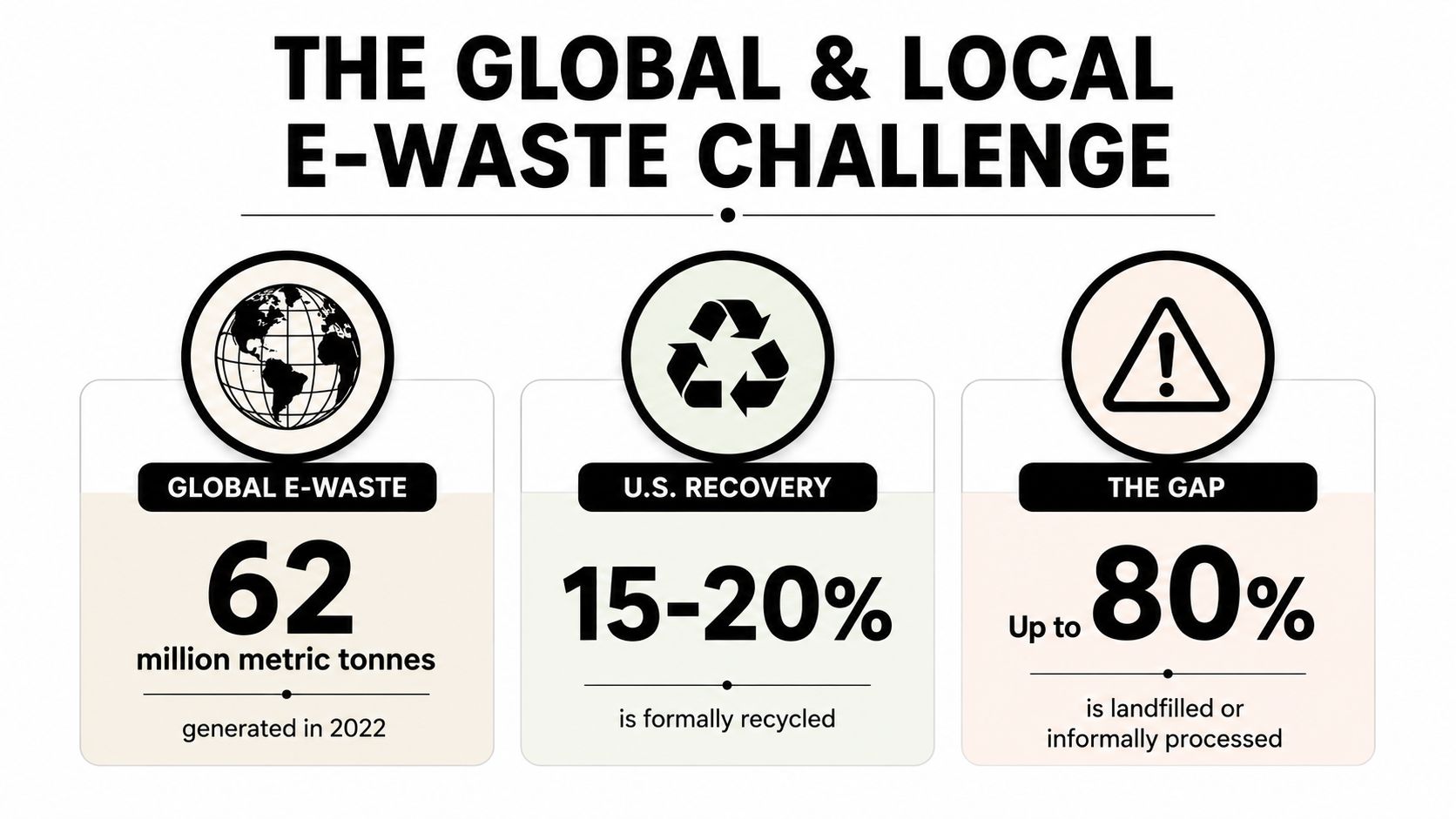
Global scale makes the point bluntly. The world generated 62 million tonnes of e-waste in 2022, up 82% from 2010, and only 22.3% was formally collected and recycled, according to the Global E-waste Monitor 2024. The same source projects annual generation to reach 82 million tonnes by 2030, with about 2.6 million tonnes added each year, which is exactly why Atlanta organizations should treat retired electronics as a controlled business process, not a pile of leftovers.

Practical rule: If a device doesn't have an owner, a disposition path, and a documented handoff, it's already a liability.
For U.S. organizations, the pattern is familiar. The EPA estimated that in 2009, U.S. consumers and businesses discarded 2.37 million tons of electronics, and only about 25% were collected for recycling, according to the EPA's e-waste overview on cleaning electronic waste. That low recovery rate shows how easily valuable material gets lost when teams rely on casual disposal.
Atlanta operations leaders need a playbook built for business continuity, not cleanup. A serious program starts with serial-level inventory control, clear disposition routing, and certified documentation that stands up during an audit. Organizations that want to connect that work to broader ESG goals should also review how Atlanta organizations can improve ESG goals through electronics recycling, because the compliance file and the sustainability record should match.
The Scale of the Problem and What Structured ITAD Fixes
Retired electronics are valuable assets until someone treats them like trash. That is the mistake that drains recovery value and creates compliance exposure. A structured ITAD program keeps the disposition options open, reuse, resale, donation, shredding, or recycling, while a casual disposal process pushes every device into the same scrap stream.
The scale of the problem is clear, as noted earlier in this article. Global e-waste volumes keep rising, and the gap between what gets generated and what gets formally collected still leaves too much recoverable material outside controlled channels. For Atlanta organizations, that means more devices leaving the building without the serial-level tracking, transfer records, or downstream proof that auditors expect. The image of e-waste as a waste haul problem misses the core issue. It is an asset-governance problem first.
Why structured ITAD changes the math
Structured ITAD fixes the part most organizations ignore, the internal sorting decision. Once a device is identified at the serial level and routed into the right stream, the organization protects value and reduces exposure. That is the difference between recovering usable equipment and sending working hardware straight to downstream scrap.
The same point shows up in the U.S. context as well. The EPA's e-waste summary shows how easily electronics slip into inefficient handling when organizations rely on casual disposal instead of controlled transfer. A program that starts with inventory control and ends with documented handoff is stronger than a collect-and-haul model, because it preserves chain-of-custody and gives you a file you can defend.
Bottom line: If you do not separate reusable assets from shred-only assets before pickup, you give up recovery value before the recycler even arrives.
That is why Atlanta teams should treat e-waste reduction as an internal inventory and documentation process. A solid disposition workflow protects resale options, reduces exceptions, and gives operations cleaner records. For a closer look at where the market is heading, review Atlanta IT asset disposal trends for 2026.
Rewriting Procurement and Policy to Prevent Waste Upstream
Most e-waste problems start before the first device is retired. Procurement writes contracts that leave end-of-life handling vague, then operations inherits the mess. Fixing that means tightening the language around returns, sanitization, and ownership while the hardware is still being bought or leased.
Put disposition terms in the contract, not in someone's inbox
Ask OEMs and resellers for right of first refusal on take-back or buyback, clear return logistics, and written responsibility for downstream handling. If the vendor wants the business, the vendor should spell out how devices come back, who pays for transport, and what documentation you receive at the end.
Data handling language belongs there too. Require data sanitization requirements, proof of destruction or wiping, and named certifications for any partner that touches storage media. If a contract says “responsible disposal” but never defines responsibility, it's not a control, it's a slogan.
Update internal policy where employees actually follow it
Device return procedures need a hard rule for offboarding. Employees should know that company phones, laptops, docking stations, and peripherals don't sit in desks, storage closets, or personal vehicles. Donation guidelines should also be explicit, because unsanctioned donations create a gap between intent and control.
One useful way to frame this is to tie every policy back to the disposition path. If a device is reusable, it can go to redeployment or resale. If it isn't, it goes to controlled destruction or recycling. That logic should be visible in procurement, HR offboarding, and facilities procedures.
Beyond Surplus's IT asset lifecycle management page reflects the kind of lifecycle thinking that belongs in these discussions, because upstream controls always make downstream disposition cleaner.
The cheapest e-waste is the device you never let drift into an unmanaged category.
Atlanta organizations that rewrite procurement and policy this way reduce confusion later. They also make every pickup faster, every audit easier, and every retired asset more likely to follow the right route.
Building an Internal Disposition Workflow That Holds Up to Audit
A defensible disposition program starts at the serial level. Every retired item gets recorded before it leaves the building, and every item gets routed with intent. ReWorx's Atlanta guidance on responsible electronics recycling for Atlanta businesses is useful here because it treats e-waste as an inventory and compliance issue, not just a hauling task.
Sort by disposition, not by convenience
Separate devices into reuse, resale, donation, shredding, and recycling streams before pickup. Mixing everything into one load destroys recoverable value and makes downstream reporting sloppy. A working laptop should not end up in a scrap bin just because it was stacked beside broken monitors.
Every record should include asset type, location, serial or asset tag, hostname, and disposition intent. That gives your team a clean inventory baseline and makes it easier to prove what happened to each device. It also supports tighter chain of custody documentation when auditors ask for a trail they can follow.
Control the hold area
Create a separate hold area for data-bearing devices. Access should be limited, and the final disposition owner should be named, not implied. That owner is accountable for confirming the route, checking the documentation, and making sure the device does not sit in limbo.
Practical rule: If a drive can still contain data, it does not belong on an open pallet with miscellaneous scrap.
An internal workflow diagram helps only when the team follows the sequence. Identify and tag the device, check the sanitization status, assign the correct category, then log the handoff to the certified partner. That process is what makes chain of custody defensible when internal audit or a client questionnaire lands in your inbox.
The same operational discipline appears in ReWorx's Atlanta-focused chain of custody documentation, and for good reason, because the paperwork is only credible when the workflow behind it is controlled.
Choosing a Certified ITAD Partner in Atlanta
A real ITAD partner is not a generic electronics hauler with a truck and a warehouse. The difference shows up in documentation, process control, and how they handle the media that still carries data risk. Atlanta organizations should verify credentials before a single device changes hands.
Compare credentials before you compare price
| ITAD Credentials and What They Actually Verify | ||
|---|---|---|
| Credential | What It Verifies | Why It Matters |
| R2 | Responsible electronics recycling practices | Helps show the partner follows recognized handling standards |
| e-Stewards | Electronics recycling and downstream accountability | Adds confidence around environmental and export controls |
| NAID AAA | Secure data destruction capabilities | Matters when media handling is part of the scope |
| ISO 14001 | Environmental management system discipline | Useful for organizations that need process structure and documentation |
These are the kinds of controls that separate a controlled program from an informal pickup. They also matter because a credible partner should provide certificates of recycling, certificates of data destruction, and serialized asset reports without making you chase them down later.
Ask for enterprise support, not just collection
Multi-site rollouts require coordination, not just a truck window. If a partner can't support serial reporting, staged pickups, and audit requests, they're not ready for an Atlanta enterprise environment. That's especially true for organizations with recurring refresh cycles or mixed hardware across offices, warehouses, and technical spaces.
ReWorx's step-by-step how to choose an ITAD vendor in Georgia guidance is worth reviewing because the decision should start with process credibility, not sales language.
The right partner makes your compliance file easier to defend, not harder to assemble.
If you want a simple test, ask for a sample certificate set and a serialized report before you schedule the first pickup. The response tells you a lot.
Secure Data Destruction and FTC Disposal Rule Compliance
Atlanta organizations need to treat data-bearing equipment as an asset-governance issue, not a junk removal problem. The device, the storage media, and the final disposition path all need to line up with the reuse plan and the documentation trail. If they do not, you create avoidable exposure and weaken your own chain of custody.
Match the method to the device and the risk
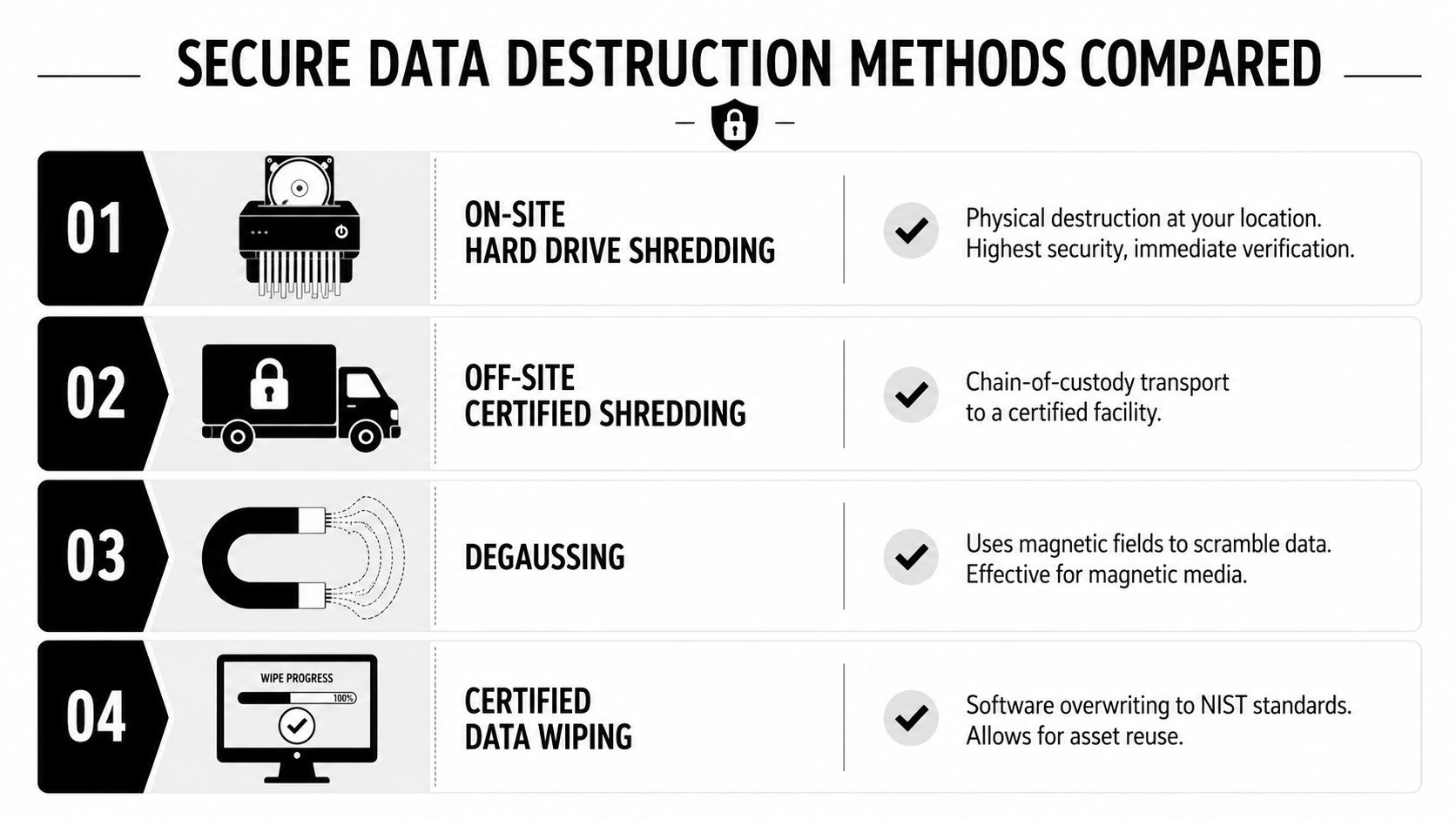
A laptop headed for redeployment calls for certified data wiping so the storage media stays in service while the information is cleared. A drive that cannot be reused, or a device carrying sensitive records, calls for physical destruction. Degaussing still has a place for magnetic media, but it must be documented carefully, and the media still needs a valid downstream path after treatment.
The method has to fit the inventory. That is why a serial-level disposition decision matters more than a generic pickup instruction.
For a practical comparison of secure destruction paths, see the A comparison chart outlining four secure data destruction methods including shredding, degaussing, and certified software data wiping. It shows why the right method depends on device condition, media type, and whether value recovery is still on the table.
The FTC Disposal Rule requires covered entities to take reasonable measures to protect consumer information when disposing of records and information. In practical terms, that means your team needs a process that blocks unauthorized access and produces proof of what happened to each device. A certificate of destruction helps document that handoff when the vendor performs the work and records it correctly.
Keep the record with the asset file. Include the method used, the device identifier, and the date of transfer. That gives compliance teams, procurement, and auditors something concrete to verify instead of forcing them to reconstruct the disposition later.
Logistics, Pickups, and Atlanta Drop-Off Workflows
Good e-waste reduction falls apart when logistics are sloppy. The staging area should be secure, labeled, and ready before the truck arrives. Facilities, security, and IT need to know who controls access, who signs off, and where the devices go once they're collected.
Pickups should be scheduled, serialized, and visible
A professional pickup team should show up with uniforms, a documented inventory process, and secure transport procedures. For multi-site refreshes, the partner should be able to coordinate timing across locations and keep the handoff clean from end to end. If they can't explain how they protect serialized inventory in transit, they're not operating at the level Atlanta businesses need.
The City of Atlanta also gives organizations a formal local option. The Atlanta Regional Commission's waste-reduction document says the City of Atlanta offers an e-waste drop-off center at the William B. Hartsfield Solid Waste Reduction Plant, and it lists accepted items including cell phones, computers, monitors, electronics, televisions, and stereos. That matters when a small volume or special case needs a legitimate destination, as documented in the ARC waste-reduction material.
For organizations that are coordinating office moves or facility cleanouts, it helps to understand how broader logistics partners manage timing and access. A useful operational comparison can be found in office removals London, especially for teams thinking about staging, access control, and removal sequencing.
Track the right KPIs
Report a small set of metrics to finance, sustainability, and compliance teams, not a bloated dashboard.
- Units or pounds diverted: Shows how much equipment left the waste stream.
- Reuse versus shredding split: Shows whether value recovery is happening or whether everything is being destroyed.
- Value recovered through resale and buyback: Keeps the finance team engaged.
- Certificates issued: Proves documentation is complete.
- On-time pickup rate: Shows whether operations can trust the schedule.
Quarterly reporting is the right cadence for most Atlanta organizations. It keeps the data current without turning the program into noise.
Beyond Surplus handles certified electronics recycling, secure IT asset disposal, and chain-of-custody documentation for organizations that need a serious process, not a pickup gamble. If you're ready to reduce electronic waste with a workflow that protects data, recovers value, and stands up to audit, visit Beyond Surplus and start the conversation now.


