

Old laptops in a locked closet. A stack of monitors waiting for “the next cleanout.” Retired servers sitting in a back room because no one wants to guess what's on the drives. That's where a lot of Atlanta companies are right now, especially SMBs that grew faster than their internal processes.
IT asset management is supposed to solve that. In practice, many teams still treat it as a loose inventory exercise. That approach breaks down once devices move between offices, homes, remote users, cloud services, and disposal vendors. For Atlanta organizations, the issue isn't just tidiness. It's cost control, data risk, audit readiness, and whether retired equipment still has recoverable value.
Navigating Modern IT Challenges for Atlanta Businesses
A 40-person Atlanta company opens a storage room and finds six retired laptops, two old switches, and a server nobody wants to touch because no one is certain what data is still on it. Finance has purchase records. IT has a partial spreadsheet. HR confirms three of those employees left months ago. That is not unusual. It is what weak IT asset control looks like on the ground.
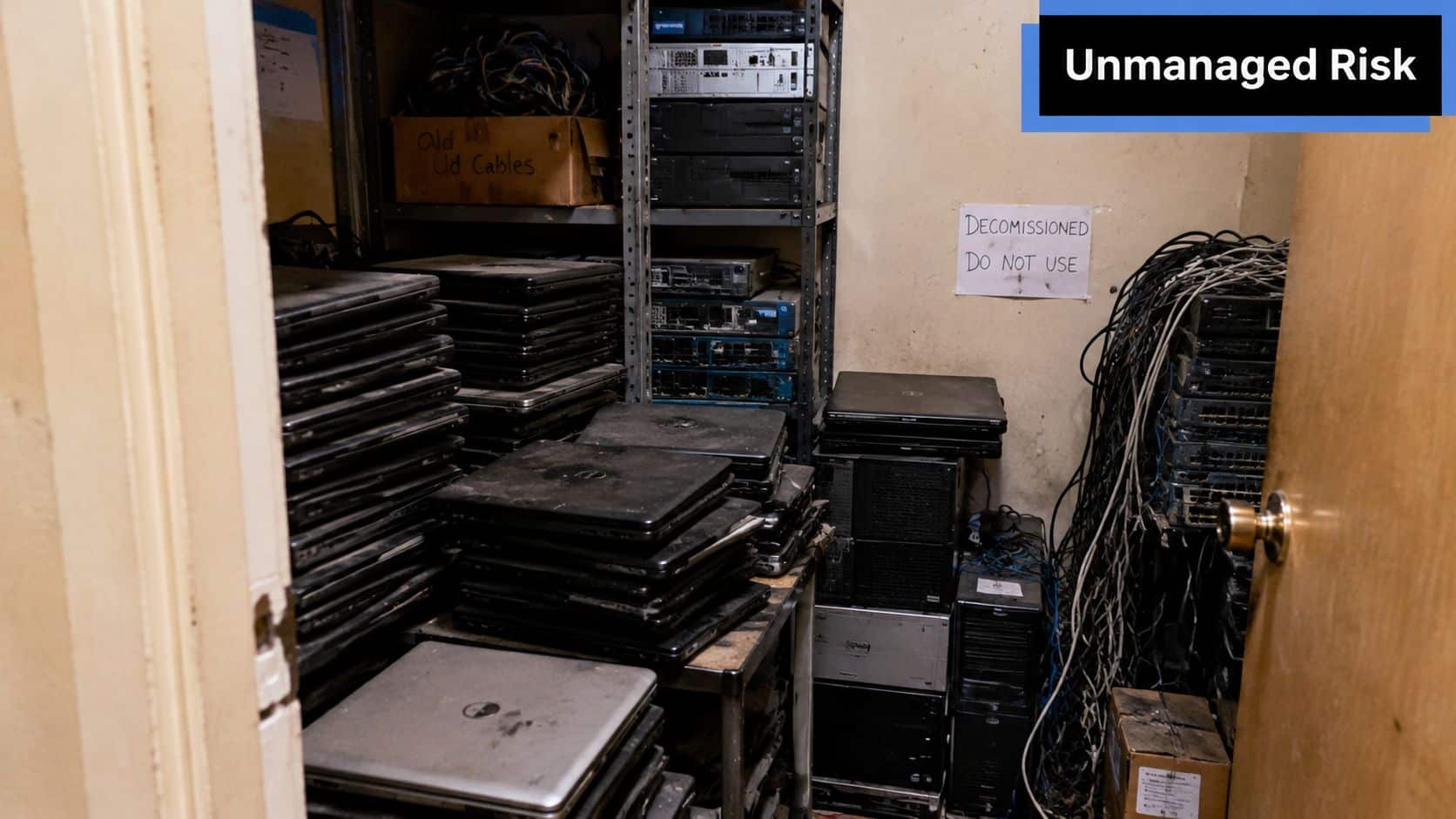
For Atlanta SMBs, the problem is rarely a total lack of effort. The problem is fragmentation. Procurement records what was ordered. IT tracks what was deployed. Finance tracks depreciation. Offboarding happens in HR. Then retired equipment sits in Buckhead, Alpharetta, Marietta, or a warehouse near the airport waiting for someone to decide whether it should be wiped, reused, sold, or destroyed.
That gap creates real business exposure. Devices remain on the books after they are no longer useful. Data-bearing assets sit in unsecured rooms. Teams lose resale value by waiting too long. If a client, auditor, or cyber insurer asks for proof of custody or disposition, the answer is often incomplete.
Why the old approach stops working
A basic spreadsheet can work for a very small office with stable headcount and almost no remote staff. It breaks once the business adds hybrid employees, multiple locations, shared devices, or frequent refreshes. Atlanta SMBs are dealing with all of that, plus practical local issues such as scheduling pickups, documenting chain of custody, and making sure retired hardware leaves the site on a documented timeline instead of during an annual cleanout.
The operational cost is easy to miss because it shows up in pieces. One team spends hours tracking down missing laptops. Another delays refresh decisions because warranty status is unclear. A third keeps obsolete equipment because disposal has not been scheduled. Over a year, those small failures turn into avoidable labor, unnecessary storage, slower audits, and higher security risk.
Strong ITAM fixes the handoffs. Each asset needs a clear owner, current status, and a documented next action. For companies that need local disposition support, Atlanta IT asset disposition and electronics recycling services can handle pickup logistics, chain of custody, and final processing in a way that fits the pace of an Atlanta-area SMB.
Old gear does not have to be worthless to become a liability.
The Critical Shift to Full Lifecycle Management
A static inventory answers one question: what do we own? Modern ITAM has to answer a harder one: where is each asset in its life, and what should happen next?
That's the core shift. Good programs don't stop at counting devices. They manage procurement, assignment, maintenance, refresh timing, retirement, and final disposition as one continuous process.
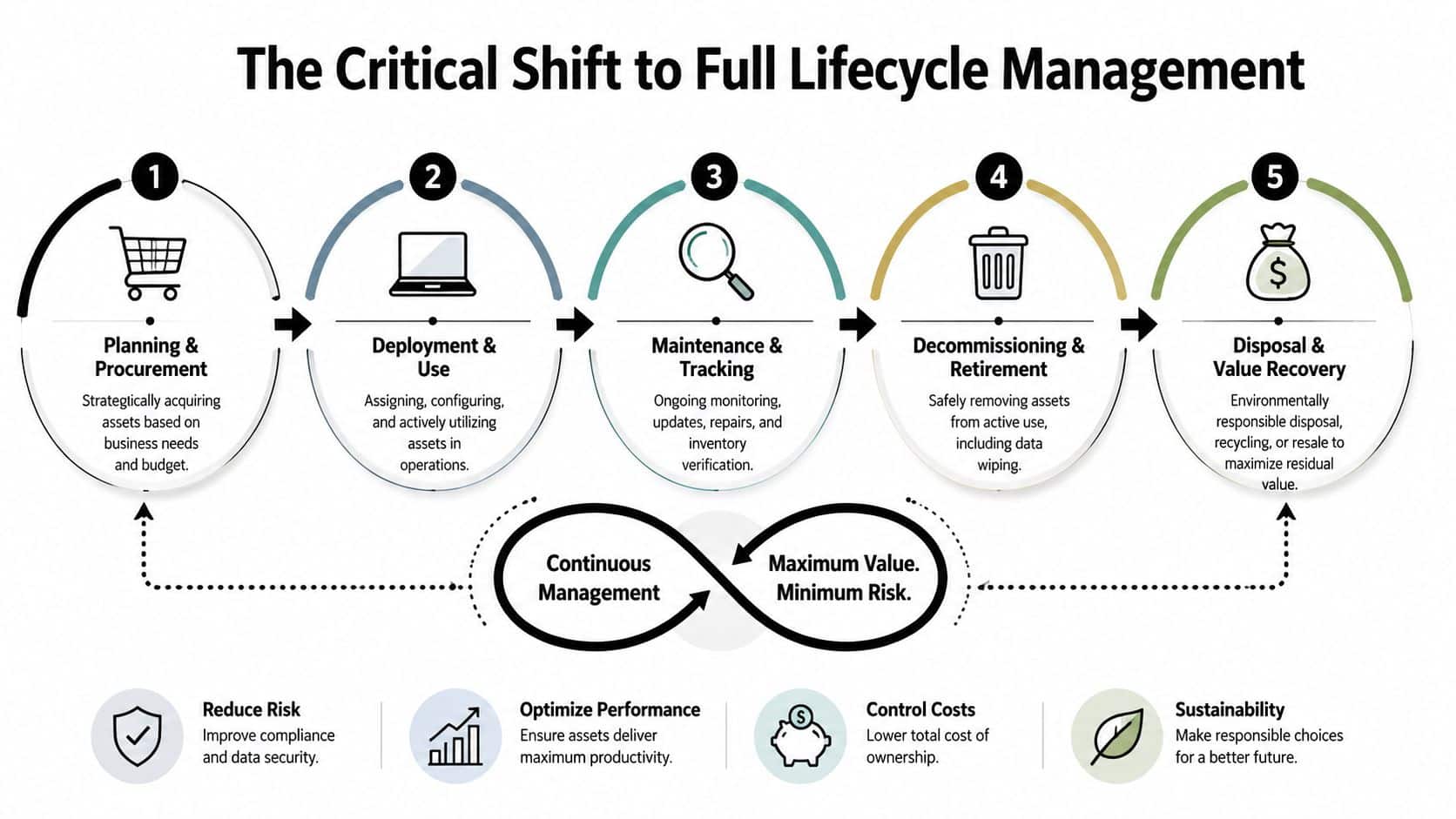
What lifecycle tracking actually includes
The fleet-management analogy works well here. A company vehicle isn't managed with a single line item on a spreadsheet. It has a purchase date, service schedule, assigned driver, and retirement plan. IT hardware needs the same treatment.
Best-practice guidance now emphasizes recording serial number, purchase date, warranty status, and expected end-of-life date for every device, then automating discovery so inventory stays current without manual effort, as outlined in Primo's IT asset management best practices for SMBs. The same guidance ties that discipline to standardized refresh cycles and secure decommissioning.
Where SMBs usually go wrong
The common failure isn't lack of effort. It's fragmented ownership.
- Procurement buys well: But the receiving record never becomes a lifecycle record.
- IT deploys devices: But assignment changes aren't updated consistently.
- Finance tracks depreciation: But that doesn't tell you whether a laptop is unsupported or missing.
- Operations stores retired hardware: But storage isn't disposition.
A practical lifecycle record should connect at least these fields:
| Lifecycle field | Why it matters |
|---|---|
| Serial number | Confirms the specific asset being tracked |
| Purchase date | Supports budgeting and age-based decisions |
| Warranty status | Helps avoid unnecessary repair spend |
| Assigned user or location | Improves accountability during moves and offboarding |
| Expected end-of-life | Prevents last-minute replacement cycles |
What works in the real world
Automated discovery helps, but it won't fix a weak policy. Teams need clear rules for check-in, reassignment, and retirement. They also need a disposal path that starts before equipment becomes a closet problem.
For Georgia organizations formalizing this process, IT lifecycle management services in Georgia are relevant when internal teams need outside support for retirement planning, pickup coordination, and documented disposition.
Practical rule: If a device has no expected end-of-life date, it usually stays in service too long or sits in storage too long.
Top ITAM Trends Impacting Atlanta Businesses in 2026
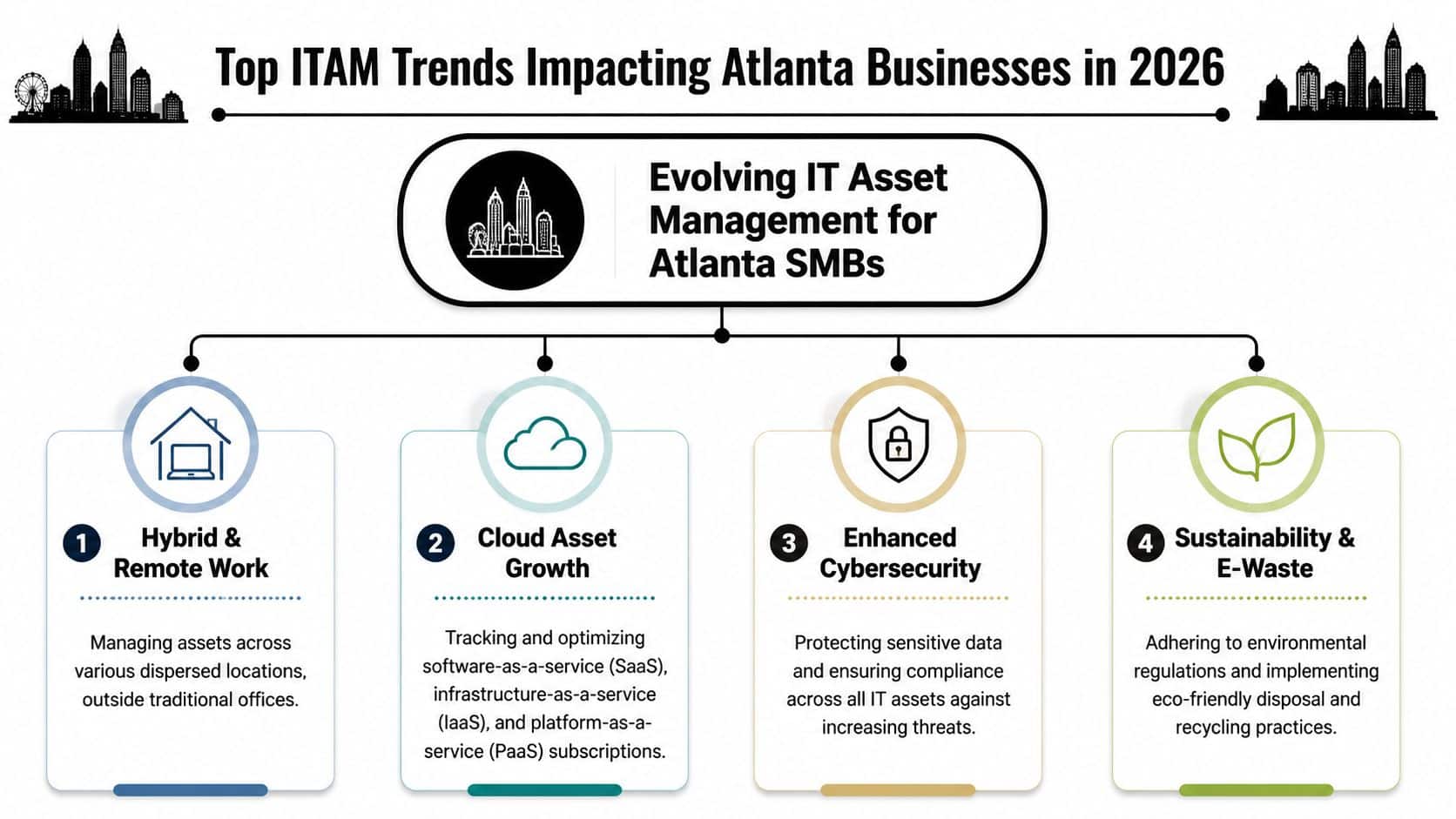
Atlanta SMBs don't need trend reports for entertainment. They need to know which shifts are changing risk and workload right now. Three stand out most on the ground: asset sprawl from hybrid work, broader asset visibility across cloud and SaaS, and increased use of automation.
Hybrid work changed the asset map
The old model assumed most business hardware stayed in one office. That's over. Devices now move between branch offices, employee homes, coworking spaces, and temporary project sites. Every move complicates inventory accuracy, support, and retrieval at offboarding.
An Atlanta company with a small in-house IT team feels that quickly. It's one thing to deploy fifty laptops from a single office. It's another to recover them, verify condition, confirm assigned users, and route them into a secure retirement process when people leave or upgrade.
ITAM now reaches beyond hardware
Industry analysis says ITAM now extends beyond on-prem hardware to include data centers, public clouds, containers, SaaS, IoT, and OT, with AI increasingly used to automate cleanup, detect anomalies, and update inventories in real time, according to InvGate's review of ITAM trends. The same analysis notes that regulations such as NIS2, DORA, and CSRD are pushing organizations toward reliable, current inventories for cyber resilience and audit readiness. It also states that the software asset management market was valued at USD 3.5 billion in 2024 and is projected to reach USD 7.3 billion by 2029 at a 16.0% CAGR.
For SMBs, the practical implication is simple. If you only track physical devices, your asset picture is incomplete. SaaS licenses, cloud workloads, and connected devices all generate spend and security exposure. The missing license or untracked cloud instance may not sit in a closet, but it still belongs in your control model.
Automation is becoming operational, not experimental
Most SMBs don't need a flashy AI narrative. They need fewer manual reconciliations and fewer blind spots. Automation helps most when it handles repetitive work: discovering assets, updating records, flagging mismatches, and identifying devices that should move into refresh or retirement.
That's also why many local companies are pairing ITAM process improvements with broader workflow reviews around AI and operations. A useful example is this look at how AI is impacting Atlanta businesses today, especially where automation replaces manual handoffs instead of just adding another dashboard.
- Hybrid environments require retrieval discipline
- Cloud assets need ownership, not just billing visibility
- Automation works best when policy is already clear
- Sustainability expectations now affect vendor selection
Sustainability belongs on that list too. Buyers, partners, and internal stakeholders increasingly expect documented downstream handling for electronics. In practice, that means your recycling and ITAD vendors need to provide more than a truck and a receipt.
Enhancing Security and Ensuring Compliance
Secure disposal sits at the center of modern ITAM because every lifecycle eventually ends with data-bearing equipment leaving active use. If that step is weak, the rest of the program doesn't matter much.
A surprising number of businesses still treat retirement as storage. They pull a device from service, place it on a shelf, and assume the risk is contained. It isn't. If the device still holds customer data, employee information, credentials, financial records, or internal files, the risk has moved locations.
Wiping versus documented destruction
Software wiping has a role. So does physical destruction. The right method depends on device type, reuse goals, data sensitivity, and internal policy. What matters most is that the method is deliberate, documented, and tied to chain of custody.
If an organization wants resale or redeployment, wiping may fit if the process is controlled and verified. If the drive contains highly sensitive data or the company wants a simpler liability posture, physical shredding is often the cleaner decision. The mistake is not choosing one method over the other. The mistake is using neither in a controlled, auditable way.
Security teams should treat retired media the same way they treat live systems. Access, custody, and proof all matter.
Compliance is a disposal issue too
The federal FTC Disposal Rule makes proper disposal of consumer information a business obligation, not just a technical preference. In regulated sectors such as healthcare and finance, disposal failures can create legal exposure even when the original security controls were strong.
Atlanta companies also need to think practically about facility controls during staging, storage, and decommissioning. If retired servers or endpoint devices sit in unsecured rooms before pickup, the process already has a gap. This data center physical security guide is useful because it frames physical controls as part of overall information security, not as a separate facilities issue.
That same mindset applies to office closets, storage rooms, and loading docks. Devices are most vulnerable during transitions.
What a defensible process looks like
A defensible disposal program usually includes:
- Chain of custody records: Who handled the asset, where it moved, and when.
- Controlled staging: Retired devices stored in restricted areas before pickup.
- Sanitization or shredding decision rules: Applied by asset class and data sensitivity.
- Certificates of destruction or recycling: Retained for audit and vendor management files.
Atlanta organizations reviewing these risks in the broader threat environment should also consider cybersecurity threats targeting Atlanta companies, because end-of-life devices often become the overlooked edge of a larger security program.
Maximizing Value from Retiring IT Assets
Many SMBs treat end-of-life hardware as a disposal expense because they wait too long. By the time the equipment leaves the closet, it has little resale value, expired support, and uncertain condition. That's not an ITAD problem. It's usually a timing problem.
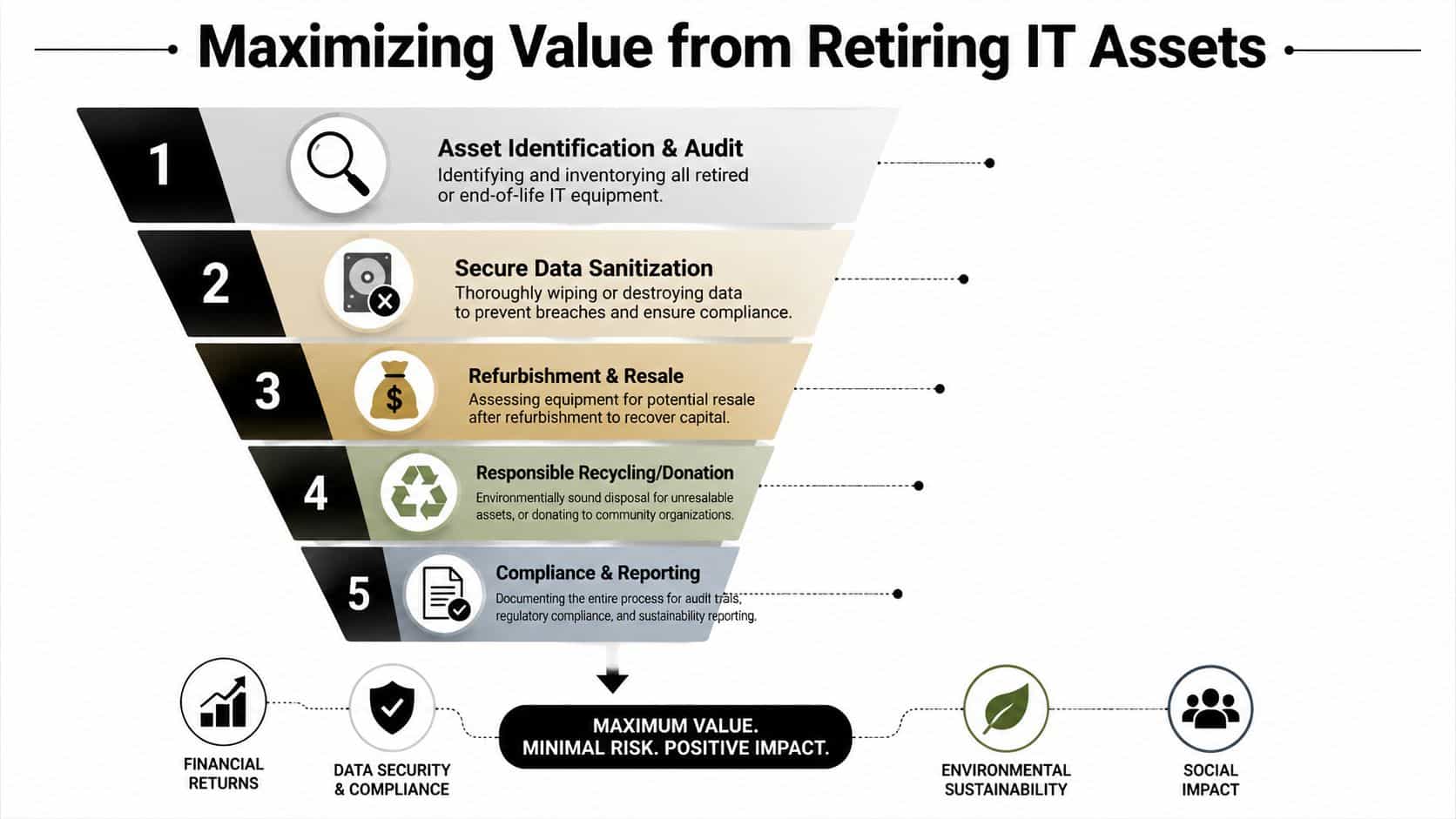
A stronger ITAM program turns retirement into a planned financial event. Assets that still have market demand can be tested, refurbished, and remarketed. Assets that don't should move quickly into certified recycling. The important point is speed and structure.
The old way versus the useful way
The old way looks familiar. A company upgrades staff laptops, stacks the old units in storage, and postpones decisions because operations are busy. Months later, some machines are missing power adapters, others can't be matched to users, and several have aged out of remarketing demand.
The useful way is planned retirement tied to lifecycle dates. Devices are collected while they still have recognizable value, evaluated quickly, sanitized based on policy, and routed either to resale or recycling.
Retired hardware loses value while it waits for someone to decide what to do with it.
What improves recovery
The biggest drivers are operational, not theoretical:
- Retire on schedule: Planned refreshes usually preserve more resale potential than open-ended use.
- Keep records complete: Missing identifiers slow testing and disposition.
- Separate reusable from scrap fast: Delay hurts both value recovery and storage discipline.
- Use a documented downstream path: Finance and compliance both need proof.
For Georgia companies comparing options, how Georgia businesses can maximize value with ITAD services gives a practical view of how buyback, resale, and certified recycling fit together in one disposition workflow.
Implementing a Practical ITAM Strategy in Atlanta
A common Atlanta SMB scenario looks like this. Midtown hires 20 people in a quarter, a Sandy Springs office closes, laptops move between users without clean records, and six months later finance asks what is still in service and what can be retired. The problem is turning scattered habits into a repeatable process.
More SMBs are formalizing ITAM for that reason, as noted earlier. Growth in the market reflects a practical shift. Companies your size need a system that holds up under employee turnover, hybrid work, audits, and multi-site pickup logistics across metro Atlanta. That does not require a heavy platform rollout on day one. It requires clear ownership, a short policy, and a disposal process your team can readily follow.
Start with a short policy
Keep the first version tight. If it runs five pages and nobody uses it, it failed.
The policy should answer a few operating questions clearly:
- Ownership: Who updates the asset record after purchase and during reassignment?
- Required fields: Which identifiers must be captured for every device?
- User assignment: How are check-out, reassignment, remote shipping, and offboarding documented?
- Retirement trigger: What event moves an asset from active use to disposition?
- Data handling: Which assets can be wiped for reuse, and which require physical destruction?
- Exception handling: Who approves lost devices, damaged assets, or undocumented returns?
Write it so IT, HR, finance, and office managers can all use it. That matters for Atlanta SMBs with satellite offices, field staff, or shared admin support, where assets often move faster than the records do.
Vet Atlanta-area vendors like an operator
Vendor selection is usually where good intentions break down. A provider may promise recycling, but your team still needs proof of custody, pickup coordination, and final disposition records that stand up during a customer questionnaire or insurance review.
Ask direct questions:
| Vendor question | Why it matters |
|---|---|
| Can they document chain of custody from pickup through final processing? | Reduces audit risk and helps resolve missing-asset disputes |
| Do they support on-site and off-site data destruction? | Lets you match the method to device sensitivity and internal policy |
| Can they coordinate secure pickup across Atlanta-area locations? | Matters if you operate from Buckhead, Alpharetta, Marietta, or multiple small offices |
| Do they issue certificates of recycling and data destruction? | Gives legal, compliance, and procurement teams the records they need |
| Do they handle value recovery as well as recycling? | Helps offset refresh costs instead of treating every retired asset as scrap |
One Atlanta option is Beyond Surplus, which provides ITAD, secure data destruction, electronics recycling, value recovery, and business pickup coordination. The point is not the name. The point is choosing a partner that can collect from your locations on schedule, document every handoff, and separate resale from scrap fast enough to protect value.
Good ITAM at the SMB level is operational discipline. Accurate records, defined refresh timing, secure retirement, and local pickup support will do more for risk control than a larger toolset with weak process behind it.


