

Atlanta companies don't operate in a neutral threat environment. A 2024 industry summary reported that Georgia ranked 11th in the nation for cybercrime complaints, with phishing and ransomware identified as the most common attack vectors for businesses in the region, according to this Atlanta cybersecurity market summary. For an IT director, that changes the conversation. You're not planning for edge cases. You're managing a steady stream of common, repeatable attack methods that work because they hit email, identity, endpoints, and recovery gaps.
That local reality matters even more in Atlanta, where finance, healthcare, logistics, legal, and technology firms all move sensitive data fast. The companies that struggle after an incident usually aren't the ones hit by a novel exploit. They're the ones that underestimated routine controls, trusted old devices too long, or forgot that data risk doesn't end when hardware leaves production.
Atlanta's Rising Digital Risk Profile
Atlanta's cyber risk starts with geography and economics. Georgia's position near the top tier of reported cybercrime states means local businesses are operating in a market where attackers already know the target mix, the common software stacks, and the sectors most likely to pay to restore operations or contain fallout.
The practical takeaway is simple. If you're running a company in metro Atlanta, you should assume phishing attempts, credential theft, ransomware staging, and account compromise are part of normal background noise. Waiting for a dramatic security event before tightening controls is usually a mistake.
Why the ranking matters operationally
A state ranking by itself doesn't secure anything. What matters is what the ranking points to: a mature attack environment built around familiar methods. Phishing still gets users to hand over credentials. Ransomware still turns weak segmentation and poor recovery into business interruption.
Practical rule: Build your baseline around the attacks criminals actually use most often, not the ones that make the most dramatic conference slides.
That means reviewing:
- Email controls: Tighten filtering, attachment handling, and impersonation detection.
- Identity controls: Require MFA for cloud apps, admin access, and remote workflows.
- Endpoint controls: Remove local admin where possible and harden laptops and servers.
- Data exit controls: Add documented processes for secure data destruction when drives, laptops, and storage media leave service.
A lot of Atlanta teams still separate cybersecurity from asset retirement. That's a blind spot. If sensitive data sits on retired devices in a closet, loading dock, or third-party truck, your exposure hasn't ended. It's just moved.
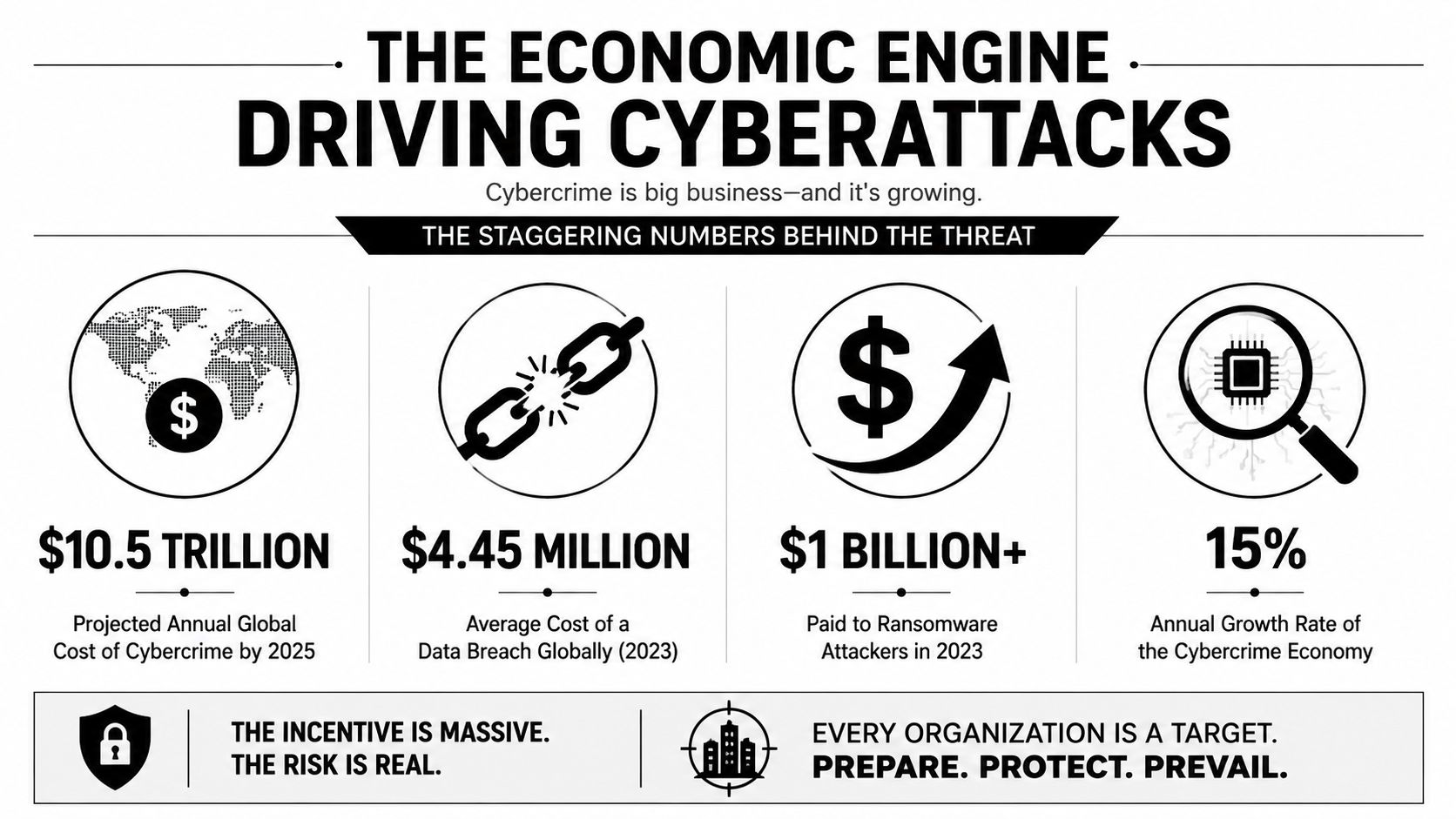
The Economic Engine Driving Cyberattacks
Cybercrime isn't random. It's a revenue model. The scale of that market explains why Atlanta businesses keep seeing the same attacks delivered in high volume.
According to SentinelOne's cyber security statistics roundup, global cybercrime losses are projected to reach $10.5 trillion in 2026, weekly cyberattacks average 1,968 per organization, and that pace is up 18% year over year and 70% since 2023. The same source says ransomware damage costs alone are forecast at $74 billion in 2026.
Why Atlanta sits in the path of that pressure
Atlanta has exactly the traits attackers look for in a profitable metro. Dense business concentration. Heavy use of cloud identity. Finance and payment workflows. Healthcare data. Logistics systems that can't tolerate downtime. Fast-moving executive teams that approve transactions by email and mobile device.
That combination creates multiple ways to monetize a compromise:
| Target type | What attackers want | Business impact |
|---|---|---|
| Finance workflows | Wire fraud, invoice fraud, account takeover | Immediate monetary loss |
| Healthcare systems | Sensitive records, extortion leverage | Operational disruption, reporting pressure |
| Logistics platforms | Access, disruption, downstream leverage | Delays, customer impact, recovery complexity |
| Executive accounts | Impersonation, internal fraud | Fast unauthorized approvals |
What this changes for IT leadership
The main shift is mindset. Treat attacks like an industrial process. Criminal groups don't need a personal reason to target your company. They need exposed credentials, an unpatched edge, a spoofable mailbox, or weak backup discipline.
Most Atlanta firms won't lose to a sophisticated chain first. They'll lose to an ordinary one that wasn't interrupted early.
That's why the highest-value work is often boring work done consistently: access reviews, email hardening, patch cadence, admin separation, tested restore procedures, and vendor accountability. If the criminal market is built on volume, your defenses have to remove easy conversion paths.
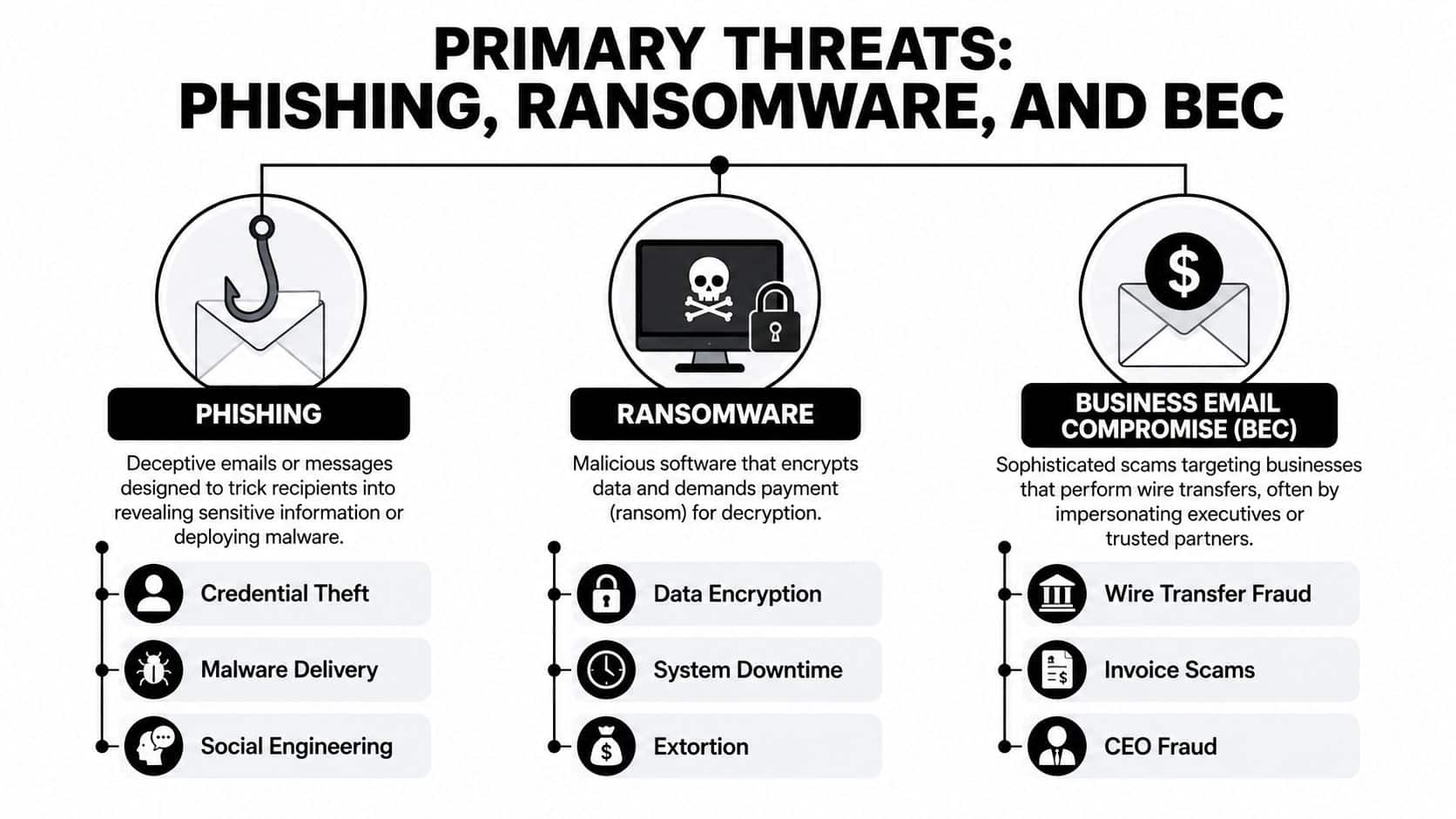
Primary Threats Phishing Ransomware and BEC
The three threats that matter most in Atlanta aren't mysterious. They're effective because they exploit normal business behavior. People read email, approve invoices, reset passwords, open attachments, and trust known contacts.
Georgia's Attorney General specifically highlights business email compromise and directs victims to report incidents to financial institutions, local law enforcement, and the FBI's IC3, as described on the state cybersecurity guidance page. That matters because BEC isn't just an IT event. It's a financial-crime incident with time-sensitive response requirements.
Phishing still opens the door
Phishing remains the primary initial access vector. That's because it bypasses a lot of traditional perimeter thinking. If a user enters credentials into a fake Microsoft 365 login page, the attacker doesn't need to break in. The user lets them in.
The pattern is familiar:
- A user receives a convincing email about a shared file, payroll issue, MFA prompt, or invoice.
- The user clicks through to a fake login or opens a malicious payload.
- The attacker captures credentials or lands code on the endpoint.
- From there, they move toward mailbox access, privilege escalation, or lateral movement.
What works against this isn't one tool. It's layered friction. MFA, strong email filtering, fast patching, role-based access, and well-scoped admin rights all reduce the chance that one click becomes a wider incident.
Ransomware succeeds before encryption starts
A lot of teams still think of ransomware as the ransom note. In practice, the actual failure often happens earlier. The attacker gets access, expands privileges, finds backup weaknesses, and maps critical systems. Encryption is the visible final act.
Here's the trade-off many IT directors face:
- Fast access for staff improves convenience but can leave broad file permissions in place.
- Flat networks simplify support but increase blast radius.
- Untested backups look fine on paper but fail during restoration.
- Legacy systems keep operations moving until they become the attacker's easiest foothold.
If you haven't tested restore workflows under pressure, you don't yet know whether your backup strategy is a recovery strategy.
For media leaving service, align destruction and wiping practices with recognized methods such as NIST SP 800-88 guidance. That doesn't stop ransomware directly, but it closes a separate data-loss path many teams ignore until an audit or incident forces the issue.
BEC is a process failure as much as a mailbox problem
BEC hits where business speed outruns verification. A spoofed executive request. A changed vendor banking instruction. A payroll diversion email sent late in the day. No malware required.
The first 24 hours matter. When a suspected BEC incident lands, finance, legal, IT, and leadership need a coordinated workflow:
- Contact the bank immediately: Try to stop or reverse movement of funds.
- Preserve evidence: Keep emails, headers, timestamps, payment details, and account activity intact.
- Escalate externally: Follow Georgia guidance and report to law enforcement and IC3.
- Contain access: Reset credentials, revoke sessions, review mailbox rules, and check forwarding settings.
A lot of organizations document technical incident response but not fraud response. In Atlanta, that's an avoidable gap.
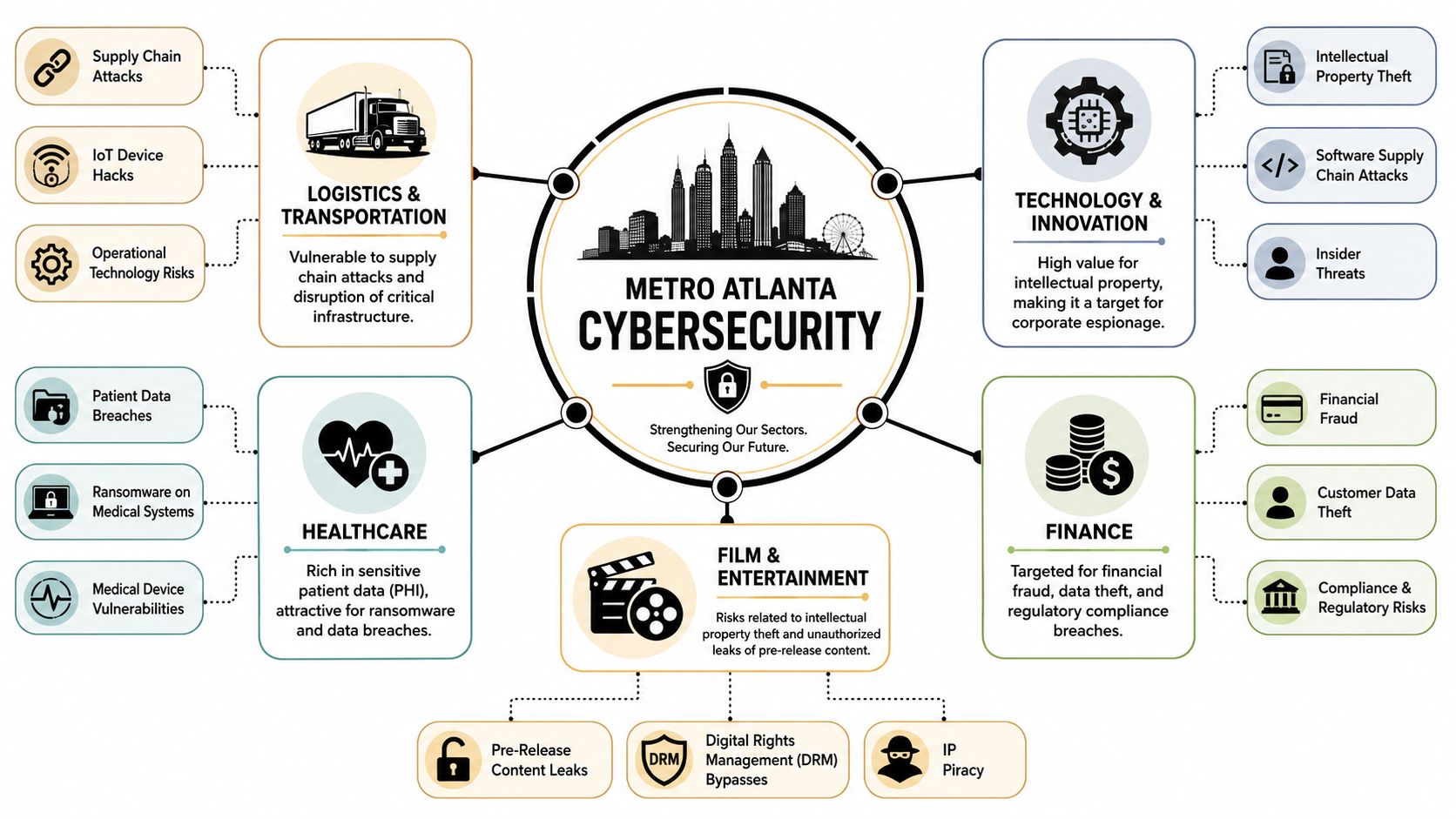
Sector-Specific Vulnerabilities in Metro Atlanta
Atlanta isn't one market. It's a cluster of industries with different pressure points. The threat pattern changes depending on whether your company moves money, handles patient information, routes freight, or manages legal records.
This Atlanta market overview notes that the city's concentration of fintech, healthtech, and logistics ecosystems increases the value of attacks focused on identity theft, payment fraud, and business email compromise. That's the local detail many generic threat lists miss.
Fintech and payment-heavy firms
Atlanta's finance and payment ecosystem creates obvious incentives for attackers. They don't need to exfiltrate everything if they can alter one transaction path, compromise one executive mailbox, or hijack one vendor communication thread.
Common weak points include:
- Treasury approvals by email: Easy to impersonate under time pressure.
- Shared finance workflows: Too many users with broad access to payment systems.
- Vendor master changes: Bank detail updates that aren't independently verified.
For these firms, identity controls and payment verification procedures matter as much as endpoint tooling.
Healthcare and healthtech environments
Healthcare environments carry a different burden. Attackers know these organizations can't tolerate downtime and often run mixed fleets of modern cloud tools alongside older clinical or line-of-business systems.
The challenge isn't only privacy. It's continuity. If scheduling, imaging, intake, or specialty systems become unavailable, patient operations feel it immediately. When healthcare organizations retire workstations, servers, or storage arrays, they also need disposal workflows that stand up to compliance review. For teams addressing end-of-life handling, this overview of HIPAA-compliant ITAD services in Georgia is a useful operational reference.
Logistics, legal, and technology firms
Logistics companies depend on uptime, partner access, and accurate movement data. Attackers know disruption can create urgency and force risky decisions. Legal and professional services firms carry trust-based communications that are ideal for impersonation and document theft. Technology companies often hold source code, internal product plans, and privileged access to customer environments.
The more your business depends on trusted communication and uninterrupted workflow, the more attractive social engineering becomes.
A generic control stack won't fit all of them. Finance needs tight transaction validation. Healthcare needs resilience and documented handling. Logistics needs operational continuity. Legal needs communication integrity. Technology firms need stronger privilege boundaries and third-party access discipline.
Essential Mitigation and Proactive Controls
If you're deciding where to spend limited time, focus on controls that interrupt common attack chains early. Not every security investment delivers the same operational value.
Controls worth enforcing first
Start with the basics that reliably shrink exposure:
- MFA everywhere it matters: Prioritize email, cloud admin, VPN, remote access, and privileged systems.
- Patch discipline: Internet-facing systems, endpoints, browsers, and common productivity tools need a defined cadence.
- Email hardening: Impersonation protection, attachment scanning, URL defense, and mailbox rule monitoring matter.
- Access scoping: Role-based permissions and reduced admin rights limit lateral movement after compromise.
These aren't glamorous projects. They work because they attack the mechanics of how most incidents spread.
Controls that fail in practice
Some defenses look solid in policy but collapse in operations. Annual awareness training is a common example. If users get one slide deck a year and no realistic reinforcement, phishing resistance won't hold. The same goes for backups that are never restored in a live test, and vendor reviews that stop after signature collection.
For broader operational thinking on network hygiene and layered defense, Throughwire’s guide to China network security is worth reading for its practical treatment of segmentation, visibility, and control discipline.
The vendor and asset side of cyber risk
A lot of Atlanta incidents involve third parties somewhere in the chain. MSP access, disposal vendors, logistics handlers, cloud platforms, and downstream service providers all expand the trust boundary. A documented vendor due diligence checklist helps expose weak chain-of-custody terms, vague destruction language, and missing accountability before they become incident-response problems.
The best control set is the one your team can maintain consistently. Fancy tools with weak ownership usually lose to straightforward controls that are reviewed, tested, and enforced.
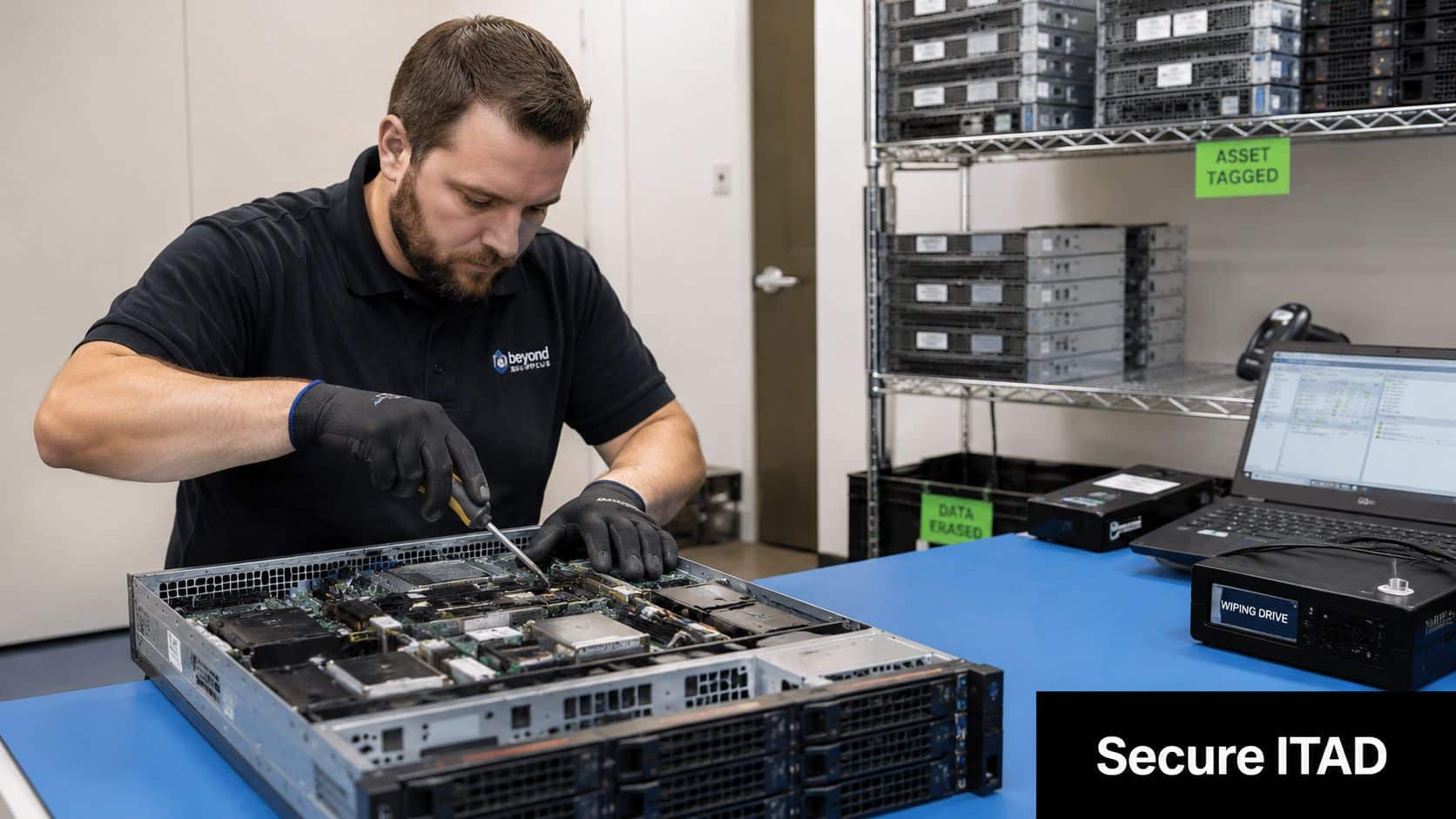
Closing the Loop with Secure IT Asset Disposition
A surprising number of security programs stop caring the moment a device is unplugged. That's a mistake. Retired laptops, decommissioned servers, failed drives, spare network gear, and returned lease equipment can all carry recoverable data, credentials, cached access tokens, business records, and regulated information.
Why disposal belongs in the security program
An ITAD gap can undo stronger controls upstream. You can harden email, enforce MFA, and run good endpoint security. If a retired storage device leaves your environment without verified wiping or destruction, the exposure is still yours.
Internal ownership frequently breaks down. Security thinks facilities is handling it. Facilities thinks infrastructure signed off. Procurement assumes the recycler has a process. Nobody confirms chain of custody, media handling, serialization, or proof of destruction.
A workable standard usually includes:
- Asset tracking: Identify what left service and whether media was present.
- Disposition decisioning: Reuse, resale, wipe, shred, or destroy based on risk and device type.
- Chain of custody: Document possession from pickup through final processing.
- Evidence: Keep certificates, inventory logs, and destruction records aligned to the asset list.
What good looks like in practice
For organizations with regular refresh cycles, data center moves, or multi-site collections, secure ITAD should sit inside the same governance model as offboarding and incident response. That means legal, compliance, infrastructure, and procurement all agree on handling standards before assets pile up.
One practical option in Atlanta is Beyond Surplus, which provides business ITAD services including data wiping, hard drive shredding, logistics coordination, and chain-of-custody documentation. Used correctly, that kind of service isn't janitorial cleanup. It's a final security control that reduces residual data exposure after systems leave production.
Building Your Cyber Resilient Atlanta Business
Cybersecurity threats targeting Atlanta companies are shaped by local conditions. The regional business mix makes the city attractive for fraud, identity compromise, extortion, and disruption. The attacks that land most often are still the familiar ones: phishing, ransomware staging, and BEC aimed at fast-moving business processes.
The strongest Atlanta security programs usually share three habits. They tune controls to the threats that are showing up. They coordinate IT, finance, legal, and operations instead of treating security as a silo. And they protect data across the full asset lifecycle, not just while devices are active on the network.
A practical operating model
Use a short checklist:
- Prioritize common attack paths: Email, identity, endpoint privilege, and recovery.
- Build fraud response muscle: Don't leave BEC to ad hoc decision-making.
- Match controls to your sector: Payment workflows, patient systems, and logistics operations need different emphasis.
- Manage end of life deliberately: Fold retired devices into your security governance with IT asset lifecycle management.
Cyber resilience isn't one product. It's the discipline of reducing easy wins for attackers at every stage, including the last stage when hardware leaves your hands.
If you're responsible for security in Atlanta, that's the standard to aim for. Not perfect prevention. Repeatable control, fast containment, and clean disposition of the systems that once held your most sensitive data.
If your organization needs a cleaner end-to-end approach to device retirement, data destruction, and documented chain of custody, contact Beyond Surplus for secure IT asset disposal and certified electronics recycling support.


