

A Georgia healthcare IT manager usually sees the problem before anyone else does. The storeroom fills with retired laptops, old nursing-station PCs, decommissioned servers, tablets from a failed rollout, and diagnostic devices nobody wants to touch because they may still hold patient data. Operations wants the space back. Procurement wants assets off the books. Compliance wants proof that nothing leaves the building in a risky state.
That's where HIPAA-compliant ITAD services in Georgia stop being a back-office chore and become a risk decision. If your organization has invested heavily in digital records and revolutionizing patient care with EMRs, the end-of-life side matters just as much as deployment. The same systems that improved care also created a larger footprint of devices that can expose ePHI if disposal is handled casually.
A surprising number of failures happen at the end. Someone assumes a device was wiped. A recycler provides a generic pickup receipt instead of destruction records. A damaged SSD gets boxed for resale because no one verified whether sanitization succeeded. In healthcare, those are management failures, not minor process gaps.
The High Stakes of Retiring Healthcare IT Assets in Georgia
In Georgia, healthcare organizations deal with more than privacy rules. They also work inside a state environment where surplus handling, records practices, and downstream e-waste controls affect how retired equipment should move. That means the old approach of “send it to recycling and get a receipt” doesn't hold up.
What goes wrong in real environments
The risky situations are familiar:
- Storage creep: Old assets sit in closets for months because nobody owns the retirement workflow.
- Partial inventory: IT tracks desktops but misses external drives, mobile devices, and embedded storage in medical equipment.
- Informal handoff: Facilities or third-party haulers move equipment without serialized logs.
- Bad assumptions: Teams think deletion or reimaging equals compliant disposal.
Healthcare organizations rarely get in trouble because they lacked a recycler. They get in trouble because they lacked proof.
The practical issue isn't whether your team intends to do the right thing. It's whether you can show, device by device, that ePHI was rendered unreadable before custody changed.
Why this lands on IT and compliance together
IT usually owns the inventory. Compliance owns the risk. Facilities may control dock access and storage. Legal may care about retention and hold issues. If those groups don't work from one retirement process, the chain breaks fast.
That's why disciplined ITAD belongs in the same conversation as incident response, access control, and records management. Retiring assets is part of protecting patient information, not separate from it.
What HIPAA Requires for IT Asset Disposition
HIPAA-compliant ITAD starts with a rule that isn't new. The HIPAA Security Rule took effect on April 20, 2005, and one key requirement is that organizations maintain policies for the final disposition of electronic protected health information. A Georgia compliance summary also cites a maximum of $2.067 million per identical violation per year in 2025, which is why audited destruction matters more than informal recycling (HIPAA compliance guidance).
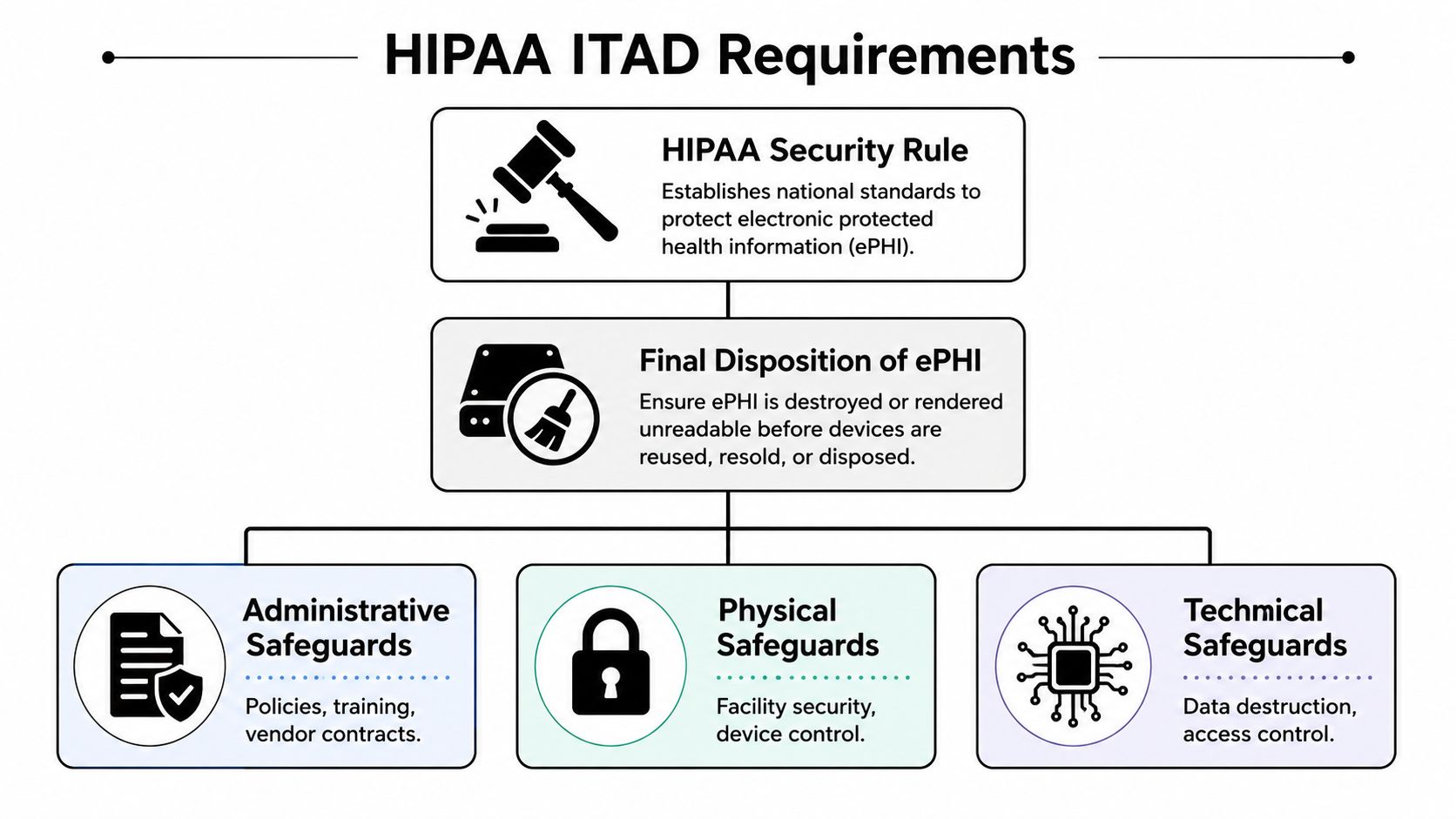
Final disposition means more than getting rid of equipment
For retired laptops, servers, phones, drives, and storage media, “final disposition” means your organization needs a documented method to sanitize or destroy ePHI before the asset leaves controlled custody.
That usually includes:
- Written policy that covers end-of-life handling for devices that may store ePHI.
- Approved destruction or sanitization methods matched to the media type.
- Vendor controls so an outside provider follows the same security expectations your internal team would.
- Audit-ready records that show what happened, when it happened, and who handled each asset.
If you need a practical baseline for these requirements, Beyond Surplus maintains a useful resource on HIPAA requirements for IT equipment disposal.
The three safeguard buckets still apply at end of life
HIPAA doesn't stop mattering because a device is obsolete.
| Safeguard area | What it means in ITAD practice |
|---|---|
| Administrative | Policies, staff training, vendor agreements, approval workflows |
| Physical | Secure staging, locked transport, controlled pickup, facility security |
| Technical | Verified sanitization, destruction methods, access control over asset data |
Practical rule: If a device once held ePHI, treat disposal as a controlled security event, not a recycling pickup.
What doesn't work is casual decommissioning. A quick reformat, an unsigned pickup ticket, or a blanket statement that “all drives were wiped” won't satisfy a serious audit question.
The Unbreakable Paper Trail Required for Compliance
Secure destruction without documentation is hard to defend. Auditors, privacy officers, and breach counsel don't just ask whether media was destroyed. They ask what was destroyed, who handled it, where custody changed, and what records support that claim.
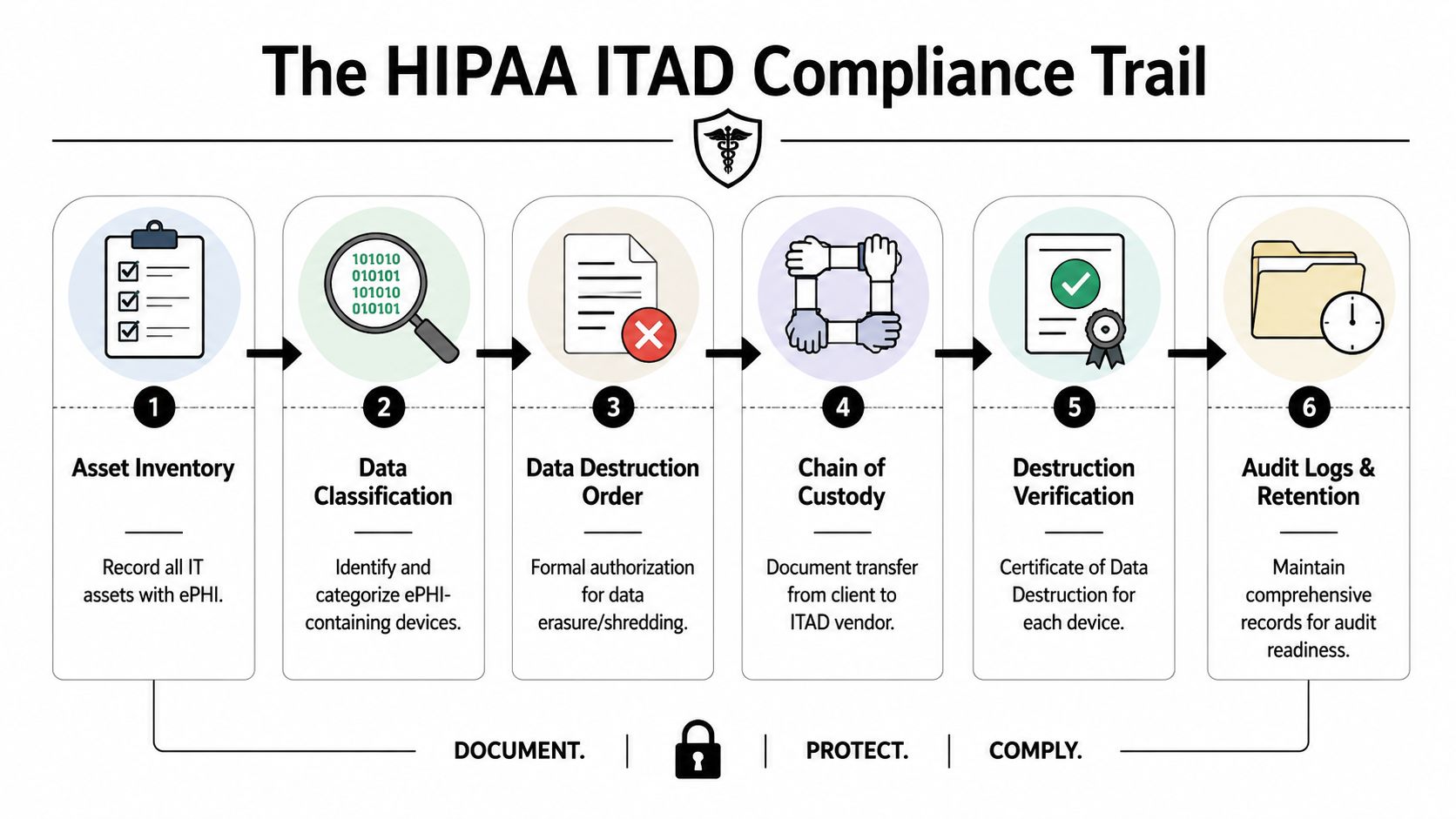
The documents that matter most
Three records drive most of the defensibility in a healthcare ITAD program.
Business Associate Agreement
If the vendor may handle media containing ePHI before destruction, the relationship should be reviewed through the same HIPAA lens you'd use for other outside service providers. A Business Associate Agreement should spell out responsibilities, permitted handling, safeguards, and breach-related obligations.
Red flag: a vendor willing to “help with healthcare clients” but unwilling to formalize obligations in writing.
Chain of custody
This is the operational backbone. The chain-of-custody record should connect each device to a pickup, transfer, transport event, and final destruction step. The stronger versions are serialized and time-linked, not just summarized by pallet or gaylord.
You can see the kind of documentation healthcare clients typically expect in a proper certificate of destruction workflow.
Certificate of destruction
This is the closeout document. It should identify what was destroyed and confirm the method used. Device-level certificates are stronger than generic statements because they tie destruction to specific assets.
What a strong record set should show
Look for a packet that includes:
- Serialized asset logs: Device identifiers tied to each item in scope.
- Transfer evidence: Who released the assets and who accepted them.
- Method detail: Whether the media was wiped, shredded, or otherwise destroyed.
- Completion proof: A final certificate linked back to the inventory.
If a vendor says “trust us, we destroyed everything,” they're asking you to accept liability on faith.
Common weak points
Weak vendors often produce one of these instead:
- a pickup receipt with no serials
- a recycling certificate that says nothing about data
- a destruction certificate that covers a whole load without identifying assets
- a chain log that begins after transport, not at pickup
For healthcare, that isn't enough. The paper trail is the service.
Secure Data Destruction Methods Explained
Not every media type should be handled the same way. The right method depends on the asset, its condition, and how much risk you're willing to carry if someone later questions recoverability.
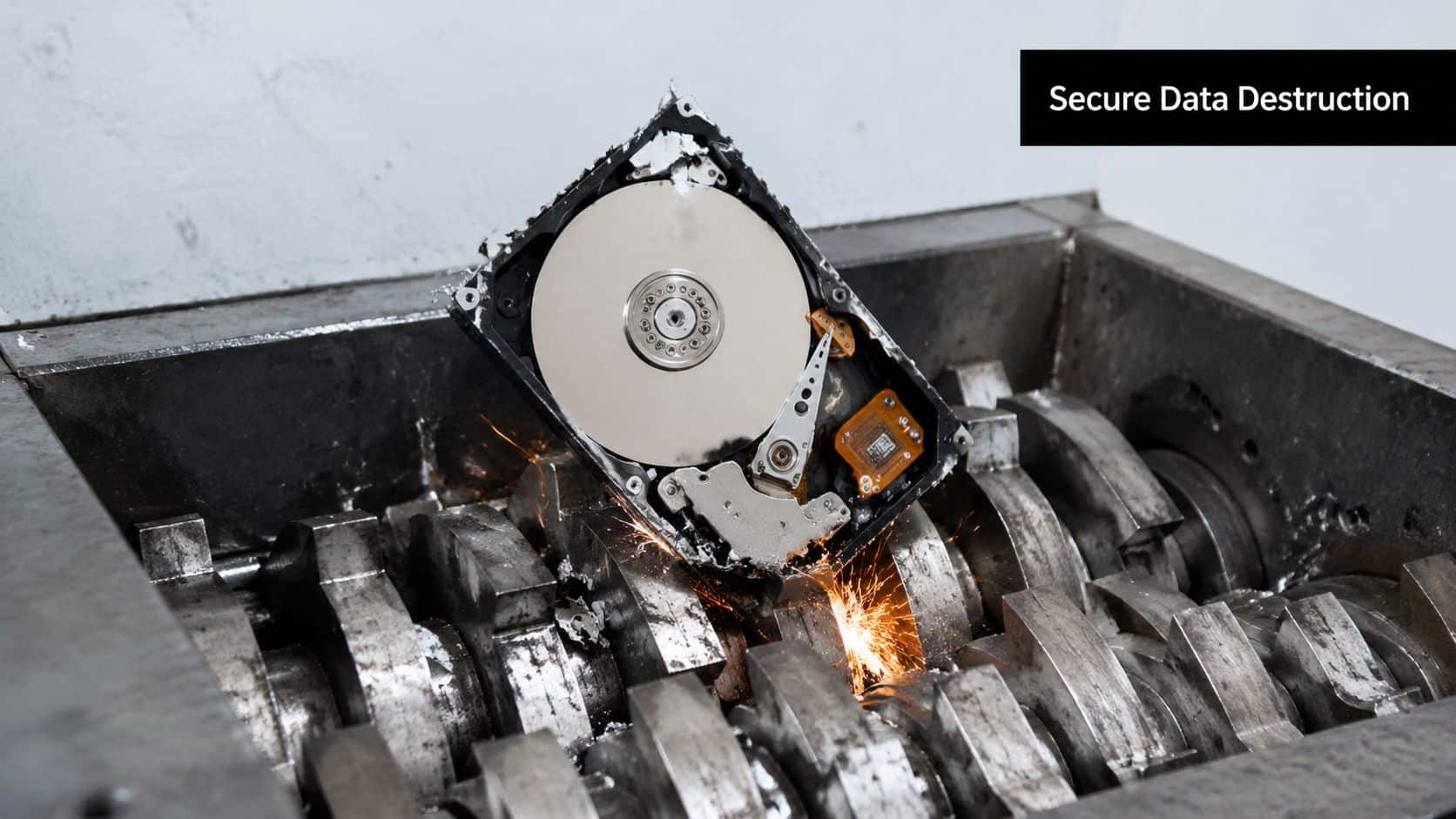
Wiping, degaussing, and shredding
Data wiping or sanitization works when the media is functional and the process can be verified. It's useful for assets headed for reuse or remarketing, but only if the workflow captures proof that the wipe succeeded.
Degaussing applies to magnetic media. It has narrower use today because many healthcare environments now retire mixed media, including SSDs.
Physical shredding or pulverization is the practical benchmark for higher-risk workloads when media can't be reliably sanitized, especially damaged drives, mixed media, or SSDs where overwrite verification can be less certain. Georgia-focused guidance also notes that a compliant packet should include serialized asset logs, chain-of-custody records, and device-level destruction certificates (HIPAA-compliant electronics recycling in Georgia).
What usually works best in healthcare
A simple comparison helps:
| Method | Best fit | Main trade-off |
|---|---|---|
| Wiping | Reuseable, functional devices | Requires verification discipline |
| Degaussing | Some magnetic media | Limited relevance for SSD-heavy environments |
| Shredding | Damaged, mixed, high-risk media | Asset value recovery is lost |
For many hospitals and clinics, shredding becomes the default for drives removed from critical systems, failed assets, and anything with uncertain media status. If your team needs a direct service reference, Beyond Surplus offers secure data destruction options that align with this kind of workflow.
The strongest method is the one your team can verify and document without exceptions.
On-site versus off-site
On-site shredding gives staff immediate witness capability. Off-site destruction may fit larger logistics programs when chain-of-custody controls are mature. The decision isn't ideological. It depends on risk tolerance, asset volume, and how much visibility your compliance team wants at the destruction step.
Georgia-Specific Compliance Considerations
Georgia adds an important operational layer to ITAD. The state's public and private sectors retire large volumes of electronics under overlapping environmental, records-retention, and privacy requirements. State-level guidance notes that compliant disposal must account for surplus-property process requirements, Georgia Technology Authority information-security policies, and Environmental Protection Division concerns tied to downstream hazardous fractions (Georgia ITAD compliance guidance).
Why Georgia buyers ask tougher questions
In practice, Georgia organizations often screen vendors for standards and workflows before they discuss price. The market expectation is evidence, not broad promises.
That's why reputable providers in the state commonly advertise:
- R2v3 for responsible electronics processing
- NAID AAA for secure destruction credibility
- NIST 800-88 aligned sanitization practices
- HIPAA-ready workflows for regulated data environments
Public sector and healthcare overlap more than people expect
If your organization touches state contracts, public health systems, university health operations, or hybrid funding environments, the retirement process may need to satisfy more than one internal rule set. A device can be an IT asset, a records container, and regulated waste all at once.
That overlap changes vendor selection. You need a partner that understands asset pickup, destruction controls, and downstream handling in Georgia, not just a recycler with a truck.
For a broader state-specific overview, this Georgia ITAD guide is a useful reference point.
Your Vendor Selection Checklist for HIPAA ITAD in Georgia
Most healthcare teams don't need another generic vendor questionnaire. They need a shortlist of questions that expose weak process fast.
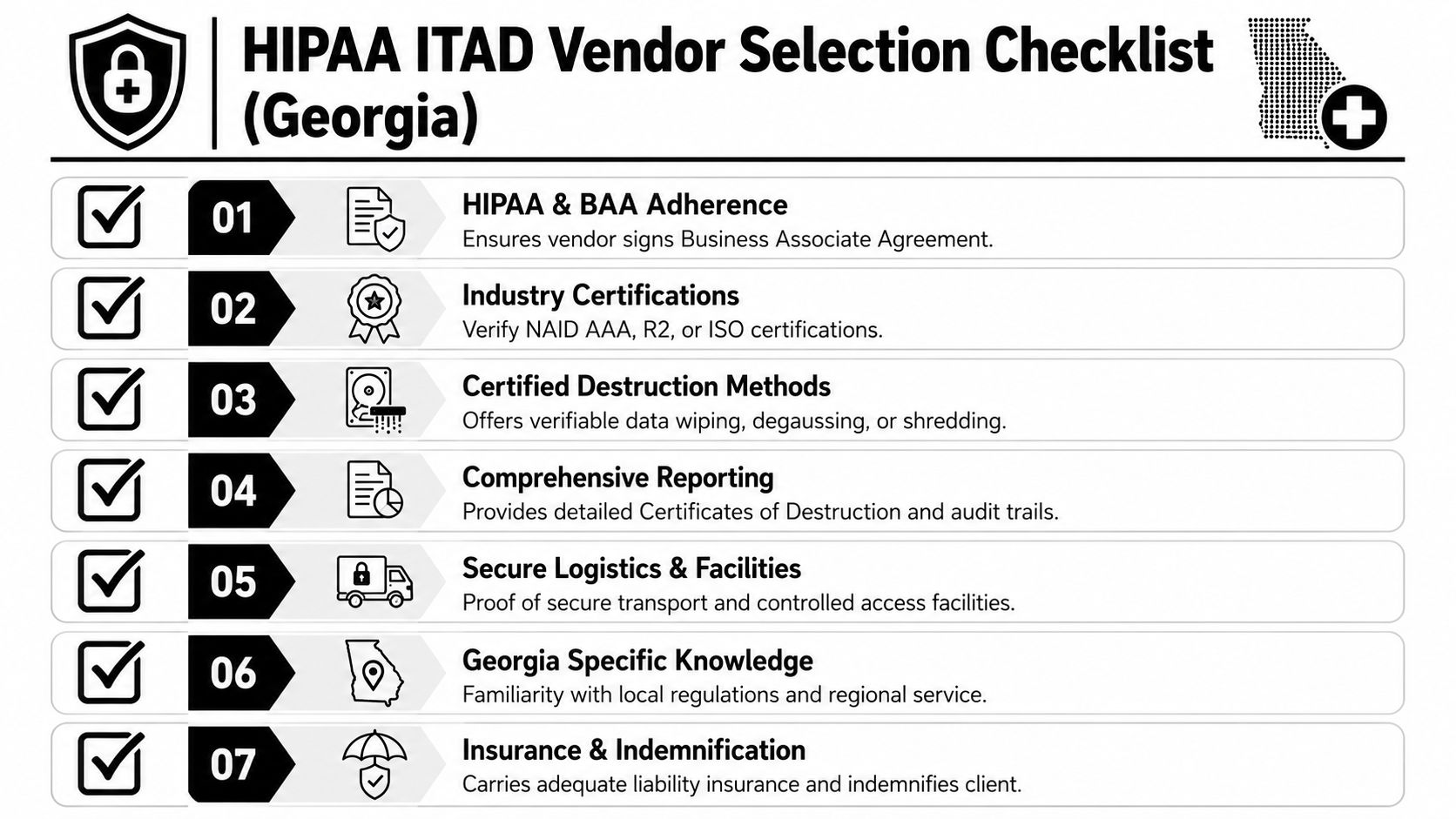
Ask these before you approve pickup
Will you sign the required healthcare agreements?
If the answer is vague, stop there.Which certifications and standards do you operate under?
Listen for specific references such as NAID AAA, R2v3, and NIST 800-88-aligned workflows.How do you track each device from pickup through destruction?
“We log everything” isn't enough. Ask whether tracking is serialized and whether the chain starts at your dock.Which destruction methods do you use for SSDs, failed drives, and mixed media?
The vendor should explain the decision logic, not just list services.
Review the evidence, not the pitch
A capable vendor should be comfortable showing sample documentation and process detail.
- Request sample records: Ask for a redacted chain-of-custody form and destruction certificate.
- Check exception handling: Find out what happens when a serial number is unreadable or a drive arrives damaged.
- Verify logistics controls: Ask who transports assets and how vehicles and facilities are secured.
- Clarify downstream handling: For non-destroyed equipment, ask how reuse, recycling, and residual media risks are separated.
For a practical screening framework, use this guide on how to choose an ITAD vendor in Georgia step by step.
A strong ITAD vendor answers hard questions quickly. A weak one redirects to marketing language.
Final internal check before you sign
Have your privacy, security, and asset-management stakeholders review the same scope document. Most disposal problems start when one team assumes another team verified the controls. Shared review prevents that gap.
How Beyond Surplus Delivers Compliant ITAD in Georgia
For Georgia healthcare organizations that need a vendor aligned to these requirements, Beyond Surplus provides a practical fit. Its service model includes secure ITAD, certified data wiping, on-site and off-site hard drive shredding, certificates of data destruction, electronics recycling, logistics coordination, and documented chain-of-custody handling for business clients.
That maps directly to what regulated healthcare teams typically need:
Where the service aligns
- Documentation support: serialized reporting and destruction records matter when audit questions arise
- Destruction flexibility: wiping for suitable assets, shredding for higher-risk media
- Georgia operational knowledge: local service experience matters when pickup, surplus handling, and downstream controls intersect
- Broader ITAD scope: decommissions, equipment removal, and value-recovery decisions can sit inside one managed workflow
This isn't just about making devices disappear. It's about retiring them in a way your security officer, compliance lead, and legal team can defend later.
If you're evaluating HIPAA-compliant ITAD services in Georgia, judge the process the same way you'd judge any other security control. Look for written obligations, verified handling, device-level documentation, and destruction methods matched to actual media risk. That's what holds up.
Contact Beyond Surplus to review your healthcare IT asset retirement workflow, schedule secure pickup, and get documented data destruction that supports compliance in Georgia.


