

A Georgia IT manager usually sees the problem before anyone else does. The laptops from the refresh project are stacked in a locked room. A few retired servers are still sitting in a rack because nobody wants to touch them without a plan. Facilities wants the space back, finance wants the assets cleared, and legal wants proof that nothing leaves the building without controls.
That situation looks like a disposal task. It isn't. For Georgia businesses, old technology creates data exposure, compliance exposure, and environmental liability the moment it stops being actively managed. A hard drive in storage can be just as risky as a hard drive in production if it still contains regulated data, customer records, employee files, engineering documents, or internal credentials.
This GA Full Guide is built for companies that need a practical path from “we have obsolete equipment” to “it's documented, secure, compliant, and out of our building.”
Your Georgia Business Has Old Tech Now What
A common pattern plays out the same way. A company upgrades workstations, closes a satellite office, replaces network gear, or migrates systems to the cloud. The new equipment goes live quickly. The retired equipment stays behind.
That backlog becomes e-waste debt. It ties up space, confuses asset records, and creates unnecessary risk. If your business has devices spread across Atlanta, Augusta, Savannah, Columbus, or smaller Georgia locations, that debt usually grows faster than internal teams expect.
What businesses usually miss
The first mistake is treating old electronics like ordinary junk removal. They're not chairs and they're not scrap metal. A retired firewall, copier hard drive, laptop, server, or medical workstation can still hold sensitive data.
The second mistake is assuming storage equals control. It doesn't. If your team can't show what assets exist, where they are, what data they held, and what happened to them at end of life, you don't have a clean process. You have delay.
Old equipment is only “safe in storage” if it's inventoried, access-controlled, and already assigned to a documented disposition plan.
A more useful starting point is to classify the inventory before anyone moves it:
- Data-bearing devices that need wiping, shredding, degaussing, or another controlled destruction method
- Non-data equipment such as cables, peripherals, or accessories that still need responsible recycling
- Assets with resale potential that may offset part of the project cost
- Special handling items tied to healthcare, finance, labs, or other regulated operations
Georgia companies that want a better framework can review this Georgia business IT asset recovery guide as part of their planning.
The real business issue
Once obsolete equipment starts piling up, the question isn't “how do we get rid of this stuff?” The right question is “how do we close this risk with proof?” That shift changes who owns the project. It stops being a housekeeping issue and becomes a controlled business process involving IT, compliance, legal, operations, and often procurement.
If you're staring at a room full of retired electronics, the next move isn't guessing. It's inventory, data classification, custody control, and disposal planning.
Why ITAD is a Risk Management Function Not a Janitorial Task
IT asset disposition, or ITAD, sits at the intersection of security, compliance, and operational control. That's why mature organizations don't hand it off as an afterthought.
A janitorial task removes clutter. A risk management function protects the business when equipment leaves service.
Three risk categories that matter
The first is data security risk. If a laptop, SSD, server, phone, tablet, or copier drive still contains information, improper disposal can create a breach event. That risk applies whether the data is regulated or confidential to the business.
The second is legal and compliance risk. Healthcare providers, financial firms, schools, manufacturers, and government contractors all face different obligations, but the underlying issue is the same. If your organization can't demonstrate reasonable controls over end-of-life data and equipment handling, it may have a hard time defending its process.
The third is environmental liability risk. Electronics contain materials that require responsible downstream handling. If a vendor cuts corners, your company can still face the operational and reputational fallout.
What weak ITAD looks like
Weak programs usually have familiar symptoms:
- Ad hoc pickups: Assets leave when someone “has time” to deal with them.
- No serialized tracking: Teams know roughly what went out, not exactly what went out.
- Undefined destruction method: Staff assume all drives were handled the same way when they weren't.
- Missing documentation: Certificates are incomplete, delayed, or never issued.
A serious disposal program starts before pickup day. Vendor controls matter, but so does internal discipline. Procurement should validate the vendor. IT should define data handling requirements. Compliance should verify records retention and destruction standards. Facilities should coordinate secure staging and controlled access.
Practical rule: If your ITAD provider can't explain chain of custody, downstream handling, and documentation in plain language, stop the project until they can.
Vendor review is where many companies either reduce risk or inherit more of it. A structured ITAD vendor due diligence checklist helps separate routine hauling from accountable asset disposition.
What works in practice
The companies that manage this well do a few things consistently. They treat retired technology as a controlled asset class. They assign ownership. They define approved destruction methods before collection. They require paperwork that stands up to an audit.
That approach costs more effort up front. It usually costs less than cleaning up preventable mistakes later.
Navigating Georgia and Federal E-Waste Compliance
Georgia businesses operate under a mix of federal disposal obligations, industry-specific requirements, and practical state-level environmental responsibilities. That mix creates confusion because many companies look for one Georgia rule that answers everything. There isn't one.
Federal duties come first
At the federal level, disposal obligations often attach to the data, not just the device. If your company handles consumer information, healthcare data, financial records, or other protected categories, end-of-life equipment has to be managed with the same seriousness as live systems.
For many businesses, the core question is simple. Did you dispose of information in a way that made unauthorized access unlikely? If the answer is uncertain, your process is weak no matter where the equipment physically went.
Some organizations also fall under rules tied to sector obligations, contract terms, or internal governance standards. That's why legal and compliance teams should review ITAD policies alongside security and records management.
Georgia-specific reality
Georgia doesn't remove that burden from the business. In practice, the state's framework means companies still have to make careful vendor choices, control logistics, and document outcomes. The absence of a single business e-cycling mandate doesn't reduce exposure. It places more weight on due diligence.
For that reason, businesses should look closely at how a provider handles items under broader environmental rules and related waste streams. Universal waste requirements are often part of that larger compliance picture.
Compliance doesn't fail only when a company breaks a rule. It also fails when the company can't prove what happened to the equipment and data.
A practical compliance lens
Use this short filter when reviewing a Georgia ITAD project:
| Question | Why it matters |
|---|---|
| Does the device contain or likely contain sensitive data? | This determines destruction requirements. |
| Is the equipment tied to a regulated function? | Healthcare, finance, education, and government often need tighter controls. |
| Can the vendor document custody and final processing? | Without records, your audit trail is weak. |
| Do internal teams agree on retention and release authority? | Assets shouldn't leave before approvals are complete. |
A compliant process is rarely about memorizing statutes. It's about proving that your company used reasonable controls from inventory through final disposition.
Secure Data Destruction Options Explained
Choosing a destruction method should depend on the media type, data sensitivity, internal policy, and chain-of-custody tolerance. Too many businesses choose based on habit alone.
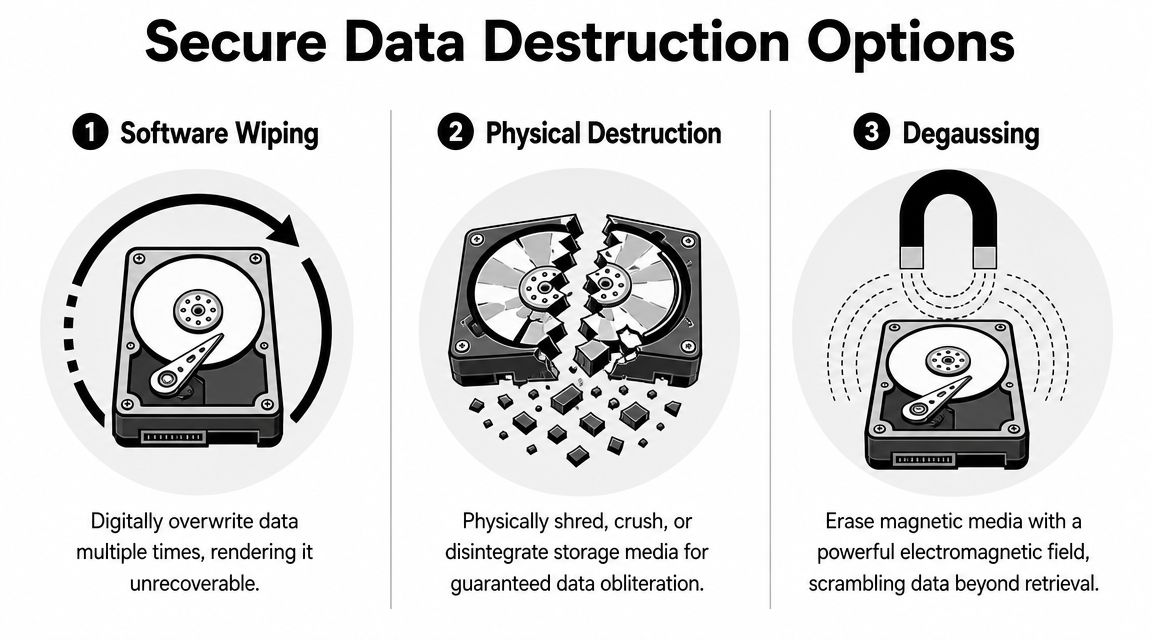
Side-by-side decision view
| Method | Best fit | Trade-off |
|---|---|---|
| Software wiping | Reusable devices that can be remarketed or redeployed | Requires the media to be functional and the process to be validated |
| Off-site shredding | Large volumes or projects where transport to a secure facility is acceptable | Custody remains critical during transit |
| On-site shredding | Sensitive projects where the client wants destruction at the premises | Usually less flexible operationally and may affect project cost |
| Degaussing | Magnetic media in environments that approve that method | Not suitable for every storage type and usually destroys reuse value |
Software wiping
Wiping makes sense when an organization wants data destruction plus value recovery. A working laptop, desktop, or server drive may still have remarketing value after a validated erase process. That makes wiping attractive for standard enterprise refresh cycles.
The downside is that wiping isn't a shortcut. It has to be executed, logged, and verified properly. If a drive is damaged or inaccessible, wiping may not be possible.
Businesses reviewing policy alignment should understand NIST SP 800-88 guidance when deciding whether sanitization or destruction fits the asset.
Off-site and on-site shredding
Physical shredding is the clearest option when the priority is irreversible destruction. It's common for failed drives, highly sensitive media, and environments where reuse isn't worth the risk.
Off-site shredding works well if the transport chain is secure and documented. On-site shredding works well when an organization wants destruction witnessed at its facility. Neither method is automatically better. The choice depends on your controls, not on marketing language.
What actually works
Use wiping when the media is healthy and your organization wants reuse or resale. Use shredding when policy, media condition, or data sensitivity makes physical destruction the cleaner answer. Use degaussing only when it fits the actual media and your internal standards.
One Georgia option in this category is Beyond Surplus, which provides data wiping and on-site or off-site hard drive shredding as part of commercial ITAD services. That's useful when a business wants one vendor to handle collection, destruction, and downstream recycling under the same custody process.
The Power of Proof Chain of Custody and Certificates
Disposal isn't complete when the truck leaves. It's complete when your company has documentation that proves what moved, who handled it, what happened to it, and when the process closed.
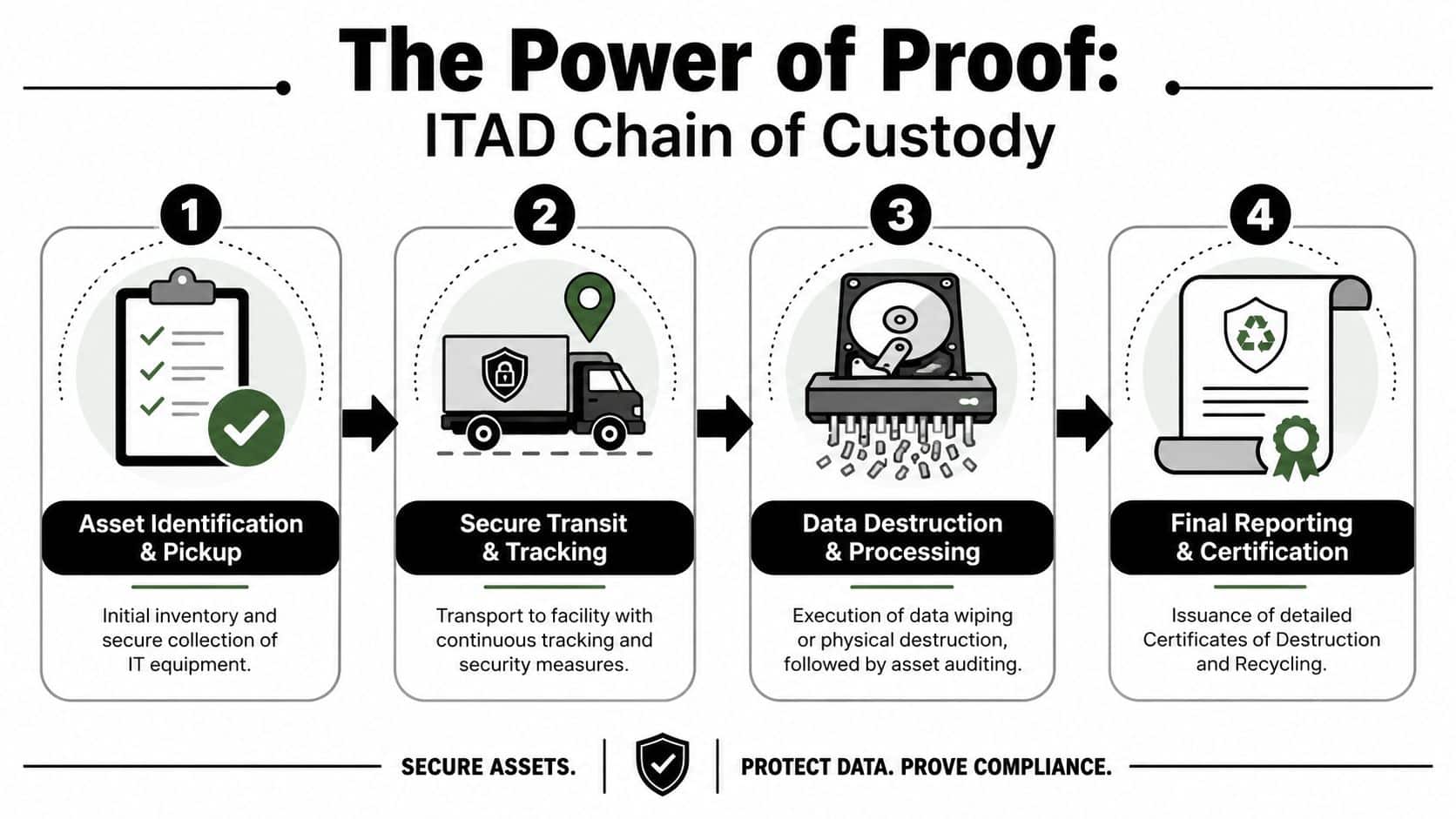
What chain of custody actually means
Chain of custody is the record of possession and control from the moment an asset is identified for disposition to the moment it is destroyed, recycled, remarketed, or otherwise processed. For audit purposes, gaps matter.
A strong custody record usually includes:
- Pickup authorization showing who requested service and what categories of assets were approved
- Asset listing with serial numbers or other identifiers where appropriate
- Transfer record showing the handoff to transport personnel or receiving staff
- Processing record showing what destruction or recycling action occurred
- Final certificates that close the file
Why certificates matter
A Certificate of Destruction or Certificate of Recycling isn't decorative paperwork. It's evidence. Your finance, legal, compliance, and security teams may all need it later.
Documentation rule: If a device leaves your control without a matching record, assume you'll have trouble proving due diligence later.
That's why businesses should know exactly what the final packet will include before scheduling service. The more regulated the environment, the less room there is for vague reporting.
For teams that need a model, this Certificate of Destruction overview shows what this record is meant to support.
Liability transfer is not automatic
Some companies assume liability transfers the moment a vendor signs for the equipment. That's too simplistic. Real liability control comes from a combination of vendor qualification, documented custody, proper processing, and defensible records.
If your internal file only says “old computers picked up,” you don't have much protection. If the record shows serialized assets, custody transitions, destruction method, and issued certificates, your position is much stronger.
That's the difference between saying disposal occurred and proving it.
Logistics in Georgia Pickup and Drop-Off Services
Georgia logistics are straightforward when the project is planned correctly. They become messy when businesses wait until equipment has piled up across multiple rooms, branches, and departments.
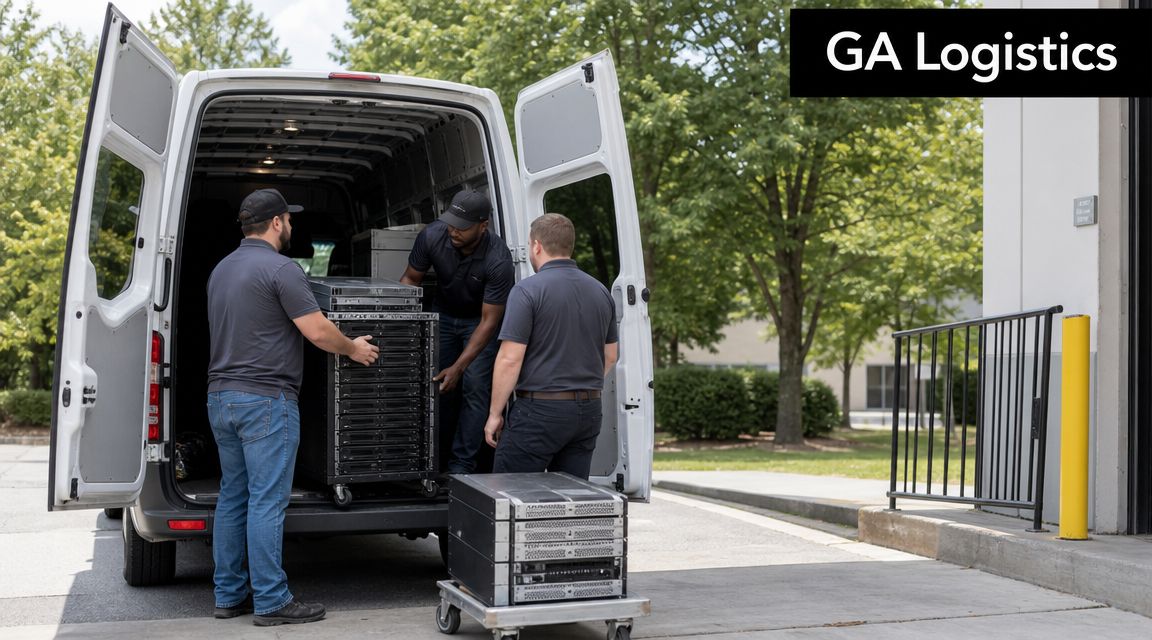
Pickup for larger commercial projects
A downtown Atlanta office closing a floor usually needs scheduled pickup. The same is true for a healthcare network clearing exam-room systems, a manufacturer replacing workstations, or a data center team de-installing retired hardware. In these cases, the right model is controlled collection with staging instructions, access coordination, loading procedures, and transport records.
Pickup works best when the company has:
- Volume that justifies scheduling
- Data-bearing assets that shouldn't sit in open loading areas
- Multiple departments contributing equipment
- A deadline tied to moves, renovations, or lease events
For larger Georgia operations, that approach is usually more secure and more efficient than asking internal staff to improvise.
Drop-off for smaller business loads
A smaller company may have a simpler need. Maybe it's a law office with retired laptops and monitors, or a branch location with a manageable quantity of network gear and desktops. In those cases, drop-off can work if the receiving process is still documented and the business confirms what the vendor accepts, how data-bearing devices are handled, and what paperwork follows.
Drop-off is practical when the load is limited and the company can control transport internally. It's less practical when equipment includes large server lots, medical devices, or mixed material from several sites.
Georgia-specific planning points
A Georgia business should settle these questions before moving anything:
Who releases the assets
IT, facilities, compliance, or department leadership should be identified in advance.Where equipment will be staged
Use a secure location with restricted access.How pickup windows will work
Building access, dock scheduling, freight elevator access, and after-hours rules matter.Whether rural locations need consolidation
Some companies save time by aggregating assets from smaller Georgia branches into one pickup event.
The right logistics plan isn't complicated. It's just deliberate.
Unlocking Hidden Value IT Asset Buyback Programs
Not every retired asset is pure cost. Some equipment still has residual value, and a buyback program can convert part of an ITAD project from expense control to value recovery.
What tends to hold value
In commercial environments, value usually remains in equipment that is still relevant to current business use. That often includes newer enterprise laptops, servers, networking gear, and certain bulk IT assets with consistent specifications and usable condition.
Condition matters. Age matters. Quantity matters. A small batch of mixed, heavily worn devices usually performs differently from a standardized fleet refresh with matching models and intact components.
What usually doesn't
Older, damaged, incomplete, or low-demand equipment often has little or no resale value. The same goes for gear that is too old for practical commercial reuse, has missing parts, or costs more to process than it can return.
That doesn't make those assets unimportant. It just changes the objective from value recovery to secure and compliant disposition.
A buyback discussion should start with realistic sorting. Put reusable assets in one lane and recycling-only assets in another.
How to evaluate a buyback offer
A practical review should look at these factors:
| Factor | What it changes |
|---|---|
| Model relevance | Newer and marketable equipment is easier to resell |
| Cosmetic and functional condition | Damage lowers recovery potential |
| Quantity consistency | Bulk lots are easier to process and price |
| Storage media status | Reusable equipment still needs approved data handling |
| Missing accessories or components | Incomplete lots reduce value |
The strongest buyback projects start with a clean inventory and realistic expectations. Businesses get into trouble when they assume every old asset should generate a return. It won't.
Still, when a company has organized surplus from a refresh, closure, merger, or equipment standardization project, buyback can offset disposal and logistics costs while keeping the security process intact.
Your Georgia ITAD Project Checklist
A good ITAD project doesn't rely on memory. It relies on a repeatable checklist that covers inventory, security, logistics, documentation, and closeout.
Pre-project controls
Start with internal preparation before any vendor arrives.
- Build the asset list: Identify devices by type, location, business unit, and whether they are data-bearing.
- Separate regulated equipment: Flag systems tied to healthcare, finance, legal, HR, labs, or government work.
- Confirm release authority: Decide who can approve removal and who must sign off.
- Define the destruction method: Match wiping, shredding, degaussing, or recycling to each asset category.
Vendor and logistics controls
Once the inventory is clean, align the project details.
Validate the vendor
Review scope, custody handling, downstream processing, and records.Plan site logistics
Confirm dock access, staging rooms, elevator use, parking, security escort needs, and pickup windows.Prepare the assets
Keep devices together by category. Don't let staff remove drives casually unless your policy requires a separate handling path.Control handoff day
Make sure the internal contact is present, the load matches the planned scope, and transfer records are captured.
Documentation and closeout
Many projects weaken at this stage. Don't stop at collection.
- Request final reporting: Make sure your team receives the destruction and recycling records applicable to the job.
- Match documents to inventory: Confirm the paperwork aligns with what left your sites.
- Archive compliance records: Store certificates with retention schedules that make sense for legal, audit, and customer requirements.
- Update internal asset systems: Mark assets as retired only after the project is documented and complete.
Print-ready checklist
For Georgia businesses, the working sequence is simple:
- Inventory everything
- Flag data-bearing devices
- Choose the right destruction path
- Qualify the vendor
- Schedule pickup or drop-off
- Track custody
- Obtain certificates
- Archive proof
If your team follows that order, you reduce confusion and tighten liability control. If you skip steps, the same equipment can create problems long after it leaves the building.
If your company needs commercial electronics recycling, secure data destruction, IT asset buyback, or coordinated pickup in Georgia, contact Beyond Surplus to discuss a documented ITAD plan built for business risk, compliance, and logistics.