

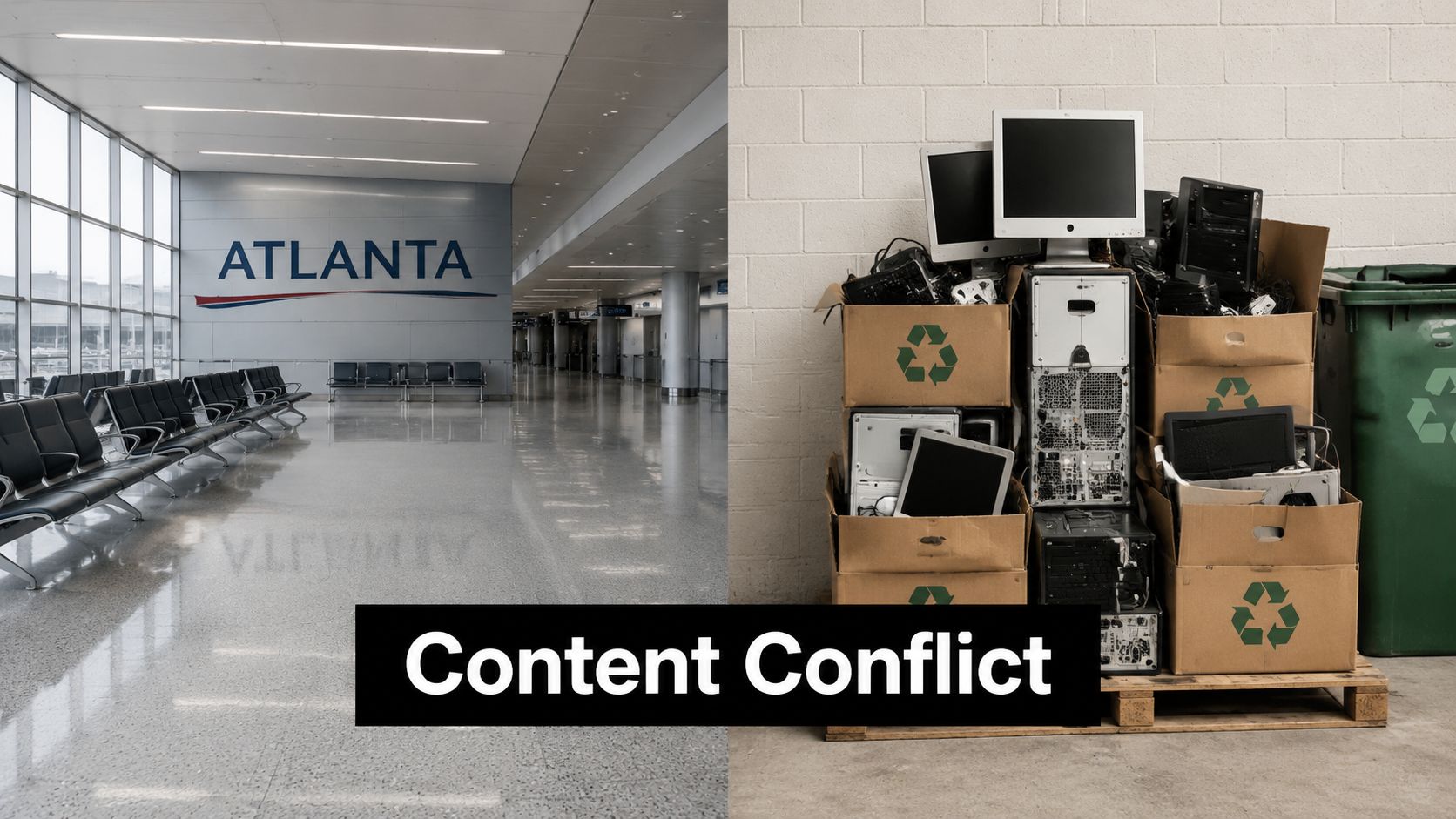
When Content Instructions Collide, the problem usually isn't a lack of ideas, it's a lack of alignment. A traveler asking for faster routes through ATL and a brand brief centered on electronics recycling are pulling in opposite directions, and that kind of contradiction shows up in real work all the time. The right move is to stop pretending both goals can be satisfied in one clean pass and instead sort the brief into a clear decision path, so the final content stays useful, credible, and on-brand. For a separate example of how confusing travel framing can get, see premium cabin booking strategies.
1. Conflict Between Requested Topic and Content Requirements
The first problem is simple. The topic asks for Atlanta Airport travel tips, but the brand direction centers on Beyond Surplus, electronics recycling, and IT asset disposal. Those are different audiences, different intents, and different outcomes.
A traveler at ATL wants speed, wayfinding, security advice, and connection planning. A business buyer looking at Beyond Surplus wants secure pickup, chain of custody, certified destruction, and compliance support. If one article tries to serve both, it stops serving either one well.

Separate the intent before you write
The cleanest fix is to decide which reader matters most. If the goal is airport travel advice, the content should stay on ATL, and the business reference should be removed. If the goal is brand content for Beyond Surplus, the article should focus on IT equipment logistics and secure disposition.
Practical rule: one page should solve one primary problem. If the title says airport guide, don't force in recycling services that don't belong there.
That separation protects both clarity and search performance. Searchers can tell when a page wanders, and they leave fast when the promise in the title doesn't match the body. A coherent article earns trust because every paragraph supports the same destination.
2. Issue Creating Misleading Content
Writing airport tips under a recycling company's name misleads the reader even if every sentence is technically correct. Someone landing on a Beyond Surplus page expects business disposal services, not terminal navigation. That mismatch creates confusion before the reader even gets to the first useful point.
The deeper issue is intent. A facilities manager searching for e-waste pickup doesn't want to read about Plane Train transfers. A traveler searching for ATL security advice doesn't need a vendor pitch about hard drive shredding. Mixing them weakens the page's usefulness and makes the brand look unfocused.

Match the page promise to the reader's goal
A credible page should answer the exact question the visitor came with. If the page is about ATL, the strongest content is route planning, concourse movement, and connection timing. If the page is about Beyond Surplus, the strongest content is IT equipment disposal, secure e-waste management, and data destruction.
The best commercial content feels specific from the first sentence. It does not borrow a topic from another industry just because the brief is crowded. It tells the truth about what the company does, then explains it clearly.
3. Issue Misrepresenting Beyond Surplus's Services
Beyond Surplus is a service provider for IT asset disposition, electronic waste recycling, secure data destruction, and related business disposal needs. Airport logistics is not part of that core identity, so using ATL travel copy under their name would misrepresent the company.
That kind of mismatch hurts more than a single page. It muddies positioning, confuses buyers, and gives the impression that the site is publishing whatever fits the headline instead of content built around actual services. For a B2B company, that's a credibility problem, not just a content problem.
A business reader expects operational clarity. They want to know how pickup works, how data is handled, and what happens to retired equipment. They do not want to infer whether the company is an airport advisory source.

For a practical example of the brand story, see how Beyond Surplus helps businesses recover remote employee laptops.
When a company writes outside its lane, the reader notices fast. The safest move is to keep the page tightly tied to the service line the brand actually sells.
That approach also makes internal navigation cleaner. Readers can move from a service explanation to a process page without wondering why an airport guide appeared in the middle of a disposal workflow.
4. Issue Violating Content Authenticity and Credibility
Publishing irrelevant content under a company name damages trust even if the copy is polished. Readers judge the whole site by what shows up on it, and a page that doesn't fit the brand raises a fair question about editorial standards. If one article is off-topic, what else is off-topic?
For business audiences, credibility matters at every step. Procurement teams, IT managers, and compliance stakeholders all look for consistency. They want a vendor that sounds deliberate, not random.
See the difference in positioning by reviewing Beyond Surplus's vendor due diligence checklist.
Keep the content auditable
Authentic content should clearly reflect the company's actual offerings, proof points, and operating model. That means writing about pickup logistics, secure handling, device recovery, and end-of-life processing when the topic is Beyond Surplus. It does not mean improvising around a catchy headline.
A strong content system protects the brand by refusing false shortcuts. It chooses the right subject, uses the right terminology, and supports claims with real service detail. That's how a page stays believable and useful.
5. Option A Provide 8 Atlanta Airport Time-Saving Travel Tips
A good ATL guide stays practical and specific. Travelers waste time at Hartsfield-Jackson Atlanta International Airport when they guess at entrances, underestimate the layout, or ignore the airport's own timing guidance. ATL's official advice is clear. Arrive 2 to 3 hours before departure, and plan your route before you leave home ATL travel guidance. For more detail on the airport itself, see our Hartsfield-Jackson Atlanta International Airport guide.
ATL also has seven concourses, so concourse planning is not optional. The airport says the Plane Train is the fastest way to move between concourses, which makes it the right choice whenever your gate is in a different part of the airport operational data.
The fastest practical choices
- Check your terminal before you leave home. ATL's layout can add avoidable walking and queue time if you start at the wrong entrance.
- Use your airline app for live changes. Flight timing shifts happen often enough that you should confirm gate and status before you arrive.
- Use the Plane Train for cross-concourse trips. It is the fastest option when you need to move between concourses transfer guidance.
- Arrive ready for screening. ATL guidance says to prepare electronics for screening, and the TSA 3-1-1 rule limits liquids to 3.4 ounces or less in one quart-sized bag per traveler screening guidance.
- Choose the right entrance. Domestic North, Domestic South, and the International Terminal each serve different trip types, so the best entry point depends on your airline and destination routing guidance.
- Book help if your trip is tight. For a premium experience, consider a meet-and-greet at the airport.
- Keep connections simple. If your itinerary forces a concourse change, build in time for the train instead of trying to sprint across the airport.
- Recheck your route before entering security. A correct entrance and a correct concourse choice save more time than rushing once you are inside.
For travelers with tight connections, the simplest wins come from planning, not speed. The right entrance, the right concourse, and the right transport choice usually save more time than trying to recover it later.
6. Option B Provide 8 Tips for Managing IT Equipment Logistics and Decommissioning
If the goal is Beyond Surplus content, the article should speak directly to IT and facilities leaders. A good decommissioning plan starts with inventory, because nobody can secure what they can't track. Every asset should be tagged before transport so records stay clean from the first pickup to final disposition.
The same logic applies to custody and documentation. Certified carriers, clear handoffs, and disposal certificates are what make an ITAD program auditable. That's what business buyers need when they're retiring laptops, servers, and network gear.
For process detail, review Beyond Surplus's data center decommissioning process.
Core operating steps
- Inventory every device before pickup. Tag laptops, desktops, servers, and peripherals so nothing disappears in transit.
- Document chain of custody. Keep signed records for each handoff to preserve accountability.
- Schedule certified pickup windows. Coordinate transport to reduce downtime for the business.
- Use approved data destruction methods. Match the method to the asset and the risk level.
- Request certificates after completion. Keep documentation ready for audit and compliance review.
- Consolidate shipments where practical. Fewer trips usually simplify logistics and handling.
- Reconcile every asset against the manifest. Close the loop after processing so records match reality.
- Plan contingencies for delays. Decommissioning projects move faster when stakeholders know what happens if timing shifts.
A strong IT asset strategy is about control. It protects data, reduces operational disruption, and keeps leadership confident that retired equipment was handled properly.
7. Option C Structured Article About Beyond Surplus Services
A structured Beyond Surplus article should be built around the service line, not around a travel topic that doesn't belong. The right shape is straightforward: introduce the business problem, explain the services, describe the process, and close with compliance and contact.
The content should make the company sound like what it is, a commercial partner for secure disposition and recycling. That means writing for IT directors, procurement teams, healthcare organizations, schools, and enterprises that need documented handling of end-of-life equipment.
Use a simple service structure like this:
- Service scope
- Electronics recycling
- IT asset disposition
- Data destruction
- Product destruction
- Operating process
- Pickup
- Inventory
- Chain of custody
- Processing
- Reporting
- Compliance support
- Certificates of recycling
- Certificates of data destruction
- Liability transfer documentation
- Business use cases
- Office refreshes
- Laptop recovery
- Data center decommissions
- Fleet-wide hardware replacement
For a brand page, a service article should stay concrete. It should explain what gets accepted, how assets move through the workflow, and what the customer receives at the end. That's far more persuasive than trying to dress the company up as an airport authority.
8. Next Steps and Clarifying Question
The fastest path is to choose one lane and stay in it. If the goal is ATL travel content, the page should become a clean airport guide with route tips, concourse advice, and security timing. If the goal is Beyond Surplus content, the page should become a commercial service article about electronics recycling, IT asset recovery, and secure disposal.
A mixed brief can still be resolved, but it needs a decision. The writer should not guess which audience matters more. The client needs to say whether the page should educate travelers, attract IT buyers, or present a structured service overview.
For a useful brand example that fits the company's real audience, review Beyond Surplus's brunch guide for Atlanta locals.
Clarity beats compromise when the brief conflicts. Pick the audience, pick the purpose, and the content becomes easier to trust and easier to publish.
8-Point Comparison: Faster Travel Tips at ATL
| Item | 🔄 Complexity | ⚡ Resources | 📊 Expected Outcomes / ⭐ | Ideal Use Cases | 💡 Key Advantages |
|---|---|---|---|---|---|
| Conflict Between Requested Topic and Content Requirements | Low, identify mismatch quickly | Minimal, review scope only | Misalignment between request and requirements; ⭐ Low brand relevance | Internal scope/brief review | Clarifies scope to avoid wasted work |
| Issue: Creating Misleading Content | Low, easy to produce but ethically wrong | Low, little effort to write | Misleads audience; damages trust; ⭐ Very low credibility | None, not recommended | Highlights reputational and SEO risks |
| Issue: Misrepresenting Beyond Surplus's Services | Low, simple mismatch to detect | Low, requires brand/service check | Incorrect service portrayal; ⭐ Very low brand accuracy | Avoid publishing under company name | Prevents customer confusion and liability |
| Issue: Violating Content Authenticity and Credibility | Low, editorial governance needed | Low, governance action required | Erodes trust and consistency; SEO risk; ⭐ Very low long-term value | Governance/quality control | Emphasizes need for authentic, consistent messaging |
| Option A: 8 ATL Time‑Saving Travel Tips | Low, short list format | Minimal, quick research and writing | Useful for travelers but unrelated to brand; ⭐ Medium for travel, Low for company | Travel blogs or neutral platforms | Fast to produce; high immediate audience utility |
| Option B: 8 IT Equipment Logistics & Decommissioning Tips | Medium, needs SME input | Moderate, subject matter experts, validation | Aligns with Beyond Surplus; builds authority; ⭐ High brand relevance | Company blog, client guidance, lead nurture | Actionable, compliance-minded content that supports sales |
| Option C: Structured Article About Beyond Surplus Services | High, long‑form + structured data | High, research, writing, JSON, approvals | Comprehensive marketing asset; strong SEO/lead value; ⭐ Very high | Website cornerstone content, sales enablement | Reusable assets, measurable ROI, compliance-ready |
| Next Steps / Clarifying Question | Low, decision point | Minimal, client direction only | Clear direction ensures aligned deliverable; ⭐ High for project success | Project kickoff / content planning | Ensures truthful, focused content and avoids scope creep |
The Path to Clarity in Content Generation
Resolving instructional conflicts is essential for an effective content strategy. When a brief asks for two incompatible outcomes, the writer has to identify the primary goal and protect it. That's how the final piece stays accurate, relevant, and commercially useful.
The safest content decision is the one that matches the brand's real identity. A travel guide should help travelers move faster through ATL, and a service page should help businesses manage retired technology. Those are both valid projects, but they need separate execution.
Clear direction also improves credibility. Readers can tell when a page knows what it is and what it isn't. That confidence matters for search, for conversions, and for long-term trust.
The right resolution is straightforward. Define the audience, define the job of the page, and remove anything that distracts from that job. Once the brief is clean, the content becomes stronger, easier to edit, and much more likely to perform.
Beyond Surplus helps businesses handle electronics recycling, IT asset disposition, and secure data destruction with documented, professional service. If you need a trusted partner for end-of-life technology, visit Beyond Surplus and connect with a team that can support pickup, processing, and compliance-focused reporting.


