

Sustainable IT Asset Disposal Solutions for Atlanta Companies starts with a hard number. The world generated 62 million metric tons of electronic waste in 2022, and that total is projected to reach 82 million tons by 2030 according to Beyond Surplus's e-waste overview. Only 22.3% of e-waste was properly collected and recycled, which means most retired devices still move through risky disposal streams that can expose data and create environmental liability.
For Atlanta businesses, that pressure lands on IT, finance, facilities, and compliance at the same time. A laptop, server, storage array, copier, or printer is no longer just old equipment when it leaves the rack or desk. If the handoff isn't documented, the organization is left with a sustainability gap, a security gap, or both.
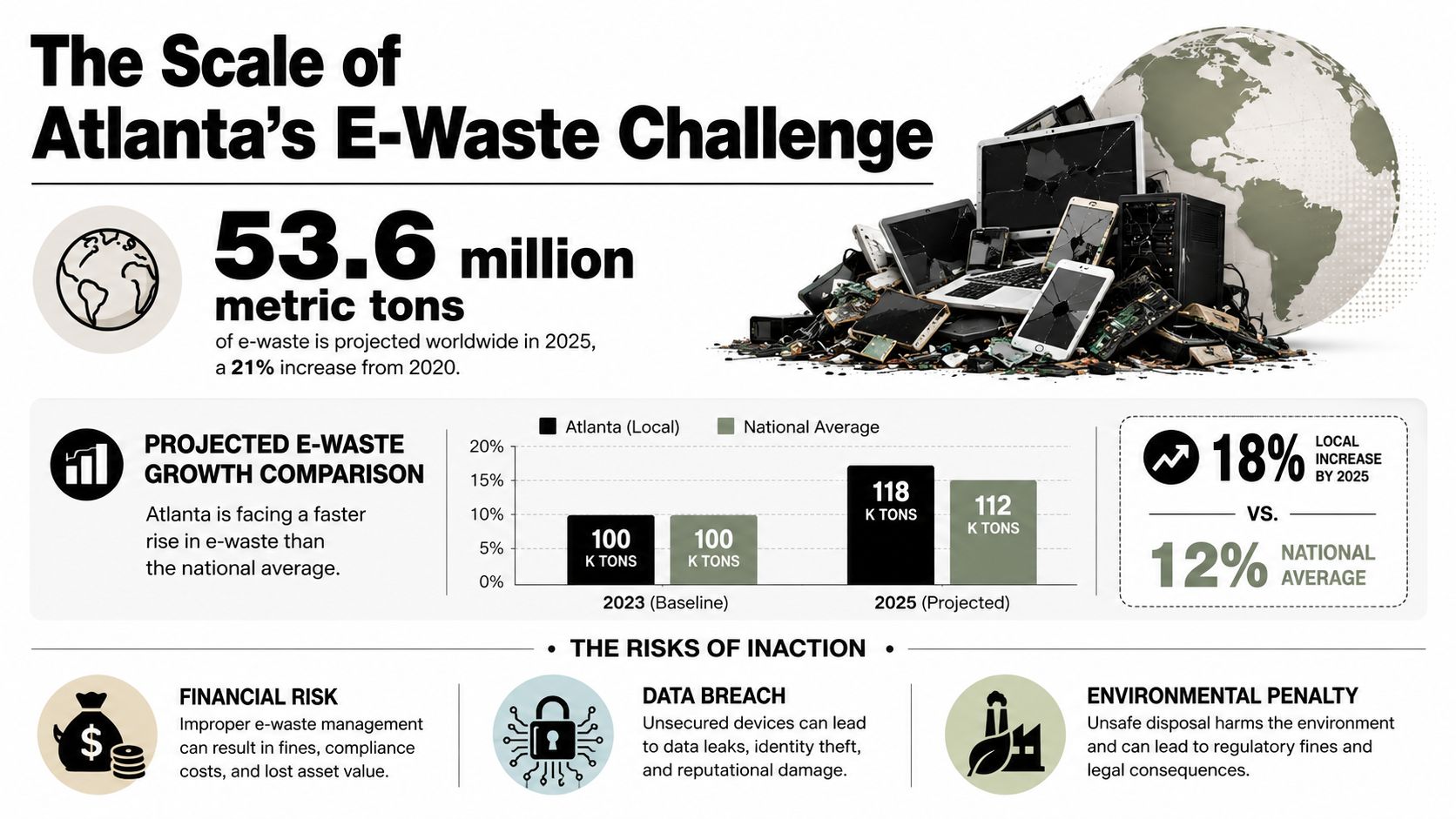
The practical answer is a disposal program that treats retirement as a controlled process, not a cleanup task. Atlanta teams need certified recycling, data destruction, and chain-of-custody controls tied together, because that's what holds up when auditors ask where the assets went and who touched them.
Atlanta ESG and sustainable IT practices
Why Sustainable IT Asset Disposal Matters for Atlanta Businesses
Atlanta companies can't afford to think of retired hardware as scrap. The global volume of e-waste makes the operational problem bigger every year, but the primary business issue is what happens between decommission and final disposition. Once equipment leaves your site, every untracked step becomes a weak point.
The sustainability side is also a control issue
A mature ITAD program maximizes reuse first, then recovers value where it makes sense, and recycles what can't be repurposed. That mirrors the broader market behavior captured in a survey where 80% of companies recycled at least some IT hardware, 65% redeployed usable devices internally, 62% remarketed assets, 54% donated equipment, and 29% admitted to landfill disposal responsible IT asset disposition survey. Those numbers matter because they show that responsible disposal isn't niche anymore, it's the dominant operating model.
For Atlanta firms, the business case is straightforward. If a device still has useful life, remarketing or redeployment is better than paying to destroy value. If it contains sensitive records or regulated data, secure erasure or destruction comes first. The mistake I see most often is treating every retired asset the same, which wastes recoverable value and creates compliance noise.
Practical rule: sort devices before pickup, not after. Once a truck leaves, your options narrow fast.
The stronger approach is to build sustainable IT asset disposal into the refresh plan itself. That way facilities, procurement, and IT aren't improvising when racks empty out, offices consolidate, or a data center decommissions.
Core Disposal Methods for IT Equipment
There are three defensible paths for most business assets, and the right one depends on the device's condition and data exposure. Good triage at the start makes the vendor handoff cleaner, and it reduces the chance of gaps in chain-of-custody paperwork later.
Reuse and remarketing fit viable hardware
If a laptop boots cleanly, a workstation still has marketable life, or a switch remains functionally useful, the first question should be whether it can be reused internally or resold. That path preserves the most value and keeps usable material out of the waste stream. It also helps Atlanta procurement teams extend refresh budgets without taking shortcuts on control.
Certified data erasure is for usable assets with sensitive storage
Recoverable hardware does not always need to be shredded. If the machine still has service life but stores business records, patient data, employee files, or customer information, certified wiping is the right middle ground. The erasure method has to be documented and tied to the serial number, not handled as an informal desktop task.
That documentation matters in audits. I want to see the wipe certificate, the asset tag, and the final disposition record line up before the device leaves the floor.
Physical destruction is for non-viable or high-risk devices
Hard drives that will not boot, media that cannot be trusted, and assets that policy says must never be reused should be physically destroyed. Beyond Surplus describes certified data destruction, including on-site or off-site hard drive shredding, in its secure hard drive shredding service. That approach fits the point where residual value matters less than removing any doubt about recoverable data.
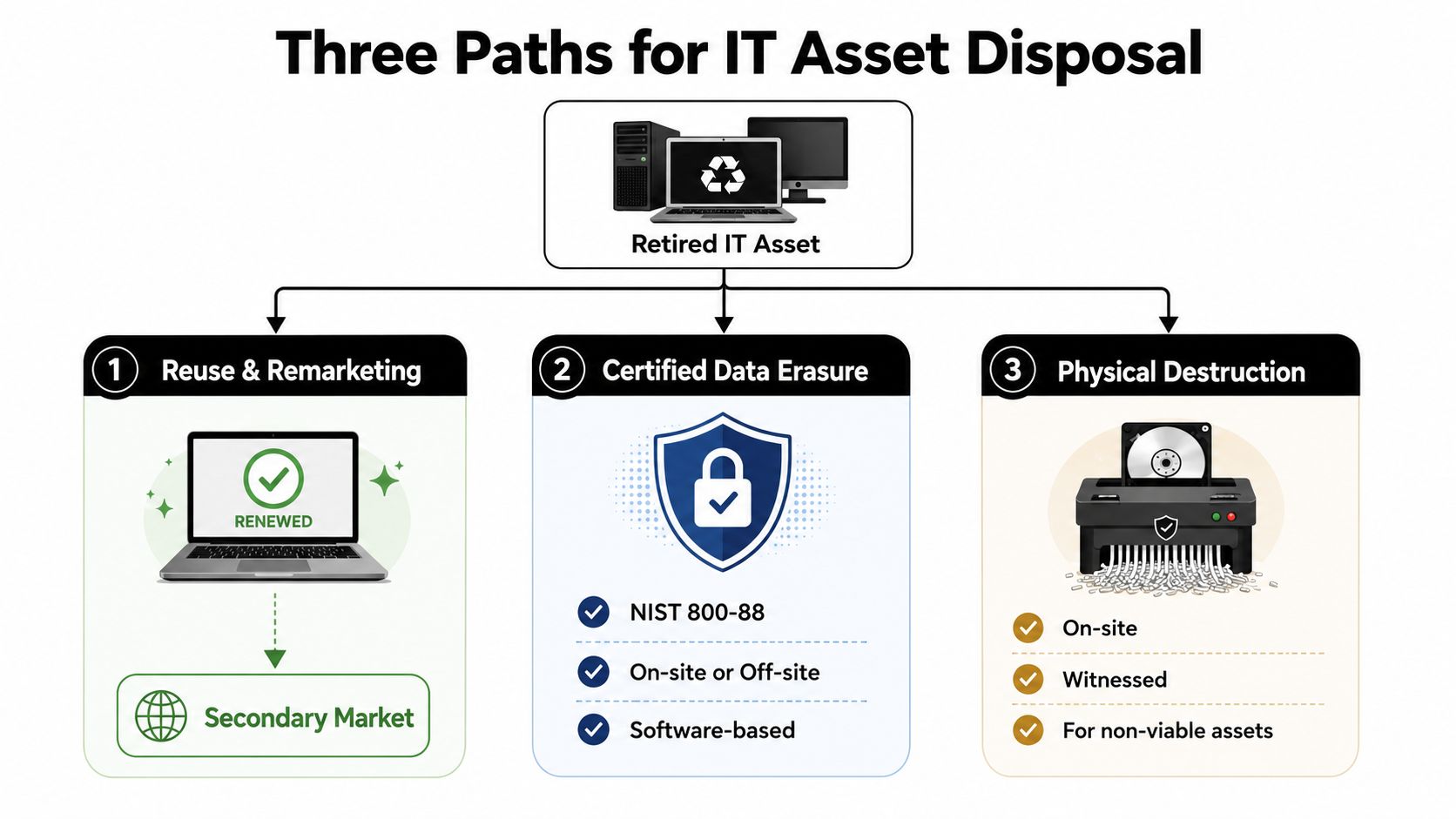
The practical rule is straightforward. Route assets that can be reused safely to remarketing. Send devices with accessible data but usable hardware to certified erasure. Use physical destruction for compromised, damaged, or policy-restricted equipment.
Regulatory and Compliance Drivers in Georgia
Compliance is where many disposal programs either harden or fall apart. Atlanta organizations often deal with overlapping obligations, and the paperwork has to match the actual disposition path.
Different sectors face different exposure
The FTC Disposal Rule can apply when an organization handles consumer information, so the disposal process needs to prevent unauthorized access once records are retired. Healthcare organizations also have HIPAA obligations around protected health information, which means disposal must be secure, documented, and consistent with internal safeguards. Georgia-based e-waste handling adds another operational layer, because the vendor's process has to align with the state's handling and recycling expectations Georgia ITAD compliance.
Financial institutions, schools, government agencies, and medical groups don't all need the same proof set, but they do need evidence. Certificates of destruction, recycling certificates, chain-of-custody manifests, and final disposition reports are what turn a disposal event into audit-ready documentation. Without that packet, a good process is hard to prove and a bad process is hard to defend.
A compliance team should ask one question before every pickup, can we prove exactly where each serial number went?
That's the standard that matters in practice. If your vendor can't produce serial-level records, the disposal workflow may be convenient, but it isn't defensible.
Managing Chain of Custody from Pickup to Certificate
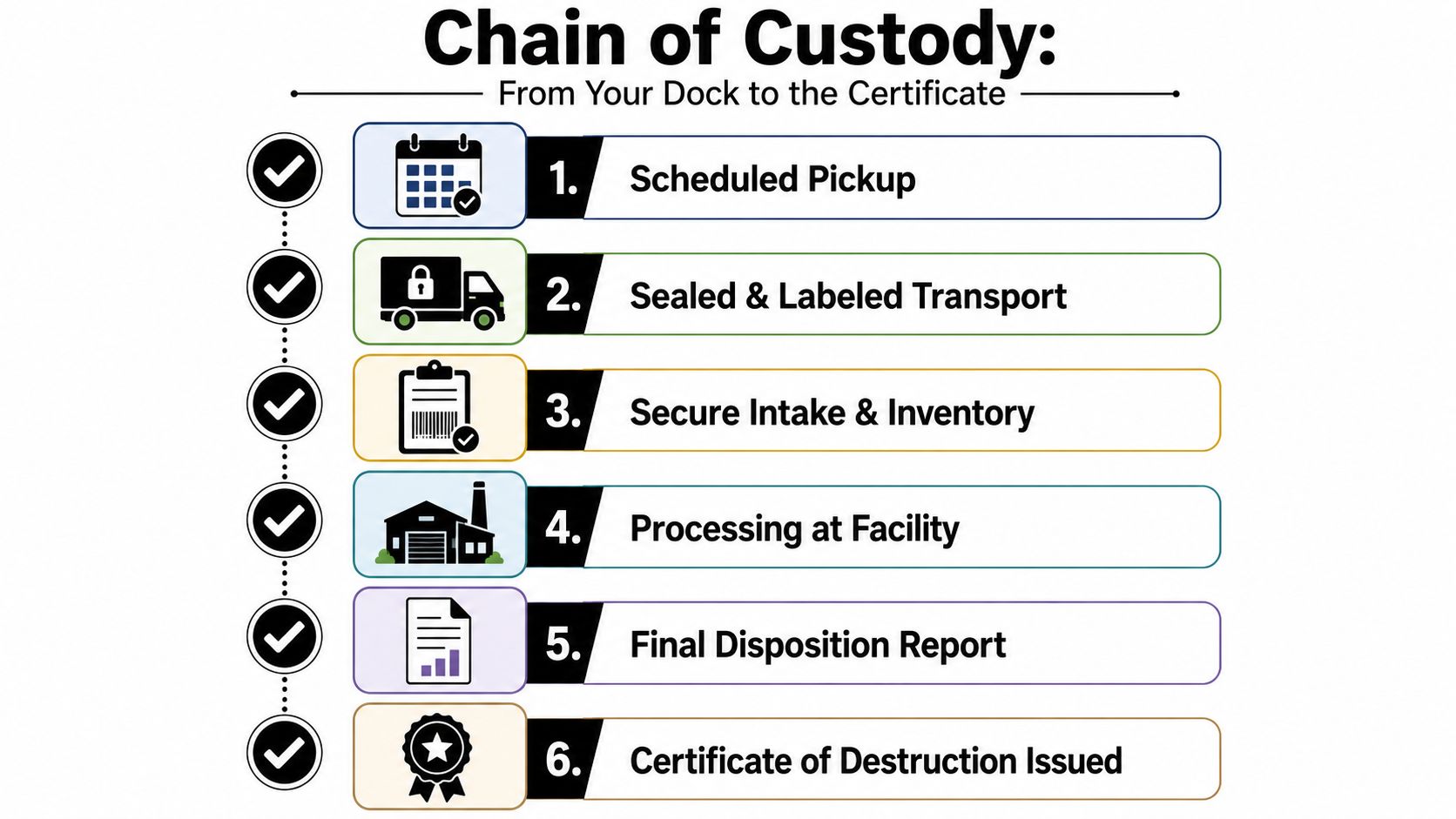
A chain of custody only works if every handoff is documented. If a record breaks anywhere between the loading dock and the final certificate, the disposal event becomes harder to defend during an audit and easier to question later.
Start with serial-level inventory
Start with serial-level asset records, a clear disposal decision for each device, and a documentation packet that ties the pickup manifest to destruction certificates and final category reporting. Beyond Surplus's chain-of-custody documentation guidance fits that approach because it treats documentation as part of the operating process, not as an afterthought. For Atlanta businesses, that matters because facilities teams, security teams, and compliance staff often need the same record set to answer different audit questions.
Verify the handoff, not just the appointment
At pickup, the on-site team should reconcile the manifest against the inventory, confirm how the assets are secured in transit, and retain internal copies of every document. If a device is missing from the manifest, resolve it immediately, before the truck leaves or the asset disappears into downstream processing. That is the difference between a controlled transfer and a handoff you cannot explain later.
Close the loop with final reporting
The final report should map what was collected to what was reused, wiped, destroyed, or recycled. Reworx Atlanta guidance is relevant here because it reflects the kind of evidence Atlanta operations need when multiple departments, building sites, and disposal paths are involved Reworx Atlanta guidance. In large decommissions I have managed, the last reconciliation is where errors surface, usually because a department left equipment off the list or attached the wrong serial number. Final reporting is where you prove the process held together.
How to Select a Certified ITAD Vendor in Atlanta
A vendor comparison should be practical, not marketing-driven. The right partner can explain how it handles logistics, data destruction, environmental processing, and reporting, then prove it with records you can audit later.
| Criterion | Certified ITAD Provider | General Recycler |
|---|---|---|
| Data destruction | Offers documented wiping or shredding tied to serial numbers | May recycle equipment without strong destruction proof |
| Chain of custody | Provides manifests, certificates, and final reporting | Often limited to basic pickup confirmation |
| Logistics | Handles scheduled business pickups and secure transport | May rely on drop-off or informal transport |
| Compliance fit | Supports regulated sectors and audit needs | Better suited to low-risk, non-sensitive material |
| Asset recovery | Can separate reuse, resale, and recycle paths | Usually focuses on material processing only |
That difference matters during a refresh or decommission. If a vendor cannot connect the asset list to the destruction record, the paperwork will not hold up under security review or environmental compliance checks.
Use a selection guide that forces those questions up front, such as Beyond Surplus's step-by-step guide to choosing an ITAD vendor in Georgia. The point is to evaluate the operating process, not just the sales pitch.
Atlanta eWaste Solutions says it serves commercial clients with on-site equipment removal, logistics setup, and hardware processing for recycling or sales evaluations, and it identifies itself as licensed and insured Atlanta eWaste Solutions services. That is the kind of service model businesses should look for when multi-site pickups or secure processing are involved.
The vendor checklist I'd use is short, but every item should be answered in writing:
- Certifications and controls: ask how data destruction and recycling are documented.
- Insurance and logistics: confirm who handles transport and whether the vendor uses its own fleet or a managed partner.
- Reporting depth: require serial-level records, not a generic weight ticket.
- Site coverage: verify whether they can support offices, warehouses, or data centers across the metro area.
A credible partner does more than remove equipment. They leave behind a record that stands up to procurement review, security review, and audit review.
Cost Factors and Value Recovery Opportunities
Disposal costs aren't just about pickup. They're shaped by the asset mix, the level of data protection required, and how complicated the logistics are across buildings, floors, and loading docks.
High-density server rooms usually cost more to clear than a simple office refresh because the equipment is heavier, more sensitive, and slower to stage. On the other hand, machines with residual market value can offset part of the process through remarketing or buyback. That's why finance teams should look at net disposition cost, not just service fees.
The biggest mistake is to treat value recovery and secure disposal as separate decisions. They're part of the same workflow. If a device can be redeployed, sold, or donated safely, that choice often lowers the cost of the overall refresh. If it can't, then secure destruction protects the organization from a much larger downstream problem.
In practice, I've seen the best outcomes when procurement sets the rules early. That means defining which asset classes are eligible for resale, which require wiping, and which must be destroyed. Once those rules are fixed, the vendor can process inventory faster and with fewer exceptions.
Implementation Roadmap for Your Next Hardware Refresh
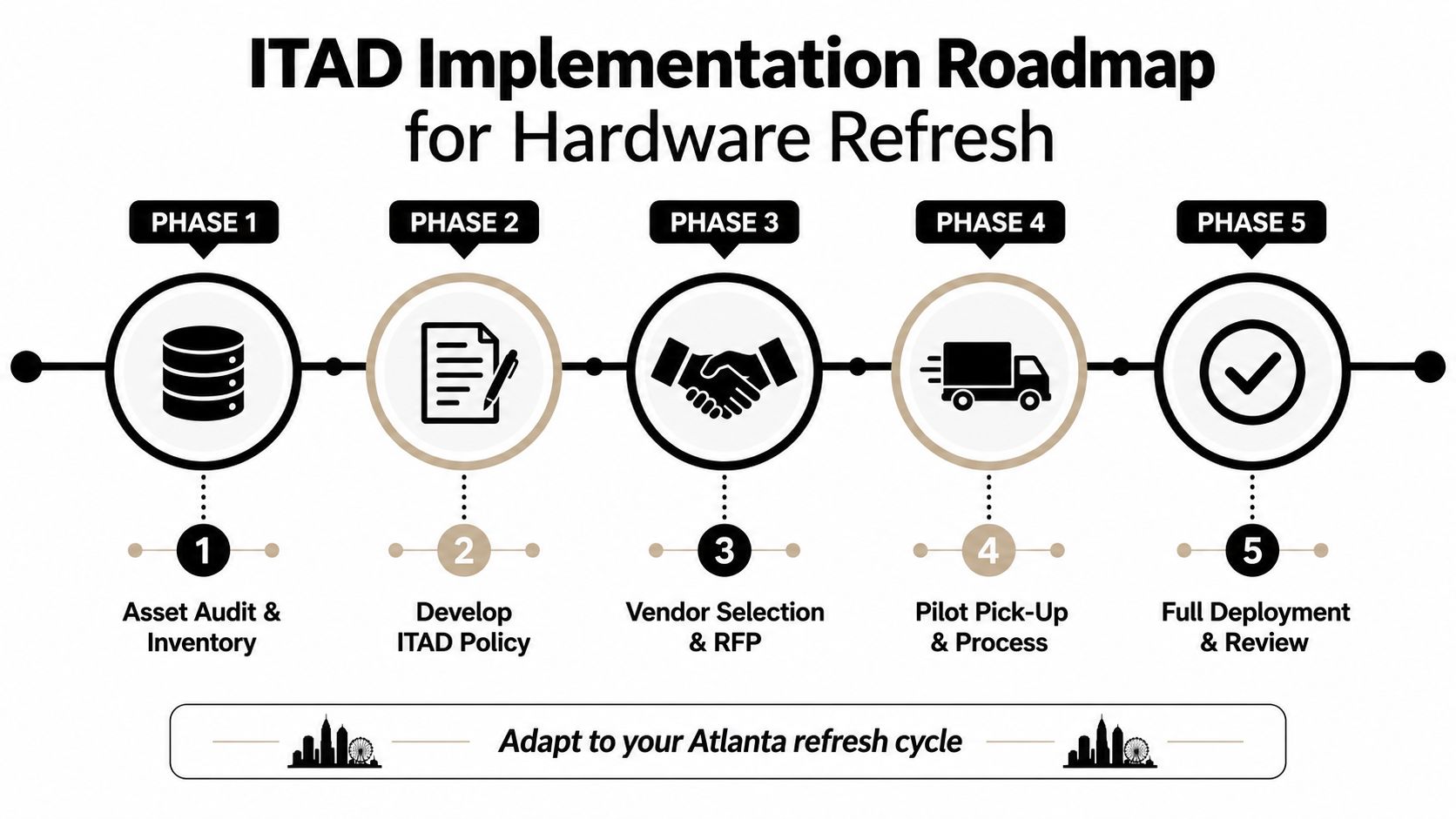
A repeatable ITAD program starts before the first pallet moves. The strongest refresh projects I've seen all followed a simple sequence: inventory, policy, vendor selection, pilot, then scale.
Phase one, audit the assets
Start with a full inventory of what's leaving the environment. Separate laptops, servers, networking gear, printers, copiers, and specialized devices into categories, then mark what can be reused, erased, or destroyed.
Phase two, write the policy
Your disposal policy should define approval paths, data handling rules, and who signs off on final disposition. Keep it short enough that people use it.
Phase three, choose the vendor and test the flow
Run a pilot pickup before committing the entire refresh to one process. That reveals whether the labels, manifests, scheduling, and certificate delivery all work in real conditions.
Phase four, roll it out across the business
Once the pilot holds up, expand to every site, then require the same records for each pickup. Training facilities staff and IT coordinators matters here because they're often the ones staging equipment.
Phase five, review the outcome
Check final reports against your original inventory and adjust the policy where exceptions came up. That review is what turns a one-time cleanup into an operating standard.
Take the Next Step Toward Certified IT Asset Disposal
Atlanta companies don't need another vague recycling promise, they need a process that protects data, documents every handoff, and keeps usable equipment out of the wrong stream. Sustainable IT asset disposal works when the logistics, reporting, and destruction controls are aligned from the start.
Beyond Surplus handles business-focused IT asset disposal, certified data destruction, and documented logistics for organizations that need a cleaner audit trail. If your team is planning a refresh, data center decommission, or office consolidation, the safest move is to line up the disposal path before equipment starts leaving the floor.
If you're ready to retire hardware without guessing about compliance or chain of custody, contact Beyond Surplus through Beyond Surplus and schedule a business pickup or disposal consultation. Their team can help Atlanta organizations move retired equipment through certified recycling, secure data destruction, and documented final disposition.


