

Most advice on Georgia e-waste law starts in the wrong place. It tells IT teams that Georgia doesn't require broad business electronics recycling, then leaves them with the impression that disposal is mostly an operational choice. That advice misses the true risk.
For an IT Director, the practical issue isn't whether Georgia forces you to recycle every retired server or laptop. It's whether your organization can defend its end-of-life process when a drive goes missing, a device with regulated data is mishandled, or hazardous components are dumped into the wrong waste stream. That is where Electronics Recycling Laws in Georgia: ITAD Compliance becomes a liability question, not a recycling question.
The Hidden Risks of IT Asset Disposal in Georgia
Assuming Georgia's lack of a statewide electronics take-back mandate eliminates compliance exposure is a costly mistake. In practice, that gap can increase risk because organizations often treat retirement and disposal as an operational cleanup task instead of a controlled data-handling event.
Exposure to risk begins after a device leaves the user. A recycler pickup ticket does not prove a hard drive was sanitized. A bill of lading does not show who handled the asset at each transfer point. If a laptop, server, backup device, or mobile phone contains regulated or sensitive data, weak disposal records leave the company defending a breach without proof that proper controls were followed.
A common failure point is treating end-of-life equipment as a simple facilities issue. Equipment gets boxed, stacked in a storage room, and released in bulk with little coordination between IT, security, legal, and procurement. That shortcut saves time on the front end and creates a much larger problem if an asset goes missing or resurfaces intact.
As outlined in Georgia ITAD liability guidance for Atlanta businesses, the missing statewide recycling mandate does not remove liability tied to poor end-of-life handling. It shifts the burden back to the business to prove that disposal was controlled, documented, and defensible.
Practical rule: If you cannot trace a device by serial number from pickup through sanitization, destruction, resale, or final downstream processing, your ITAD process is exposed.
Logistics controls matter here for the same reason they matter in regulated shipping. Documentation failures, custody gaps, and bad handoffs create downstream cost that can far exceed the original service fee, much like the broader financial impact of shipping violations when companies underestimate handling requirements.
The organizations that reduce risk do four things consistently:
- Track assets at the unit level by serial number or other unique identifier
- Maintain documented chain of custody from internal collection through final disposition
- Use defined data destruction methods that match the media type and risk level
- Keep records long enough to support audits, investigations, insurance questions, and breach response
That is the defensive posture in Georgia. Without those controls, the absence of a state recycling mandate becomes a liability trap, not a compliance advantage.
Understanding Georgia's Unique Regulatory Landscape
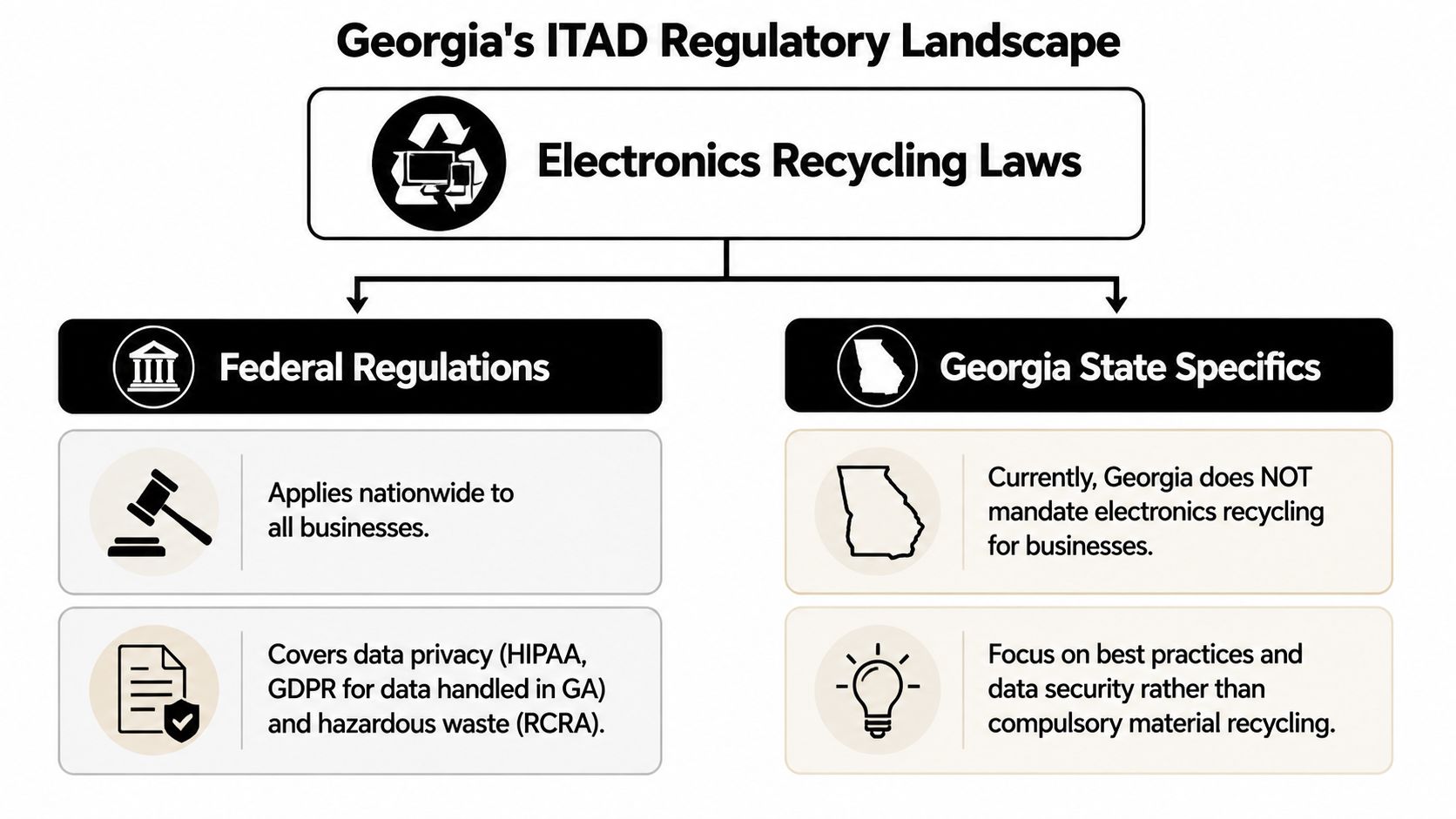
Georgia creates a compliance trap for IT teams because the state does not impose a broad business e-waste mandate, yet other disposal and data rules still apply. That gap leads some organizations to treat retired equipment like ordinary surplus. In practice, that is where exposure starts.
What Georgia doesn't require
Georgia does not have a statewide law that requires businesses to recycle electronics through a specific program. There is no universal commercial takeback rule and no broad producer responsibility system that dictates how every retired device must move.
That absence gets misread as flexibility. It is really a transfer of burden.
If the state is not telling you exactly how to retire every device, your organization has to prove that its own process was controlled, lawful, and defensible. That is why Atlanta e-waste law guidance for commercial organizations matters more to IT directors than consumer recycling summaries.
What still applies in Georgia
Georgia still restricts disposal when equipment contains regulated materials. The state solid waste rules prohibit disposal of certain hazardous waste in municipal solid waste landfills, and electronics can enter that category depending on the device and its components. The controlling source is the Georgia Environmental Protection Division's solid waste rules under Rule 391-3-4, read alongside applicable federal hazardous waste requirements under RCRA.
For IT operations, the practical question is not whether a device looks like trash. It is whether the device contains batteries, lamps, circuit boards, mercury-bearing parts, or other components that require a different handling path.
That creates a split analysis:
| Issue | Practical effect for Georgia businesses |
|---|---|
| General electronics recycling | No statewide business recycling mandate tells you exactly what to do |
| Devices with regulated components | Disposal method has to account for hazardous waste and landfill restrictions |
| Data-bearing assets | Privacy, security, and sector rules still govern sanitization and disposition |
| Audit defense | Records have to show how assets moved, how data was handled, and where material ended up |
A storage array, laptop cart, or VoIP phone lot can cross more than one rule set at the same time. Facilities may view it as cleanup. Security sees data exposure. Compliance sees documentation risk. If nobody owns the handoff, the company inherits the liability.
Why this matters for IT leaders
This is the part many teams miss. In Georgia, the lack of a specific business e-waste mandate does not reduce the need for disciplined ITAD. It increases the importance of documented control.
A clear state recycling rule gives companies a checklist. Georgia often does not. That means breach response, regulator questions, insurer scrutiny, and internal audits turn on your records, your vendor controls, and your chain of custody.
The practical standard is straightforward. Treat retired IT assets as a regulated data and materials stream, not as office junk waiting for a pickup. That approach reduces legal ambiguity, contains breach risk, and gives your team something defensible if a drive goes missing or a downstream processor mishandles material.
Defining Real ITAD Compliance Beyond Recycling
Georgia creates a problem many IT teams underestimate. Without a single statewide business e-waste mandate telling you exactly how to retire every asset class, weak vendors can present hauling and resale as "ITAD" and leave your company holding the data risk.
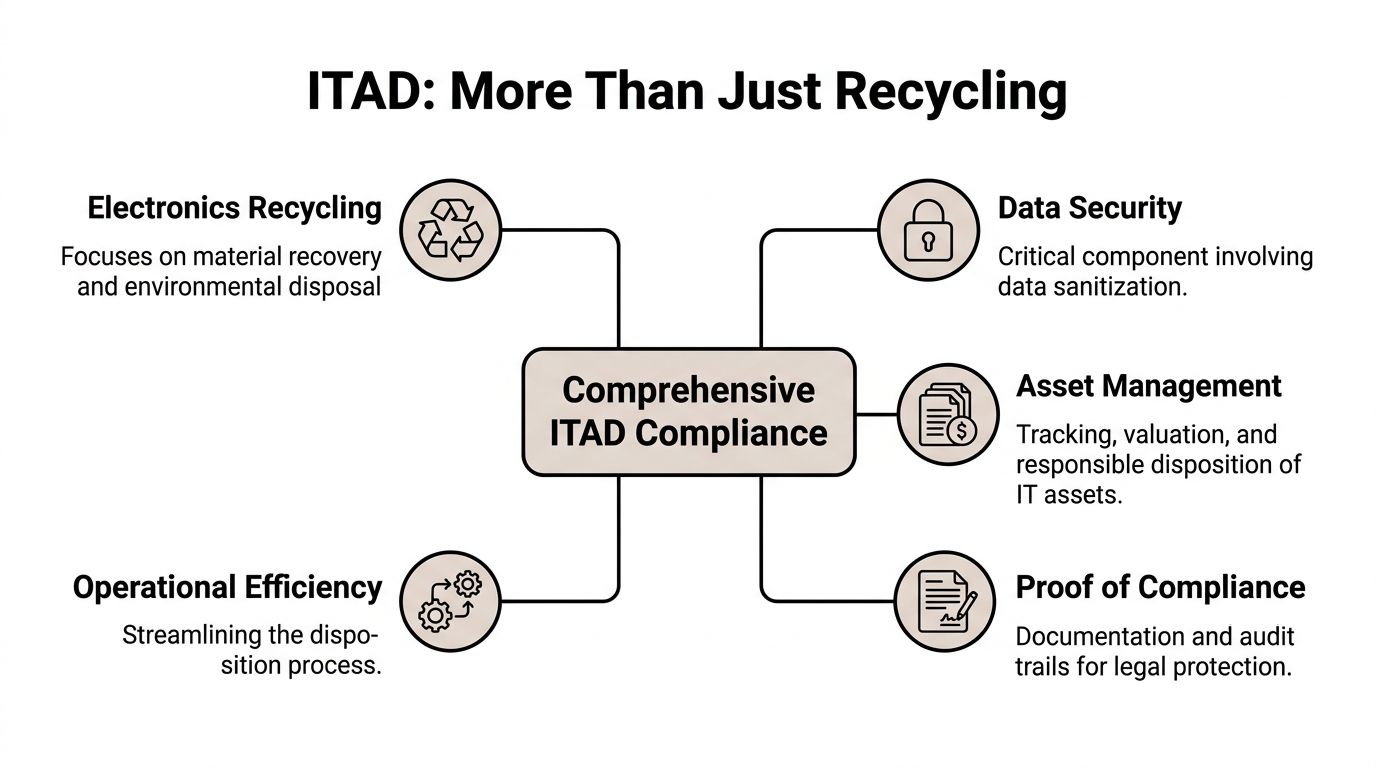
Recycling deals with materials. ITAD deals with materials, data, documentation, and accountability for each device that changed hands.
What separates ITAD from commodity recycling
The difference shows up the moment an auditor, insurer, or privacy counsel asks for proof. A recycler typically documents weight, downstream processing, and environmental handling. An ITAD provider should document the serial number, custody path, sanitization or destruction method, final disposition, and the records tying all of that together.
That distinction matters more in Georgia because the state leaves more room for interpretation than a prescriptive e-waste program would. If a laptop disappears after pickup or a storage device is resold without proper sanitization, the defense will not be "the vendor said they recycle electronics." The defense will be your inventory log, your service scope, your destruction records, and your ability to show who controlled the asset at each step.
A low-cost recycler can still be a reasonable choice for non-data scrap. It is the wrong fit for laptops, desktops, phones, servers, network gear with retained configs, backup media, printers with hard drives, and medical or financial equipment that may store user data.
The operational standard
A compliance-grade ITAD program should include:
- Serialized asset tracking tied to pickup and processing records
- Sanitization methods matched to media type instead of one generic process for every device
- Documented chain of custody from your site through final processing
- Certificates of Destruction or equivalent reporting with serial numbers, dates, and method used
- Third-party certifications that support audit review and vendor oversight
- Clear resale versus destruction rules so reusable assets are screened before anything leaves control
For Georgia teams evaluating vendors, chain-of-custody requirements in Georgia ITAD programs is a practical way to test whether a provider can support audit defense instead of just pickup logistics.
If a vendor cannot show these controls before the first pallet leaves your building, the service is closer to recycling pickup than defensible ITAD.
What enterprise buyers should actually test
Procurement often focuses on price per pound or pickup convenience. Security and compliance need a different checklist.
Ask whether the vendor records serials at collection or later at the warehouse. Ask how they handle drives in failed devices. Ask what happens when an item arrives without a readable asset tag. Ask whether they issue destruction records at the lot level or the device level. Those details determine whether your paper trail will hold up after an incident.
In Georgia, companies such as Beyond Surplus provide business ITAD services that include certified data destruction, itemized documentation, and electronics recycling for commercial equipment. Those are the features to evaluate, regardless of vendor name.
The trade-off is simple. Commodity recycling may reduce the invoice total. Certified ITAD usually reduces the cost of explaining a missing drive, an undocumented resale, or a broken chain of custody later.
Secure Data Destruction Methods and Legal Proof
Deletion isn't sanitization. Reformatting isn't sanitization either. If a device is leaving organizational control, the standard has to be defensible.
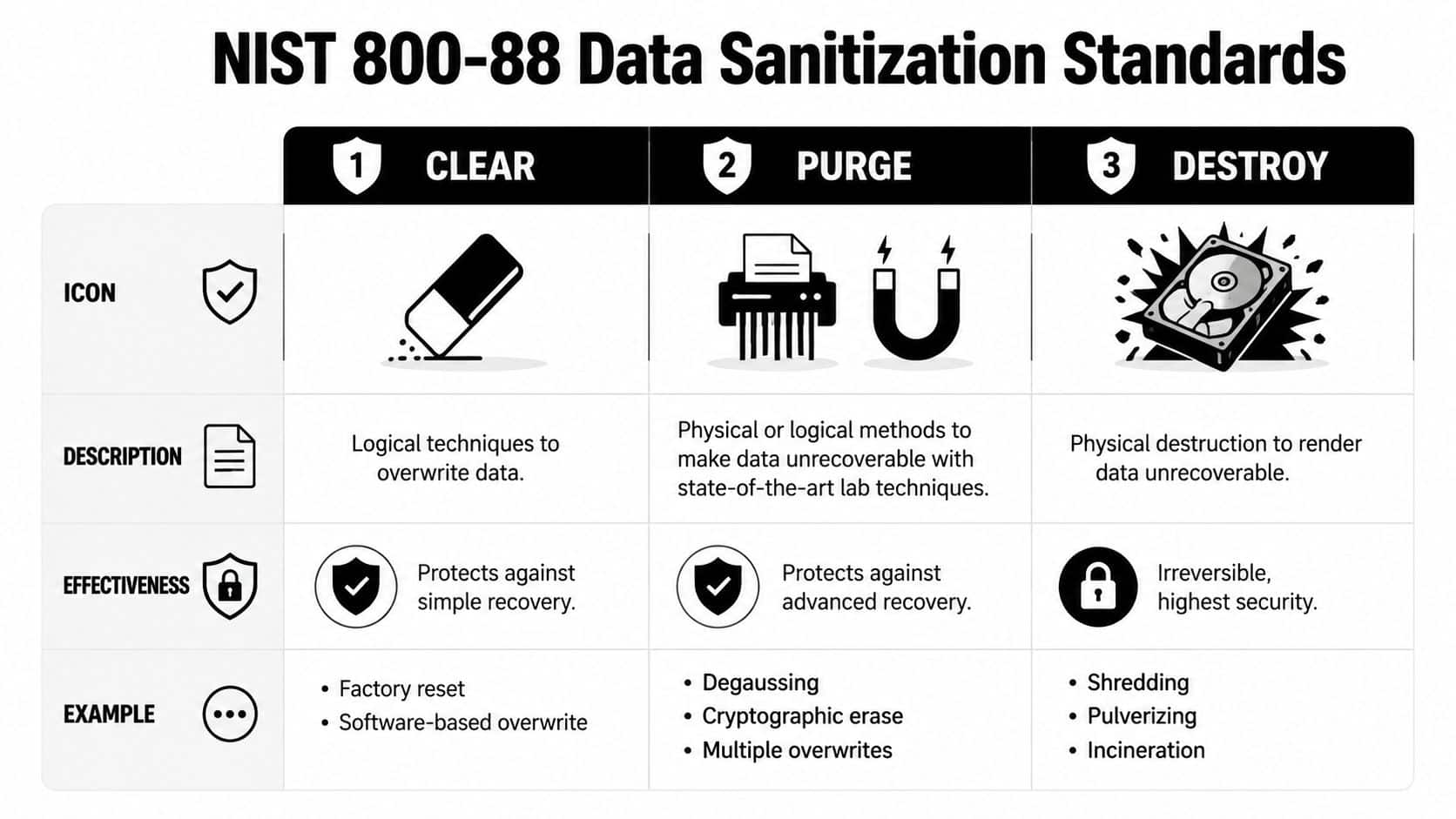
NIST SP 800-88 is the practical benchmark because it defines three methods for media sanitization and destruction. According to NIST 800-88 guidance for ITAD certifications and compliance, those methods are Clear, Purge, and Destroy.
What Clear Purge and Destroy mean in practice
| Method | What it does | Typical use case |
|---|---|---|
| Clear | Protects against routine tampering | Reuse scenarios with lower recovery risk |
| Purge | Protects against sophisticated laboratory attacks | Higher-risk media where stronger sanitization is required |
| Destroy | Physically renders media unrecoverable | End-of-life assets that won't be reused |
This isn't just technical vocabulary. It affects what your vendor can legally and operationally defend after disposal.
Why media type matters
Hard drives and SSDs don't behave the same way. SSDs can't be treated as if they're old magnetic disks. Where degaussing is insufficient, SSDs require physical destruction or cryptographic erasure to prevent recovery. That is a major compliance point because many outdated disposal processes still assume one method works for every device.
A disciplined workflow usually maps method to media before pickup:
- Laptops for redeployment may qualify for certified wiping if policy allows reuse
- Failed drives often move directly to physical destruction
- SSDs and flash media require special handling rather than blanket degaussing assumptions
- Mixed loads from offices or clinics need sorting before anyone decides they are "ready for recycling"
The document that matters in an audit
Technical destruction only solves half the problem. You still need proof.
A proper certificate should identify the asset by serial number and state the sanitization or destruction method and date. That's what turns a disposal event into something legal, security, and audit teams can rely on. For a practical review of that paperwork, Georgia certified data destruction checklist guidance is useful.
If a vendor gives you one generic certificate for an entire truckload, ask what happened to each drive. If they can't answer at the device level, the paperwork is weak.
The method matters. The certificate matters just as much.
How to Build a Compliant ITAD Program Step by Step
Most failures in ITAD don't come from bad intent. They come from informal process. A compliant program fixes that by making each handoff visible and repeatable.
Start with the asset list
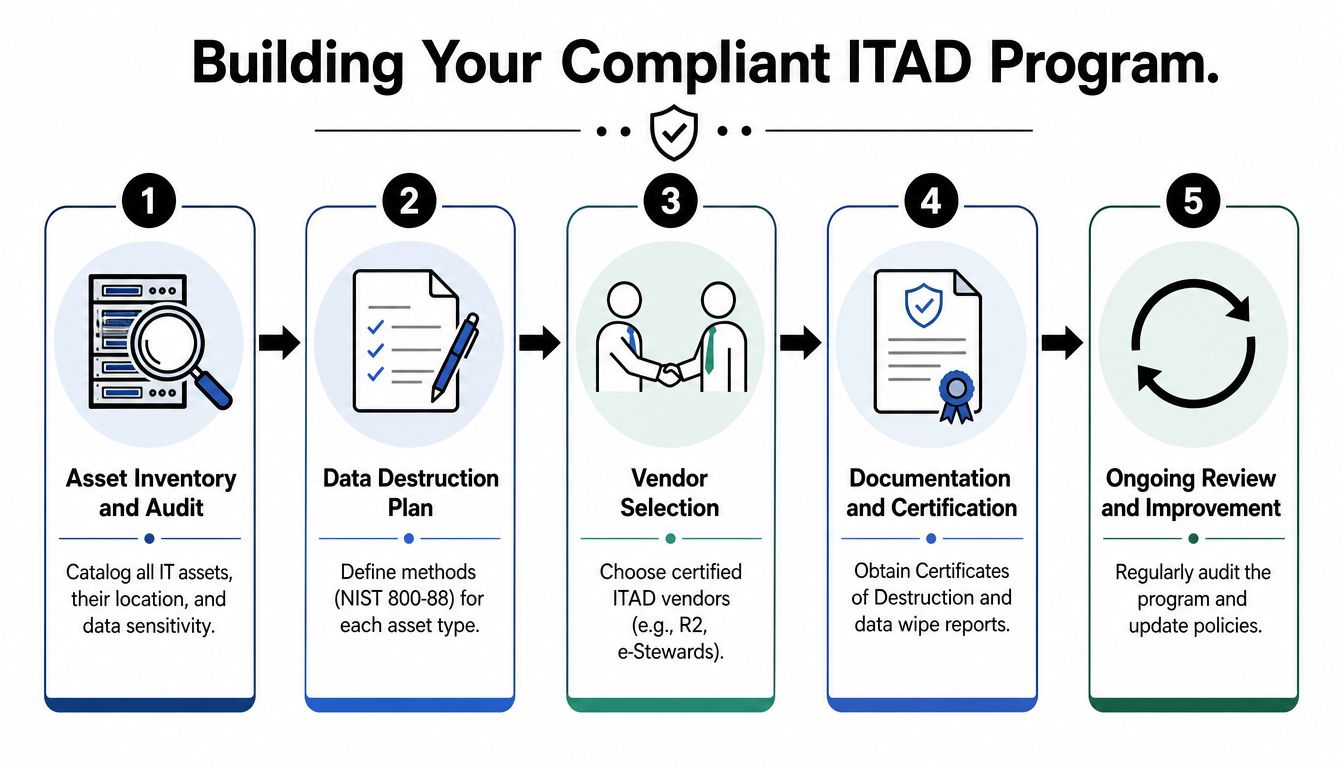
Before any pickup is scheduled, build a working inventory. Include asset type, location, known user or department, and whether the device is likely to contain regulated or confidential data.
This step sounds basic, but it drives every later decision. If inventory is weak at the front end, certificates at the back end won't match what left the building.
Build the program in controlled stages
Identify what you're retiring
Separate servers, laptops, mobile devices, network gear, storage media, and specialty equipment such as medical or lab systems.Assign a sanitization path
Match each class of asset to a defensible method. Reuse, resale, destruction, and recycling should not be decided ad hoc on the loading dock.Vet the provider carefully
Ask for certification details, sample reporting, chain-of-custody workflow, and examples of serialized Certificates of Destruction.Control pickup logistics
Define who releases assets, who signs transfer records, and how sealed transport or documented handoff will work.Retain the evidence
Keep inventory logs, transfer records, wipe reports, and destruction certificates in a retrievable compliance file.
Questions worth asking vendors
A short due-diligence review surfaces most problems quickly:
- How do you track assets? Ask whether reporting is item-level or pallet-level.
- What happens to SSDs? The answer should reflect media-specific handling.
- What does your certificate include? Look for serial number, date, and method.
- Who controls transportation? Pickup security is part of the compliance chain.
- How do you support audits? Good vendors can show sample documentation immediately.
For a practical vendor review process, step-by-step Georgia ITAD vendor selection guidance is a useful benchmark.
The best ITAD programs don't rely on trust. They rely on repeatable documentation.
Sector-Specific Compliance in Healthcare Finance and Government
In Georgia, regulated organizations often face more disposal risk, not less, because there is no single statewide e-waste program doing the control work for them. Healthcare systems, banks, agencies, and their contractors have to prove their own process. If an asset goes missing, a generic recycling receipt will not answer the questions that follow.
Healthcare organizations
Hospitals, physician groups, imaging centers, labs, and billing companies retire equipment that may store ePHI long after users assume it is inactive. Servers and laptops are obvious. Diagnostic workstations, portable media, thin clients, printers, and specialty clinical devices are where problems usually hide.
HIPAA does not require any one disposal vendor. It does require covered entities and business associates to protect protected data through final disposition. In practice, that means serialized asset tracking, media-specific sanitization, and records that show exactly what happened to each device. For teams evaluating healthcare-specific controls, HIPAA-compliant ITAD services in Georgia gives a useful benchmark for what that documentation should include.
A recycler that reports by pallet or by truckload leaves too much unanswered.
Financial institutions
Banks, lenders, insurers, and payment-related operations have the same core problem with a different regulator set. Customer information, account records, and internal financial data create liability long after a machine leaves service. The main trade-off is usually between resale recovery and evidentiary certainty. If a device can be remarketed, the wipe process and audit record have to hold up under scrutiny. If that proof is weak, physical destruction is often the safer choice.
Vendor selection should reflect that reality. Look for documented NIST 800-88 processes, certification for data destruction operations, item-level inventory control, and reporting that ties serial numbers to the final disposition method. Cheap pickups become expensive when legal, security, or audit teams cannot verify what happened.
Government and public sector teams
Government agencies, public authorities, contractors, and education-adjacent entities usually answer to internal policy before they answer to any recycler. Records retention, procurement rules, public accountability, and security review all shape disposal decisions. A missed serial number or an undocumented handoff can turn a routine refresh into an incident review.
The files that matter here are not complicated, but they do have to be complete:
- Asset inventories matched to pickup records
- Custody documentation for every transfer point
- Sanitization or destruction records tied to the specific device or media
- Final disposition reports that reconcile back to the original list
Across all three sectors, the pattern is the same. Georgia's lighter e-waste structure does not reduce compliance pressure. It puts more of the burden on the organization to show that data was controlled from retirement through final disposition.
Partner with Beyond Surplus for Guaranteed Georgia ITAD Compliance
Georgia's lighter e-waste rules create a common mistake. Companies assume disposal is simpler here. From a compliance standpoint, it is often riskier, because the burden shifts back to your team to prove what happened to every retired asset and every data-bearing device.
That is the standard Beyond Surplus should be held to.
A qualified Georgia ITAD partner needs to operate like a control point, not a haul-away vendor. The right provider should be able to document each handoff, apply the correct sanitization or destruction method, and reconcile the final outcome back to the original asset list without gaps. If a vendor cannot do that on demand, the problem is not recycling quality. It is exposure.
What the right provider should deliver
- NIST 800-88-aligned sanitization for reusable and non-reusable media
- Physical destruction options for hard drives and SSDs when destruction is required
- Serialized Certificates of Destruction that identify what happened to each asset
- Documented chain of custody from pickup through final processing
- Commercial electronics recycling for non-data components and downstream material handling
- Support for complex projects such as office closures, data center decommissioning, medical equipment retirement, and product destruction
In Georgia, documented control matters more than generic recycling promises. There is no broad state e-waste program you can point to later if counsel, auditors, or regulators ask how custody was maintained. If records are incomplete, your organization owns that gap.
Treat every pickup like evidence preservation. Build the shipment list before anything leaves the site. Separate data-bearing assets from commodity equipment. Tie each device to a sanitization decision. Confirm who signed at pickup, who received it at processing, and what final disposition was applied. Then store the paperwork where security, legal, and audit teams can retrieve it quickly.
That is the practical value of working with Beyond Surplus. The service should reduce uncertainty, not add another black box to your disposal chain.
For Georgia organizations retiring laptops, servers, storage, networking gear, medical devices, or full data center equipment, the question is straightforward. Can the vendor prove custody, sanitization, and final disposition at the asset level? If the answer is yes, you have a defensible ITAD process. If the answer is vague, you have a liability problem.
Contact Beyond Surplus for certified electronics recycling and secure IT asset disposal in Georgia, including serialized chain-of-custody documentation, data destruction, IT equipment pickup, and support for enterprise refresh, relocation, and decommissioning projects.


