

Atlanta absorbed 705.8 MW of positive net absorption in 2024. That level of leasing activity pushed the market out of the “regional growth” category and into national priority status.
For an IT director, the headline is not just more capacity coming online. It is the operational load that follows. Faster buildouts and tighter deployment calendars usually mean more servers, storage, and network gear entering service in shorter cycles, with less margin for sloppy decommissioning later.
That shift is significant for IT leaders because every new deployment creates a future disposition event. If asset tracking is weak, chain of custody is informal, or refresh planning starts too late, growth turns into compliance exposure. The Atlanta market is expanding quickly around facilities, carriers, and startups connected to hubs such as Atlanta Tech Village's broader tech ecosystem. Inside enterprise environments, the question is simpler. How well can the team retire equipment at the same pace it deploys it?
In a hot market, that discipline separates controlled growth from avoidable risk.
Why Atlanta's Data Center Scene is Exploding
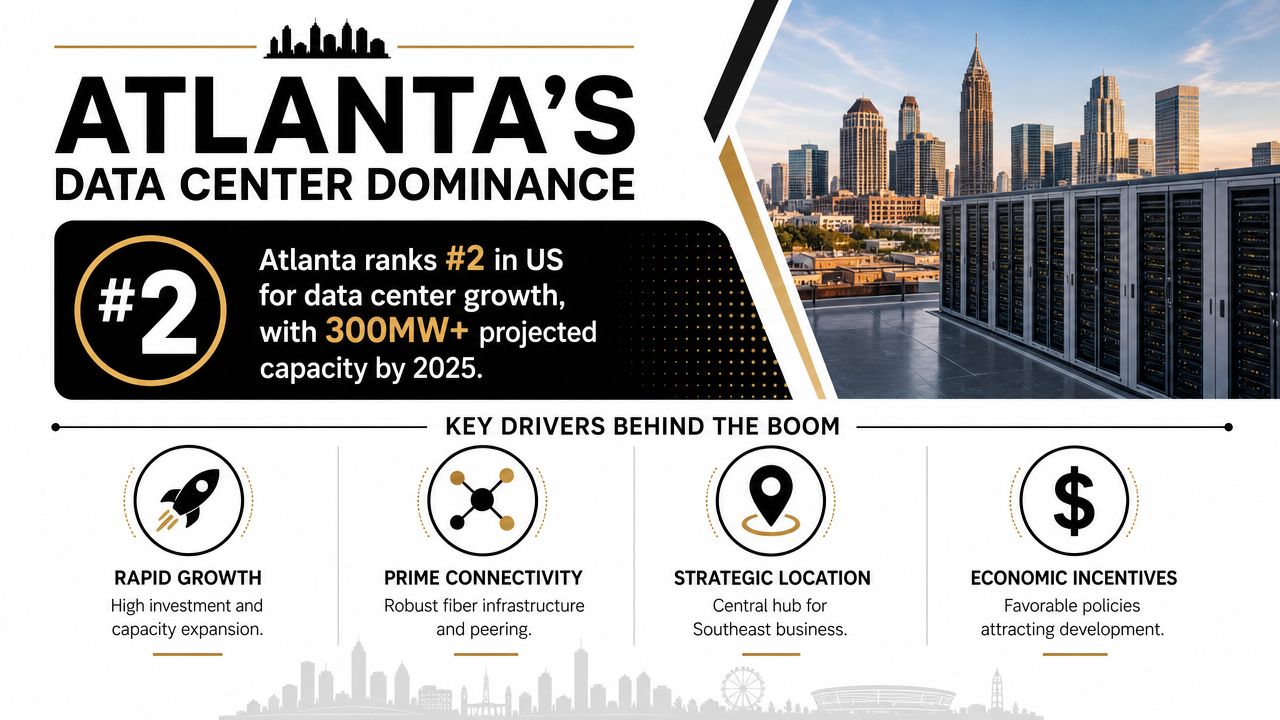
Atlanta moved into the top tier of U.S. data center markets in 2024. For IT leaders, that growth matters less as a real estate headline and more as an operations signal. More build activity means more hardware entering service, more migrations running in parallel, and more end-of-life equipment that has to leave the environment under control.
A fast-growing market changes day-to-day execution. Colocation decisions get compressed. Deployment teams push harder on staging and cutover timelines. Meanwhile, decommissioning can slip to the bottom of the queue, which is usually where chain-of-custody mistakes start.
What this means on the ground
In a slower market, teams can absorb some operational inefficiency. In Atlanta, the margin is thinner. A delayed refresh, a rushed cage exit, or weak asset records can leave retired servers sitting onsite longer than planned, waiting for approvals, transport, or audit documentation.
The practical issue is simple. Growth increases the number of disposition events.
That affects more than storage rooms and recycling pickups. It changes how IT directors should plan refresh cycles, vendor controls, and compliance evidence. If a team is adding capacity quickly, it also needs a repeatable process for wiping drives, validating serials, documenting downstream handling, and separating remarketable gear from scrap. Companies that invest early in secure data center solutions usually reduce risk on both sides of the lifecycle, during deployment and during retirement.
A few questions tend to surface once expansion gets real:
- Where will retired equipment go during overlapping refresh and migration work?
- Who signs off on custody changes when gear leaves a suite, cage, or office?
- Can the team produce destruction, recycling, and resale records months later without chasing vendors?
- Which assets still hold secondary market value, and which ones should be processed immediately?
Atlanta's broader innovation base adds another layer. Companies scaling near the Atlanta Tech Village startup ecosystem often move fast on deployment, but startup speed and data center discipline are not the same thing. In enterprise and colocation environments, speed without disposal controls creates exposure that shows up later in audits, contract disputes, and missed recovery value.
The boom is real. The operational test is whether asset retirement controls can keep pace with deployment.
The Key Drivers Behind Atlanta's Unprecedented Growth
Atlanta's growth isn't the result of a single trend. It comes from a stack of conditions that reinforce each other. CBRE-based reporting said data center construction activity in Atlanta nearly tripled from 2023 to 2024, the biggest increase among major U.S. markets. By the end of 2024, Atlanta had become the second-largest active data center market in the United States by inventory and also led the country in space under construction (AJC reporting on Atlanta construction growth).
Infrastructure still comes first
Operators follow power and connectivity before they follow hype. Atlanta has long been a major regional network hub, and that matters because low-latency connectivity and diverse fiber routes remain foundational for cloud, enterprise, and AI workloads.
For enterprises evaluating metro deployments, network readiness isn't just a leasing issue. It affects migration sequencing, redundancy planning, and lead times for interconnection. Teams working through expansion plans often start with fiber optic installation options near Atlanta because transport design and facility strategy now overlap much earlier in the process.
Economics still shape the map
Tax policy and land economics don't decide everything, but they decide a lot. When developers can make a campus pencil out faster in one market than another, construction follows. Atlanta benefited from that reality while demand for cloud and AI capacity kept rising.
Geography still matters
Atlanta serves the Southeast with a mix of business density, logistics reach, and network centrality that few markets can match. That doesn't guarantee smooth execution, but it does explain why so many operators continue to treat the region as strategic rather than opportunistic.
For teams studying facility design and operations, it helps to review practical examples of secure data center solutions because Atlanta's expansion isn't just about where buildings go. It's about how those environments are secured, serviced, and run under constant uptime pressure.
Growth looks simple from the outside. Inside the project timeline, it's a coordination problem across utilities, carriers, contractors, procurement, and asset owners.
Navigating Infrastructure and Supply Chain Challenges
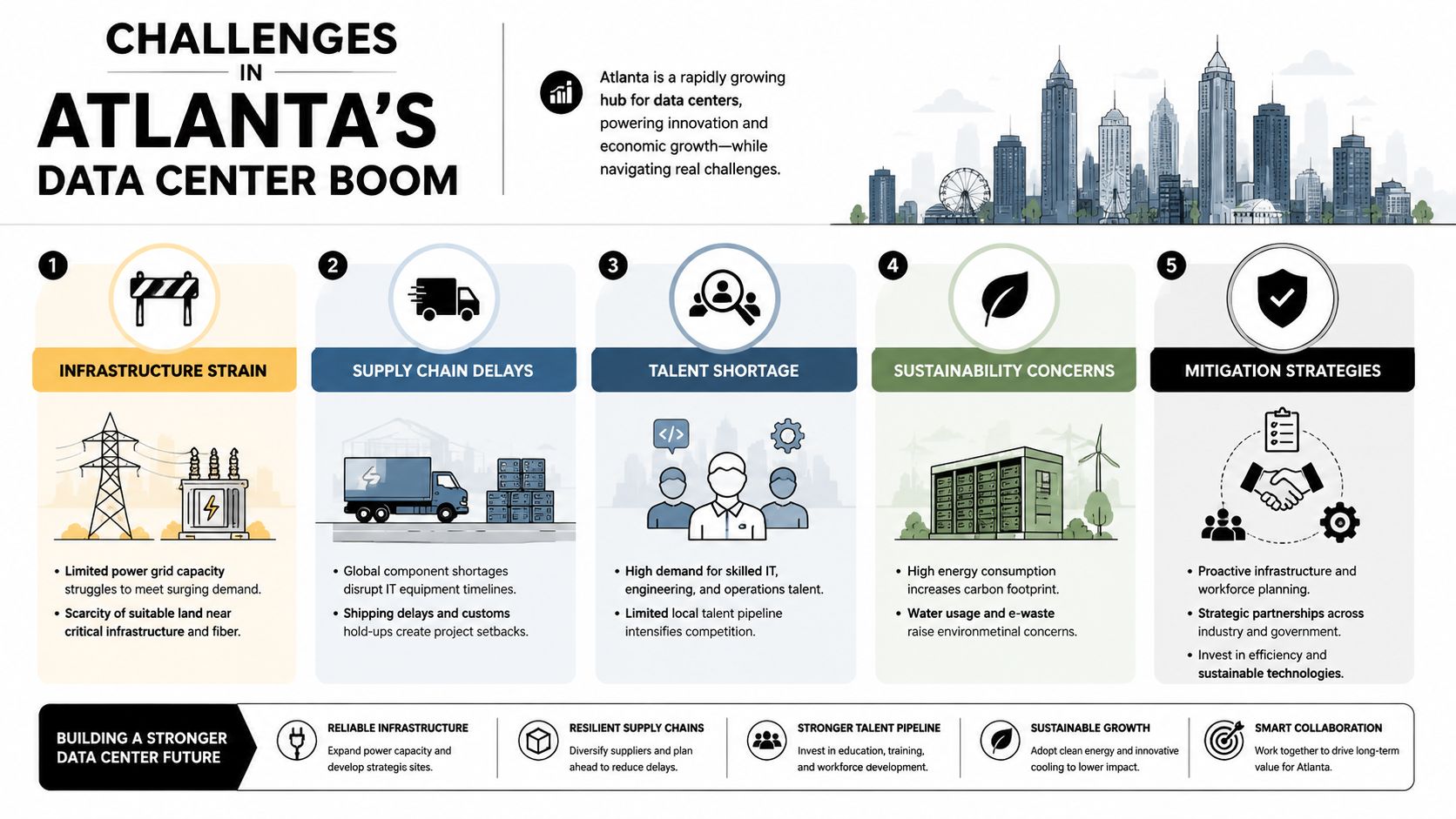
Atlanta's boom has a hard edge. Metro Atlanta moved from the sixth-largest U.S. data center hub to the second-largest, and CBRE reported that the amount of space under construction has roughly doubled every six months since mid-2023. That pace turns supply chain and utility planning into critical path issues, especially for switchgear, transformers, generators, and fiber backhaul (AJC on Atlanta's compounding construction pace).
The bottleneck isn't only square footage
A building shell doesn't create usable capacity by itself. Operators still need power delivery, cooling systems, backup generation, carrier access, controls, and installation sequencing to line up. In a market expanding this fast, one delayed component can hold up an entire launch.
That's why experienced teams treat long-lead electrical gear and site utility constraints as board-level schedule risks, not procurement details.
What breaks first in a hot market
The practical stress points usually show up in a familiar order:
- Utility coordination: Power availability can decide whether a site is realistic long before design is complete.
- Procurement timing: Switchgear, transformers, and generators can push schedules if sourcing starts too late.
- Installation labor: Specialized trades get booked quickly when many facilities move at once.
- Backhaul readiness: A great facility isn't useful if carrier connectivity lags behind occupancy.
- Exit logistics: Old hardware doesn't disappear when a new room comes online. Someone still has to remove, document, wipe, shred, package, and transport it.
For organizations facing expansion, consolidation, or relocation, that last point is where decommissioning often gets underestimated. A formal data center decommissioning process reduces the risk of stranded assets, undocumented media, and cleanup delays that can hold over fees or disrupt turnover.
Why modular thinking keeps coming up
Many operators are looking for faster deployment methods because conventional schedules are under pressure. Resources on transforming industrial data projects are useful in that context because they show how teams are trying to compress implementation time without losing control of infrastructure quality.
If procurement, utilities, and removal planning aren't coordinated together, the project doesn't just slow down. It gets more expensive and harder to audit.
Opportunities and Risks for Enterprises in Metro Atlanta
Atlanta offers real advantages for enterprises that need proximity to cloud infrastructure, colocation options, carrier ecosystems, and regional redundancy. It also comes with a policy and community environment that's getting more complicated.
GovTech reported that Georgia's statewide incentive is projected to waive about $296 million in sales tax revenue this year, and local governments have approved hundreds of millions of dollars in property-tax savings to attract facilities. The same reporting noted that some counties are imposing moratoriums and Atlanta has already restricted data centers in certain areas (GovTech on incentives and backlash in the Atlanta market).
Where the opportunity is real
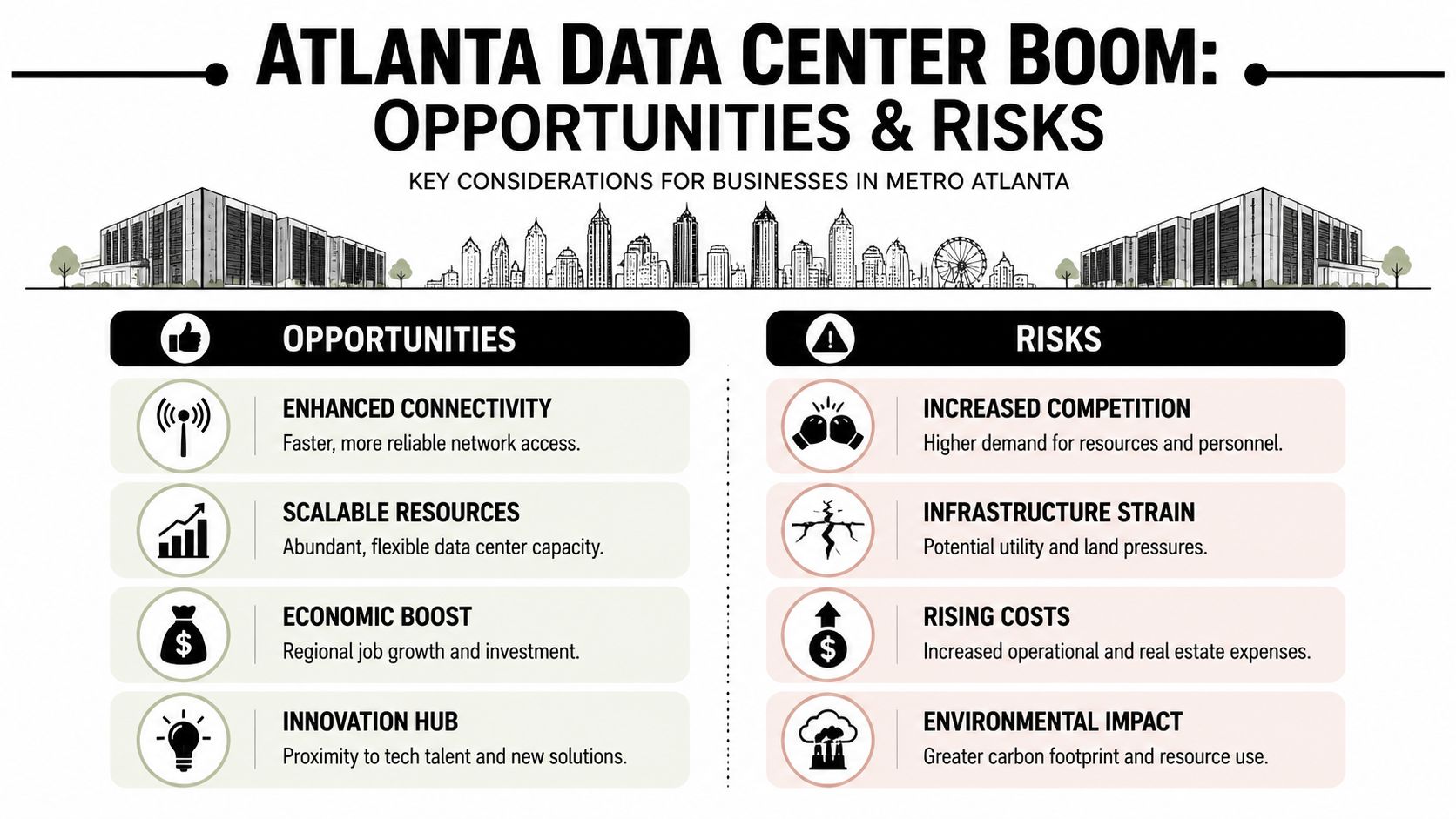
The upside is straightforward. Enterprises can operate in a market with strong infrastructure momentum, more supplier activity, and broader ecosystem support than Atlanta had even recently.
A practical view of the opportunity looks like this:
| Opportunity | Why it matters |
|---|---|
| Connectivity depth | More network options can improve resilience and routing flexibility. |
| Capacity access | A larger active market can create more room for colocation and phased growth. |
| Regional position | Atlanta remains a strong operating base for Southeast business footprints. |
Where the risk gets missed
The downside isn't abstract. Incentives can bring rapid development, but backlash can change timelines, zoning assumptions, and local political support.
Three risks deserve attention:
- Policy volatility: A market can welcome facilities and scrutinize them at the same time.
- Local opposition: Water, land use, and noise concerns can affect approvals and expansion plans.
- Cost pressure: Competition for infrastructure, labor, and suitable parcels can narrow the margin for error.
Enterprises shouldn't read incentives as a guarantee of smooth execution. They should read them as one variable in a market that's now under heavier public scrutiny.
The Critical Role of ITAD in the Data Center Lifecycle
Atlanta's demand surge is being driven by scale. CBRE says the market has more than 3 GW of committed power and about 10 GW of future expansion potential, while Atlanta saw 706 MW of net leased data center space added in 2024. The practical implication is simple. A very large hardware footprint is being created, and that equipment will eventually require secure end-of-life management (GovTech on Atlanta's committed power and future expansion potential).
Every deployment creates an eventual retirement event
This is the piece many market overviews skip. Servers, arrays, network switches, PDUs, UPS units, backup media, and loose drives all move through a lifecycle. In a fast-growth market, that lifecycle often compresses because refreshes, migrations, consolidations, and lease events happen closer together.
When that happens, ITAD stops being a cleanup task and becomes a risk-control function.
What good ITAD actually covers
A credible IT asset disposition plan should account for more than hauling away old equipment. It usually needs to cover:
- Data destruction: Serialized media handling, documented wiping where appropriate, and physical shredding when policy requires it.
- Chain of custody: Clear handoff records from rack removal through transport and final processing.
- Environmental processing: Responsible downstream recycling for material that can't be remarketed.
- Value recovery: Reuse and resale pathways for eligible assets so retired equipment doesn't automatically become scrap.
- Project coordination: De-installation, palletization, staging, and removal timing that fits maintenance windows or move schedules.
That's why enterprises in this market should build disposition into the original infrastructure plan. If you wait until after the migration weekend, you're already behind.
What doesn't work
The weak approach is common. A team upgrades compute, leaves retired gear in a cage, delays media review, and assumes someone can “pick it up later.” That creates exposure on several fronts at once: undocumented drives, delayed turnover, lost residual value, and inconsistent audit support.
A stronger model ties deployment and retirement together from the start. If a facility expansion, colocation exit, or room consolidation is on the roadmap, the ITAD workstream should sit beside networking, facilities, and security in the planning sequence.
For organizations that need that support, data center ITAD services in Atlanta can include de-installation, secure data destruction, logistics coordination, and recycling documentation. That's not marketing language. It's the operational scope that keeps a decommission from becoming a compliance problem.
The safest time to choose your ITAD process is before the hardware becomes urgent to remove.
Your Action Plan A Checklist for Atlanta IT Leaders
As of late 2025, Atlanta had an estimated 150 to 220 operational, 32 under construction, and at least 50 planned data centers (SaportaReport on the scale of Atlanta's data center footprint). In a market that large and active, disciplined operators don't rely on informal cleanup plans.
Site selection and expansion
- Validate utility assumptions: Confirm that power, cooling approach, and carrier access are realistic before treating a site as executable.
- Stress-test schedule dependencies: Ask which component, approval, or vendor could stall occupancy even if the building itself is ready.
- Review zoning exposure: Local restrictions and community pushback can affect future flexibility.
Operational risk
- Map long-lead equipment early: If switchgear or generator timing slips, the whole project can move with it.
- Assign one owner for retired assets: Someone should be accountable for serial tracking, media segregation, and release approval.
- Document turnover steps: Facility exits and migrations need a written closeout process, not hallway coordination.
Asset lifecycle and disposition
- Write the ITAD plan before the refresh starts: Include data destruction method, pickup windows, audit records, and resale decision criteria.
- Separate reusable from scrap material: Don't let potentially recoverable equipment get mixed into bulk recycling.
- Use a formal removal checklist: A server decommissioning checklist helps teams control rack removal, media handling, labeling, and final verification.
Atlanta is a major data center market now. That creates options, but it also raises the standard for execution. Teams that manage the full asset lifecycle will handle the boom better than teams that only plan for deployment.
If your organization is expanding, consolidating, or retiring infrastructure in Georgia, contact Beyond Surplus for certified electronics recycling and secure IT asset disposal.


