

When your data center hardware in Atlanta, Georgia reaches the end of its life, what happens next? Data center ITAD is the formal, documented process for decommissioning that equipment, wiping it clean of sensitive data, and then responsibly disposing of it or finding it a new home. This is a critical service for any Atlanta-based business managing significant IT infrastructure.
This isn't just about basic e-waste recycling. It's a specialized field focused on critical business needs like data security, regulatory compliance, and getting some money back for your old gear. For any organization in Atlanta with serious IT infrastructure, a solid data center ITAD strategy isn't just a nice-to-have—it's absolutely essential for managing risk and ensuring secure e-waste management.
Defining the Business Case for Data Center ITAD
Think of your data center as the brain of your entire operation. It’s packed with servers, storage arrays, and networking equipment that hold your most valuable information—customer records, intellectual property, financial data, you name it. When that hardware is retired, just unplugging it and shoving it in a closet creates a massive security hole.
That's where data center IT asset disposition (ITAD) comes in. It provides a secure and systematic way to handle this transition. This is far more than just tossing out old computers. It’s a mission-critical function driven by some very real business pressures. The main goal is to shield your company from the devastating financial and reputational fallout of a data breach, which can easily happen when old equipment is handled carelessly.
Why ITAD Has Become a Priority
A few key trends have pushed formal ITAD from a back-burner task to a top-tier priority for smart businesses.
- Accelerated Tech Refresh Cycles: The relentless demands of AI and cloud computing mean companies are swapping out hardware faster than ever. The useful lifespan for much of this equipment has shrunk to just 3-5 years, creating a constant stream of retired assets that need to be managed.
- Escalating Data Security Risks: A single old server can hold terabytes of confidential data. If that data isn't professionally destroyed, it becomes a sitting duck for thieves. In fact, a staggering 70% of data breaches can be traced back to improperly disposed assets.
- Strict Regulatory Compliance: Laws like the FTC Disposal Rule, HIPAA, and Sarbanes-Oxley (SOX) don't mess around. They come with heavy penalties for failing to protect sensitive information, even on equipment that's no longer in use. A proper ITAD process gives you the auditable proof you need to stay compliant.
Below is a quick breakdown of the core drivers that make a formal ITAD strategy so important.
Core Business Drivers for a Formal ITAD Strategy
| Driver | Business Impact | Consequence of Neglect |
|---|---|---|
| Data Security | Protects sensitive corporate and customer data from unauthorized access on retired hardware. | Massive financial losses, brand damage, and legal liability from data breaches. |
| Regulatory Compliance | Ensures adherence to industry-specific laws (HIPAA, SOX) and federal rules (FTC). | Severe fines, legal action, and potential loss of business certifications. |
| Financial Value Recovery | Unlocks residual value from decommissioned assets through remarketing and component sales. | Lost revenue opportunities and higher total cost of ownership for IT infrastructure. |
| Sustainability Goals | Supports corporate ESG initiatives by ensuring responsible reuse and recycling of e-waste. | Reputational harm from poor environmental stewardship and non-compliance with circular economy principles. |
As you can see, ignoring ITAD is a significant strategic mistake.
The global data center IT asset disposition market is seeing explosive growth, which really highlights its growing importance. The market hit USD 12.0 billion in 2024 and is projected to climb to USD 27.38 billion by 2033. This boom is directly tied to hyperscale operators and large enterprises decommissioning old servers to keep up with the AI revolution. Learn more about these market trends from recent research.
Treating ITAD as an afterthought is a risk you can't afford to take. A proactive approach not only protects your organization from liability but can also recover hidden financial value from your old hardware. When you partner with a certified ITAD provider, you can turn a complicated operational headache into a secure, compliant, and even profitable process.
For a deeper dive, you can check out our guide on the fundamentals of IT Asset Disposition.
The End-to-End Data Center Decommissioning Workflow
A successful data center ITAD project isn't just about hauling away old gear. It's about turning a massive logistical headache into a smooth, predictable, and fully documented workflow. Think of it as a multi-stage operation that demands meticulous planning from start to finish—all to protect your data, stay compliant, and squeeze every last drop of value out of your retired assets.
To pull this off without a hitch, you need a solid plan built on effective workflow management principles. The real work begins long before a single server gets unplugged.
Project Planning and Asset Inventory
First things first: you need a battle plan. A comprehensive project plan is your roadmap, clearly defining the scope, timeline, budget, and every person involved. This document gets everyone, from your IT crew to the facilities team, on the same page and helps you sidestep costly surprises down the road.
At the same time, you'll kick off a complete asset inventory. This is far more than just a headcount. You need to capture the nitty-gritty details for every single piece of equipment on the chopping block.
Key Inventory Data Points:
- Asset Tag Number: Your internal tracking ID.
- Serial Number: The manufacturer's unique identifier.
- Make and Model: The specifics, like a Dell PowerEdge R740.
- Physical Location: Down to the exact rack and U-position.
- Configuration Details: CPU, RAM, storage, and other key specs.
This detailed list is the bedrock of your entire chain of custody. It's how you'll track every asset from its spot in the rack to its final destination.
Physical De-Installation and Secure Logistics
With a verified inventory in hand, the physical work can start. This is where technicians carefully and systematically de-install all the targeted equipment. They’ll disconnect power, unplug network cables, and safely pull servers, switches, and storage arrays from the racks.
Precision is key here. You don't want to damage equipment, especially if it's slated for resale and you're counting on that value recovery. As each asset comes out, it’s immediately checked against the inventory list, usually with barcode scanners, to keep everything tight and accurate.
A secure chain of custody is the unbroken, auditable trail of an asset's journey. It begins the moment a server is unplugged and documents every handoff, every location, and every action taken until its final destruction or resale. This documentation is your legal proof of due diligence.
The whole process is driven by three main goals: managing risk, ensuring compliance, and recovering value. This infographic breaks down how these drivers shape the entire workflow.
As you can see, every step is a balancing act between securing your data, meeting regulations, and getting a financial return.
On-Site vs. Off-Site Processing Considerations
One of the most important decisions you'll make is where the data destruction and initial processing will happen: at your facility (on-site) or at your ITAD vendor's secure location (off-site). Both have their pros and cons.
On-Site Services:
- Maximum Security: Your data-bearing devices are sanitized before they ever leave your building. This is as secure as it gets.
- Direct Oversight: Your team can watch the entire data destruction process, giving you total peace of mind.
- Ideal For: Organizations with extremely sensitive data or rigid compliance rules.
Off-Site Services:
- Operational Efficiency: This gets the equipment out of your data center fast, minimizing disruption and freeing up valuable floor space.
- Specialized Equipment: ITAD vendors have facilities built for this, with specialized tools for efficient processing, testing, and teardowns.
- Logistical Simplicity: Trained professionals handle all the packing and secure transport for you.
The right choice really boils down to your company's risk tolerance, operational needs, and the project's specific demands. A good ITAD partner like Beyond Surplus can walk you through the options and help you decide on the best strategy. No matter which route you choose, secure logistics—using sealed, GPS-tracked trucks and vetted personnel—are non-negotiable to protect assets in transit.
You can learn more about our comprehensive approach by exploring our data center decommissioning services.
Executing a Bulletproof Data Destruction Strategy
When it comes to data center ITAD, data security isn't just another box to check—it's the entire foundation of the process. A bulletproof data destruction strategy is absolutely non-negotiable, ensuring 100% of your sensitive information is permanently and verifiably wiped clean. This is your shield against the catastrophic fallout of a data breach, which all too often starts with an improperly retired asset.
To get this right, the ITAD industry leans on several core techniques, each with its own place depending on the situation and security needs. The end goal is always the same: make the data completely unrecoverable, no matter what tools someone uses to try and get it back. Knowing these methods helps you make smart decisions that balance security, compliance, and even the potential value left in your old gear.
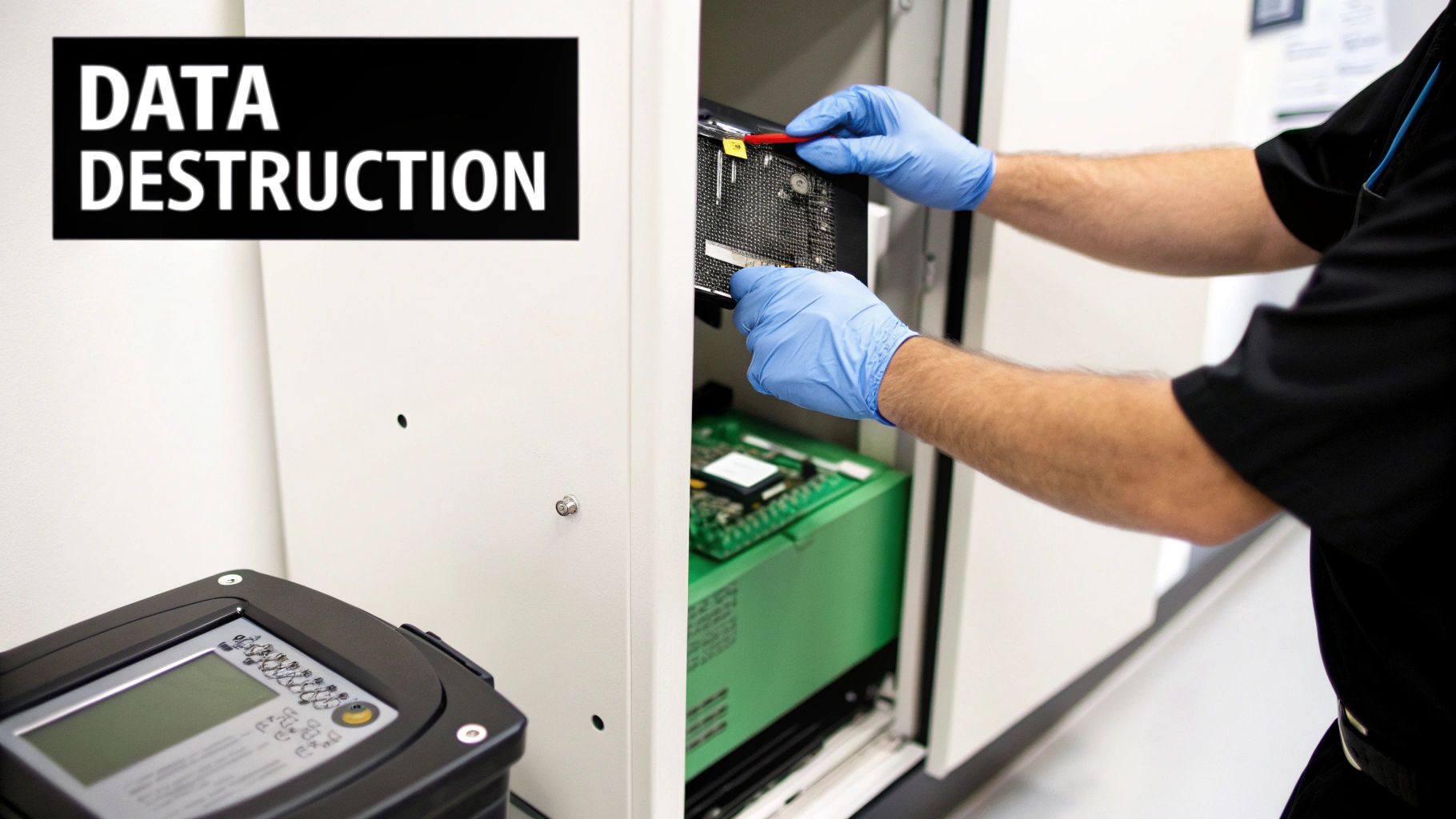
Comparing Core Data Destruction Methods
The three main ways to destroy data are software-based wiping, magnetic degaussing, and good old-fashioned physical shredding. Each serves a distinct purpose in a data center decommissioning project.
- Software-Based Data Wiping: Think of this as digitally scrubbing a hard drive. Specialized software overwrites every bit of your data with random ones and zeros, often multiple times, to make sure the original information is gone for good.
- Magnetic Degaussing: A degausser unleashes a powerful magnetic field that instantly scrambles the magnetic coating on traditional hard disk drives (HDDs) where data lives. It's a quick and total wipeout for that specific type of media.
- Physical Shredding: This is the most final solution. Industrial shredders literally grind hard drives, SSDs, tapes, and other media into tiny, mangled pieces. There's no coming back from that.
So, which one do you choose? It often boils down to one simple question: can the asset be reused or resold? If a server or storage array still has some life and value in it, software wiping is the way to go because it keeps the hardware functional. For industries with heavy compliance burdens or for gear that’s totally obsolete, physical destruction is often the required route.
The Challenge of Modern Storage Media
Destroying data on modern solid-state drives (SSDs) is a different ballgame compared to older, magnetic HDDs. SSDs store data on flash memory chips and use complex algorithms to spread out the wear and tear. A standard software wipe might not actually hit every single block where data is hiding.
For this exact reason, NIST 800-88 guidelines lay out specific sanitization techniques for SSDs. They often recommend methods like cryptographic erasure (if the drive supports it) or, for the highest level of security, physical destruction. A skilled ITAD partner knows these differences inside and out and will always apply the right method for the media type.
Getting this detail right is crucial. For organizations in sectors like healthcare and finance, a data breach from sloppy disposition practices can be absolutely devastating, costing an average of $4.88 million per incident. By using certified wiping and shredding methods and providing certificates that transfer liability, Beyond Surplus delivers the peace of mind needed for any data center de-installation.
The Role of Certification in Transferring Liability
The final, and arguably most important, piece of the data destruction puzzle is the Certificate of Data Destruction. This document is much more than a simple receipt—it’s your legal proof of compliance.
This certificate acts as an official, auditable record that spells out exactly what was destroyed, how it was done, and when and where it happened. Critically, it formally transfers the liability for that data from your organization to your ITAD vendor. Without this paperwork, you have no verifiable proof that you did your due diligence, leaving your company wide open to legal trouble and financial penalties if an audit or breach ever occurs.
Partnering with a certified vendor who provides meticulous documentation isn't just a good idea; it's an essential part of a secure data center ITAD strategy. You can learn more about how we handle this in our overview of security and data destruction services.
Navigating the Complex World of ITAD Compliance
When it comes to data center ITAD, compliance isn’t just a good idea—it’s a legal and financial necessity you can't afford to ignore. Trying to navigate this landscape on your own can feel like walking through a minefield of regulations designed to protect sensitive data and our environment. One misstep can lead to crippling fines, a damaged reputation, and serious legal headaches.
A great ITAD partner is your guide through this maze, ensuring every single decommissioned asset is handled exactly as the law demands. The first step is figuring out which specific rules apply to your retired servers, storage arrays, and networking gear. These aren't just abstract legal concepts; they have real-world consequences for how you manage equipment full of sensitive information.
Key Regulations Governing Data Disposal
Several major government and industry mandates are in place to dictate how companies must protect data, even on gear that’s reached the end of its life. These rules often come with steep penalties for non-compliance, which is a huge reason why businesses turn to professional ITAD services.
- HIPAA (Health Insurance Portability and Accountability Act): This is non-negotiable for anyone in healthcare or handling protected health information (PHI). HIPAA demands strict safeguards for patient data, and that includes retired IT assets. An improper disposal that causes a PHI breach can trigger fines running into the millions.
- Sarbanes-Oxley Act (SOX): If you’re a publicly traded company, SOX is on your radar. It requires tight controls over financial reporting data. Since this information lives on your corporate servers, ensuring it’s completely destroyed during retirement is key to staying compliant and out of legal hot water.
- GDPR (General Data Protection Regulation): For businesses handling the data of EU citizens, GDPR sets a high bar for data privacy and destruction. It requires that personal data be securely and permanently erased when it's no longer needed, and you need an auditable trail to prove you did it.
These regulations make it crystal clear: you need a documented, verifiable process for data destruction. That’s exactly what a certified ITAD vendor delivers.
The Role of Industry Certifications
Beyond government mandates, respected industry certifications act as an independent stamp of approval. They verify that an ITAD vendor meets the highest standards for security, environmental responsibility, and overall operational excellence. For any IT manager or procurement pro vetting a partner, these certifications are the most reliable signs of a trustworthy provider.
Think of certifications as a third-party audit of a vendor's promises. They confirm that a provider doesn’t just talk about security and sustainability—they have proven processes, undergo regular inspections, and are held accountable to a rigorous set of industry benchmarks.
Understanding Key ITAD Certifications for Vetting Partners
When you're evaluating potential ITAD partners, a few key certifications should be on your checklist. They serve as a quick way to gauge a vendor’s commitment to industry best practices and can save you a lot of due diligence headaches.
| Certification | Primary Focus | Key Benefit to Your Business |
|---|---|---|
| R2v3 | Environmental responsibility, worker safety, and the "reuse, recover, dispose" hierarchy. | Ensures your e-waste is managed ethically, avoiding illegal dumping and protecting your corporate reputation. |
| NAID AAA | Secure data destruction, covering everything from hiring practices to the physical destruction process. | Provides the ultimate assurance that your sensitive data is completely and verifiably destroyed, minimizing breach risk. |
Choosing a partner with these certifications is one of the smartest moves you can make to reduce risk. It ensures your data center ITAD program is not only compliant but also aligned with best practices for security and corporate responsibility.
Of course, a secure process also means understanding the technical standards behind data wiping. You can dive deeper into the specific guidelines for media sanitization in our article on the NIST SP 800-88 standard.
Unlocking Value Recovery and Achieving ESG Goals
A modern data center ITAD program is no longer just a line item on the expense report. It's evolved into a powerful value recovery engine, turning retired hardware into a real revenue stream while seriously boosting your company's sustainability credentials. This dual benefit—financial gain and environmental responsibility—is exactly why strategic ITAD has become so critical for any forward-thinking organization.
The whole process kicks off when an expert ITAD partner meticulously assesses the resale potential of your decommissioned servers, storage arrays, and networking gear. Not everything is destined for the recycler. Plenty of equipment is still functional and in demand, ready to be refurbished and sold on the secondary market. This often offsets the costs of the entire decommissioning project.
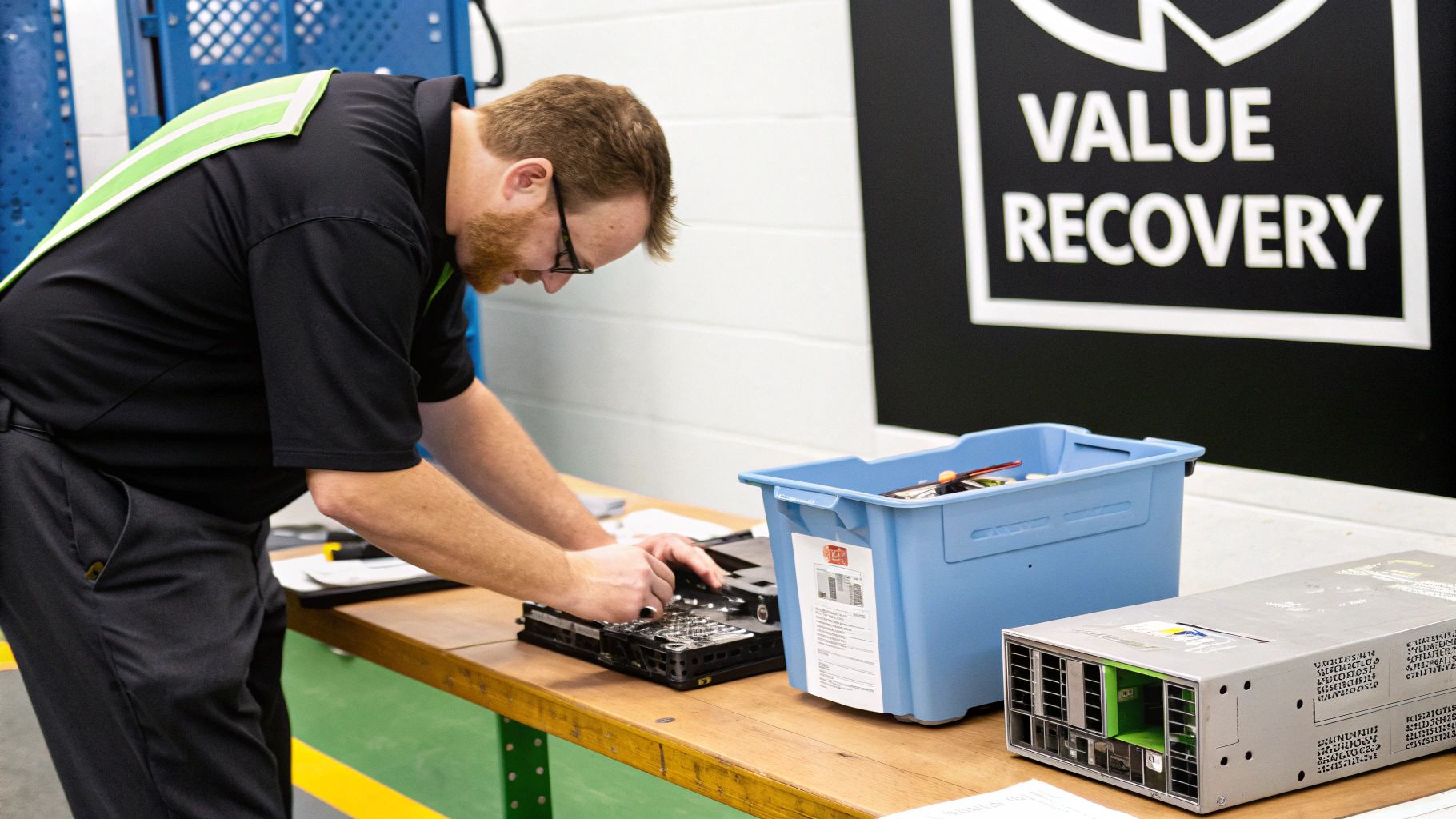
Maximizing Your Financial Return
Through carefully managed remarketing and buyback programs, you can unlock significant cash from assets you thought were worthless. The key is to partner with someone who has a deep understanding of the global secondary market for enterprise IT hardware. They know how to accurately price your equipment and connect with the right buyers, making sure you get the best possible return.
For IT directors, this has a direct impact on the bottom line. Usable servers can still fetch 10-50% of their original cost, turning a logistical headache into a financial win. On the flip side, the risks of skipping a professional ITAD process are huge, especially since a staggering number of data breaches are tied to improperly disposed-of assets. You can dig deeper into the market dynamics of IT asset disposition to see just how much value is at stake.
This financial recovery is a core piece of a successful data center ITAD strategy, converting what would be an expense into a positive number on your balance sheet.
Connecting ITAD to Corporate ESG Goals
Beyond the bottom line, responsible data center ITAD is a cornerstone of any serious corporate Environmental, Social, and Governance (ESG) program. In an era where stakeholders, investors, and customers are all demanding greater corporate responsibility, how you handle e-waste speaks volumes. A certified ITAD process is a clear, powerful demonstration of your commitment to sustainability.
For assets that truly have no resale value, a certified recycling process is non-negotiable. This guarantees that all materials are handled in an environmentally sound way, preventing hazardous e-waste from ever reaching a landfill. It's a fundamental part of the circular economy, where materials are recovered and reused instead of just being thrown away.
A professional ITAD program transforms a compliance task into a compelling corporate responsibility narrative. Detailed environmental reports provide auditable proof of your commitment to sustainability, which can be shared with stakeholders to enhance your brand reputation.
The benefits go far beyond just environmental reporting. A strong ESG profile can attract investment, improve employee morale, and build deeper trust with your customers. The process itself has several key components that feed directly into your sustainability metrics.
- Certified Recycling: All non-marketable assets are broken down into their core commodities (metals, plastics, glass) through an R2v3 certified process. Nothing harmful ends up in a landfill.
- Detailed Reporting: You get comprehensive sustainability reports that quantify your environmental impact, detailing the exact weight of materials recycled and diverted from landfills. This data is perfect for annual corporate responsibility reports.
- Circular Economy Contribution: By remarketing usable equipment, you extend the life of valuable hardware. This reduces the need for new manufacturing and conserves precious natural resources.
Ultimately, a professional ITAD program allows you to close the loop on your IT asset lifecycle. It ensures every single server, switch, and storage device is managed securely, responsibly, and profitably from the day it's deployed to its final disposition.
To see how we manage the physical logistics of getting equipment from your facility to ours, check out our guide on professional IT asset removal services.
How to Select the Right Data Center ITAD Partner
Picking the right partner for a data center ITAD project is easily one of the most important decisions you'll make in the entire process. A great vendor is your shield—they minimize your risks and get the best possible return on your old gear. The wrong partner, on the other hand, can expose your company to staggering financial, legal, and reputational damage.
This isn't a decision you can rush. It requires a hard look at a vendor's real-world capabilities, from their certifications all the way down to how they execute on the ground. You have to move past a simple price sheet and dig into the core competencies that truly define a secure and reliable ITAD provider. A thorough vetting process is the only way to ensure you end up with a team that can handle the unique scale, complexity, and security demands of a data center decommissioning.
Core Credentials and Certifications
Before you even start talking about services, you need to check a potential partner's basic credentials. Industry certifications are completely non-negotiable. They are the third-party proof that a vendor holds themselves to the highest standards for both data security and environmental responsibility.
- R2v3 (Responsible Recycling): This is the gold standard for electronics recycling. It confirms the vendor is following strict protocols for environmental safety, data security, and employee health.
- NAID AAA Certification: This one is all about secure data destruction. It ensures the provider's entire process—from who they hire to how they shred a drive—is rigorously audited and locked down.
Honestly, if a vendor doesn't have these certifications, they shouldn't even be in the running. Think of them as the absolute baseline for any professional operation.
Evaluating Service Capabilities and Logistics
Once you've confirmed their certifications, it's time to find out if they can actually handle a project as complex as a data center teardown. This kind of work demands specialized skills and resources that go way beyond a standard e-waste pickup.
You need to ask specific, probing questions about their process. How do they track chain-of-custody? What software do they use for asset management? Can they show you a detailed Statement of Work (SOW) that maps out every single step, from pulling servers out of racks to the final reports?
Look for a partner with a proven track record working inside data centers. They should be able to walk you through their experience with on-site data destruction, secure logistics using their own trucks or fully vetted transport partners, and how they provide detailed, serialized reports for every asset they touch. A truly experienced provider will offer a transparent and auditable process that gives you complete visibility from start to finish. That detailed documentation is your ultimate proof that you did your due diligence and stayed compliant.
Common Questions About Data Center ITAD
Even the most buttoned-up data center ITAD project will have a few lingering questions. It’s just the nature of the beast. Here are some of the most common things we hear from IT managers, facility leaders, and executives, along with some straight answers.
How Is the Cost of an ITAD Project Determined?
There’s really no flat fee when it comes to a data center ITAD project. The final cost is a net figure, balancing the expenses of the work against the money you get back from your assets.
- Labor and Logistics: This covers the hands-on work—the team that de-installs, packs, and securely moves all that equipment out of your facility.
- Data Destruction Services: Depending on how sensitive your data is, this is the cost for certified data wiping, degaussing the drives, or physically shredding them to bits.
- Recycling Fees: Some older or non-functional items don't have resale value and may have a fee for responsible, certified e-waste recycling.
- Value Recovery: This is where you make your money back. The resale value of your marketable servers, networking gear, and storage arrays is tallied up and credited against the project costs.
When you have a good amount of valuable equipment, it's very common for the project to generate a significant return for your company.
What Is the Typical Timeline for Decommissioning a Data Center?
The timeline can vary quite a bit. A small server closet might be a few days' work, while clearing out multiple rows of racks in a major data center could take several weeks from start to finish. We generally see projects break down into a few key phases.
- Planning and Inventory (1-2 weeks): This is the discovery phase where we scope out the project, identify all the assets, and map out a concrete plan.
- On-Site Execution (1-4 weeks): The boots-on-the-ground phase. This involves the physical de-installation, any on-site data destruction, packing, and loading everything for transport.
- Off-Site Processing (2-3 weeks): Back at our secure facility, we audit, test, and grade every single asset to determine its final path—resale or recycling.
- Final Reporting (1 week): We wrap everything up by delivering all your documentation, including the critical Certificates of Data Destruction and the final financial settlement.
Any professional ITAD partner will give you a detailed Statement of Work (SOW) that lays out this timeline clearly before a single cable is unplugged.
How Is Data Security Guaranteed Throughout the Process?
You can’t just hope for security; you have to build it into the process from the ground up. It starts with a rock-solid chain of custody, where every single asset is inventoried and tracked from the moment it leaves your control.
Security isn't just one thing—it's a whole system. It means using vetted, background-checked technicians. It means using GPS-tracked, sealed trucks for transport. And it means doing all the sensitive data destruction work in a secure, access-controlled facility. To close the loop, you receive a legally binding Certificate of Data Destruction that proves compliance and officially transfers liability away from you.
Contact Beyond Surplus for certified electronics recycling and secure IT asset disposal in Atlanta, Georgia. We provide professional, secure, and transparent data center ITAD solutions that maximize your value recovery and guarantee compliance across the nation. Learn more at https://www.beyondsurplus.com.


