
A Dallas IT director usually hits the same wall at the same moment. The business is adding headcount, opening another floor, refreshing a call center, or shifting more workloads into colocation and cloud. Then the network starts showing every shortcut that was tolerated during the last growth phase.
What looked like a bandwidth problem often turns out to be several problems stacked together. Old cabling with weak documentation. In-building wireless dead zones. Carrier handoffs that were never designed for redundancy. Cabinets full of retired gear that nobody scoped into the project budget. In Dallas, those issues matter more because infrastructure decisions tend to stay in place for years, and reversing a bad one is expensive.
Your Dallas Telecom Project Starts Here
A typical Dallas project doesn't begin with fiber maps and rack elevations. It begins with a business change. A regional office becomes a hub. A warehouse adds automation. A healthcare group consolidates locations and suddenly needs stable voice, wireless, and private connectivity across sites.
That's why telecom infrastructure services in Dallas shouldn't be treated as a narrow IT line item. They sit under occupancy plans, customer experience, compliance, and operational resilience. If your team is evaluating new circuits, structured cabling, tower connectivity, or an in-building wireless upgrade, you're really making a business continuity decision.
The broader market supports that urgency. The United States telecom infrastructure services market was valued at USD 91.5 billion in 2025 and is projected to reach USD 168.4 billion by 2033, with about 8.1% CAGR, driven by 5G rollout and demand for high-speed broadband according to U.S. telecom infrastructure services market projections. Dallas projects are part of that expansion cycle, not a quiet replacement market.
What usually triggers a rebuild
Most enterprise projects in North Texas start from one of these conditions:
- A move or expansion: New square footage exposes weak internal cabling and poor carrier diversity.
- Hybrid work pressure: VPN, VoIP, conferencing, and cloud traffic push old edge designs beyond what they were built for.
- Data center changes: New interconnection needs force a rethink of backbone paths, meet-me-room access, and failover.
- Acquisition cleanup: Merged environments leave duplicate circuits, mismatched hardware, and undocumented patching.
Practical rule: If the business is changing faster than your physical layer documentation, the project is already late.
Before you issue an RFP, define the operating model you need two or three years from now, not just the one that gets you through the next quarter. That usually means planning the build, support model, and retirement path together. If you need help framing scope before procurement starts, a Dallas telecom consulting assessment can clarify whether the priority is fiber, wireless coverage, structured cabling, or lifecycle cleanup.
The Building Blocks of Dallas Telecom Infrastructure
Dallas buyers often hear the same bundle of terms from providers and carriers, but each service solves a different operational problem. If you separate them clearly, vendor conversations get easier and budgets get cleaner.
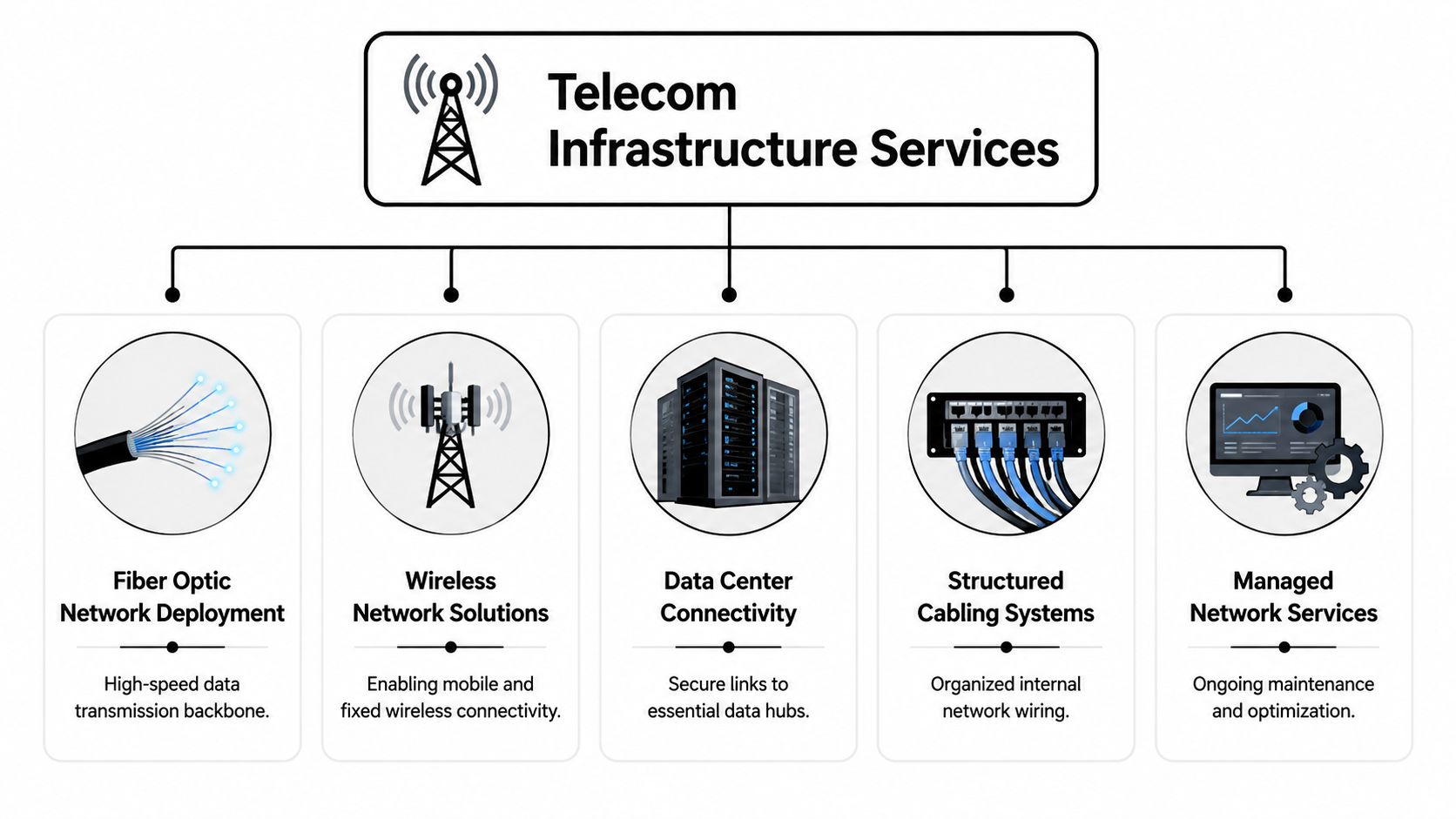
Fiber, cabling, and wireless each do different jobs
Fiber optic deployment is the backbone. Think of it as the interstate system. It moves large volumes of traffic between buildings, suites, carrier points, and data facilities with low loss and room for future growth.
Structured cabling is the local street grid inside the building. It connects telecom rooms, work areas, access points, cameras, and devices. When this layer is badly labeled or loosely installed, every later troubleshooting ticket gets slower and more expensive.
Wireless network solutions cover the mobility problem. That might mean exterior wireless links, fixed wireless backup, or in-building systems that improve signal where standard carrier coverage is weak. If users rely on mobile workflows, Wi-Fi calling, scanners, or voice over wireless, this layer can't be an afterthought.
Data center connectivity matters more in Dallas
Dallas isn't just a tower and branch-office market. The Dallas/Fort Worth region has 2.99 million square feet of commissioned data center space and 334 megawatts of critical IT load, which makes it a major node for interconnection and colocation according to Dallas telecom infrastructure market context. In practice, that means many local telecom projects depend on clean cross-connect strategy, diverse entrances, and disciplined handoff design between enterprise space and carrier or colocation environments.
The mistake I see most often is treating the carrier demarc as the end of the project. For most enterprise environments, that's where the real design responsibility starts.
Managed services and monitoring
A network operations center, or NOC, is your mission control layer. It watches circuits, edge devices, alarms, and service conditions after the install team leaves. You may not need a fully outsourced NOC, but you do need clear ownership for monitoring, escalation, maintenance windows, and change control.
For teams that want a plain-language overview of how internal cabling decisions affect long-term support, this London and Essex data cabling guide is useful because it explains physical-layer thinking without marketing fluff.
Telecom service types at a glance
| Service Type | Primary Use Case | Key Benefit |
|---|---|---|
| Fiber optic network deployment | Building-to-building and carrier backbone connectivity | High-capacity transport with room to scale |
| Structured cabling systems | Internal connections for users, devices, and network equipment | Easier moves, adds, changes, and troubleshooting |
| Wireless network solutions | Mobility, in-building signal improvement, backup connectivity | Better coverage and operational flexibility |
| Data center connectivity | Colocation, cloud access, interconnection, redundancy | Stronger resilience and lower latency paths |
| Managed network services | Monitoring, maintenance, and incident response | Faster issue detection and clearer accountability |
A provider that handles multiple layers can simplify handoffs, but it can also blur responsibility if scopes aren't written tightly. If you're comparing local options for Dallas telecommunications services, ask each vendor which parts they self-perform and which parts they subcontract.
Navigating Dallas Permits Regulations and Timelines
The schedule on paper rarely survives first contact with field conditions. In Dallas, trenching, directional boring, building access, utility coordination, and site rules can shift the timeline before cable even arrives.

Where projects slow down
Right-of-way work is the obvious source of delay, but it isn't the only one. Multi-tenant buildings add landlord approvals. Healthcare and finance sites add after-hours restrictions. Distribution and manufacturing sites add safety controls, escort rules, and shutdown windows.
Then there's the installation standard itself. In Dallas, projects increasingly require field-verified certification for structured cabling, not just physical install, according to Dallas network infrastructure service requirements. That matters because the handoff is no longer “cable is in.” The handoff is “every copper or fiber link was tested, documented, and shown to meet specification.”
What works in practice
A workable Dallas schedule usually has these traits:
- Permitting early: The team starts city and property approvals before finalizing every downstream task.
- Access planning in writing: Elevator reservations, riser access, ceiling work, shutdown windows, and escort rules are locked before crews mobilize.
- Certification in scope: Testing, labeling, and closeout documentation are priced as deliverables, not treated as optional cleanup.
- Old material handling: Removed cable, batteries, electronics, and related waste are assigned to a documented disposition path that aligns with universal waste compliance practices.
Poor closeout packages create the same pain as poor installs. Six months later, your own team can't tell whether the problem is the circuit, the patching, or the labeling.
Providers with real Dallas field experience usually manage expectations better because they know where local dependencies stack up. The best ones don't promise speed in the abstract. They show how they sequence access, testing, restoration, and documentation so the project can close.
Understanding Cost Structures and Contract Essentials
Telecom budgets go wrong when buyers compare only the install quote. The proper comparison is ownership model, support burden, risk transfer, and what happens when the network fails at an inconvenient time.
CapEx versus managed OpEx
A CapEx-heavy approach fits organizations that want control over physical assets, standards, and refresh timing. You buy more of the infrastructure, own more of the spares strategy, and keep more technical responsibility in-house. This can make sense for campuses, specialized environments, or companies with strong internal network teams.
An OpEx-oriented managed model pushes more of the service obligation to the provider. You pay for availability, support, and lifecycle activity as part of an ongoing agreement. That can be cleaner for distributed enterprises, but only if the contract defines response, restoration, and escalation clearly.
Neither model is automatically better. The wrong fit is owning a complex environment without the staff to support it, or outsourcing a critical environment under a vague service agreement.
What usually drives cost
The largest swings typically come from scope conditions, not line-item surprises.
- Civil work complexity: Trenching, boring, and restoration change the budget quickly.
- Building conditions: Occupied offices, hardened facilities, and limited riser access increase labor time.
- Documentation standards: As-builts, labeling, and test results take effort, but skipping them costs more later.
- Support model: Spare parts, after-hours dispatch, and monitoring provisions can reshape total cost.
- Retired asset handling: If old switches, UPS units, cabinets, or telecom gear are in scope, disposition needs labor, chain of custody, and compliance planning.
SLA terms that deserve scrutiny
Read the SLA like it will be used during your worst outage, because that's when it matters.
Start with fault ownership. The contract should say who answers first, who triages, who dispatches, and when escalation moves from help desk to field technician. If multiple parties touch the environment, require a clear demarcation matrix.
Then review restoration language. “Commercially reasonable efforts” is weak protection if the site supports revenue operations, patient care, or regulated workflows. You want measurable incident handling, defined maintenance windows, and explicit communication obligations during service events.
If the vendor can't explain the SLA in plain English during procurement, your operations team won't get clarity during an outage.
Security and compliance language matters too. If the project touches regulated data environments, ask how physical access is controlled, how removed devices are logged, and how retired telecom hardware is transferred. For local buyers comparing vendors, a directory of telecom companies and service models can help frame the difference between network builders, managed providers, and specialized contractors.
Your Provider Selection and RFP Checklist
The Dallas market gives you several provider models to choose from. Some firms act as broad telecom contractors. Some specialize in fiber. Others bundle wireless, VoIP, cloud connectivity, and managed support. The best choice depends on whether your project needs depth in one layer or coordination across many.
That distinction matters because local procurement isn't just a price exercise. The Dallas market includes general contractors, fiber specialists, and multi-service integrators, and the key issue is which model fits project complexity, speed, and long-term maintenance needs, especially under labor pressure, as noted in Dallas provider model analysis.
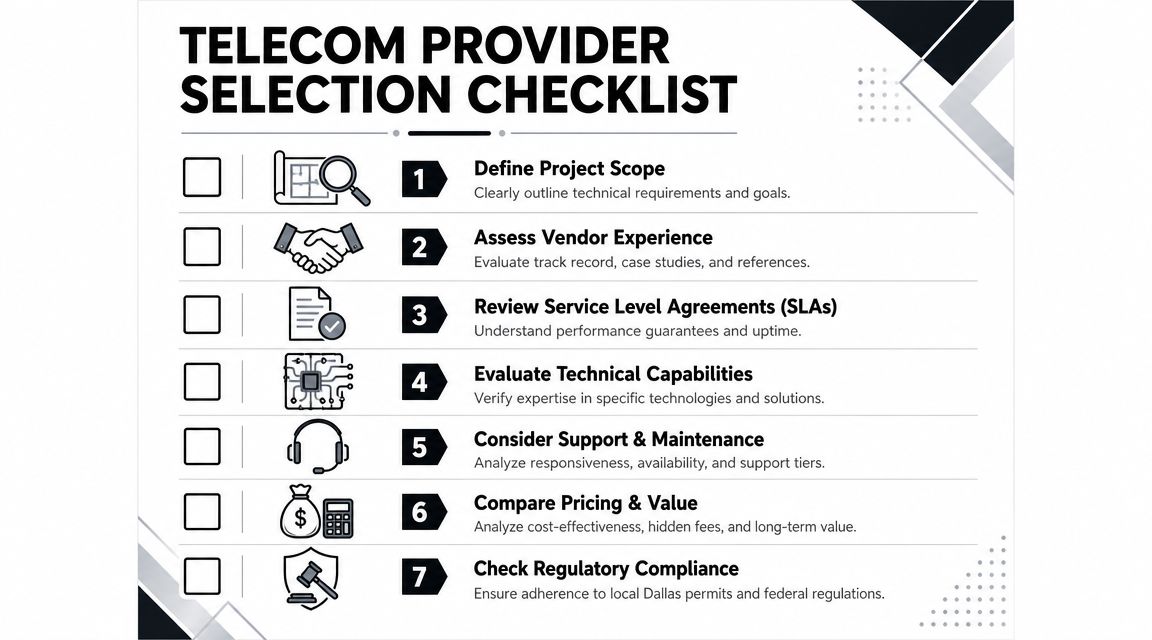
What your RFP should force vendors to answer
Don't ask for a generic proposal. Ask for evidence.
Scope ownership
Require each vendor to identify self-performed work, subcontracted work, and project management responsibility. Mixed accountability causes delays fast.Field methodology
Ask how they handle surveys, pathway validation, riser constraints, testing, labeling, and closeout packages.Support after turnover
Determine whether the install team disappears after handoff or whether the same company supports incidents, changes, and upgrades.Safety and site discipline
This matters in hospitals, logistics sites, and occupied office towers. Crews need documented access and clean work practices.
Questions that expose weak providers
A good vendor interview should sound less like a sales call and more like a pre-mortem. This list of important contractor interview questions is useful because many of the same risk checks apply to telecom projects, especially around communication, scheduling, and responsibility.
Use questions like these in your shortlist process:
- Show a closeout sample: Ask for a redacted test report, as-built, and labeling package from a similar job.
- Explain failure handling: Have them walk through a live outage at one of your critical sites.
- Define decommissioning process: If the project replaces equipment or cabling, ask how removed assets are packed, tracked, wiped, recycled, or remarketed.
- Name the project lead: You need the actual delivery lead, not just the account executive, in the room before award.
A capable provider talks comfortably about installation problems, change orders, and retired asset handling. An unprepared one stays at the level of broad promises.
One practical note. Beyond installation and support, some organizations also need downstream equipment disposition. Beyond Surplus telecom decommissioning support fits that part of the lifecycle for businesses that are removing telecom gear, network hardware, or related electronic assets.
Planning for the Full Lifecycle with Decommissioning and ITAD
Most telecom plans stop at cutover. That's a mistake in Dallas, where network changes are often driven by densification, resilience, and ongoing replacement rather than one-time greenfield builds.

Industry commentary on U.S. telecom infrastructure points out that modern growth in saturated markets is driven by resilience and densification, with upgrades and replacements becoming constant. That makes decommissioning old assets, and using alternatives like fixed wireless or satellite for backup paths, part of current strategy rather than an afterthought, according to analysis of current U.S. telecommunications infrastructure.
Plan retirement on day one
A disciplined lifecycle plan answers these questions before the first crew arrives:
- What's being removed: Cabling, switches, routers, radios, UPS units, server hardware, racks, phones, and patching components.
- What contains data: Firewalls, storage devices, call recording systems, servers, and embedded media.
- What has recovery value: Reusable network gear, optics, cabinets, and selected enterprise hardware.
- What needs certified recycling: Obsolete electronics, damaged components, and non-redeployable material.
Why this changes project economics
Retired equipment affects labor, loading dock coordination, chain of custody, and compliance. If you leave that work undefined, crews either pile gear in a closet or treat decommissioning as a surprise change order. Neither outcome helps your budget or your audit trail.
A better approach ties deployment and ITAD together. New gear goes in. Old gear is tagged, removed, documented, and routed for data destruction, resale, recycling, or destruction under the same project governance. If backup connectivity is part of the future design, document that too, so your resilience strategy includes both the new primary path and the fallback path.
The result is simple. Fewer stranded assets, less liability, cleaner closeout, and less rework when the next refresh arrives.
Conclusion Your Next Steps for a Connected Future
A solid Dallas telecom project isn't only about getting bandwidth into a building. It's about aligning physical infrastructure with how the business operates. That means choosing the right mix of fiber, cabling, wireless, interconnection, support, and documentation for the sites you run today and the ones you'll inherit tomorrow.
The companies that manage this well don't separate build decisions from lifecycle decisions. They scope test results at the start. They define support obligations before award. They decide who owns retired hardware before cutover. That's what keeps a network project from turning into a facilities problem, a security problem, or a finance problem six months later.
If you're moving now, take two steps in parallel. First, define the operating requirements for the new environment. Carrier paths, in-building coverage, certification, support, and closeout should all be written into the procurement package. Second, inventory what will come out during the project and assign a compliant path for each asset class.
That parallel planning is what gives you cleaner installs, fewer disputes, and less operational drag after go-live. In a market like Dallas, where infrastructure keeps evolving, that discipline matters more than any single product choice.
If your team is planning a Dallas telecom build, relocation, refresh, or teardown, contact Beyond Surplus for secure electronics recycling, telecom equipment disposition, and IT asset disposal support that fits the full lifecycle of enterprise infrastructure.