

If you're running IT for a Dallas company, you probably know the pattern. The business adds locations, remote users, cloud apps, wireless devices, and a few urgent vendor renewals. Then the telecom environment turns into a patchwork of circuits, mobile plans, UCaaS licenses, support tickets, and contracts nobody wants to revisit.
That's when smart leaders stop treating telecom like a utility bill and start treating it like infrastructure strategy. For Dallas organizations, telecom consulting services in Dallas matter because network performance, carrier terms, and deployment choices directly affect uptime, user experience, and operating cost.
Navigating the Dallas Telecom Maze
A common Dallas scenario looks like this. A growing company has one office in Uptown, another operation near Irving or Plano, a warehouse footprint toward the airport corridor, and field users spread across the Metroplex. Internet works most days. Voice quality is inconsistent. Wireless coverage inside the building is spotty. The carrier keeps recommending upgrades, but nobody on your side is fully confident those upgrades match the business need.
That creates three expensive problems at once. First, your team wastes time chasing outages and billing disputes. Second, you overbuy in some areas and underinvest in others. Third, every new site, migration, or renewal becomes a rushed decision instead of a planned one.

Why this isn't a side issue
Telecom consulting is already a significant strategic services category. One market estimate values the global telecom consulting market at USD 7.291 billion in 2024 and projects it to reach USD 14.52 billion by 2030, reflecting its role in network modernization, cloud migration, and strategic planning, according to telecom consulting market analysis from PS Market Research.
That matters because it tells you something simple. You're not overthinking the problem. Businesses spend serious money on telecom consulting because telecom mistakes compound fast.
What Dallas leaders usually need fixed
Dallas businesses rarely need vague “digital transformation” talk. They need someone to sort out practical issues such as:
- Carrier confusion: Too many proposals, too much jargon, not enough apples-to-apples comparison.
- Multi-site sprawl: Different contracts, different billing, different service levels across locations.
- Cloud migration friction: Microsoft Teams, VoIP, contact center, and WAN decisions made without a clear roadmap.
- Performance gaps: Users complain about dropped calls, weak indoor coverage, or inconsistent application response.
- Renewal risk: Existing agreements auto-renew before legal, finance, and IT can fully review the terms.
Practical rule: If your telecom stack has become hard to explain in one meeting, it's already hard to manage well.
A good consultant steps in as the operator on your side of the table. They assess what you have, what you're paying for, where the technical weaknesses sit, and what should change first. If your business also needs help with telecom hardware lifecycle planning, de-installation, or documented handling of retired equipment, Dallas telecommunications services can support that broader operational picture.
Defining the Role of a Telecom Consultant
A telecom consultant is not the same as a carrier rep. That distinction matters more than most buyers realize.
Carrier reps sell their employer's services. Equipment vendors push their own platforms. A telecom consultant should work from your requirements outward, not from a product quota backward. Think of the role as a financial advisor for telecom infrastructure. They help you decide what to buy, what to keep, what to renegotiate, and what to retire.
Strategy before procurement
The first job is strategic. A consultant should look at your business model, locations, user behavior, compliance needs, and growth plans, then translate that into a telecom roadmap. That roadmap might cover fiber diversity, SD-WAN design, UCaaS selection, mobility policy, contact center architecture, or in-building wireless planning.
If a provider jumps straight to quoting services, that's a warning sign. Good consulting starts with architecture and operational need.
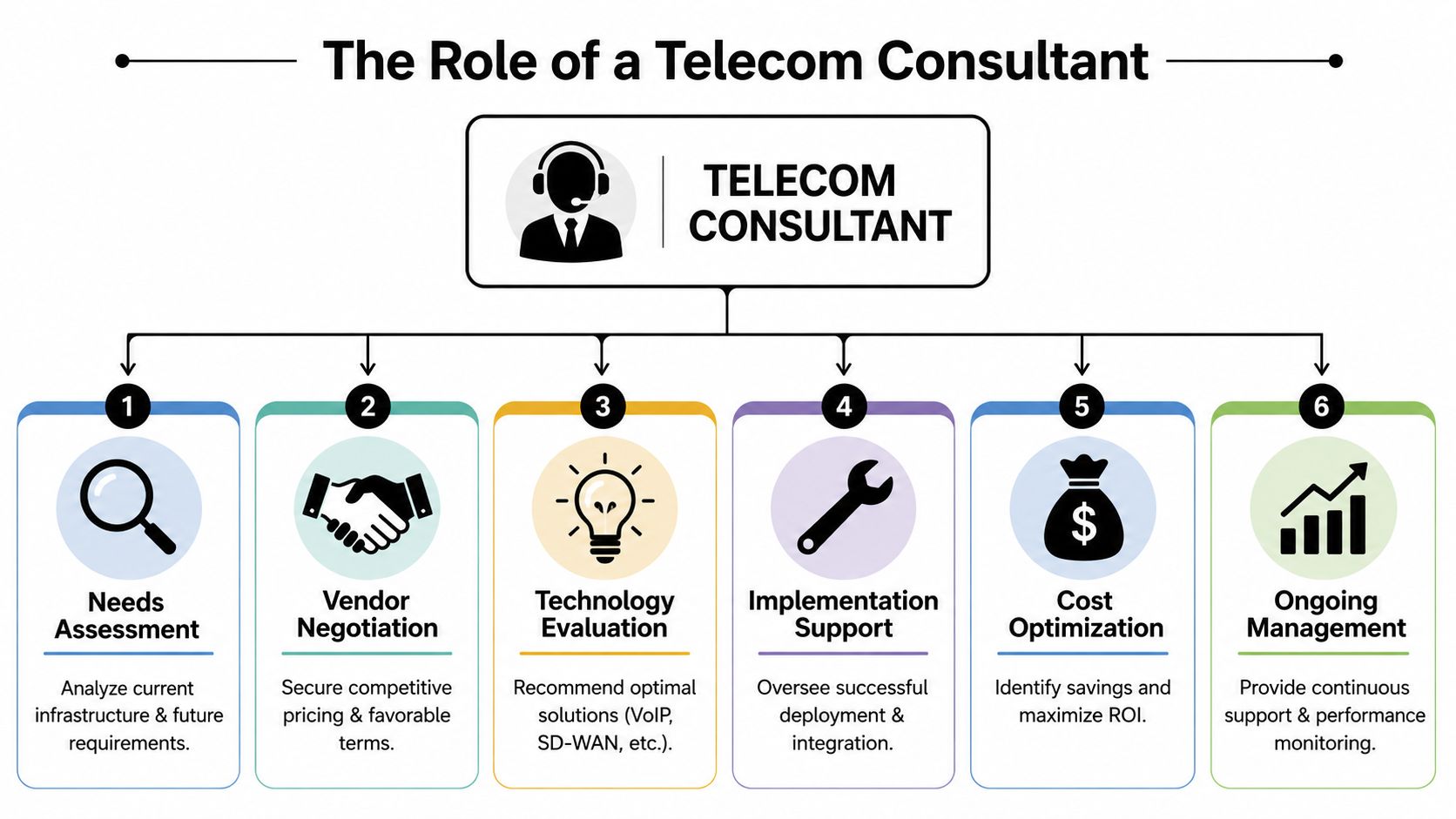
The six functions that actually matter
A serious consultant usually handles a mix of these functions:
- Needs assessment: Reviews current circuits, contracts, wireless performance, inventory, support workflows, and future requirements.
- Vendor negotiation: Compares carrier options, pushes on terms, and removes weak contract language where possible.
- Technology evaluation: Assesses tools such as VoIP, SIP, SD-WAN, UCaaS, contact center platforms, and wireless solutions.
- Implementation oversight: Coordinates project plans, dependencies, handoffs, and escalation during deployment.
- Cost optimization: Identifies unused services, duplicate billing, mismatched plans, and poorly structured renewals.
- Ongoing management: Monitors issues, handles moves-adds-changes, and keeps the telecom environment aligned with business changes.
What they should own internally
Your consultant doesn't replace your IT lead. They make your IT lead more effective.
In practice, they should help your team answer questions such as:
- Which services are mission critical and require redundancy?
- Which bills and contracts deserve immediate review?
- Which sites need better wireless engineering versus better carrier terms?
- Which migrations should happen now, and which should wait?
The best telecom consultant reduces decision noise. They don't just bring options. They narrow the field to the options that fit your business.
That's the benchmark. If a consultant can't make telecom decisions clearer, they're not consulting. They're reselling.
Common Services to Expect from a Dallas Provider
Dallas buyers should expect more than invoice reviews and brokered carrier quotes. The strongest firms combine cost control, network engineering, migration planning, and operational support. That mix matters because telecom problems rarely sit in one lane. Billing, architecture, and user experience usually intersect.
Network design and optimization
Real consulting starts with a provider's ability to assess WAN design, internet resiliency, voice architecture, branch connectivity, and internal wireless performance. For businesses expanding sites or reworking office space, this often includes circuit strategy, failover planning, and better segmentation between business-critical traffic and everything else.
For Dallas organizations with dense office, warehouse, healthcare, or venue environments, this work often extends into RF engineering. Specialized telecom consulting in Dallas can involve 4G and 5G RF network engineering, including work on small cells, Massive MIMO, and beamforming using tools such as iBwave and NetAct to optimize coverage and throughput, as reflected in Dallas telecom consultant job requirements.
Carrier sourcing and contract negotiation
Most companies don't need more vendor meetings. They need fewer, better ones.
A capable consultant should help you:
- Normalize proposals: Compare contract terms, SLAs, install assumptions, and support boundaries.
- Challenge waste: Flag overlapping services, old circuits, or mobility plans that no longer fit usage.
- Control renewals: Build enough lead time to avoid last-minute concessions.
This service matters most when you're opening locations, consolidating sites, or rolling into a contract expiration window.
Telecom expense management
Expense audits sound boring until you see how much confusion hides in telecom billing. A consultant should review invoices, inventory, tax treatment, service mapping, and orphaned charges. They should also tie each charge to an actual business use case.
That work isn't glamorous. It's profitable.
Cloud and UCaaS planning
A lot of Dallas companies moved pieces of voice and collaboration to the cloud without redesigning the surrounding network. That creates predictable issues. Voice traffic competes with other applications, support ownership gets muddy, and user experience suffers.
A consultant should build a migration path that covers:
- Readiness assessment: Does the current network support the target service?
- Platform fit: Are you selecting for user workflow, compliance, and admin burden, not just licensing?
- Cutover planning: Who owns testing, training, failback, and issue escalation?
Ongoing mobility and telecom operations
Some organizations need one project. Others need a standing advisor. If your environment changes frequently, an ongoing support model can make sense for inventory control, lifecycle planning, ticket escalation, and service changes.
For companies replacing or retiring telecom hardware during these transitions, one option is business telecom services near Dallas, which includes business telecom equipment handling and related service support.
Buy consulting where your risk is highest. If your pain is billing, start with audits. If your pain is coverage or reliability, start with engineering and architecture.
How to Choose the Right Dallas Telecom Partner
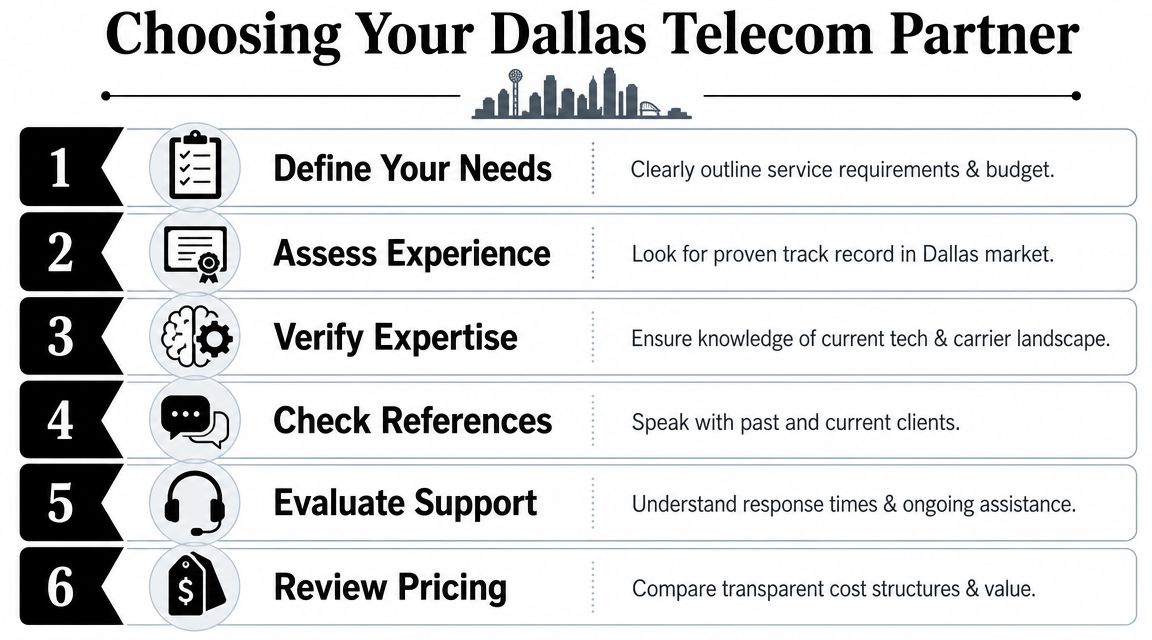
Dallas has plenty of telecom talent. That's good news, but it also means weak providers can hide behind polished sales language. You need a selection process, not a gut feeling.
The local market shows strong demand for telecom expertise. An Indeed search for “telecom consulting” in Dallas returned 306 jobs, which signals a meaningful concentration of telecom-related professional activity in the area, based on Dallas telecom consulting job listings on Indeed. More options mean more due diligence.
Start with four non-negotiables
Don't overcomplicate the first screen. Check these first:
- Technical depth: Can they discuss WAN, UCaaS, RF, mobility, and carrier architecture without slipping into buzzwords?
- Dallas market familiarity: Do they understand local building types, multi-site enterprise needs, and regional carrier realities?
- Commercial clarity: Can they explain how they get paid and where incentives may affect recommendations?
- Execution discipline: Do they run projects cleanly, document decisions, and escalate issues fast?
If any one of those is missing, move on.
Questions worth asking in the first meeting
Use direct questions. Don't ask, “Tell me about your capabilities.” Ask things that expose how they think.
- How do you separate carrier advice from carrier compensation?
- What do you review before recommending a migration or renewal?
- How do you handle poor indoor cellular or voice performance in a large building?
- What tools or methods do you use for RF, inventory, or invoice analysis?
- What should we fix first in our environment, and why?
- Who will perform the work after the sale?
Warning signs buyers ignore too often
Some firms look polished and still create expensive messes. Watch for these red flags:
- They lead with a carrier. That usually means the answer existed before the discovery.
- They can't explain the downside. Every design choice has tradeoffs. Serious consultants name them.
- They avoid accountability. If implementation fails, they blame the carrier, the cabling vendor, or your internal team.
- They oversell savings. Cost matters, but performance and contract flexibility matter too.
Ask every finalist to describe a recent project that went sideways and what they changed. Their answer will tell you more than their slide deck.
A useful shortcut is to compare firms that understand both active telecom planning and the downstream realities of decommissioning, refresh cycles, and hardware changeovers. Reviewing providers listed among local telecom companies can help frame that broader evaluation.
What to Expect for Telecom Consulting Costs
If you ask ten consultants how they price, you'll hear ten versions of the same few models. Pricing usually depends on scope, urgency, technical complexity, and whether the work is advisory, implementation-heavy, or ongoing.
The mistake buyers make is choosing the cheapest structure instead of the right structure. Low hourly pricing can become expensive if the consultant lacks process. A retainer can be smart if your environment changes constantly. A project fee works well when the deliverable is clear and the timeline is controlled.
The main pricing models
Here's the practical view.
| Model | Best For | Pros | Cons |
|---|---|---|---|
| Project-based fee | Audits, carrier sourcing, migrations, RF assessments | Clear scope, easier budgeting, defined deliverables | Change requests can add friction if scope is vague |
| Hourly consulting | Troubleshooting, short-term advisory work, executive reviews | Flexible, useful for specialized questions | Costs can drift if nobody controls scope |
| Monthly retainer | Ongoing telecom management, recurring vendor oversight, multi-site support | Predictable access to expertise, good for busy teams | Can feel underused if your environment is stable |
| Gain-sharing or contingency | Expense reduction work, billing cleanup, contract recovery | Aligns fees with identified savings | Can distort focus toward cost-only outcomes |
How to choose the right structure
Use a project fee when you know what problem you need solved. Use hourly support when the issue is narrow and technical. Use a retainer when telecom work never really stops.
Be careful with contingency models. They can be useful for invoice cleanup or expense management, but they aren't ideal when your bigger issue is architecture, resiliency, or migration sequencing. A consultant who only gets paid on savings may ignore issues that matter more than a billing line.
What buyers should demand in writing
Before signing anything, require these basics:
- Defined deliverables: Spell out reports, meeting cadence, decision support, and implementation roles.
- Named assumptions: Include sites, carriers, technologies, and dependencies.
- Escalation process: Clarify who handles blockers and how quickly issues move upward.
- Ownership of documentation: Make sure your team receives inventories, assessments, and final recommendations.
If your telecom work overlaps with site closures, hardware retirement, or branch consolidation in Texas, telecom services in Houston offers a useful parallel reference for broader business telecom support models.
Telecom Consulting in Action Across Dallas
Telecom consulting makes the most sense when you look at actual business situations instead of service labels.

A logistics operator near the airport corridor
A logistics company relies on dispatch, warehouse scanning, fleet connectivity, and mobile supervisors. The problem isn't one big outage. It's dozens of small failures. Weak indoor coverage in part of the building, inconsistent mobile plan alignment, and fragmented vendor accountability.
A consultant starts by mapping critical workflows. Then they review mobility contracts, coverage trouble spots, and failover needs. The result is a tighter operating environment where the business knows which communications paths matter most and who owns each one.
A financial firm in Uptown
This company has strict uptime expectations, remote advisors, and leadership that won't tolerate voice instability during market hours. Their old setup grew by exception. New tools were added, but architecture didn't keep pace.
The consultant doesn't begin with a sales proposal. They begin with risk. Which links need redundancy? Which voice paths need testing? Which contracts create renewal exposure? That sequence matters because regulated firms don't just need service. They need telecom decisions they can defend internally.
Strong telecom strategy is usually boring on the surface. Users stop complaining, finance gets cleaner invoices, and leadership stops hearing about preventable outages.
A multi-location healthcare group across the Metroplex
Healthcare organizations often struggle with a mix of legacy circuits, clinic-specific vendors, and inconsistent communications workflows. One location uses one phone approach. Another uses a different one. Support is fragmented.
A telecom consultant can standardize the decision process, identify what should stay local versus centralized, and help the group migrate without disrupting patient-facing operations. When obsolete telecom gear comes out during that process, telecom decommissioning services can support removal and documented handling as part of the broader change plan.
Your Next Step Toward a Better Telecom Strategy
If your Dallas business is dealing with carrier complexity, coverage problems, cloud migration friction, or opaque billing, don't treat those issues like normal background noise. They're signs that telecom has outgrown informal management.
The right consultant does three things well. They bring technical judgment, they reduce contract and vendor confusion, and they help your team make decisions in the right order. That last point is where most value shows up. Bad sequencing creates rework. Good sequencing lowers risk.
Be selective. Look for independence, technical range, local credibility, and clean execution. Ask hard questions. Push for plain answers. If a provider can't explain your environment clearly after discovery, they won't manage it clearly later.
Telecom consulting services in Dallas should produce business outcomes you can feel. Better performance. Lower waste. Fewer surprises. More control.
Start with one disciplined step. Gather your current contracts, invoices, site list, and known pain points. Then bring in a consultant who can turn that mess into a roadmap.
If your telecom strategy also involves retiring phone systems, networking hardware, or other business electronics, contact Beyond Surplus for secure IT asset disposal, telecom equipment handling, data destruction, and documented recycling support.


