

A Georgia IT manager usually meets secure disposal under pressure. The laptop refresh is done. Retired desktops are stacked in a back room. A few failed SSDs and old servers are sitting off to the side because nobody is comfortable moving them without knowing what data is still on them. Facilities needs the floor space. Finance wants the assets retired. Security needs proof that no readable data leaves the building.
That pile belongs on the risk register.
Secure IT disposal is not a cleanup task. It is a control point where data protection, records management, legal exposure, and asset recovery all meet. If the process breaks here, the problem is rarely just the hardware. It becomes an audit issue, a breach response issue, or a contract issue with customers who expect documented handling of retired devices.
The technical details matter because different media fail in different ways. A hard drive that can be sanitized and verified is a different decision from a damaged SSD with unreliable overwrite results. Treating every device the same creates avoidable risk. Georgia businesses need disposal procedures that match the media, preserve chain of custody, and produce records that hold up when legal, compliance, or cyber insurance teams ask for evidence.
That is the point of this guide. Secure disposal done correctly reduces exposure, supports defensible compliance, and helps the business close out retired assets with confidence.
Why Secure IT Disposal Is a Critical Business Function in Georgia
Most disposal failures don't start with a malicious act. They start with informal handling. A server gets parked in a hallway. Drives from a decommissioning project sit in unsecured gaylords. A recycler issues a generic receipt instead of a serialized record. Months later, nobody can prove what happened to which asset.
That's the core shift many new IT managers have to make. Retirement is part of the data lifecycle. If your controls stop when the device leaves production, your program has a blind spot.
What retired assets actually represent
A retired asset can create several kinds of exposure at once:
- Data exposure: Credentials, customer files, employee records, cached exports, and local backups may still exist on the device.
- Compliance exposure: If disposal can't be proven, your team may struggle during an audit or incident review.
- Operational exposure: Missing asset history turns simple refresh projects into exception management.
- Vendor exposure: If a downstream processor can't document custody and sanitization, liability transfer is weak.
Practical rule: If you can't match the asset tag or serial number to a destruction or wiping record, assume you can't defend the disposal event.
What works and what fails
What works is boring on purpose. A written SOP. Locked staging. barcode or serial tracking. Clear decision rules for wipe versus destroy. A vendor that documents custody from pickup through final processing.
What fails is the common shortcut list: one bulk pallet count, one pickup receipt, one generic “all items destroyed” email.
Georgia businesses often focus first on getting equipment removed quickly. Speed matters, but defensibility matters more. The right process lets you move quickly without losing control.
Navigating IT Disposal Laws and Regulations in Georgia
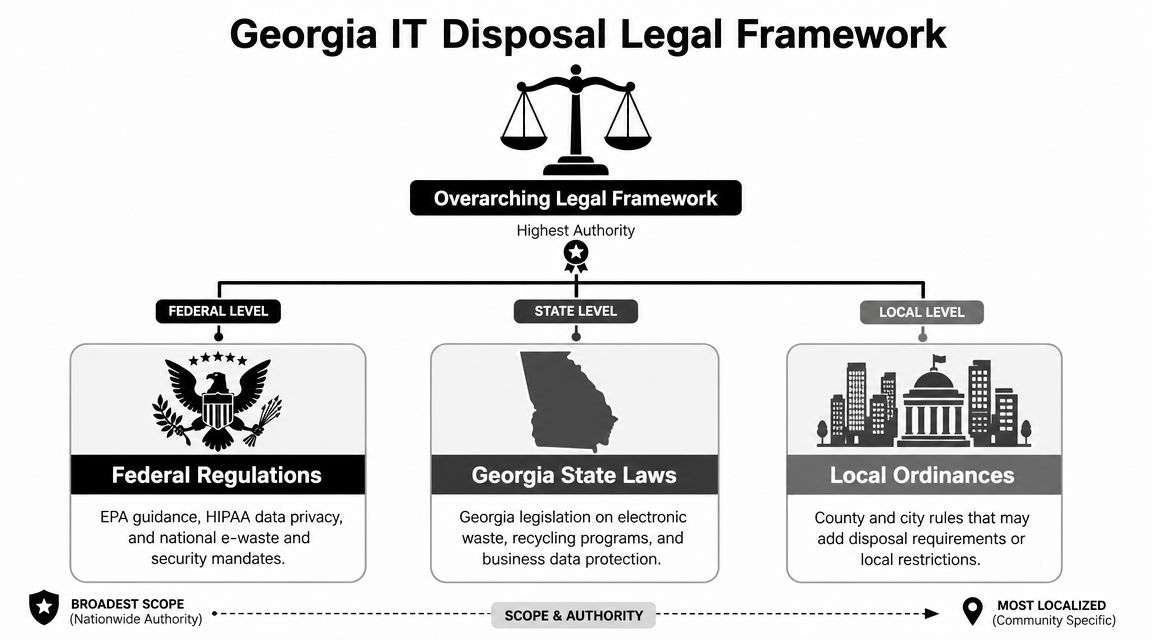
Legal compliance in disposal comes down to whether your process would look reasonable to an auditor, regulator, or plaintiff's counsel. The clearest federal reference point here is the FTC Disposal Rule. A Georgia secure-disposal guide identifies it as a foundational standard and explains that businesses must take “reasonable measures” to protect sensitive consumer information during disposal. Operationally, that means paper records must be burned, pulverized, or shredded, while electronic files and media must be destroyed or erased so the information cannot be read or reconstructed (Georgia secure data destruction requirements).
What reasonable measures mean in practice
“Reasonable measures” is where many teams get vague. It doesn't mean “we used a recycler.” It means your organization can show a controlled process.
At a minimum, your process should answer these questions:
- Who identified the assets for retirement
- Which specific devices were included
- Where they were stored before pickup
- Who took custody at pickup
- How the media was sanitized or destroyed
- What records you retained afterward
A stronger Georgia program also includes the details that enterprise ITAD teams now expect: pickup date, time, and location; locked and GPS-tracked transport; facility arrival timestamps; serialized asset reporting; the destruction method used; and a statement transferring liability to the vendor. If those elements are missing, you may have disposal activity, but not a defensible compliance record.
Policies that hold up better than receipts
A short internal policy beats a verbal understanding every time. Your policy should define approved sanitization methods, who can authorize disposal, how exceptions are escalated, and what evidence must be retained.
Useful operational language includes:
- Approved methods: Wiping, shredding, or other approved destruction based on device type and sensitivity
- Storage controls: Locked, access-controlled holding area before release
- Release controls: No asset leaves without inventory reconciliation
- Record controls: Maintain pickup, custody, and final disposition records together
If you're building or tightening a state-specific process, Georgia compliant IT disposal guidance is a practical reference point.
A disposal process is compliant only if someone outside your team can reconstruct what happened without guessing.
Data Wiping vs Physical Shredding Which Is Right for You
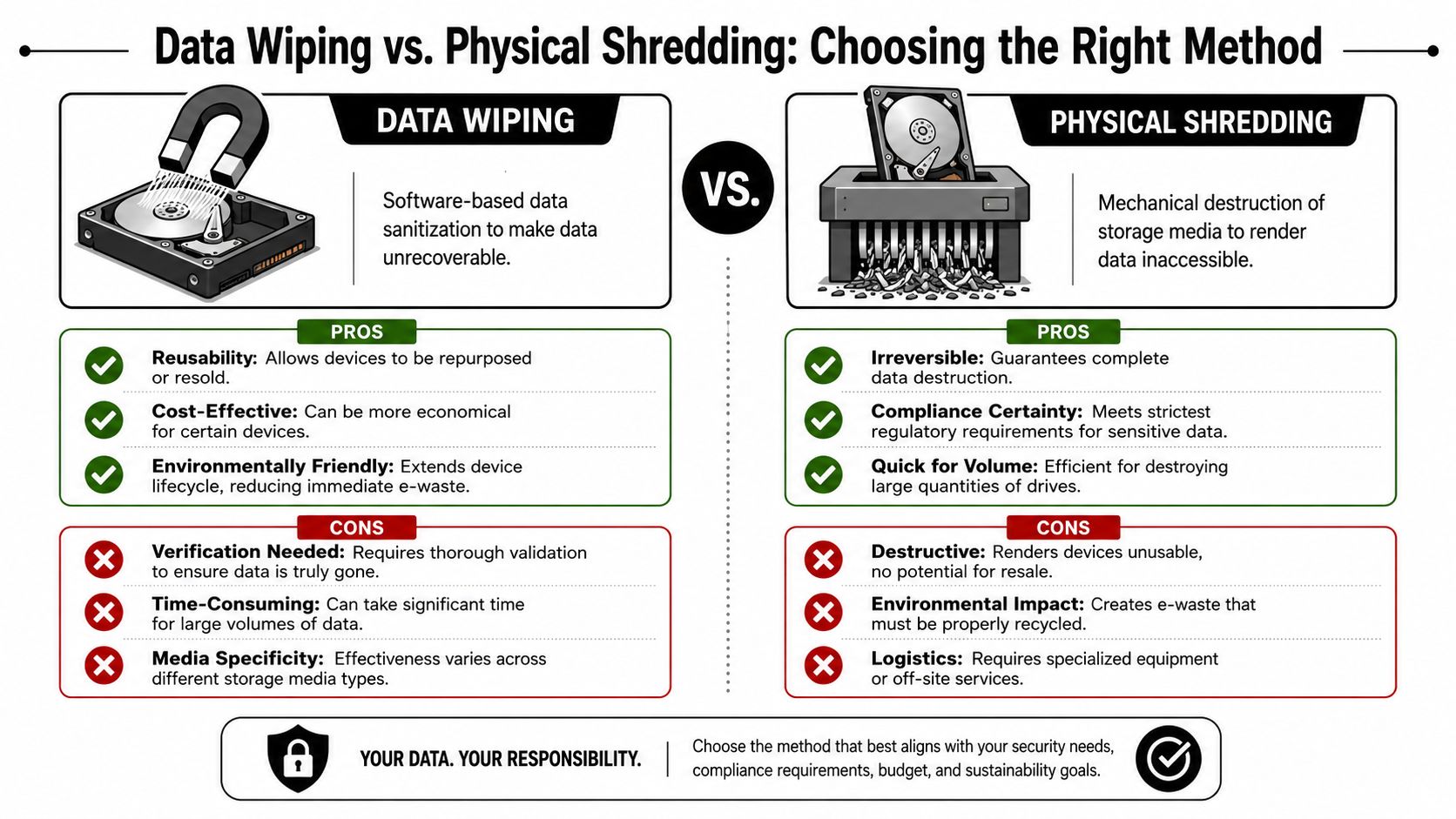
The wrong question is “which method is better?” The right question is “which method fits this media, this data sensitivity, and this business outcome?”
If you need asset reuse, wiping matters. If you need irreversible destruction, shredding matters. The trouble starts when teams apply one slogan to every device.
When wiping makes sense
Wiping is the right path when the asset still has remarketing, redeployment, or donation value and your sanitization standard is appropriate for the media involved. It preserves hardware value and supports reuse, but only if the process is validated and documented.
Wiping tends to fit:
| Situation | Better fit |
|---|---|
| Device still has resale or reuse value | Wiping |
| You need serial-level proof of sanitization | Wiping with logs |
| Media is healthy and supported by your process | Wiping |
| You need irreversible physical destruction | Not wiping |
When shredding is the safer call
Shredding is the clean answer when data sensitivity is high, the media is damaged, or reuse has no business value. It removes ambiguity. That matters in regulated environments and during high-risk decommissions.
Choose destruction when:
- Drive health is uncertain: Failed or unstable media can complicate software sanitization.
- Sensitivity is high: Some organizations prefer irreversible destruction for legal or contractual reasons.
- Time matters: Large volumes of end-of-life drives are often easier to process physically.
- Reuse isn't needed: If the hardware has no recovery value, preservation may not be worth the control burden.
HDD and SSD are not the same problem
Generic advice falls short. A Georgia-focused disposal guide makes an important point that many public summaries skip: SSD sanitization is materially different from HDD wiping, and degaussing is not appropriate for SSDs. The recommendation is a device-specific sanitization policy aligned to NIST-style practices so your final records are defensible (Georgia electronics disposal guidance on media-specific sanitization).
That means your disposal matrix should separate at least these categories:
- HDDs
- SSDs
- Magnetic tape or other legacy media
- Mobile devices with embedded storage
Don't let a vendor answer “we wipe or shred everything” without explaining how they handle each media type. If your team needs a practical starting point for wiping standards and prep, how to wipe a computer hard drive is worth reviewing.
Media type decides method. Documentation decides whether that method is defensible later.
Proving Secure Disposal with Chain of Custody Documentation
Secure disposal is an evidence problem. You're not only trying to destroy data. You're trying to prove, later, that the right asset moved through the right hands and reached the right end state.
A broken chain of custody usually looks small at first. One unlabeled drive. One missing serial. One pallet received with a different count than the pickup sheet. After that, the whole record becomes harder to trust.
The five records that matter most
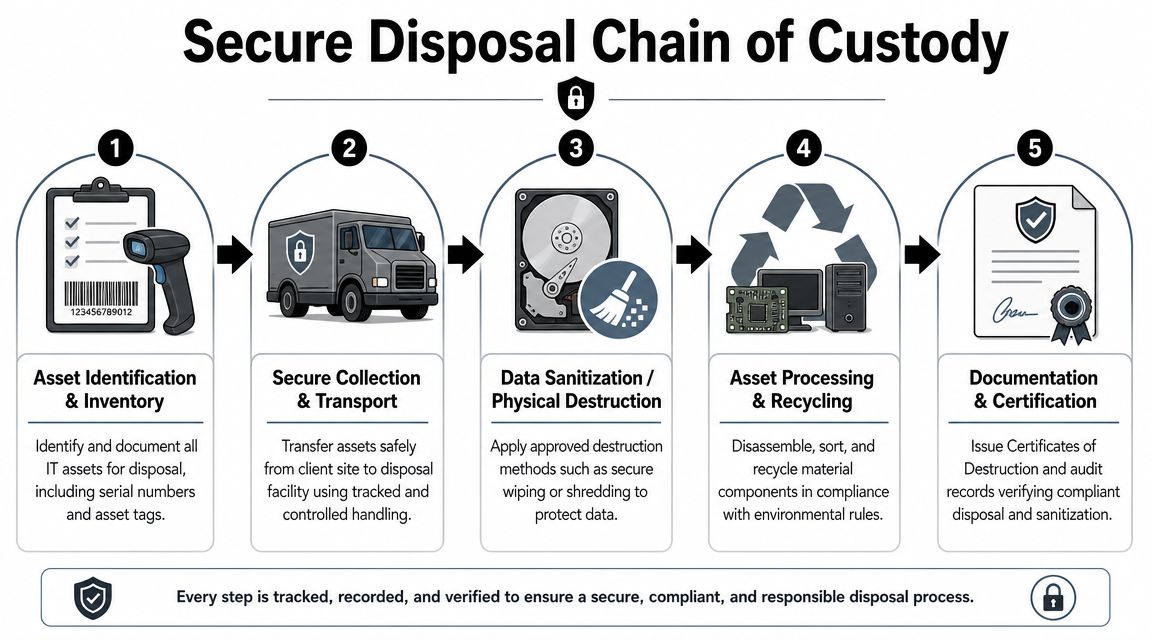
A usable chain of custody usually includes five layers of evidence:
Retirement inventory
Your internal list should tie asset tag, serial number, device type, and retirement reason together.Pickup documentation
Record the pickup date, location, responsible parties, and container count or asset count.Transport record
You want proof that assets moved under controlled conditions, not informal handoff.Processing record
Here, wiping logs or destruction records connect to individual assets.Final certificate package
This should close the loop, not summarize it vaguely.
What a valid certificate should include
For high-assurance disposal, a valid Certificate of Destruction should itemize every drive by serial number, include the exact destruction method, record the date and location of destruction, and confirm transfer of custody. That level of detail creates auditable evidence rather than a generic statement of service (requirements for a valid Certificate of Destruction).
A weak certificate says: “Items destroyed.”
A defensible certificate says, in effect: these exact devices, identified by serial number, were processed by this method, at this place, on this date, under this custody trail.
If you want your internal template to match what auditors and counsel usually expect, this destruction certificate template is a useful benchmark.
Keep the certificate with the pickup record, not in a separate inbox folder. Audit problems often start as document retrieval problems.
How to Select the Right Georgia ITAD Provider
A vendor choice can become a legal and operational problem fast. A provider picks up 200 retired laptops from your Atlanta office, but six months later you cannot match the serial numbers on the destruction paperwork to the devices that left the building. At that point, the issue is not disposal volume. It is whether your company can prove what happened, how it happened, and whether the method matched the media involved.
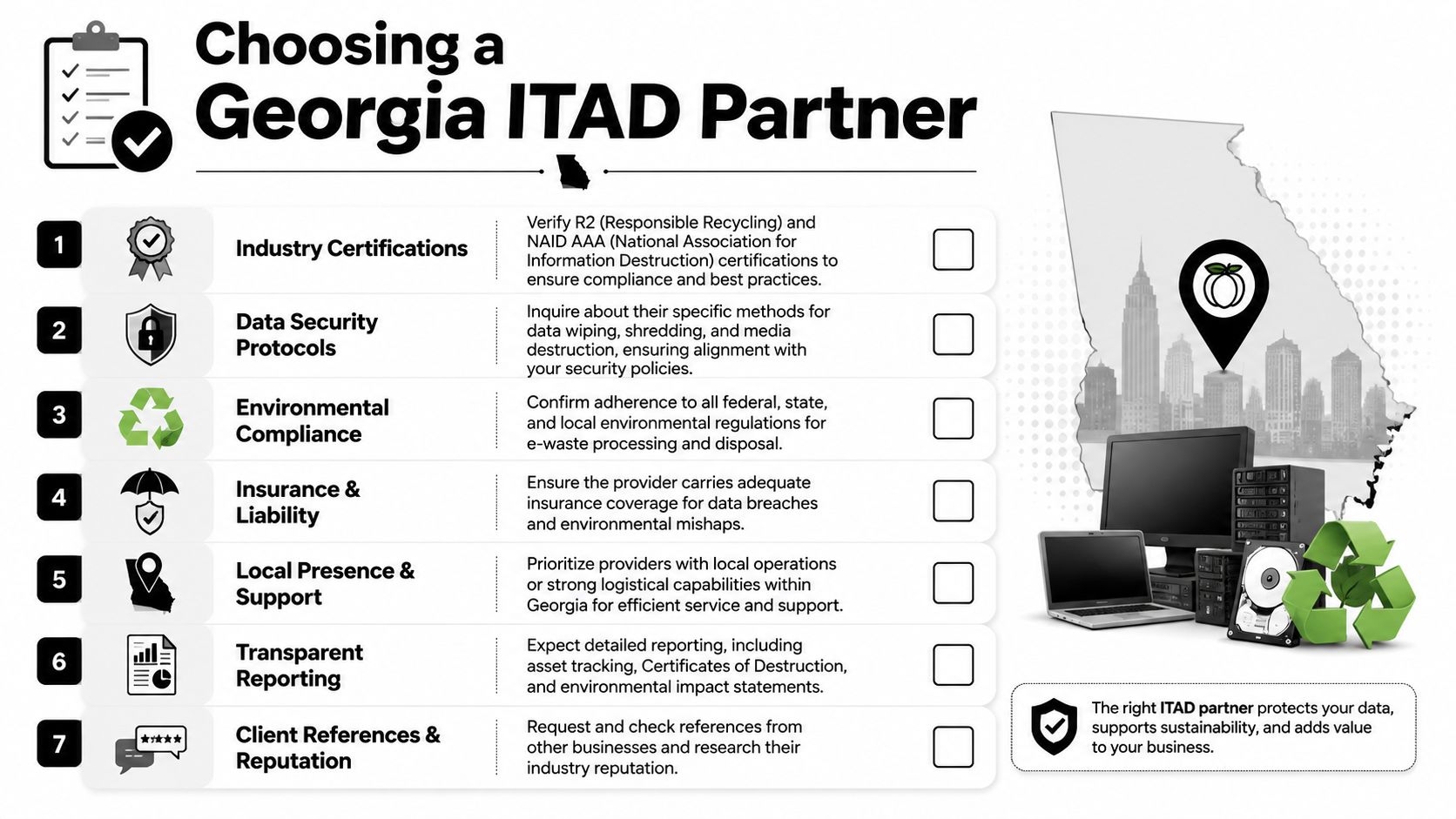
That is why ITAD selection should be handled as a risk review, not a hauling decision. The right provider helps you reduce exposure tied to data breach costs, regulatory scrutiny, contract obligations, and internal audit findings. The wrong one leaves your team with generic certificates, vague process descriptions, and too much trust placed in verbal assurances.
Questions that separate ITAD from scrap hauling
Start with process, not price. If a provider cannot explain how they handle a failed SSD, a locked laptop, or a server drive pulled from a storage array, they are not ready to manage your risk.
Ask direct questions such as these:
How do you track assets from pickup through final processing?
Look for serial-level intake, staged reconciliation, and reporting that matches what your team released.How do you decide between wiping, shredding, or another disposition method?
A credible provider should explain the decision by media type and condition. HDDs, SSDs, mobile devices, and embedded flash storage do not all follow the same sanitization path.What happens when sanitization fails or a device cannot be verified?
You want a documented exception process, not an improvised decision on the warehouse floor.What does the final documentation show?
Ask whether reports include serial numbers, processing dates, method used, and any assets routed to destruction after failed wiping.How is transport controlled?
Secure disposal starts at handoff. A provider should be able to describe sealed containers, release procedures, and who signs for custody at each stage.What records do we keep, and for how long?
The answer should cover wiping logs, destruction records, resale reporting where applicable, and support for audits or breach reviews.
What to look for beyond the pitch
Operational discipline shows up in small details. Good providers ask for sample inventories before pickup. They identify devices that are likely to hold data even when your internal list misses them. They also explain where resale is realistic and where destruction is the safer business decision.
That last point matters more than many IT managers expect. A provider who pushes reuse on every asset may be optimizing margin, not reducing your exposure. In practice, the better test is whether they can explain the trade-off. Reuse can recover value, but only after the media has been sanitized with a method that fits the device. If they treat all storage the same, the problem is not technical nuance. It is weak risk control.
One useful reference is Beyond Surplus's vendor due diligence checklist for ITAD provider selection. It helps procurement, IT, and compliance teams evaluate a vendor the way they would evaluate any other high-liability service provider.
Use a simple internal scorecard during selection:
| Evaluation area | What good looks like |
|---|---|
| Reporting | Serialized records, clear exceptions, easy reconciliation |
| Sanitization methods | Device-specific process for HDDs, SSDs, flash media, and failed drives |
| Custody controls | Documented handoff, transport, intake, and final processing |
| Liability handling | Clear service terms, documented transfer points, support for audits |
| Operational fit | Can support your locations, timelines, and asset mix without process shortcuts |
A good Georgia ITAD partner does more than remove equipment. They help your business prove that retired assets were handled correctly, with methods that match the media and records that hold up under review.
Optimizing Logistics and Recovering Asset Value
Retirement projects usually break down at the handoff stage, not at the sanitization stage. A Georgia company can approve the right destruction standard and still create avoidable exposure if assets sit untagged in a hallway, leave a branch office without a verified manifest, or arrive at processing with serials that do not match what IT expected to release.
The fix starts before the pickup is scheduled. Sort assets by handling path. Separate data-bearing devices from monitors, peripherals, and scrap. Identify equipment with resale potential, equipment that requires on-site processing, and equipment that can move off-site under controlled transport. That preparation cuts down on missed serial numbers, loading delays, and disputes over what was collected.
Build logistics around control, not convenience
A pickup plan should match the way your sites operate. For a single office, that may mean one release contact, one secured staging room, and a preapproved pickup window. For a hospital network, university, or multi-branch business, it usually means standardized labels, staged manifests, sealed containers where appropriate, and the same intake format across every location.
Consistency matters because logistics errors turn into compliance problems later. If one office labels by asset tag and another labels by user name or department, reconciliation gets messy fast. If your vendor cannot tie what left the site to what was processed, recovered, or destroyed, finance cannot close the books cleanly and compliance cannot defend the record.
Record retention belongs in the logistics plan too. Keep serialized inventories, transfer records, wiping logs, destruction certificates, and exception reports long enough to support legal review, insurance questions, and internal audits. The exact retention period should follow your legal and regulatory requirements, but the operational point is simple. If the paperwork falls apart after pickup, the program was not controlled well enough.
Recover value without weakening controls
Asset value recovery is useful, but only when the recovery process follows the same discipline as destruction. Older laptops, desktops, and enterprise hardware can still return value through resale, parts harvesting, or redeployment after proper sanitization, testing, and grading. That helps offset refresh costs, but it also introduces decisions that need clear approval criteria.
Use strict gates before anything enters a resale stream:
- Screen for realistic resale value: Skip labor-heavy processing on equipment with little market demand or poor condition.
- Complete the data decision first: Sanitization or destruction should be determined before anyone discusses resale proceeds.
- Test and grade consistently: Cosmetic and functional grading should follow a documented standard, not ad hoc judgment.
- Preserve the audit trail: Recovered value does not reduce the need for serialized records and final disposition reporting.
- Coordinate with finance: Confirm how credits, revenue share, and write-offs will be documented before the project starts.
If resale is part of your plan, Georgia IT equipment resale options can help your team decide what belongs in a recovery channel and what should go straight to destruction. That decision is not just about dollars. It is about whether the technical handling, recordkeeping, and liability profile support reuse without creating a larger problem later.
Take the Next Step with Beyond Surplus
A solid GA secure IT disposal guide is not just about getting old equipment out of the building. It's about controlling legal exposure, selecting the right sanitization method for the media involved, preserving chain of custody, and keeping the final record strong enough to survive audit scrutiny.
That's why disposal programs work best when IT, compliance, procurement, and facilities stop treating retirement as an afterthought. The handoff from active use to final disposition needs the same discipline you'd apply to deployment or incident response. The details matter. Serial numbers matter. Storage conditions matter. Certificate quality matters.
For Georgia organizations, the practical standard is straightforward. Use a documented process. Match sanitization to device type. Require auditable evidence. Keep records long enough to support later review. Vet vendors like they're handling regulated risk, because they are.
If your current process depends on a pickup receipt and a general assurance that everything was handled properly, it's time to tighten it. If your team is planning a refresh, office move, data center project, or equipment liquidation, build disposal requirements before the first asset is unplugged.
Contact Beyond Surplus for certified electronics recycling and secure IT asset disposal.


